
Though all the worlds rejoiced at the fall of Vritra, Indra alone found no peace; pursued by the sin of slaying a Brahmana, he hid within the fibres of a lotus in the Manasa lake and took refuge in the remembrance of Lord Hari.
Om Namo Bhagavate Vasudevaya.
Om Namo Bhagavate Vasudevaya.
Om Namo Bhagavate Vasudevaya.
Welcome to Srimad Bhagavatam Wisdom, a devotional journey through the sacred histories and teachings of the Srimad Bhagavat Mahapurana. The thirteenth chapter of the Sixth Canto turns from the battlefield to the conscience of a king. The slaying of Vritra set every world free from fear — every world but one heart. Indra, who struck the blow, is haunted by the sin of killing a Brahmana, and only the worship of Lord Narayana through the horse-sacrifice, and the purifying power of His holy Name, can wash that stain away.
Chapter Information
- Scripture: Śrīmad Bhāgavata Mahāpurāṇa
- Canto: 6 (Book Six)
- Chapter: 13 (Discourse 13)
- Chapter title: King Indra Afflicted by Sinful Reaction
- Principal speaker: Sukadeva Gosvami, narrating to King Parikshit; Indra and the sages within the account
- Principal listener: King Parikshit; the sages of Naimisharanya at the outer frame
- Main setting: The heavens, the Manasa lake, and the arena of the horse-sacrifice
- Central subject: Indra’s sin of slaying Vritra and his purification through the worship of Lord Narayana
- Principal verse range: Canto 6, Chapter 13, verses 1–23
- Primary edition: Gita Press Śrīmad Bhāgavata Mahāpurāṇa
The One Heart Without Peace
With Vritra slain, the three worlds and their guardian deities were at once freed from anxiety and gladdened at heart — all save Indra. The gods and sages, the manes and spirits, the demons and the celestial attendants returned to their own realms, and Brahma, Siva and the other great gods dispersed. King Parikshit, hearing this, asked the question that gives the chapter its heart: why should Indra be tormented by the very deed from which all the others found relief? (verses 1-3)
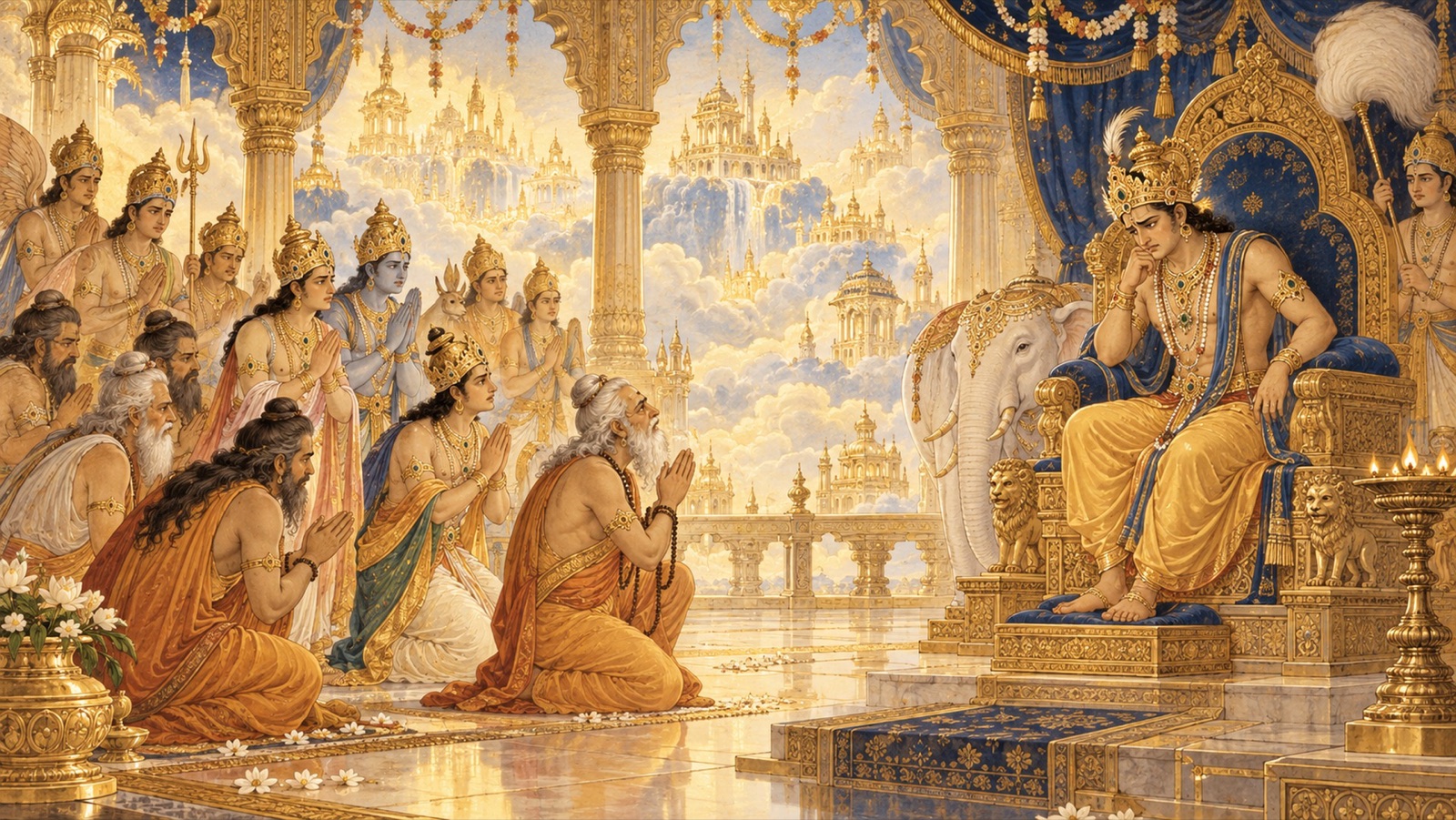
Sukadeva explained that the gods and sages, terrified by Vritra’s prowess, had themselves implored Indra to slay him — yet Indra had been reluctant, afraid of the sin of killing a Brahmana. He answered them with a troubled heart.
इन्द्र उवाच स्त्रीभूद्रुमजलैरेनो विश्वरूपवधोद्भवम् । विभक्तमनुगृह्णद्भिर्वृत्रहत्यां क्व मार्ज्म्यहम् ॥ ५ ॥
indra uvāca strī-bhū-druma-jalair eno viśvarūpa-vadhodbhavam vibhaktam anugṛhṇadbhir vṛtra-hatyāṁ kva mārjmy aham
Meaning: Indra said: The sin arising from the slaying of Visvarupa was graciously shared and divided among women, the earth, the trees and the waters; but by what means shall I wipe away the sin of slaying Vritra? (Canto 6, Chapter 13, verse 5)
The Sages’ Assurance
The sages reassured the troubled king. They would see to it, they said, that he propitiated the Lord through a horse-sacrifice, and all would be well; he need not fear. By worshipping Lord Narayana, the Supreme Spirit and Inner Controller, through the Ashvamedha, he would be absolved even of the sin of destroying the whole world — how much more of the subjugation of an evil-doer. For the holy Name itself, they declared, purifies at once the worst of sinners (verses 6-9).
ब्रह्महा पितृहा गोघ्नो मातृहाचार्यहाघवान् । श्वाद: पुल्कसको वापि शुद्ध्येरन् यस्य कीर्तनात् ॥ ८ ॥
brahma-hā pitṛ-hā go-ghno mātṛ-hācārya-hāghavān śvādaḥ pulkasako vāpi śuddhyeran yasya kīrtanāt
Meaning: The slayer of a Brahmana, the killer of a cow, of father, mother or preceptor, and even the eater of dog’s flesh or one of the lowest birth — all are purified by the chanting of His holy Name. (Canto 6, Chapter 13, verse 8)
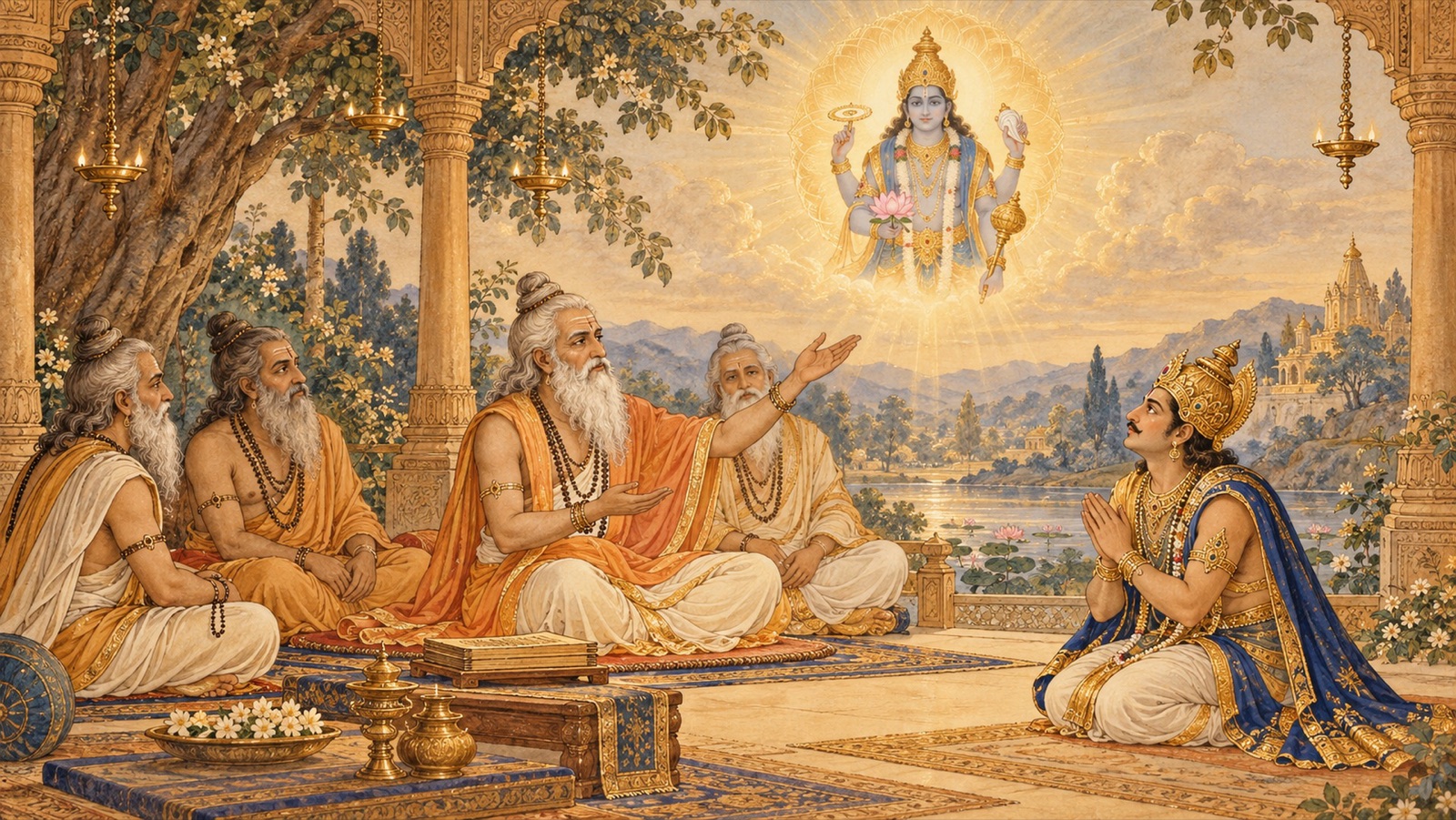
The Sin in Pursuit
Thus urged by the Brahmanas, Indra at last struck down Vritra — and the reaction of killing a Brahmana came upon him. He found no peace of mind. He saw the sin itself pursuing him in the form of a wretched outcaste woman, wasted by disease, clad in blood-stained rags, her limbs trembling with age and her grey hair flying loose, crying “Stop! Stop!” and fouling the road with her breath. Fleeing through the sky and in every direction, Indra at last betook himself to the northeast and plunged into the Manasa lake, where he lived unseen within the fibres of a lotus-stalk for a thousand years, pondering how he might atone (verses 10-15).
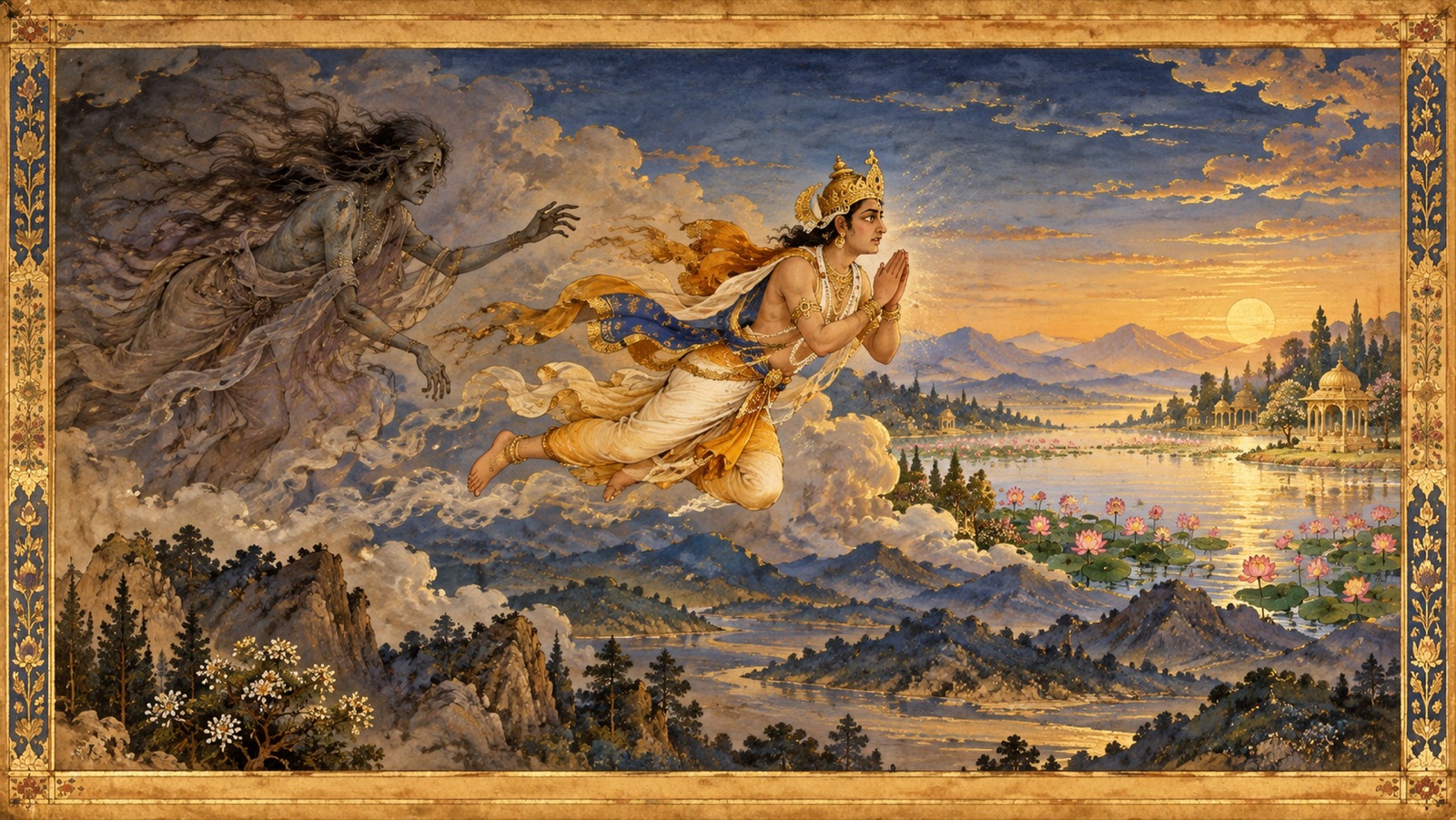
During those long ages the king Nahusha ruled the heavens in his place; but blinded by the arrogance of power, he was cast down into the serpent species. Indra, meanwhile, meditating upon Sri Hari, the upholder of truth, had his sin neutralised; sheltered by Goddess Lakshmi in the lake of lotuses, the lingering reaction could not assail him, and in time he returned to heaven (verses 16-17).
Purified by the Lord
The Brahmana sages then consecrated Indra for a horse-sacrifice offered to please Sri Hari. As the Supreme Person was worshipped through that great rite, performed by Marichi and the other sages learned in the Vedas, even the vast mass of sin from the slaying of Vritra was reduced to nothing — melted away like hoar-frost before the rising sun. Completely freed of his sins, Indra became great once more (verses 18-21).
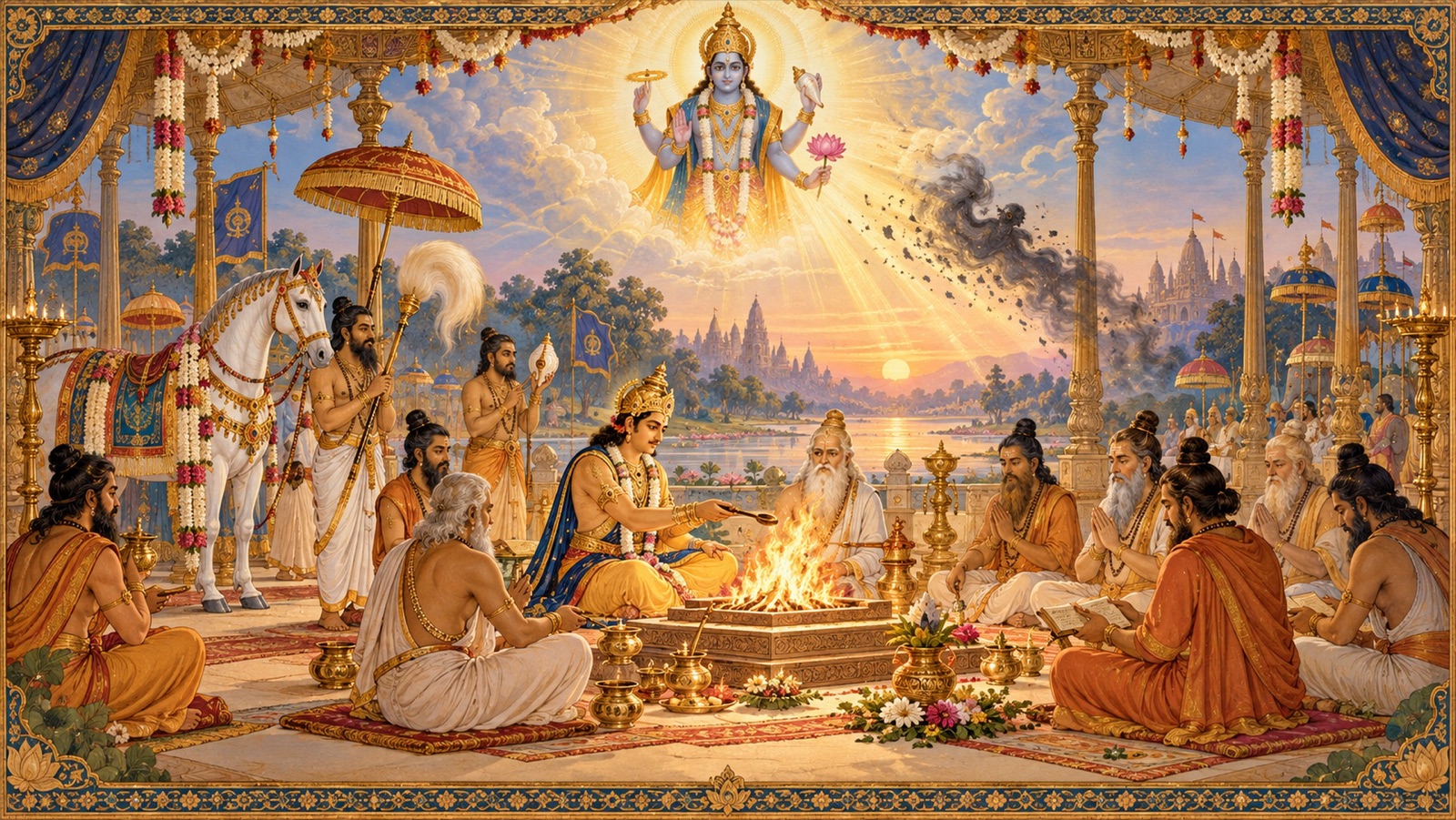
This great narrative, Sukadeva said, washes away every sin and nourishes devotion, for it is filled with the praises of the Lord and contains the account of His devotee Vritra together with the absolution and victory of Indra. The wise, therefore, should always recite or hear it, for it brings merit, fame and long life, frees one from all sinful tendencies, and is a source of every blessing (verses 22-23).
Principal Teachings of This Chapter
1. Even a righteous necessity can leave a wound. Indra slays Vritra at the urging of the gods and sages, yet still bears the reaction of killing a Brahmana — a reminder that consequence follows the deed, not merely the motive (verses 4-10).
2. The holy Name purifies the worst of sinners. The sages declare that even the gravest offender is cleansed by the chanting of the Lord’s Name — the supreme refuge for a stained heart (verse 8).
3. Refuge in the Lord dissolves sin. It is by meditating on Sri Hari and worshipping Him through sacrifice that Indra’s sin melts away like frost before the sun (verses 17-20).
4. Power without humility invites a fall. Nahusha, raised to heaven’s throne, is ruined by arrogance — a quiet warning set beside Indra’s own humbling (verse 16).
5. Hearing the Lord’s pastimes grows devotion. Sukadeva commends this very narrative as a cleanser of sin and a nourisher of bhakti, worthy to be heard again and again (verses 22-23).
A Devotional Reflection
It is striking that the one being left miserable by Vritra’s death is the very one who won. Indra has his victory, his throne, his restored glory — and none of it brings him peace, because a wound of conscience cannot be healed by success. The Bhagavata is tender and honest here: it does not pretend that a necessary act leaves no mark, nor that heaven’s king is above the law of consequence. What it shows instead is the way home. Indra does not argue that he was right, or drown his guilt in pleasure; he flees to the water, hides in a lotus, and turns his mind to the Lord. And it is there, in remembrance and in worship, that the stain begins to lift. The chapter sets before us a truth larger than any single sin: that no fault is too heavy for the mercy of the Lord, and no heart too troubled to be cleansed by His Name. When our own conscience will not let us rest, this is the refuge the Bhagavata points us toward — not denial, not despair, but the shelter of Sri Hari.
A Daily Devotional Practice
Today, bring to mind one thing that weighs on your conscience — a harsh word, a failure, an old regret — and instead of excusing it or sinking under it, offer it honestly to the Lord. Take His holy Name slowly and with attention, trusting the promise of the sages that even the gravest fault is cleansed by sincere remembrance of Him. Let the burden rest in His hands, and rise with a lighter and more grateful heart.
Conclusion
The thirteenth chapter of the Sixth Canto follows the one heart that victory could not console. Haunted by the sin of slaying a Brahmana, Indra hides in the lotus of the Manasa lake and takes refuge in the remembrance of Lord Hari, until the horse-sacrifice and the worship of Narayana melt his sin away like frost before the sun. Its lesson is one of the most comforting in the whole Canto: that the holy Name purifies even the worst of offenders, and that for the troubled conscience there is always a way home to the Lord. As the Canto turns next to the story of King Citraketu, we carry with us this assurance of cleansing grace.
May the divine wisdom of Srimad Bhagavatam awaken pure devotion within our hearts.
Om Namo Bhagavate Vasudevaya.
Jay Shree Madhav.
References and Attribution
- Primary edition: Gita Press, Śrīmad Bhāgavata Mahāpurāṇa (English, complete), Book Six, Discourse 13.
- Series: Srimad Bhagavatam Wisdom · Biswa Sanatan Dharma Seva Trust.
- Presented following the spiritual guidance and recommendation of Pandit Dr. Shri Kashinath Mishra.
This is an original, faithful retelling in the writer’s own words, with brief quoted verses shown in Devanāgarī and transliteration and their meanings given as summaries. It is not a reproduction of any single publisher’s continuous translation or commentary. No affiliation with or endorsement by any publisher is implied.
Jay Shree Madhav