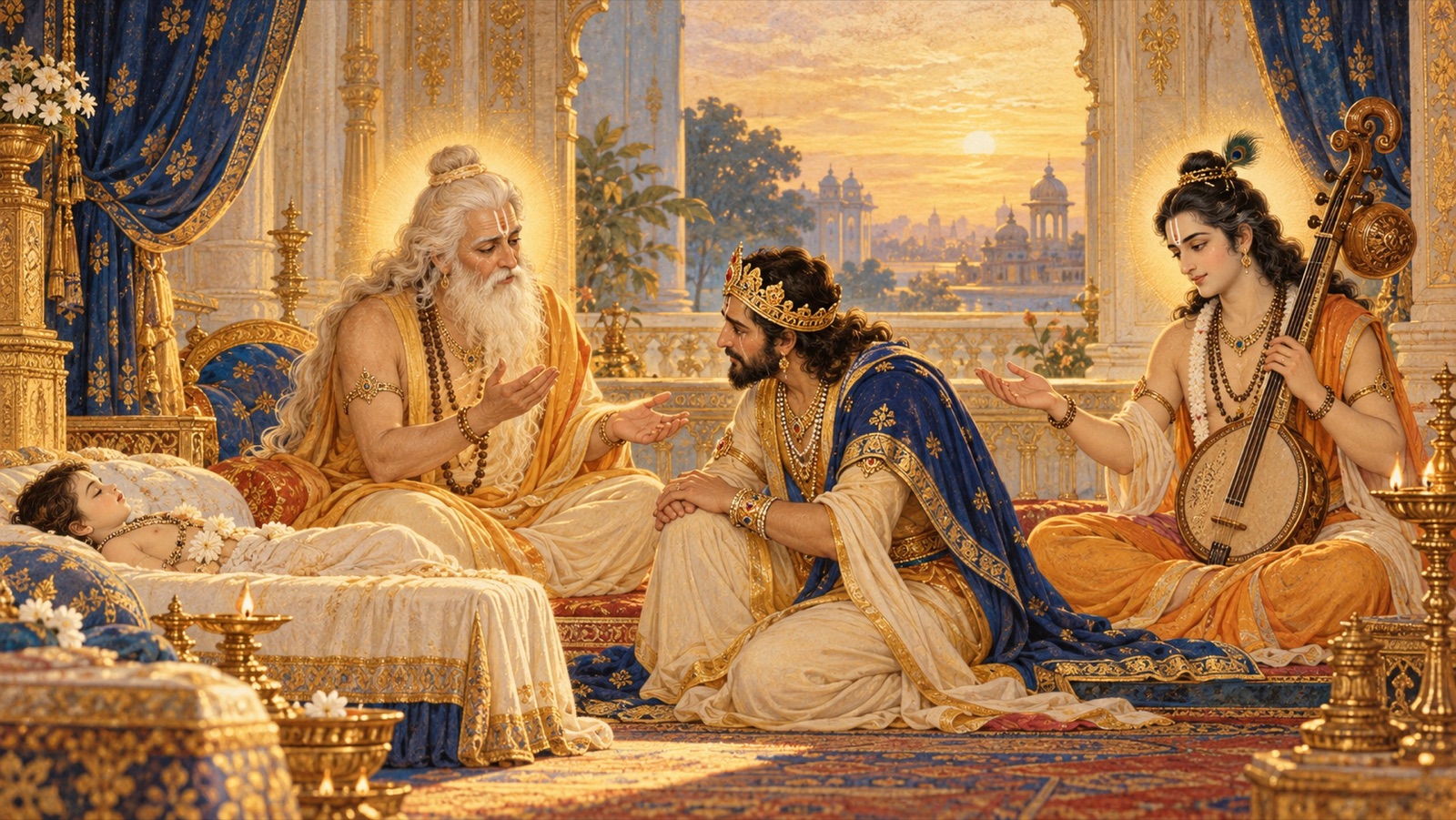
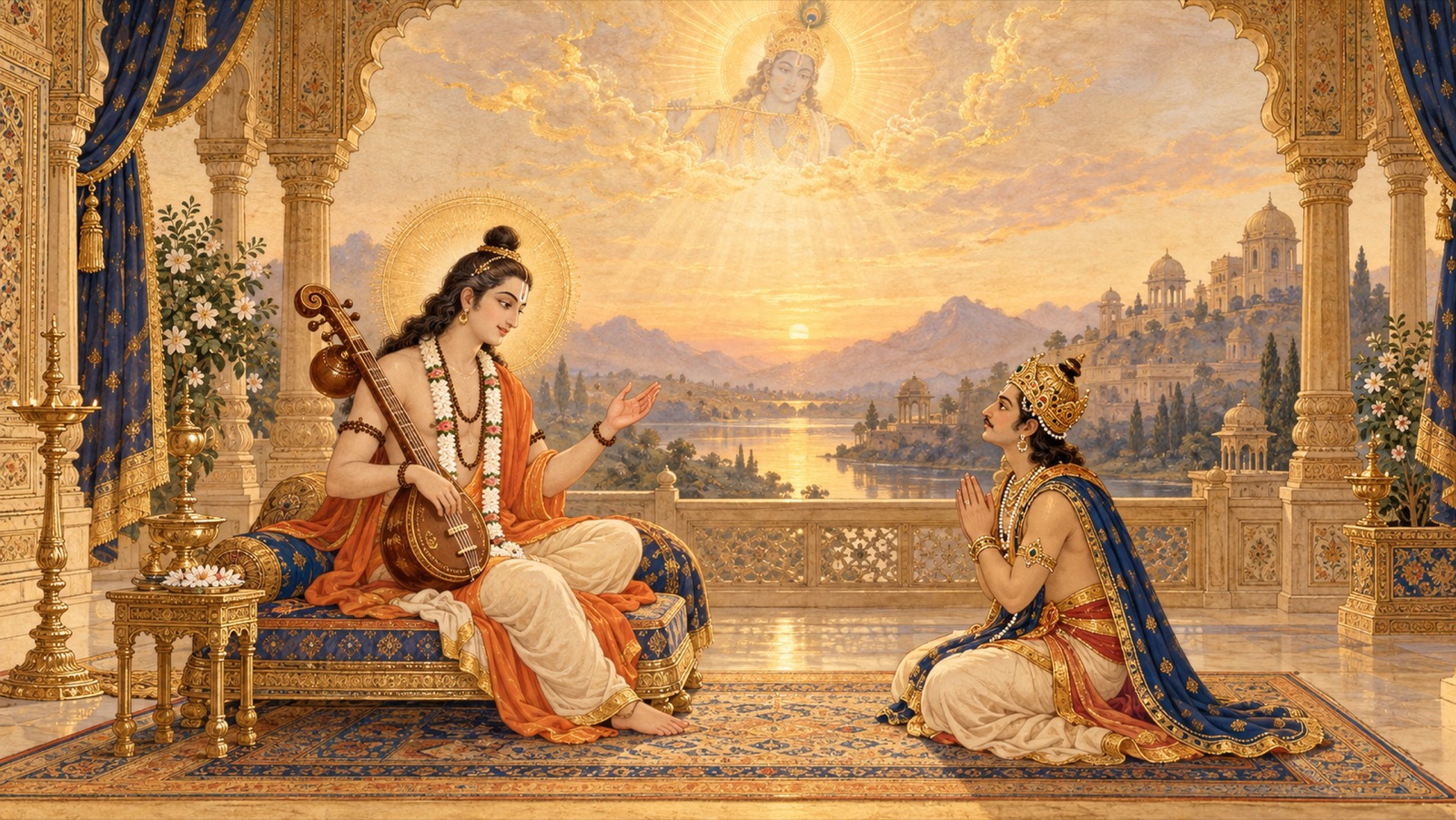
Into the grief of the broken king come the sages Angira and Narada, who gently lift his gaze from the little body to the eternal soul, teaching that beings are joined and parted by Time as grains of sand upon a stream, and that the one who grieves is deathless.
Om Namo Bhagavate Vasudevaya.
Om Namo Bhagavate Vasudevaya.
Om Namo Bhagavate Vasudevaya.
Welcome to Srimad Bhagavatam Wisdom, a devotional journey through the sacred histories and teachings of the Srimad Bhagavat Mahapurana. The fifteenth chapter of the Sixth Canto gathers up the grief of the previous chapter and begins to heal it. The sages Angira and Narada speak to the shattered King Citraketu, turning his sorrow into insight: that all meetings and partings are the work of Time, that every possession is a source of grief, and that the soul within is eternal — preparing the king to receive the sacred prayer by which he will behold the Lord.
Chapter Information
- Scripture: Śrīmad Bhāgavata Mahāpurāṇa
- Canto: 6 (Book Six)
- Chapter: 15 (Discourse 15)
- Chapter title: King Citraketu Consoled by the Sages
- Principal speaker: Sukadeva Gosvami, narrating to King Parikshit; the sages Angira and Narada within the account
- Principal listener: King Parikshit; the sages of Naimisharanya at the outer frame
- Main setting: The palace of King Citraketu, beside the body of the child
- Central subject: The sages’ consolation of Citraketu and the teaching that leads him toward the Lord
- Principal verse range: Canto 6, Chapter 15, verses 1–28
- Primary edition: Gita Press Śrīmad Bhāgavata Mahāpurāṇa
The Question That Opens the Eyes
Finding the king lying like a corpse beside his dead child, overwhelmed with grief, the sages Angira and Narada began to enlighten him with wise words. They asked him a question that cut straight to the root of his sorrow: in what relation did this boy stand to you in a former life, what is he to you now, and what will he be hereafter? And what were you to him? Just as grains of sand are carried together and carried apart by the current of a stream, so, they said, are embodied beings brought together and parted by Time (verses 1-3).
यथा प्रयान्ति संयान्ति स्रोतोवेगेन बालुका: । संयुज्यन्ते वियुज्यन्ते तथा कालेन देहिन: ॥ ३ ॥
yathā prayānti saṁyānti sroto-vegena bālukāḥ saṁyujyante viyujyante tathā kālena dehinaḥ
Meaning: Just as grains of sand are swept together and swept apart by the force of a flowing stream, so are embodied beings brought together and separated by Time. (Canto 6, Chapter 15, verse 3)
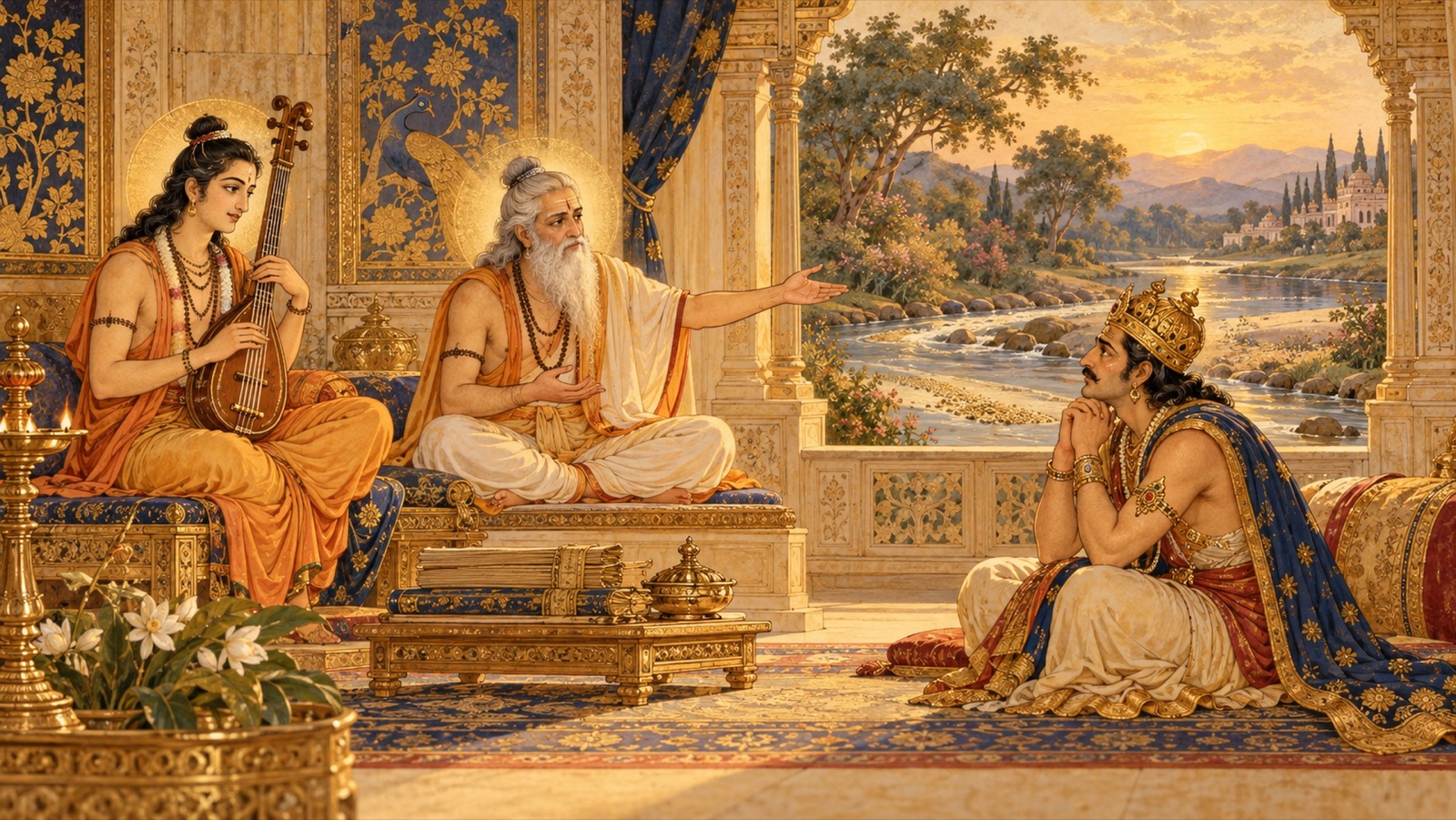
As seeds spring up from other seeds in some cases and not in others, the sages continued, so do living beings evolve from one another by the Lord’s Maya. You, we, and all these creatures did not truly exist before birth and will not exist after death; it is God alone, unborn and unconcerned, who sportfully creates, protects and destroys living beings through other beings He has evolved. The body of a son is formed from the bodies of his parents as one seed from another, yet the soul that dwells in all these bodies is eternal, like God Himself. The seeming distinction of body and soul, they said, has existed from beginningless time and is conceived through ignorance alone (verses 4-8).
The King Recognises His Teachers
Thus consoled, King Citraketu wiped his face, withered by anguish, and spoke. Who are you, he asked, so rich in wisdom and worthy of all worship, come here disguised as ascetics? He understood that Brahmanas beloved of the Lord wander the earth, sometimes appearing like madmen, to awaken sensual people such as himself. Naming the great sages who move through the world to impart wisdom, he bowed before the two and begged them to hold aloft the lamp of knowledge for one plunged in the blinding darkness of ignorance (verses 9-16).
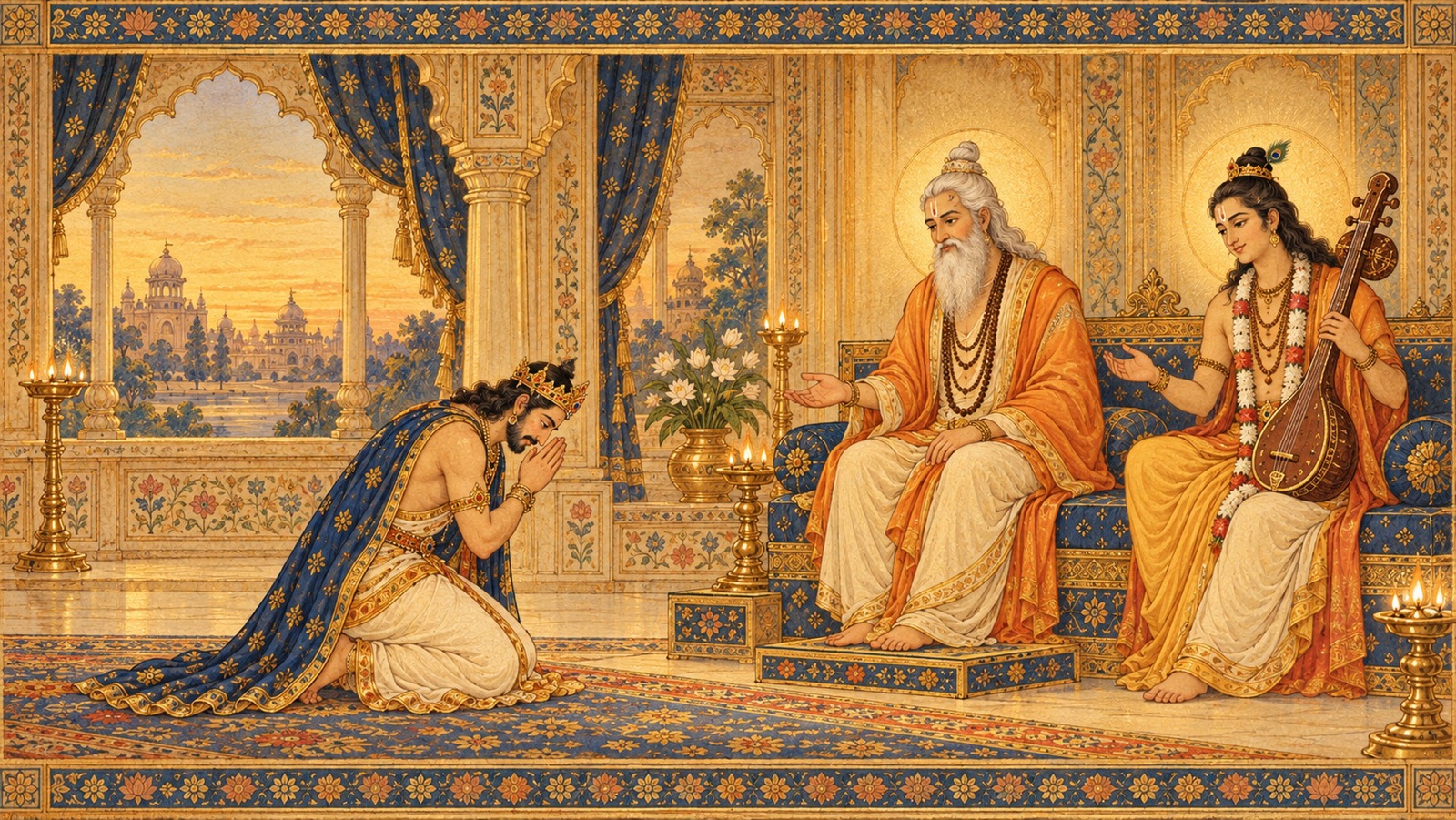
Then Angira revealed himself. “I am that same Angira who blessed you with a son when you longed for one,” he said, “and here is the divine sage Narada, the son of Brahma himself. Knowing you to be a devotee of Lord Vishnu, drowning in a grief you do not deserve, we have come to shower our grace upon you — for a votary of the Brahmanas and a devotee of the Lord ought never to despair. I meant to give you the highest wisdom even at my first visit; but seeing your insistence, I gave you a son instead, and now you have tasted the agony that those blessed with a son must bear” (verses 17-20).
All Possessions Are Sources of Grief
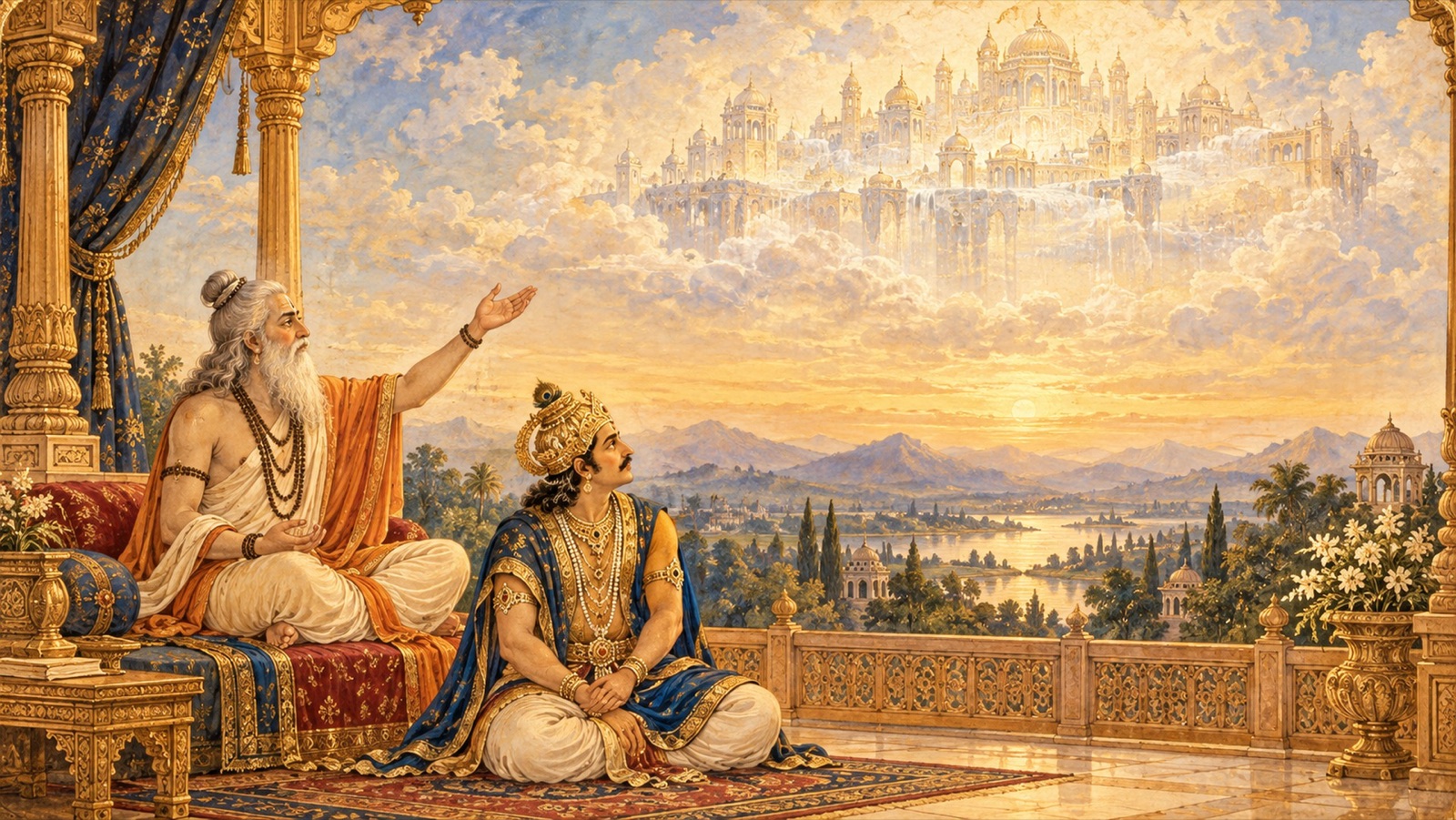
The sage then opened the king’s eyes to a wider truth. A wife, a home, riches, power, and every fleeting glory of sovereignty — land, kingdom, army, treasury, servants, ministers, friends and kin — all of these, he taught, are sources of grief, infatuation, fear and affliction. They are like a city imagined in the sky, or the fleeting stuff of a dream, an illusion, a fancy (verses 21-23).
अधुना पुत्रिणां तापो भवतैवानुभूयते । एवं दारा गृहा रायो विविधैश्वर्यसम्पद: ॥ २१ ॥ शब्दादयश्च विषयाश्चला राज्यविभूतय: । मही राज्यं बलं कोषो भृत्यामात्यसुहृज्जना: ॥ २२ ॥ सर्वेऽपि शूरसेनेमे शोकमोहभयार्तिदा: । गन्धर्वनगरप्रख्या: स्वप्नमायामनोरथा: ॥ २३ ॥
adhunā putriṇāṁ tāpo bhavataivānubhūyate evaṁ dārā gṛhā rāyo vividhaiśvarya-sampadaḥ śabdādayaś ca viṣayāś calā rājya-vibhūtayaḥ mahī rājyaṁ balaṁ koṣo bhṛtyāmātya-suhṛj-janāḥ sarve ‘pi śūraseneme śoka-moha-bhayārtidāḥ gandharva-nagara-prakhyāḥ svapna-māyā-manorathāḥ
Meaning: The agony felt by those who have children is now being tasted by you. Even so, O ruler of Surasena, a wife, home and wealth, riches of every kind, the fleeting objects of the senses and the glories of a kingdom — land, sovereignty, army, treasury, servants, ministers and friends — all are givers of grief, delusion, fear and pain; they are like a city seen in the sky, like a dream, an illusion, a mere fancy of the mind. (Canto 6, Chapter 15, verses 21-23)
Therefore, Angira urged, with a composed mind investigate the true nature of the Self, give up the belief that the objective world is abidingly real, and rest in inner peace (verses 24-26).
The Gift of the Sacred Prayer
Then the divine sage Narada, seeing the king now ready, gave him a precious gift. Purify yourself, he said, and receive from me this sacred prayer, an abode of the highest blessing; by repeating it and fixing your thought upon it, you will behold Lord Sankarshana after seven nights. By taking shelter at the soles of His feet, Narada told him, devotees of the remotest past — Lord Siva and others — crossed beyond the illusion of this world and attained His unequalled greatness, and you too will soon reach that same supreme result (verses 27-28).
Principal Teachings of This Chapter
1. Meetings and partings are the work of Time. Beings are joined and separated like grains of sand upon a stream; grief comes from forgetting this (verse 3).
2. The soul is eternal; only bodies come and go. Bodies arise from other bodies as one seed from another, but the indwelling soul neither takes birth nor dies (verse 7).
3. Every worldly possession is a source of grief. Wife, home, wealth and kingdom — all are givers of sorrow, fear and delusion, as fleeting as a city imagined in the sky (verses 21-23).
4. A devotee ought never to despair. Angira reminds the king that one dear to the Lord does not deserve to drown in grief, and comes to lift him from it (verses 18-19).
5. Wisdom prepares the heart to behold the Lord. Only once the king is consoled and detached does Narada give him the sacred prayer by which he will see Lord Sankarshana (verses 27-28).
A Devotional Reflection
Grief has a way of making us feel utterly alone, as though no one has ever stood where we are standing. The mercy of this chapter is that it does not begin by telling the king to stop crying; it begins with a question. Who was this child to you before he was your son, and who will he be when this life is over? In that one question the sages gently loosen the knot that grief has tied, reminding Citraketu that the little soul he mourns was never truly his to keep — that beings meet and part like sand swept along a stream, and that the self who loves and the self who is loved are both deathless, untouched by the body’s coming and going. This is not cold comfort. It is the deepest kind of consolation, because it does not promise that nothing was lost, but reveals that the essential thing can never be lost at all. And notice the order of the healing: first the king must be consoled and his heart turned from the world, and only then is he given the prayer that will let him see the Lord. Wisdom clears the ground; devotion builds the temple. When sorrow visits us, we may let it ask us the same question, and turn, as Citraketu did, from what passes to the One who does not.
A Daily Devotional Practice
Today, sit quietly for a few minutes and bring to mind someone you love or something you hold dear. Gently remind yourself that it has been entrusted to you for a time by the Lord, joined to you by His will as sand is gathered by a stream, and that the soul within you and within those you love is eternal and safe in Him. Release a little of your anxious grip, and in its place take the Lord’s holy name, asking Him to seat your heart in the peace that does not depend on holding anything at all.
Conclusion
The fifteenth chapter of the Sixth Canto shows grief transformed into wisdom. The sages Angira and Narada do not dismiss Citraketu’s sorrow; they lift his eyes above it, showing that all meetings are fashioned by Time, that worldly things breed only sorrow, and that the self can never die. Consoled and awakened, the king is recognised as a devotee who ought never to despair, and Narada bestows upon him the sacred prayer by which, after seven nights, he will behold Lord Sankarshana. As the Canto moves next to Citraketu’s vision of the Lord, we carry with us the chapter’s healing truth: that the essential thing can never be lost, and that sorrow, rightly guided, leads the soul home.
May the divine wisdom of Srimad Bhagavatam awaken pure devotion within our hearts.
Om Namo Bhagavate Vasudevaya.
Jay Shree Madhav.
References and Attribution
- Primary edition: Gita Press, Śrīmad Bhāgavata Mahāpurāṇa (English, complete), Book Six, Discourse 15.
- Series: Srimad Bhagavatam Wisdom · Biswa Sanatan Dharma Seva Trust.
- Presented following the spiritual guidance and recommendation of Pandit Dr. Shri Kashinath Mishra.
This is an original, faithful retelling in the writer’s own words, with brief quoted verses shown in Devanāgarī and transliteration and their meanings given as summaries. It is not a reproduction of any single publisher’s continuous translation or commentary. No affiliation with or endorsement by any publisher is implied.
Jay Shree Madhav