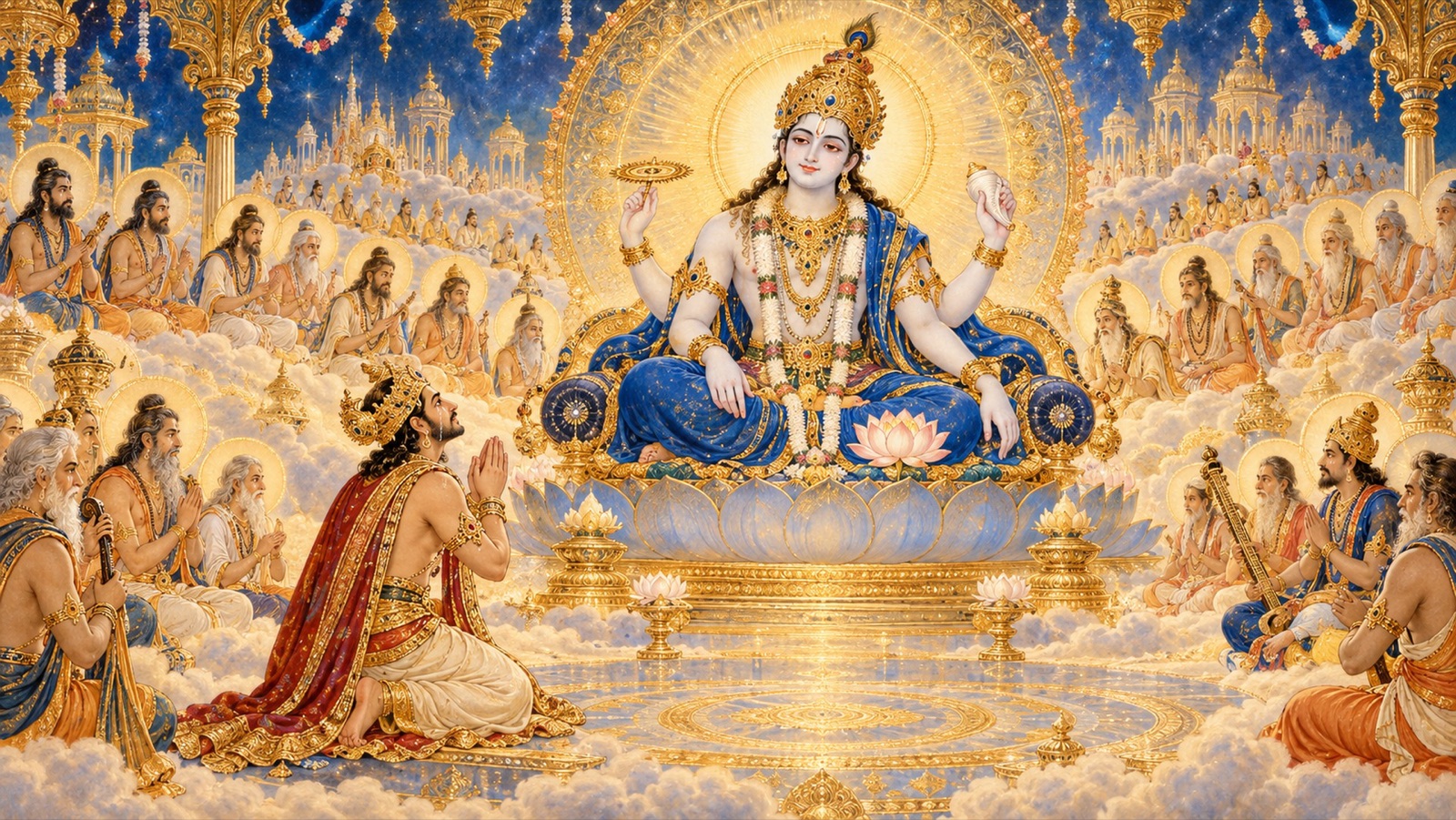
Purified by grief and ripened by wisdom, King Citraketu at last beholds Lord Sankarshana — white as a lotus fibre, clad in blue, ringed by perfected sages — and, his sins dissolved by that single sight, he pours out his heart in loving praise.
Om Namo Bhagavate Vasudevaya.
Om Namo Bhagavate Vasudevaya.
Om Namo Bhagavate Vasudevaya.
Welcome to Srimad Bhagavatam Wisdom, a devotional journey through the sacred histories and teachings of the Srimad Bhagavat Mahapurana. The sixteenth chapter of the Sixth Canto brings the story of Citraketu to its radiant summit. The departed prince himself speaks to free his grieving family from illusion; the king, now detached, repeats the sacred prayer and beholds Lord Sankarshana face to face; and the Lord, gratified by his praise, teaches him the oneness of the Supreme and the soul, and the devotion that leads to perfection.
Chapter Information
- Scripture: Śrīmad Bhāgavata Mahāpurāṇa
- Canto: 6 (Book Six)
- Chapter: 16 (Discourse 16)
- Chapter title: King Citraketu Attains the Lord
- Principal speaker: Sukadeva Gosvami, narrating to King Parikshit; the departed soul, Citraketu and the Lord within the account
- Principal listener: King Parikshit; the sages of Naimisharanya at the outer frame
- Main setting: The palace of Citraketu, the bank of the Yamuna, and the abode of Lord Sankarshana
- Central subject: The departed soul’s instruction, Citraketu’s vision of the Lord, and the Lord’s teaching on oneness and devotion
- Principal verse range: Canto 6, Chapter 16, verses 1–65
- Primary edition: Gita Press Śrīmad Bhāgavata Mahāpurāṇa
The Departed Soul Speaks
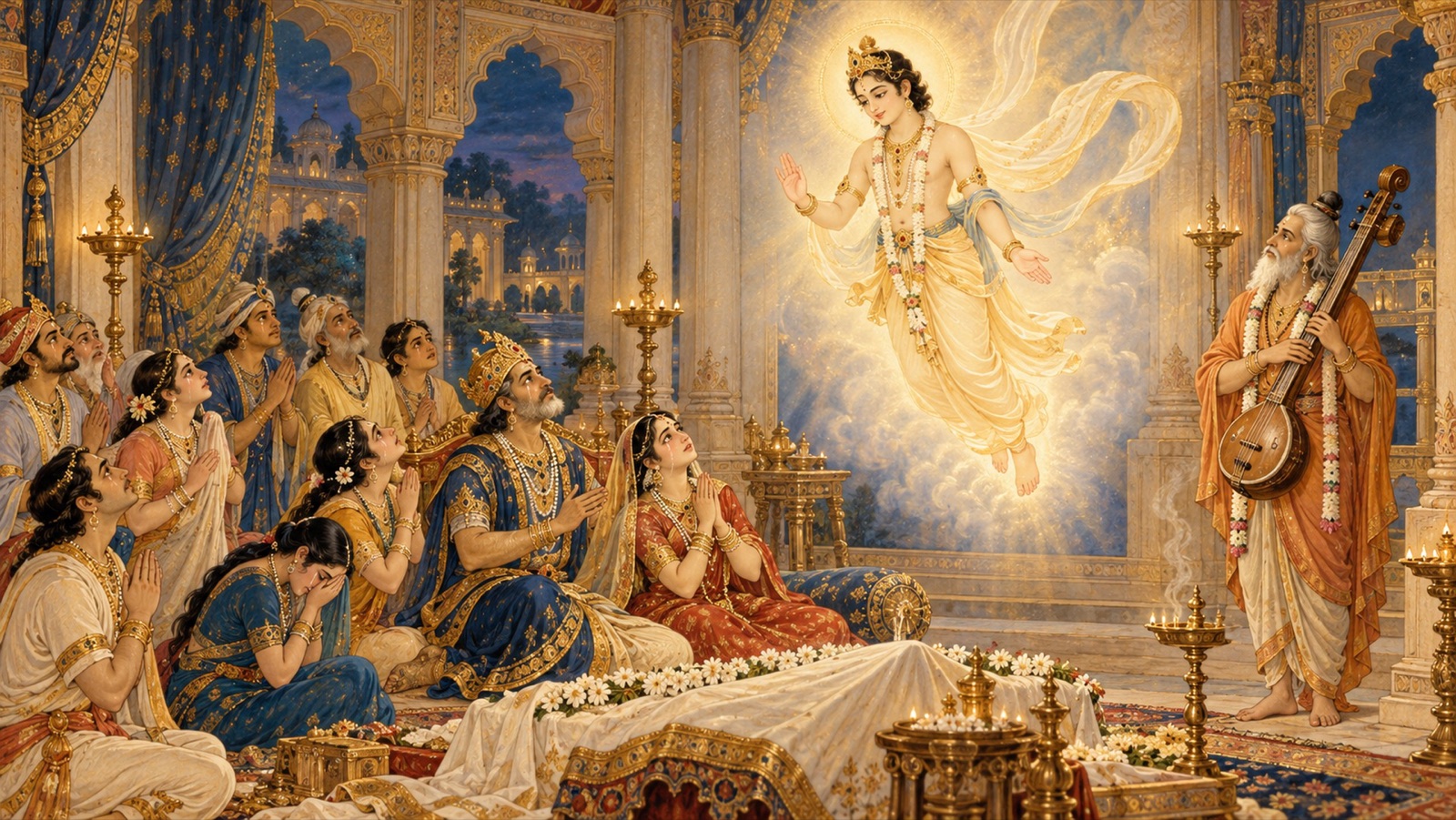
By his yogic power, Narada summoned the spirit of the dead prince and bade it return to its body to enjoy the royal fortune and the love of its grieving kinsmen. But the soul answered with a wisdom that silenced their sorrow. In which of my many births, it asked, were these people my parents? Through the long turning of birth and rebirth, all beings become, by turns, one another’s kin and strangers, friends and foes (verses 1-5).
बन्धुज्ञात्यरिमध्यस्थमित्रोदासीनविद्विष: । सर्व एव हि सर्वेषां भवन्ति क्रमशो मिथ: ॥ ५ ॥
bandhu-jñāty-ari-madhyastha- mitrodāsīna-vidviṣaḥ sarva eva hi sarveṣāṁ bhavanti kramaśo mithaḥ
Meaning: In the long course of rebirth, all beings become by turns one another’s kinsmen and relatives, enemies and neutrals, friends and the indifferent. (Canto 6, Chapter 16, verse 5)
As gold passes from hand to hand among men, the soul said, so does the embodied self pass through different wombs; the sense of “mine” lasts only as long as the relation itself. The soul within is everlasting, self-illuminating, the one witness, untouched by virtue or sin. Having spoken, the spirit vanished — and the astonished kinsmen cut the ties of their grief and gave up mourning (verses 6-12).
The King Made Ready
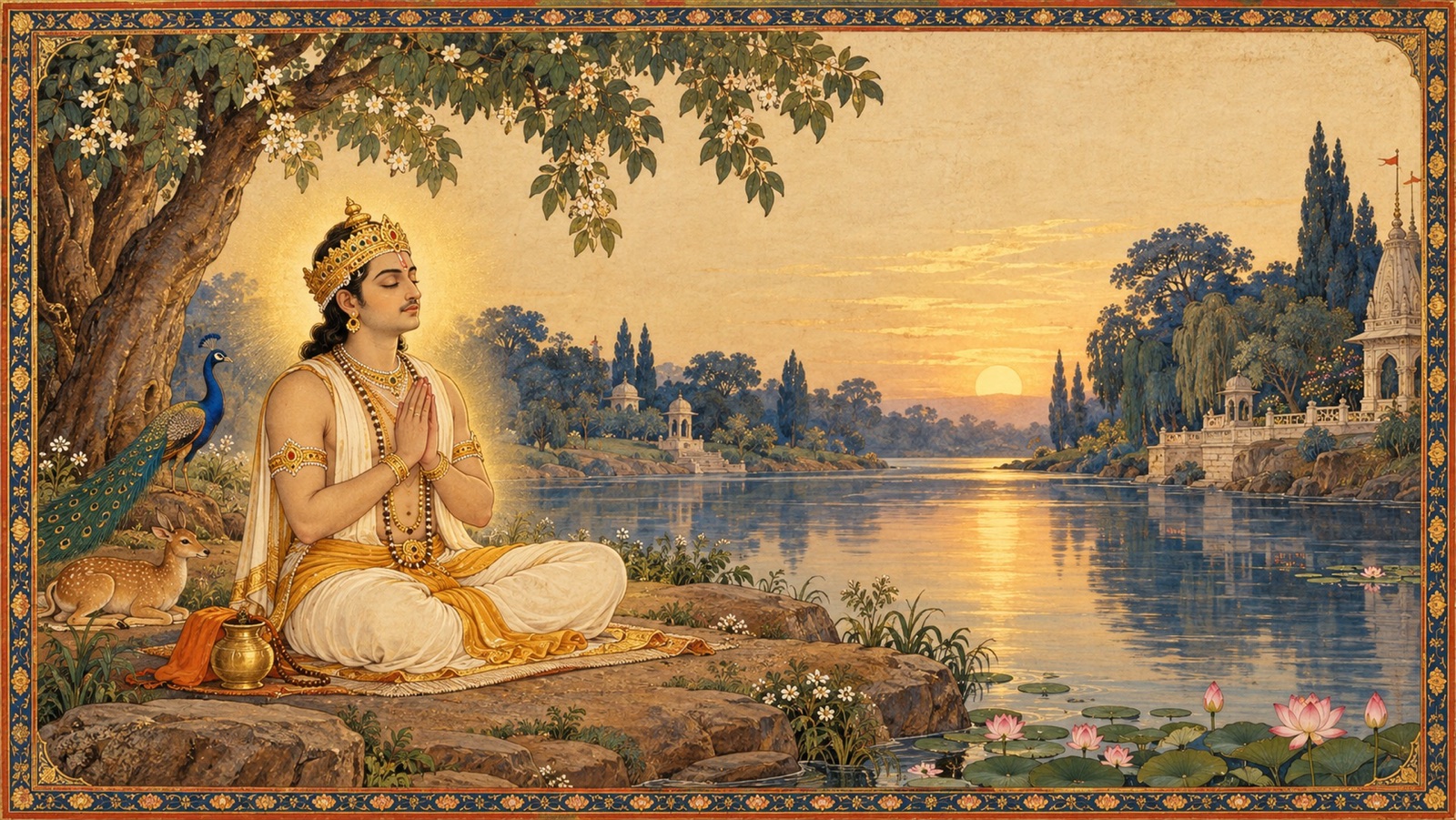
After the funeral rites, the queens who had poisoned the child, remembering the sage’s warning, were overcome with shame and performed penance on the bank of the Yamuna. Citraketu himself, having realised the Self through the words of the sages, rose from the deceptive well of worldly existence like an elephant climbing from the mire. He bathed in the Yamuna, bowed to the two sons of Brahma, and received from Narada the sacred prayer. Narada and Angira then departed to the abode of Brahma, while the king, subsisting only on water, repeated that prayer with perfect concentration for seven nights. At the end of that time he attained the lordship of the Vidyadharas, and soon after, his mind wholly illumined, he betook himself to the feet of Lord Sesha (verses 13-29).
The Vision of the Lord
There Citraketu beheld the Lord — His form white as the fibre of a lotus, clad in blue, adorned with a brilliant diadem, armlets and wristlets, His countenance cheerful and His eyes reddish, surrounded by rings of perfected sages. All his sins washed away by that very sight, his heart clear of every impurity, the king approached with intensified devotion, tears of love streaming and his hair standing on end, and bowed before Him. For a long while love so choked his voice that he could not speak; then, composing his mind, he extolled the Preceptor of the universe (verses 30-33).
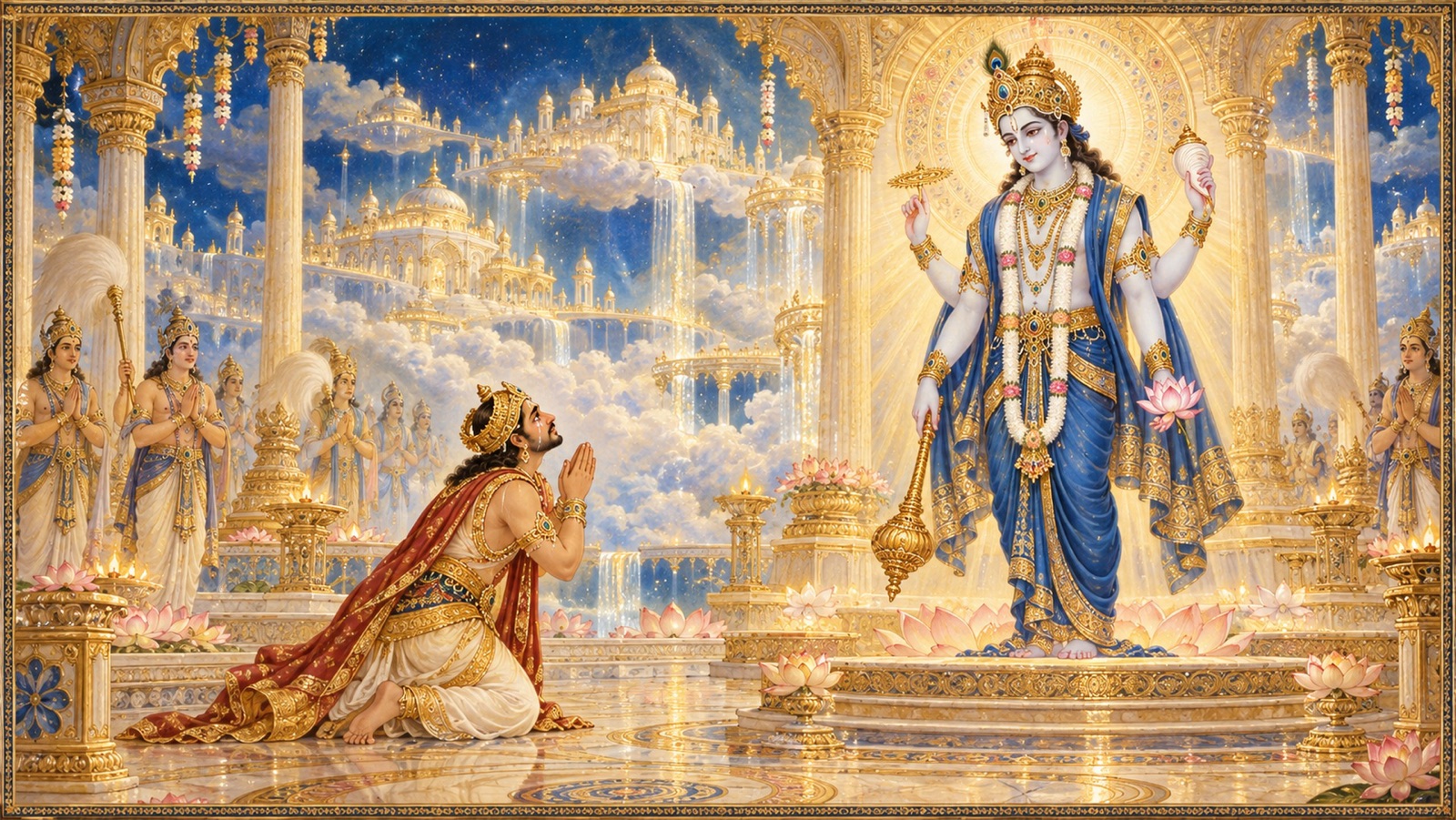
Citraketu praised the Lord as the unconquerable One who is yet conquered by the loving hearts of His devotees; whose creation, maintenance and dissolution of the universe are mere sport; within whom this egg-shaped universe floats like a single atom among countless others. He lamented those who, thirsting for sense pleasure, worship lesser gods but not the Supreme, whose gifts perish with their givers. Most tender of all was his wonder at the power of the Lord’s mercy (verses 34-43).
न हि भगवन्नघटितमिदं त्वद्दर्शनान्नृणामखिलपापक्षय: । यन्नाम सकृच्छ्रवणात् पुक्कशोऽपि विमुच्यते संसारात् ॥ ४४ ॥
na hi bhagavann aghaṭitam idaṁ tvad-darśanān nṛṇām akhila-pāpa-kṣayaḥ yan-nāma sakṛc chravaṇāt pukkaśo ‘pi vimucyate saṁsārāt
Meaning: O Lord, it is no wonder that the sight of You destroys every sin of men, when even an outcaste is freed from the bondage of birth and death merely by hearing Your name once. (Canto 6, Chapter 16, verse 44)
He acknowledged that nothing he could say was news to the Lord, the Soul of all, before whom the worshipper is like a firefly before the sun, and bowed again to the thousand-headed Lord (verses 45-48).
The Lord’s Teaching
Gratified by his praise, Lord Ananta spoke to Citraketu. You have fully achieved your aim, He said, through the instruction of Narada and Angira and through beholding Me. Then He unfolded the highest wisdom: that He Himself is all living beings, their indwelling Self and their very source (verses 49-51).
अहं वै सर्वभूतानि भूतात्मा भूतभावन: । शब्दब्रह्म परं ब्रह्म ममोभे शाश्वती तनू ॥ ५१ ॥
ahaṁ vai sarva-bhūtāni bhūtātmā bhūta-bhāvanaḥ śabda-brahma paraṁ brahma mamobhe śāśvatī tanū
Meaning: I am all living beings, their inner Self and their origin; the sound of the Veda and the transcendent Absolute are both My eternal bodies. (Canto 6, Chapter 16, verse 51)
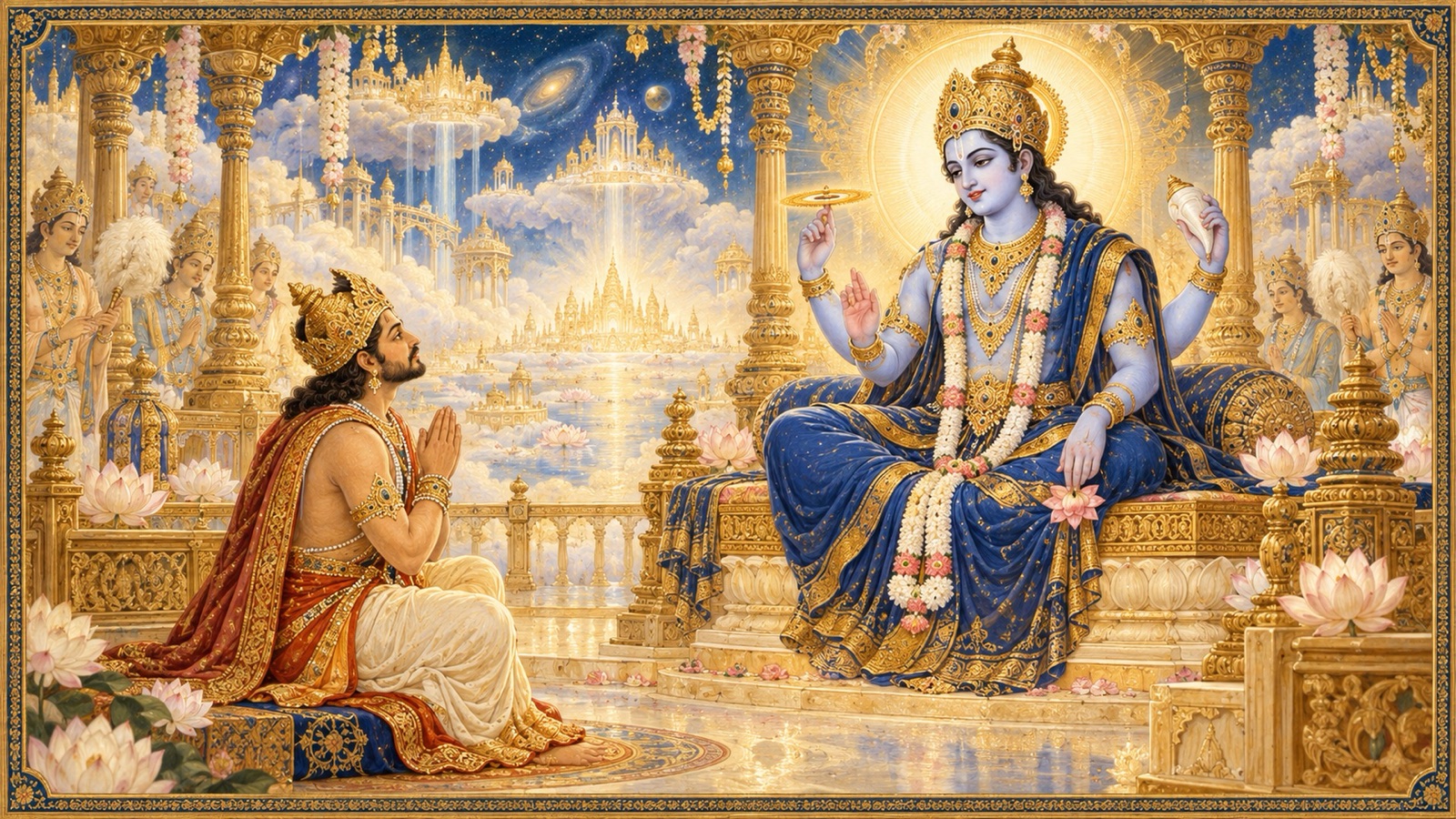
A person should recognise his own self as pervading the whole universe, and the universe as resting within his self, both pervaded by the Lord, the Lord taught. As one who dreams sees a world within himself and wakes to find it was only the play of his mind, so should one realise all states of mind as products of Maya and fix the mind upon the Supreme. Whoever fails to realise his true nature, even after birth in the human form, finds no peace anywhere; but one who cultivates devotion to the Lord, having seen the subtle Self beyond the three states, attains the one thing truly worth knowing — the oneness of the Supreme Spirit and the individual soul. Bearing this exhortation reverently in mind, the Lord assured Citraketu, he would soon reach perfection. Then, while the king looked on, Lord Sri Hari disappeared (verses 52-65).
Principal Teachings of This Chapter
1. Family ties are temporary roles, not the soul’s truth. The departed prince shows that beings become kin and strangers by turns through many lives, and that the “mineness” of relationship lasts only while the relation does (verses 5-8).
2. The soul is the deathless witness. It is self-illuminating, untouched by virtue or sin, the one observer of all that passes (verses 9-11).
3. The sight and the Name of the Lord destroy all sin. Citraketu marvels that even an outcaste is freed by hearing the Lord’s name but once, and his own sins vanish at the sight of Him (verse 44).
4. The Lord is the Self and source of all beings. He reveals that He Himself is every living being, their indwelling soul and origin, and that Veda and Absolute are His eternal forms (verse 51).
5. The goal is devotion grounded in oneness. The Lord teaches that realising the unity of the Supreme and the soul, and cultivating devotion to Him, is the one aim truly worth pursuing (verses 61-64).
A Devotional Reflection
What finally lifts Citraketu out of his sorrow is not a comforting word but a change of vision. The very child he had mourned returns to tell him, gently and without reproach, that the bond of father and son is a costume worn for a single scene in a play that has run through countless lifetimes — that love is real, but the roles are not permanent, and the soul beneath them was never truly his to lose. Freed by this, the king does not grow cold; he grows clear. He bathes, he prays, and he beholds the Lord Himself, and in that sight every stain of his heart dissolves. Most beautiful of all is what the Lord then tells him: not merely that the soul is eternal, but that the Lord is the very Self of every being, so that nothing we love is ever truly separate from Him. The grief that began in an empty cradle ends in the embrace of the whole universe within God. This is the Bhagavata’s promise to every mourner: that the One we seek in our scattered loves is nearer than all of them, and that the path through loss, walked with devotion, leads straight to His feet.
A Daily Devotional Practice
Today, gently loosen your grip on one relationship or role you cling to as though it defined you, and remember that the soul within you and within every person you love belongs eternally to the Lord. Spend a few minutes repeating a sacred name or short prayer with full attention, as Citraketu repeated his, and ask the Lord to let you see Him as the indwelling Self of all. Carry through the day the quiet knowledge that nothing truly dear to you is ever separate from Him.
Conclusion
The sixteenth chapter of the Sixth Canto carries Citraketu from mourning into the very presence of God. His lost son, speaking as a freed soul, dissolves the family’s illusion; the awakened king then wins the vision of Lord Sankarshana and hears from His own lips that He dwells as the Self within every creature, the goal being a devotion rooted in that oneness. As the Canto turns next to Citraketu’s meeting with Lord Siva and Goddess Parvati, its radiant promise stays with us: that whatever we have loved and lost is held safe in the One who was always closest of all, and that grief walked through in loving devotion opens straight upon His feet.
May the divine wisdom of Srimad Bhagavatam awaken pure devotion within our hearts.
Om Namo Bhagavate Vasudevaya.
Jay Shree Madhav.
References and Attribution
- Primary edition: Gita Press, Śrīmad Bhāgavata Mahāpurāṇa (English, complete), Book Six, Discourse 16.
- Series: Srimad Bhagavatam Wisdom · Biswa Sanatan Dharma Seva Trust.
- Presented following the spiritual guidance and recommendation of Pandit Dr. Shri Kashinath Mishra.
This is an original, faithful retelling in the writer’s own words, with brief quoted verses shown in Devanāgarī and transliteration and their meanings given as summaries. It is not a reproduction of any single publisher’s continuous translation or commentary. No affiliation with or endorsement by any publisher is implied.
Jay Shree Madhav