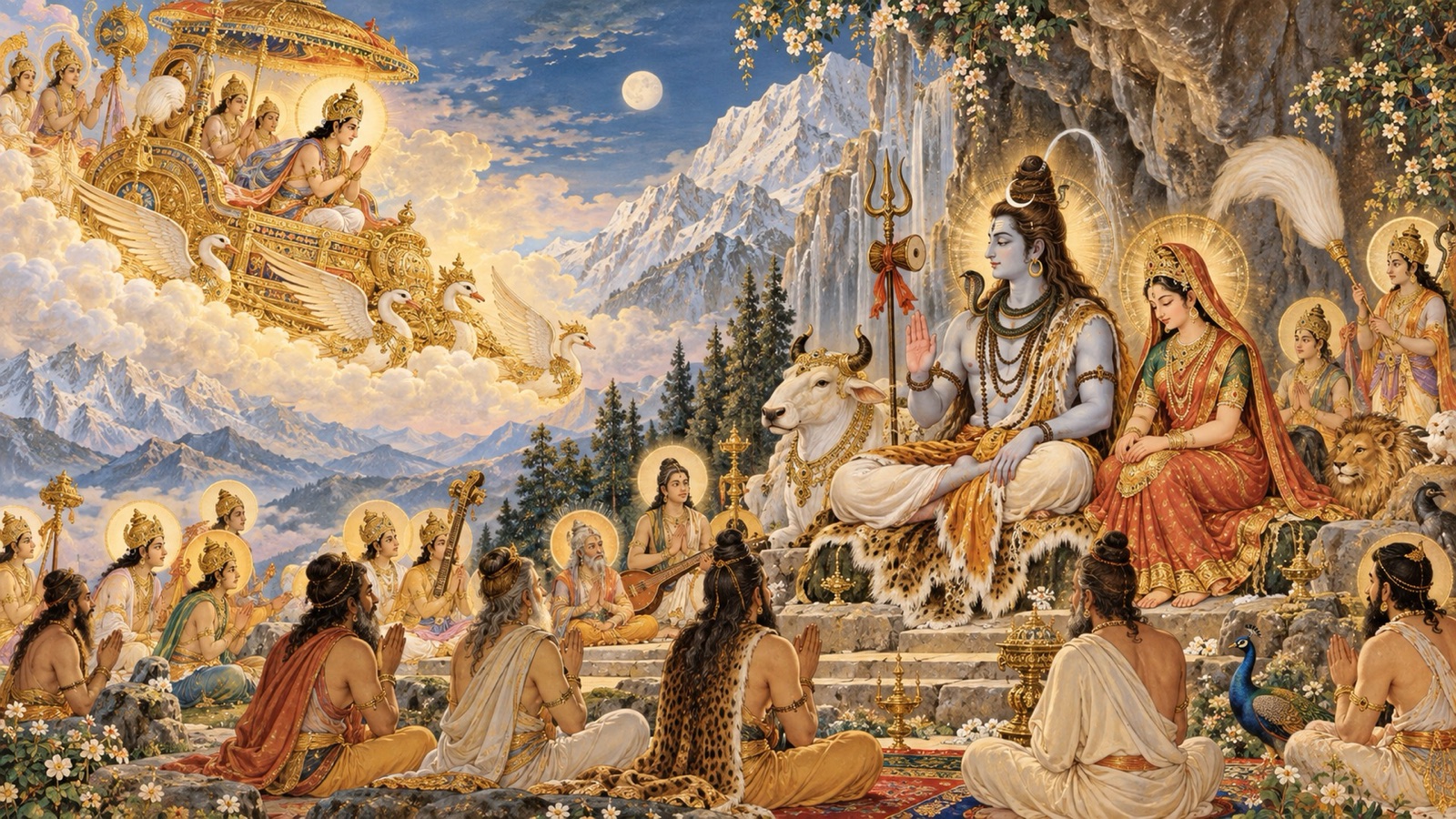
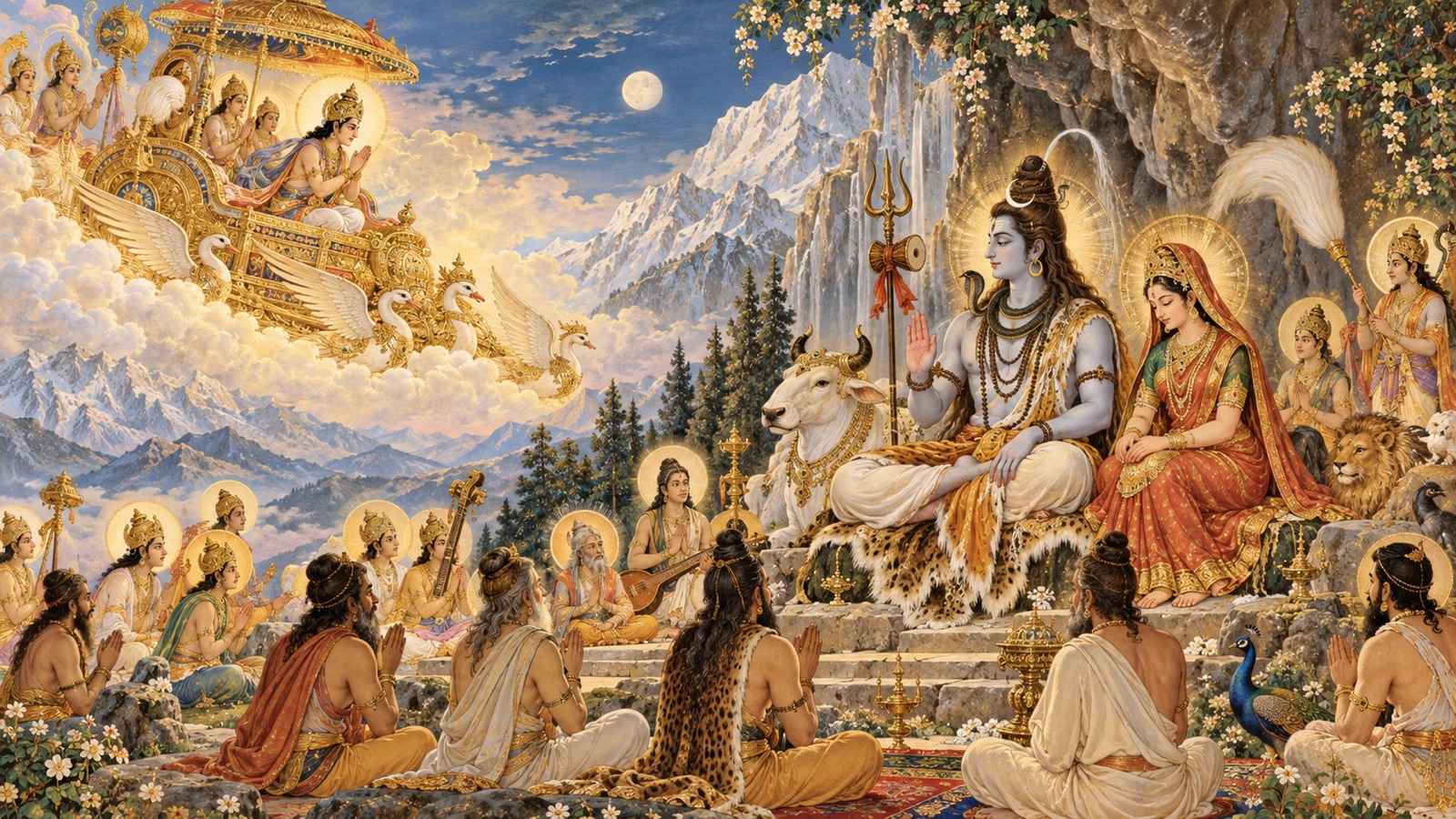
Flying through the heavens in a shining aerial car, the Vidyadhara king Citraketu comes upon Lord Siva seated with Goddess Parvati amid an assembly of sages — an encounter that will draw a curse upon him and reveal, through his serene acceptance, the deepest marks of a true devotee.
Om Namo Bhagavate Vasudevaya.
Om Namo Bhagavate Vasudevaya.
Om Namo Bhagavate Vasudevaya.
Welcome to Srimad Bhagavatam Wisdom, a devotional journey through the sacred histories and teachings of the Srimad Bhagavat Mahapurana. The seventeenth chapter of the Sixth Canto completes the story of Citraketu and answers the question that began it. A careless remark before Lord Siva and Goddess Parvati brings a curse upon the king; yet his flawless, fearless acceptance of it reveals the heart of a true devotee, and Lord Siva Himself praises him — explaining at last how this great soul came to be born as the demon Vritra.
Chapter Information
- Scripture: Śrīmad Bhāgavata Mahāpurāṇa
- Canto: 6 (Book Six)
- Chapter: 17 (Discourse 17)
- Chapter title: Mother Parvati Curses Citraketu
- Principal speaker: Sukadeva Gosvami, narrating to King Parikshit; Citraketu, Parvati and Lord Siva within the account
- Principal listener: King Parikshit; the sages of Naimisharanya at the outer frame
- Main setting: The heavens and the assembly of Lord Siva upon Mount Kailasa
- Central subject: Citraketu’s curse, his equanimity, and Lord Siva’s praise of the devotee
- Principal verse range: Canto 6, Chapter 17, verses 1–41
- Primary edition: Gita Press Śrīmad Bhāgavata Mahāpurāṇa
The Encounter in the Assembly
Having become a chief of the Vidyadharas, Citraketu sported for vast ages in the valleys of Mount Sumeru, praised by Siddhas and sages, his devotion to Sri Hari undiminished. One day, as he flew in a resplendent aerial car bestowed by Lord Vishnu, he came upon Lord Siva seated amid an assembly of sages, holding His divine consort, Goddess Parvati, upon His lap. Not understanding the greatness of the Lord, Citraketu laughed aloud and made a careless, mocking remark within the goddess’s hearing — questioning how the preceptor of the universe, the head of ascetics, could embrace His spouse in open assembly (verses 1-8).
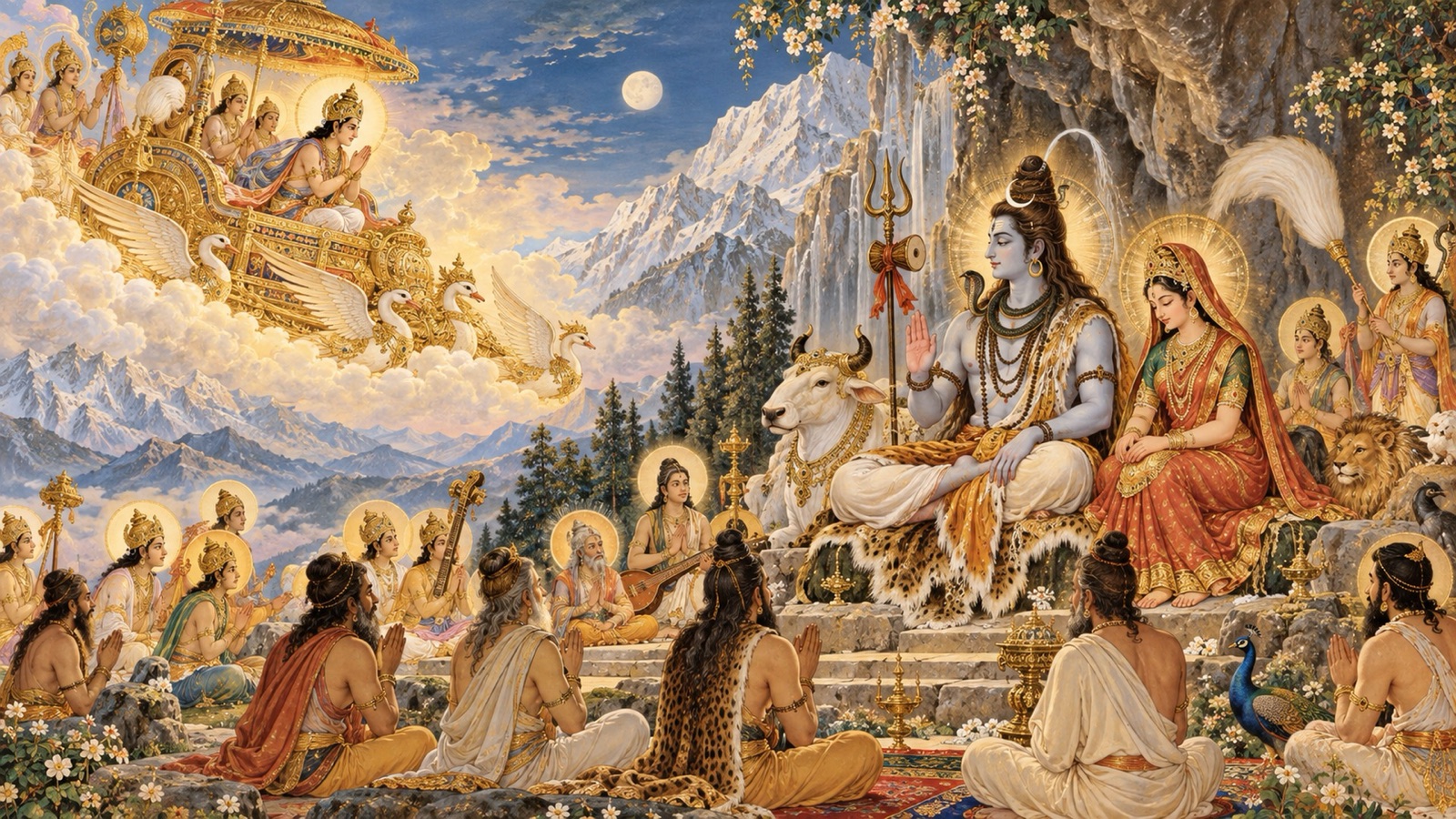
Lord Siva, whose mind is too deep to fathom, only smiled and kept silent, and so did the worthies present. But Goddess Parvati, seeing the Vidyadhara so ignorant of her Lord’s glory and so pleased with his own self-control, grew angry and spoke. Does this one alone, she asked, now rule the world and wield the rod of punishment, that he should presume to correct souls like us? Judging him unfit, in his pride, to resort to the feet of Lord Vishnu, she pronounced her curse: that he be reborn in the demoniac species, so that he might not again offend exalted souls (verses 9-15).
The Equanimity of the Devotee
Here the chapter turns from fault to grace. Hearing the curse, Citraketu did not grow angry or afraid. He came down from his aerial car, bowed his head low, and propitiated the goddess — not to escape the curse, but out of pure humility. Whatever divinities pronounce, he said, is surely ordained; and he accepted it with folded hands as a loving gift from the Mother (verses 16-17).
Then he spoke words of profound equanimity. A soul deluded by ignorance, he said, meets joy and sorrow everywhere; neither oneself nor another is truly their cause, for only a fool imagines himself or another to be responsible. In this ceaseless flow of nature’s modes, he asked, what real difference is there between a curse and a blessing, between heaven and hell, between joy and sorrow? (verses 18-20)
गुणप्रवाह एतस्मिन् क: शाप: को न्वनुग्रह: । क: स्वर्गो नरक: को वा किं सुखं दु:खमेव वा ॥ २० ॥
guṇa-pravāha etasmin kaḥ śāpaḥ ko nv anugrahaḥ kaḥ svargo narakaḥ ko vā kiṁ sukhaṁ duḥkham eva vā
Meaning: In this ceaseless current of the modes of nature, what is a curse and what a blessing, what is heaven and what hell, what is joy and what is sorrow? (Canto 6, Chapter 17, verse 20)
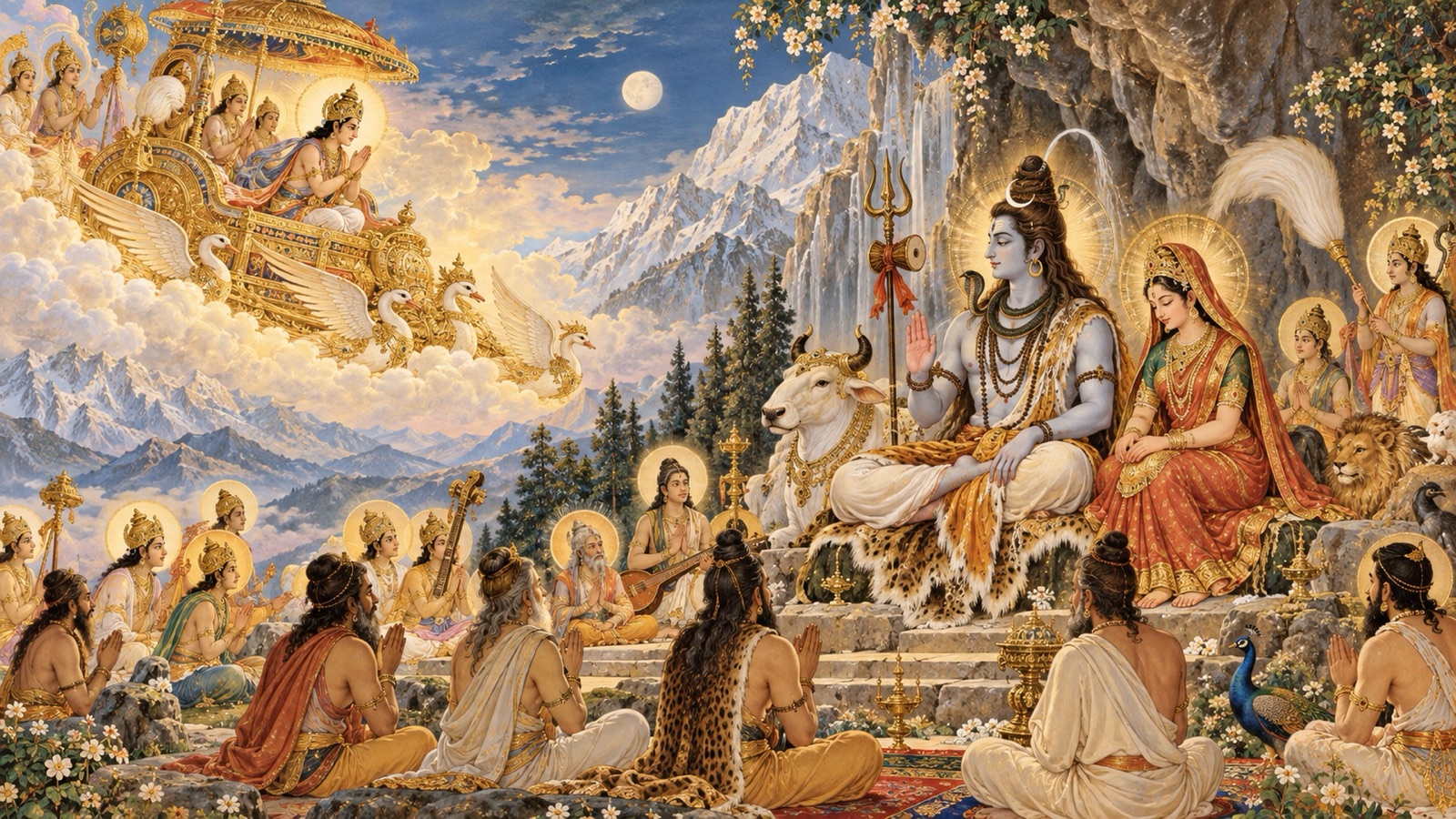
The one Lord, he continued, brings forth all beings by His Maya and ordains their bondage and liberation, their happiness and misery, while remaining untouched Himself; to Him, alike to all, none is dear and none hateful. Therefore, Citraketu said, he did not pray to be freed from the curse — he asked only that the goddess forgive whatever she judged to have been wrongly said (verses 21-24). Having thus appeased Lord Siva and Goddess Parvati, he went on his way, while the divine couple looked on in wonder.
Lord Siva Praises the Devotee
Then Lord Rudra spoke to His consort, within the hearing of gods and sages, demons and Siddhas. You have seen, He said, the glory of the servants of the servants of Sri Hari, who are free from every craving. Those devoted to Lord Narayana fear nothing from any quarter whatsoever (verses 25-28).
नारायणपरा: सर्वे न कुतश्चन बिभ्यति । स्वर्गापवर्गनरकेष्वपि तुल्यार्थदर्शिन: ॥ २८ ॥
nārāyaṇa-parāḥ sarve na kutaścana bibhyati svargāpavarga-narakeṣv api tulyārtha-darśinaḥ
Meaning: Those wholly devoted to Lord Narayana are never afraid of anything, for they look with an equal eye upon heaven, liberation and even hell. (Canto 6, Chapter 17, verse 28)
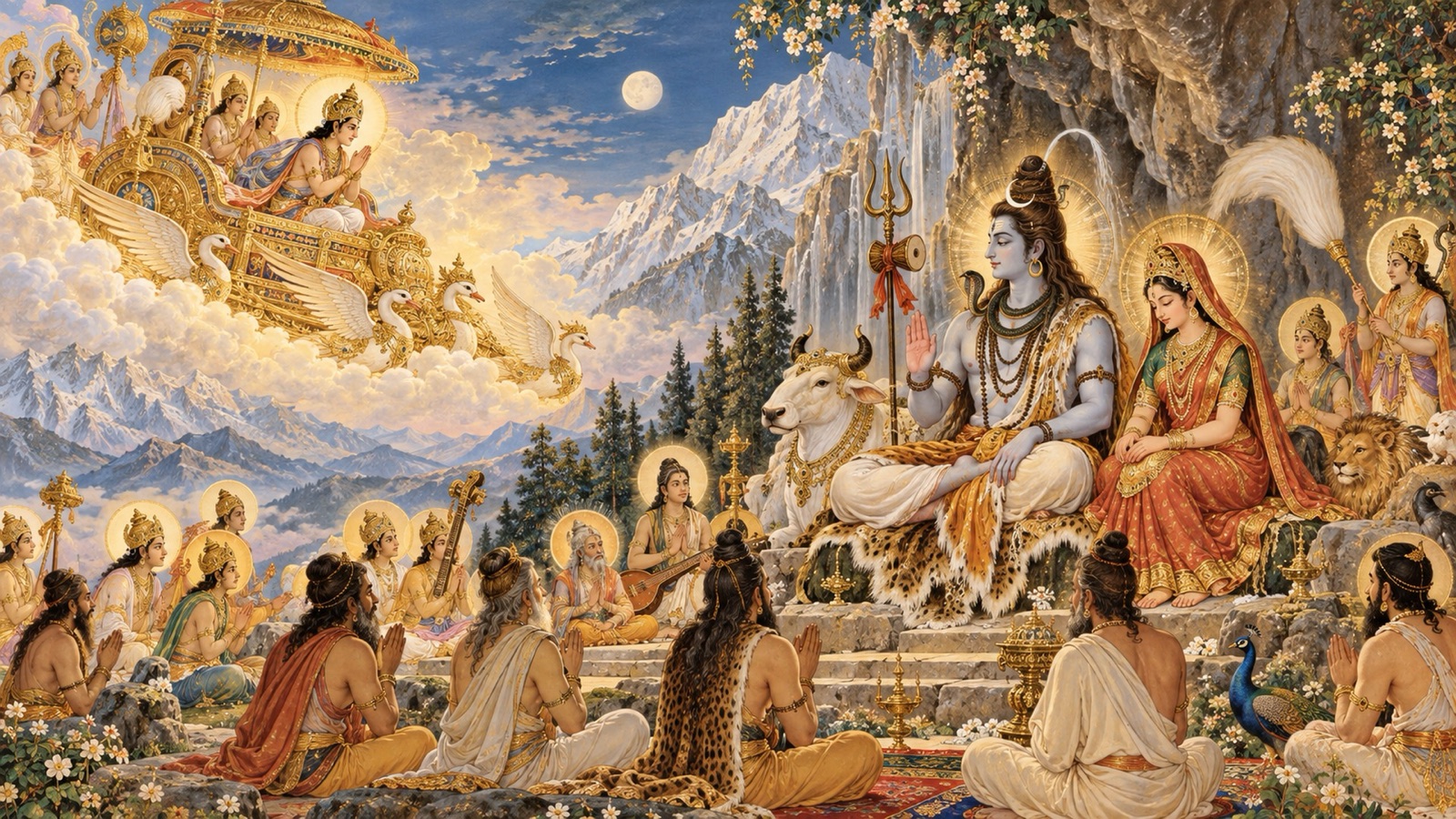
It is only through the Lord’s deluding power, Siva taught, that souls take a body and experience pairs of opposites. For those devoted to Lord Vasudeva and armed with wisdom and dispassion, there is nothing in the world worth craving. Neither I, He said, nor Brahma, nor the great sages, nor the rulers of the gods know the Lord’s full intention; none is dear or hateful to Him, for, being the Self of all beings, Sri Hari is beloved of all. This Citraketu is His dear servant, equal-visioned and serene — and I too am a devotee of the imperishable Lord. Therefore, He concluded, you need feel no wonder at the conduct of those who are devoted to Lord Vishnu (verses 29-35).
How Citraketu Became Vritra
Thus instructed, Goddess Parvati was freed of her astonishment and set at peace. Though fully able to pronounce a counter-curse, Citraketu had accepted the goddess’s curse with reverence — for such forbearance is the very mark of a pious soul. Cast into the demoniac species, he sprang up from the sacred fire of the sacrifice performed by Tvashta and became known as Vritra, still endowed with spiritual knowledge and wisdom (verses 36-38).
With this, Sukadeva answered the question that had opened the whole story: how the devotion to the Lord that shone so wonderfully in the demon Vritra had come to be. Whoever listens to this sacred episode of the exalted Citraketu, he said, is freed from the bondage of worldly existence; and one who rises early, recites it with reverence, and remembers Sri Hari, attains the supreme goal (verses 39-41).
Principal Teachings of This Chapter
1. Even great souls may stumble through careless judgment. Citraketu, a realised devotee, errs by mocking Lord Siva, showing that no one is above the need for humility (verses 6-8).
2. A true devotee meets a curse without anger or fear. Citraketu accepts the imprecation with folded hands, praying not for escape but only for forgiveness (verses 16-17).
3. Curse and blessing are alike in the flow of the modes. He sees no real difference between heaven and hell, joy and sorrow, for all arise in the play of nature under the one Lord (verse 20).
4. Those devoted to Narayana fear nothing. Lord Siva declares that the Lord’s devotees look with an equal eye on heaven, liberation and hell alike (verse 28).
5. Forbearance is the hallmark of a pious soul. Though able to curse in return, Citraketu accepts his fate in peace — and the whole ordeal is revealed as the Lord’s own arrangement (verses 37-38).
A Devotional Reflection
This chapter holds two surprises, one humbling and one consoling. The humbling one is that a soul as advanced as Citraketu — who had beheld the Lord face to face only a chapter before — can still slip into careless mockery, reminding us that no height of attainment excuses us from reverence and watchfulness of speech. But the consoling surprise is far greater. When the curse falls, Citraketu does not defend himself, does not retaliate, does not even flinch; he bows, accepts, and speaks of a peace so deep that curse and blessing have become one to him, because he sees the single hand of the Lord moving behind them both. And then Lord Siva Himself lifts the whole scene into light, revealing that this was never a tragedy at all but the Lord’s own way of drawing His servant onward. The curse that sounds like punishment is in truth the doorway by which Citraketu will become Vritra and, through that very life, return to the Lord. Here is the devotee’s secret strength: not that hard things never come, but that he has stopped dividing life into fortune and misfortune, and receives everything from the hand of God with the same steady, grateful heart.
A Daily Devotional Practice
Today, when something unwelcome comes — a criticism, a setback, a word that stings — practise receiving it as Citraketu received his curse: without retaliation, without panic, and without dividing the moment into “good” or “bad.” Pause, bow inwardly to the Lord, and remind yourself that the same divine hand moves behind both your joys and your sorrows. Guard your speech, too, especially toward those who are devoted to God, and let the holy name steady your heart through whatever the day brings.
Conclusion
The seventeenth chapter of the Sixth Canto brings the Citraketu story full circle. A thoughtless remark before Lord Siva and Goddess Parvati earns the king a curse, yet he receives it with such fearless equanimity that Lord Siva Himself praises him as a beloved servant of the Lord who sees curse and blessing alike. The curse becomes the path by which Citraketu is reborn as Vritra, still luminous with devotion — the very answer to the question that opened his tale. As the Canto turns next to the birth of the Maruts, we carry with us this chapter’s quiet strength: that the devotee, seeing the Lord’s hand in all things, fears nothing and receives everything in peace.
May the divine wisdom of Srimad Bhagavatam awaken pure devotion within our hearts.
Om Namo Bhagavate Vasudevaya.
Jay Shree Madhav.
References and Attribution
- Primary edition: Gita Press, Śrīmad Bhāgavata Mahāpurāṇa (English, complete), Book Six, Discourse 17.
- Series: Srimad Bhagavatam Wisdom · Biswa Sanatan Dharma Seva Trust.
- Presented following the spiritual guidance and recommendation of Pandit Dr. Shri Kashinath Mishra.
This is an original, faithful retelling in the writer’s own words, with brief quoted verses shown in Devanāgarī and transliteration and their meanings given as summaries. It is not a reproduction of any single publisher’s continuous translation or commentary. No affiliation with or endorsement by any publisher is implied.
Jay Shree Madhav