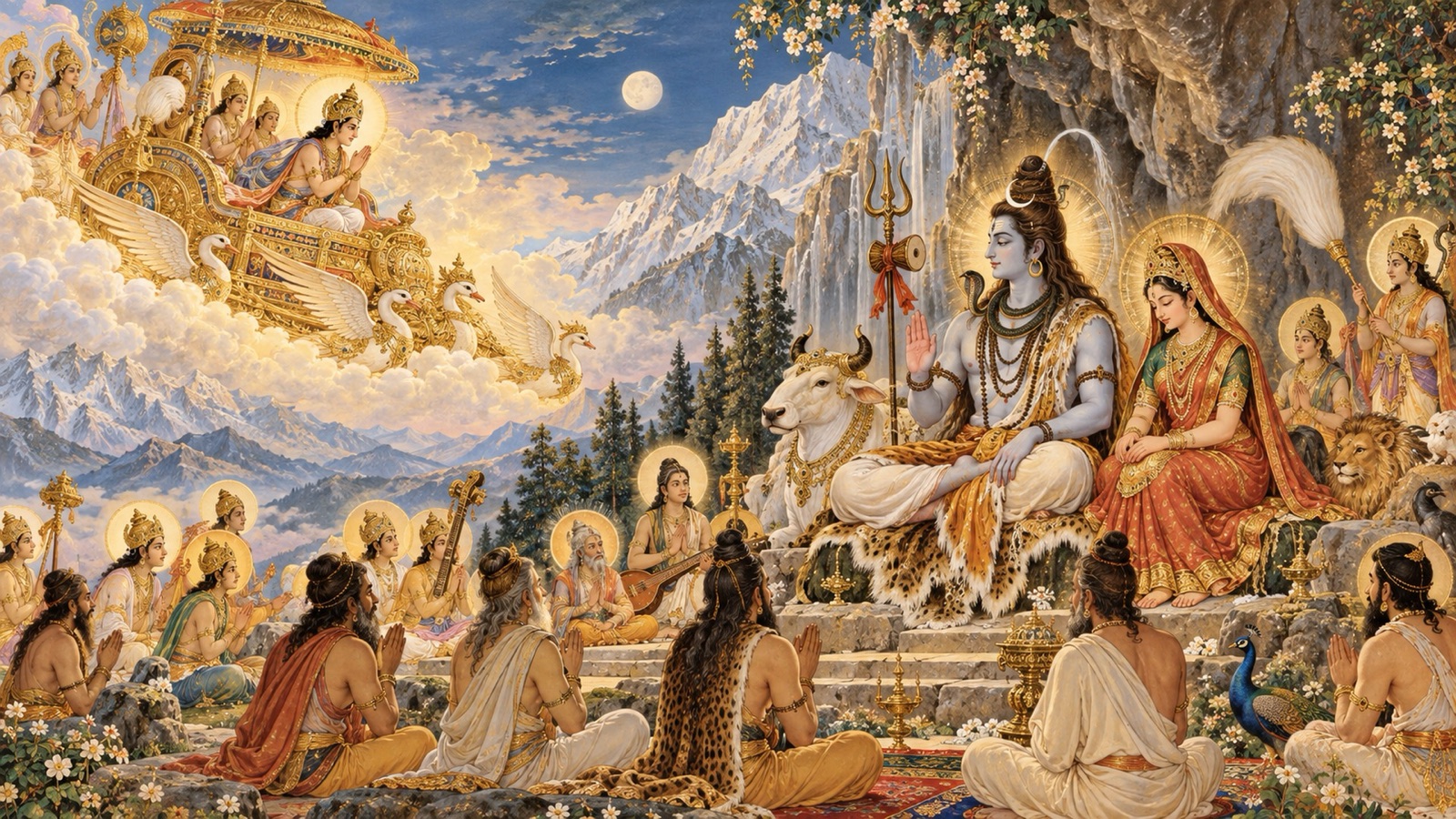
A grieving mother’s vow to destroy Indra is overturned by the grace of the Lord: her forty-nine sons, meant to be weapons of vengeance, rise instead as the radiant Marut wind-gods and become Indra’s own devoted brothers.
Om Namo Bhagavate Vasudevaya.
Om Namo Bhagavate Vasudevaya.
Om Namo Bhagavate Vasudevaya.
Welcome to Srimad Bhagavatam Wisdom, a devotional journey through the sacred histories and teachings of the Srimad Bhagavat Mahapurana. The eighteenth chapter of the Sixth Canto traces the lineage of Aditi’s sons and then tells a remarkable tale: how Diti, burning to avenge her slain sons, undertakes a sacred vow to obtain a child who will kill Indra — and how the worship of Lord Vishnu at the heart of that vow turns her vengeance into blessing, so that her sons become the Maruts, the beloved companions of the very king she meant to destroy.
Chapter Information
- Scripture: Śrīmad Bhāgavata Mahāpurāṇa
- Canto: 6 (Book Six)
- Chapter: 18 (Discourse 18)
- Chapter title: Diti Vows to Kill King Indra
- Principal speaker: Sukadeva Gosvami, narrating to King Parikshit; Kasyapa, Diti and Indra within the account
- Principal listener: King Parikshit; the sages of Naimisharanya at the outer frame
- Main setting: The hermitage of the sage Kasyapa
- Central subject: The lineage of Aditi’s sons, Diti’s vow against Indra, and the grace-filled birth of the Maruts
- Principal verse range: Canto 6, Chapter 18, verses 1–78
- Primary edition: Gita Press Śrīmad Bhāgavata Mahāpurāṇa
The Lineage and the Question
Sukadeva first recounts the descendants of the twelve sons of Aditi, among whom appear many presiding deities, the reborn sages Bhrgu, Valmiki, Agastya and Vasistha, and Lord Upendra, the divine Dwarf who took birth through Aditi. He then turns to the line of Diti, in which the great devotee Prahlada and King Bali were born, and mentions that besides Hiranyakasipu and Hiranyaksa, Diti had forty-nine more sons, the Maruts, who were made into gods by Indra. King Parikshit, struck by this, asks how Indra came to transform these demon-born sons into gods, and what service they had rendered him (verses 1-21).
Diti’s Vow of Vengeance
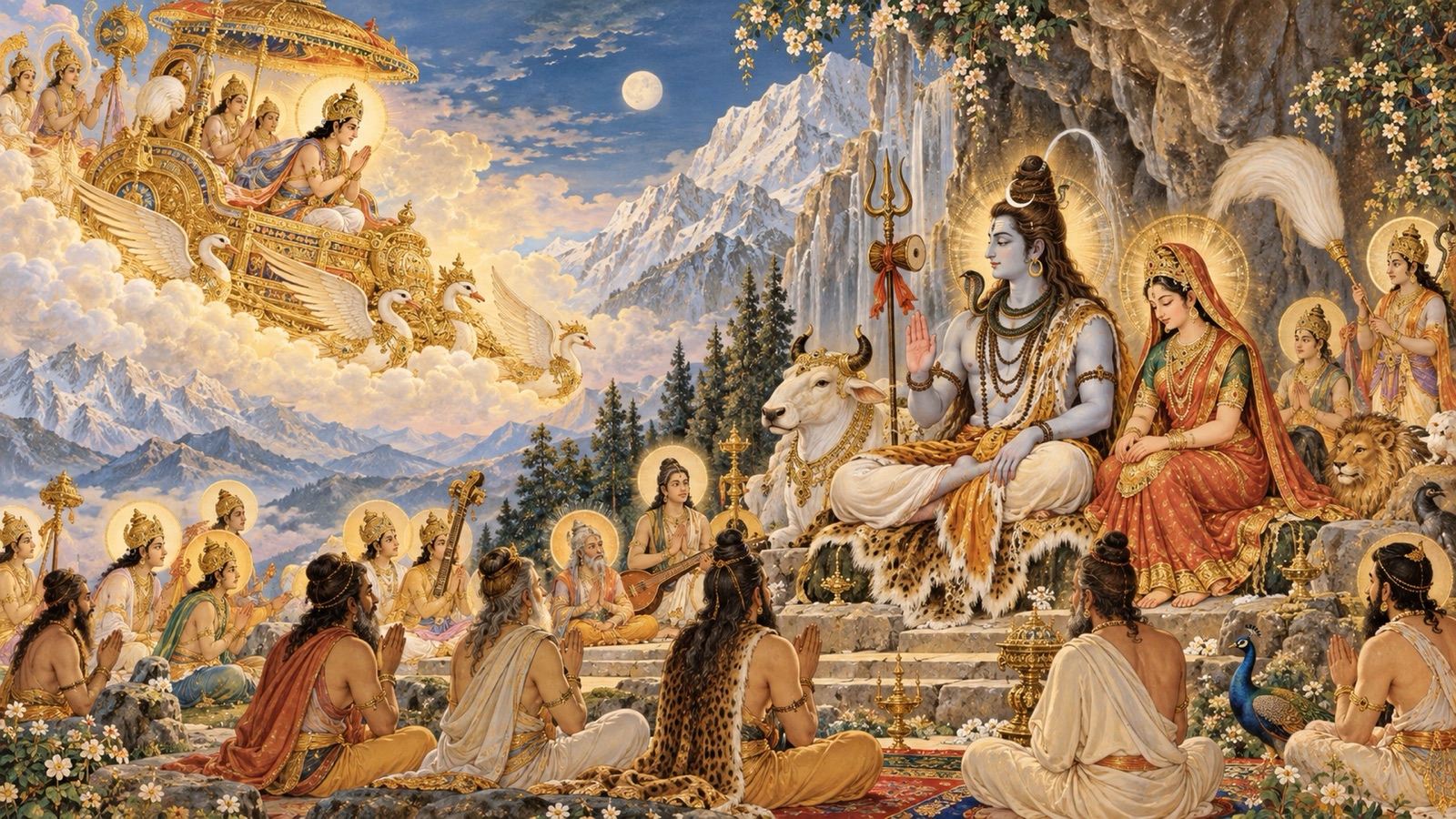
Diti, whose sons had been slain by Lord Vishnu, the ally of Indra, burned with grief and rage. She resolved to obtain a son who would quell Indra’s pride, and with this hidden aim she served her husband, the sage Kasyapa, with such devotion, humility and sweetness that his mind was captivated and he promised to grant her wish. When she asked for an immortal son able to slay Indra, Kasyapa was stricken with sorrow and repentance, grieving that he had bound himself by a rash word (verses 22-39).
Yet the sage also taught her, in that very moment, a truth that reaches far beyond their story — that behind every form of worship stands the one Supreme Lord.
Finding, however, that his plighted word must not prove false, and that Indra, favoured by the Lord, did not deserve death, Kasyapa devised a middle course. A son able to slay Indra would be born, he told Diti, only if she observed a sacred year-long vow without the slightest lapse; but if the vow were broken, the child would become instead a friend of the gods (verses 40-45).
The Sacred Vow
Kasyapa then taught Diti the Pumsavana vow in detail. A woman observing it, he said, must injure no living being, must never curse or lie, must keep herself pure in conduct, speech and food, must not give way to anger, and must each day worship the cow, the Brahmanas, Goddess Sri and Lord Vishnu before taking food, contemplating her husband as the Lord Himself. Observed faithfully for a full year, the vow would grant her the son she sought (verses 46-54).
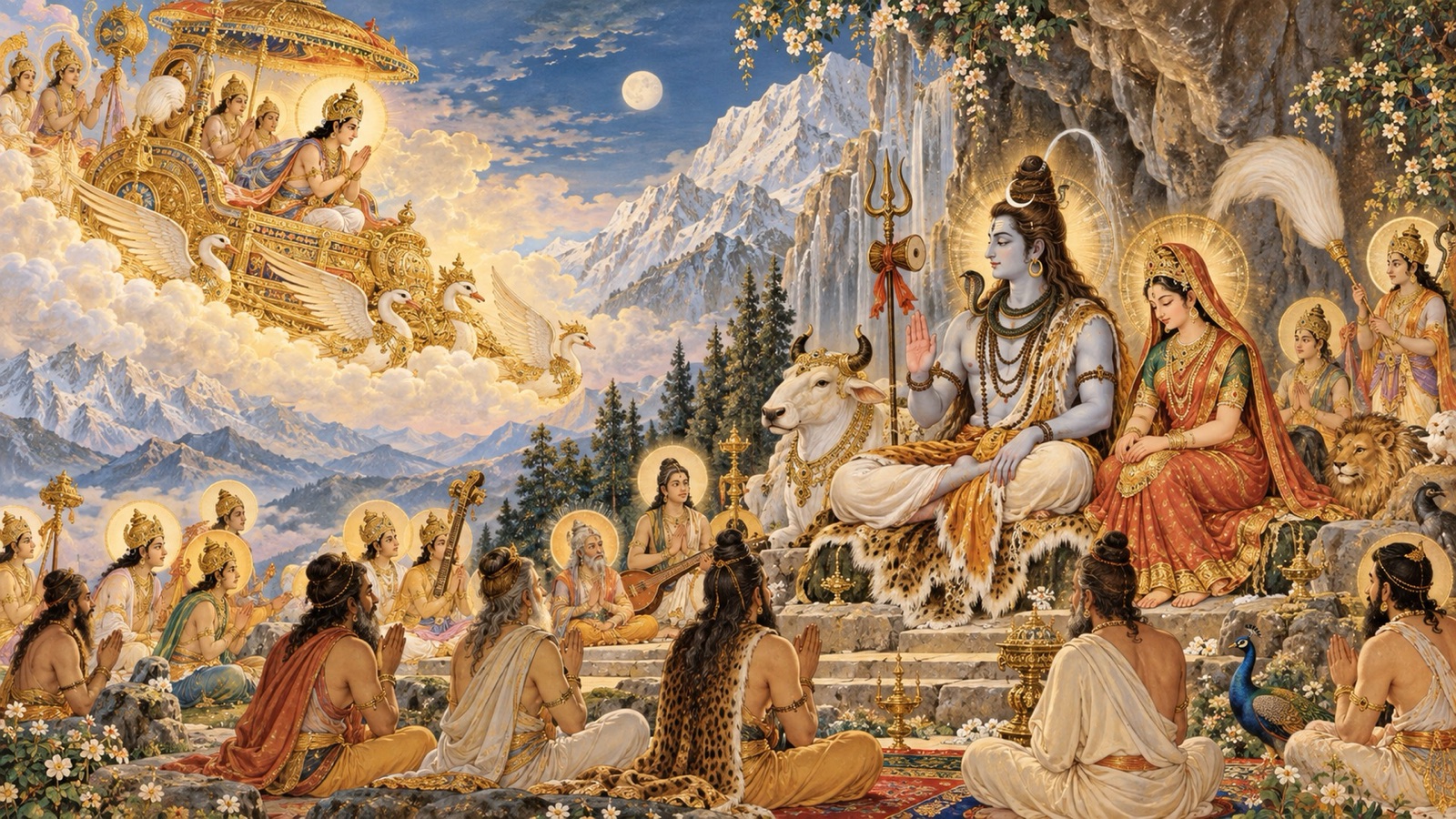
Diti gladly undertook the vow and conceived. But Indra, discerning his aunt’s intention, came to her hermitage and served her with every courtesy — not out of love, but watching, like a hunter in disguise, for any slip in her observance. For a long time he found none, and grew anxious for his own safety (verses 55-59).
Grace Within the Flaw
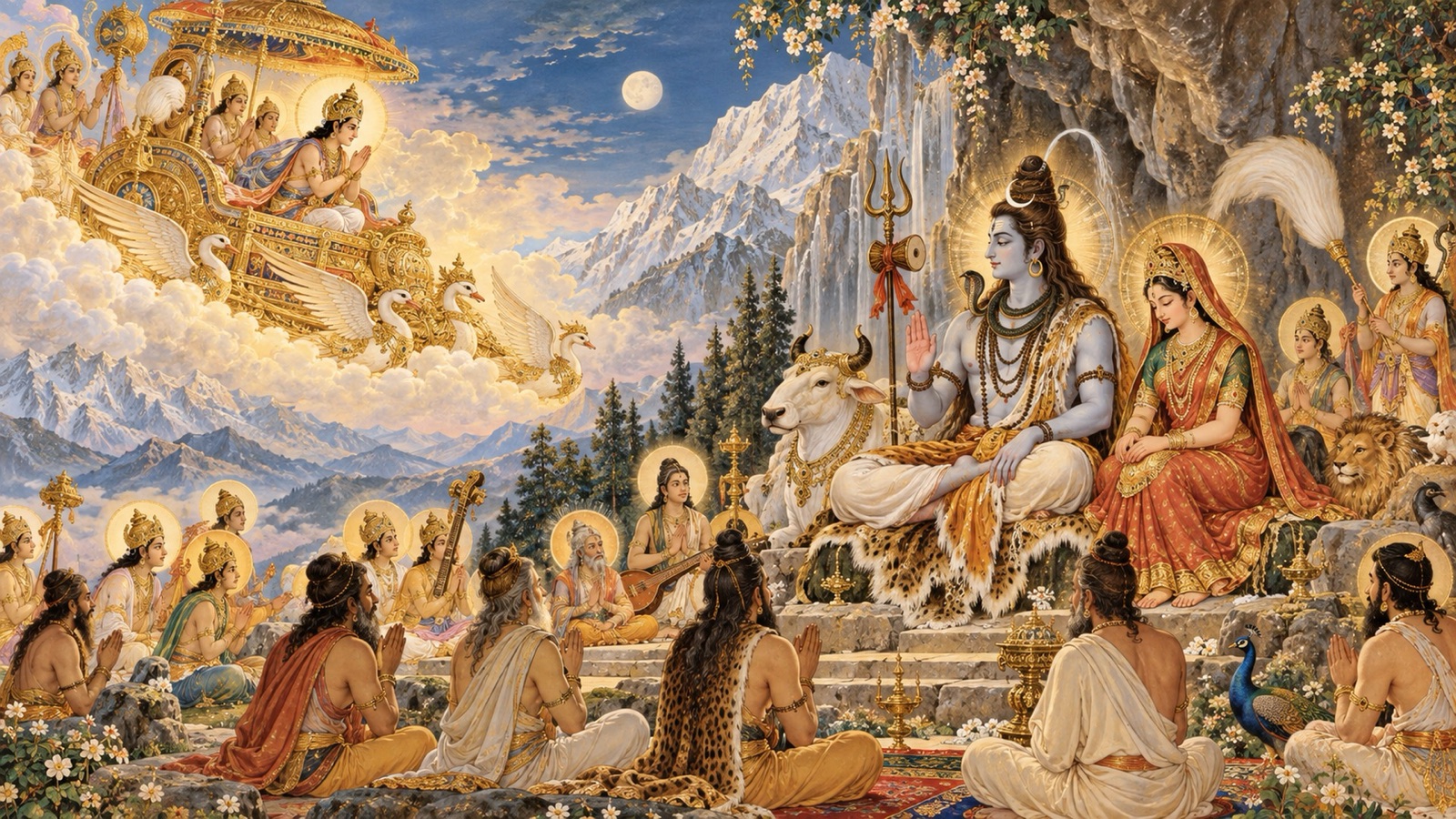
At last, one day, weakened by her austerity and overcome by fate, Diti fell asleep at dusk with the remnants of food still in her mouth, without washing or rinsing — and in that lapse the vow was broken. Seizing the moment, Indra, master of mystic power, entered her womb and, with his thunderbolt, cut the embryo into seven; and when the pieces cried out, he cut each of them into seven again. Yet by the grace of Lord Vishnu the children could not be killed. Instead of dying, the forty-nine little beings folded their palms and cried, “Why do you strike us, Indra? We are the Maruts, your own brothers!” Moved, Indra answered, “Do not be afraid; you are indeed my brothers,” and the stigma of their demonic birth was washed away (verses 60-65).
For such is the power of the Lord’s worship, undertaken even imperfectly, that it transforms every outcome.
सकृदिष्ट्वादिपुरुषं पुरुषो याति साम्यताम् । संवत्सरं किञ्चिदूनं दित्या यद्धरिरर्चित: ॥ ६६ ॥
sakṛd iṣṭvādi-puruṣaṁ puruṣo yāti sāmyatām saṁvatsaraṁ kiñcid ūnaṁ dityā yad dharir arcitaḥ
Meaning: By worshipping the Supreme Person even once, a person attains a status like His own; and Diti had worshipped Sri Hari for very nearly a whole year. (Canto 6, Chapter 18, verse 66)
The Confession of Indra
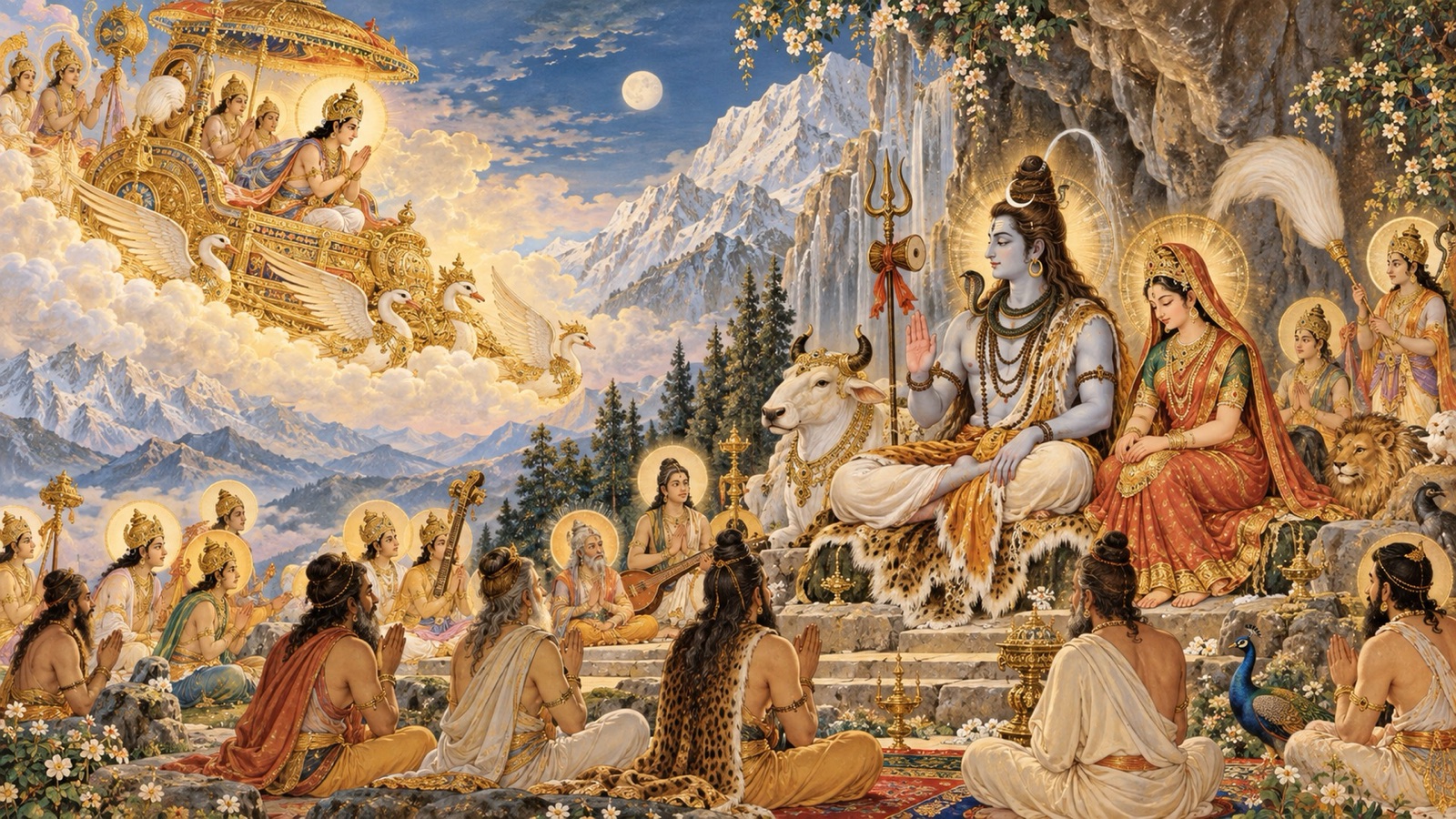
Together with Indra, these forty-nine Maruts became fifty gods, their demonhood wiped away. When Diti awoke and saw the babes, radiant as fire, standing beside Indra, she was gratified rather than grieved, and asked how her one desired son had become forty-nine. Indra confessed the whole truth: that, bent on his own ends and lost to righteousness, he had cut the child, but that the miracle of its surviving had revealed to him the fruit of her worship of Lord Vishnu. The truly wise, he said, worship the Lord free of all desire, not even craving liberation (verses 66-74).
आराध्यात्मप्रदं देवं स्वात्मानं जगदीश्वरम् । को वृणीत गुणस्पर्शं बुध: स्यान्नरकेऽपि यत् ॥ ७५ ॥
ārādhyātma-pradaṁ devaṁ svātmānaṁ jagad-īśvaram ko vṛṇīta guṇa-sparśaṁ budhaḥ syān narake ‘pi yat
Meaning: Having worshipped the Lord of the universe, who gives His very Self and is the Self of all, what wise person would ask Him for fleeting sense pleasures, which can be had even in hell? (Canto 6, Chapter 18, verse 75)
Begging his aunt’s forgiveness, and rejoicing that the child had, as it were, risen to new life, Indra bowed to Diti, who was pleased by his sincerity, and departed for heaven with the Maruts. Thus, Sukadeva concluded, was the auspicious birth of the Maruts accomplished (verses 76-78).
Principal Teachings of This Chapter
1. Behind every worshipped form stands the one Lord. Kasyapa teaches that the Supreme Lord Vasudeva is worshipped by all under many names and forms, so that all true worship reaches Him (verses 33-35).
2. Worship of the Lord purifies even a flawed intention. Diti’s vow is undertaken for vengeance, yet because its heart is the worship of Vishnu, it yields blessing instead of destruction (verse 66).
3. The Lord’s grace preserves what He wishes to protect. Though cut again and again, the embryo cannot be killed, for the Lord shields those He favours (verse 65).
4. Enmity can be transformed into brotherhood. The sons meant as weapons against Indra become his loving companions, the Maruts — hatred dissolved by grace (verses 63-67).
5. The wise desire nothing but the Lord. Indra declares that one who has worshipped the Lord would never ask Him for sense pleasures, which even hell can supply (verses 74-75).
A Devotional Reflection
This is a strange and wonderful story, because almost everyone in it acts from a tangled motive, and yet grace quietly turns everything toward good. Diti worships out of grief and the longing for revenge; Kasyapa grants a boon he immediately regrets; Indra serves his aunt only to sabotage her, and then attacks her unborn children. By every human measure this should end in tragedy. But woven through the whole affair is the worship of Lord Vishnu, and that single thread redeems it all. The vow meant to produce a killer produces instead forty-nine radiant gods; the weapon becomes a brother; the mother who sought vengeance wakes to joy. The Bhagavata is showing us something it never tires of repeating: that the Lord is so merciful that even our imperfect, half-selfish turning toward Him bears fruit beyond anything we intended, and that He can bring light out of the most clouded of motives. And through Indra’s closing confession it adds the higher note — that the wise, having once tasted the Lord, no longer approach Him with their hands out for trifles, for they have found the giver Himself. Our own devotion may be mixed and imperfect; this chapter assures us that it is never wasted, and gently calls us to purify it until we want nothing but Him.
A Daily Devotional Practice
Today, offer a simple act of worship to the Lord — a lamp, a flower, a few minutes of His name — and as you do, examine your motive honestly. If it is mixed with some worldly wish, do not be discouraged; offer it anyway, trusting that the Lord receives even imperfect devotion and purifies it. Then, following Indra’s realisation, add one wordless prayer that asks for nothing at all except the Lord Himself, and let that pure note sweeten everything else you bring to Him.
Conclusion
The eighteenth chapter of the Sixth Canto carries us from genealogy to grace. Diti, grieving and vengeful, undertakes a sacred vow to obtain a son who will destroy Indra; but because the worship of Lord Vishnu lies at its heart, her vengeance is transformed into blessing. When Indra shatters the unborn child, the Lord’s grace preserves it, and the forty-nine Maruts rise as gods and as Indra’s own brothers. Indra’s confession crowns the tale with its deepest truth: that the wise ask nothing of the Lord but Himself. As the Canto moves next to the detailed procedure of the Pumsavana vow, we carry with us this chapter’s assurance that even our clouded devotion, offered to Him, is turned toward the light.
May the divine wisdom of Srimad Bhagavatam awaken pure devotion within our hearts.
Om Namo Bhagavate Vasudevaya.
Jay Shree Madhav.
References and Attribution
- Primary edition: Gita Press, Śrīmad Bhāgavata Mahāpurāṇa (English, complete), Book Six, Discourse 18.
- Series: Srimad Bhagavatam Wisdom · Biswa Sanatan Dharma Seva Trust.
- Presented following the spiritual guidance and recommendation of Pandit Dr. Shri Kashinath Mishra.
This is an original, faithful retelling in the writer’s own words, with brief quoted verses shown in Devanāgarī and transliteration and their meanings given as summaries. It is not a reproduction of any single publisher’s continuous translation or commentary. No affiliation with or endorsement by any publisher is implied.
Jay Shree Madhav