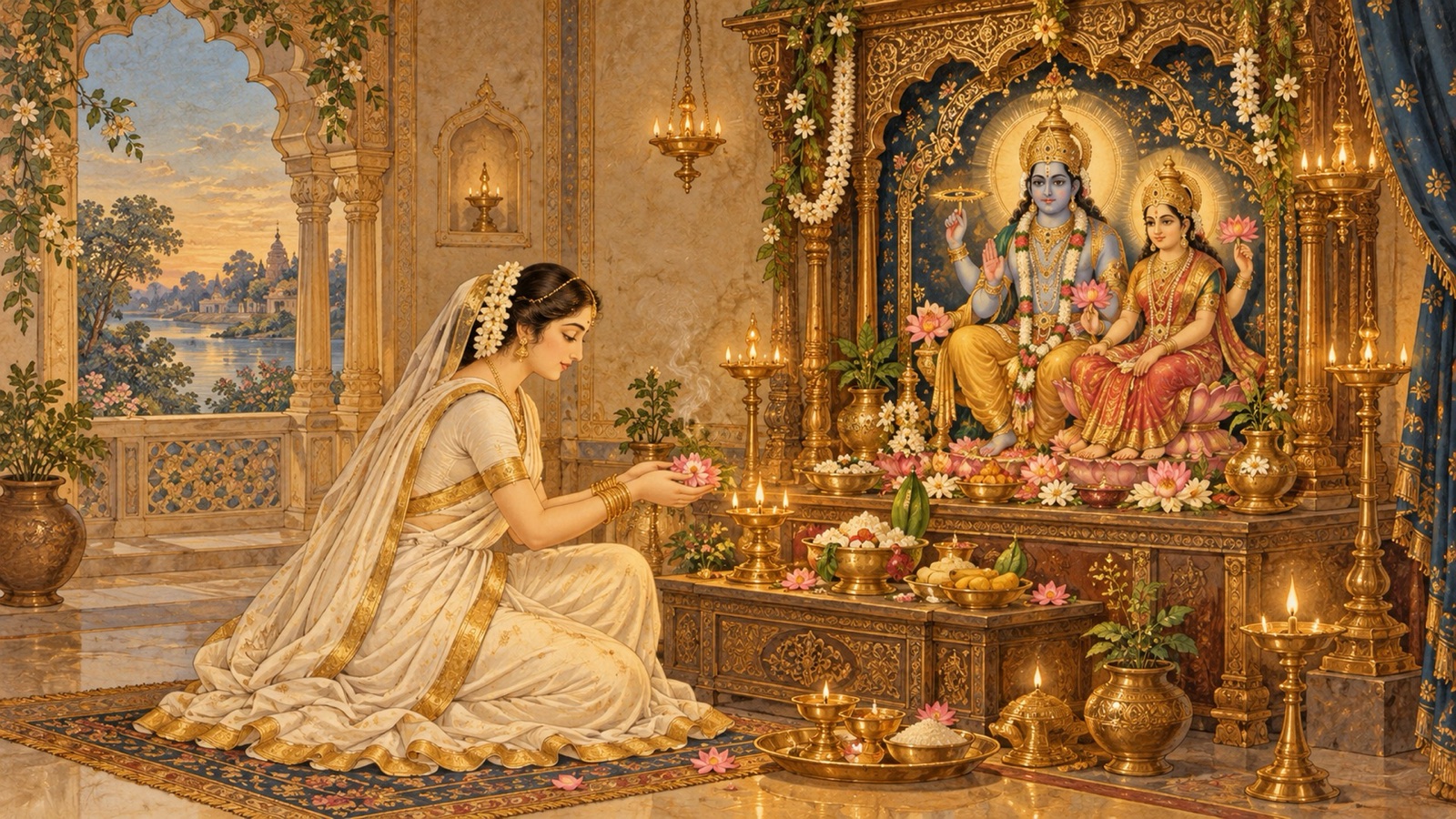
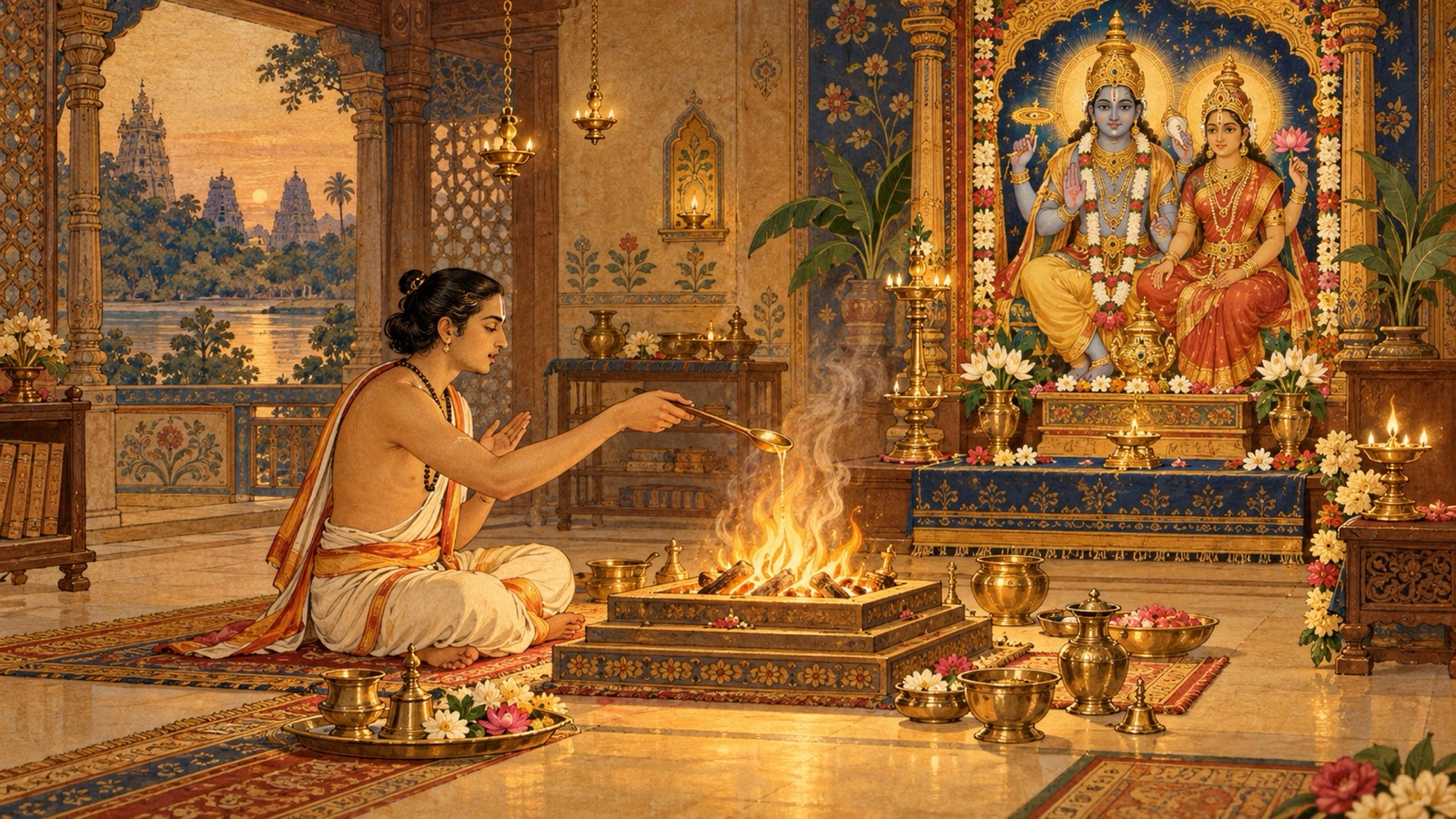
A devoted wife, bathed and robed in white, worships Lord Vishnu together with Goddess Lakshmi — the sacred Pumsavana vow by which the Supreme Lord is lovingly propitiated and every blessing drawn down upon a household.
Om Namo Bhagavate Vasudevaya.
Om Namo Bhagavate Vasudevaya.
Om Namo Bhagavate Vasudevaya.
Welcome to Srimad Bhagavatam Wisdom, a devotional journey through the sacred histories and teachings of the Srimad Bhagavat Mahapurana. The nineteenth and final chapter of the Sixth Canto sets forth, at King Parikshit’s request, the detailed procedure of the Pumsavana vow — the very observance that transformed Diti’s heart. It is a gentle manual of household devotion, centred wholly on the worship of Lord Vishnu with Goddess Lakshmi, closing the Canto on a note of loving, practical bhakti.
Chapter Information
- Scripture: Śrīmad Bhāgavata Mahāpurāṇa
- Canto: 6 (Book Six)
- Chapter: 19 (Discourse 19)
- Chapter title: The Pumsavana Vow
- Principal speaker: Sukadeva Gosvami, narrating to King Parikshit
- Principal listener: King Parikshit; the sages of Naimisharanya at the outer frame
- Main setting: The household shrine of the devotee
- Central subject: The procedure and fruits of the sacred Pumsavana vow dedicated to Lord Vishnu and Goddess Lakshmi
- Principal verse range: Canto 6, Chapter 19, verses 1–28
- Primary edition: Gita Press Śrīmad Bhāgavata Mahāpurāṇa
The Beginning of the Vow
King Parikshit wished to learn the procedure of the Pumsavana vow, by which Lord Vishnu is so easily pleased. Sukadeva explained that a wife should begin this vow — which grants every desire — on the first day of the bright fortnight of the month of Margashirsha, with her husband’s permission. Having heard the story of the birth of the Maruts and consulted the Brahmanas, she should cleanse herself, bathe, put on a pair of white garments, adorn herself, and, before taking food, worship the Lord together with Goddess Sri, offering this prayer of pure surrender (verses 1-4).
अलं ते निरपेक्षाय पूर्णकाम नमोऽस्तु ते । महाविभूतिपतये नम: सकलसिद्धये ॥ ४ ॥
alaṁ te nirapekṣāya pūrṇa-kāma namo ‘stu te mahāvibhūti-pataye namaḥ sakala-siddhaye
Meaning: O Lord of fulfilled desire, who need nothing, whatever You already possess is enough for You; obeisance unto You, the Lord of Mahalakshmi, the abode of all perfections. (Canto 6, Chapter 19, verse 4)
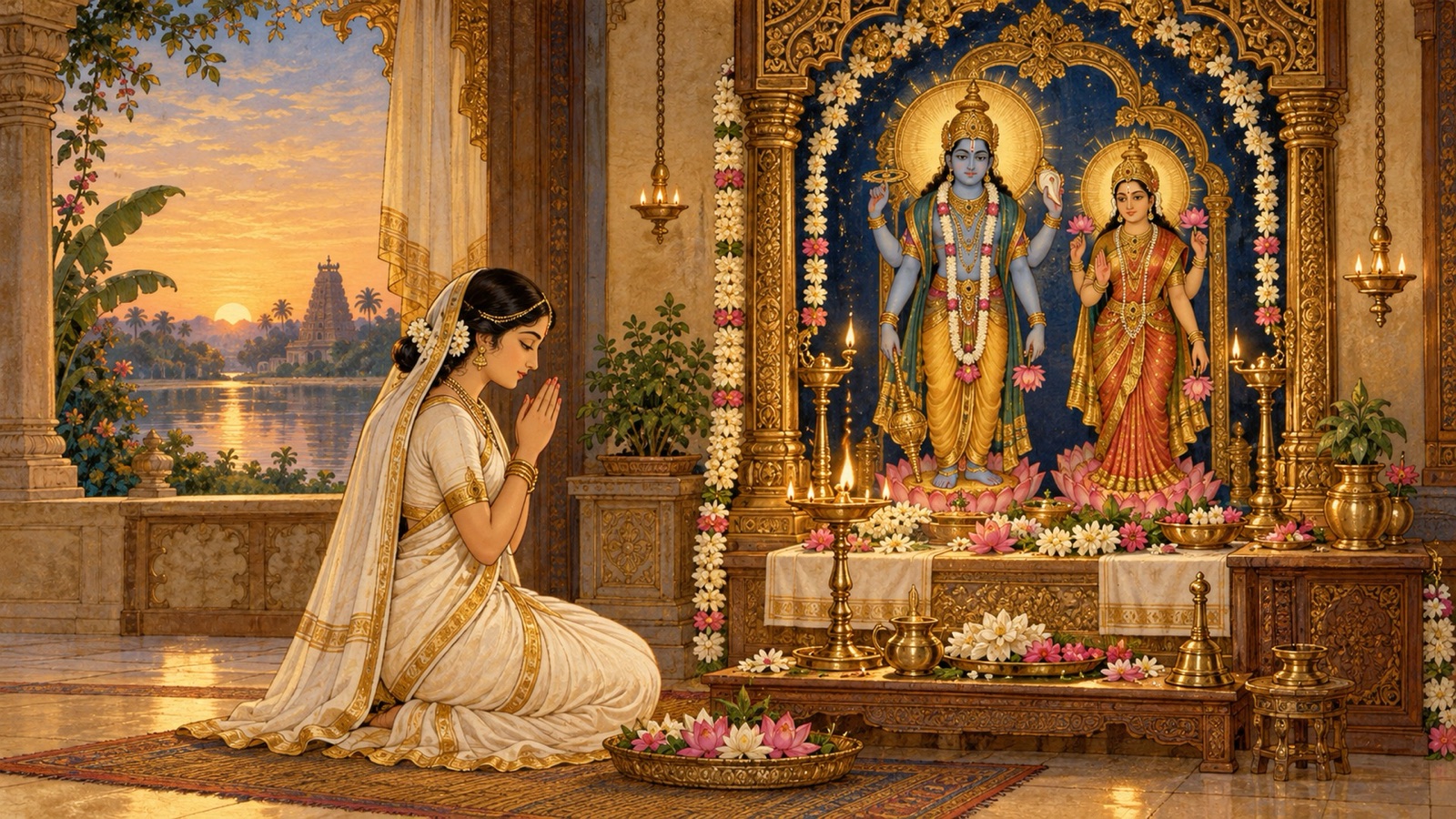
She should praise Him further as full of compassion, fortune, glory, majesty and every excellence — the almighty Ruler — and pray to the divine Consort of Vishnu, the Mother of the universe, to be gracious to her (verses 5-6).
The Daily Worship and Hymn
Repeating the sacred text, the worshipper should each day offer the Lord the full round of loving service — invocation, water for His feet and bath, garments and sacred thread, ornaments, sandal-paste, flowers, incense, a lamp, and food. From the offered food, twelve oblations are poured into the sacred fire. Then, falling prostrate with a mind made humble by devotion, she repeats the sacred text ten times and recites a hymn to the Lord and His consort (verses 7-10).
युवां तु विश्वस्य विभू जगत: कारणं परम् । इयं हि प्रकृति: सूक्ष्मा मायाशक्तिर्दुरत्यया ॥ ११ ॥
yuvāṁ tu viśvasya vibhū jagataḥ kāraṇaṁ param iyaṁ hi prakṛtiḥ sūkṣmā māyā-śaktir duratyayā
Meaning: You two are the all-pervading rulers and the supreme cause of the universe; and She is the subtle primordial nature, the deluding potency that is so difficult to overcome. (Canto 6, Chapter 19, verse 11)
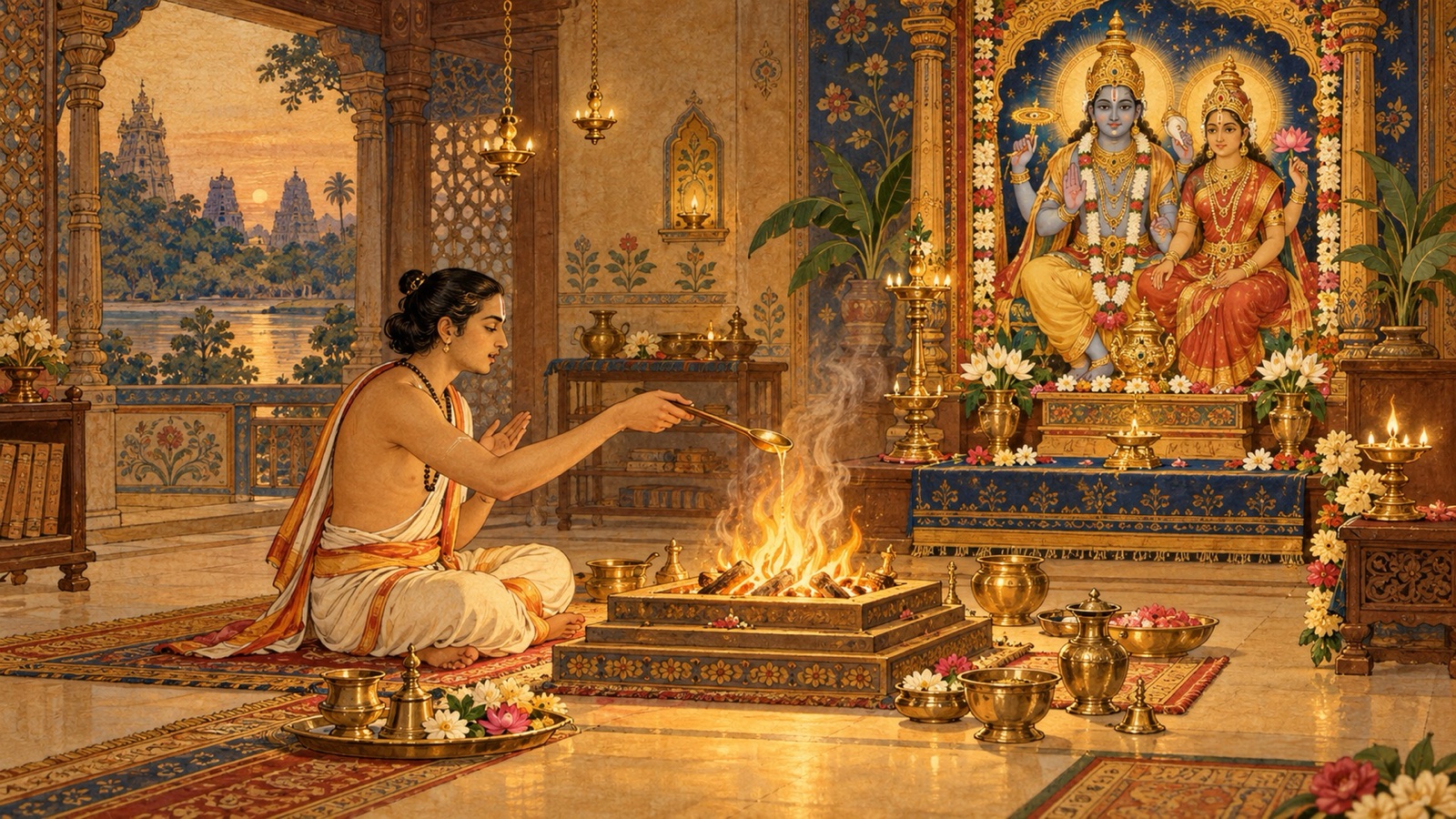
In the hymn the worshipper adores the Lord as the Supreme Person who embodies all sacrifice and is the enjoyer of its fruit, and Goddess Lakshmi as faith, activity and the manifested glory of the worlds; the Lord as the Time-Spirit and Cosmic Person, the goddess as the names and forms of creation which He illumines and sustains. As the supreme rulers who confer boons upon their devotees, the worshipper prays, may my lofty aspirations prove true (verses 12-14).
Devotion Shared in the Home
Having extolled the Lord and Sri, she removes the offerings, presents water and betel, and worships Him once more. The chapter then draws the husband into the devotion: the wife is to serve her husband with supreme regard, accounting him the Lord Himself, while the loving husband assists in all her duties, high and low alike. What even one of a married couple performs benefits them both, and should the wife be unable, the husband should carry out the worship with a concentrated mind. The vow must never be broken, and each day the Brahmanas and women whose husbands are living are also to be honoured (verses 15-20).
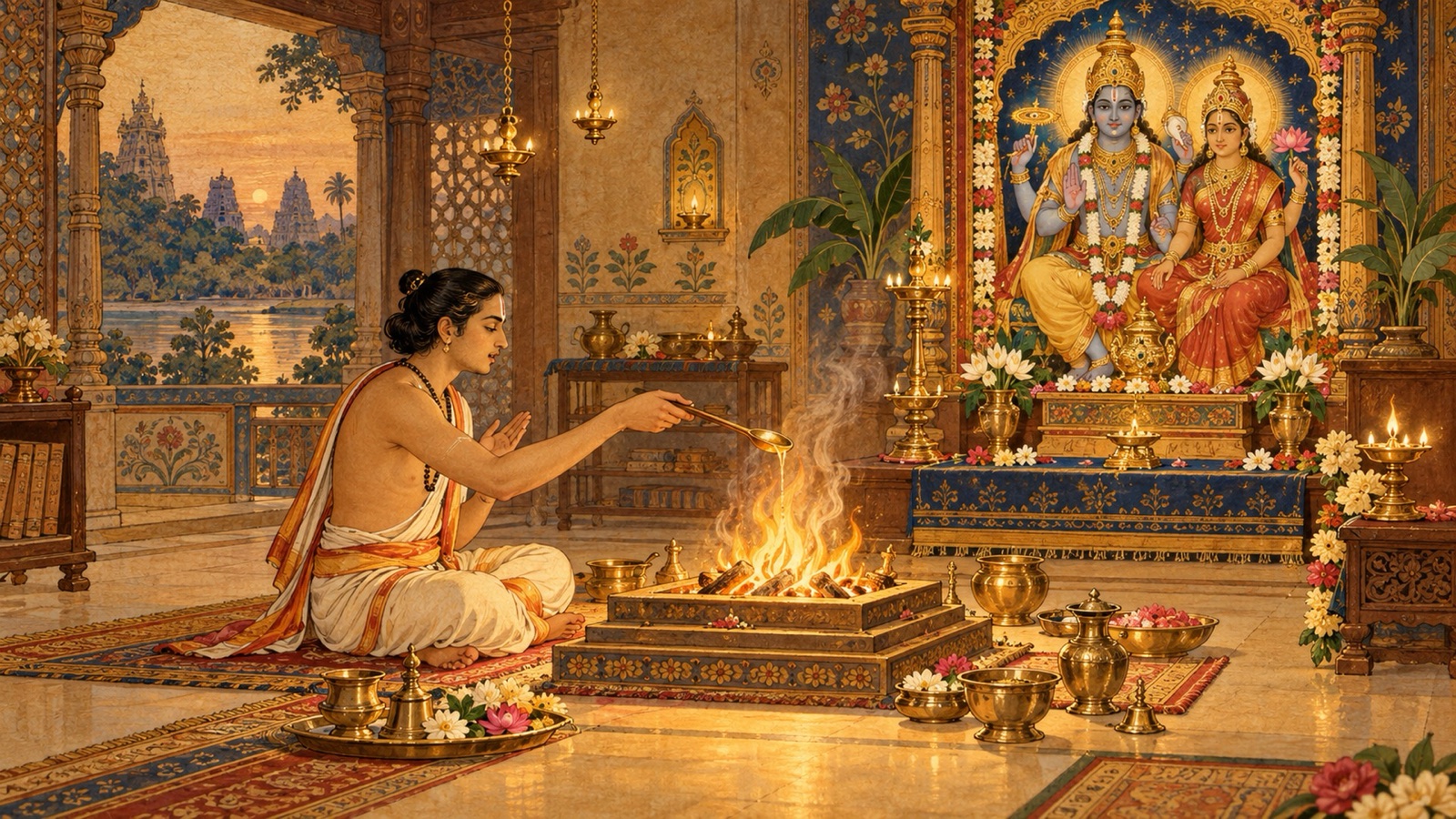
After a full year of such worship, the pious wife fasts on the last day of Kartika; on the following day the Lord is worshipped as before, and the husband pours twelve oblations of rice boiled in milk and ghee into the sacred fire. Receiving the benedictions of the pleased Brahmanas with bowed head, the couple take their meal with their kinsmen, having first fed their preceptor and guests (verses 21-24).
The Fruits of the Vow
Sukadeva then described the abundant blessings of this observance — worldly well-being in full measure for the householder who keeps it, and every good fortune for the devoted wife (verse 25).
एतच्चरित्वा विधिवद्व्रतं विभो रभीप्सितार्थं लभते पुमानिह । स्त्री चैतदास्थाय लभेत सौभगं श्रियं प्रजां जीवपतिं यशो गृहम् ॥ २५ ॥
etac caritvā vidhivad vrataṁ vibhor abhīpsitārthaṁ labhate pumān iha strī caitad āsthāya labheta saubhagaṁ śriyaṁ prajāṁ jīva-patiṁ yaśo gṛham
Meaning: A man who duly performs this vow of the Lord obtains his cherished object in this life; and a woman who undertakes it gains good fortune, prosperity, progeny, a long-lived husband, glory and a happy home. (Canto 6, Chapter 19, verse 25)
An unmarried girl, Sukadeva said, obtains a worthy husband; a widow attains final beatitude, freed of all sins; a childless woman gains long-lived offspring; the unfortunate find fortune, the plain are given beauty, and the sick are restored to health. Whoever recites this account on auspicious occasions gladdens the departed ancestors and the guardian deities; and, pleased with the devotee, the god of fire, Goddess Sri and Lord Sri Hari Himself bestow upon him every desired blessing at the close of the sacred performance (verses 26-28).
Principal Teachings of This Chapter
1. The Lord is worshipped not because He lacks, but out of love. The vow’s opening prayer declares that the self-sufficient Lord needs nothing from us — our worship is an offering of the heart (verse 4).
2. The Lord and His energy are the cause of all. The hymn adores Vishnu and Lakshmi as the supreme cause of the universe, He the Person and enjoyer, She the primordial nature (verse 11).
3. Devotion belongs in the home. The Pumsavana vow weaves the worship of the Lord into daily household life, shared by husband and wife together (verses 17-18).
4. A shared act of devotion blesses both. What one member of a couple performs with devotion benefits them both, so that no one is excluded from the fruit of worship (verse 18).
5. Sincere worship bears abundant fruit. The vow grants worldly well-being to the householder and spiritual liberation to the renounced, for the Lord rewards every heart that turns to Him (verses 25-28).
A Devotional Reflection
It is fitting that the Sixth Canto, after all its storms — the sin and sorrow of Indra, the terror and the glory of Vritra, the grief and awakening of Citraketu — should close not with a battle or a vision but with a quiet household lighting a lamp before the Lord. The Pumsavana vow brings the vast truths of the Canto down to the scale of an ordinary home, where a husband and wife worship together, honour the holy, and offer their days to Vishnu and Lakshmi. And notice how the very first words of the vow set the tone: the Lord needs nothing from us at all. He is complete, self-fulfilled, lacking no perfection — and so our worship can never be a transaction in which we feed a needy god. It can only be love, offered freely, for its own sake. That is why the vow blesses the one who keeps it so richly: not because the Lord is bribed, but because a heart that learns to give without bargaining is already being transformed. The Canto that began with the deliverance of a fallen Ajamila ends by placing that same saving devotion within reach of every home, every day, through the simplest acts of worship offered with love.
A Daily Devotional Practice
Today, make a small act of worship in your own home — light a lamp, offer a flower or a little food before an image of the Lord, and speak a few words of praise and gratitude. Begin, as the vow does, by remembering that the Lord needs nothing from you; let your offering be pure love rather than a request. If you live with family, invite one of them to share even a moment of it, remembering that devotion shared blesses all who take part. Then carry that spirit of unbargaining love through the rest of your day.
Conclusion
The nineteenth chapter of the Sixth Canto closes the book with a gift of practical devotion. The Pumsavana vow, dedicated to Lord Vishnu and Goddess Lakshmi, is laid out step by step for the household — its daily worship, its shared observance by husband and wife, and its abundant fruits for all who keep it. At its heart lies the loveliest of truths: that the Lord, complete and self-fulfilled, is worshipped not out of His need but out of ours, and that love offered freely to Him draws down every blessing upon a home. So the Sixth Canto, which travelled through sin and sorrow, battle and grief, comes to rest in the quiet worship of an ordinary heart, reminding us that the highest wisdom finally lives in simple, daily devotion.
May the divine wisdom of Srimad Bhagavatam awaken pure devotion within our hearts.
Om Namo Bhagavate Vasudevaya.
Jay Shree Madhav.
References and Attribution
- Primary edition: Gita Press, Śrīmad Bhāgavata Mahāpurāṇa (English, complete), Book Six, Discourse 19.
- Series: Srimad Bhagavatam Wisdom · Biswa Sanatan Dharma Seva Trust.
- Presented following the spiritual guidance and recommendation of Pandit Dr. Shri Kashinath Mishra.
This is an original, faithful retelling in the writer’s own words, with brief quoted verses shown in Devanāgarī and transliteration and their meanings given as summaries. It is not a reproduction of any single publisher’s continuous translation or commentary. No affiliation with or endorsement by any publisher is implied.
Jay Shree Madhav