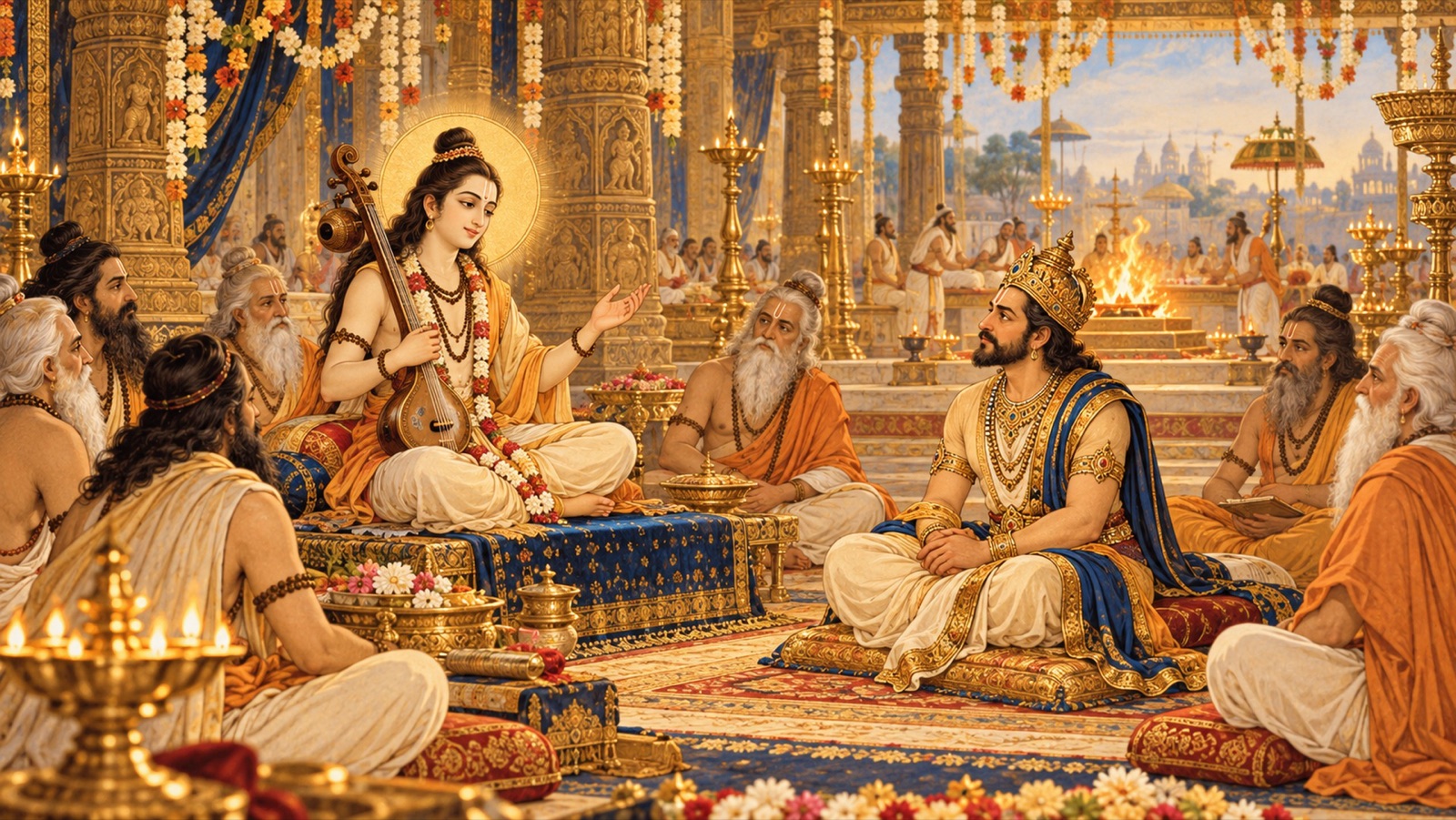
At the great Rajasuya sacrifice, a king who has just watched his cousin’s bitter enemy dissolve into light within the Lord asks the sage Narada the question every loving heart eventually asks: if God is equal to all, why does He seem to take sides?
Om Namo Bhagavate Vasudevaya.
Om Namo Bhagavate Vasudevaya.
Om Namo Bhagavate Vasudevaya.
Welcome to Srimad Bhagavatam Wisdom, a devotional journey through the sacred histories and teachings of the Srimad Bhagavat Mahapurana. With this chapter we open the Seventh Canto, one of the most beloved books of the entire Bhagavata — the book that will give us the immortal story of the child-devotee Prahlada and the Lord’s ferocious yet tender descent as Nrisimha, the Man-Lion. But before that great narrative can begin, Sukadeva Gosvami must first answer a doubt that troubles King Parikshit: how can the Supreme Lord, who is the equal well-wisher of every living being, appear again and again to slay demons on behalf of the gods? Does the Absolute really have friends and enemies?
Chapter Information
- Scripture: Śrīmad Bhāgavata Mahāpurāṇa
- Canto: 7 (Book Seven)
- Chapter: 1
- Chapter title: The Supreme Lord Is Equal to All — The Story of Jaya and Vijaya
- Principal speakers: Sukadeva Gosvami (replying to King Parikshit); within his account, the celestial sage Narada (instructing Emperor Yudhishthira)
- Principal listener: King Parikshit; within the recalled scene, Yudhishthira and the sages assembled at the Rajasuya sacrifice
- Main setting: The riverside teaching of Sukadeva to Parikshit on the bank of the Ganga; within it, the great Rajasuya sacrificial hall of Yudhishthira
- Central subject: The Lord’s perfect equality and freedom from partiality; how fixing the mind on the Lord — even through enmity, fear, or desire — leads to Him; and the account of the Vaikuntha doorkeepers Jaya and Vijaya, cursed to three demoniac births
- Principal verse range: Canto 7, Chapter 1, verses 1–48
- Primary edition: Gita Press Śrīmad Bhāgavata Mahāpurāṇa
A King’s Honest Doubt
The Seventh Canto opens not with a story but with a question — and it is the kind of question only a sincere heart dares to ask aloud. Having heard, through the earlier books, of the Lord’s many descents in which demons were struck down for the protection of the gods, King Parikshit turns to his teacher with a difficulty he cannot quietly set aside.
श्रीराजोवाच समः प्रियः सुहृद्ब्रह्मन् भूतानां भगवान् स्वयम् । इन्द्रस्यार्थे कथं दैत्यानवधीद्विषमो यथा ॥ १ ॥
śrī-rājovāca samaḥ priyaḥ suhṛd brahman bhūtānāṁ bhagavān svayam indrasyārthe kathaṁ daityān avadhīd viṣamo yathā
Meaning: King Parikshit said: O holy sage, the Lord is Himself equal to all, the dear friend and well-wisher of every created being; how, then, like a partial person, did He slay the demons merely for the sake of Indra? (SB 7.1.1)
Parikshit presses the point further. The Lord is the very embodiment of perfect bliss; He gains nothing from the gods and stands untouched by the modes of material nature — so He could have neither a selfish stake in Indra’s victory nor any genuine grudge, much less fear, toward the demons. A grave doubt, the king admits, has arisen in his mind about the perfection of Lord Narayana, and he asks his teacher to resolve it.
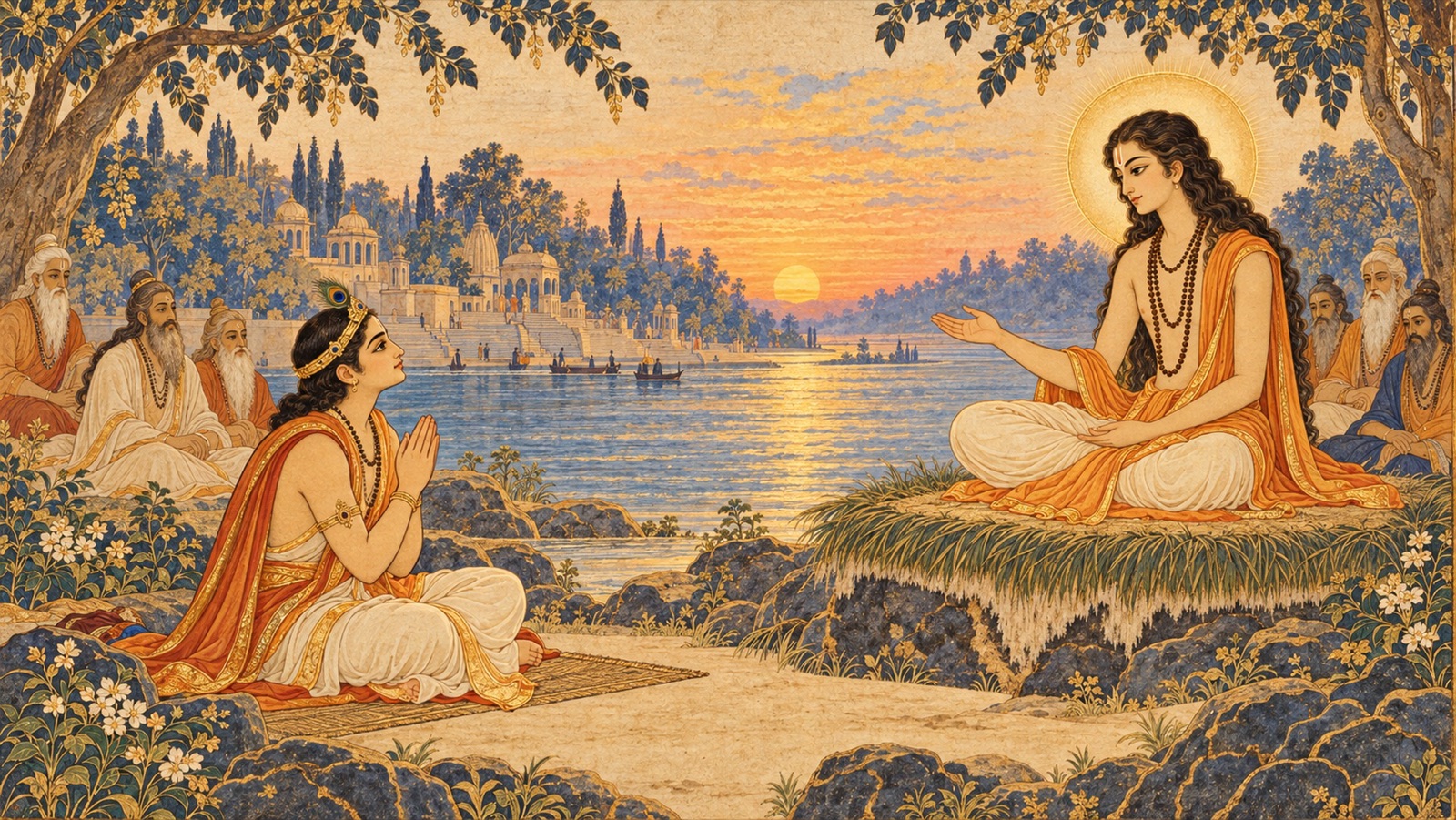
The Lord Acts Through Time, Not Partiality
Sukadeva is delighted rather than disturbed by the question, praising it as one that intensifies devotion and is sung by sages like Narada. His answer begins with a clear principle: the Lord is indeed beyond the three gunas — sattva, rajas, and tamas — for these belong to material nature, not to the Spirit. When the Lord appears to punish, He is not moved by anger or favoritism; He simply presides over the workings of His own creative power. The rise and fall of the modes in the world is not simultaneous, and the Lord, conforming to the movement of cosmic Time, fosters the gods and sages when sattva prevails, and curtails the demons when rajas and tamas dominate.
य एष राजन्नपि काल ईशिता सत्त्वं सुरानीकमिवैधयत्यतः । तत्प्रत्यनीकानसुरान् सुरप्रियो रजस्तमस्कान् प्रमिणोत्युरुश्रवाः ॥ १२ ॥
ya eṣa rājann api kāla īśitā sattvaṁ surānīkam ivaidhayaty ataḥ tat-pratyanīkān asurān sura-priyo rajas-tamaskān pramiṇoty uruśravāḥ
Meaning: O king, this very Time, of which the Lord is the controller, strengthens the army of the gods as sattva grows; and so the renowned Lord, dear friend of the gods, diminishes their opponents, the demons, who are dominated by rajas and tamas — acting through Time, not through any partiality. (SB 7.1.12)
To illustrate that the Lord is entirely free of hatred, Sukadeva recalls a story once told by Narada to Emperor Yudhishthira during his Rajasuya sacrifice — the very occasion on which Yudhishthira had witnessed something astonishing.
The Enemy Who Merged into the Lord
At the Rajasuya, the assembled kings and sages had watched the wicked Sisupala — ruler of Chedi and a lifelong reviler of Sri Krishna — struck down by the Lord’s discus, and then, before their eyes, his very soul rise up as a blazing light and merge directly into the person of Krishna. Yudhishthira was bewildered. How could a bitter, blaspheming enemy attain the supreme absorption that even the Lord’s exclusive devotees find hard to reach? He recalled how King Vena had nearly been cast into hell by the brahmanas for blaspheming the Lord, and yet Sisupala and Dantavakra, who had scorned Krishna since childhood, suffered no such fate but were instead taken into Him. His mind, he confessed, wavered like a lamp-flame in the wind.
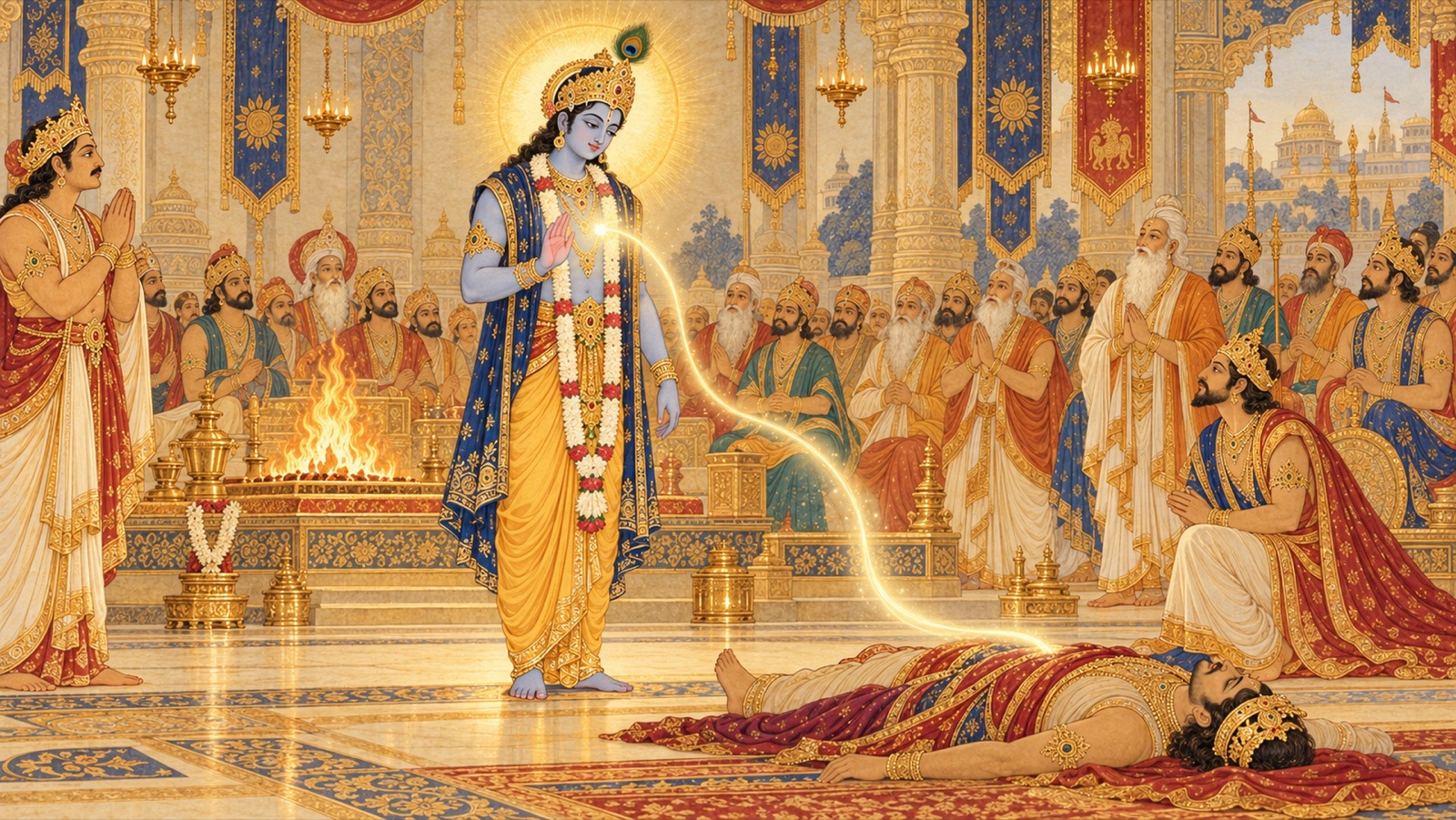
Narada’s Secret: The Mind Fixed on the Lord
Narada’s reply unfolds one of the most striking teachings of the Bhagavatam. The bodily notion of “I” and “mine,” he explains, is the root of all pleasure and pain, honour and insult; but the Supreme Spirit, being one without a second, has no such bodily identity and therefore no real enmity toward anyone — even when He appears to chastise, He does so for the offender’s own ultimate good. What matters, Narada says, is not the emotion but the intensity with which the mind becomes absorbed in the Lord. Whether through devotion, or fear, or desire, or hatred, if a person’s whole consciousness becomes fixed upon Him, that person is purified and drawn to Him.
यथा वैरानुबन्धेन मर्त्यस्तन्मयतामियात् । न तथा भक्तियोगेन इति मे निश्चिता मतिः ॥ २७ ॥
yathā vairānubandhena martyas tan-mayatām iyāt na tathā bhakti-yogena iti me niścitā matiḥ
Meaning: So completely does a mortal become absorbed in the Lord through sustained enmity that he does not become equally absorbed even through devotional yoga — such is my settled conviction. (SB 7.1.27)
Narada gives a homely image: just as a small insect, imprisoned by a wasp and thinking of it constantly in fear, is said to take on the wasp’s very form, so those who fix their minds on Krishna without pause — even through hostility — have their sins washed away and attain Him. He then names the many paths by which different souls reached the Lord, a verse cherished by devotees ever since.
गोप्यः कामाद्भयात्कंसो द्वेषाच्चैद्यादयो नृपाः । सम्बन्धाद् वृष्णयः स्नेहाद्यूयं भक्त्या वयं विभो ॥ ३१ ॥
gopyaḥ kāmād bhayāt kaṁso dveṣāc caidyādayo nṛpāḥ sambandhād vṛṣṇayaḥ snehād yūyaṁ bhaktyā vayaṁ vibho
Meaning: The cowherd women of Vraja attained Him through the intensity of their love-longing; Kamsa through fear; Sisupala and other such kings through hatred; the Vrishnis through kinship; you Pandavas through affection; and we sages through devotion, O Lord. (SB 7.1.31)
The lesson is not that hatred is a recommended path — Narada is clear that hostility carries souls to their ruin along the way, and only the Lord’s inconceivable mercy turns their fixed enmity into liberation. The point, rather, is that no one who truly fixes the mind on Krishna is ever lost. Therefore, Narada urges, by every means one should learn to fix the mind on Him.
Who Were Sisupala and Dantavakra?
Hearing this, Yudhishthira wonders aloud how servants of the Lord could ever have fallen into demoniac bodies at all, and asks Narada to tell the story. Narada explains that Sisupala and Dantavakra were, in truth, none other than Jaya and Vijaya, the two gatekeepers of Vaikuntha, the eternal abode of Lord Vishnu.
Yudhishthira’s astonishment ran deeper than curiosity. The residents of Vaikuntha have bodies wholly spiritual, he protests, untouched by matter — and one who has reached that eternal abode is never said to return to birth and death. How, then, could the Lord’s own liberated associates be hurled down to hate Him? (SB 7.1.34-35) Narada’s reply carries the chapter’s most hidden secret: such a descent is never truly a fall. When an intimate companion of the Lord seems to leave Vaikuntha, it happens by the Lord’s own inconceivable arrangement, so that He may enjoy the pastime of fighting a worthy opponent; the exile is a service rendered at His pleasure, not a lapse from grace, and the three demoniac births that follow are simply its price and its timetable (SB 7.1.35-46).
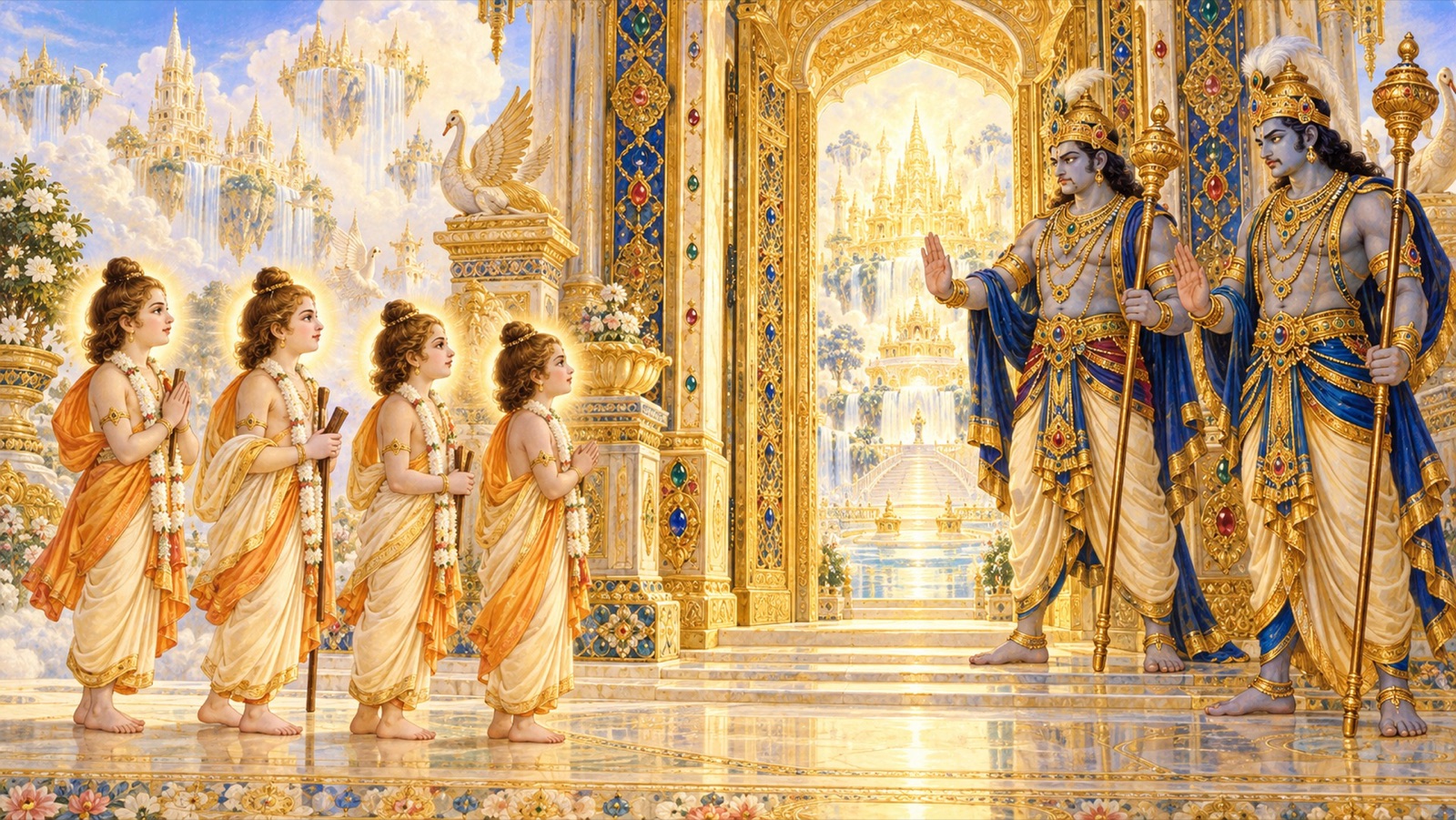
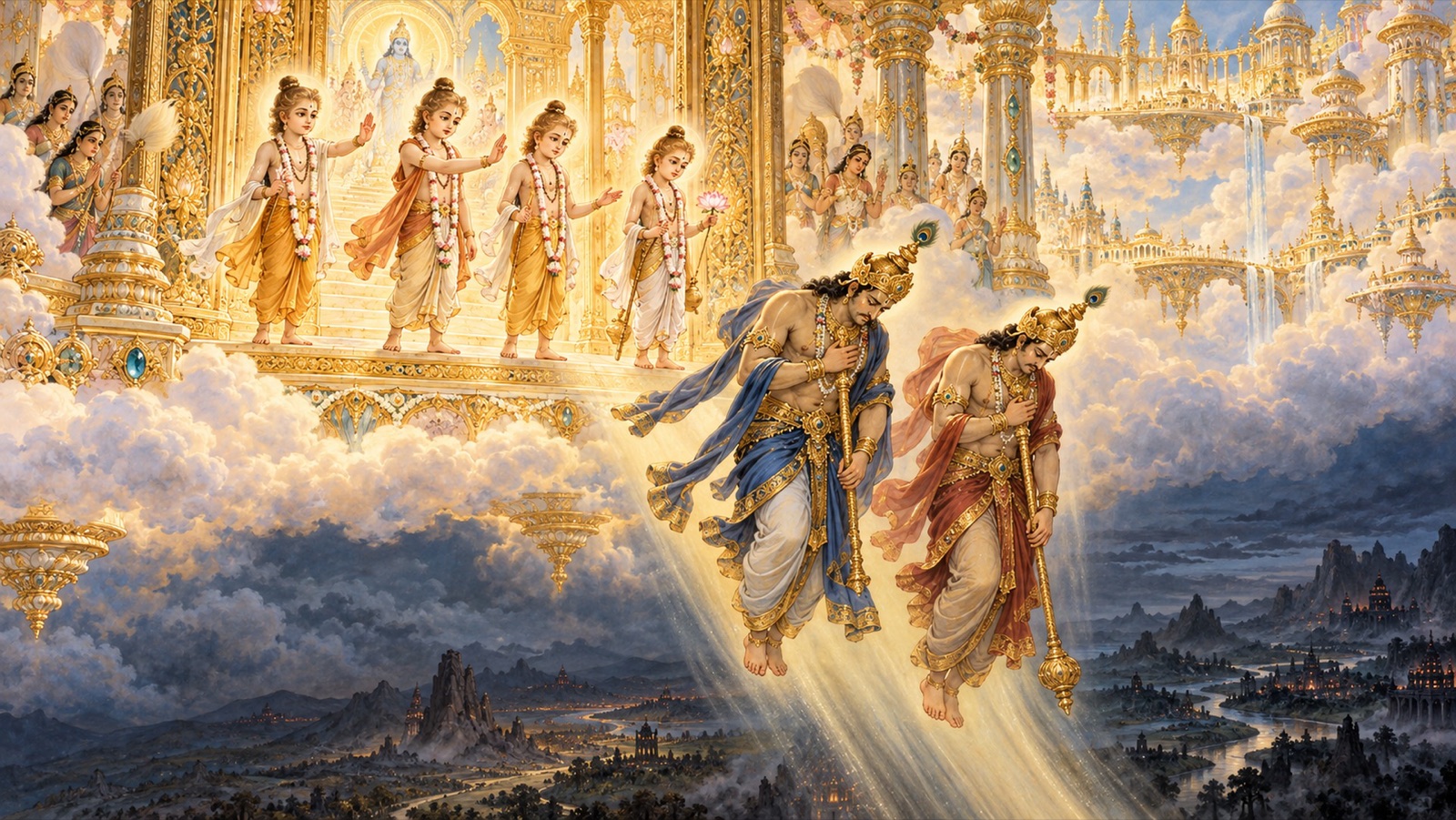
Long ago, the four boy-sages — Sanandana and his brothers, the mind-born sons of Brahma — wandered through the three worlds and came at last to the gates of Vaikuntha. Though these sages were older than the very first patriarchs of creation, they appeared as naked children of five or six years, and the two doorkeepers, taking them for mere infants, barred their way.
पञ्चषड्ढायनार्भाभाः पूर्वेषामपि पूर्वजाः । दिग्वाससः शिशून् मत्वा द्वाःस्थौ तान् प्रत्यषेधताम् ॥ ३७ ॥
pañca-ṣaḍḍhāyanārbhābhāḥ pūrveṣām api pūrvajāḥ dig-vāsasaḥ śiśūn matvā dvāḥ-sthau tān pratyaṣedhatām
Meaning: Though born before even the oldest of beings, the four sages looked like children five or six years old and wore only the directions as their garment; taking them for mere infants, the two gatekeepers stopped them at the door. (SB 7.1.37)
The Curse and the Threefold Return
Angered by the insult, the sages cursed the two gatekeepers to fall from Vaikuntha and enter demoniac wombs. As Jaya and Vijaya began to fall, the merciful sages softened the curse: after three births as enemies of the Lord, the two would return to their eternal service.
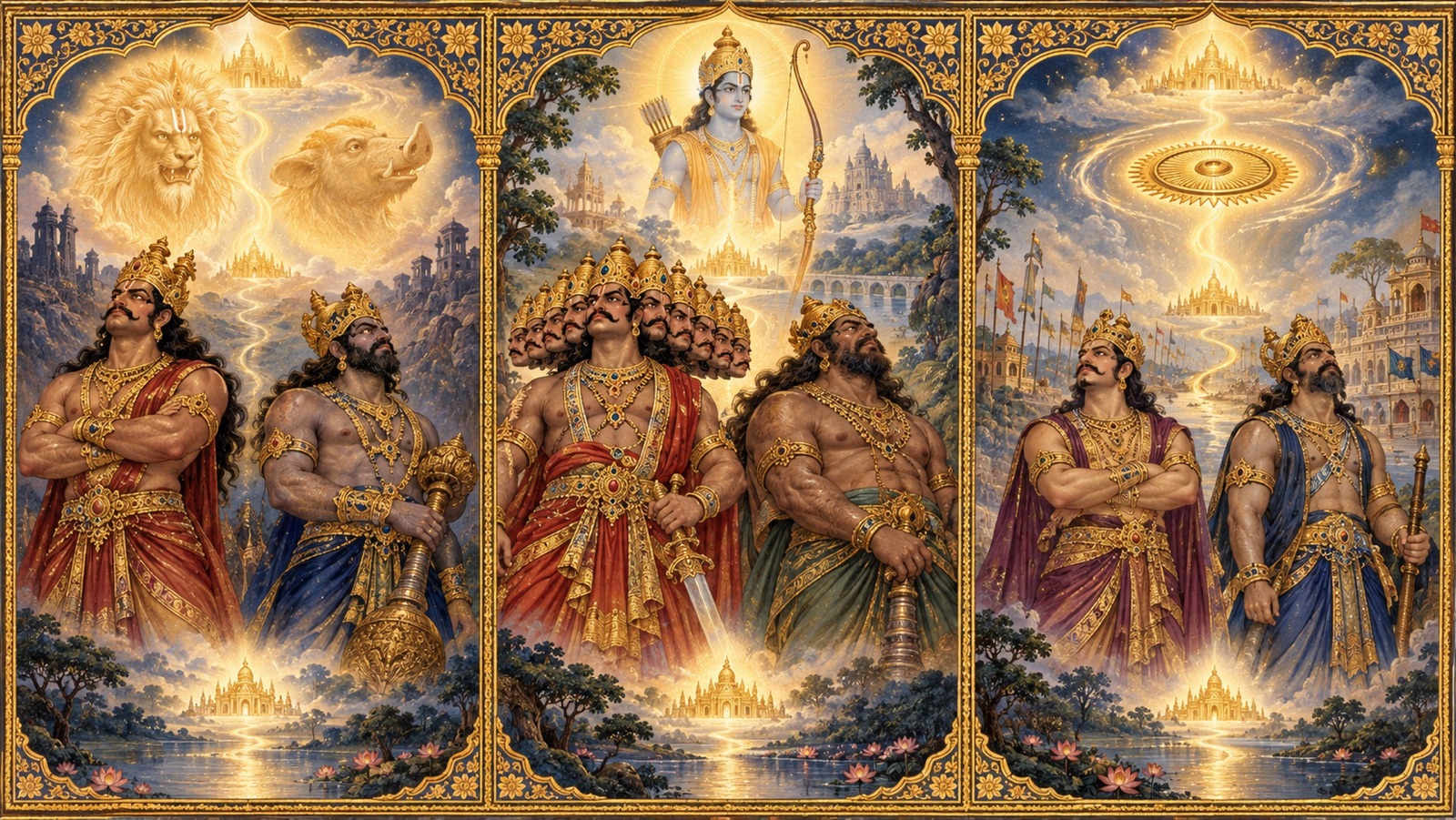
And so, Narada tells Yudhishthira, the two were first born as Hiranyakasipu and Hiranyaksa, the mighty sons of Diti — the elder slain by the Lord in His Man-Lion form, the younger by the Lord as the divine Boar. In their next birth they became the ogre brothers Ravana and Kumbhakarna, sons of the sage Vishrava, whom the Lord slew as Sri Rama. And now, in their third and final demoniac birth, they had become Sisupala and Dantavakra.
तावत्र क्षत्रियौ जातौ मातृष्वस्रात्मजौ तव । अधुना शापनिर्मुक्तौ कृष्णचक्रहतांहसौ ॥ ४६ ॥
tāv atra kṣatriyau jātau mātṛ-ṣvasrātmajau tava adhunā śāpa-nirmuktau kṛṣṇa-cakra-hatāṁhasau
Meaning: Those two were born here in the warrior race as Sisupala and Dantavakra, the sons of your maternal aunts; and now, their sins destroyed by Sri Krishna’s discus, they have been released from the curse. (SB 7.1.46)
Through three lifetimes of constant, burning enmity, their minds had never left Krishna for a moment — and so, at the appointed time, they returned to His presence as His own attendants once more.
With the story told, Yudhishthira’s doubt — and Parikshit’s — is answered: the Lord never acts from partiality, for even those He appears to strike down are being carried home. And the mention of Hiranyakasipu leads Yudhishthira to ask the very question that will open the rest of this Canto: why did that demon king come to hate his own gentle, God-loving son, Prahlada?
Principal Teachings of This Chapter
1. The Lord is truly equal to all. He has no material body, no selfish stake, and no genuine enemy; what looks like partiality is the impartial working of Time and the modes of nature (SB 7.1.6-12).
2. Divine chastisement is a hidden mercy. Even when the Lord appears to slay an enemy, He acts for that soul’s ultimate liberation, never from hatred (SB 7.1.23-25).
3. What saves is the mind wholly fixed on God. Absorption in the Lord — whether coloured by love, fear, desire, or even hatred — purifies and delivers; no one who truly fixes the mind on Him is ever finally lost (SB 7.1.25-31).
4. Devotion remains the safe and sweet path. Narada names enmity only to show the Lord’s boundless mercy, not to recommend it; hostility ruins the soul along the way, while devotion carries it home in peace (SB 7.1.28-31).
5. No true devotee ever really falls. What looks like the fall and threefold rebirth of Jaya and Vijaya was, in truth, an arrangement of the Lord’s own will so that He could relish their service as opponents — never a lapse from His grace (SB 7.1.34-46).
A Devotional Reflection
There is a strange comfort hidden in this chapter. We tend to imagine that only the pure and the loving are close to God, and that the hateful and the fallen are somehow beyond His reach. Narada gently overturns this. The measure, he says, is not the sweetness of our feeling but the completeness of our attention. Sisupala hated Krishna — but he could not stop thinking of Him. His whole life was consumed by that one Name he despised, and in the end that unbroken remembrance, ignited by the Lord’s mercy, burned away everything that separated them. We are not asked to imitate his hatred, of course; the gopis’ longing and the sages’ devotion are the paths worth walking. But we may take heart from the deeper truth beneath the story: that the Lord loses no one who keeps Him in mind, and that even our resistance, our fear, our confused and imperfect attention, when turned toward Him, becomes a thread by which He quietly draws us home.
A Daily Devotional Practice
Today, notice where your mind keeps returning on its own — perhaps to a worry, a resentment, or a fear that will not leave you alone. Just once, gently redirect that same restless intensity toward the Lord. Sit quietly, breathe, and repeat with full attention: “Om Namo Bhagavate Vasudevaya.” Let the very energy you would have spent on anxiety become, for one minute, energy spent in remembrance of Him. This is Narada’s teaching made practical: the mind that cannot stop moving can at least be pointed toward the One who saves.
Conclusion
What this chapter finally tells us is that the Lord is never partial — what looks like favour or wrath is simply Time and nature doing their work around a Being who has no enemy and no friend. And what it promises is sweeter still: no mind that stays fixed on Him, however that fixation begins, is ever lost to Him. Sisupala’s hatred could not outlast Krishna’s mercy, and Jaya and Vijaya’s three demoniac births could not finally sever them from Vaikuntha, for even their exile served His pleasure. The rest of this Canto — the story of Prahlada and his tyrant father — will show how far that mercy reaches.
May the divine wisdom of Srimad Bhagavatam awaken pure devotion within our hearts.
Om Namo Bhagavate Vasudevaya.
Jay Shree Madhav.
References and Attribution
- Primary edition: Gita Press, Śrīmad Bhāgavata Mahāpurāṇa (English, complete), Book Seven, Discourse 1, pages 646–650.
- Series: Srimad Bhagavatam Wisdom · Biswa Sanatan Dharma Seva Trust.
- Presented following the spiritual guidance and recommendation of Pandit Dr. Shri Kashinath Mishra.
This is an original, faithful retelling in the writer’s own words, with brief quoted verses shown in Devanāgarī and transliteration and their meanings given as summaries. It is not a reproduction of any single publisher’s continuous translation or commentary. No affiliation with or endorsement by any publisher is implied.
Jay Shree Madhav