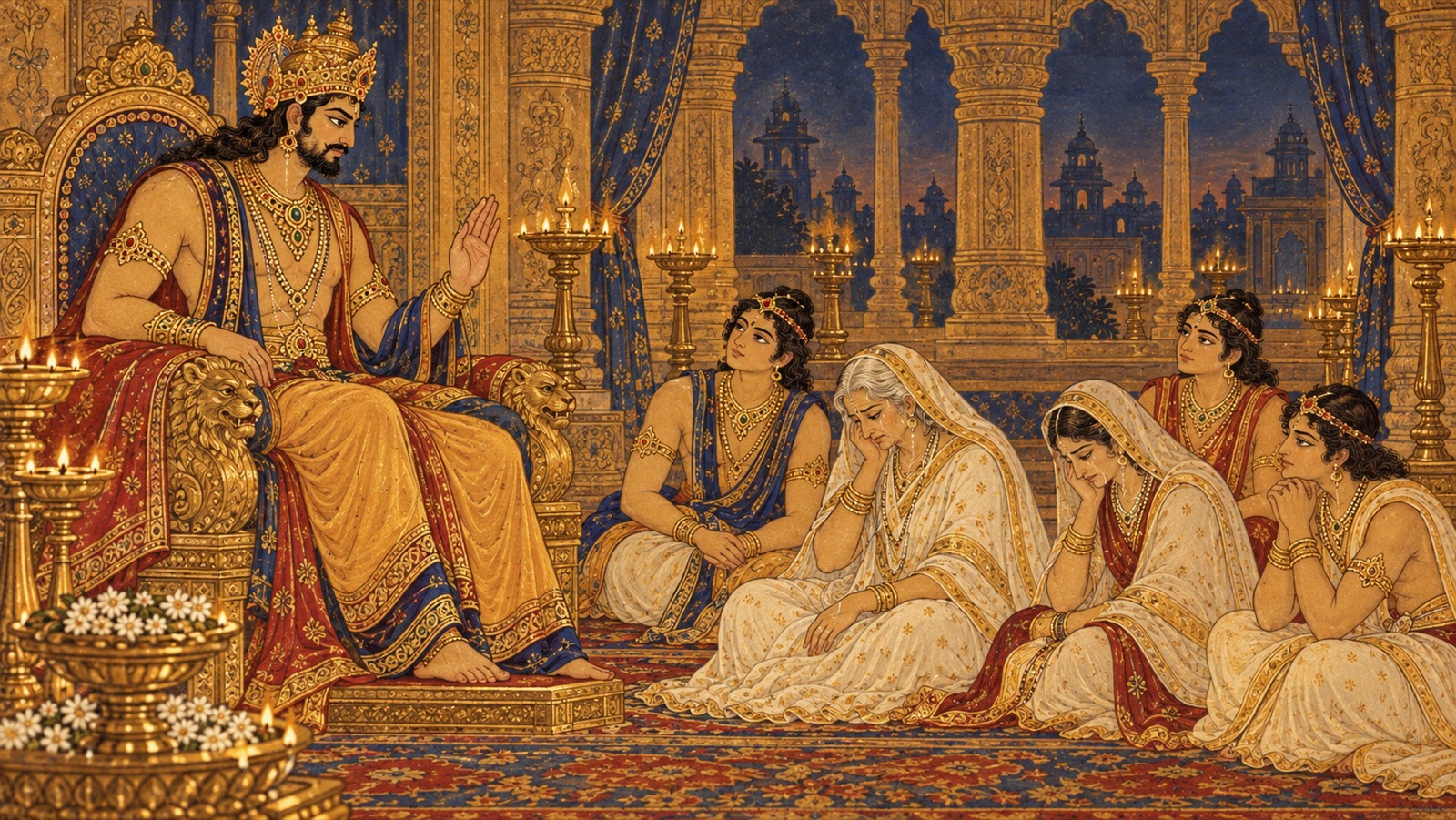
A demon king who has just vowed to burn the world with vengeance turns, in the same breath, to his weeping mother and speaks words of such piercing wisdom about the deathless soul that her grief simply dissolves. In the Bhagavatam even a tyrant can utter the truth.
Om Namo Bhagavate Vasudevaya.
Om Namo Bhagavate Vasudevaya.
Om Namo Bhagavate Vasudevaya.
Welcome to Srimad Bhagavatam Wisdom, a devotional journey through the sacred histories and teachings of the Srimad Bhagavat Mahapurana. In the previous chapter, Narada revealed that Hiranyakasipu and his brother Hiranyaksa were the Vaikuntha gatekeepers Jaya and Vijaya, fallen through a curse. This chapter opens in the raw aftermath of Hiranyaksa’s death, and it holds a startling contrast: the same tongue that vows the ruin of the righteous also offers some of the loftiest teaching on the deathless soul found anywhere in the scriptures.
Chapter Information
- Scripture: Śrīmad Bhāgavata Mahāpurāṇa
- Canto: 7 (Book Seven)
- Chapter: 2
- Chapter title: Hiranyakasipu Consoles His Mother’s Grief (Diti Rid of Her Sorrow)
- Principal speakers: The sage Narada (narrating to Yudhishthira); within his account, Hiranyakasipu; and within Hiranyakasipu’s speech, Yama (the lord of death, appearing as a child)
- Principal listener: Emperor Yudhishthira; within the narration, Diti, her widowed daughter-in-law, and the sons of Hiranyaksa; and, in the legend, the grieving queens of King Suyajna
- Main setting: The court and household of Hiranyakasipu; within the recalled legend, the battlefield and palace of King Suyajna in the Ushinara land
- Central subject: Hiranyakasipu’s grief-born vow of vengeance and the devastation of the earth; and his consolation of his family through the teaching that the soul is eternal and grief is born of the illusion of “I” and “mine”
- Principal verse range: Canto 7, Chapter 2, verses 1–61
- Primary edition: Gita Press Śrīmad Bhāgavata Mahāpurāṇa
A Brother’s Death and a Demon’s Vow
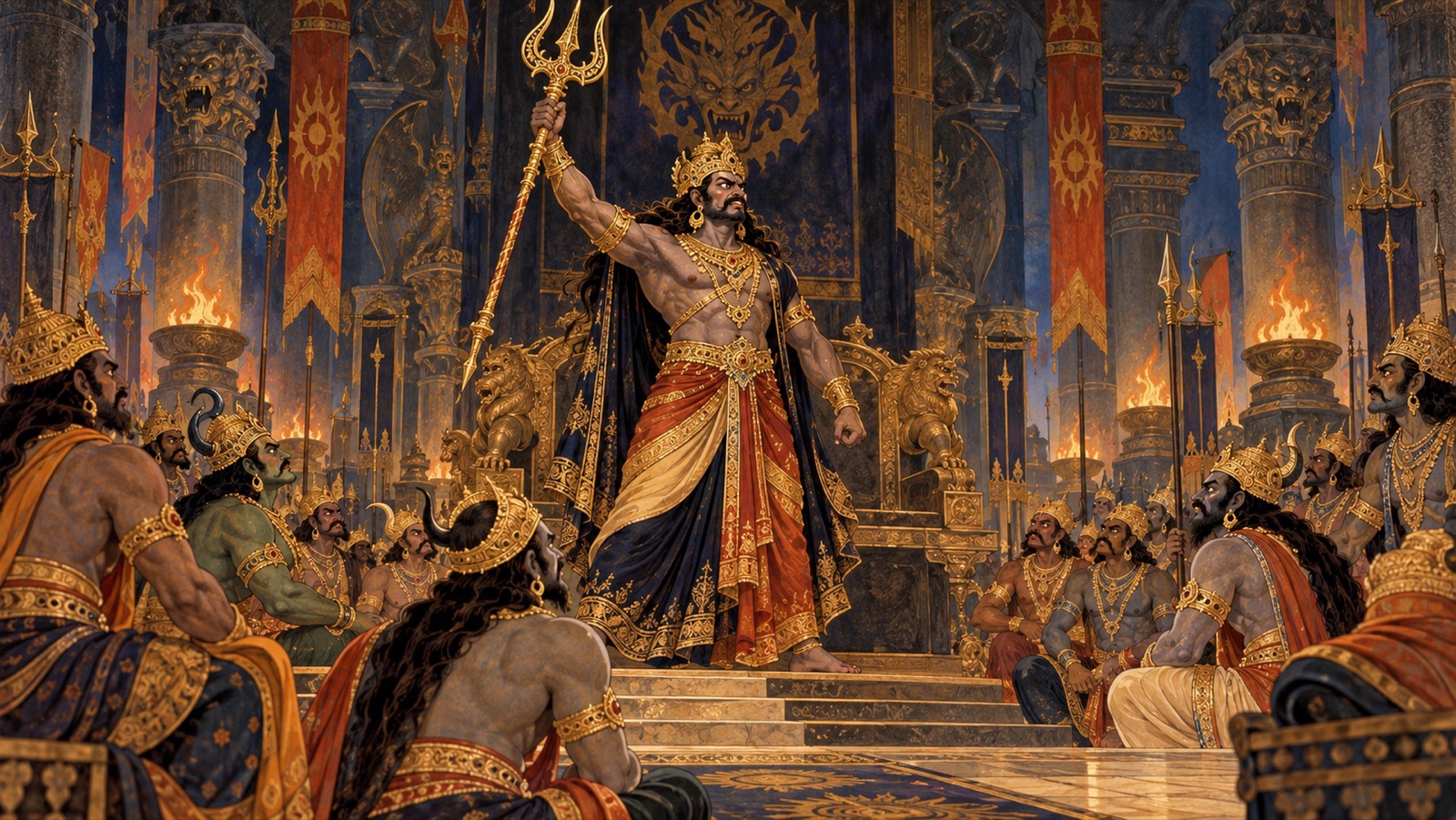
Narada continues his account for Yudhishthira. When Hiranyakasipu learned that his beloved younger brother Hiranyaksa had been slain by Sri Hari in the form of the Boar, he was overcome with anguish and rage. Grinding his teeth and biting his lips, his eyes blazing until the sky itself seemed to smoke, he raised his trident and addressed the assembled Danavas and Daityas of his court. He named his fierce lieutenants one by one and swore to avenge his brother — vowing to sever the head of Vishnu, whom he scorned as a fickle, partial deity who merely favours whoever worships Him.
Yet Hiranyakasipu’s fury rests on a familiar demoniac misreading. He accuses Vishnu of favouritism, as though the Lord, like a fickle child, sides with whoever flatters Him. In truth the Lord is impartial to every being, exactly as a just government is impartial to every citizen — it is not the ruler who discriminates, but each citizen’s own conduct that determines the law’s reward. The demigods prevail because they follow the Lord’s word with sincerity; the demons, though they know Vishnu is the Supreme, refuse His instruction and so reap the fruits of their own defiance. Yet here a deeper mercy is hidden: because Hiranyakasipu’s mind, however malevolently, stays fixed on Vishnu day and night, that very absorption is not wholly wasted, for such demons often attain liberation in oneness with the Lord at death. Even enmity, when its object is the Supreme, cannot go entirely unrewarded (verses 6–8).
More chilling than the vow against the Lord was his command against the innocent. Since Vishnu, he reasoned, is sustained by sacrifice and righteousness, the way to strike at Him was to destroy dharma on earth. He ordered his demons to descend upon the world and lay waste to every place where brahmanas performed sacrifice, where cows were kept, where the Vedas were studied, and where charity and sacred vows were observed.
The Earth Under Siege
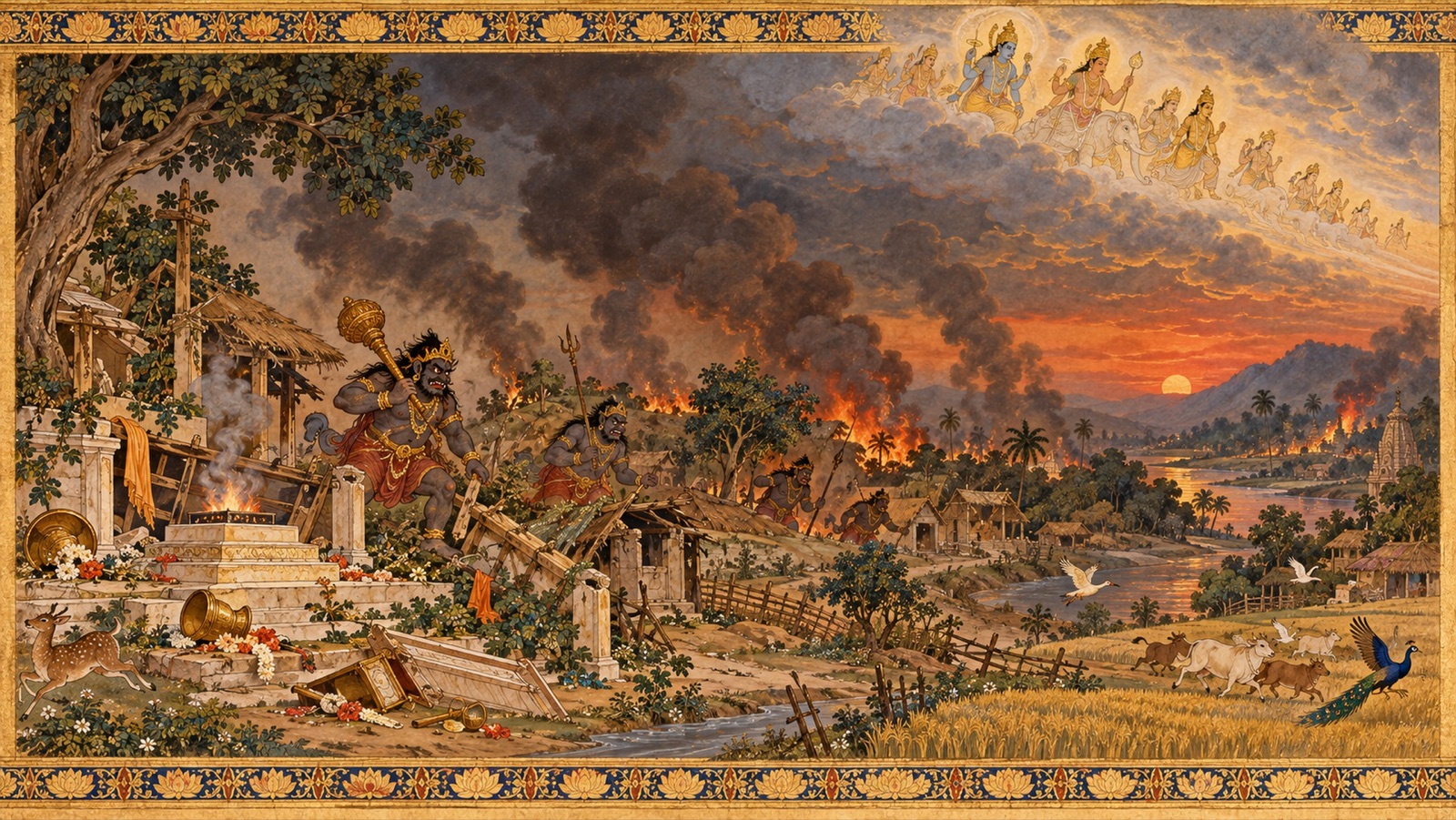
Bowing to their master’s command, the demons fell upon the world. They burned towns and villages, cow-pens and gardens, hermitages and farmers’ hamlets; they demolished bridges, walls, and gateways; they felled the fruit-bearing trees on which people depended and set fire to homes. As the people suffered this oppression again and again, the gods themselves abandoned heaven and wandered the earth unseen, watching the devastation and weighing what could be done. It is a grim portrait of a world in which cruelty has been given free rein — the necessary backdrop against which the fearless devotion of Prahlada will soon shine all the more brightly.
Words of Comfort: The Soul Never Dies
Then the chapter turns, unexpectedly, from destruction to consolation. Having performed the water-oblations for his dead brother, Hiranyakasipu himself remained miserable — and he found his mother Diti, his widowed sister-in-law Rushabhanu, and his nephews sunk in grief. Knowing what the moment required, he spoke to them gently. The death of a hero facing his foe, he told them, is praiseworthy and not to be lamented. The gathering of loved ones in this world, he said, is like travellers meeting by chance at a roadside rest-house with a water-tank: brought together by destiny, they are parted again by destiny according to their past deeds.
Then he spoke words that could have come from the mouth of a sage:
नित्य आत्माव्ययः शुद्धः सर्वगः सर्ववित्परः । धत्तेऽसावात्मनो लिङ्गं मायया विसृजन्गुणान् ॥ २२ ॥
nitya ātmāvyayaḥ śuddhaḥ sarvagaḥ sarva-vit paraḥ dhatte ‘sāv ātmano liṅgaṁ māyayā visṛjan guṇān
Meaning: The soul is eternal, imperishable, pure, all-pervading, all-knowing, and transcendent; yet by its own illusory power it takes on a subtle bodily covering and brings forth the play of the modes of nature. (SB 7.2.22)
Just as trees reflected in a running stream appear to move, and the earth seems to spin to one whose eyes are whirling, so, Hiranyakasipu explained, when the mind is agitated by the modes of nature, the unmoved soul seems to share in the body’s changes. To mistake the deathless self for the perishable body is the root of all sorrow — from it flow attachment and aversion, birth and death, and every kind of grief. To illustrate, he retold an ancient legend.
The Legend of King Suyajna
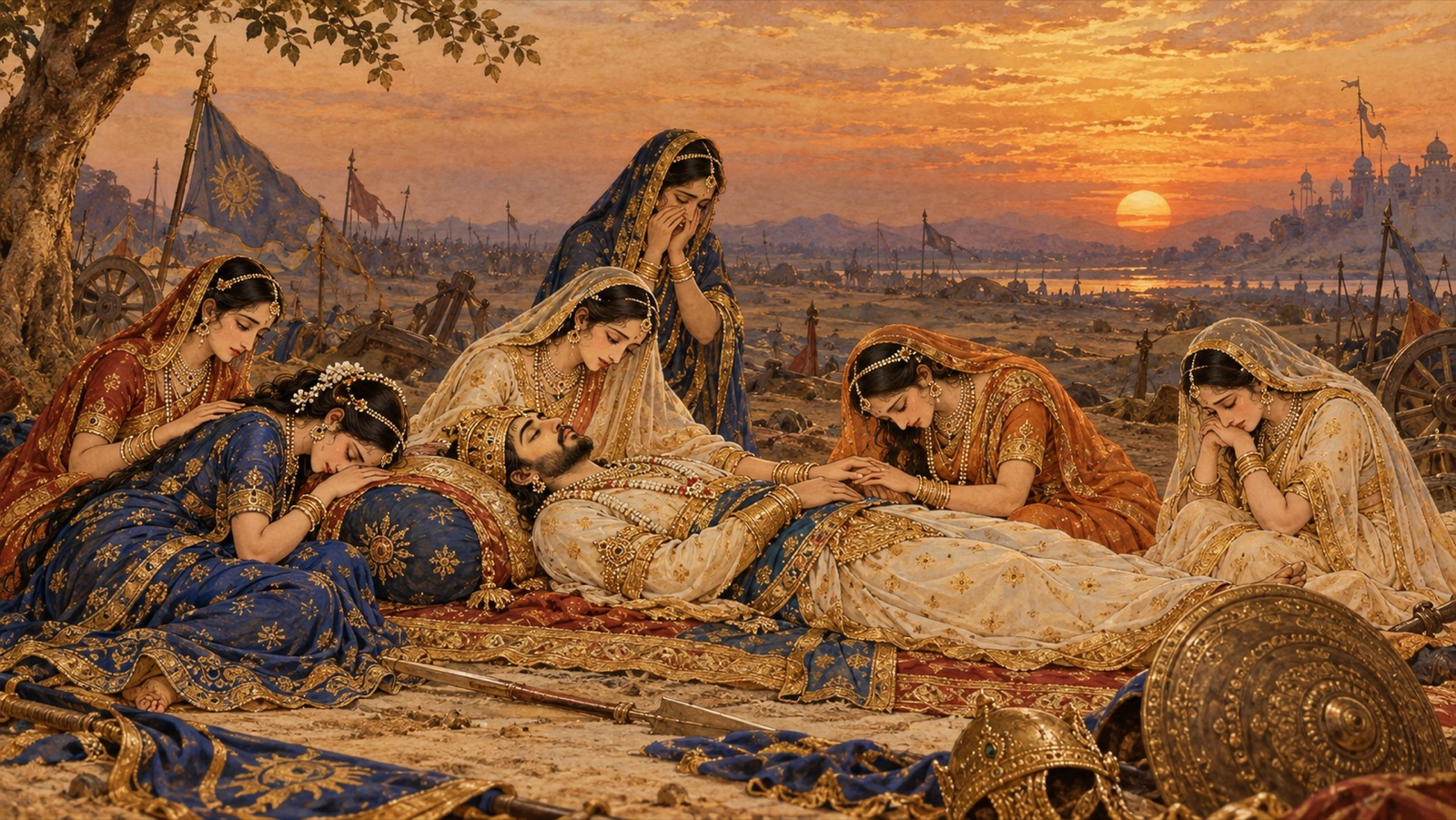
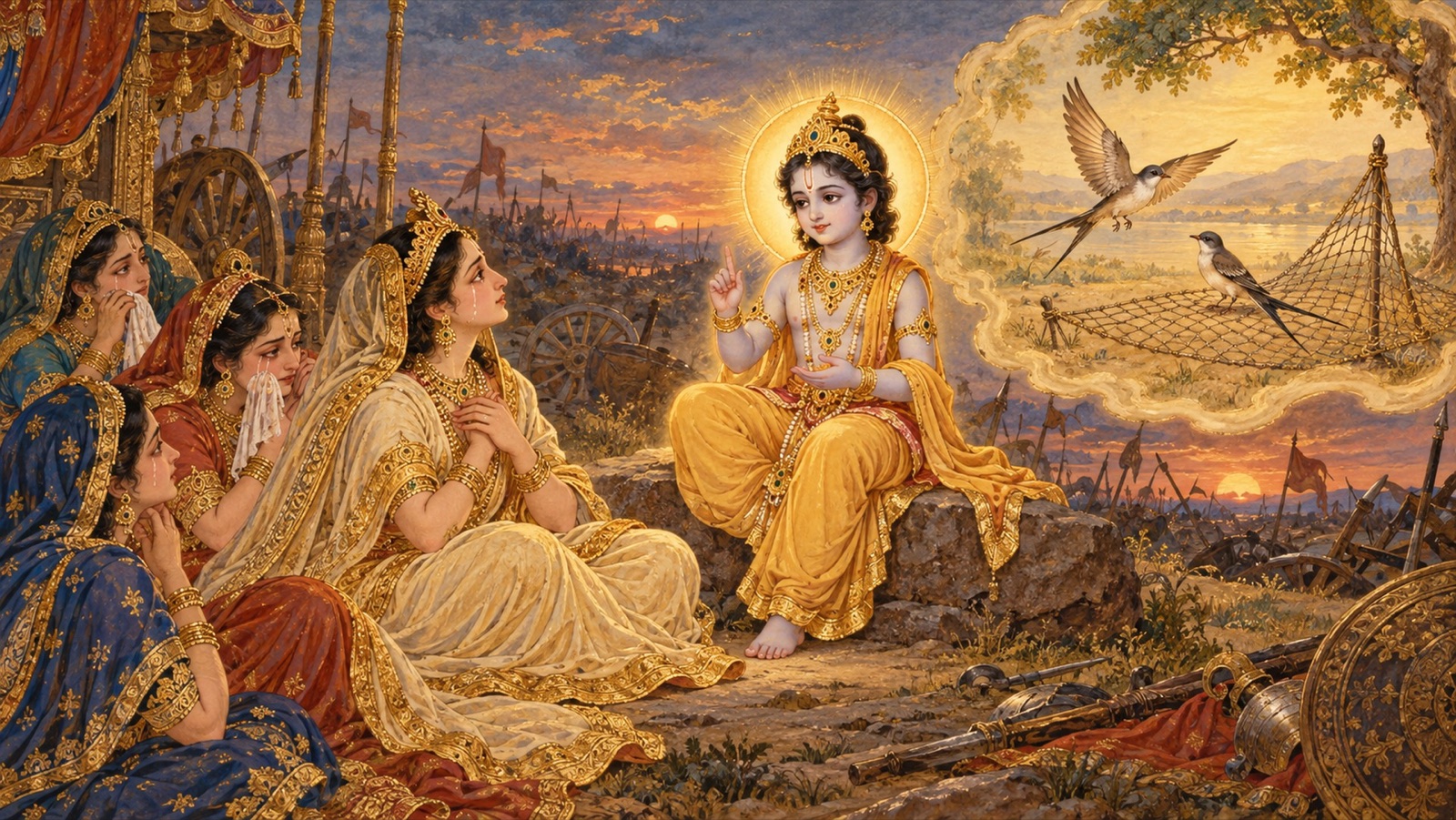
In the land of Ushinara, he said, there once lived an illustrious king named Suyajna, who was slain by his enemies in battle. His kinsmen gathered around his fallen body on the battlefield, his ornaments scattered and his armour shattered. His queens, seeing their lord reduced to such a state, beat their breasts and fell weeping at his feet, bathing them in tears. “How can we live without you, our dearest friend?” they cried, unwilling even to let his body be taken for cremation — until the sun itself sank below the horizon while they wept.
Yama Appears as a Child
Hearing the endless lament of the king’s relatives, Yama, the lord of death, appeared among them in the form of a small child and gently rebuked their sorrow.
श्रीयम उवाच अहो अमीषां वयसाधिकानां विपश्यतां लोकविधिं विमोहः । यत्रागतस्तत्र गतं मनुष्यं स्वयं सधर्मा अपि शोचन्त्यपार्थम् ॥ ३७ ॥
śrī-yama uvāca aho amīṣāṁ vayasādhikānāṁ vipaśyatāṁ loka-vidhiṁ vimohaḥ yatrāgatas tatra gataṁ manuṣyaṁ svayaṁ sadharmā api śocanty apārtham
Meaning: Yama said: Ah, the delusion of these, my elders, who, though they clearly see the way of the world, lament in vain for a man who has merely returned to the source from which he came — and this, though they themselves are of the very same mortal nature! (SB 7.2.37)
The Lord alone, the child continued, is the true protector — He who guards the helpless infant even in the womb; a soul protected by Providence survives even abandoned in a forest, while one whose time has come perishes even guarded at home. Bodies come and go by the law of karma, but the spirit dwelling within is untouched, distinct from body, senses, and even the life-breath, as fire is distinct from the wood in which it dwells. The one you call Suyajna, said Yama, was never truly the hearer or speaker within this body; the seer within can never itself be seen.
The Parable of the Two Birds
To press the lesson home, Yama told a further parable. A fowler, created as death itself for birds, once spread his net in a forest. A pair of kulinga birds lived there, and the female was suddenly caught in the meshes. The male bird, helpless to save his mate, wailed piteously over her — grieving for her suffering, lamenting his own broken life, and worrying who would feed their unfledged young. And while he grieved, blind to his own danger, the same fowler crept close and pierced him too with an arrow. “In just this way,” Yama told the queens, “you foolish women, lamenting your husband and not foreseeing your own death, will not get him back even in a hundred years.”
Grief Dissolved in Truth
Hearing the child’s discourse, the relatives of Suyajna were struck with wonder and realized the whole world to be transient and unreal; and Yama, his teaching given, vanished on the spot. Hiranyakasipu drew the lesson to a close with a striking conclusion:
अतः शोचत मा यूयं परं चात्मानमेव वा । क आत्मा कः परो वात्र स्वीयः पारक्य एव वा । स्वपराभिनिवेशेन विनाज्ञानेन देहिनाम् ॥ ६० ॥
ataḥ śocata mā yūyaṁ paraṁ cātmānam eva vā ka ātmā kaḥ paro vātra svīyaḥ pārakya eva vā sva-parābhiniveśena vinājñānena dehinām
Meaning: Therefore do not grieve, neither for others nor for your own selves. Where, in truth, is “self” and where is “other,” what is “one’s own” and what is “another’s” — except through the ignorant clinging of embodied beings to the notion of self and other? (SB 7.2.60)
Narada closes the chapter with its quiet resolution:
श्रीनारद उवाच इति दैत्यपतेर्वाक्यं दितिराकर्ण्य सस्नुषा । पुत्रशोकं क्षणात्त्यक्त्वा तत्त्वे चित्तमधारयत् ॥ ६१ ॥
śrī-nārada uvāca iti daitya-pater vākyaṁ ditir ākarṇya sasnuṣā putra-śokaṁ kṣaṇāt tyaktvā tattve cittam adhārayat
Meaning: Narada said: Hearing these words of the lord of the Daityas, Diti, together with her daughter-in-law, at once gave up her grief for her son and fixed her mind upon the truth. (SB 7.2.61)
Principal Teachings of This Chapter
1. The soul is eternal and untouched by death. What perishes is only the body; the deathless self, pure and all-pervading, is never born and never dies (SB 7.2.22-24).
2. Grief is born of mistaken identity. Sorrow arises when we take the temporary body for the eternal self, and cling to “I” and “mine”; seen rightly, there is no true loss (SB 7.2.25-26, 60).
3. The Lord alone is the real protector. Neither wealth nor guardians can preserve one whose time has come, while the soul protected by the Lord is safe even when abandoned; He guards us even in the womb (SB 7.2.38-40).
4. Grief blinds us to our own mortality. Like the male bird lamenting his mate while the fowler takes aim, one who is lost in grieving forgets that death is coming for the mourner too (SB 7.2.50-57).
5. Truth can be spoken even by the unworthy. That so lofty a teaching comes from the mouth of a demon king reminds us to receive wisdom wherever it is found, and to weigh the truth of words rather than only the character of the speaker (SB 7.2.20-61).
A Devotional Reflection
This is one of the strangest and most instructive chapters in the Bhagavatam, because the great consoling wisdom of the deathless soul is placed in the mouth of a man about to become the arch-tyrant of the age. Hiranyakasipu speaks the truth perfectly — and lives it not at all. He can explain to his mother that the soul never dies, that grief is illusion, that the Lord alone protects; and then he turns and orders the burning of the world and, before long, the killing of his own son. The chapter quietly warns us that knowing the truth and being transformed by it are two very different things. It is possible to master the words of scripture, to console others beautifully, and yet to keep one’s own heart untouched. The child Yama, and the child Prahlada who is coming, show us the other way: wisdom that has become one with the life. Let us pray that what we understand with the mind may sink down and become who we are.
A Daily Devotional Practice
Today, when some small loss disturbs you — a disappointment, a parting, a thing that did not go your way — pause before reacting and gently remind yourself of the truth Hiranyakasipu spoke better than he lived: the soul is eternal; only the passing forms come and go. Sit quietly for a moment and offer the disturbance to the Lord, repeating: “Om Namo Bhagavate Vasudevaya.” Ask that this truth become not merely something you know, but something that steadies you from within.
Conclusion
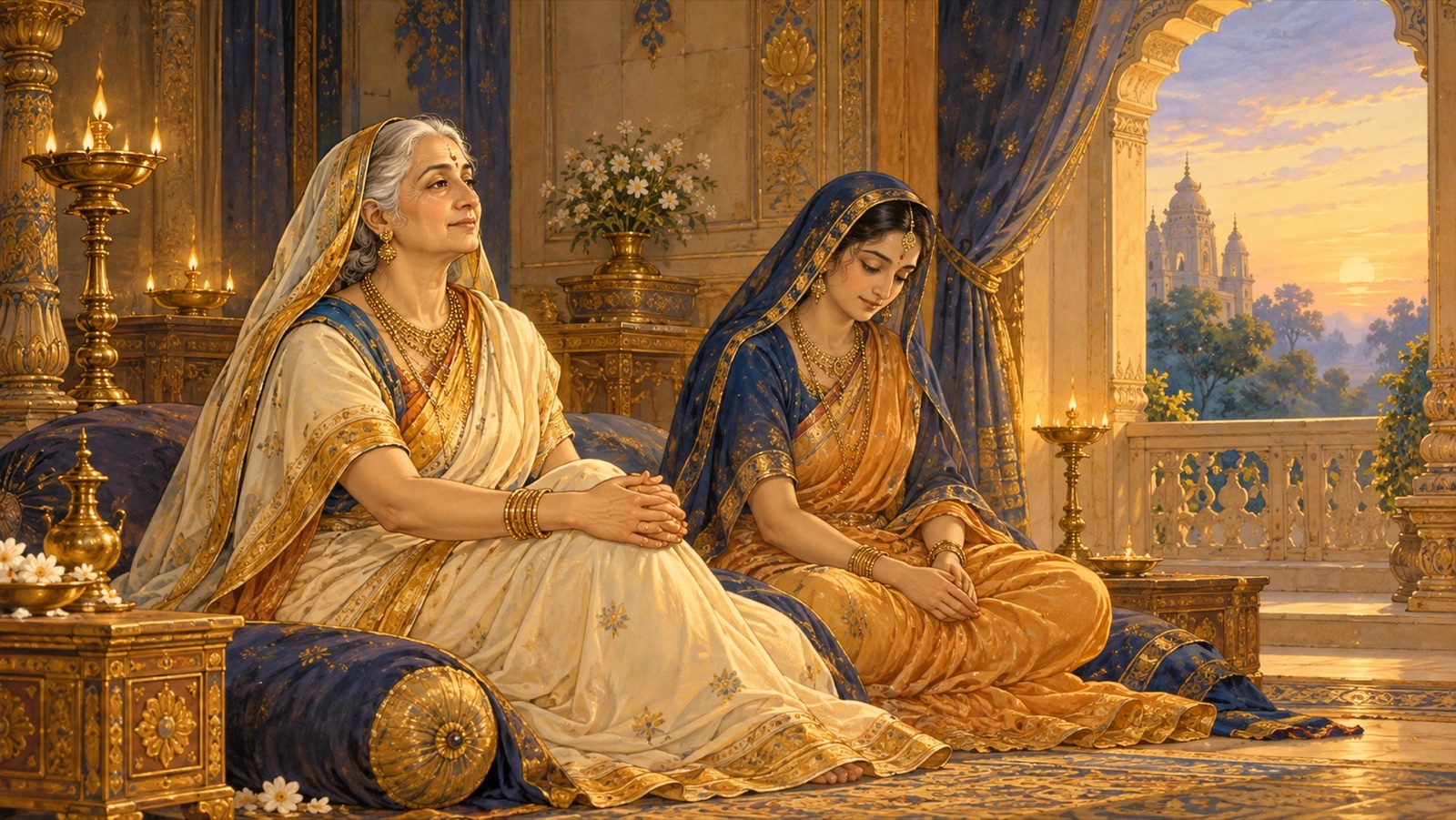
This chapter’s whole teaching turns on a single truth: the self who mourns and the self who is mourned are both, in essence, the deathless soul — and grief only takes root where this truth is forgotten. Hiranyakasipu could speak that truth with rare clarity, even while his own heart remained ruled by anger and vengeance; a warning that wisdom recited is not wisdom lived. May we take from Diti’s quiet peace the deeper lesson she received in silence — that the one who truly knows the soul as eternal has nothing left to fear, and nothing left to grieve.
May the divine wisdom of Srimad Bhagavatam awaken pure devotion within our hearts.
Om Namo Bhagavate Vasudevaya.
Jay Shree Madhav.
References and Attribution
- Primary edition: Gita Press, Śrīmad Bhāgavata Mahāpurāṇa (English, complete), Book Seven, Discourse 2, pages 651–657.
- Series: Srimad Bhagavatam Wisdom · Biswa Sanatan Dharma Seva Trust.
- Presented following the spiritual guidance and recommendation of Pandit Dr. Shri Kashinath Mishra.
This is an original, faithful retelling in the writer’s own words, with brief quoted verses shown in Devanāgarī and transliteration and their meanings given as summaries. It is not a reproduction of any single publisher’s continuous translation or commentary. No affiliation with or endorsement by any publisher is implied.
Jay Shree Madhav