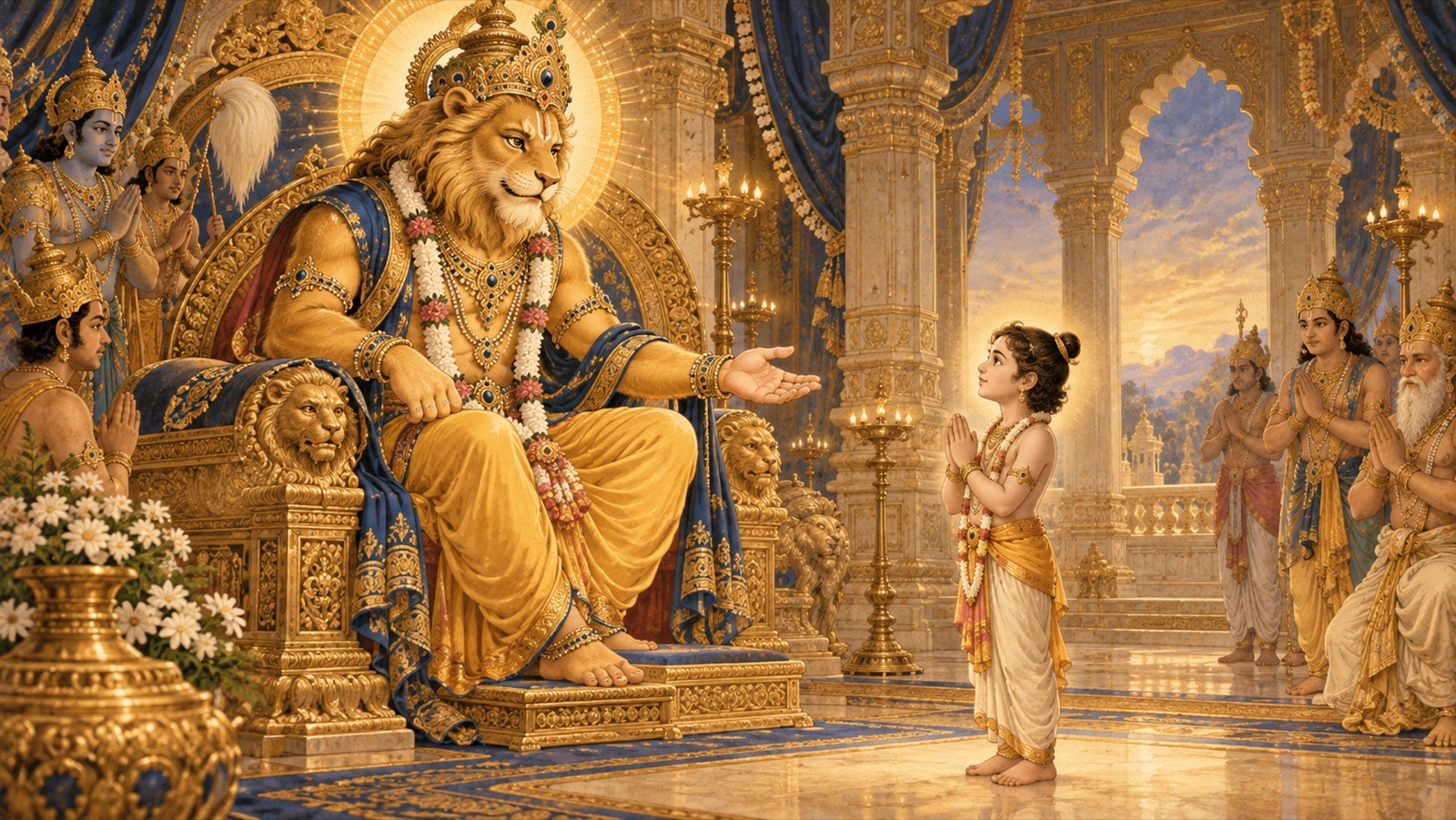
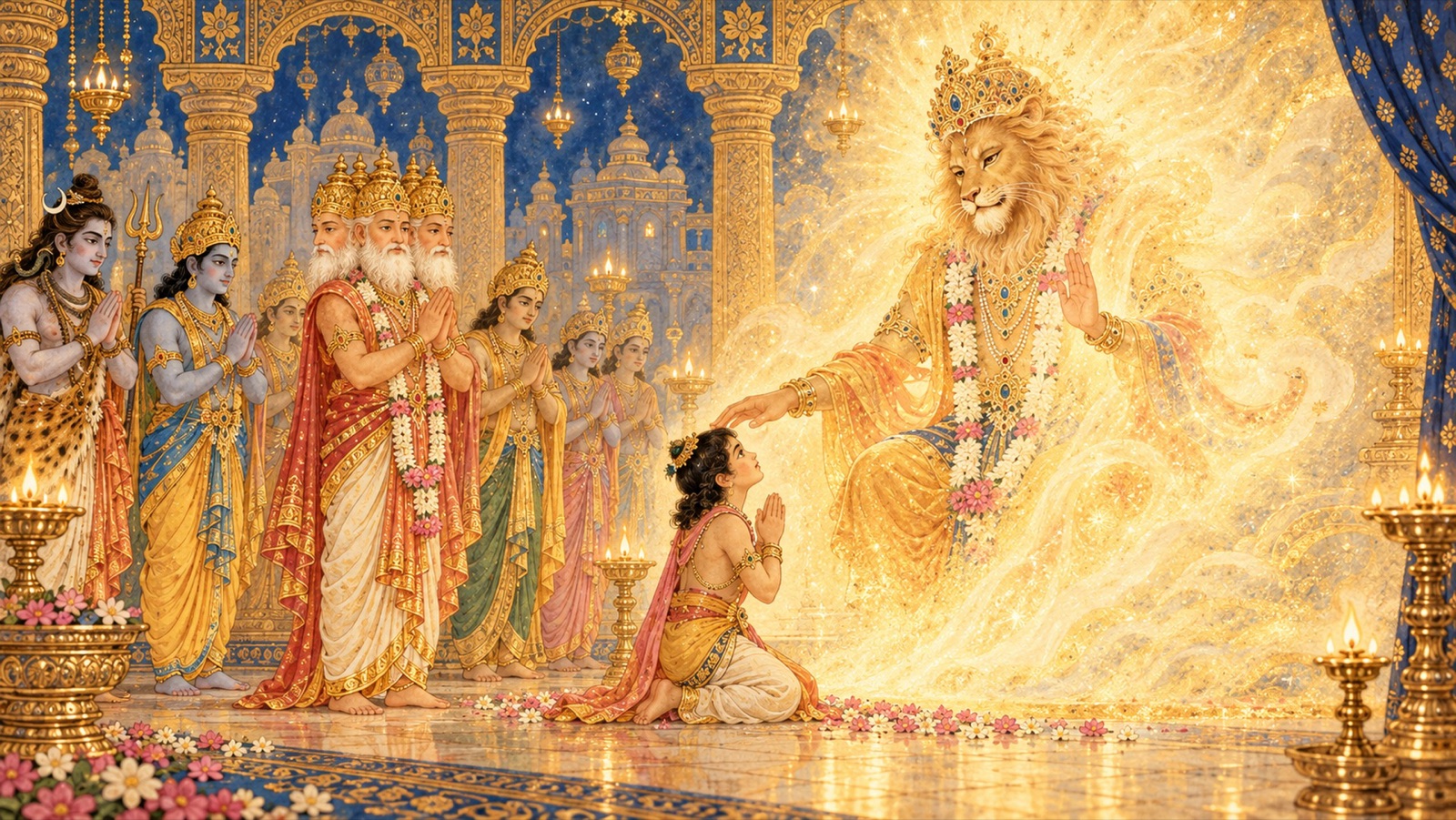
The Lord offered the child anything he could wish for. What Prahlada asked in return has become the measure of every true devotee: not wealth, not power, not even heaven — but a heart in which desire would never again take root.
Om Namo Bhagavate Vasudevaya.
Om Namo Bhagavate Vasudevaya.
Om Namo Bhagavate Vasudevaya.
Welcome to Srimad Bhagavatam Wisdom, a devotional journey through the sacred histories and teachings of the Srimad Bhagavat Mahapurana. In the previous chapter the child Prahlada pacified the Lord Narasimha with a prayer of pure love; this tenth chapter brings that meeting to its tender conclusion, ending in Narada’s revelation of a secret spanning many lifetimes.
Chapter Information
- Scripture: Śrīmad Bhāgavata Mahāpurāṇa
- Canto: 7 (Book Seven)
- Chapter: 10
- Chapter title: Prahlada, the Best of Devotees
- Principal speaker: The sage Narada, narrating to Emperor Yudhishthira; with the words of the Lord and of Prahlada
- Principal listener: Emperor Yudhishthira
- Main setting: The court of Hiranyakasipu, before the Lord Narasimha
- Central subject: The Lord’s offer of boons, Prahlada’s desireless response and prayer for his father, his coronation, and the hidden story of the Lord’s cursed doorkeepers
- Principal verse range: Canto 7, Chapter 10, verses 1–70; the Prahlada narrative — the boons declined, the prayer for his father, the coronation, and Narada’s revelation of Jaya and Vijaya — spans verses 1–43
- Primary edition: Gita Press Śrīmad Bhāgavata Mahāpurāṇa
The Offer of Boons
Regarding the granting of boons as itself an obstacle to pure devotion, the child Prahlada smiled and gently answered the Lord. “Do not tempt me,” he said, “with the very pleasures of sense to which I am already bound by birth. Afraid of that attachment and weary of it, I have come to You for shelter, longing to be free.” He understood that the Lord, ever eager to make known to the world the marks of a true devotee, had offered him worldly delights only to test him — for one who begs blessings from the Lord is no true servant at all:
नान्यथा तेऽखिलगुरो घटेत करुणात्मन: । यस्त आशिष आशास्ते न स भृत्य: स वै वणिक् ॥ ४ ॥
nānyathā te ‘khila-guro ghaṭeta karuṇātmanaḥ yas ta āśiṣa āśāste na sa bhṛtyaḥ sa vai vaṇik
Meaning: O preceptor of all the worlds, O compassionate Lord, it could not be otherwise with You. He who begs blessings from You is no servant of Yours; he is only a merchant. (SB 7.10.4)
The Only Boon Worth Asking
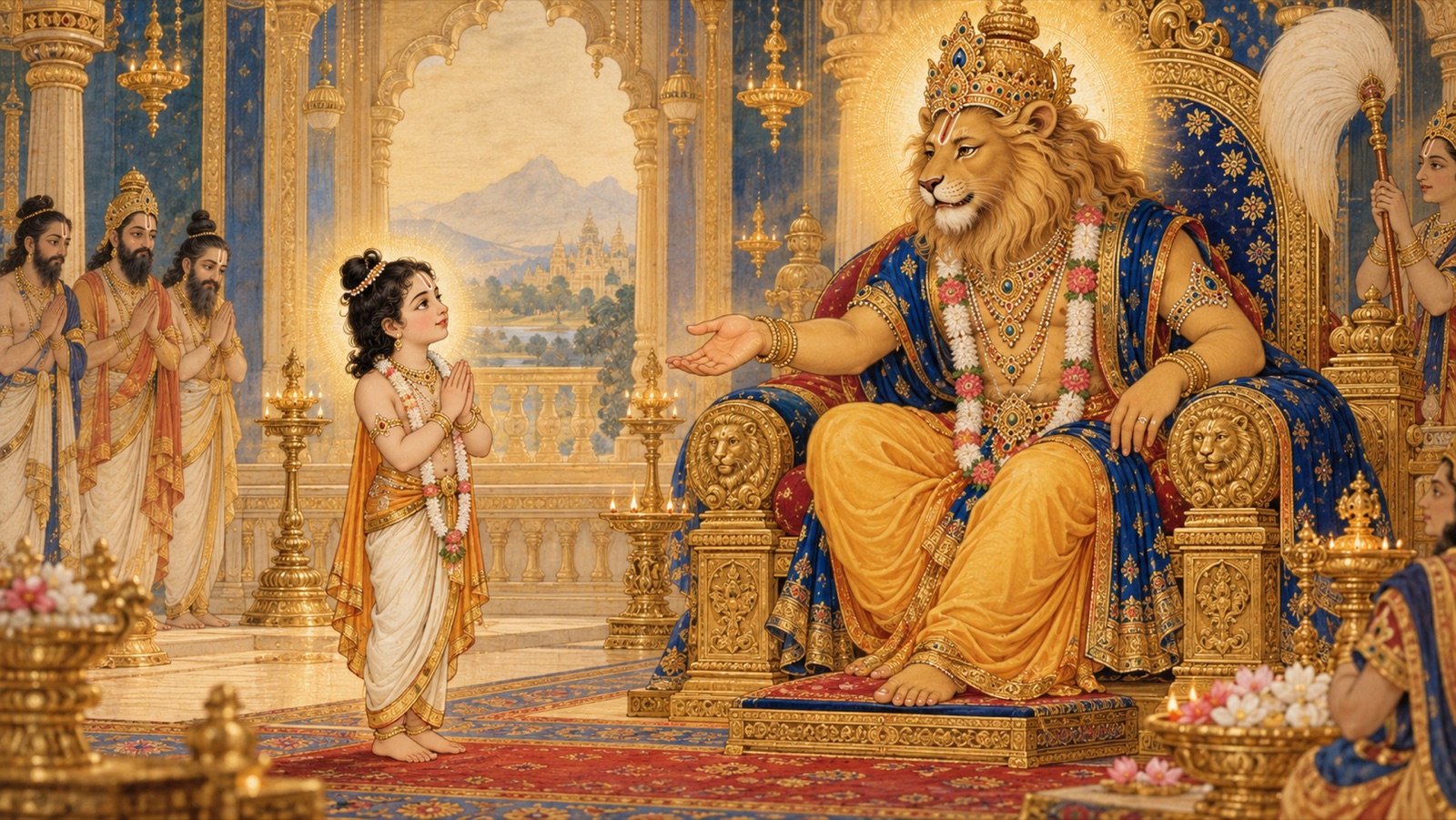
Prahlada then set forth the pure relationship between the Lord and His devotee — a bond untouched by any bargain. He was a devotee with no craving; the Lord was a master with no motive; and between them there was nothing of the calculation that governs a king and his hired servant.
अहं त्वकामस्त्वद्भक्तस्त्वं च स्वाम्यनपाश्रय: । नान्यथेहावयोरर्थो राजसेवकयोरिव ॥ ६ ॥
ahaṁ tv akāmas tvad-bhaktas tvaṁ ca svāmy anapāśrayaḥ nānyathehāvayor artho rāja-sevakayor iva
Meaning: I am Your devotee, free of all desire, and You are my master, seeking nothing in return. Between us there is no other interest, as there is between a king and his servant. (SB 7.10.6)
And yet, since the Lord insisted on giving, Prahlada asked for the one gift that closes the door to every other want — that desire itself might never again arise within him:
यदि दास्यसि मे कामान्वरांस्त्वं वरदर्षभ । कामानां हृद्यसंरोहं भवतस्तु वृणे वरम् ॥ ७ ॥
yadi dāsyasi me kāmān varāṁs tvaṁ varadarṣabha kāmānāṁ hṛdy asaṁrohaṁ bhavatas tu vṛṇe varam
Meaning: O best of the bestowers of boons, if You will grant me a boon, then this alone I ask: that no desire may ever take root in my heart. (SB 7.10.7)
For with the very rise of desire, he explained, a person’s senses, mind, strength, righteousness, understanding, modesty, and truthfulness all slip away; only when the desires rooted in the heart are cast out does one become fit for divine glory.
A Prayer for His Father
The Lord, delighted, promised Prahlada undisturbed royal fortune through the age, and — better still — that he would go on hearing and remembering the Lord until, all fruitive activity set aside, he came home to Him at last (SB 7.10.11-13). But Prahlada had one more request — and it was not for himself. Bowing low, he named the grave fault plainly rather than excuse it: his father, not knowing the Lord’s true greatness, had raged against Him as the slayer of his own brother, and in that same blind anger had wronged Prahlada, the Lord’s devotee.
श्रीप्रह्राद उवाच वरं वरय एतत्ते वरदेशान्महेश्वर । यदनिन्दत्पिता मे त्वामविद्वांस्तेज ऐश्वरम् ॥ १५ ॥ विद्धामर्षाशय: साक्षात्सर्वलोकगुरुं प्रभुम् । भ्रातृहेति मृषादृष्टिस्त्वद्भक्ते मयि चाघवान् ॥ १६ ॥ तस्मात्पिता मे पूयेत दुरन्ताद् दुस्तरादघात् । पूतस्तेऽपाङ्गसंदृष्टस्तदा कृपणवत्सल ॥ १७ ॥
śrī-prahrāda uvāca varaṁ varaya etat te varadeśān maheśvara yad anindat pitā me tvām avidvāṁs teja aiśvaram
viddhāmarṣāśayaḥ sākṣāt sarva-loka-guruṁ prabhum bhrātṛ-heti mṛṣā-dṛṣṭis tvad-bhakte mayi cāghavān
tasmāt pitā me pūyeta durantād dustarād aghāt pūtas te ‘pāṅga-saṁdṛṣṭas tadā kṛpaṇa-vatsala
Meaning: Prahlada said: O Supreme Lord, grant me only this: since my father did not know Your true power, he spoke against You in anger, mistaking You for his brother’s killer, and in that same delusion he wronged me, Your devotee. For that offence, O Lord who is tender to the fallen, let him be made pure by Your merciful glance. (SB 7.10.15-17)
The Lord answered that Hiranyakasipu had already been purified — indeed that Prahlada’s very birth had sanctified twenty-one generations of his line. Wherever such tranquil, noble-hearted devotees are born, He said, the very land is made holy.
The Model Devotee
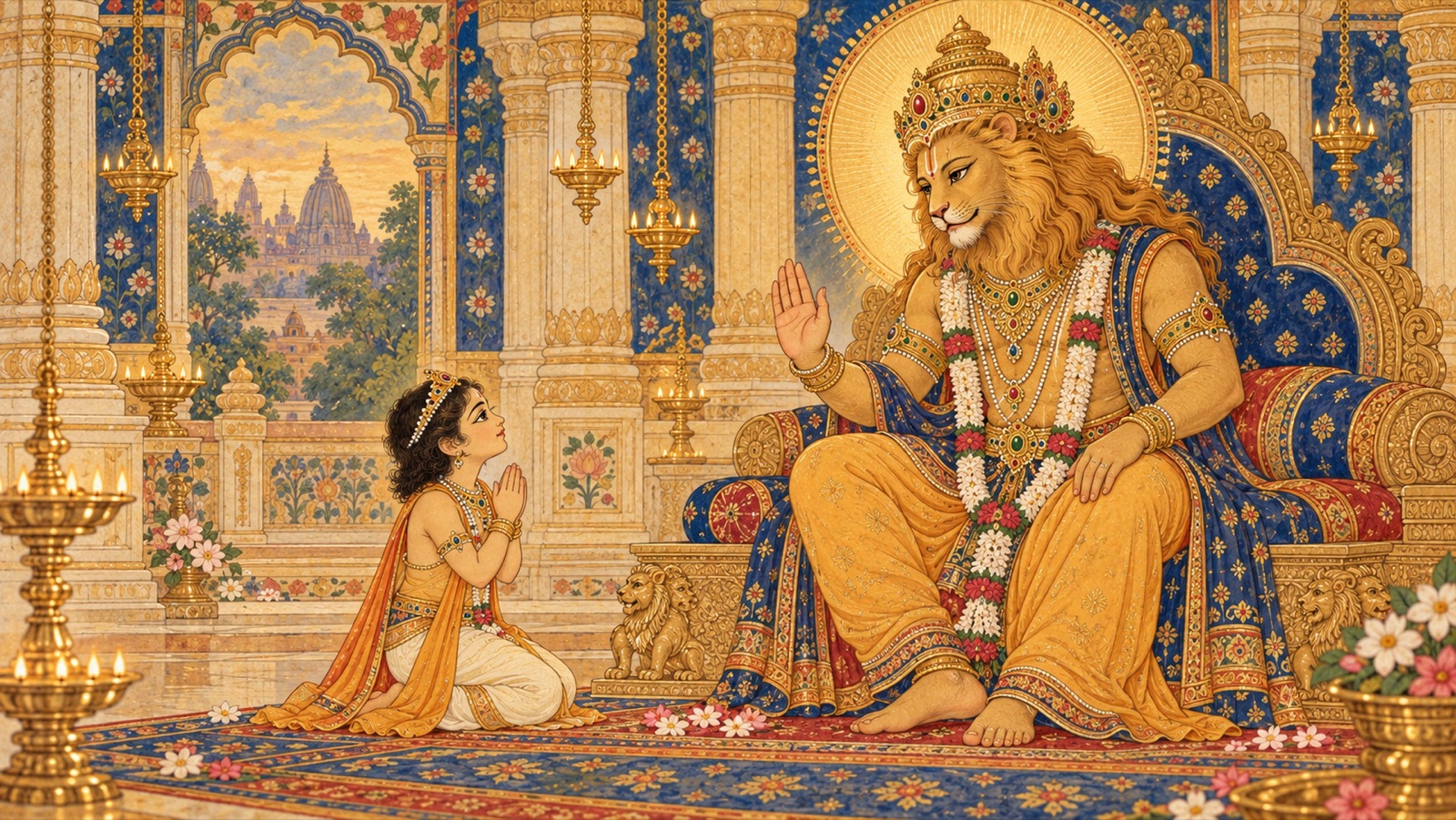
Then the Lord bestowed upon Prahlada the honour that crowns the whole story: that those who follow his path would become the Lord’s own devotees, and that Prahlada himself would stand as the very model of devotion for all time.
भवन्ति पुरुषा लोके मद्भक्तास्त्वामनुव्रता: । भवान्मे खलु भक्तानां सर्वेषां प्रतिरूपधृक् ॥ २१ ॥
bhavanti puruṣā loke mad-bhaktās tvām anuvratāḥ bhavān me khalu bhaktānāṁ sarveṣāṁ pratirūpa-dhṛk
Meaning: Those in this world who follow your example will become My devotees. Indeed, you shall be the model for all My devotees. (SB 7.10.21)
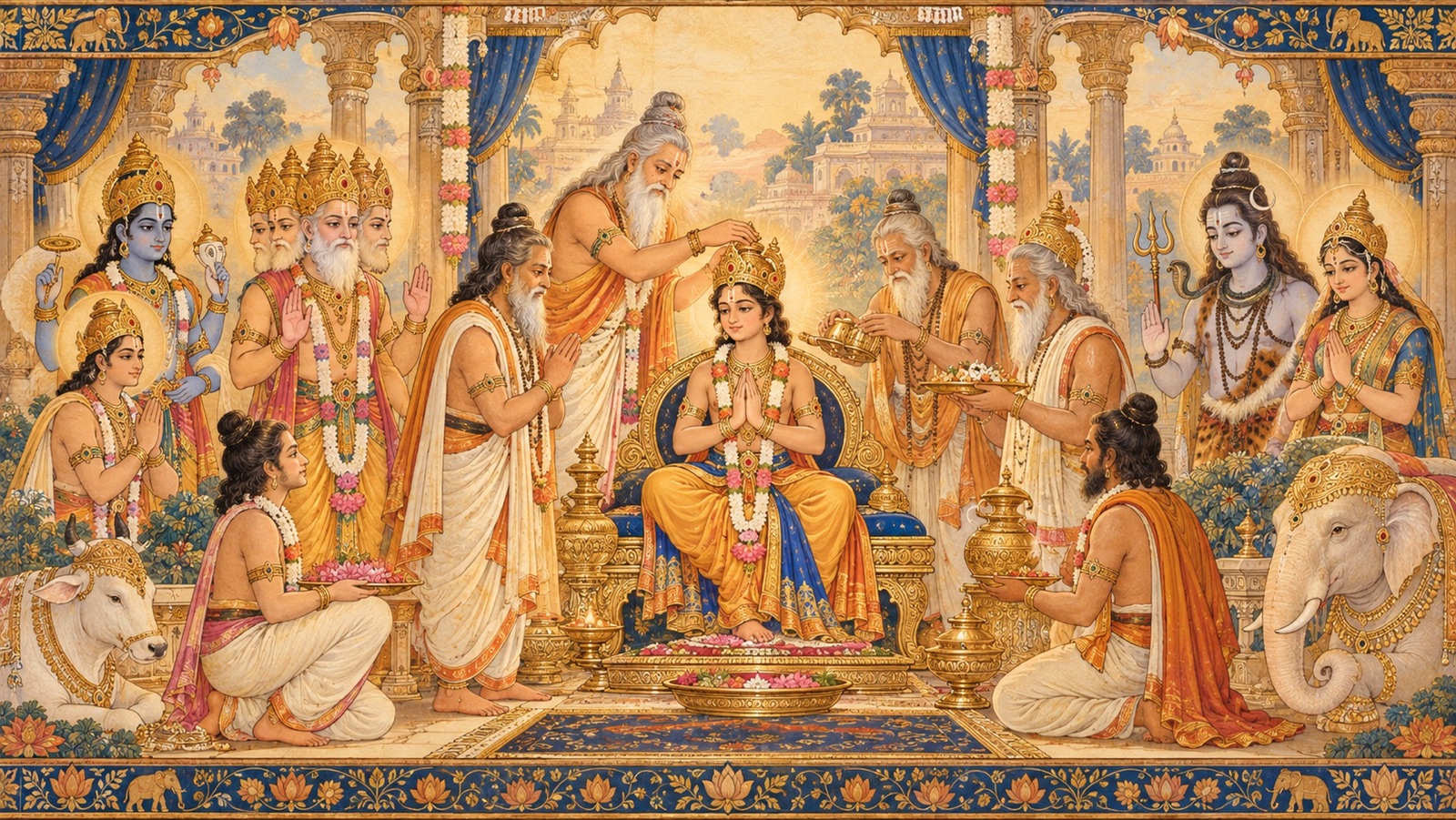
Just before this, the Lord had named the very quality that makes such devotion possible: because Prahlada’s heart was fixed on Him alone, he could no longer see any being as higher or lower, and envy of no one could find a place in him (SB 7.10.20). The Lord bade Prahlada perform the funeral rites for his father, who through so noble a son would attain the higher worlds, and to accept his father’s throne, ruling with his mind ever fixed on Him. Prahlada carried out the last rites as the Lord had commanded and was crowned king of the Daityas by the foremost of the sages, while Brahma and the gods offered their blessings.
The Hidden Story
Before disappearing, the Lord gently instructed Brahma to grant no more such boons to the cruel, for a gift to the cruel is like milk fed to a serpent. Then, worshipped by Brahma, the Lord vanished from that very spot. Narada closed the narrative by revealing the secret behind it all. Hiranyakasipu and his brother Hiranyaksa were, in truth, none other than Jaya and Vijaya, the two doorkeepers of the Lord’s own abode, cursed by the sages to be born in the world. Through lifetime after lifetime — as those demons, then as Ravana and Kumbhakarna slain by Sri Rama, then as Sisupala and Dantavakra in the age of Sri Krishna — they returned again and again, and by their very intensity of remembrance, even in enmity, were at last merged into the Lord. As a caterpillar becomes a wasp by constant thought of it, so these souls, their minds fixed on the Lord even as foes, attained Him in the end.
Why should hatred of God end in reaching Him? Because the Lord is the one reality every soul is already made to rest in, and whichever shape the mind’s absorption in Him takes — love, fear, or fury — it is still the mind coming to rest on Him and nothing else (SB 7.10.38-40). This is why Jaya and Vijaya, cursed to oppose Him life after life, could never truly escape Him: their very enmity kept their thoughts nailed to His form. No devotee is ever advised to seek God through hatred — that road opens only by the Lord’s own arrangement, for souls already His own. What it teaches instead is the worth of undivided remembrance: the same constancy that trapped Hiranyakasipu in opposition is, turned toward love, the very thing Prahlada asked for when he prayed that nothing but the Lord take root in his heart.
Principal Teachings of This Chapter
1. A true devotee asks nothing in return. Prahlada declines every worldly boon; one who serves God for a reward, he says, is a merchant, not a servant. Love that seeks a wage is not yet love (SB 7.10.4-6).
2. The highest gift is freedom from desire. The one boon Prahlada requests is that desire never again take root in his heart — for desire is the source of every fall, and its absence the doorway to divine glory (SB 7.10.7-9).
3. Devotion forgives and uplifts others. Prahlada’s first thought after his own blessing is his father’s forgiveness. A saint’s birth sanctifies a whole lineage, and true devotion always turns outward in mercy (SB 7.10.15-19).
4. Prahlada is the model of the devotee. The Lord Himself declares Prahlada the pattern for all devotees to come — desireless, humble, forgiving, and wholly surrendered (SB 7.10.21).
5. A heart fixed on the Lord has no room for envy. Because his devotion admitted no rival object, Prahlada could no longer see any living being as lower or higher than himself (SB 7.10.20).
6. Even enmity toward God, held with unbroken intensity, can end in reaching Him. Jaya and Vijaya returned birth after birth as the Lord’s foes — Hiranyakasipu and Hiranyaksa, then Ravana and Kumbhakarna, then Sisupala and Dantavakra — and because their minds never left Him, they were finally drawn into Him; the lesson for a devotee is to seek that same constancy through love (SB 7.10.35-40).
A Devotional Reflection
There is something almost startling in Prahlada’s refusal. Offered anything at all by the Lord of the universe, he wants nothing — and the reason he gives is piercingly honest: he knows his own heart. He knows that to ask for pleasure would be to feed the very attachment he has come to escape, and that the one who bargains with God, even for good things, has quietly turned love into commerce. So he asks instead for the only gift that makes all others unnecessary: a heart in which desire can no longer grow. This is the secret of his peace. And notice where his freedom leads him — not to self-satisfaction, but straight to concern for his father, the very man who had tried to kill him. A heart emptied of craving has room for others; a heart forgiven of its own hunger can forgive. Prahlada shows us that the summit of devotion is not to get more from God, but to want nothing but God, and to carry that fullness outward as mercy toward all.
A Daily Devotional Practice
Today, in your prayer, ask God for less rather than more. Instead of presenting a list of wants, offer one simple request in Prahlada’s spirit — that your heart be freed from the restless craving that never satisfies, and filled instead with love for the Lord. As you do, repeat within: “Om Namo Bhagavate Vasudevaya.” Then, like Prahlada, let that peace overflow into forgiveness: silently pardon someone who has wronged you, and wish them well before the Lord.
Conclusion
This chapter leaves behind one measure of a devotee: offered anything at all, Prahlada asks only that desire never touch his heart again, then spends that very freedom on mercy for the father who had wronged him. Narada’s closing word carries the same truth further still — that even souls who opposed the Lord for lifetime after lifetime were, by their sheer constancy of remembrance, finally drawn home to Him. What this chapter asks of us is not complicated, only immense: to want nothing but God, and to hold Him so steadily in the heart that nothing — not desire, not old wounds, not even enmity — can pull the mind away.
May the divine wisdom of Srimad Bhagavatam awaken pure devotion within our hearts.
Om Namo Bhagavate Vasudevaya.
Jay Shree Madhav.
References and Attribution
- Primary edition: Gita Press, Śrīmad Bhāgavata Mahāpurāṇa (English, complete), Book Seven, Discourse 10, pages 698–704.
- Series: Srimad Bhagavatam Wisdom · Biswa Sanatan Dharma Seva Trust.
- Presented following the spiritual guidance and recommendation of Pandit Dr. Shri Kashinath Mishra.
This is an original, faithful retelling in the writer’s own words, with brief quoted verses shown in Devanāgarī and transliteration and their meanings given as summaries. It is not a reproduction of any single publisher’s continuous translation or commentary. No affiliation with or endorsement by any publisher is implied.
Jay Shree Madhav