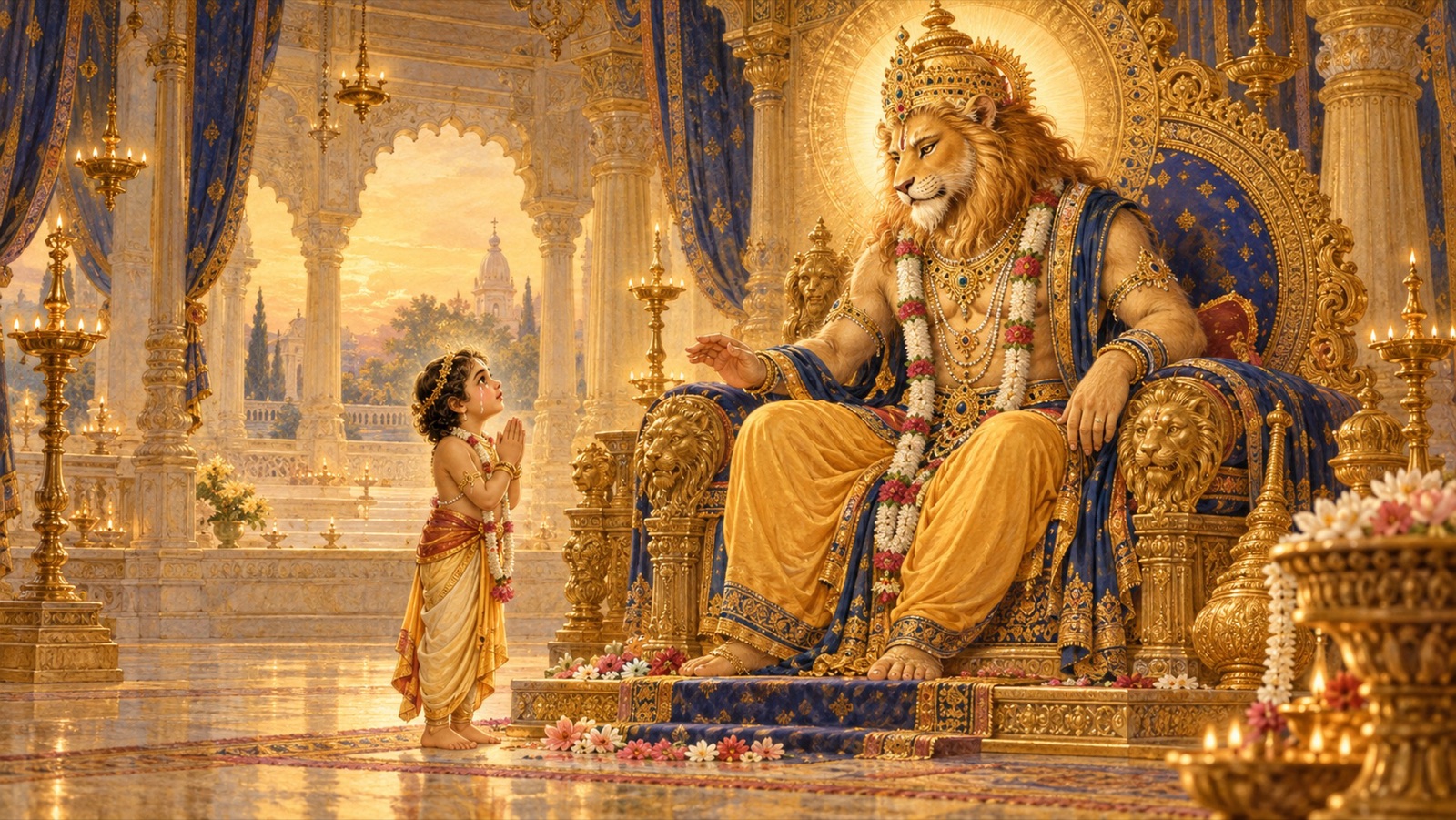
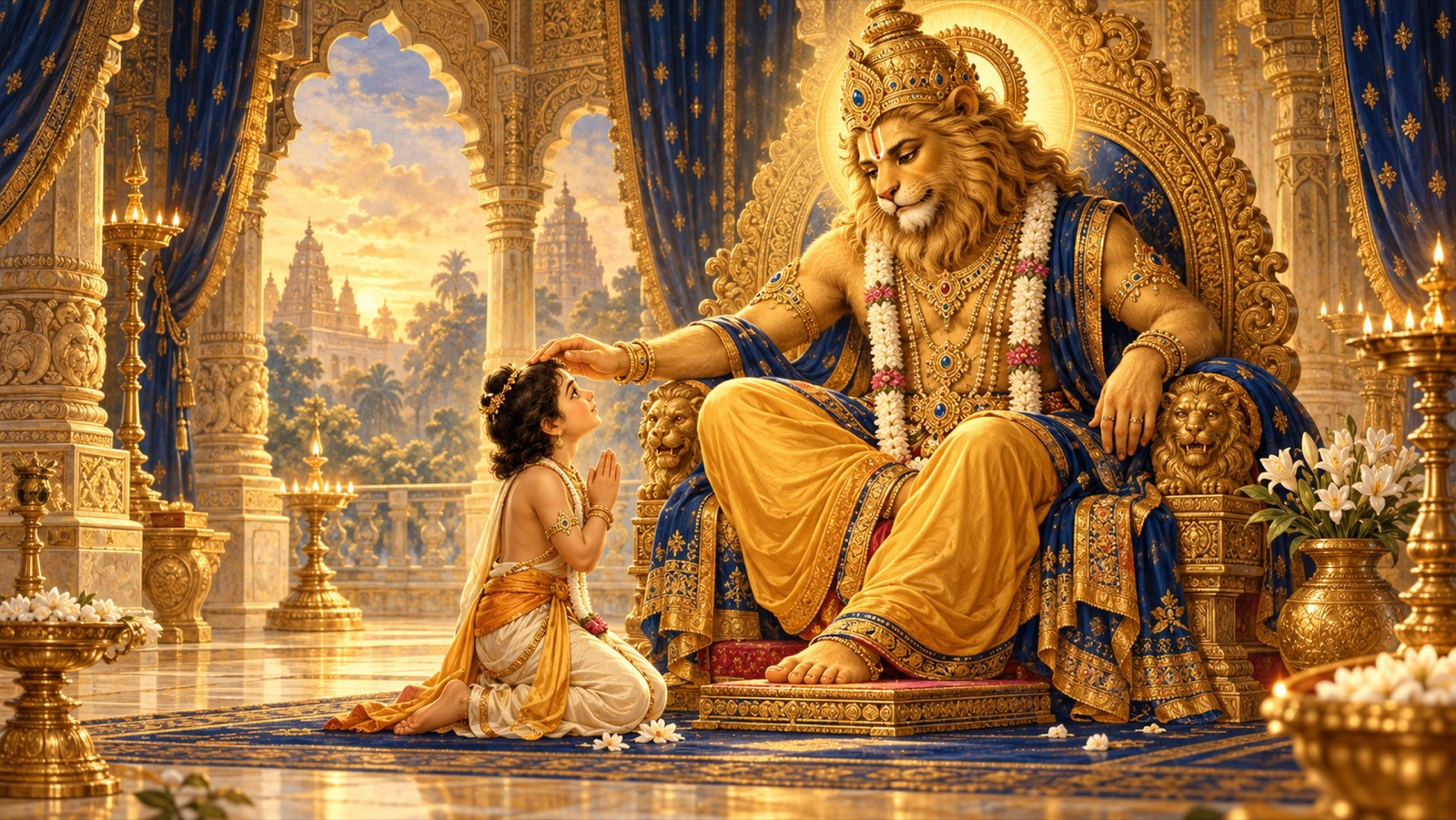
When the gods themselves dared not approach the wrathful Lord, a small boy walked forward, bowed to the ground, and was lifted up by the Lord’s own hand. What poured from his heart then is one of the most beloved prayers in all of scripture.
Om Namo Bhagavate Vasudevaya.
Om Namo Bhagavate Vasudevaya.
Om Namo Bhagavate Vasudevaya.
Welcome to Srimad Bhagavatam Wisdom, a devotional journey through the sacred histories and teachings of the Srimad Bhagavat Mahapurana. In the previous chapter the Lord appeared as Narasimha and delivered the world from the tyrant Hiranyakasipu; this ninth chapter of the Seventh Canto is its tender sequel, in which a small boy’s prayer succeeds where the gods themselves feared even to draw near.
Chapter Information
- Scripture: Śrīmad Bhāgavata Mahāpurāṇa
- Canto: 7 (Book Seven)
- Chapter: 9
- Chapter title: Prahlada’s Prayers to Lord Narasimha
- Principal speaker: Prahlada, offering prayer to the Lord (within Narada’s narration to Emperor Yudhishthira)
- Principal listener: Lord Narasimha; and, in the frame, Emperor Yudhishthira
- Main setting: The court of Hiranyakasipu, before the enthroned Lord Narasimha
- Central subject: Prahlada’s prayer pacifying the Lord — on the futility of worldly qualifications, the supremacy of devotion, and his compassion for all suffering souls
- Principal verse range: Canto 7, Chapter 9, verses 1–55
- Primary edition: Gita Press Śrīmad Bhāgavata Mahāpurāṇa
The Child Approaches
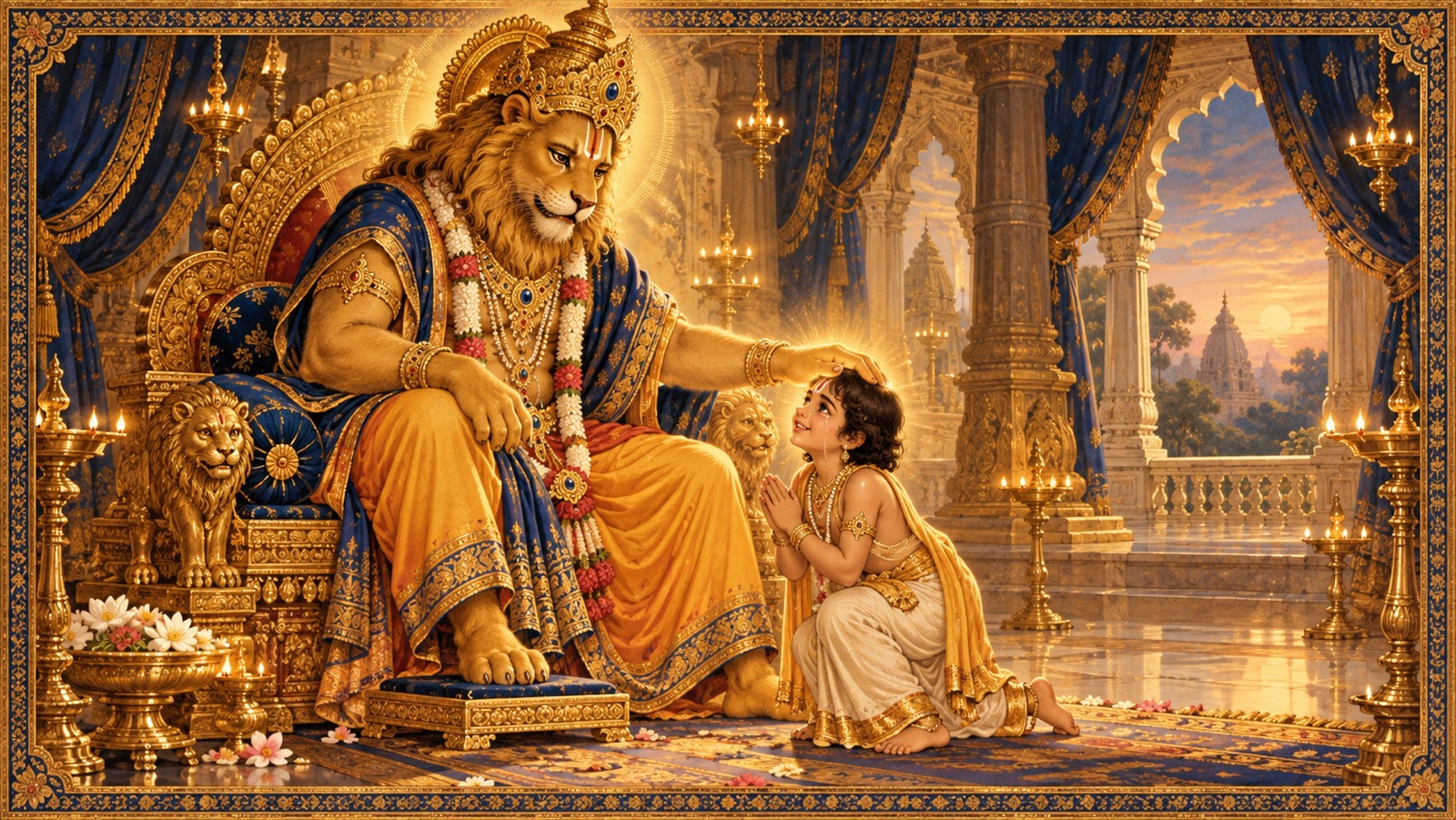
The gods and celestial beings, led by Brahma and Rudra, could not draw near the Lord, so terrible was His anger. The goddess Sri herself, sent to appease Him, hesitated before a form she had never seen or heard of before. Then Brahma turned to the child standing close by. “Approach, dear one,” he said, “and pacify the Lord, who has grown angry for your father’s sake.” Saying “So be it,” Prahlada drew slowly near and fell prostrate on the ground, his palms joined. Overwhelmed with compassion at the sight of the infant fallen at His feet, the Lord lifted him and placed upon his head the lotus hand that banishes all fear. At that touch every trace of impurity was wiped away, direct knowledge of the Supreme dawned within him, and — his hair standing on end, his eyes brimming with tears — Prahlada fixed the Lord’s feet within his heart and began to praise Him in a voice choked with love.
How Can I Praise You?
Prahlada began with disarming humility. If even Brahma, the gods, the sages, and the perfected beings, whose minds are absorbed in goodness, have not to this day satisfied the Lord with their streams of eloquent prayer — how, he asked, could one born of a fierce demon race hope to please Him?
श्रीप्रह्राद उवाच ब्रह्मादय: सुरगणा मुनयोऽथ सिद्धा: सत्त्वैकतानगतयो वचसां प्रवाहै: । नाराधितुं पुरुगुणैरधुनापि पिप्रु: किं तोष्टुमर्हति स मे हरिरुग्रजाते: ॥ ८ ॥
śrī-prahrāda uvāca brahmādayaḥ sura-gaṇā munayo ‘tha siddhāḥ sattvaikatāna-gatayo vacasāṁ pravāhaiḥ nārādhituṁ puru-guṇair adhunāpi pipruḥ kiṁ toṣṭum arhati sa me harir ugra-jāteḥ
Meaning: Prahlada said: Brahma and the hosts of gods, the sages, and the perfected ones, their minds wholly fixed on goodness, have not to this day been able to please Sri Hari with their streams of prayer rich in many virtues. How, then, can He be pleased by me, born of a ferocious race? (SB 7.9.8)
Yet he did not despair, for he knew that the Lord is won not by qualifications but by love. Neither wealth, nor noble birth, nor beauty, nor austerity, nor learning, nor strength, nor genius, he said, is enough to please the Supreme Person — the Lord was won by the mere devotion of a leader of elephants in distress. He went further still, declaring an outcaste who has surrendered his mind, words, and life to the Lord to be greater than a learned brahmana who has turned away from His feet:
विप्राद् द्विषड्गुणयुतादरविन्दनाभ- पादारविन्दविमुखात् श्वपचं वरिष्ठम् । मन्ये तदर्पितमनोवचनेहितार्थ- प्राणं पुनाति स कुलं न तु भूरिमान: ॥ १० ॥
viprād dvi-ṣaḍ-guṇa-yutād aravinda-nābha- pādāravinda-vimukhāt śvapacaṁ variṣṭham manye tad-arpita-mano-vacanehitārtha- prāṇaṁ punāti sa kulaṁ na tu bhūrimānaḥ
Meaning: I regard a person of the lowliest birth who has dedicated his mind, words, deeds, wealth, and very life to the lotus-navelled Lord as far greater than a brahmana endowed with all twelve noble qualities who has turned his face from those lotus feet; for the former sanctifies his whole family, while the latter, full of pride, cannot. (SB 7.9.10)
Let Your Anger Rest
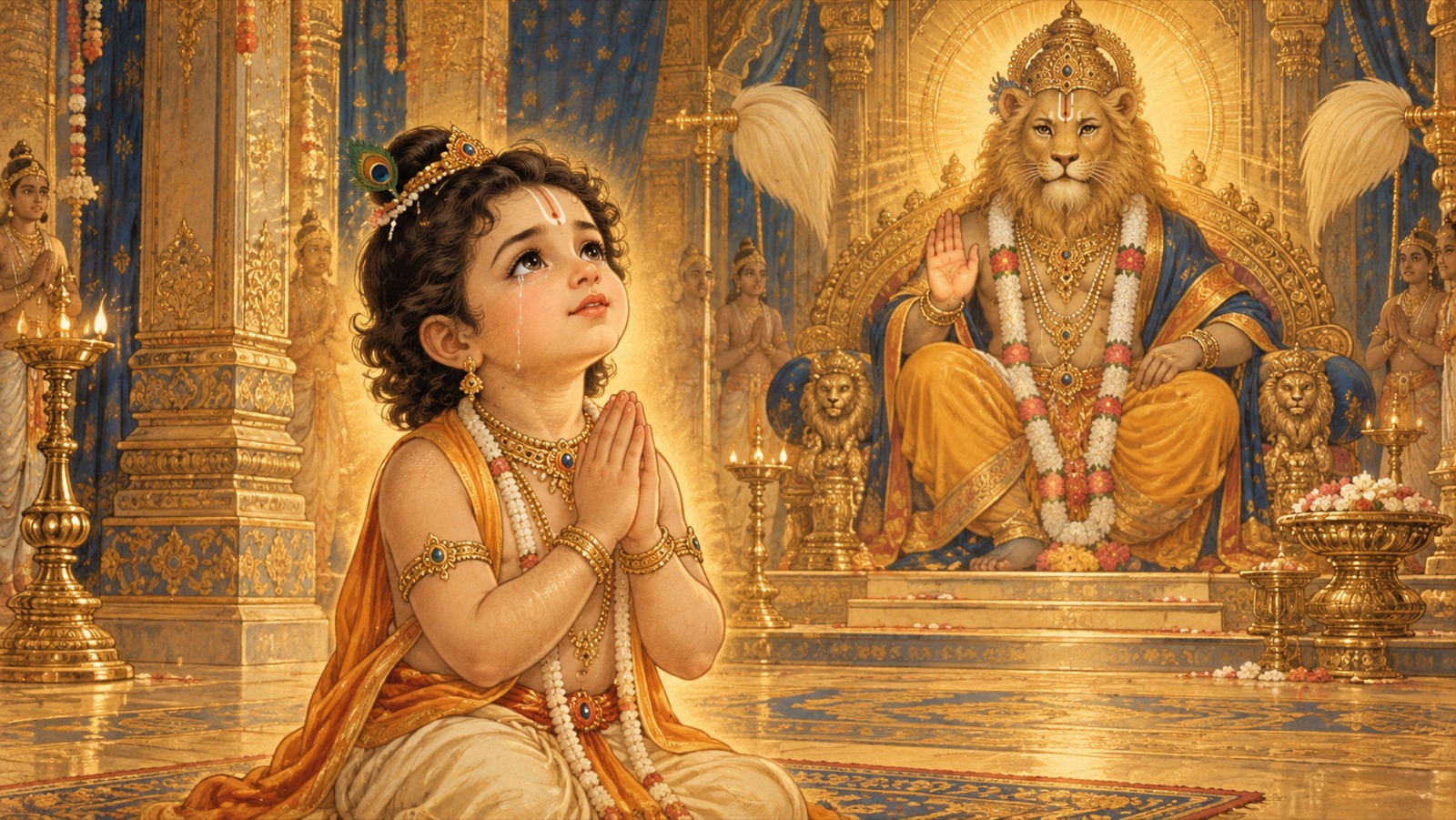
With his own fear entirely gone, Prahlada gently prayed the Lord to let His anger subside, now that the demon had been slain and all the worlds were at peace. Even the wrath of the Lord, he understood, was for the good of the world, as one is glad to be rid of a scorpion or a serpent; and people would remember this very form of Narasimha in ages to come as a refuge from fear. As for himself, he was not afraid of that fierce countenance. What frightened him was something else entirely — the endless round of birth and death, and being cast among cruel and grasping company. When, he asked, would the Lord be pleased to call him to the shelter of His feet?
A Mercy Never Shown Before
As his prayer continued, Prahlada marveled at something stranger still than the killing of his father. He, born in a race that stands for everything opposed to God, weighed down by the darkest of natures — what was he, that the Lord’s compassion should turn toward him at all? And then he named the wonder precisely: that very lotus hand, resting now upon his head, had never once been placed on the head of Brahma, nor of Rudra, nor even of Sri, the goddess of fortune who never leaves the Lord’s side.
क्वाहं रज:प्रभव ईश तमोऽधिकेऽस्मिन् जात: सुरेतरकुले क्व तवानुकम्पा । न ब्रह्मणो न तु भवस्य न वै रमाया यन्मेऽर्पित: शिरसि पद्मकर: प्रसाद: ॥ २६ ॥
kvāhaṁ rajaḥ-prabhava īśa tamo ‘dhike ‘smin jātaḥ suretara-kule kva tavānukampā na brahmaṇo na tu bhavasya na vai ramāyā yan me ‘rpitaḥ śirasi padma-karaḥ prasādaḥ
Meaning: Where am I, born in a family opposed to the gods and steeped in the mode of darkness, and where is Your compassion — which was shown neither to Brahma, nor to Shiva, nor even to Lakshmi, but which has placed Your lotus hand upon my head? (SB 7.9.26)
This is the point a devotee returns to again and again in this chapter: the Lord’s grace does not travel up the ladder of greatness, rewarding the exalted before the small. It runs, if anything, the other way. Brahma creates, Shiva dissolves, and Sri never leaves His side — yet it is the son of a demon, offering nothing but a broken voice and a surrendered heart, who receives this particular favor. Prahlada’s birth, his family, his past could not have earned it and did nothing to block it; that is the whole meaning of causeless mercy.
Fearless in the World, Grieving for the Fallen
Then came the words for which this prayer is most cherished. Prahlada declared that, with his mind plunged in the nectar of singing the Lord’s glories, he did not fear the terrible ocean of worldly existence at all. His sorrow was not for himself, but for others — for the deluded souls who turn away from God and carry the crushing burden of worldly life for the sake of fleeting, illusory pleasure.
नैवोद्विजे पर दुरत्ययवैतरण्या- स्त्वद्वीर्यगायनमहामृतमग्नचित्त: । शोचे ततो विमुखचेतस इन्द्रियार्थ मायासुखाय भरमुद्वहतो विमूढान् ॥ ४३ ॥
naivodvije para duratyaya-vaitaraṇyās tvad-vīrya-gāyana-mahāmṛta-magna-cittaḥ śoce tato vimukha-cetasa indriyārtha- māyā-sukhāya bharam udvahato vimūḍhān
Meaning: O Supreme Lord, my mind plunged in the great nectar of singing Your glories, I do not fear this hard-to-cross ocean of worldly existence. My grief is for the deluded souls who, turning their minds away from You, bear the heavy burden of worldly life for the sake of illusory sense pleasure. (SB 7.9.43)
Most sages, he observed, seek liberation quietly and alone, caring little for others; but he could not free himself while leaving these helpless ones behind. Wandering as they were through the world, he saw no shelter for them other than the Lord.
प्रायेण देव मुनय: स्वविमुक्तिकामा मौनं चरन्ति विजने न परार्थनिष्ठा: । नैतान्विहाय कृपणान्विमुमुक्ष एको नान्यं त्वदस्य शरणं भ्रमतोऽनुपश्ये ॥ ४४ ॥
prāyeṇa deva munayaḥ sva-vimukti-kāmā maunaṁ caranti vijane na parārtha-niṣṭhāḥ naitān vihāya kṛpaṇān vimumukṣa eko nānyaṁ tvad asya śaraṇaṁ bhramato ‘nupaśye
Meaning: O Lord, most sages, desiring their own liberation, dwell silently in solitude, unconcerned with others’ good. But I do not wish to be liberated alone, leaving behind these poor, helpless souls; for I see no shelter for them, wandering as they are, other than You. (SB 7.9.44)
The Whole World Is His
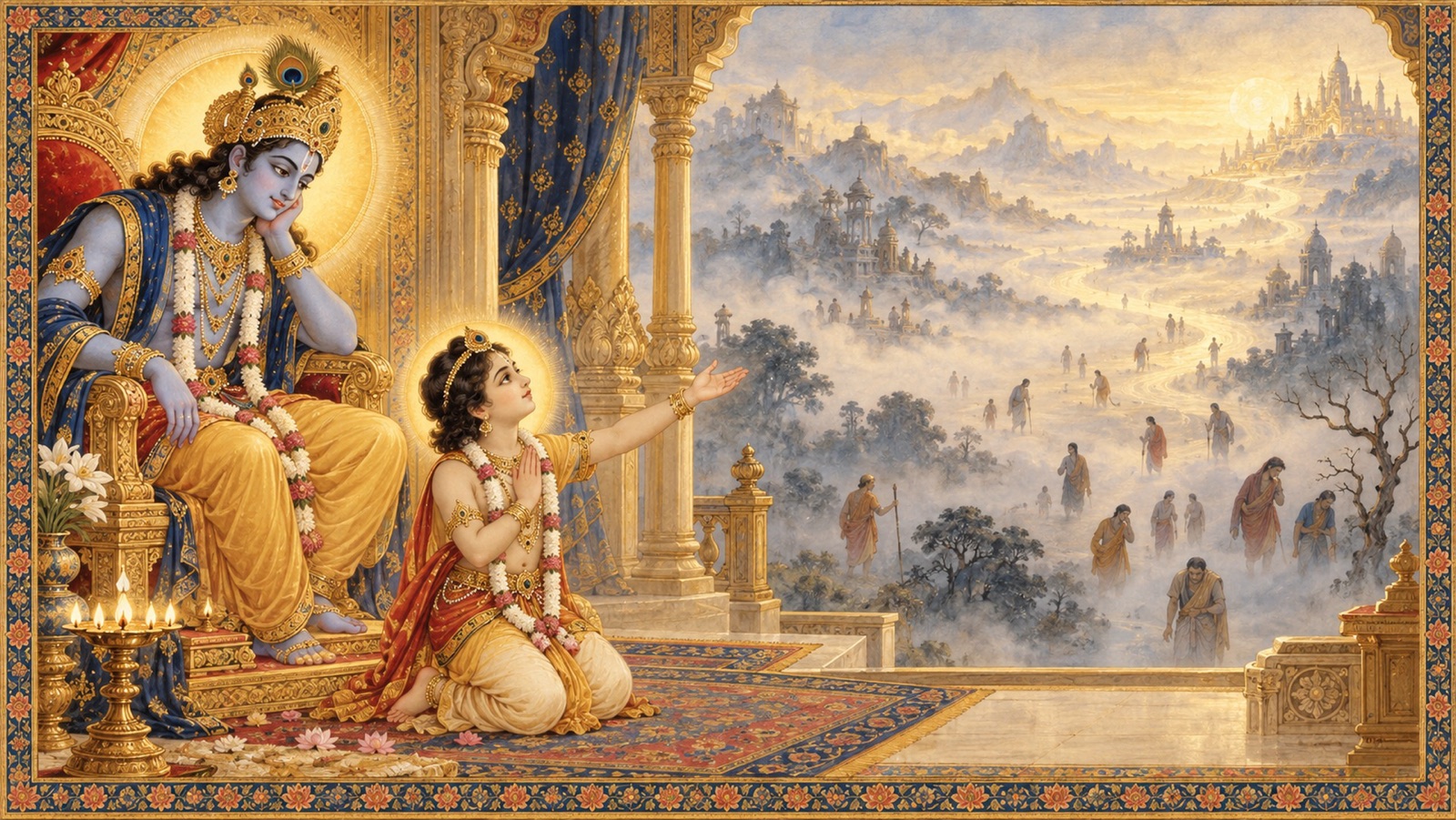
Prahlada went on to glorify the Lord as the sole reality behind all things — the source, the doer, and the goal of every action, so that whatever anyone makes or does, by whatever means, is in truth nothing other than the Lord. He spoke of Maya, the beginningless illusion set in motion by Time, spinning the wheel of birth and death, which none who is averse to the Lord can cross. He prayed to be drawn up out of that wheel and kept always in the company of devotees, ever repeating the soul-enthralling stories of his beloved Friend and Lord. In parents, in medicine, in every worldly remedy, he said, there is no true protection; the only sure refuge is the Lord Himself. His prayer, from first to last, is the confession of a soul that has found its whole security in God and longs to share that security with all.
Wanting Nothing But Service
Hearing this prayer offered from a heart fixed wholly on Him, Lord Narasimha set His anger aside. Turning to Prahlada with great affection, He blessed him with a long life and told him plainly: it is by pleasing Me, and by nothing else, that any being finds real satisfaction; ask, then, for whatever boon you desire, for I delight in fulfilling the wishes of those who love Me.
श्रीनारद उवाच एवं प्रलोभ्यमानोऽपि वरैर्लोकप्रलोभनै: । एकान्तित्वाद् भगवति नैच्छत्तानसुरोत्तम: ॥ ५५ ॥
śrī-nārada uvāca evaṁ pralobhyamāno ‘pi varair loka-pralobhanaiḥ ekāntitvād bhagavati naicchat tān asurottamaḥ
Meaning: Narada Muni said: Though tempted in this way with boons that allure the whole world, that best of the demon race did not desire them, for his devotion to the Lord admitted of nothing else. (SB 7.9.55)
Here is the quiet answer to everything Prahlada has prayed. Offered the very rewards that draw the rest of creation — wealth, power, position, the fulfillment of every worldly want — he simply has no room left for them; his one attachment is already spent on the Lord Himself. This is what the whole prayer has been building toward: not renunciation as a hardship, but a heart so filled with love that lesser things cannot find a place in it.
Principal Teachings of This Chapter
1. Grace comes first; qualifications follow. Prahlada is purified and enlightened not by his own effort but by the touch of the Lord’s hand. The spiritual life begins in grace received, not merit earned (SB 7.9.5-6).
2. Devotion, not status, wins the Lord. Wealth, birth, learning, and austerity cannot by themselves please God; sincere love can, even from the lowliest. A humble devotee is greater than a proud scholar (SB 7.9.8-10).
3. The true fear is not danger but forgetfulness of God. Prahlada is unafraid of the fierce Lord and even of the world; what he laments is a life turned away from God for the sake of passing pleasure (SB 7.9.43).
4. Real devotion overflows into compassion for all. Prahlada refuses to seek liberation for himself alone, praying instead for every wandering soul. Love of God and love of all beings are one movement of the heart (SB 7.9.44).
5. Causeless mercy answers to no rank. The Lord’s hand, never placed even on Brahma, Shiva, or Sri, rests on a demon’s child; and when finally offered any boon at all, Prahlada wants none of them, his heart already full of the Lord (SB 7.9.26, 55).
A Devotional Reflection
Of all that Prahlada says, the most piercing is that he is not afraid for himself. He has just watched his own father struck down; he stands before a form so terrible the gods dare not approach — and yet his heart is at rest, because it is “plunged in the nectar of singing the Lord’s glories.” That is the secret the whole chapter offers us: that a mind absorbed in God is simply beyond the reach of fear. But Prahlada does not keep this peace to himself. The moment he is secure, his thoughts turn outward, toward the confused multitudes still chasing fleeting shadows for their happiness. He will not be saved alone. There is no gentler rebuke to our ordinary selfishness, and no clearer picture of what devotion finally makes of a person: not someone who escapes the world, but someone who, having found refuge, cannot bear to see others without it. To pray for the whole world, as a child once prayed before the Lion of God, is the highest reach of the loving heart.
A Daily Devotional Practice
Today, let your prayer include someone besides yourself. After your own remembrance of the Lord, pause and sincerely pray for a few others — a struggling friend, a stranger, even someone difficult — that they too may find shelter and peace in God. As you do, repeat within: “Om Namo Bhagavate Vasudevaya.” Let this small widening of the heart be a share in Prahlada’s prayer, which sought liberation not for himself alone but for every wandering soul.
Conclusion
The ninth chapter of the Seventh Canto shows the sweetness on the far side of the Lord’s fierceness: a child’s love, where even the gods dared not go, pacifies Him completely. Prahlada’s prayer teaches that devotion alone wins the Lord, and that His mercy can reach lowest before it reaches the great. It teaches, too, that a heart secure in God fears nothing for itself, and grieves only for others still lost. And when the Lord finally offers any boon at all, Prahlada wants none of them; his love was never a transaction. That is the summit this chapter climbs toward: a devotion so complete it desires only to serve, and to see every wandering soul brought home.
May the divine wisdom of Srimad Bhagavatam awaken pure devotion within our hearts.
Om Namo Bhagavate Vasudevaya.
Jay Shree Madhav.
References and Attribution
- Primary edition: Gita Press, Śrīmad Bhāgavata Mahāpurāṇa (English, complete), Book Seven, Discourse 9, pages 689–697.
- Series: Srimad Bhagavatam Wisdom · Biswa Sanatan Dharma Seva Trust.
- Presented following the spiritual guidance and recommendation of Pandit Dr. Shri Kashinath Mishra.
This is an original, faithful retelling in the writer’s own words, with brief quoted verses shown in Devanāgarī and transliteration and their meanings given as summaries. It is not a reproduction of any single publisher’s continuous translation or commentary. No affiliation with or endorsement by any publisher is implied.
Jay Shree Madhav