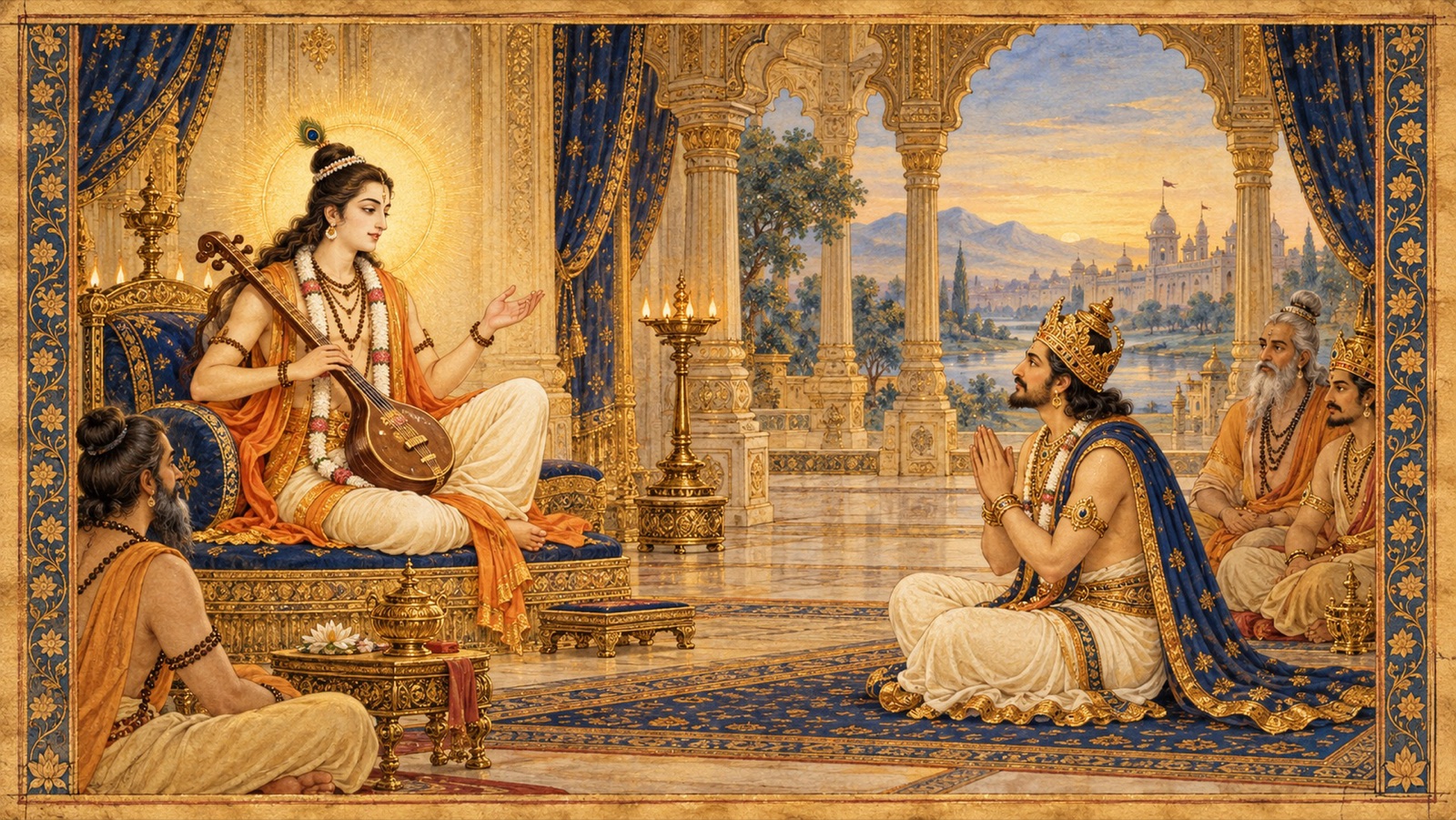
Having heard the story of Prahlada, Emperor Yudhishthira asked a larger question: how should a human being actually live? Narada’s answer is one of scripture’s clearest maps of a righteous life — a path open to every soul, in every station, that leads at last to the Lord.
Om Namo Bhagavate Vasudevaya.
Om Namo Bhagavate Vasudevaya.
Om Namo Bhagavate Vasudevaya.
Welcome to Srimad Bhagavatam Wisdom, a devotional journey through the sacred histories and teachings of the Srimad Bhagavat Mahapurana. The tenth chapter closed the great story of Prahlada. Now, in this eleventh chapter of the Seventh Canto, Emperor Yudhishthira turns from the tale to its living lesson and asks the sage Narada a plain but weighty question: what is the eternal course of right conduct for human beings? Narada answers with a luminous summary of sanatana-dharma — first the thirty marks of virtue that belong to every person without exception, and then the particular duties and qualities of the four social orders and of a devoted wife. Throughout, the teaching keeps returning to one root: that the true source of all right conduct is the Lord Himself, and that the whole purpose of duty is to purify the heart until it rests in Him.
Chapter Information
- Scripture: Śrīmad Bhāgavata Mahāpurāṇa
- Canto: 7 (Book Seven)
- Chapter: 11
- Chapter title: The Eternal Dharma and the Four Social Orders
- Principal speaker: The sage Narada
- Principal listener: Emperor Yudhishthira
- Main setting: The assembly of Emperor Yudhishthira, in the course of Narada’s discourse
- Central subject: The eternal law of right conduct — the thirty universal marks of virtue, the duties and characteristics of the four orders of society, and the duties of a devoted wife
- Principal verse range: Canto 7, Chapter 11, verses 1–35
- Primary edition: Gita Press Śrīmad Bhāgavata Mahāpurāṇa
Yudhishthira’s Question
Having heard the narrative of Prahlada — celebrated even in the assemblies of the pious — Yudhishthira was filled with joy and inquired further of Narada. He longed to hear about the eternal Dharma prescribed for human beings, together with the code that governs the four Varnas (grades of society) and the four Asramas (stages of life), by following which a person at last reaches the Supreme. And he asked it of the right teacher, for Narada is the mind-born and best-beloved son of Brahma, purified by asceticism, concentration, and deep meditation. Only tranquil, kind-hearted souls devoted to Lord Narayana, Yudhishthira observed, truly know the highest and most guarded conception of virtue.
The Law Learned from Narayana
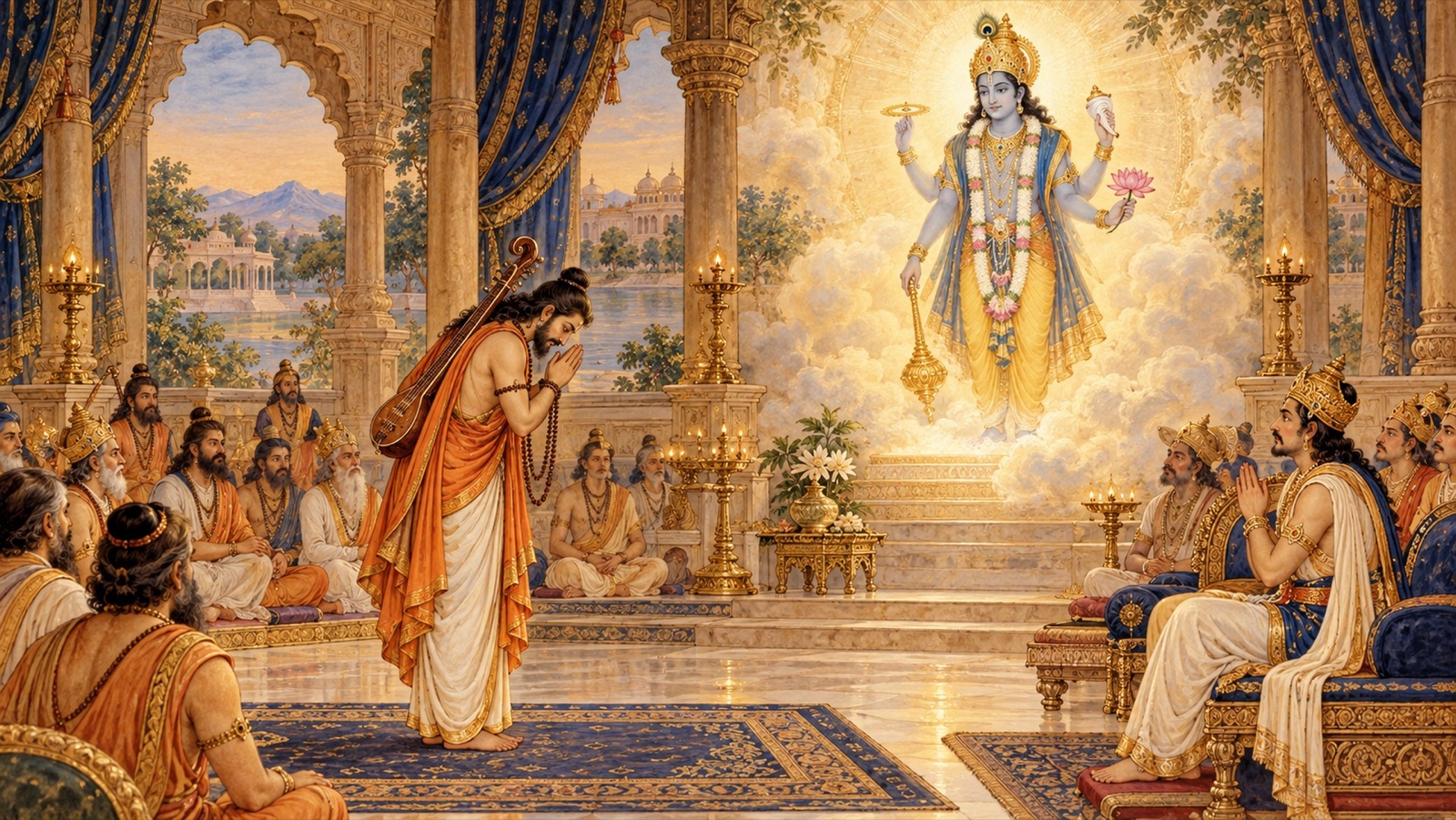
Narada began by bowing to the birthless Lord, the promoter of righteousness among all beings, and declared that he would expound the eternal Law exactly as he had learned it from the lips of the divine sage Narayana — who, along with His companion Nara, still practises austerities at Badarikashrama for the good of the world. Then he named the true foundation of all Dharma. Right conduct does not rest merely upon custom or human opinion; its very root is the Lord Himself, who is the embodiment of all the Vedas, together with the codes handed down by the wise and the settled satisfaction of a purified heart:
धर्ममूलं हि भगवान्सर्ववेदमयो हरि: । स्मृतं च तद्विदां राजन्येन चात्मा प्रसीदति ॥ ७ ॥
dharma-mūlaṁ hi bhagavān sarva-vedamayo hariḥ smṛtaṁ ca tad-vidāṁ rājan yena cātmā prasīdati
Meaning: The very root of Dharma is the Lord Sri Hari, the embodiment of all the Vedas; so too are the codes handed down by those who know Him, O king, and that inner satisfaction by which the self is pleased. (SB 7.11.7)
Narada’s definition carries a deliberate weight. He does not root Dharma in custom, opinion, or even the codes of the wise taken by themselves — he places its very source in Bhagavan, and its test not in outward form but in whether the self is genuinely satisfied. This is why, verses later, the thirty universal virtues do not stop at truthfulness and self-mastery but climb, deliberately, to hearing, chanting, and surrendering to the Lord — for a duty that stops short of Him is only half performed. The Varnas and Asramas that follow are real Dharma only so far as they, too, carry the heart toward that same surrender; agriculture, sacrifice, protection, and service are not ends in themselves but a scaffolding raised for one purpose — to make the soul fit to rest in Hari.
The Thirty Marks of Virtue
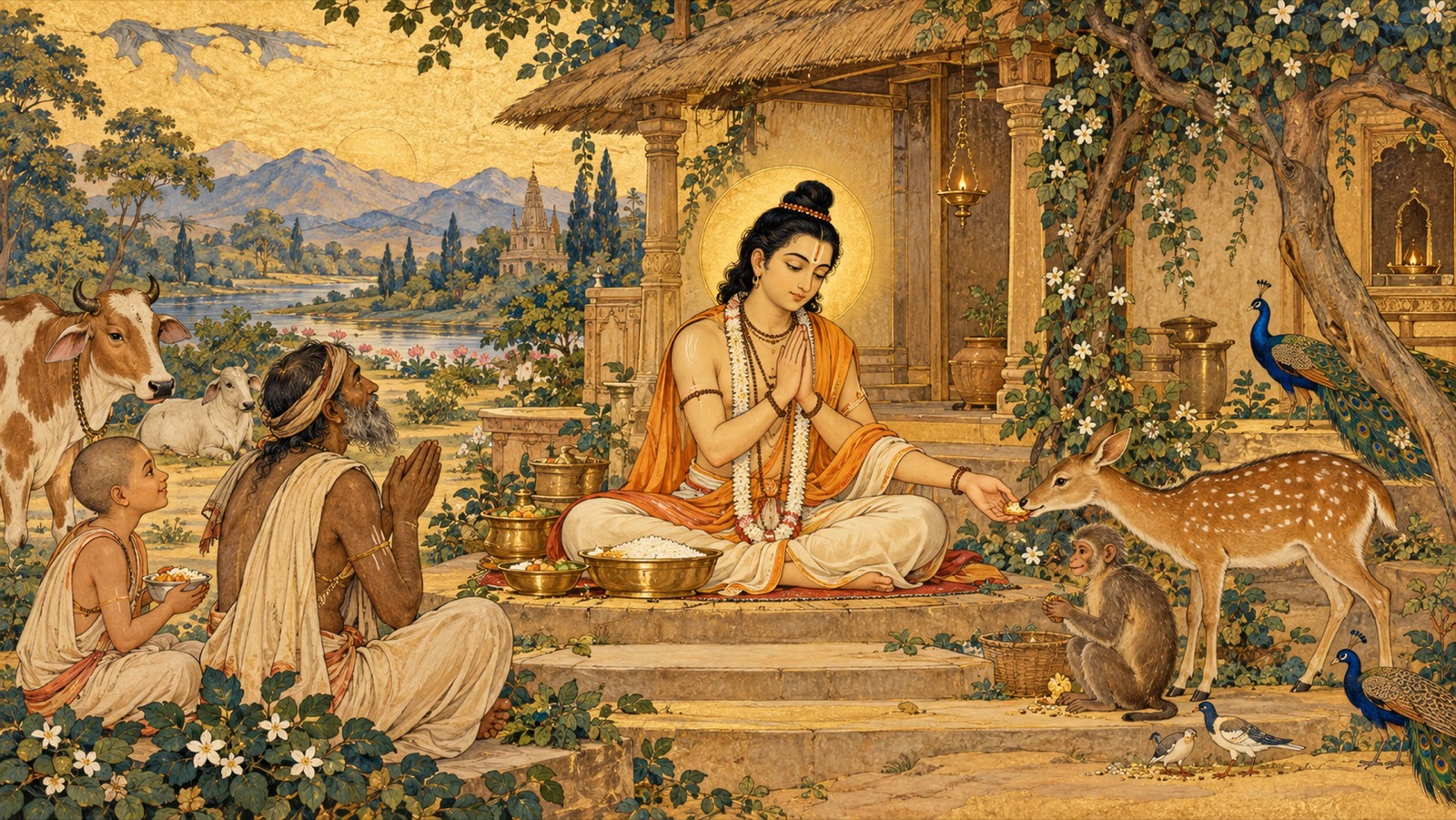
Before dividing duty by order or station, Narada set down the virtues that belong to every human being alike — the general Dharma from which all particular duties draw their life. He listed thirty marks by which the Lord, the Soul of all, is pleased: truthfulness, compassion, austerity, purity, endurance, discrimination, control of the mind and of the senses, non-violence, continence, renunciation, study of scripture, straightforwardness, contentment, service of those who look upon all equally, gradual withdrawal from worldless pursuits, reflection on the fruitlessness of selfish action, restraint of idle speech, inquiry into the Self, the equitable sharing of food and necessities with all beings — regarding them, and human beings especially, as one’s own self and the very abode of God — and, crowning them all, the ninefold devotion: hearing, chanting, and remembering the Lord, waiting upon, worshipping, and bowing to Him, offering the fruit of one’s work, treating Him as one’s dearest friend, and finally offering one’s very self to Him.
सत्यं दया तप: शौचं तितिक्षेक्षा शमो दम: । अहिंसा ब्रह्मचर्यं च त्याग: स्वाध्याय आर्जवम् ॥ ८ ॥ सन्तोष: समदृक्सेवा ग्राम्येहोपरम: शनै: । नृणां विपर्ययेहेक्षा मौनमात्मविमर्शनम् ॥ ९ ॥ अन्नाद्यादे: संविभागो भूतेभ्यश्च यथार्हत: । तेष्वात्मदेवताबुद्धि: सुतरां नृषु पाण्डव ॥ १० ॥ श्रवणं कीर्तनं चास्य स्मरणं महतां गते: । सेवेज्यावनतिर्दास्यं सख्यमात्मसमर्पणम् ॥ ११ ॥ नृणामयं परो धर्म: सर्वेषां समुदाहृत: । त्रिंशल्लक्षणवान् राजन्सर्वात्मा येन तुष्यति ॥ १२ ॥
satyaṁ dayā tapaḥ śaucaṁ titikṣekṣā śamo damaḥ ahiṁsā brahmacaryaṁ ca tyāgaḥ svādhyāya ārjavam santoṣaḥ samadṛk-sevā grāmyehoparamaḥ śanaiḥ nṛṇāṁ viparyayehekṣā maunam ātma-vimarśanam annādyādeḥ saṁvibhāgo bhūtebhyaś ca yathārhataḥ teṣv ātma-devatā-buddhiḥ sutarāṁ nṛṣu pāṇḍava śravaṇaṁ kīrtanaṁ cāsya smaraṇaṁ mahatāṁ gateḥ sevejyāvanatir dāsyaṁ sakhyam ātma-samarpaṇam nṛṇām ayaṁ paro dharmaḥ sarveṣāṁ samudāhṛtaḥ triṁśal-lakṣaṇavān rājan sarvātmā yena tuṣyati
Meaning: These are the thirty marks Narada named — beginning in honesty, compassion, and mastery of mind and senses, and rising at last to hearing of the Lord, serving Him, befriending Him, and surrendering the self entirely into His keeping. Whoever holds to them, O king, brings full contentment to the Soul of all; this, above every other observance, is declared the highest Dharma for every human being. (SB 7.11.8-12)
The Duties of the Four Orders
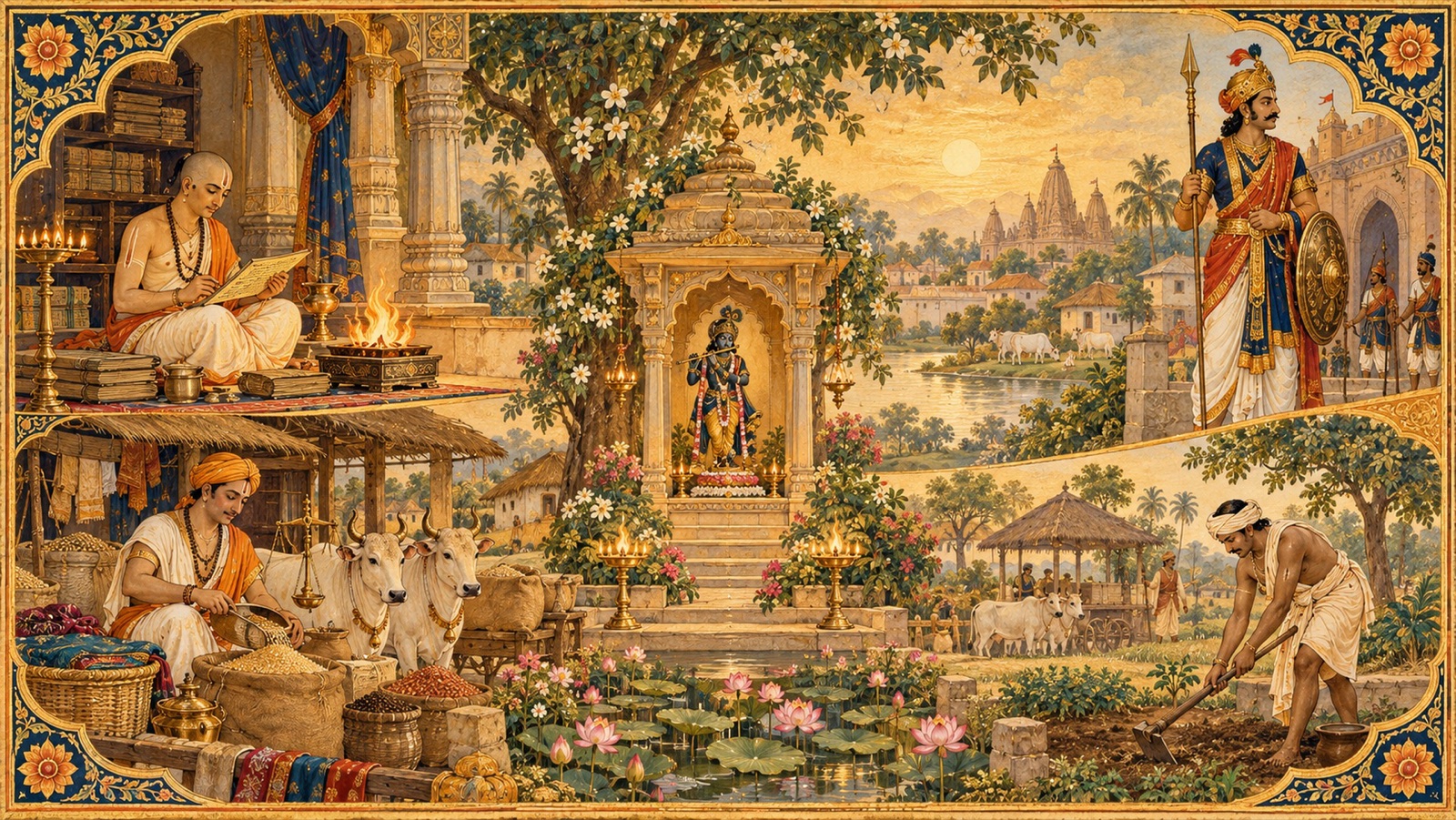
Narada then turned to the particular duties of the four Varnas. A twice-born person, he explained, is one in whose family the purificatory rites have been performed in unbroken succession; upon such persons the study of scripture, the performance of sacrifice, and the giving of charity are enjoined, along with the duties of the four stages of life. The Brahmana’s six duties are study and teaching, sacrifice and officiating at sacrifice, and giving and receiving charity from those whose means are pure. The Ksatriya is to protect the people and to maintain himself from just taxes and fines, but not to accept charity. The Vaisya lives by agriculture, the care of cattle, and honest trade, following the guidance of the wise. And service — first to the twice-born and to his master — is ordained as the sustaining path of the Sudra. In times of true distress, Narada added, the ordinary boundaries may be crossed: one may live by what comes unasked, by gleaning grain left in field or market, by asking farmers directly, by tilling the soil oneself, or by honest trade — five recognized means, ranked from purest to least so. Yet even in such need he set one firm limit: a Brahmana or Ksatriya must never take up what he called the profession of the dog, currying favour through servile flattery of the unworthy — for honest hardship is no disgrace, but dignity sold cheaply is.
The Qualities That Reveal Each Order
More important than occupation, Narada taught, are the inner qualities that truly mark a person. The signs of a Brahmana are peacefulness, self-control, austerity, purity, contentment, forgiveness, straightforwardness, wisdom, compassion, devotion to the Lord, and truthfulness. A Ksatriya is known by valour, fortitude, generosity, self-mastery, forgiveness, love of the Brahmanas, and the protection of the weak. A Vaisya by faith, devotion to elders and to the Lord, and honest industry. And a Sudra by humble, guileless service, honesty, and the protection of cows and Brahmanas.
शमो दमस्तप: शौचं सन्तोष: क्षान्तिरार्जवम् । ज्ञानं दयाच्युतात्मत्वं सत्यं च ब्रह्मलक्षणम् ॥ २१ ॥
śamo damas tapaḥ śaucaṁ santoṣaḥ kṣāntir ārjavam jñānaṁ dayācyutātmatvaṁ satyaṁ ca brahma-lakṣaṇam
Meaning: Calm, self-mastered, austere, inwardly and outwardly clean, contented, quick to forgive, honest, wise, compassionate, wholly given over to the infallible Lord, and truthful — these, O king, are the marks by which a Brahmana is known. (SB 7.11.21)
The Devoted Wife
Narada then described the duty of a wife devoted to her husband — to serve him with love, to keep her home clean and auspicious, and to speak truthfully and agreeably not only to him but to all. Content with her means and free of covetousness, diligent, vigilant, pure of body, and full of affection, she gratifies her family. A wife who honours her husband as an image of the Lord, and is devoted to him as Goddess Lakshmi is to Sri Hari, is said to rejoice in the highest realm — for such love, offered in the spirit of devotion, purifies and uplifts.

Character, Disposition, and Freedom from Desire
Narada closed his discourse with two searching observations. First, that the conduct natural to a person’s own disposition, discharged faithfully, gradually leads even to the state of one who has transcended the three modes of nature. And second — with a striking image — that the mind is not freed from craving by cautious little sips of pleasure, any more than a field sown again and again finally turns barren, or a fire is quelled by mere drops of ghee:
उप्यमानं मुहु: क्षेत्रं स्वयं निर्वीर्यतामियात् । न कल्पते पुन: सूत्यै उप्तं बीजं च नश्यति ॥ ३३ ॥ एवं कामाशयं चित्तं कामानामतिसेवया । विरज्येत यथा राजन्नग्निवत् कामबिन्दुभि: ॥ ३४ ॥
upyamānaṁ muhuḥ kṣetraṁ svayaṁ nirvīryatām iyāt na kalpate punaḥ sūtyai uptaṁ bījaṁ ca naśyati evaṁ kāmāśayaṁ cittaṁ kāmānām atisevayā virajyeta yathā rājann agnivat kāma-bindubhiḥ
Meaning: A field sown again and again of itself becomes barren, no longer fit to bear, and even the seed cast in it perishes. Just so, O king, the mind that is the seat of desire grows disgusted with cravings only through their surfeit — never satisfied by mere drops of enjoyment, any more than fire is quenched by drops of ghee. (SB 7.11.33-34)
The Closing Teaching — Character Above Birth
Finally Narada gave the principle that governs the whole discourse: a person is to be recognized not merely by birth but by the qualities he actually displays. If the marks described as belonging to one order are seen in a person of another, then that person should be classed by those very marks — for character, not lineage alone, reveals a man’s true nature.
यस्य यल्लक्षणं प्रोक्तं पुंसो वर्णाभिव्यञ्जकम् । यदन्यत्रापि दृश्येत तत्तेनैव विनिर्दिशेत् ॥ ३५ ॥
yasya yal lakṣaṇaṁ proktaṁ puṁso varṇābhivyañjakam yad anyatrāpi dṛśyeta tat tenaiva vinirdiśet
Meaning: Whatever marks have been described as indicative of a person’s order — if they are seen in another as well, then that person should be designated by those very marks. (SB 7.11.35)
Principal Teachings of This Chapter
1. The root of all Dharma is the Lord. Right conduct is not a human invention but flows from Sri Hari, the embodiment of the Vedas. To live rightly is, in the end, to move toward Him (SB 7.11.7).
2. Some virtues belong to everyone. Before any division by station, thirty marks of virtue — truthfulness, compassion, purity, self-control, and above all devotion — are the common Dharma of every human being (SB 7.11.8-12).
3. Every honest calling can be a path of purification. Whether one studies, protects, trades, or serves, work done in the right spirit refines the heart and leads toward freedom (SB 7.11.13-20).
4. Character matters more than birth. A person is truly known by the qualities he displays, not by lineage alone; the marks of virtue may appear in anyone (SB 7.11.21, 35).
5. Desire is not conquered by indulgence. Craving is not tamed by small tastes of pleasure but only overcome, like a fire needing more than drops of ghee — a reason to turn instead to devotion and restraint (SB 7.11.33-34).
A Devotional Reflection
There is a quiet generosity in the way this chapter is arranged. Narada could have begun with the divisions of society, but instead he begins with the virtues that belong to us all — truthfulness, compassion, purity, and the hearing and remembering of the Lord — as if to say that the door to holiness is open to everyone before any question of station arises. Only then does he describe the particular duties, and even there he insists that it is character, not birth, that truly names a person. Underneath every distinction runs a single current: that all right conduct has its source in God and its purpose in returning the heart to Him. Read this way, duty is not a burden imposed from outside but a training of the heart — each honest act, in whatever calling, quietly loosening the grip of selfish desire until the soul is fit to rest in the Lord. The map Narada draws is wide enough for every life, and every road on it leads home.
A Daily Devotional Practice
Today, choose one of the universal virtues from Narada’s list — truthfulness, compassion, contentment, or the simple remembrance of the Lord — and practise it deliberately through the day, in whatever work is yours. Do your ordinary duty as an offering rather than a burden, and when a craving rises, meet it not with a small indulgence but with a turn of the mind toward God, gently repeating within: “Om Namo Bhagavate Vasudevaya.” Let your calling, whatever it is, become a means of purifying the heart.
Conclusion
The eleventh chapter of the Seventh Canto lifts the reader from story to teaching, as Narada answers Yudhishthira’s question with one of scripture’s clearest maps of eternal Dharma. Beneath every rule of caste, calling, and household lies a single truth: duty is never an end in itself. The thirty universal virtues, the marks of each order, and the discipline of desire all exist to carry the heart toward surrender at the Lord’s feet, and even a person’s true order is decided by character, not birth. To live truthfully, serve faithfully, and offer every act to the Lord — this is the eternal way that Narada opens to every soul, in every station.
May the divine wisdom of Srimad Bhagavatam awaken pure devotion within our hearts.
Om Namo Bhagavate Vasudevaya.
Jay Shree Madhav.
References and Attribution
- Primary edition: Gita Press, Śrīmad Bhāgavata Mahāpurāṇa (English, complete), Book Seven, Discourse 11, pages 705–711.
- Series: Srimad Bhagavatam Wisdom · Biswa Sanatan Dharma Seva Trust.
- Presented following the spiritual guidance and recommendation of Pandit Dr. Shri Kashinath Mishra.
This is an original, faithful retelling in the writer’s own words, with brief quoted verses shown in Devanāgarī and transliteration and their meanings given as summaries. It is not a reproduction of any single publisher’s continuous translation or commentary. No affiliation with or endorsement by any publisher is implied.
Jay Shree Madhav