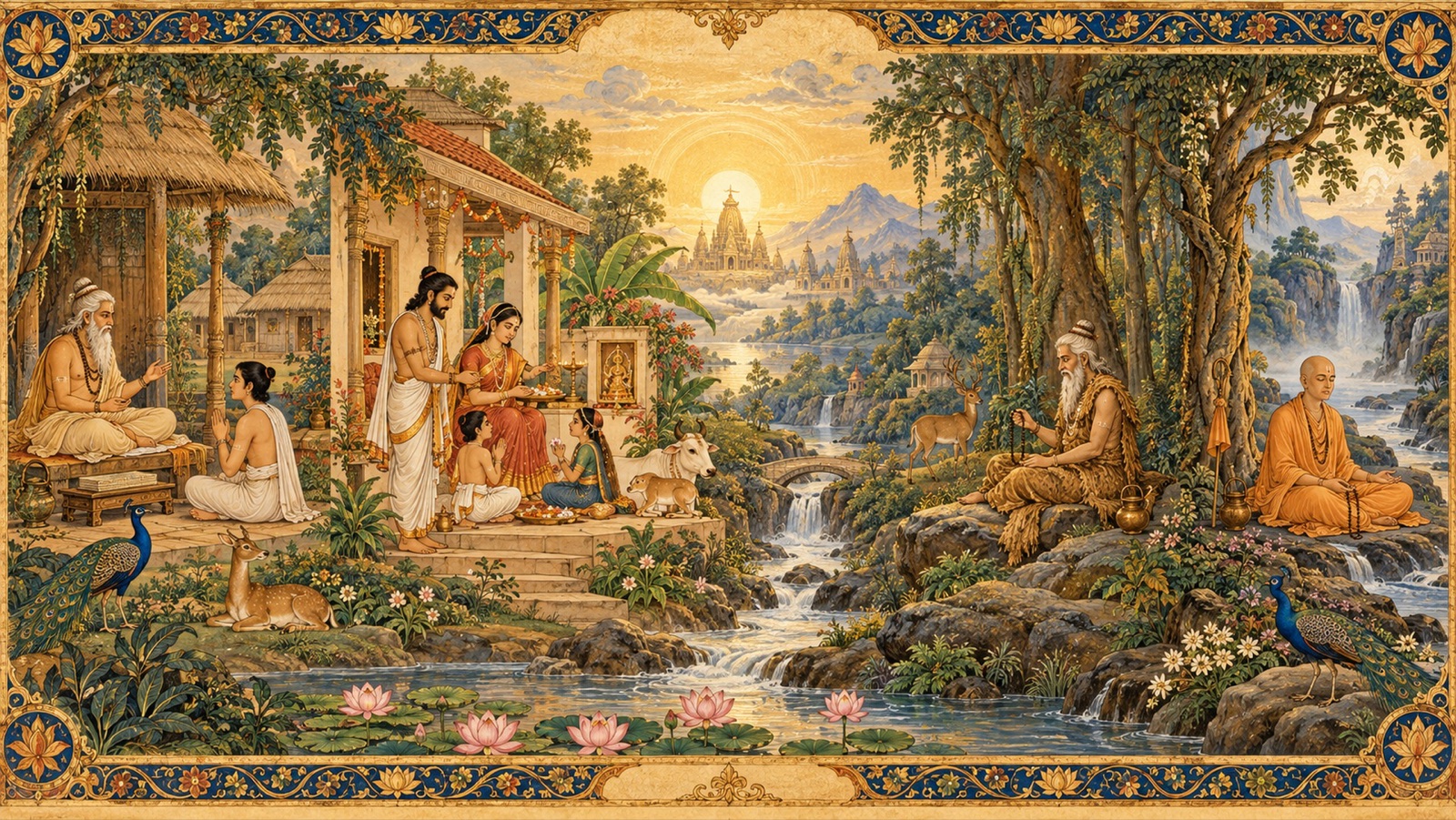
Having named the duties of the four social orders, Narada now turns to the four stages of life — the student, the householder, the forest-dweller, and the renunciant. Each is a school of self-mastery, and each, rightly lived, leads the soul to the same goal: the vision of the Lord within all.
Om Namo Bhagavate Vasudevaya.
Om Namo Bhagavate Vasudevaya.
Om Namo Bhagavate Vasudevaya.
Welcome to Srimad Bhagavatam Wisdom, a devotional journey through the sacred histories and teachings of the Srimad Bhagavat Mahapurana. Continuing from the four social orders described in the previous chapter, Narada now turns to the four Asramas — the stages of a human life — showing that each, rightly lived, becomes a school for the same inward discipline: recognizing the Lord’s presence at the very center of whatever life one leads.
Chapter Information
- Scripture: Śrīmad Bhāgavata Mahāpurāṇa
- Canto: 7 (Book Seven)
- Chapter: 12
- Chapter title: The Four Ashramas, Stages of Spiritual Life
- Principal speaker: The sage Narada
- Principal listener: Emperor Yudhishthira
- Main setting: The assembly of Emperor Yudhishthira, in the course of Narada’s discourse
- Central subject: The duties of the celibate student and the forest-dweller, the mastery of desire, and the vision of the Lord within all as the goal of every stage of life
- Principal verse range: Canto 7, Chapter 12, verses 1–31
- Primary edition: Gita Press Śrīmad Bhāgavata Mahāpurāṇa
The Life of the Student
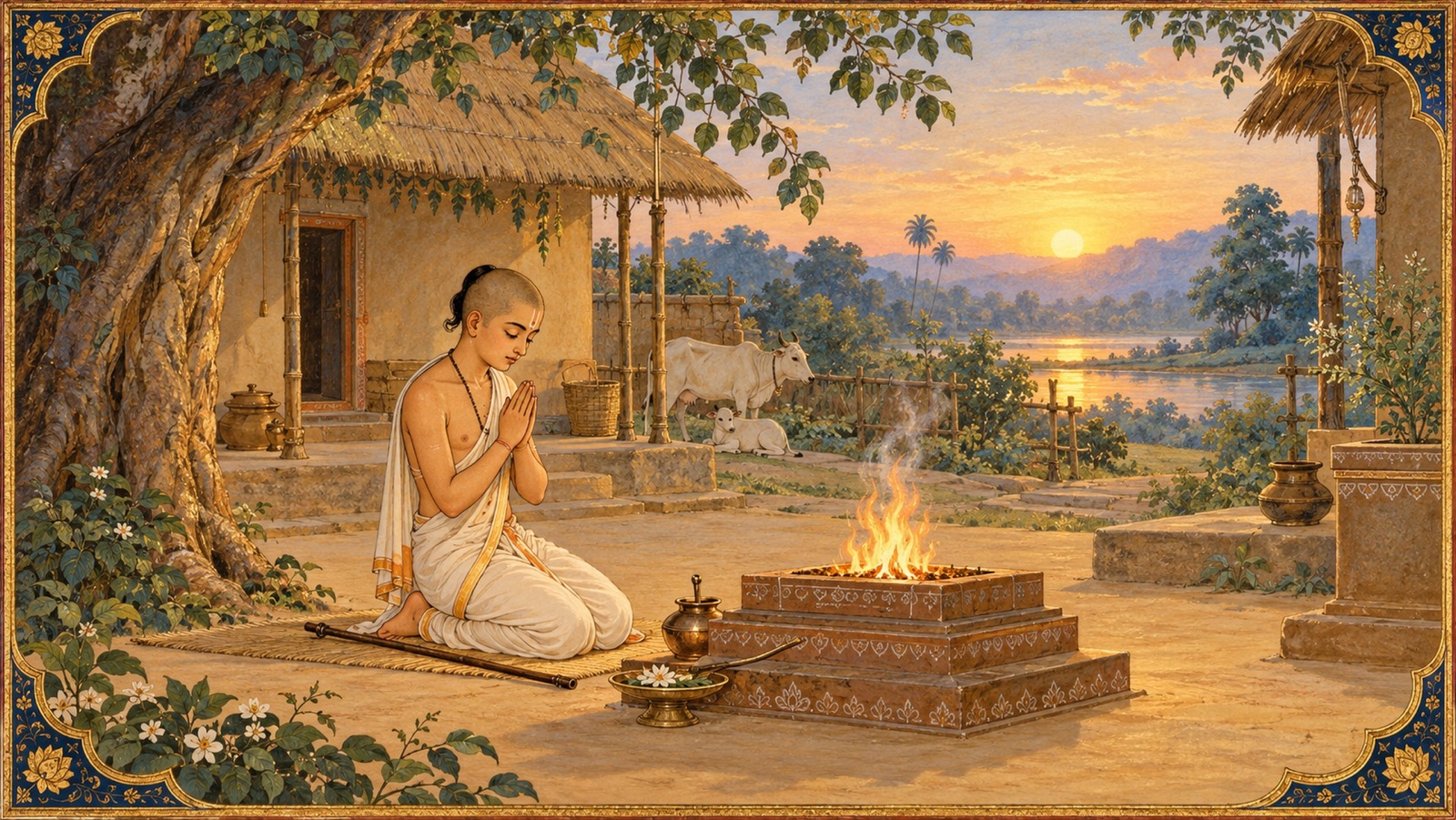
Narada began with the brahmacari, the celibate student. Dwelling in his teacher’s house, humble as a servant, his senses controlled and his heart full of affection for his guru, the student worships each morning and evening — his teacher, the sacred fire, the sun, and the Lord Vishnu, chief of the gods — silently repeating the holy Gayatri with a concentrated mind. He takes his lessons in the Vedas when called, bowing to touch his teacher’s feet at the beginning and end of study. He wears the simple emblems of his vow — the sacred thread, deerskin, a girdle, a staff and water-pot — and goes out to beg food morning and evening, offering it first to his teacher and eating only what is permitted; on days he is not permitted, he fasts. Moderate in diet, reverent, and active, he keeps company with the opposite sex only as much as duty strictly requires.
The Mastery of Desire
Narada then spoke frankly of the great danger to a life of continence: the pull of the senses, which are turbulent by nature and can carry away even a well-controlled mind. One under the vow, he taught, should shun idle talk of the opposite sex and avoid all unnecessary familiarity. With a memorable image he underscored how careful one must be — that fire and its fuel should not be kept together carelessly:
नन्वग्नि: प्रमदा नाम घृतकुम्भसम: पुमान् । सुतामपि रहो जह्यादन्यदा यावदर्थकृत् ॥ ९ ॥
nanv agniḥ pramadā nāma ghṛta-kumbha-samaḥ pumān sutām api raho jahyād anyadā yāvad-artha-kṛt
Meaning: It is a truism that a woman is like fire and a man like a pot of ghee; therefore one should be circumspect even with one’s own daughter in a solitary place, and at other times keep company only so far as necessary. (SB 7.12.9)
Until a person, through self-realization, has truly understood that the body and the senses are but a passing appearance, Narada explained, the sense of duality — of “I the enjoyer” and “this the thing enjoyed” — does not cease; and from that duality flows all the soul’s bondage. These restraints, he noted, apply not only to the student but in their measure to the householder and the recluse as well.
Seeing the Lord Within All
Having studied the Vedas and grasped their meaning, and with his teacher’s blessing, the student may then enter whichever stage of life suits his nature — becoming a householder, retiring to the forest, renouncing the world as a wandering ascetic, or remaining a lifelong celibate. But whichever path he chooses, Narada gave one practice that consecrates them all: to recognize Lord Vishnu, who transcends the senses, intimately present wherever one turns — in the flame one tends, in the teacher one serves, in one’s own heart, and in every living being — the same Inner Controller who, in truth, was never separate from any of them.
अग्नौ गुरावात्मनि च सर्वभूतेष्वधोक्षजम् । भूतै: स्वधामभि: पश्येदप्रविष्टं प्रविष्टवत् ॥ १५ ॥
agnau gurāv ātmani ca sarva-bhūteṣv adhokṣajam bhūtaiḥ sva-dhāmabhiḥ paśyed apraviṣṭaṁ praviṣṭavat
Meaning: One should behold the transcendent Lord, beyond sense-perception, within the sacred fire, within the teacher, within one’s own self, and within all beings together with the elements — present in them as though He had entered them, though He never truly enters, being already all-pervading. (SB 7.12.15)

Living by the rules of his own stage, and thus coming to know what ought to be known, such a devotee — whether student, forest-dweller, renunciant, or householder — attains the transcendent Absolute:
एवं विधो ब्रह्मचारी वानप्रस्थो यतिर्गृही । चरन्विदितविज्ञान: परं ब्रह्माधिगच्छति ॥ १६ ॥
evaṁ vidho brahmacārī vānaprastho yatir gṛhī caran vidita-vijñānaḥ paraṁ brahmādhigacchati
Meaning: Living in this way — whether as a celibate student, a forest-dweller, a renunciant, or a householder — and having realized true knowledge, a person attains the Supreme Brahman. (SB 7.12.16)
Why must the Lord be recognized this way — as flame, as guide, as self, and as every creature alike, present as though entered, yet never truly entered? Because the four ashramas are not simply four ways of living; they are four schools built to carry the soul toward this one realization. The rules of study, of restraint, of forest life, and of final renunciation exist only to loosen the grip of “I am this body,” until the devotee sees what was always so: the Lord’s presence never depended on entering anything, for He is already the ground of all things, while remaining eternally, undividedly Himself. An austerity that never arrives at this vision has not yet reached its own goal (SB 7.12.15–16).
The Forest-Dweller
Narada then described in loving detail the vanaprastha, the one who retires to the forest. By following the rules approved by the sages, such an ascetic rises easily after this life toward the higher realms and, in due course, to liberation:
वानप्रस्थस्य वक्ष्यामि नियमान्मुनिसम्मतान् । यानास्थाय मुनिर्गच्छेदृषिलोकमुहाञ्जसा ॥ १७ ॥
vānaprasthasya vakṣyāmi niyamān muni-sammatān yān āsthāya munir gacched ṛṣi-lokam uhāñjasā
Meaning: I shall now tell you the rules approved by the sages for a forest-dweller, by observing which the ascetic easily attains the realm of the seers. (SB 7.12.17)
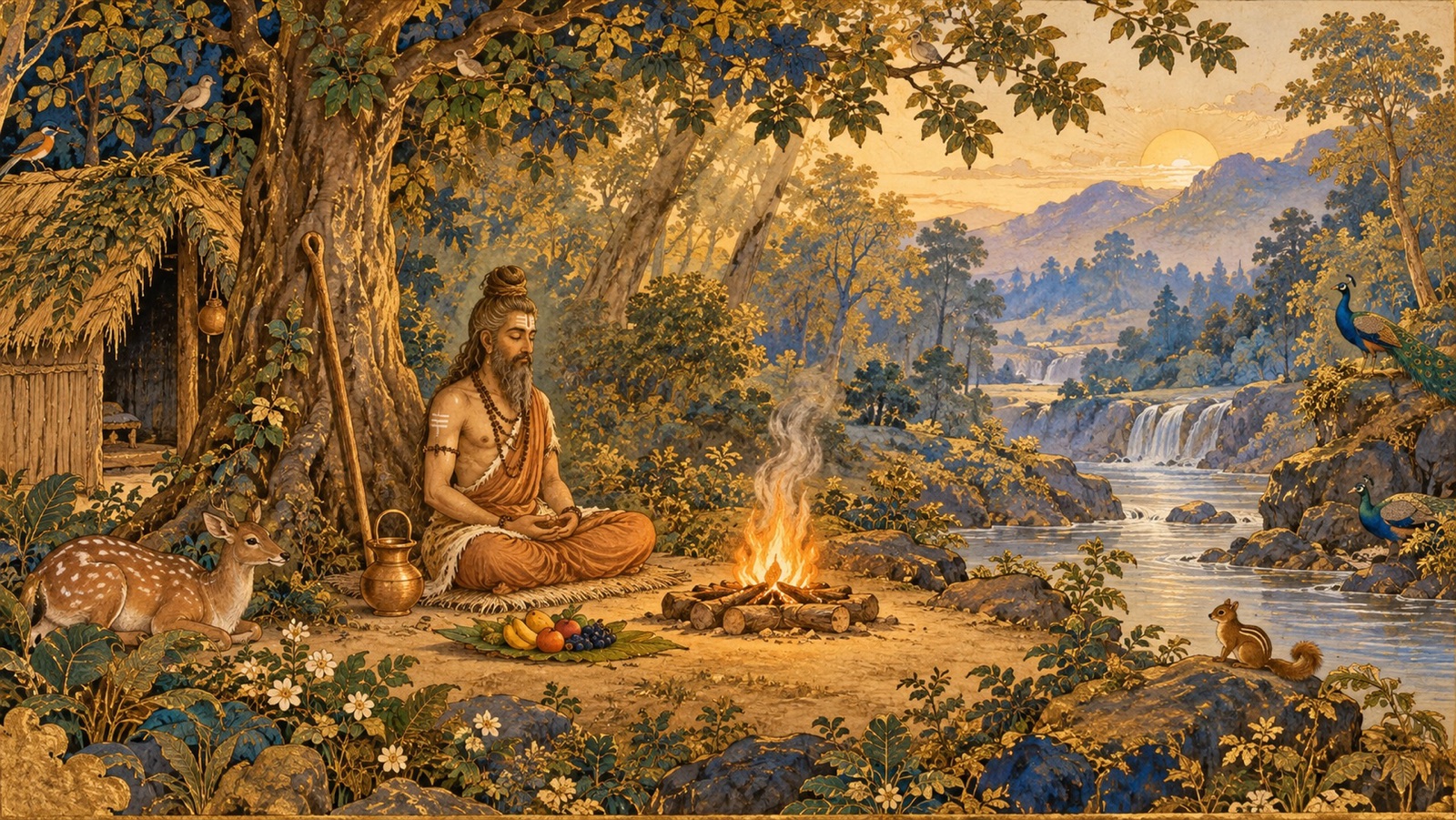
The forest-dweller lives on what nature freely gives — fruits and grains ripened by the sun, never the products of cultivation, rejecting the old store whenever a fresh supply is found. He endures snow, wind, rain, fire, and sun, taking shelter only to guard his sacred fire. Wearing matted locks and bark garments, keeping only a water-pot, a staff, and the implements of worship, he practises austerity in the woods, careful never to let hardship pervert his mind.
The Return of All Things to Their Source
Finally Narada described the forest-dweller who, grown incapable through age or illness of his religious duties, prepares for the last surrender. Withdrawing the sacred fires into himself and giving up the feeling of “I” and “mine,” he merges his body and mind, part by part, back into the very sources from which they came:
आत्मन्यग्नीन् समारोप्य सन्न्यस्याहं ममात्मताम् । कारणेषु न्यसेत् सम्यक्सङ्घातं तु यथार्हत: ॥ २४ ॥
ātmany agnīn samāropya sannyasyāhaṁ mamātmatām kāraṇeṣu nyaset samyak saṅghātaṁ tu yathārhataḥ
Meaning: Withdrawing the sacred fires into himself, and giving up the sense of “I” and “mine,” a wise man should duly merge his psycho-physical organism into its causes, assigning each part to its proper place. (SB 7.12.24)
He returns the openings of his body to ether, his breath to the cosmic air, his warmth to fire, his fluids to water, and his solid frame to earth; he consigns each sense and faculty to the deity that presides over it, and finally merges the self, with the three modes of nature, into the transcendent Absolute. What remains, when all the borrowed elements have been given back, is the pure, imperishable, non-dual awareness that is the true self — and, knowing it, the sage grows still, like a fire that has consumed its own fuel and quietly goes out:
इत्यक्षरतयात्मानं चिन्मात्रमवशेषितम् । ज्ञात्वाद्वयोऽथ विरमेद् दग्धयोनिरिवानल: ॥ ३१ ॥
ity akṣaratayātmānaṁ cin-mātram avaśeṣitam jñātvādvayo ‘tha viramed dagdha-yonir ivānalaḥ
Meaning: Thus realizing the self as imperishable, as pure consciousness alone remaining, the non-dual sage becomes still — like a fire that grows quiet once the fuel that fed it is burnt away. (SB 7.12.31)

Principal Teachings of This Chapter
1. Discipline is the foundation of spiritual life. The student’s controlled, reverent, service-filled life — worship, study, begging, and restraint — is the training ground of the soul (SB 7.12.1-6).
2. Desire must be met with vigilance, not carelessness. Fire and fuel are not kept together lightly; the wise remain circumspect, knowing how easily the senses carry away the mind (SB 7.12.9).
3. Every stage of life shares one inner practice. Whether student, householder, forest-dweller, or renunciant, the devotee is to see the Lord present within the fire, the teacher, the self, and all beings (SB 7.12.15).
4. All honest paths lead to the same goal. Lived rightly and with true knowledge, any of the four stages leads to the Supreme Brahman (SB 7.12.16).
5. The end of the journey is a joyful surrender. Giving back every borrowed element and every trace of “I” and “mine,” the sage rests in the pure, imperishable self (SB 7.12.24-31).
A Devotional Reflection
It would be easy to read this chapter as a list of rules for a way of life long past — the student in his teacher’s house, the hermit in the forest. But underneath the outward forms, Narada is describing something timeless: a steady movement from self-will toward self-offering. The student learns to serve and to restrain; the forest-dweller learns to need almost nothing; the sage learns at last to give back even the sense of being a separate self. And the single thread that runs through them all is the practice of seeing the Lord within — within the fire we tend, the teacher we honour, the self we are, and every being we meet. That vision is not reserved for hermits. Wherever we stand, we can begin to hold our small duties as worship and to look for the Lord already present in the people and the moments before us. The stages of life are many; the inward journey is one, and it ends where every soul longs to be: at rest in God.
A Daily Devotional Practice
Today, take up the one practice that Narada gives to every stage of life: look for the Lord already present within your day. As you light a lamp, greet a teacher or elder, or simply pause in your own heart, quietly acknowledge that the Lord dwells there as the Inner Controller of all, softly repeating: “Om Namo Bhagavate Vasudevaya.” Then choose one small act of restraint — a needless indulgence set aside — and offer it not as deprivation but as a gift of love to the Lord who lives within.
Conclusion
The twelfth chapter of the Seventh Canto reveals that every stage of life — student, householder, forest-dweller, or renunciant — is finally one and the same journey: from grasping toward giving, until nothing remains between the soul and its Lord. Whatever asrama we occupy, the discipline is the same discipline, and the goal is the same goal — the Supreme Brahman realized as the one Lord who quietly pervades all things while remaining eternally Himself. To live any duty as worship of Him is already to have begun the journey home.
May the divine wisdom of Srimad Bhagavatam awaken pure devotion within our hearts.
Om Namo Bhagavate Vasudevaya.
Jay Shree Madhav.
References and Attribution
- Primary edition: Gita Press, Śrīmad Bhāgavata Mahāpurāṇa (English, complete), Book Seven, Discourse 12, pages 710–713.
- Series: Srimad Bhagavatam Wisdom · Biswa Sanatan Dharma Seva Trust.
- Presented following the spiritual guidance and recommendation of Pandit Dr. Shri Kashinath Mishra.
This is an original, faithful retelling in the writer’s own words, with brief quoted verses shown in Devanāgarī and transliteration and their meanings given as summaries. It is not a reproduction of any single publisher’s continuous translation or commentary. No affiliation with or endorsement by any publisher is implied.
Jay Shree Madhav