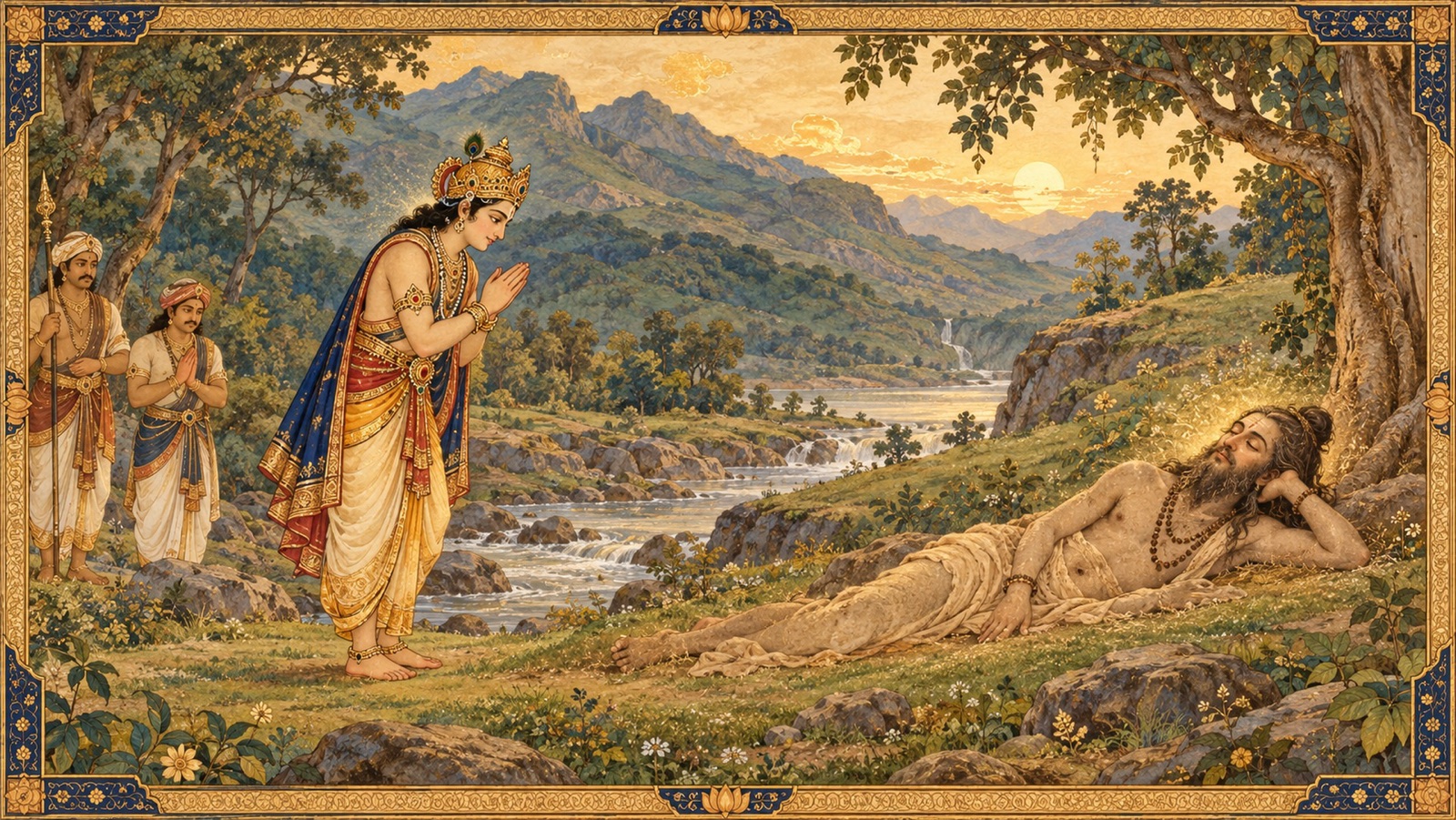
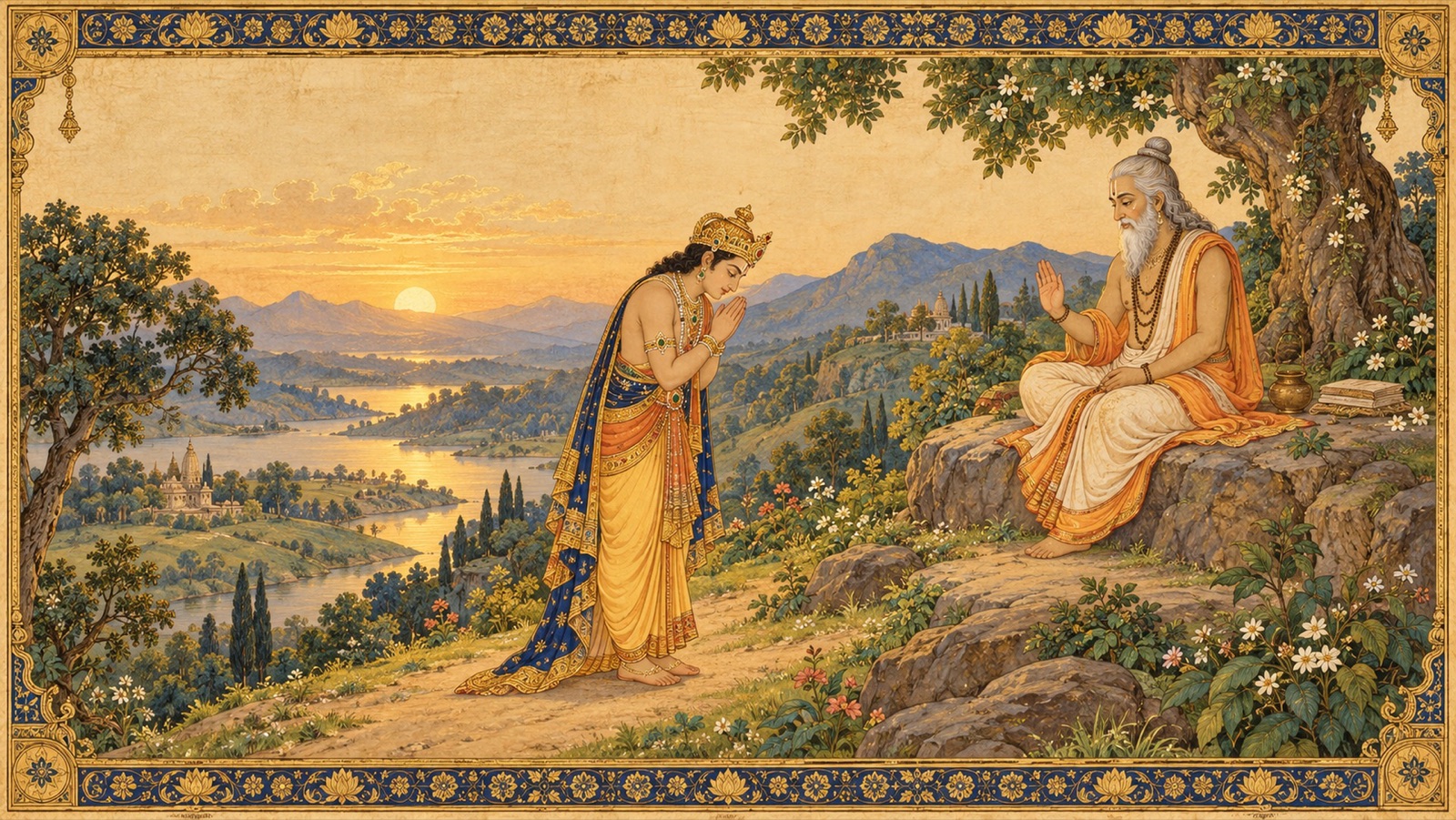
On the slopes of the Sahyadri hills, the devotee-king Prahlada came upon a saint lying on the bare ground, his body covered with dust, doing nothing at all — and yet radiant with an inner peace no wealth could buy. What that saint told him is one of the Bhagavatam’s most beautiful lessons in contentment.
Om Namo Bhagavate Vasudevaya.
Om Namo Bhagavate Vasudevaya.
Om Namo Bhagavate Vasudevaya.
Welcome to Srimad Bhagavatam Wisdom, a devotional journey through the sacred histories and teachings of the Srimad Bhagavat Mahapurana. In this thirteenth chapter of the Seventh Canto, Narada completes his teaching on the renounced order of life with the story of Prahlada and a saintly ascetic, on the true meaning of contentment.
Chapter Information
- Scripture: Śrīmad Bhāgavata Mahāpurāṇa
- Canto: 7 (Book Seven)
- Chapter: 13
- Chapter title: The Renunciant’s Path and the Saintly Avadhuta
- Principal speaker: The sage Narada, narrating; within the story, the saintly ascetic and Prahlada
- Principal listener: Emperor Yudhishthira; within the story, Prahlada
- Main setting: The assembly of Yudhishthira; within the story, the slopes of the Sahyadri hills
- Central subject: The conduct of the renunciant, and the saint’s teaching on contentment, the futility of greed, and rest in the Self
- Principal verse range: Canto 7, Chapter 13, verses 1–46
- Primary edition: Gita Press Śrīmad Bhāgavata Mahāpurāṇa
The Path of the Renunciant
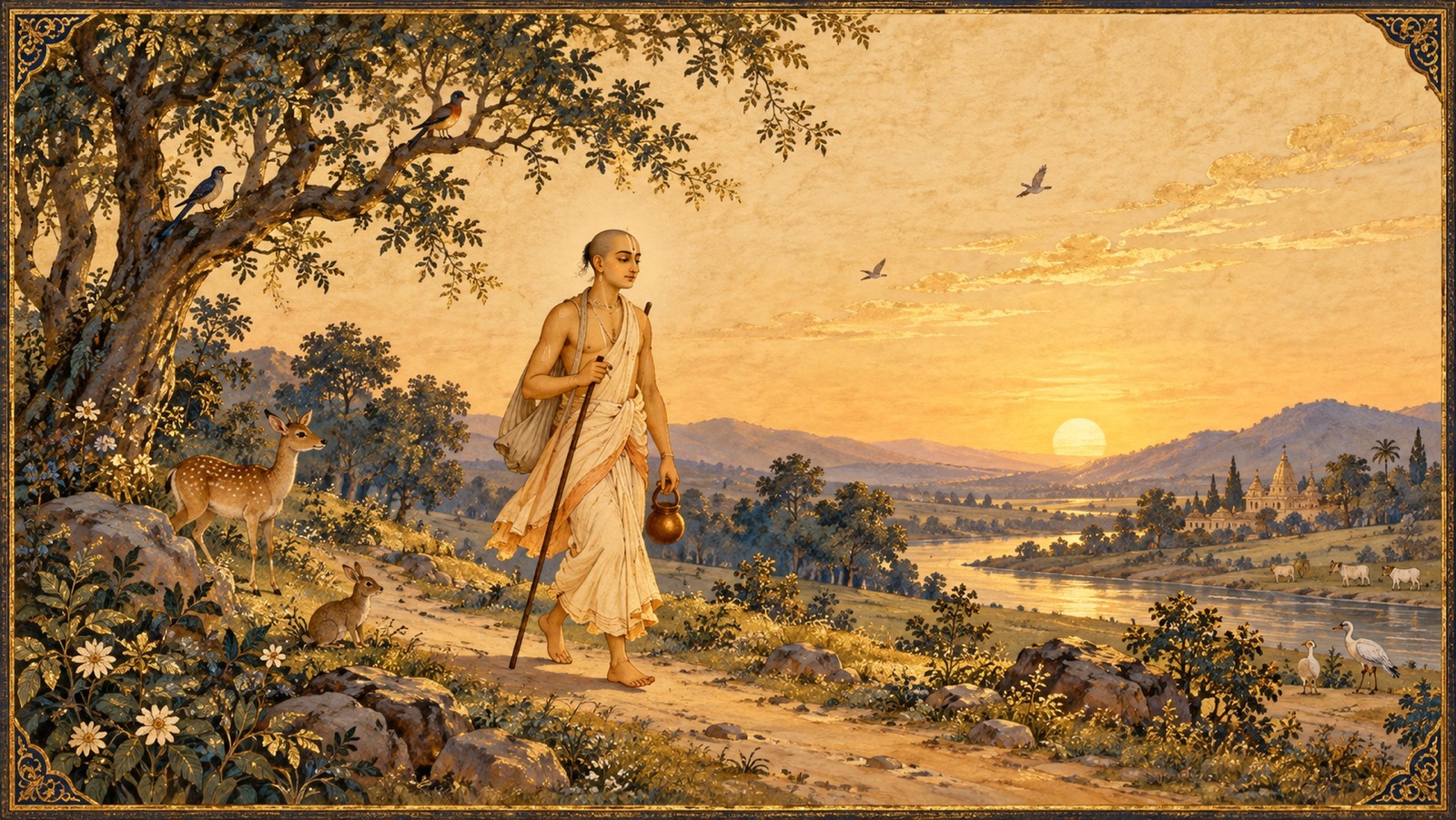
Narada described the sannyasi, the one fit to renounce the world entirely. With nothing left to him but his body, free of all desire, he wanders the earth, staying no more than a single night in any village. He carries only the marks of his order — a staff and a water-pot — living on alms, sheltering nowhere, a friend to every living being, tranquil, and wholly devoted to Lord Narayana:
एक एव चरेद्भिक्षुरात्मारामोऽनपाश्रय: । सर्वभूतसुहृच्छान्तो नारायणपरायण: ॥ ३ ॥
eka eva cared bhikṣur ātmārāmo ‘napāśrayaḥ sarva-bhūta-suhṛc-chānto nārāyaṇa-parāyaṇaḥ
Meaning: The mendicant should wander entirely alone, delighting in the Self, taking shelter in nothing, a well-wishing friend to all beings, tranquil, and wholly devoted to Lord Narayana. (SB 7.13.3)
Such a sage, Narada added, should not gather disciples, accumulate books, undertake worldly projects, or engage in vain debate. Though deeply wise, he should carry himself unnoticed — appearing to the world like a child, a madman, or a mute, hiding his greatness while keeping his purpose clear.
This freedom runs deeper than outward appearance. Narada explained that a soul who has truly reached this peace need not even keep the staff and water-pot that mark a sannyasi outwardly; he may take them up or set them aside, as the moment requires (SB 7.13.9). What matters is not the symbol but the substance: such a paramahamsa’s very identity rests in unbroken absorption in the Supreme Person, exactly as verse three has already declared him nārāyaṇa-parāyaṇaḥ, wholly devoted to Narayana. This is why the story Narada is about to tell cannot be mistaken for a lesson in mere idleness — the saint’s stillness, as will soon become clear, is not indolence but the outward shell of a heart entirely given to God.
An Ancient Meeting
To show this life in practice, Narada recalled an old and holy story — a dialogue between Prahlada and a saintly ascetic who was then living in the manner of a python:
अत्राप्युदाहरन्तीममितिहासं पुरातनम् । प्रह्रादस्य च संवादं मुनेराजगरस्य च ॥ ११ ॥
atrāpy udāharantīmam itihāsaṁ purātanam prahrādasya ca saṁvādaṁ muner ājagarasya ca
Meaning: On this very point the wise relate an ancient story — the dialogue between Prahlada and the sage who followed the way of the python. (SB 7.13.11)
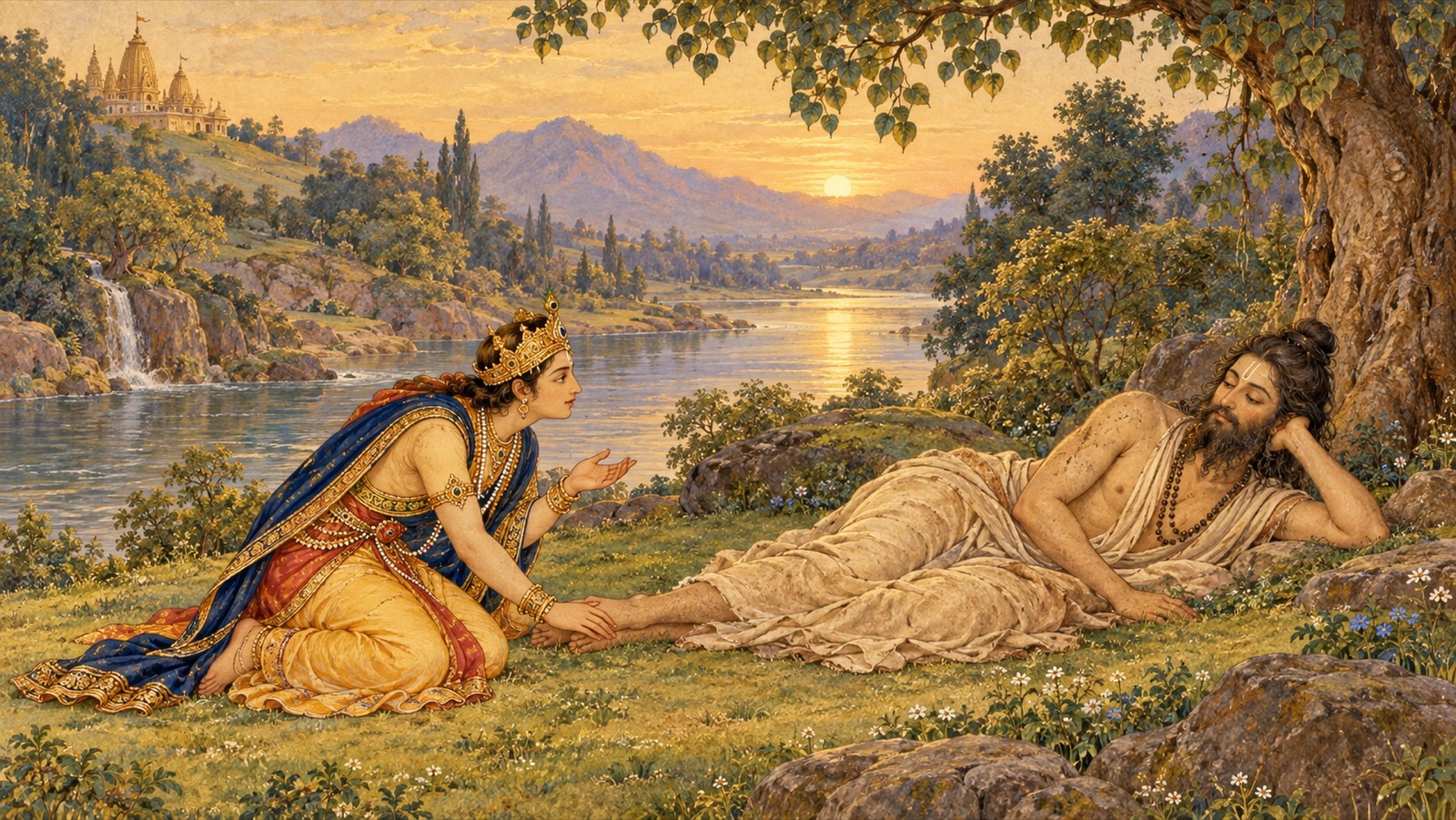
Travelling the worlds to learn the truth of people’s hearts, Prahlada came upon this saint lying on the bare ground on the slopes of the Sahyadri hills, his spiritual radiance concealed beneath a body covered with dust. Nothing about his conduct, dress, or speech revealed his station in life. Prahlada greeted him with reverence, touched his feet, and — eager to understand — put his question. The saint’s body was robust and healthy, like that of a man who enjoys comforts; yet he owned nothing and did nothing, lying still while the whole world laboured. How, Prahlada asked, had he come to such a state?
The Saint’s Answer — The Futility of Striving
Smiling, the saint replied. He acknowledged that Prahlada, ever illumined by the Lord Narayana dwelling in his heart, already knew the truth; yet he would answer for the good of all who seek purity of heart. Driven through countless births by unquenchable craving, he had at last, in this human life, seen clearly the frustration of all restless striving — how even husbands and wives, labouring endlessly for happiness and to ward off sorrow, reap only the opposite of what they seek:
तत्रापि दम्पतीनां च सुखायान्यापनुत्तये । कर्माणि कुर्वतां दृष्ट्वा निवृत्तोऽस्मि विपर्ययम् ॥ २६ ॥
tatrāpi dam-patīnāṁ ca sukhāyānyāpanuttaye karmāṇi kurvatāṁ dṛṣṭvā nivṛtto ‘smi viparyayam
Meaning: Seeing how even married couples, striving to gain happiness and drive away sorrow, meet only the very opposite of their aim, I have withdrawn from all such activity. (SB 7.13.26)
Happiness, the saint explained, is the very essence of the Self and needs no external cause; material sense enjoyment is only imagination, mistaken for happiness by those who have forgotten their own nature. He offered a simple picture of this forgetfulness: just as a deer, unaware of a spring hidden beneath the grass close by, runs off across the wilderness in search of water, so the soul, covered by the material body, fails to see the happiness within itself and chases it in the outer world instead:
जलं तदुद्भवैश्छन्नं हित्वाज्ञो जलकाम्यया । मृगतृष्णामुपाधावेत्तथान्यत्रार्थदृक् स्वत: ॥ २९ ॥
jalaṁ tad-udbhavaiś channaṁ hitvājño jala-kāmyayā mṛgatṛṣṇām upādhāvet tathānyatrārtha-dṛk svataḥ
Meaning: A deer, unable to notice a spring concealed beneath the grass, wanders far in thirst; likewise the embodied soul, ignorant of its own inner joy, keeps searching for it among external things. (SB 7.13.29)
The rich, far from being at peace, are tormented by greed and sleepless fear, dreading the king, thieves, enemies, kinsmen, beggars, and even themselves. Therefore, he said, the wise abandon the craving for wealth and long life, which are the very root of grief and bondage:
शोकमोहभयक्रोधरागक्लैब्यश्रमादय: । यन्मूला: स्युर्नृणां जह्यात्स्पृहां प्राणार्थयोर्बुध: ॥ ३४ ॥
śoka-moha-bhaya-krodha- rāga-klaibya-śramādayaḥ yan-mūlāḥ syur nṛṇāṁ jahyāt spṛhāṁ prāṇārthayor budhaḥ
Meaning: Grief, delusion, fear, anger, attachment, weakness, and toil have their root in the craving for long life and wealth; therefore the wise should give up that craving. (SB 7.13.34)
Lessons from the Bee and the Python
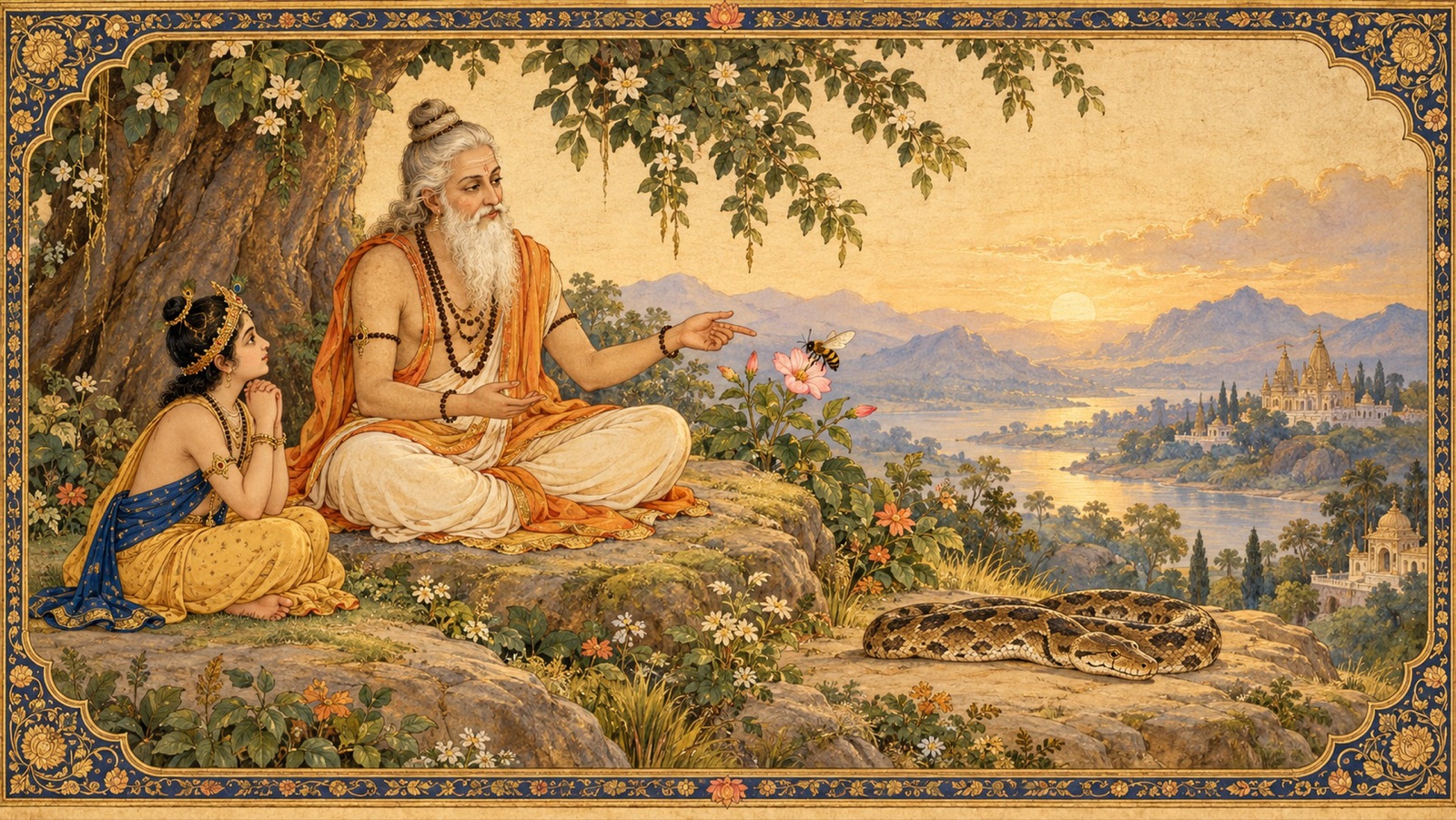
The saint then named his true teachers. From the bee, who wanders gathering only a little from each flower, he had learned dispassion — to take from the world only what is needed and to hoard nothing. From the python, who lies still and eats only what comes to it unsought, he had learned contentment — to rest in the Self and let destiny bring what it will. He would neither condemn nor flatter anyone, whatever their nature; he wished only the good of all, and their union with the Supreme Self:
नाहं निन्दे न च स्तौमि स्वभावविषमं जनम् । एतेषां श्रेय आशासे उतैकात्म्यं महात्मनि ॥ ४२ ॥
nāhaṁ ninde na ca staumi sva-bhāva-viṣamaṁ janam eteṣāṁ śreya āśāse utaikātmyaṁ mahātmani
Meaning: I neither blame nor praise those whose natures differ; I wish only their welfare, and their oneness with the Supreme Self. (SB 7.13.42)
Prahlada Honours the Saint
Having thus offered his own secret way of life — a way beyond the concerns of ordinary society and scripture — the saint acknowledged that he had shared it only because Prahlada was so wholly devoted to the Lord:
स्वात्मवृत्तं मयेत्थं ते सुगुप्तमपि वर्णितम् । व्यपेतं लोकशास्त्राभ्यां भवान्हि भगवत्पर: ॥ ४५ ॥
svātma-vṛttaṁ mayetthaṁ te suguptam api varṇitam vyapetaṁ loka-śāstrābhyāṁ bhavān hi bhagavat-paraḥ
Meaning: Thus I have described to you my own way of life, secret though it is and beyond ordinary custom and scripture — for you are wholly devoted to the Lord. (SB 7.13.45)
Having heard this teaching of the paramahamsa, the highest order of renunciants, Prahlada honoured the saint with reverence, and, well pleased, took his leave and returned home.
Principal Teachings of This Chapter
1. The renunciant belongs to God alone. Wandering free of all shelter, a friend to every being, the sannyasi lives entirely devoted to Lord Narayana (SB 7.13.3).
2. True greatness hides itself. The wise sage conceals his eminence, appearing as a child or a mute, keeping only his purpose clear before the Lord (SB 7.13.10).
3. Restless striving defeats itself. Those who labour endlessly for pleasure and against pain meet only the opposite; happiness is not found in the objects of the senses (SB 7.13.26).
4. Craving for wealth and long life is the root of sorrow. Grief, fear, anger, and toil all spring from that craving; the wise let it go (SB 7.13.34).
5. Contentment is learned by watching the world rightly. The bee teaches dispassion, the python teaches contentment; the saint wishes only the welfare of all (SB 7.13.42).
6. Real happiness lies hidden within, not without. Like a deer that cannot see the spring beneath its own feet, the soul forgetting the Self runs after joy in the outer world (SB 7.13.29).
A Devotional Reflection
There is a gentle irony at the heart of this chapter. Prahlada — himself a great king and the very model of devotion — bows at the feet of a man who owns nothing and does nothing, and finds in him a teacher. The saint has discovered what all our striving so often hides: that happiness is not a thing to be seized from the world but a peace already resting in the Self, waiting to be uncovered. His stillness is not laziness but freedom — the freedom of one who has stopped chasing mirages and turned to the water at his feet. And notice the tenderness of his final word: he neither blames nor praises anyone, but wishes every soul, of every temperament, its true good and its union with God. This is the fruit of real detachment — not coldness, but a wide and quiet love. We need not lie on the bare earth to begin. We can begin by loosening one grip, silencing one complaint, and letting the restless heart rest, even for a moment, in the God who is already its joy.
A Daily Devotional Practice
Today, learn from the bee and the python. Like the bee, take from your day only what you truly need, and set aside one thing you were tempted to hoard or grasp. Like the python, when something you did not seek comes to you — an inconvenience, a delay, a small loss — receive it calmly as the gift of destiny, without struggle or complaint. In that moment of stillness, turn inward and quietly repeat: “Om Namo Bhagavate Vasudevaya.” Let contentment, not craving, be the ground you rest upon.
Conclusion
This chapter’s one teaching outlasts its story: real renunciation was never mere inactivity, and contentment is not something built by effort — both are simply what remains when a heart turns wholly toward Narayana. The saint’s stillness was never idleness; it was love with nothing left to want. May we, too, stop chasing the water we already carry within us, loosen the small cravings that keep us restless, and let devotion alone — not achievement — become the ground of our peace.
May the divine wisdom of Srimad Bhagavatam awaken pure devotion within our hearts.
Om Namo Bhagavate Vasudevaya.
Jay Shree Madhav.
References and Attribution
- Primary edition: Gita Press, Śrīmad Bhāgavata Mahāpurāṇa (English, complete), Book Seven, Discourse 13, pages 714–718.
- Series: Srimad Bhagavatam Wisdom · Biswa Sanatan Dharma Seva Trust.
- Presented following the spiritual guidance and recommendation of Pandit Dr. Shri Kashinath Mishra.
This is an original, faithful retelling in the writer’s own words, with brief quoted verses shown in Devanāgarī and transliteration and their meanings given as summaries. It is not a reproduction of any single publisher’s continuous translation or commentary. No affiliation with or endorsement by any publisher is implied.
Jay Shree Madhav