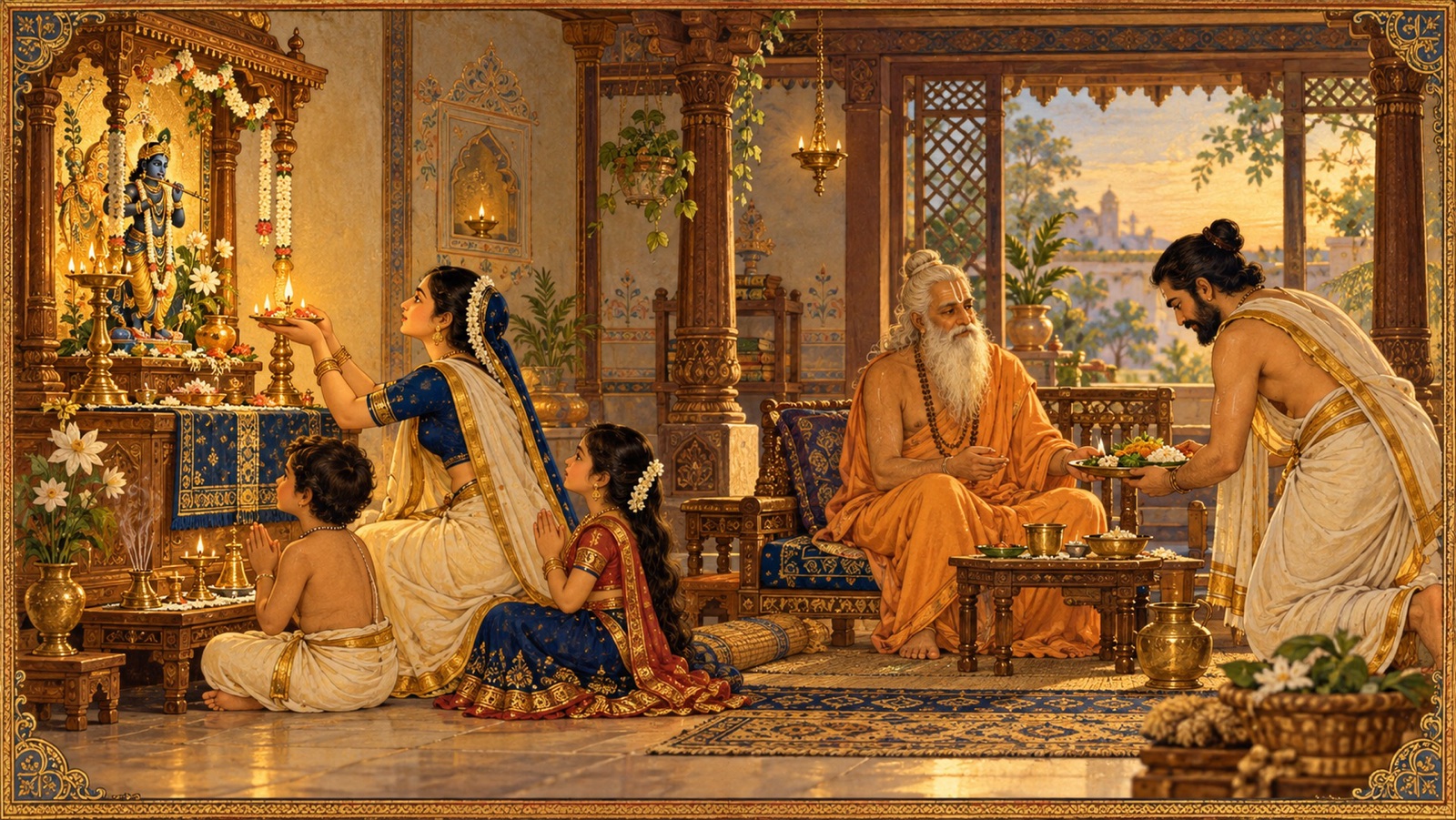
Not everyone can retire to the forest. So Yudhishthira asks the question that belongs to most of us: how can a householder, bound to home and family, still reach God? Narada’s answer turns ordinary domestic life into a path of devotion, compassion, and quiet surrender.
Om Namo Bhagavate Vasudevaya.
Om Namo Bhagavate Vasudevaya.
Om Namo Bhagavate Vasudevaya.
Welcome to Srimad Bhagavatam Wisdom, a devotional journey through the sacred histories and teachings of the Srimad Bhagavat Mahapurana. Having described the renunciant and the forest-dweller, Narada now turns, in this fourteenth chapter of the Seventh Canto, to answer a question Emperor Yudhishthira asks on behalf of most of us: how can someone whose mind is bound to home and family still walk the road to God?
Chapter Information
- Scripture: Śrīmad Bhāgavata Mahāpurāṇa
- Canto: 7 (Book Seven)
- Chapter: 14
- Chapter title: Ideal Family Life, the Householder’s Path to God
- Principal speaker: The sage Narada
- Principal listener: Emperor Yudhishthira
- Main setting: The assembly of Emperor Yudhishthira, in the course of Narada’s discourse
- Central subject: How a householder may attain liberation — through devotion, detachment, compassion for all beings, generous sharing, and worship of the Lord present within all
- Principal verse range: Canto 7, Chapter 14, verses 1–42
- Primary edition: Gita Press Śrīmad Bhāgavata Mahāpurāṇa
The Householder’s Question
Yudhishthira put the question with disarming honesty, counting himself among those whose minds are bound to the home. How, he asked the celestial sage, may a householder like himself easily attain the highest state?
गृहस्थ एतां पदवीं विधिना येन चाञ्जसा । यायाद्देवऋषे ब्रूहि मादृशो गृहमूढधी: ॥ १ ॥
gṛhastha etāṁ padavīṁ vidhinā yena cāñjasā yāyād deva-ṛṣe brūhi mādṛśo gṛha-mūḍha-dhīḥ
Meaning: O celestial sage, tell me the method by which a householder like me, whose mind is bewildered by attachment to home, may easily attain that highest state. (SB 7.14.1)
Home as an Offering
Narada’s answer began at the very heart of the matter: that the householder should remain in his home and perform all its proper duties — but perform them as a direct offering to the Lord Vasudeva, expecting no reward, while faithfully serving the great sages and devotees:
गृहेष्ववस्थितो राजन्क्रिया: कुर्वन्यथोचिता: । वासुदेवार्पणं साक्षादुपासीत महामुनीन् ॥ २ ॥
gṛheṣv avasthito rājan kriyāḥ kurvan yathocitāḥ vāsudevārpaṇaṁ sākṣād upāsīta mahā-munīn
Meaning: Dwelling in his home, O king, and performing his proper duties as a direct offering to Lord Vasudeva, a householder should wait upon the great sages. (SB 7.14.2)
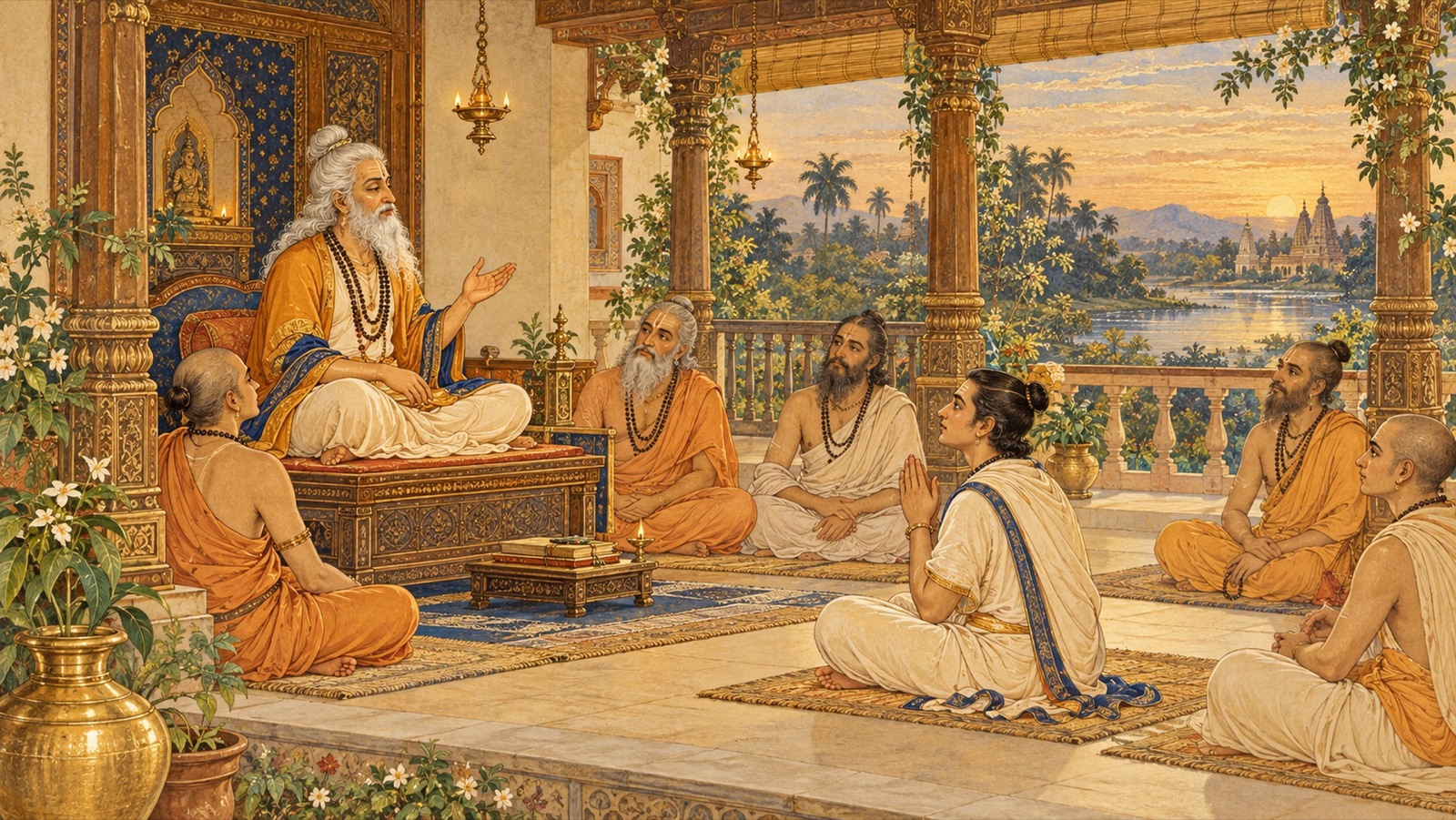
By keeping the company of the tranquil and hearing again and again, with faith, the nectar-like stories of the Lord and His incarnations, Narada taught, a householder gradually loosens the pull of family affection — not by force, but the way someone leaving a dream simply drops everything witnessed inside it:
शृण्वन्भगवतोऽभीक्ष्णमवतारकथामृतम् । श्रद्दधानो यथाकालमुपशान्तजनावृत: ॥ ३ ॥ सत्सङ्गाच्छनकै: सङ्गमात्मजायात्मजादिषु । विमुञ्चेन्मुच्यमानेषु स्वयं स्वप्नवदुत्थित: ॥ ४ ॥
śṛṇvan bhagavato ’bhīkṣṇam avatāra-kathāmṛtam śraddadhāno yathā-kālam upaśānta-janāvṛtaḥ
sat-saṅgāc chanakaiḥ saṅgam ātma-jāyātmajādiṣu vimuñcen mucyamāneṣu svayaṁ svapnavad utthitaḥ
Meaning: One who hears again and again, in the company of the peaceful, the nectar of the Lord’s incarnation-stories should, in this way, gradually give up attachment to spouse and offspring — precisely as a sleeper, upon waking, releases every scene of a dream now ended. (SB 7.14.3–4)
He should serve his body and household only as much as necessary, appearing outwardly like other people while remaining inwardly free, claiming nothing as his own, and enjoying whatever wealth comes as the gift of the Lord. Narada then drew the boundary of that gift with unusual precision:
यावद् भ्रियेत जठरं तावत् स्वत्वं हि देहिनाम् । अधिकं योऽभिमन्येत स स्तेनो दण्डमर्हति ॥ ८ ॥
yāvad bhriyeta jaṭharaṁ tāvat svatvaṁ hi dehinām adhikaṁ yo ’bhimanyeta sa steno daṇḍam arhati
Meaning: A person’s rightful claim extends only as far as what is needed to keep body and soul together; whoever considers himself entitled to more than that should be regarded as a thief, deserving of punishment under the law of nature. (SB 7.14.8)
Compassion for Every Creature
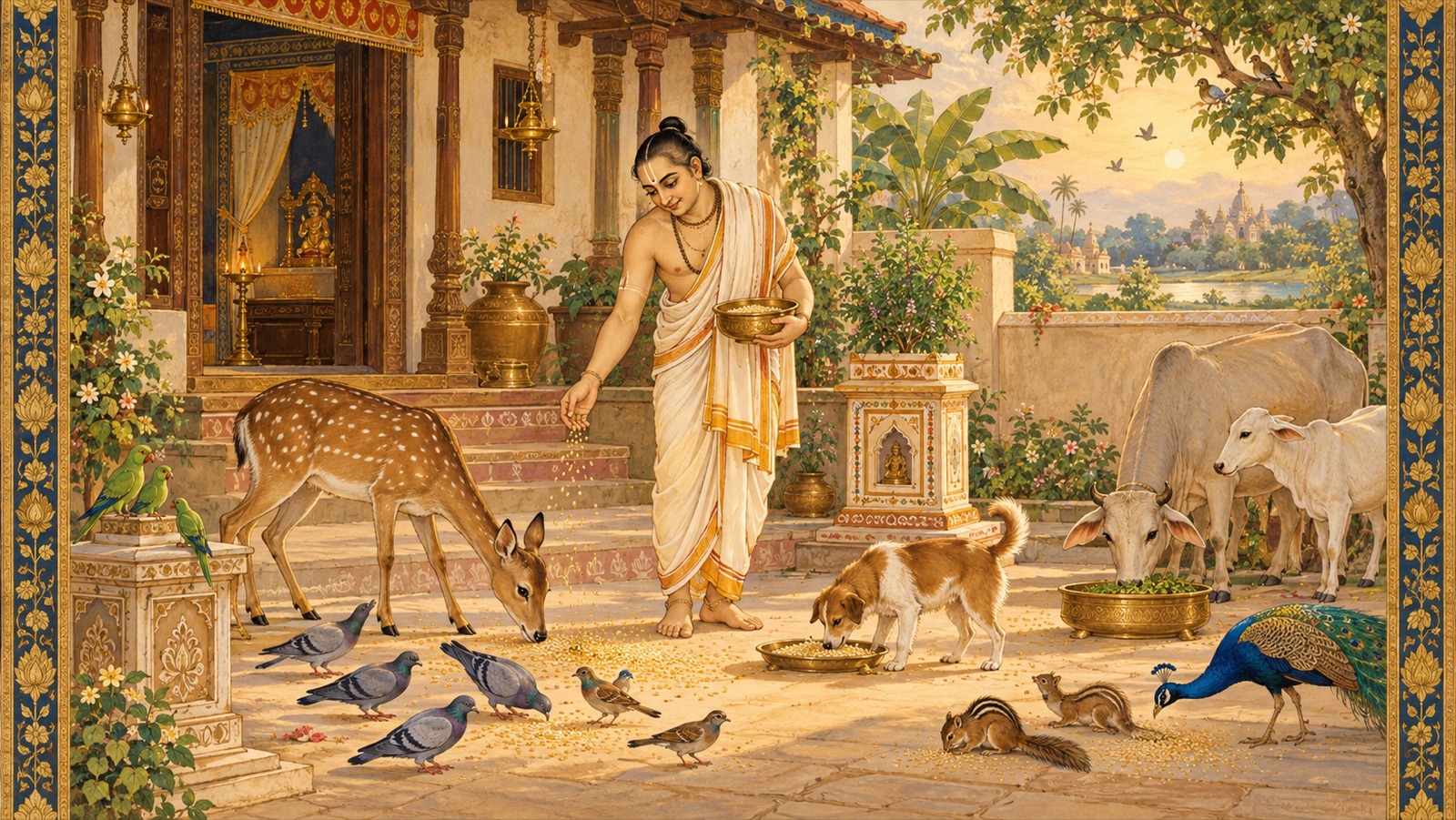
Then came one of the tenderest instructions of the chapter. The householder is to look upon the animals around him — deer and camels, donkeys and monkeys, mice, reptiles, birds, and even insects — as though they were his own children, for what, after all, so greatly divides them from our children?
मृगोष्ट्रखरमर्काखुसरीसृप्खगमक्षिका: । आत्मन: पुत्रवत् पश्येत्तैरेषामन्तरं कियत् ॥ ९ ॥
mṛgoṣṭra-khara-markākhu- sarīsṛp khaga-makṣikāḥ ātmanaḥ putravat paśyet tair eṣām antaraṁ kiyat
Meaning: One should look upon deer, camels, donkeys, monkeys, mice, reptiles, birds, and insects as one’s own children — for how little truly separates them from one’s own offspring! (SB 7.14.9)
In the same generous spirit, Narada urged the householder not to strive anxiously even for the ordinary aims of life, but to accept what fate assigns; to share his enjoyments freely with all — even dogs and the lowliest of creatures; and to hold his attachments so lightly that he inwardly relinquishes even his claim to what he holds most dear. The body, he reminded Yudhishthira, is destined to become worms, ashes, or dust; how exalted, by contrast, is the imperishable soul.
Worshipping the Lord Within All
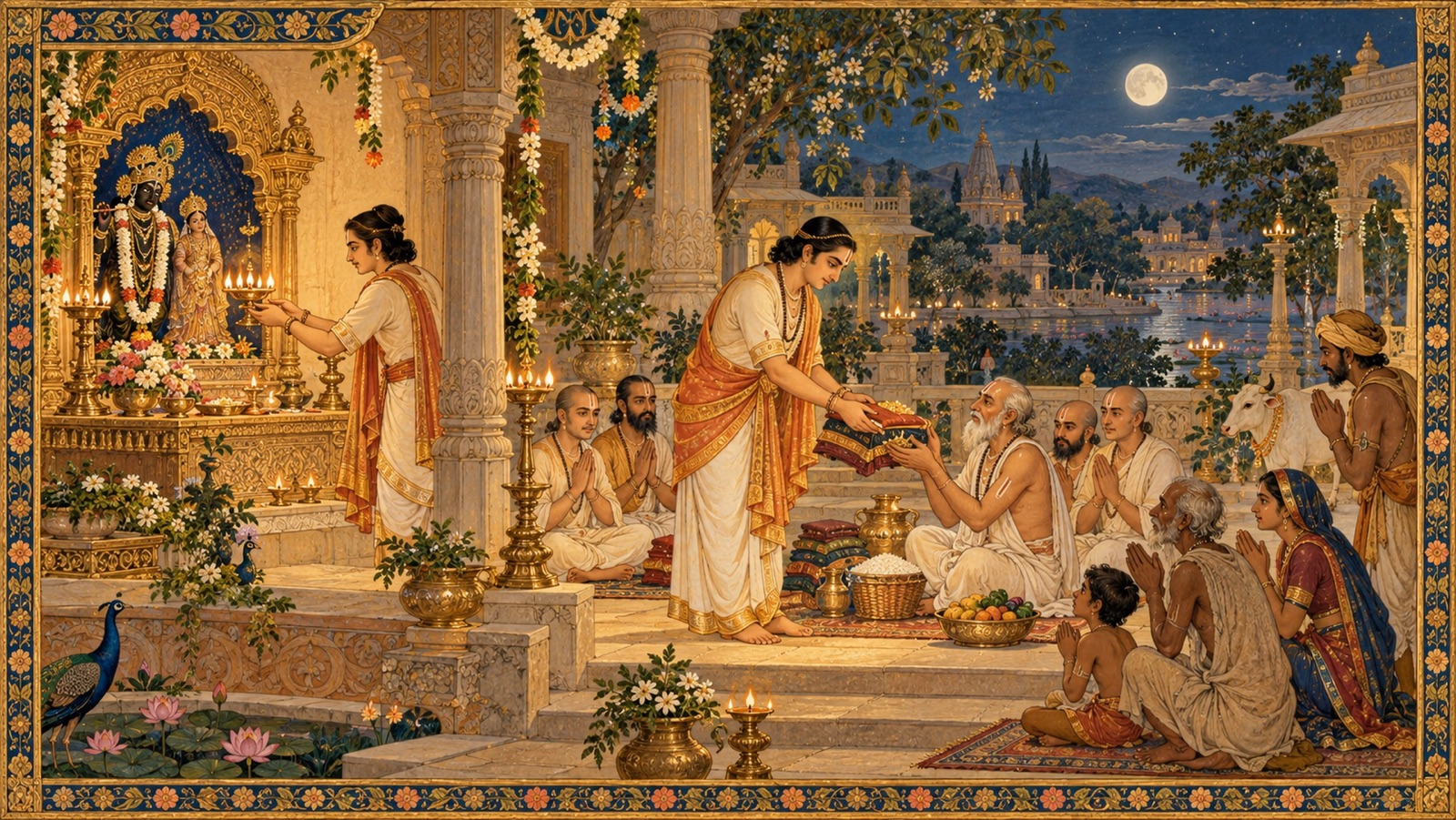
Narada then gave the householder a daily worship broad enough to embrace the whole of creation. With whatever he earns through his own honest work, he should worship the Supreme Person — the Inner Controller of all — as present in the gods, the sages, human beings, other living creatures, the departed ancestors, and his own self:
देवानृषीन् नृभूतानि पितृनात्मानमन्वहम् । स्ववृत्त्यागतवित्तेन यजेत पुरुषं पृथक् ॥ १५ ॥
devān ṛṣīn nṛ-bhūtāni pitṝn ātmānam anvaham sva-vṛttyāgata-vittena yajeta puruṣaṁ pṛthak
Meaning: Each day, with the wealth earned through his own honest work, a householder should worship the Supreme Person as present severally in the gods, the sages, human beings, other living beings, the ancestors, and his own self. (SB 7.14.15)
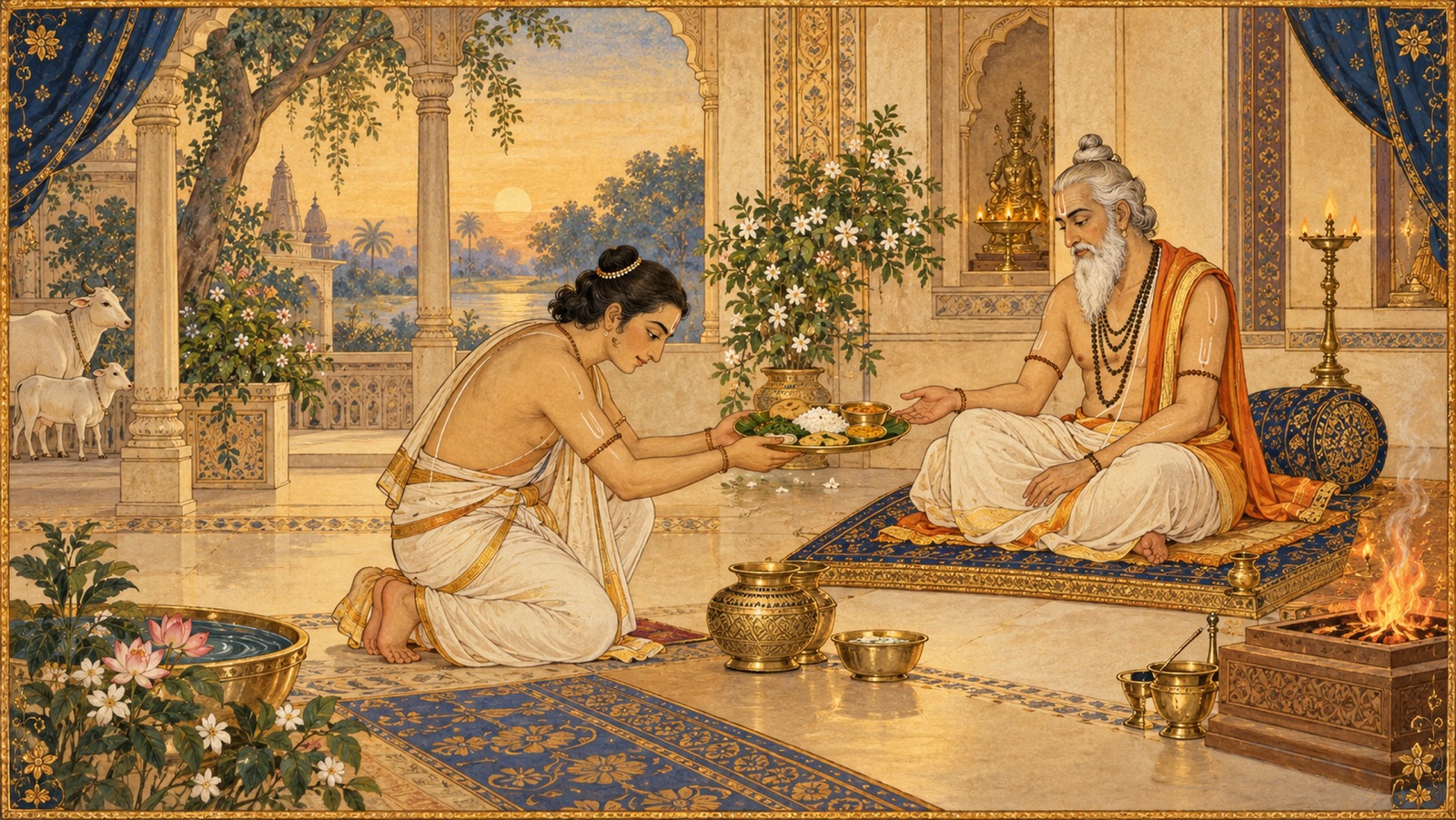
And though sacrifice offered through the sacred fire is holy, Narada revealed something that lifts worship out of ritual and into love: that the Lord is more fully pleased by food placed with reverence into the mouth of a hungry Brahmana than by oblations poured into the fire:
न ह्यग्निमुखतोऽयं वै भगवान्सर्वयज्ञभुक् । इज्येत हविषा राजन्यथा विप्रमुखे हुतै: ॥ १७ ॥
na hy agni-mukhato ‘yaṁ vai bhagavān sarva-yajña-bhuk ijyeta haviṣā rājan yathā vipra-mukhe hutaiḥ
Meaning: The Lord, the enjoyer of all sacrifices, is not so fully worshipped by oblations offered through the mouth of the sacred fire, O king, as by offerings placed into the mouth of a Brahmana. (SB 7.14.17)
Sacred Times and the Glory of the Devout
Narada went on to describe the sacred occasions for worship, charity, and remembrance of the ancestors — the equinoxes and solstices, eclipses, holy lunar days, and the constellation of one’s birth — teaching that acts of virtue performed at these times become imperishable, bringing everlasting good (SB 7.14.19–26). He named, too, the most sacred grounds for such observance: wherever a Vaishnava may be found, wherever the Deity of the Lord is worshipped, and the great tirthas — Kurukshetra, Prayaga, Varanasi, Mathura, and the rest — declaring that a single act of devotion performed there yields fruit a thousand times over (SB 7.14.27–33). Finally he exalted the true recipients of the householder’s reverence. Among all human beings, the worthiest vessel of worship is the Brahmana, who by austerity, learning, and contentment embodies the Veda, the very form of the Lord. Such Brahmanas, devoted to Krishna, the Soul of the universe, sanctify the three worlds with the dust of their feet:
नन्वस्य ब्राह्मणा राजन्कृष्णस्य जगदात्मन: । पुनन्त: पादरजसा त्रिलोकीं दैवतं महत् ॥ ४२ ॥
nanv asya brāhmaṇā rājan kṛṣṇasya jagad-ātmanaḥ punantaḥ pāda-rajasā tri-lokīṁ daivataṁ mahat
Meaning: Surely, O king, the Brahmanas devoted to Krishna, the Soul of the universe, purify the three worlds with the dust of their feet; they are the great deity. (SB 7.14.42)
Krishna, the Root of All
Narada then answered a deeper question: of all the worthy recipients a householder might honour, who alone deserves everything? Learned sages, he said, have settled this once and for all — it is Hari, and Hari alone, for the whole of this moving and unmoving creation rests in Him:
पात्रं त्वत्र निरुक्तं वै कविभि: पात्रवित्तमै: । हरिरेवैक उर्वीश यन्मयं वै चराचरम् ॥ ३४ ॥
pātraṁ tv atra niruktaṁ vai kavibhiḥ pātra-vittamaiḥ harir evaika urvīśa yan-mayaṁ vai carācaram
Meaning: On this the wise who best understand true worthiness have settled it: Hari alone, O king, is that one supreme recipient, for this whole universe of moving and unmoving beings rests entirely in Him. (SB 7.14.34)
Narada explained why this is so: the universe, teeming with countless living beings, is like a vast tree, and the infallible Lord is its single root. Just as watering a tree’s root nourishes every branch, leaf, and flower at once, worship offered to Krishna alone already feeds and satisfies every living being within His creation:
जीवराशिभिराकीर्ण अण्डकोशाङ्घ्रिपो महान् । तन्मूलत्वादच्युतेज्या सर्वजीवात्मतर्पणम् ॥ ३६ ॥
jīva-rāśibhir ākīrṇa aṇḍa-kośāṅghripo mahān tan-mūlatvād acyutejyā sarva-jīvātma-tarpaṇam
Meaning: This vast universe, filled with countless living beings, is like a great tree whose root is the infallible Lord; because He alone is that root, worship offered to Him nourishes the very self of every living being. (SB 7.14.36)
Narada then offered Yudhishthira a proof he himself had witnessed. At the emperor’s own Rajasuya sacrifice, when sages, demigods, and even the four sons of Brahma gathered to decide who among that vast assembly deserved the first worship, everyone present concluded it must be Krishna; only Shishupala protested, and for that defiance the Lord slew him with His own hand (SB 7.14.35). This, Narada said, is why generosity to guests, kindness to the animal at the door, and remembrance of the ancestors never compete with love of God — every one of them is an offering made to the single root that already sustains them all.
Principal Teachings of This Chapter
1. Home can be a temple. The householder need not flee the world; performing every duty as an offering to Lord Vasudeva turns family life itself into worship (SB 7.14.2).
2. Detachment can be lived within attachment. By hearing the Lord’s stories among saints, one loosens the grip of “mine” while still caring faithfully for one’s family (SB 7.14.3-4).
3. Take only your share. To live on what fills the belly is right; to grasp more than one needs is a kind of theft (SB 7.14.8).
4. Compassion extends to every creature. Even animals and insects are to be cherished as one’s own children, for how little truly separates them from us (SB 7.14.9).
5. Worship the Lord present in all. The Supreme is honoured through the gods, sages, guests, and creatures — and is more pleased by feeding the hungry than by fire alone (SB 7.14.15, 17).
6. Krishna is the root that sustains all. Because this entire creation rests in Him as branches rest on one root, worship offered to Krishna already nourishes every living being (SB 7.14.34, 36).
A Devotional Reflection
What makes this chapter so consoling is its refusal to reserve holiness for the few. Yudhishthira speaks for all of us who feel bound by our responsibilities — the home, the family, the daily round of work — and worries that such a life is somehow lesser, a barrier to God. Narada gently overturns that fear. He does not tell the householder to abandon his duties but to transfigure them: to cook, to earn, to care, and to give, all as an offering to the Lord who dwells within every guest and every creature that comes to the door. In this vision, love of family is not opposed to love of God but becomes its training ground, provided the heart holds all things loosely and sees the one Lord in all. The animals fed at the threshold, the guest honoured with a meal, the ancestors remembered on a sacred day — each becomes an act of worship. We do not have to go elsewhere to find the Lord. He is already present in the people and creatures placed before us, waiting to be served.
A Daily Devotional Practice
Today, make your home a place of worship. Choose one ordinary duty — preparing a meal, earning your living, caring for someone in your household — and offer it silently to the Lord before you begin, expecting nothing in return, saying within: “Om Namo Bhagavate Vasudevaya.” Then, in the spirit of this chapter, feed someone: set out food for a bird or animal, or share a meal with a guest or a person in need, seeing the Lord present in them. Let compassion and offering, not acquisition, be the rhythm of your day.
Conclusion
The fourteenth chapter of the Seventh Canto answers Yudhishthira’s fear of being gṛha-mūḍha with a single, liberating image: this creation is a tree, and Krishna alone is its root. A householder need not abandon hearth or family to reach God — he need only see that every duty offered to that one root, every guest fed, every creature sheltered, already reaches and nourishes the whole tree of living beings. Home becomes no obstacle once its doors open toward that root instead of closing around it. May we, too, learn to water it daily, until our whole life flowers as a single, unbroken offering.
May the divine wisdom of Srimad Bhagavatam awaken pure devotion within our hearts.
Om Namo Bhagavate Vasudevaya.
Jay Shree Madhav.
References and Attribution
- Primary edition: Gita Press, Śrīmad Bhāgavata Mahāpurāṇa (English, complete), Book Seven, Discourse 14, pages 719–723.
- Series: Srimad Bhagavatam Wisdom · Biswa Sanatan Dharma Seva Trust.
- Presented following the spiritual guidance and recommendation of Pandit Dr. Shri Kashinath Mishra.
This is an original, faithful retelling in the writer’s own words, with brief quoted verses shown in Devanāgarī and transliteration and their meanings given as summaries. It is not a reproduction of any single publisher’s continuous translation or commentary. No affiliation with or endorsement by any publisher is implied.
Jay Shree Madhav