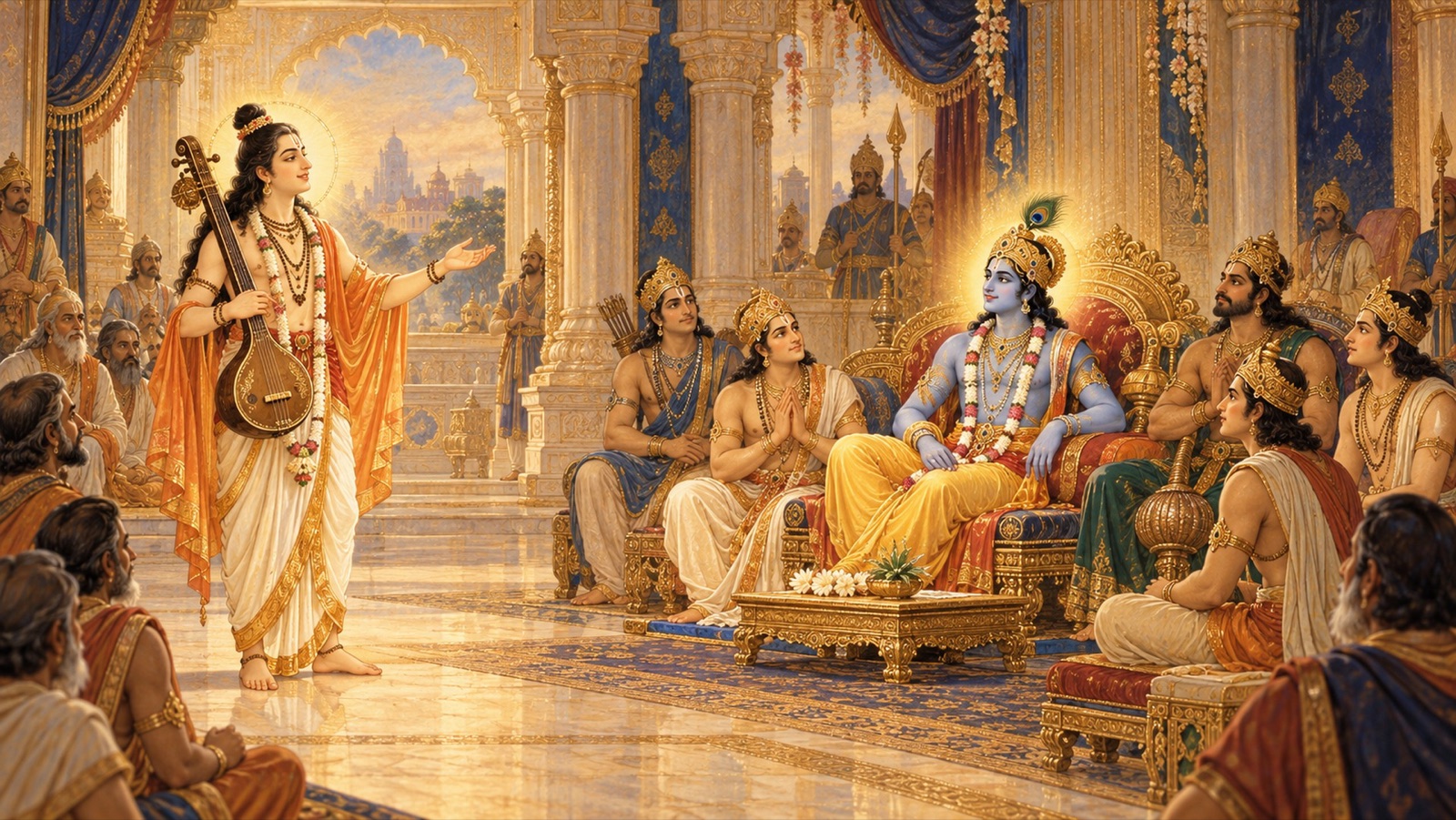
Narada’s great discourse to Yudhishthira reaches its summit here. After teaching the whole art of right conduct — non-violence, contentment, meditation, and the mastery of the inner enemies — he turns to the Pandavas with astonishing news: the Supreme Brahman, sought by the greatest sages, is living in their very home, disguised as their beloved friend and cousin, Sri Krishna.
Om Namo Bhagavate Vasudevaya.
Om Namo Bhagavate Vasudevaya.
Om Namo Bhagavate Vasudevaya.
Welcome to Srimad Bhagavatam Wisdom, a devotional journey through the sacred histories and teachings of the Srimad Bhagavat Mahapurana. This fifteenth chapter of the Seventh Canto brings Narada’s long teaching on right conduct — and the entire Seventh Canto — to its glorious close, culminating in one of the most moving revelations in all of scripture: that Sri Krishna, seated among the Pandavas as friend and kinsman, is none other than the Supreme Brahman Himself.
Chapter Information
- Scripture: Śrīmad Bhāgavata Mahāpurāṇa
- Canto: 7 (Book Seven)
- Chapter: 15
- Chapter title: The Culmination of Right Conduct
- Principal speaker: The sage Narada
- Principal listener: Emperor Yudhishthira
- Main setting: The assembly of Emperor Yudhishthira, in the presence of Sri Krishna
- Central subject: The perfection of right conduct — non-violence, contentment, mastery of the inner enemies, meditation, the chariot of the body, and the revelation that Sri Krishna is the Supreme Brahman
- Principal verse range: Canto 7, Chapter 15, verses 1–80
- Primary edition: Gita Press Śrīmad Bhāgavata Mahāpurāṇa
The Highest Virtue and the Secret of Happiness
Narada began by ranking the many kinds of Brahmanas — those devoted to ritual, to austerity, to study, and, highest of all, to knowledge and devotion. He gave careful guidance on offerings and charity, then arrived at a truth that towers above all rites: that for those who truly seek virtue, there is no higher dharma than the complete renunciation of violence toward all beings, in thought, word, and deed:
नैतादृश: परो धर्मो नृणां सद्धर्ममिच्छताम् । न्यासो दण्डस्य भूतेषु मनोवाक्कायजस्य य: ॥ ८ ॥
naitādṛśaḥ paro dharmo nṛṇāṁ sad-dharmam icchatām nyāso daṇḍasya bhūteṣu mano-vāk-kāyajasya yaḥ
Meaning: For those who desire true virtue, there is no higher dharma than the renunciation of all violence toward living beings — the harm born of mind, speech, and body. (SB 7.15.8)
He then praised contentment as the very ground of happiness. The contented soul, delighting in the Self, finds joy in every direction, while the greedy run themselves ragged in all directions and never arrive. Discontent, he warned, dissolves even the learning and austerity of a Brahmana; and greed alone, of all the passions, is never satisfied — not even by the conquest of the whole earth.
Conquering the Inner Enemies
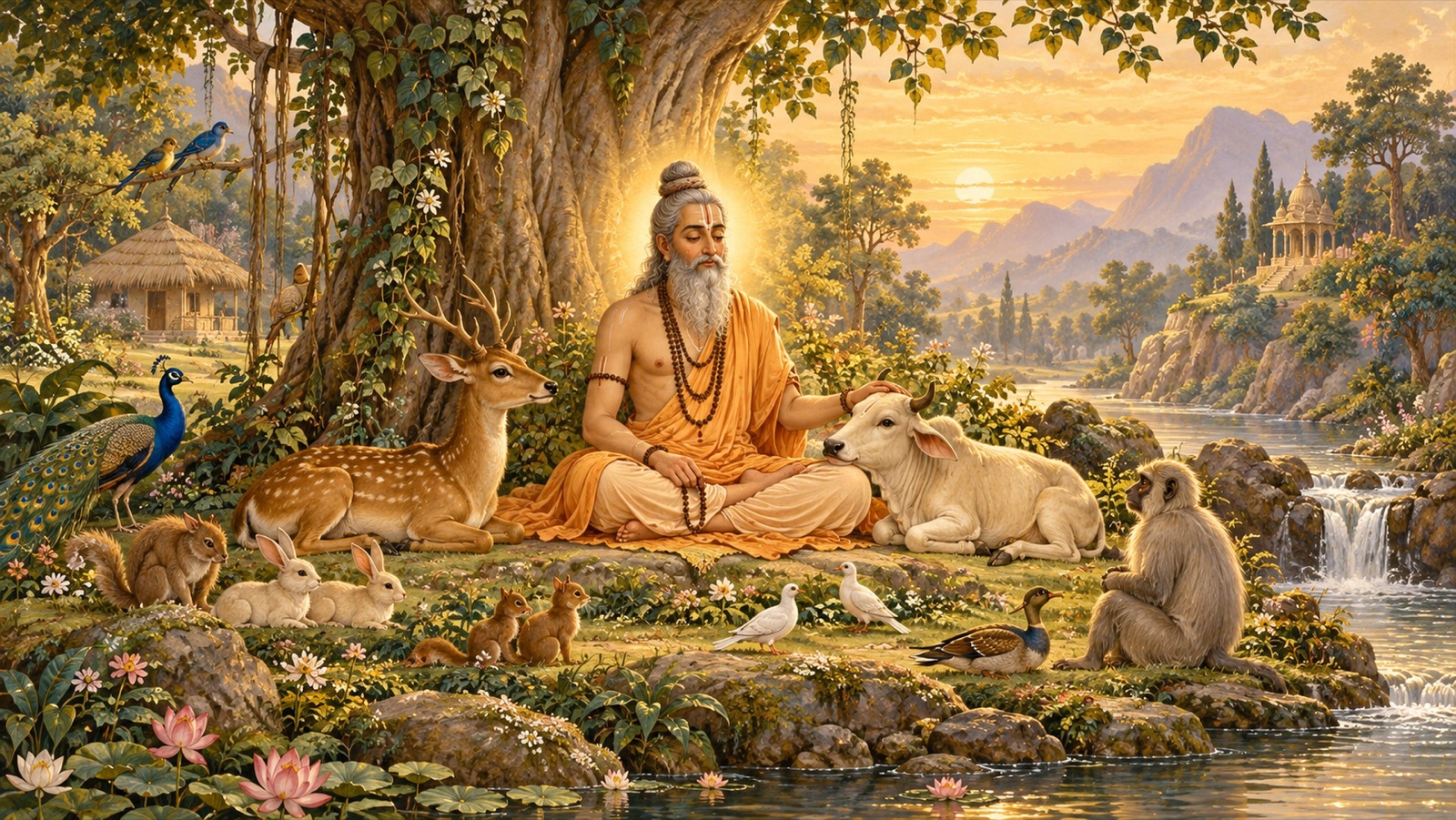
Narada then mapped the inner battlefield. Desire is conquered by determined resolve, anger by giving up envy, greed by seeing wealth as a source of misery, fear by discerning the truth, grief and delusion by distinguishing spirit from matter, and false pride by serving the great (verses 22–24). But above every particular remedy he set one master-key: that the modes of passion and inertia are overcome by goodness, goodness itself by dispassion, and all of these together, easily, by devotion to the spiritual teacher:
रजस्तमश्च सत्त्वेन सत्त्वं चोपशमेन च । एतत्सर्वं गुरौ भक्त्या पुरुषो ह्यञ्जसा जयेत् ॥ २५ ॥
rajas tamaś ca sattvena sattvaṁ copaśamena ca etat sarvaṁ gurau bhaktyā puruṣo hy añjasā jayet
Meaning: One conquers passion and inertia through goodness, and goodness itself through tranquil dispassion; but all of these a person conquers easily through devotion to the spiritual teacher. (SB 7.15.25)
For the teacher, Narada explained, is not a mere mortal but the Lord Himself in human form — just as Sri Krishna, seated before them and taken by the world for an ordinary man, is in truth the Supreme Lord whose feet are sought even by the masters of yoga.
Narada presses this point further, and it is the axis on which the whole chapter turns: the spiritual master must be honoured as directly the Supreme Lord, because he is the one who lights the lamp of transcendental knowledge, and a disciple who dismisses him as an ordinary man reduces all his learning and austerity to nothing — like an elephant that bathes carefully and then throws dust over itself the moment it reaches the shore (verses 26–27). The reasoning is not flattery; it is a warning. Whatever looks ordinary to the eye — a teacher, a cousin, a friend — may in truth be carrying the Lord’s own authority, or, as this chapter’s climax will show, may be the Lord Himself. Outward familiarity is never proof of an inward absence of divinity.
The Chariot of the Body
To show how the seeker must drive himself toward liberation, Narada offered the ancient image of the chariot. The body is the chariot, the senses its horses, the mind the reins, the intellect the charioteer, and the pure Self the arrow to be aimed at the Supreme as its target:
आहु: शरीरं रथमिन्द्रियाणि हयानभीषून्मन इन्द्रियेशम् । वर्त्मानि मात्रा धिषणां च सूतं सत्त्वं बृहद् बन्धुरमीशसृष्टम् ॥ ४१ ॥
āhuḥ śarīraṁ ratham indriyāṇi hayān abhīṣūn mana indriyeśam vartmāni mātrā dhiṣaṇāṁ ca sūtaṁ sattvaṁ bṛhad bandhuram īśa-sṛṣṭam
Meaning: The wise call the body a chariot, the senses its horses, the mind — the lord of the senses — its reins, the objects of the senses the paths, the intellect the charioteer, and the great inner faculty the seat — all fashioned by the Lord. (SB 7.15.41)
While the body-chariot is still under his control, Narada taught, the seeker must slay the enemies within — attachment and aversion, greed, grief, fear, and pride — wielding the sword of wisdom, sharpened by worship of the feet of the exalted and made strong by taking refuge in the infallible Lord Acyuta. Otherwise the runaway horses of the senses drag the unwary soul into the pit of endless rebirth.

Meditation and the Two Paths
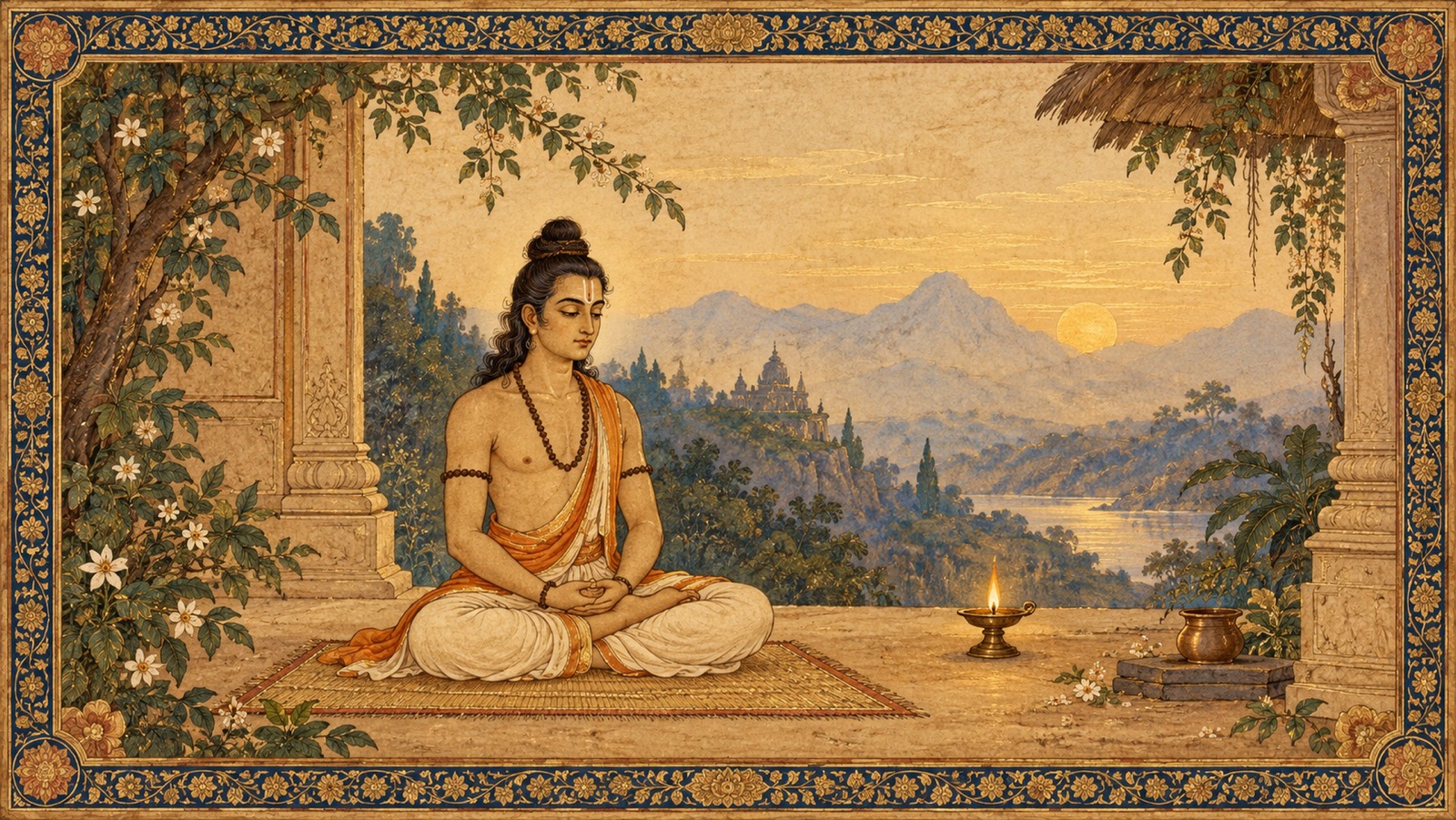
Narada described the way of meditation for one intent on subduing the mind: to withdraw to a clean, secluded place, sit erect and steady, repeat the sacred syllable OM, control the breath, and gently draw the restless mind back from every object it chases. Such a mind, he said, soon grows still — like a fire that goes out once its fuel is spent — and, absorbed in the bliss of the Absolute, is never again disturbed. He then unfolded the two great paths open to departed souls: the “dark path” of interested action, which leads back to rebirth, and the “bright path” of inward, God-turned action, which culminates in liberation.
The Three Unities and the Devotee at Home
Drawing the teaching toward its practical heart, Narada named three forms of non-dual living. There is unity of thought — seeing the one Reality behind all apparent diversity; unity of interest — regarding the welfare of one’s family and all beings as one’s own; and, most beautiful of all, unity of action — offering every deed of mind, speech, and body directly to the Supreme:
यद् ब्रह्मणि परे साक्षात्सर्वकर्मसमर्पणम् । मनोवाक्तनुभि: पार्थ क्रियाद्वैतं तदुच्यते ॥ ६४ ॥
yad brahmaṇi pare sākṣāt sarva-karma-samarpaṇam mano-vāk-tanubhiḥ pārtha kriyādvaitaṁ tad ucyate
Meaning: The direct offering of all actions — of mind, speech, and body — to the Supreme Brahman: this, O son of Pritha, is called the unity of action. (SB 7.15.64)
By such living, Narada assured Yudhishthira, a devoted householder can attain the very realm of Sri Krishna without ever leaving home — just as the Pandavas themselves had crossed a sea of calamities by the grace of Krishna, and would surely cross the ocean of worldly existence as well. He even shared his own history: how in a former age he had been a proud celestial musician named Upabarhana, cursed for irreverence to be born as a servant, and how, through humble service to the sages, he had risen at last to become a son of Brahma — proof that the path of devotion can lift any soul.
The Lord Among You
Then came the revelation toward which the whole discourse had been moving. Narada declared the Pandavas supremely fortunate — for sages sanctifying the world flocked to their home, since the Supreme Brahman Himself dwelt there, hidden in human form:
यूयं नृलोके बत भूरिभागा लोकं पुनाना मुनयोऽभियन्ति । येषां गृहानावसतीति साक्षाद् गूढं परं ब्रह्म मनुष्यलिङ्गम् ॥ ७५ ॥
yūyaṁ nṛ-loke bata bhūri-bhāgā lokaṁ punānā munayo ‘bhiyanti yeṣāṁ gṛhān āvasatīti sākṣād gūḍhaṁ paraṁ brahma manuṣya-liṅgam
Meaning: Truly, O Pandavas, you are supremely fortunate in this world of men — for sages who purify the whole world come to your homes, since the Supreme Brahman Himself, hidden in the form of a human being, dwells there. (SB 7.15.75)
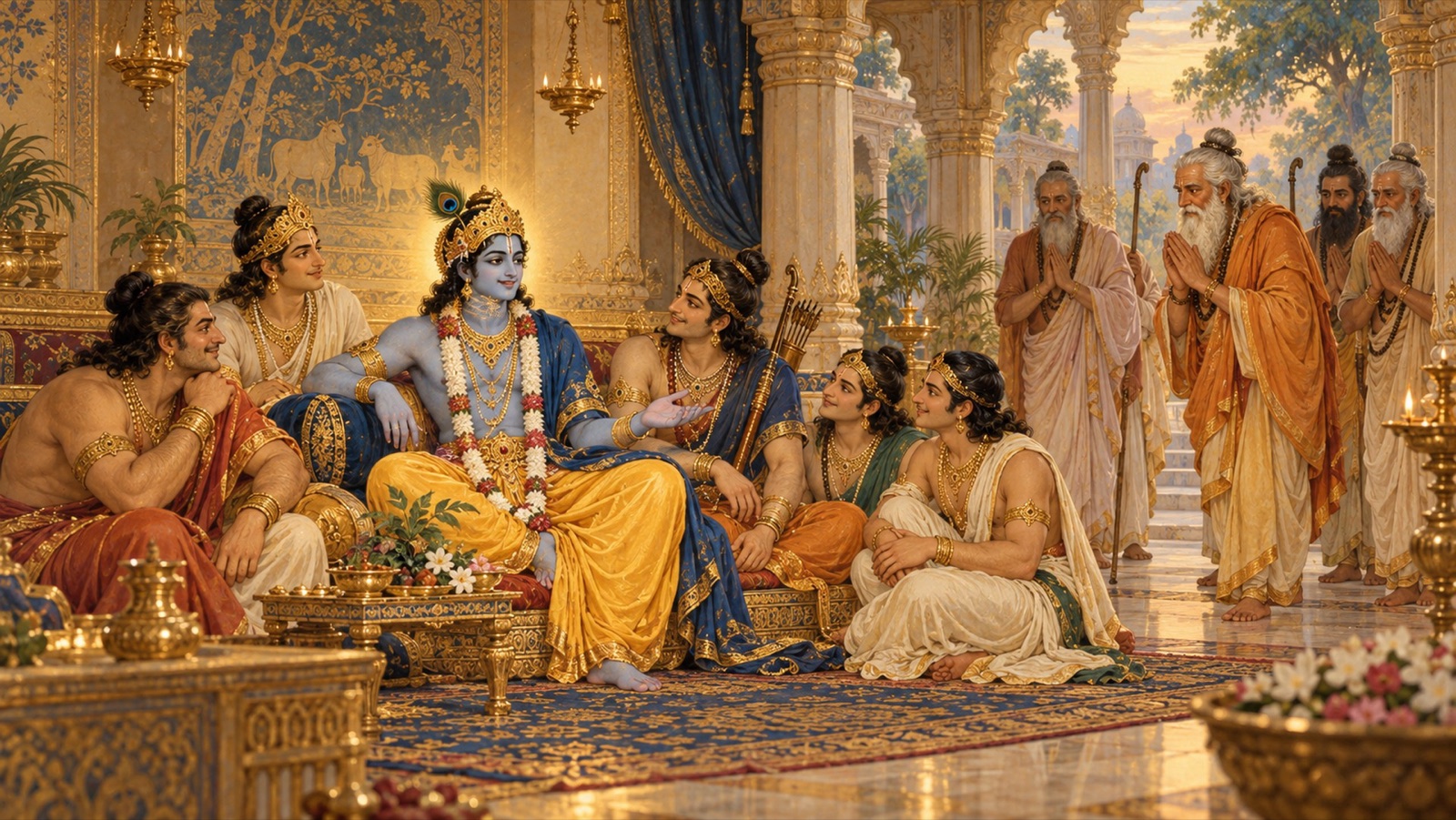
And lest there be any doubt whom he meant, Narada named Him plainly: this very Sri Krishna — their beloved friend, their cousin, their trusted servant and charioteer, their worshipful guide — is the Supreme Brahman, the realization of absolute bliss, diligently sought after even by the greatest of souls:
स वा अयं ब्रह्म महद्विमृग्य कैवल्यनिर्वाणसुखानुभूति: । प्रिय: सुहृद् व: खलु मातुलेय आत्मार्हणीयो विधिकृद्गुरुश्च ॥ ७६ ॥
sa vā ayaṁ brahma mahad-vimṛgya- kaivalya-nirvāṇa-sukhānubhūtiḥ priyaḥ suhṛd vaḥ khalu mātuleya ātmārhaṇīyo vidhi-kṛd guruś ca
Meaning: This very one is the Supreme Brahman, sought by the great, the very experience of absolute liberating bliss — your dear friend, your cousin, worthy of your worship, your obedient helper and your guide. (SB 7.15.76)
Principal Teachings of This Chapter
1. Non-violence is the highest virtue. For all who truly seek goodness, no dharma stands higher than freedom from harm to any being in thought, word, and deed (SB 7.15.8).
2. Contentment is the ground of happiness. The contented soul finds joy everywhere; the greedy find no rest even by conquering the whole earth (SB 7.15.16-20).
3. The spiritual master is to be honoured as the Lord Himself. A disciple who considers the guru an ordinary man reduces all his knowledge and austerity to nothing; the inner enemies, too, are conquered most easily through devotion to him (SB 7.15.25-27).
4. The body is a chariot to be driven toward God. With the mind as reins and wisdom as a sword, and refuge in Acyuta, the seeker steers past the senses toward the Supreme (SB 7.15.41-45).
5. The Lord may be nearer than we know. The Supreme Brahman, sought by sages, lived in the Pandavas’ home as Sri Krishna — a reminder that God is present, often hidden in plain sight (SB 7.15.75-76).
A Devotional Reflection
There is a quiet astonishment at the close of this chapter. Narada has just laid out the entire architecture of a holy life — non-violence, contentment, meditation, the conquest of the inner enemies, the offering of every act to God. It is a vast and demanding path. And then, almost gently, he turns to the Pandavas and tells them that the goal of all this striving has been sitting in their living room the whole time. The Supreme they have been taught to seek is their own dear Krishna — friend, cousin, charioteer — so near and so familiar that they had not fully grasped who He was. How often it is the same for us. We search for God in distant places and difficult disciplines, and He is present all along in the love and duties closest to us, hidden in plain sight. The disciplines are not wasted; they open our eyes. But the sweetness of this ending is its assurance that the Lord we seek is not far off. He is already among us, waiting to be recognized, worshipped, and loved.
A Daily Devotional Practice
Today, practise the “unity of action” that Narada names: offer every deed — of mind, speech, and body — to the Lord as you do it, expecting nothing in return, silently saying within: “Om Namo Bhagavate Vasudevaya.” Choose, too, one act of true non-violence — a gentle word instead of a harsh one, patience instead of retaliation, kindness to a creature in need. And before the day ends, look for the Lord hidden in plain sight: in a family member, a friend, or a guest, honour the presence of Krishna dwelling near you.
Conclusion
The fifteenth chapter of the Seventh Canto closes Narada’s teaching, and the whole Canto, on its single deepest note: the Lord we spend a lifetime seeking through discipline and detachment may already be seated beside us, unrecognised. Narada revealed that the Supreme Brahman, whom the greatest sages struggle to see, had been dwelling all along in the Pandavas’ home as their own beloved Sri Krishna. The Seventh Canto, which opened with a devotee’s love drawing the Lord to earth, ends here — with God found not in some distant heaven, but in the ordinary intimacy of family life. May we learn to recognise Him just as near, hidden in plain sight, waiting to be loved.
May the divine wisdom of Srimad Bhagavatam awaken pure devotion within our hearts.
Om Namo Bhagavate Vasudevaya.
Jay Shree Madhav.
References and Attribution
- Primary edition: Gita Press, Śrīmad Bhāgavata Mahāpurāṇa (English, complete), Book Seven, Discourse 15, pages 723–733.
- Series: Srimad Bhagavatam Wisdom · Biswa Sanatan Dharma Seva Trust.
- Presented following the spiritual guidance and recommendation of Pandit Dr. Shri Kashinath Mishra.
This is an original, faithful retelling in the writer’s own words, with brief quoted verses shown in Devanāgarī and transliteration and their meanings given as summaries. It is not a reproduction of any single publisher’s continuous translation or commentary. No affiliation with or endorsement by any publisher is implied.
Jay Shree Madhav