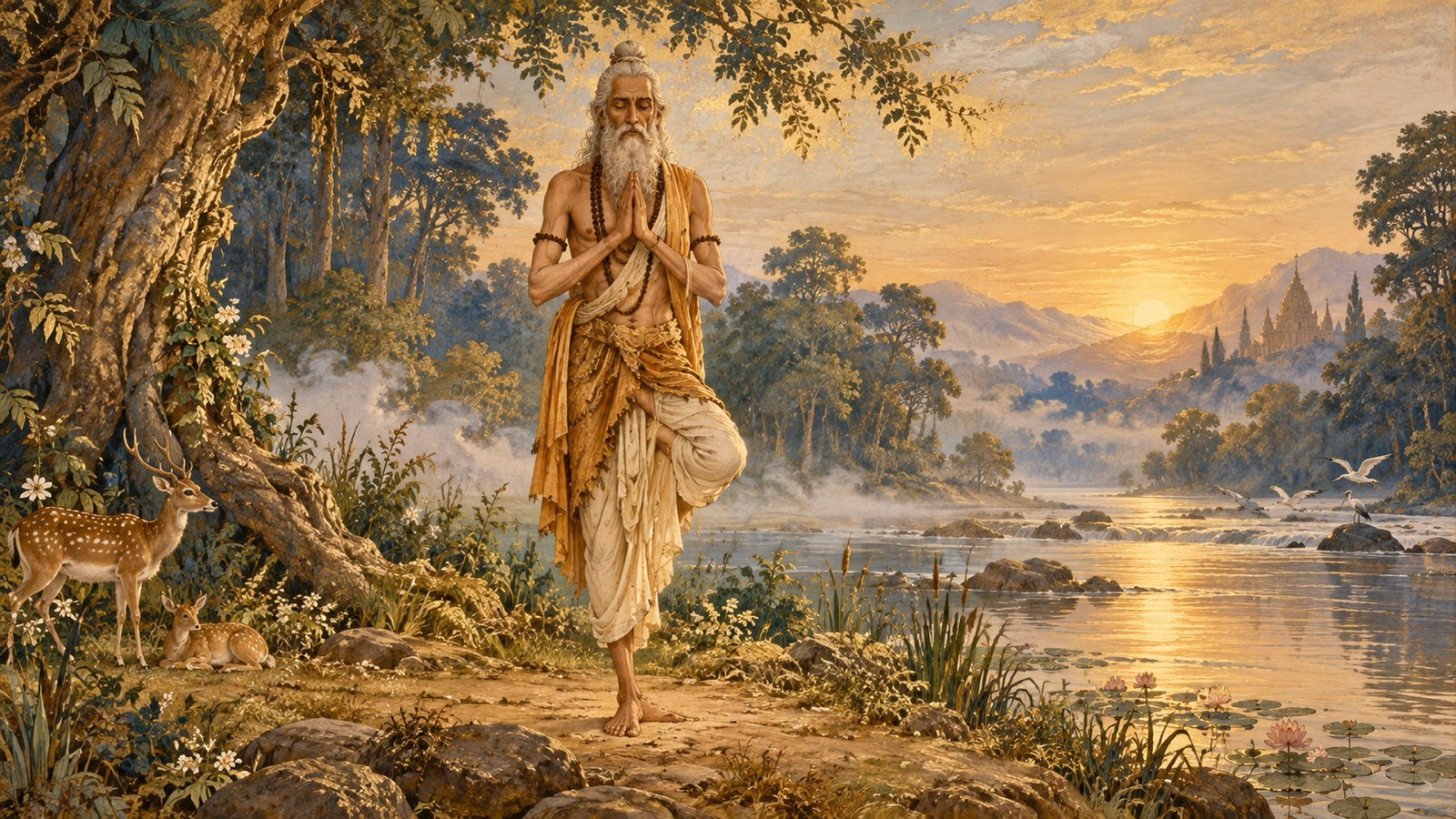
On the bank of the river Sunanda, an emperor who has given up a kingdom stands on a single foot for a hundred years, and from his lips flows a prayer that will summon the Lord Himself to his defence.
Om Namo Bhagavate Vasudevaya.
Om Namo Bhagavate Vasudevaya.
Om Namo Bhagavate Vasudevaya.
Welcome to Srimad Bhagavatam Wisdom, a devotional journey through the sacred histories and teachings of the Srimad Bhagavat Mahapurana. With this chapter we open the Eighth Canto — a book filled with some of the most beloved stories in all of scripture: the rescue of Gajendra, the churning of the ocean of milk, the appearance of the enchanting Mohini, and the descent of the Lord as the divine Dwarf, Vamana. Yet before any of these unfold, Sukadeva Gosvami sets the vast stage on which they all take place: the Manvantaras, the great cosmic ages, each presided over by a Manu, the progenitor and lawgiver of humankind.
Chapter Information
- Scripture: Śrīmad Bhāgavata Mahāpurāṇa
- Canto: 8 (Book Eight)
- Chapter: 1 (Discourse 1)
- Chapter title: The Manvantaras Described
- Principal speaker: Sukadeva Gosvami, narrating to King Parikshit — the whole related by Suta Gosvami to Saunaka and the assembled sages at Naimisharanya
- Principal listener: King Parikshit (within Sukadeva’s narration); the sages of Naimisharanya (hearing it from Suta)
- Main setting: The bank of the Ganga, where the fasting King Parikshit hears the Bhagavata from Sukadeva; within the narration, the forests and riverbanks of successive world-ages
- Central subject: The nature of the Manvantaras, the description of the first four Manus and their ages, and the Lord’s repeated descent in each age to protect the world
- Principal verse range: Canto 8, Chapter 1, verses 1–33
- Primary edition: Gita Press Śrīmad Bhāgavata Mahāpurāṇa
A King’s Question About the Ages of the World
Having heard, in the earlier books, the full account of Swayambhuva Manu and the great line of creators descended from Marici and the other sages, King Parikshit now longs to hear more. He asks Sukadeva to describe the other Manus as well — for the learned, he says, associate each Manvantara with a particular descent and exploit of Sri Hari, the greatest of the great. What did the Lord, the Protector of the universe, actually do in each past age; what is He doing now; and what will He accomplish in the ages yet to come?
श्रीराजोवाच स्वायम्भुवस्येह गुरो वंशोऽयं विस्तराच्छ्रुत: । यत्र विश्वसृजां सर्गो मनूनन्यान्वदस्व न: ॥ १ ॥
śrī-rājovāca svāyambhuvasyeha guro vaṁśo ’yaṁ vistarāc chrutaḥ yatra viśva-sṛjāṁ sargo manūn anyān vadasva naḥ
Meaning: The King said: O preceptor, I have heard in full the line of Swayambhuva Manu, in which the creators of the universe appeared; now kindly tell us of the other Manus as well. (Canto 8, Chapter 1, verse 1)
Sukadeva replies that in the current Kalpa — a single day of Brahma — six Manus have already come and gone, beginning with Swayambhuva. Of the first he has already spoken, along with the creation of gods, demons, and human beings, and how the Lord took birth as a son of Manu’s daughters: as Yajna, born of Akuti, to teach righteous action, and as the sage Kapila, born of Devahuti, to teach spiritual wisdom. Having already related Kapila’s teaching, Sukadeva now takes up the deeds of Lord Yajna, and the ages that followed.
The First Manu and His Century of Austerity
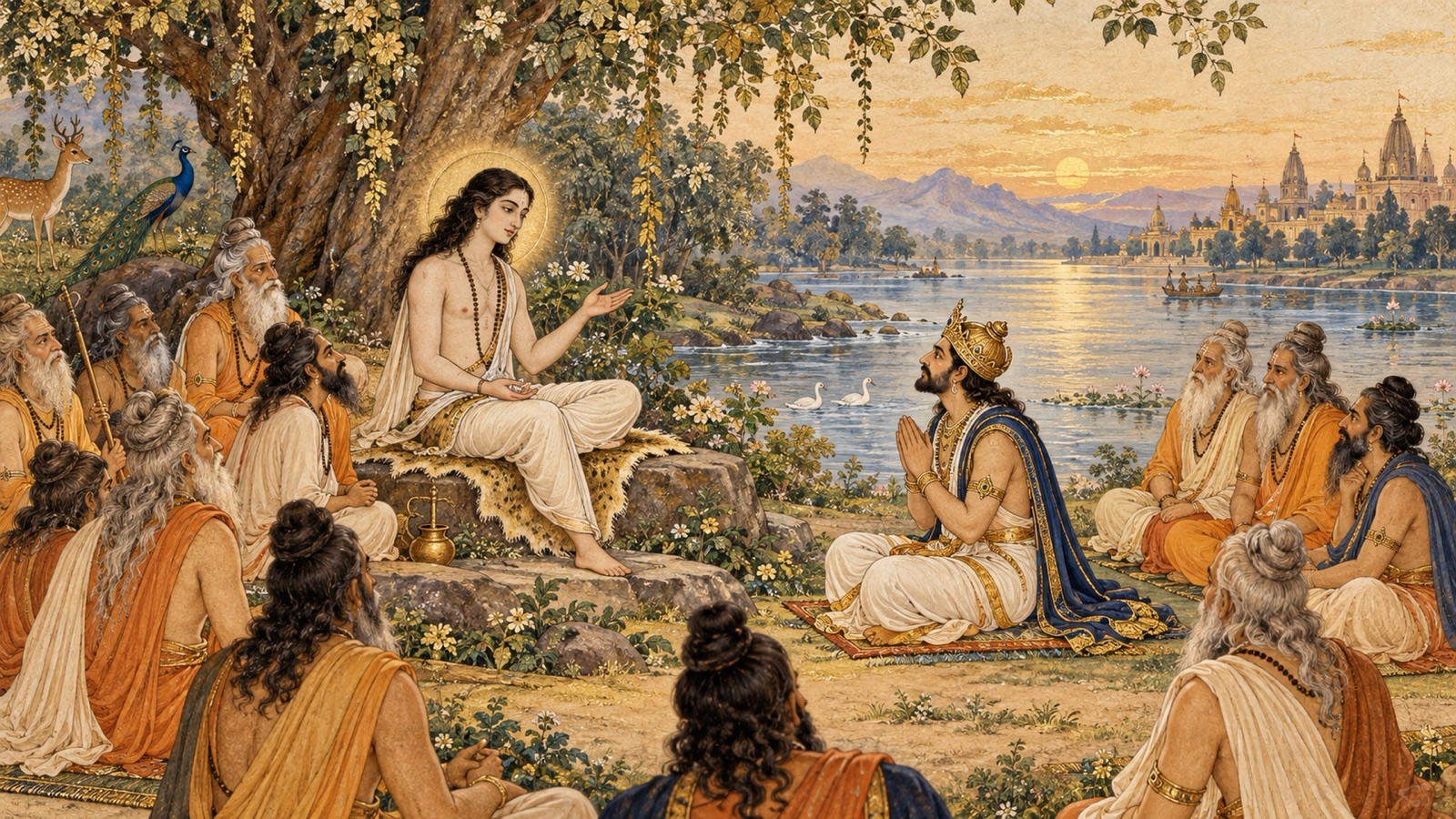
Weary at last of the enjoyment of the senses, Emperor Swayambhuva Manu, husband of Satarupa, gave up his kingship and withdrew to the forest with his consort to practise austerity. On the bank of the river Sunanda he stood upon a single foot for a hundred years, and there he uttered a prayer of surpassing depth — a prayer drawn from the very heart of the Upanishads. He marvelled that the individual soul does not know the Lord, though the Lord knows every soul; that the whole world of matter is lit with consciousness only by His presence, while He Himself is conscious by His very nature and keeps awake as the silent witness even while the world sleeps.
Whatever exists, animate or inanimate, Manu prayed, is pervaded by the cosmic Spirit; therefore one should live upon what has been allotted by Him and never covet the wealth of another. He took refuge in the self-effulgent Lord, without beginning, middle, or end, in whose vision there is neither friend nor foe. He taught, too, that the wise first engage ordinary people in the duties enjoined by scripture, since none can leap straight into action that yields no further bondage without first passing through disciplined, dutiful work. And in a teaching that reaches across the ages, Manu observed that the Lord, though He engages in action, is never bound by it, for He is complete in Himself and free of all craving — and that those who follow in His footsteps, offering their duties to Him, are likewise freed. It is to that Lord, who acts without ego and teaches humanity by His own example, that Manu surrendered himself.
तमीहमानं निरहङ्कृतं बुधं निराशिषं पूर्णमनन्यचोदितम् । नृञ् शिक्षयन्तं निजवर्त्मसंस्थितं प्रभुं प्रपद्येऽखिलधर्मभावनम् ॥ १६ ॥
tam īhamānaṁ nirahaṅkṛtaṁ budhaṁ nirāśiṣaṁ pūrṇam ananya-coditam nṝñ śikṣayantaṁ nija-vartma-saṁsthitaṁ prabhuṁ prapadye ’khila-dharma-bhāvanam
Meaning: I take refuge in that Lord — active yet free from ego, all-wise, desireless, complete, self-impelled, teaching humanity by treading Himself the very path He ordains, the origin and sustainer of all righteousness. (Canto 8, Chapter 1, verse 16)
Underneath this simple instruction lies a reason deeper than mere frugality. Because the very Spirit that pervades every being and every element is one and the same, nothing in this universe finally belongs to any person, family, or nation — the land beneath a throne, the wealth in a treasury, even the body one calls one’s own, are held only in trust from the Lord who fashioned them. To take no more than what sustains life is to remain a faithful trustee of that gift; to claim a larger share for one’s own enjoyment is, in the logic of this prayer, indistinguishable from theft. This is why an emperor of Swayambhuva Manu’s stature could walk away from his throne without a backward glance: he had never once mistaken his stewardship of the world for ownership of it (verses 9–10).
The Lord Yajna Defends His Devotee
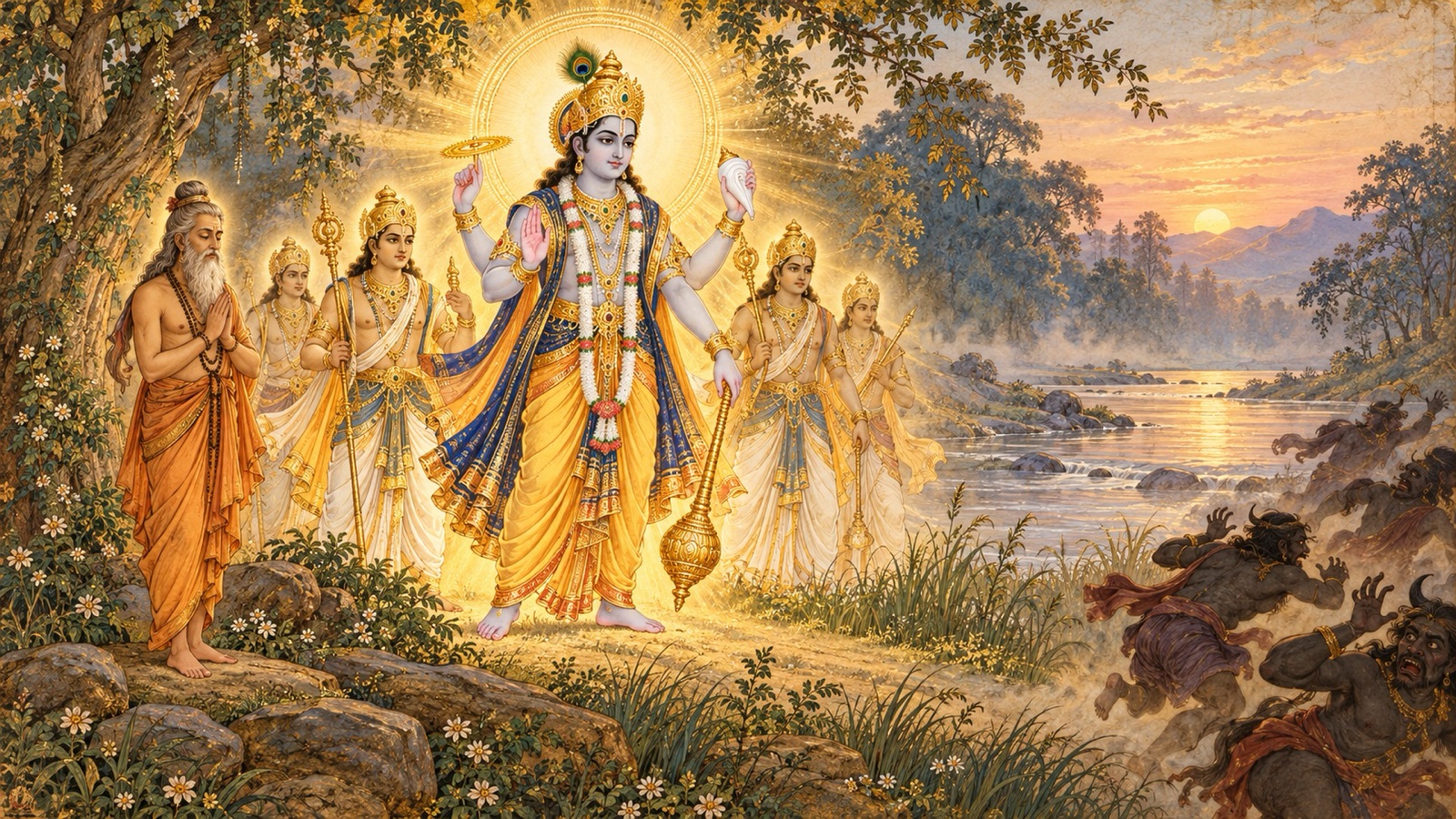
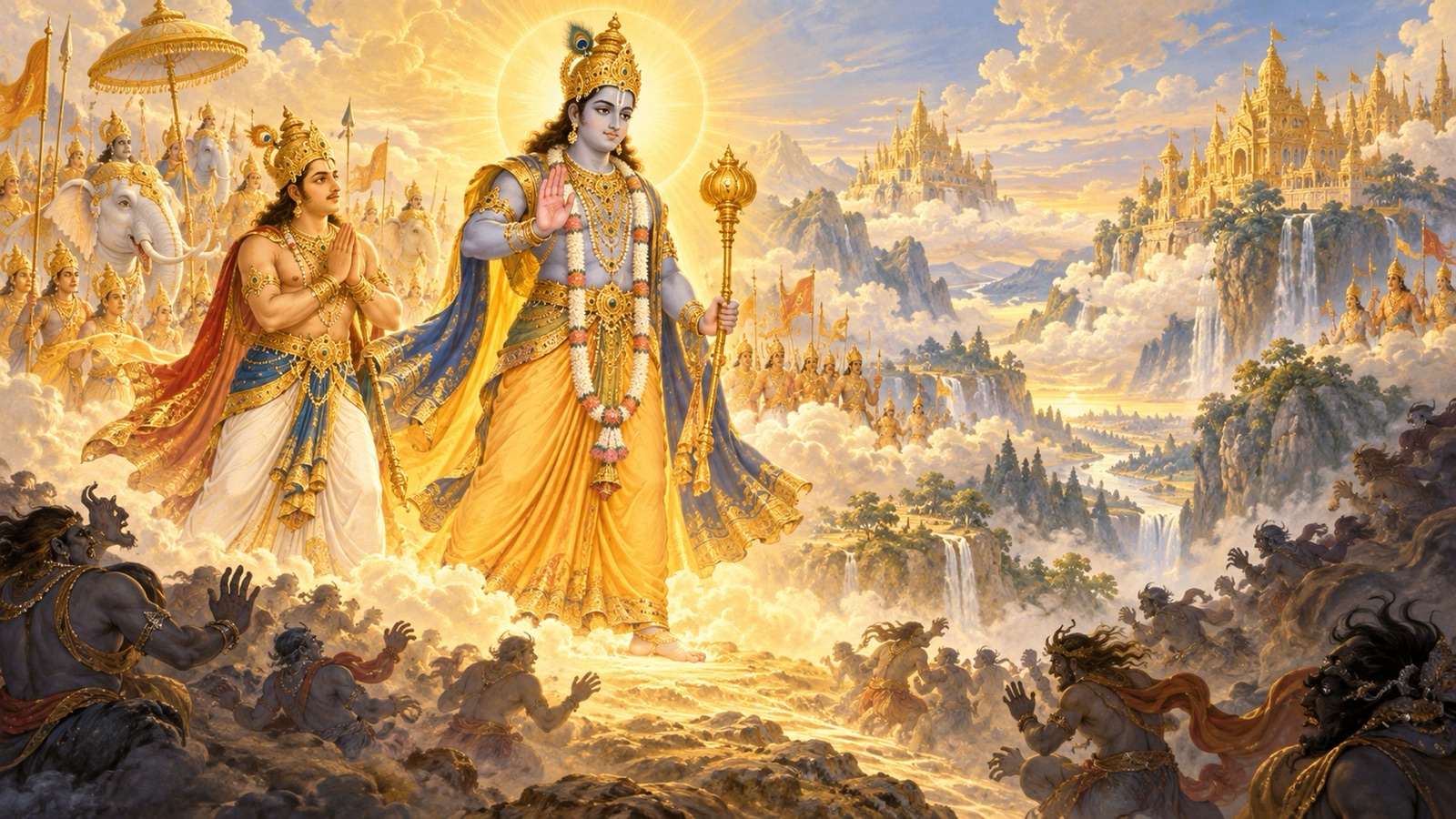
As Manu stood absorbed in this profound meditation, murmuring the sacred prayer as though in a dream, a band of demons and ogres, driven by hunger, rushed upon him from every side, intent on devouring him. Seeing their evil resolve, the all-pervading Sri Hari appeared there in the form of Lord Yajna — the very deity who presides over sacrifice, born of Ruci and Akuti — surrounded by His sons, the gods known as the Yamas. He slew the attacking demons and thereafter ruled over heaven as Indra, the lord of paradise, throughout that first Manvantara. Here, at the very threshold of the Eighth Canto, the recurring theme of the entire book is already sounded: whenever a surrendered soul is in danger, the Lord Himself comes without delay.
The Second Age: The Lord as Vibhu
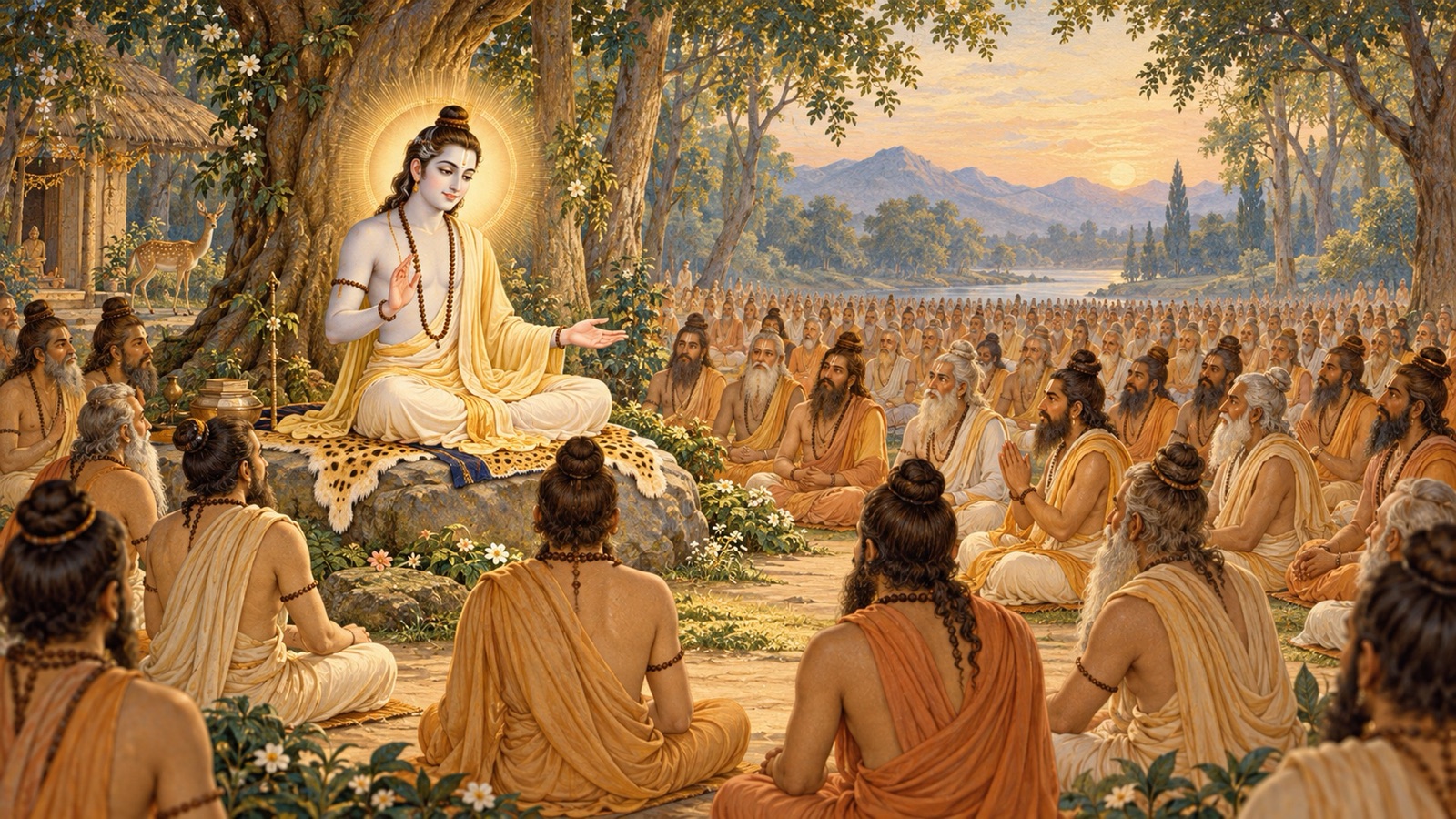
Sukadeva then moves to the second Manvantara, presided over by Swarocisa, a son of Agni, the god of fire. His chief sons were Dyuman, Susena, and Rocisman; the Indra of that age was named Rocana, and the gods were the Tushitas. Among the seven seers were Urja, Stambha, and others, all expositors of the Vedas. In that age the Lord Himself appeared as Vibhu, born from the sage Vedasira through his wife Tushita. Vibhu remained a lifelong celibate from His very boyhood, and eighty-eight thousand sages, inspired by His example, took up the vow of austerity and followed the same path of unbroken continence and self-discipline.
The Third Age: The Lord as Satyasena
The third Manu, Uttama, was a son of the celebrated Emperor Priyavrata. His sons were Pavana, Srnjaya, Yajnahotra, and others; the seven seers were the sons of Vasistha; the gods were the Satyas, Vedasrutas, and Bhadras; and the Indra of that age was Satyajit. In this Manvantara the Supreme Person appeared as Lord Satyasena, born of Dharma through his wife Sunrita, along with a class of gods called the Satyavratas. With Indra Satyajit as His helpmate, Satyasena destroyed the wicked Yakshas and Rakshasas — those given to falsehood and evil ways — together with the hosts of malignant spirits who were enemies of all created beings.
The Fourth Age and a Rescue Foretold
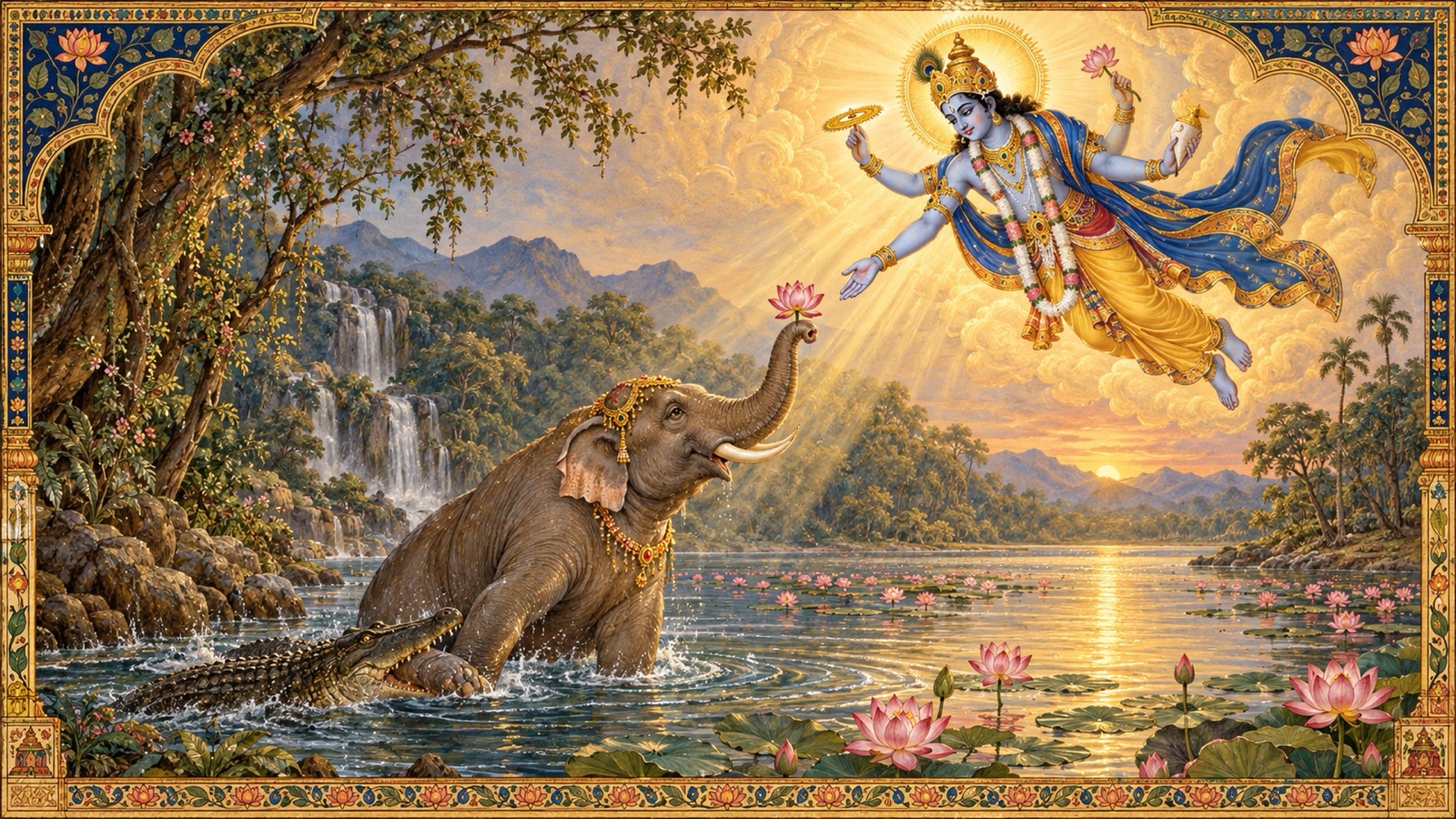
The fourth Manu was Tamasa, a brother of Uttama, with ten sons — Prthu, Khyati, Nara, Ketu, and others. The gods of that age were the Satyakas, Haris, and Viras; their Indra was Trisikha; and the seven seers were Jyotirdhama and others. In that age another group of gods, the Vaidhritis, sons of Vidhriti, preserved by the sheer power of their intellect the Vedas that had been forgotten in the course of time. And in this Tamasa Manvantara the Lord was born as Sri Hari, through Harini from the sage Harimedha — and it was this Sri Hari who rescued the great leader of the elephants from the grip of a fierce alligator.
तत्रापि जज्ञे भगवान्हरिण्यां हरिमेधस: । हरिरित्याहृतो येन गजेन्द्रो मोचितो ग्रहात् ॥ ३० ॥
tatrāpi jajñe bhagavān hariṇyāṁ harimedhasaḥ harir ity āhṛto yena gajendro mocito grahāt
Meaning: In that age too the Lord was born, as the son of Harini and the sage Harimedha, and was known as Hari — He by whom the king of the elephants was delivered from the alligator’s grip. (Canto 8, Chapter 1, verse 30)
A Question That Opens the Canto
At the mention of the elephant-king’s rescue, King Parikshit can wait no longer. Addressing Sukadeva as the son of Badarayana, he begs to hear the full story: how did Sri Hari deliver the king of the elephants seized by the alligator? For, he says, that story alone of all stories is truly sacred, praiseworthy, and auspicious in which the Lord of excellent renown is glorified. Suta, relating all this to the sages of Naimisharanya, tells how Sukadeva — pleased by the earnest request of the king, who sat fasting unto death to atone for his fault — congratulated Parikshit and joyfully began, in that great assembly of listening sages, the story that fills the next chapters.
श्रीसूत उवाच परीक्षितैवं स तु बादरायणि: प्रायोपविष्टेन कथासु चोदित: । उवाच विप्रा: प्रतिनन्द्य पार्थिवं मुदा मुनीनां सदसि स्म शृण्वताम् ॥ ३३ ॥
śrī-sūta uvāca parīkṣitaivaṁ sa tu bādarāyaṇiḥ prāyopaviṣṭena kathāsu coditaḥ uvāca viprāḥ pratinandya pārthivaṁ mudā munīnāṁ sadasi sma śṛṇvatām
Meaning: Suta said: Thus urged to continue his sacred narrations by Parikshit, who sat fasting unto death, the son of Badarayana congratulated the king and joyfully spoke, in the midst of the sages who listened with rapt attention. (Canto 8, Chapter 1, verse 33)
Principal Teachings of This Chapter
1. The Lord protects the world in every age. Each Manvantara has its own descent of the Lord — Yajna, Vibhu, Satyasena, Sri Hari — showing that divine protection is not a single historical event but a continuous, unfailing reality across all time (verses 18, 21, 25-26, 30).
2. Austerity draws the Lord near. Swayambhuva Manu’s hundred years of penance on one foot, and his surrendered prayer, are answered by the Lord’s own appearance to defend him — the sincere effort of the devotee meets the immediate response of the divine (verses 7-18).
3. Act without attachment, as the Lord does. Manu’s prayer teaches that the Lord engages in action yet remains untouched by it, and that those who offer their duties to Him are similarly freed from bondage (verses 14-16).
4. Live on what is given; covet nothing. “Live upon what has been assigned by Him; do not covet the wealth of another” — a simple, searching instruction for daily life folded into a cosmic prayer (verse 10).
5. The truly worthwhile story is the one that glorifies the Lord. Parikshit’s own words remind us why these histories are told at all: a narration is sacred and auspicious precisely to the degree that it celebrates the Supreme Lord (verse 32).
A Devotional Reflection
It is easy to be dazzled by the sheer scale of this chapter — six Manus, uncounted seers and gods, ages heaped upon ages until ordinary time dissolves. But hidden inside that vastness is something intimate and reassuring. The same Lord who orders the turning of the cosmic ages is the Lord who rushes to defend a single old emperor standing on one foot in a lonely forest, and who reaches down into a muddy lake to save one drowning elephant. The Manvantaras are not a lesson in our smallness; they are a promise. Whatever age we happen to live in, however forgotten the truth may seem, the Protector of the universe has never once failed to appear when a surrendered heart called out to Him. Swayambhuva Manu’s prayer shows us the posture that invites that grace: to live on what we are given, to covet nothing, to act without ego, and to take refuge in the One who teaches us the way by walking it Himself.
A Daily Devotional Practice
Today, take one small portion of your day — a meal, a task, an hour of work — and consciously offer it to the Lord before you begin, quietly repeating: “Om Namo Bhagavate Vasudevaya.” As you do, remember Manu’s teaching to live gratefully upon what has been given and to covet nothing that belongs to another. Let even an ordinary duty become, like the sages’ work in Manu’s prayer, an offering that binds you not to the world but to the Lord who dwells beyond it.
Conclusion
The first discourse of the Eighth Canto does not ask us to memorise its Manus, seers, and demigods; it asks us to notice the one truth that outlasts them all. Ages rise and fall, kingdoms are taken up and renounced, but the Lord who pervades every being and every element never changes, and He has never once failed to shelter a surrendered soul, in whatever age that soul happened to live. That assurance alone is the real gift of this opening chapter. And with Parikshit’s eager question about the elephant-king, the stage is now set for the tender, thunderous story of Gajendra’s deliverance that the coming chapters will unfold.
May the divine wisdom of Srimad Bhagavatam awaken pure devotion within our hearts.
Om Namo Bhagavate Vasudevaya.
Jay Shree Madhav.
References and Attribution
- Primary edition: Gita Press, Śrīmad Bhāgavata Mahāpurāṇa (English, complete), Book Eight, Discourse 1, pages 735–740.
- Series: Srimad Bhagavatam Wisdom · Biswa Sanatan Dharma Seva Trust.
- Presented following the spiritual guidance and recommendation of Pandit Dr. Shri Kashinath Mishra.
This is an original, faithful retelling in the writer’s own words, with brief quoted verses shown in Devanāgarī and transliteration and their meanings given as summaries. It is not a reproduction of any single publisher’s continuous translation or commentary. No affiliation with or endorsement by any publisher is implied.
Jay Shree Madhav