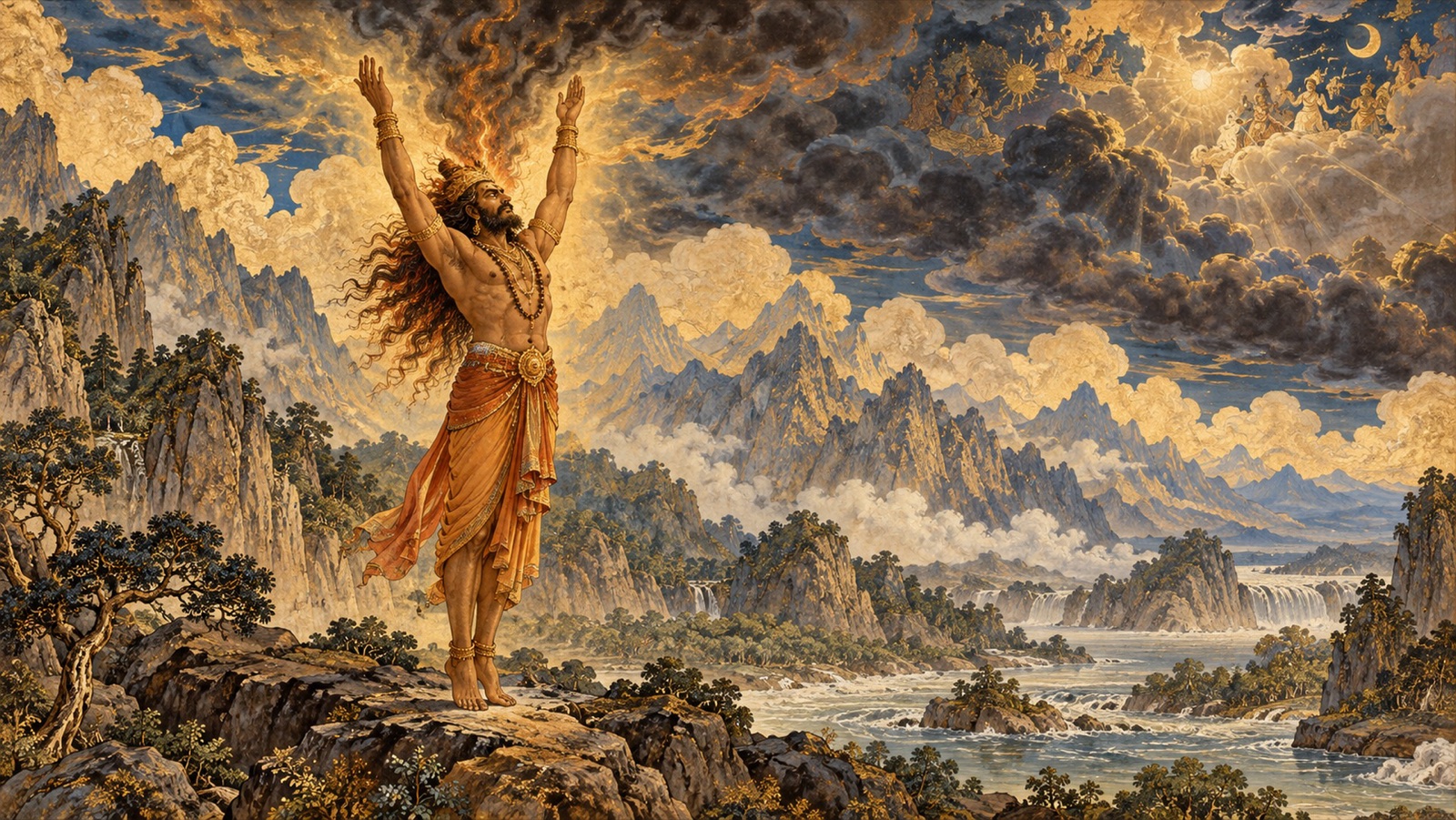
In the lonely valley of Mount Mandara a demon king stands on the tips of his toes with his arms raised to the sky, and burns with a penance so fierce that the oceans swell and the stars are shaken from their courses. He is not seeking God. He is seeking to become one.
Om Namo Bhagavate Vasudevaya.
Om Namo Bhagavate Vasudevaya.
Om Namo Bhagavate Vasudevaya.
Welcome to Srimad Bhagavatam Wisdom, a devotional journey through the sacred histories and teachings of the Srimad Bhagavat Mahapurana. In the previous chapter, Hiranyakasipu grieved his slain brother, consoled his mother with a discourse on the deathless soul, and resolved on a terrible ambition. This chapter follows that ambition into action, as the demon’s tapasya grows fierce enough to shake the three worlds and draw Brahma himself to his side.
Chapter Information
- Scripture: Śrīmad Bhāgavata Mahāpurāṇa
- Canto: 7 (Book Seven)
- Chapter: 3
- Chapter title: Hiranyakasipu’s Austerities and the Boon of Deathlessness
- Principal speaker: The sage Narada (narrating to Emperor Yudhishthira); within his account, Brahma and Hiranyakasipu
- Principal listener: Emperor Yudhishthira; within the narration, Brahma, the gods, and Hiranyakasipu
- Main setting: A valley of Mount Mandara, where Hiranyakasipu performs his austerities; and the realm of Brahma, to which the tormented gods flee
- Central subject: Hiranyakasipu’s fearsome penance, its cosmic disturbance, and the intricately worded boon of near-immortality granted him by Brahma
- Principal verse range: Canto 7, Chapter 3, verses 1–38
- Primary edition: Gita Press Śrīmad Bhāgavata Mahāpurāṇa
An Ambition Beyond Death
Narada continues his account for Yudhishthira. Hiranyakasipu, he says, had conceived a single overwhelming desire: to become invincible, free from old age and death, and the sole monarch of the three worlds, with no rival anywhere.
श्रीनारद उवाच हिरण्यकशिपू राजन्नजेयमजरामरम् । आत्मानमप्रतिद्वन्द्वमेकराजं व्यधित्सत ॥ १ ॥
śrī-nārada uvāca hiraṇyakaśipū rājann ajeyam ajarāmaram ātmānam apratidvandvam eka-rājaṁ vyadhitsata
Meaning: Narada said: O King, Hiranyakasipu wished to make himself unconquerable, free from old age and death, without any rival, and the one sovereign of all. (SB 7.3.1)
To win these ends, he withdrew to a valley of Mount Mandara and undertook an austerity of the most extreme kind. He stood with both arms raised toward the sky, his gaze fixed on the heavens, and balanced upon the tips of his great toes. The dazzling splendour of his matted hair blazed like the sun’s rays at the hour of cosmic dissolution. So complete was his absorption that the gods who had earlier been driven from their homes quietly slipped back to their abodes in his absence.
The Worlds Begin to Burn
This was no ordinary penance. From the crown of Hiranyakasipu’s head a smoky fire of asceticism rose and spread in every direction, scorching the higher worlds, the lower worlds, and the region between. The rivers and oceans swelled; the earth with its great divisions and mountains trembled; stars and planets were shaken from their places, and all ten directions seemed to burst into flame. The cosmos itself convulsed under the heat of one being’s concentrated will.
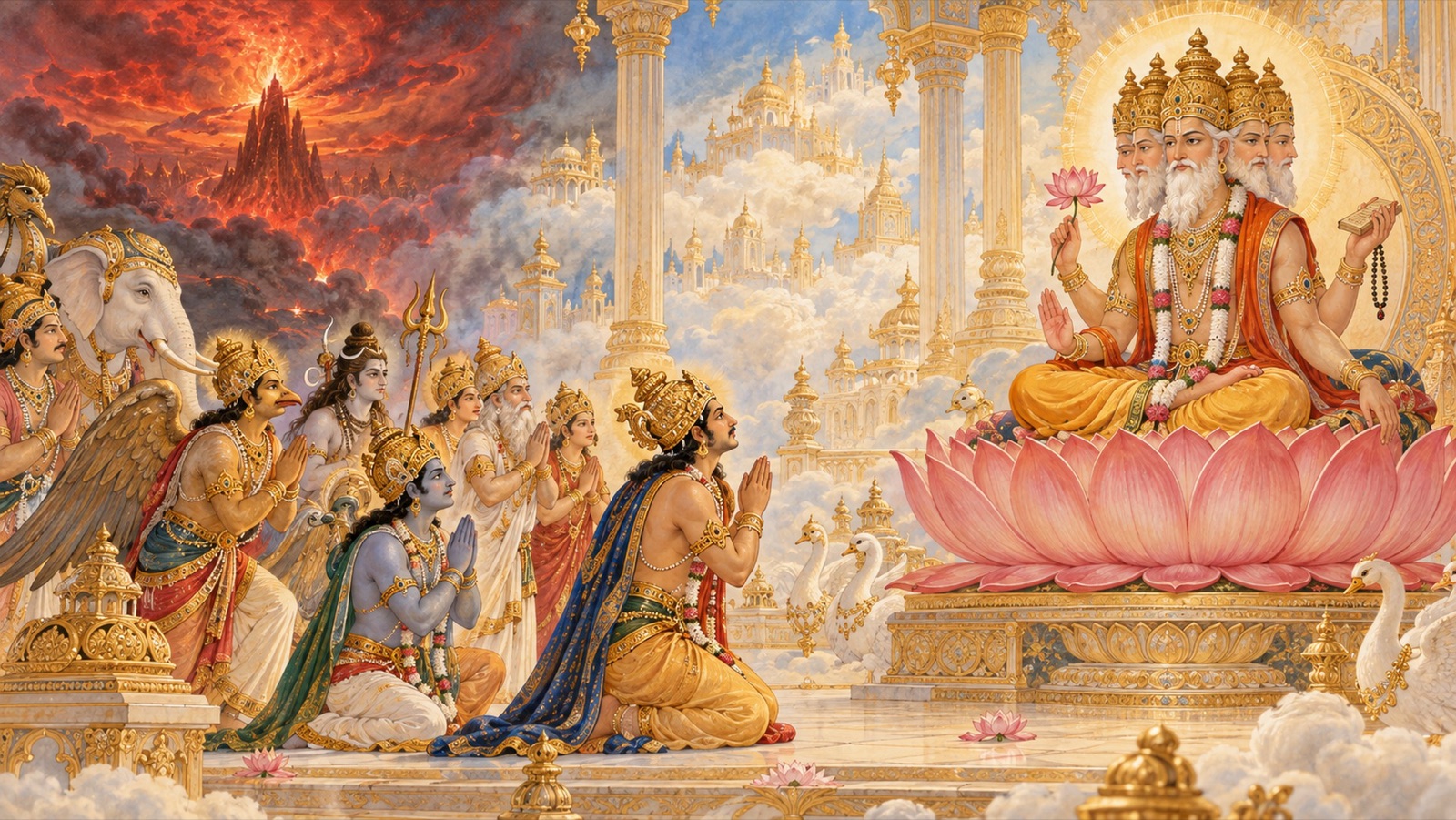
Unable to bear it, the gods abandoned heaven and fled to the realm of Brahma, the Creator, and laid their distress before him. Tormented by Hiranyakasipu’s austerity, they said, they could no longer remain in heaven; they begged Brahma to devise a remedy before the worlds that sustained him were destroyed. They then disclosed the demon’s true purpose: by the sheer force of his penance he meant to attain Brahma’s own exalted seat, to overturn the entire moral order — exalting sin and degrading virtue, driving the gods and sages down into the subterranean regions and raising the demons to the higher spheres — and to make the world utterly unlike what it had been. In their report the gods repeated the demon’s own reasoning, word for word.
सृष्ट्वा चराचरमिदं तपोयोगसमाधिना । अध्यास्ते सर्वधिष्ण्येभ्य: परमेष्ठी निजासनम् ॥ ९ ॥ तदहं वर्धमानेन तपोयोगसमाधिना । कालात्मनोश्च नित्यत्वात्साधयिष्ये तथात्मन: ॥ १० ॥
sṛṣṭvā carācaram idaṁ tapo-yoga-samādhinā adhyāste sarva-dhiṣṇyebhyaḥ parameṣṭhī nijāsanam
tad ahaṁ vardhamānena tapo-yoga-samādhinā kālātmanoś ca nityatvāt sādhayiṣye tathātmanaḥ
Meaning: Because Brahma has won his unrivalled seat above every other throne through relentless austerity, mystic power and trance, and because the self and time are both without end, I too shall pursue that same discipline birth after birth, for as long as it takes, until his throne becomes mine. (SB 7.3.9–10)
Brahma Comes to the Ascetic
Hearing the gods, Brahma set out for Hiranyakasipu’s hermitage, accompanied by the sages Bhrigu, Daksa, and others. At first he could not even find the Daitya, for the ascetic’s body had been so long motionless that it lay entirely buried under ant-hills, grass, and bamboo, his fat, skin, flesh, and blood eaten away by ants — his life clinging, as it were, to his bare bones. Brahma was struck with wonder to behold him still scorching the worlds with his penance, like the sun wholly veiled by clouds.
Before restoring him, Brahma spoke directly to the ant-eaten ascetic. Rise, rise, he said, for such austerity no sage before him had equalled and none hereafter would; even Brahma himself confessed to being conquered by it, and stood ready to grant whatever benediction Hiranyakasipu desired (SB 7.3.17–20). Yet in that same breath Brahma quietly drew the one boundary his boon could never cross: the demigods who dwell with him do not perish as ordinary beings do, but Hiranyakasipu, being born of Diti, remained subject to death regardless — the audience would not go in vain, Brahma said, but it could not undo that condition (SB 7.3.21). Long before Hiranyakasipu speaks a single word of his elaborate plea, then, the door through which death will finally come has already been left standing, by the plain admission of the very one who is about to bless him.
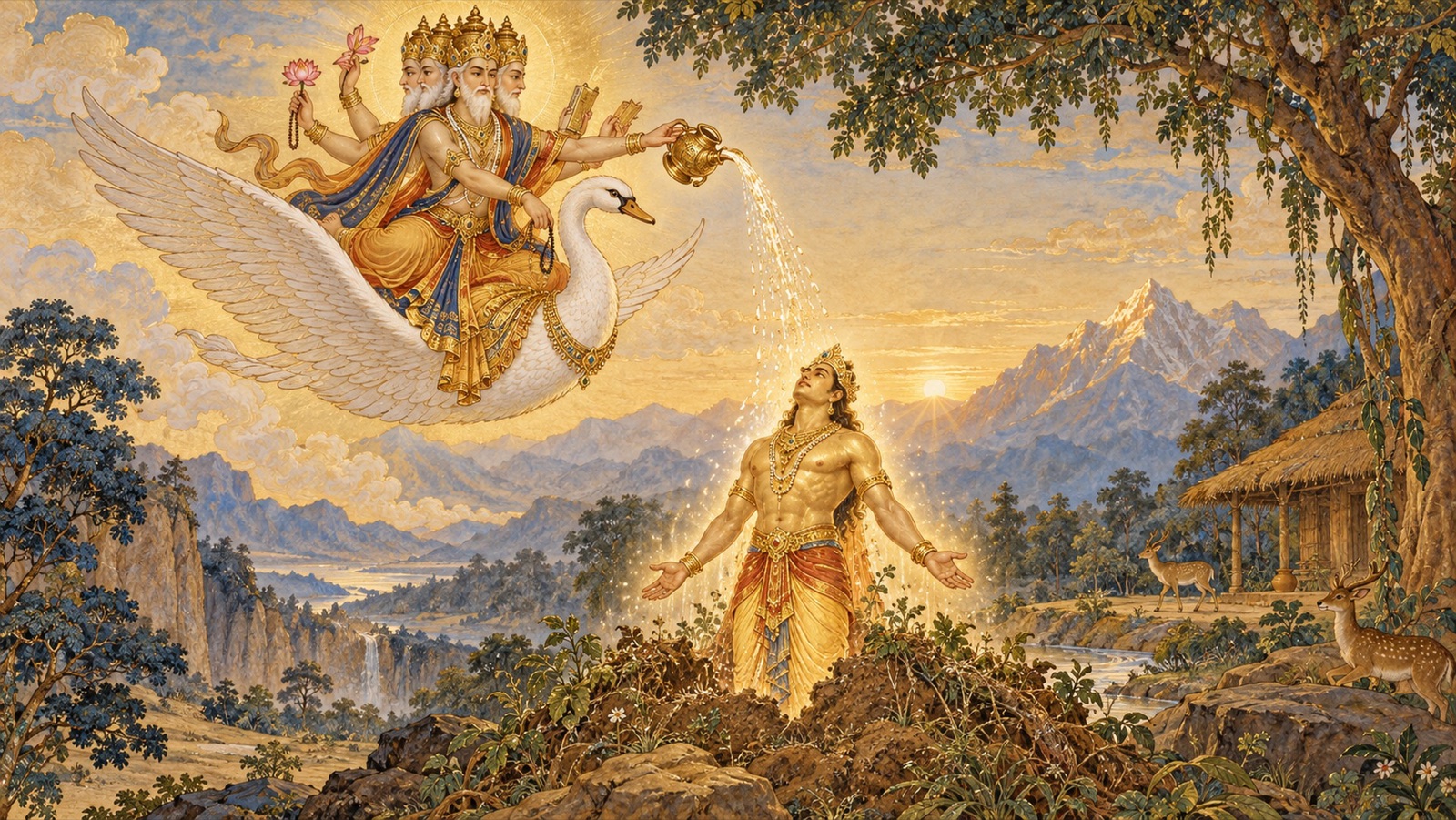
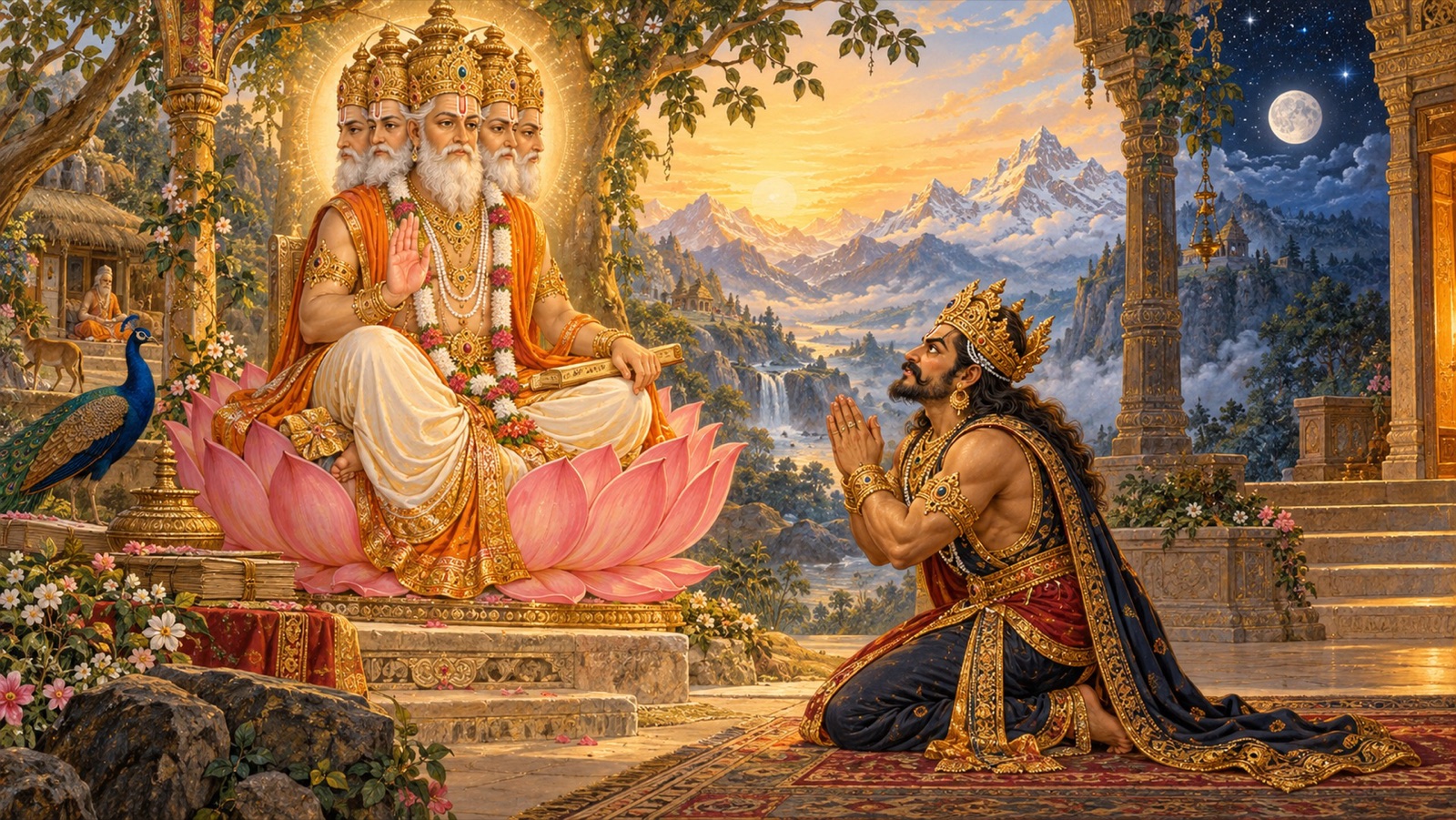
Then, taking up his kamandalu, Brahma sprinkled its sacred water upon the ant-eaten body of the demon. At once Hiranyakasipu rose from the ant-hill like fire leaping from fuel — his mind vigorous, his senses keen, his body whole and adamantine, youthful, and glowing like molten gold.
The Demon’s Praise of the Creator
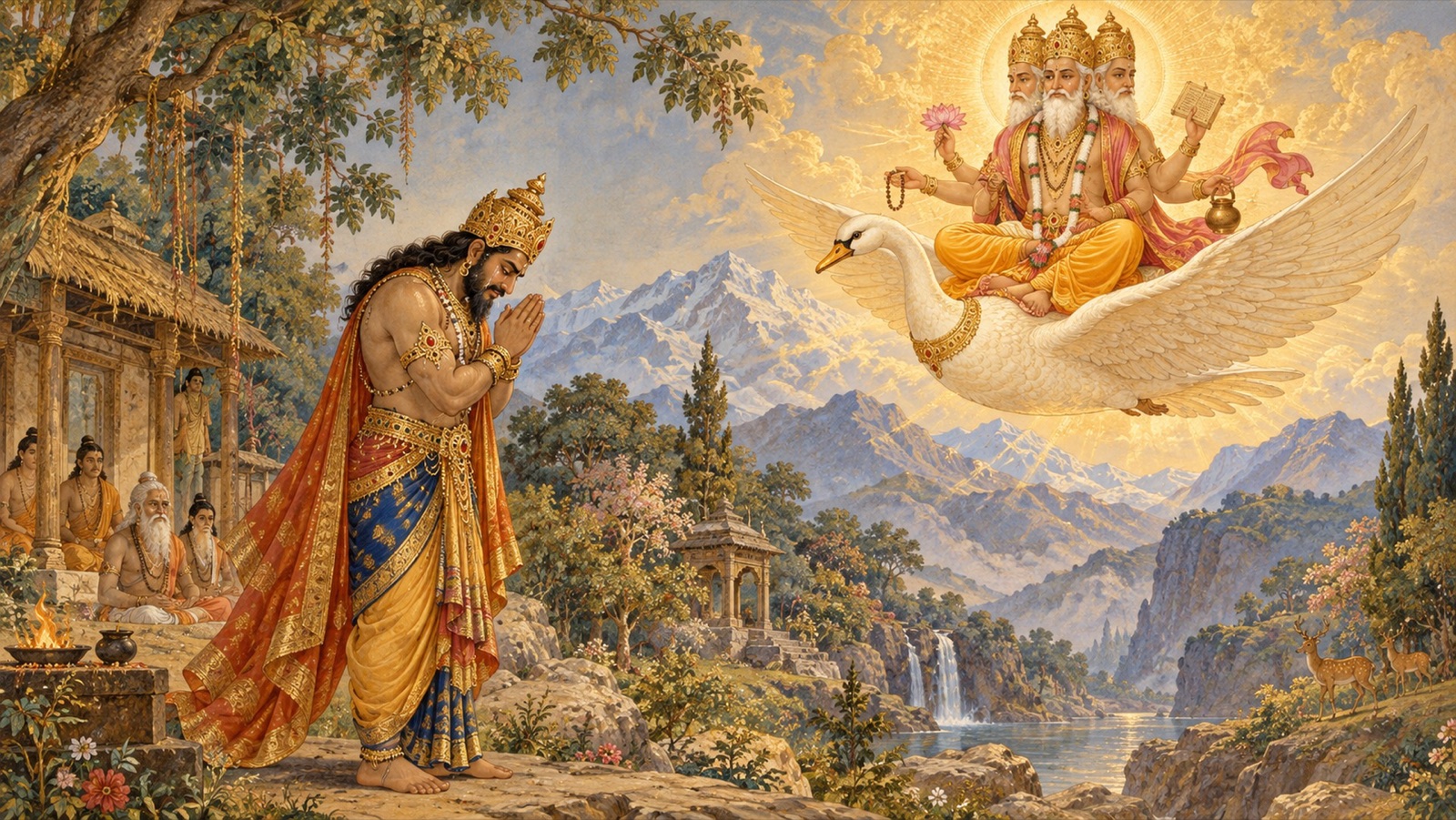
Perceiving Brahma poised in the air upon his swan-vehicle, Hiranyakasipu bowed with his head to the ground, overcome with joy. Rising with joined palms and gazing at the Creator with unwinking eyes, tears streaming and hair standing on end, he offered a long hymn of praise. He hailed the Supreme as the all-pervading ground of the three modes of nature — harmony, activity, and inertia — the self-effulgent one who, by his own splendour, projects, sustains, and withdraws the entire universe age after age (SB 7.3.26–27).
श्रीहिरण्यकशिपुरुवाच कल्पान्ते कालसृष्टेन योऽन्धेन तमसावृतम् । अभिव्यनग्जगदिदं स्वयञ्ज्योति: स्वरोचिषा ॥ २६ ॥ आत्मना त्रिवृता चेदं सृजत्यवति लुम्पति । रज:सत्त्वतमोधाम्ने पराय महते नम: ॥ २७ ॥
śrī-hiraṇyakaśipur uvāca kalpānte kāla-sṛṣṭena yo ‘ndhena tamasāvṛtam abhivyanag jagad idaṁ svayañjyotiḥ sva-rociṣā
ātmanā tri-vṛtā cedaṁ sṛjaty avati lumpati rajaḥ-sattva-tamo-dhāmne parāya mahate namaḥ
Meaning: Hiranyakasipu said: My obeisances to that great and supreme being, the shelter of goodness, passion and ignorance, who, self-luminous, brings this universe forth from the blind darkness time spreads at the close of each cosmic day, and who, through that same threefold nature, creates it, sustains it, and dissolves it again. (SB 7.3.26–27)
He praised that same Being as the First Cause, manifest as the vital airs, the senses, the mind and intellect, and the elements, and as the inner controller and soul seated within every embodied creature, the very source of their consciousness (SB 7.3.29). Beyond every form he assumes within the cosmos, Hiranyakasipu confessed, that One is simultaneously the impersonal Brahman, the indwelling Supersoul, and the Personality of Godhead himself, the oldest of the old (SB 7.3.33). There is nothing, he declared, that exists apart from that Supreme, cause or effect, moving or unmoving (SB 7.3.32).
The Boon That Sealed Every Door
Then Hiranyakasipu made his request — and here the chapter reveals the cunning of a mind determined to outwit death itself. He did not ask, bluntly, to be immortal, for he knew that no created being can be granted absolute deathlessness. Instead he tried to close, one by one, every avenue through which death might come.
Let not my death, he begged, come from any being created by Brahma. Let it come neither indoors nor outdoors; neither by day nor by night; not on the earth nor in the sky; not from any weapon; not from any man or any beast; not from any being animate or inanimate; not from gods, demons, or great serpents.
नान्तर्बहिर्दिवा नक्तमन्यस्मादपि चायुधै: । न भूमौ नाम्बरे मृत्युर्न नरैर्न मृगैरपि ॥ ३६ ॥
nāntar bahir divā naktam anyasmād api cāyudhaiḥ na bhūmau nāmbare mṛtyur na narair na mṛgair api
Meaning: Let my death occur neither within any dwelling nor outside it, neither by day nor by night, neither from any weapon nor from any other cause; neither upon the ground nor in the sky, and neither at the hands of any man nor of any beast. (SB 7.3.36)
To this he added still more: that he should have no rival in battle, undisputed lordship over all embodied beings, glory equal to that of the guardians of the worlds, and the unfailing mystic powers won by those pre-eminent in austerity and meditation. It was, in his own reckoning, a flawless fortress — every gate barred, every wall raised. He believed he had made himself a god who could not die.
Principal Teachings of This Chapter
1. Astonishing power is not the same as spiritual perfection. Hiranyakasipu’s penance is so severe that Brahma himself admits no sage before him achieved its equal and none after him ever will (SB 7.3.19) — yet Brahma, even while granting the boon, quietly reminds him that he still remains subject to death (SB 7.3.21). The size of a spiritual effort does not decide its worth; only the intention behind it does. Fuelled by pride and the hunger for sole dominion rather than by love of God, the same fire that shakes oceans and dislodges stars (SB 7.3.2-5) only enlarges the self it was meant to conquer. Offered instead in surrender, that same effort would have burned away the ego rather than fed it.
2. The desire to escape death is the demon’s true religion. At the root of Hiranyakasipu’s every act is the refusal to accept mortality and dependence. The chapter quietly exposes the fear of death as the hidden engine of a godless life (SB 7.3.1, 36-38).
3. Even the enemy of God must borrow God’s language. The demon’s hymn to the Supreme is genuinely lofty; he can describe the Absolute with perfect accuracy. Knowledge of the truth, the Bhagavatam reminds us again, is not the same as surrender to it (SB 7.3.26-34).
4. No fortress of cleverness can shut out the Lord. Hiranyakasipu’s boon is a masterpiece of loophole-hunting, and yet, as the story will show, the Supreme is not bound by inside or outside, day or night, man or beast. Every calculation that leaves God out is finally undone by God (SB 7.3.36-38).
A Devotional Reflection
There is something almost pitiable in Hiranyakasipu’s great labour. He endures what no ordinary being could endure — years of standing on his toes, his body devoured to the bone — all to build a wall against death. And the wall, for all its ingenuity, has a gap he cannot even see, because it lies in a direction he has refused to look: toward humble dependence on the Lord. He asks to be safe from every creature Brahma has made, forgetting that the Uncreated is not among them. His whole tragedy is the tragedy of the self-made soul who will accept a boon from God but never accept God. We may not raise oceans with our penance, but we know the same temptation in miniature: to secure our lives so thoroughly by our own effort that we no longer feel any need to lean on Him. The chapter gently turns us the other way — toward the safety that is found not in sealing every door against death, but in opening one door to the Deathless.
A Daily Devotional Practice
Today, notice one thing you are trying to control entirely by your own strength — a worry about the future, a fear of loss, a plan you are gripping too tightly. For a moment, loosen that grip and consciously entrust it to the Lord, saying inwardly: I cannot secure myself; I take refuge in You. Then repeat with quiet attention: “Om Namo Bhagavate Vasudevaya.” Let this be a small act of the surrender that Hiranyakasipu could not make — the choice to be protected by God rather than to become a fortress against Him.
Conclusion
The third chapter of the Seventh Canto shows ambition raised to its highest and most dangerous pitch: a soul so determined to escape death that it tries to bar every door through which death might come, while forgetting the one door it can never close — surrender to the Lord who is beyond every condition it named. Hiranyakasipu believes he has thought of everything; the Bhagavatam quietly promises that the Supreme will fulfil the letter of his boon while shattering its intent. As we close this chapter, we stand at the threshold of the great story to come — the birth of a fearless child of God within the demon’s own house, and the advent of Nrisimha.
May the divine wisdom of Srimad Bhagavatam awaken pure devotion within our hearts.
Om Namo Bhagavate Vasudevaya.
Jay Shree Madhav.
References and Attribution
- Primary edition: Gita Press, Śrīmad Bhāgavata Mahāpurāṇa (English, complete), Book Seven, Discourse 3, pages 657–661.
- Series: Srimad Bhagavatam Wisdom · Biswa Sanatan Dharma Seva Trust.
- Presented following the spiritual guidance and recommendation of Pandit Dr. Shri Kashinath Mishra.
This is an original, faithful retelling in the writer’s own words, with brief quoted verses shown in Devanāgarī and transliteration and their meanings given as summaries. It is not a reproduction of any single publisher’s continuous translation or commentary. No affiliation with or endorsement by any publisher is implied.
Jay Shree Madhav