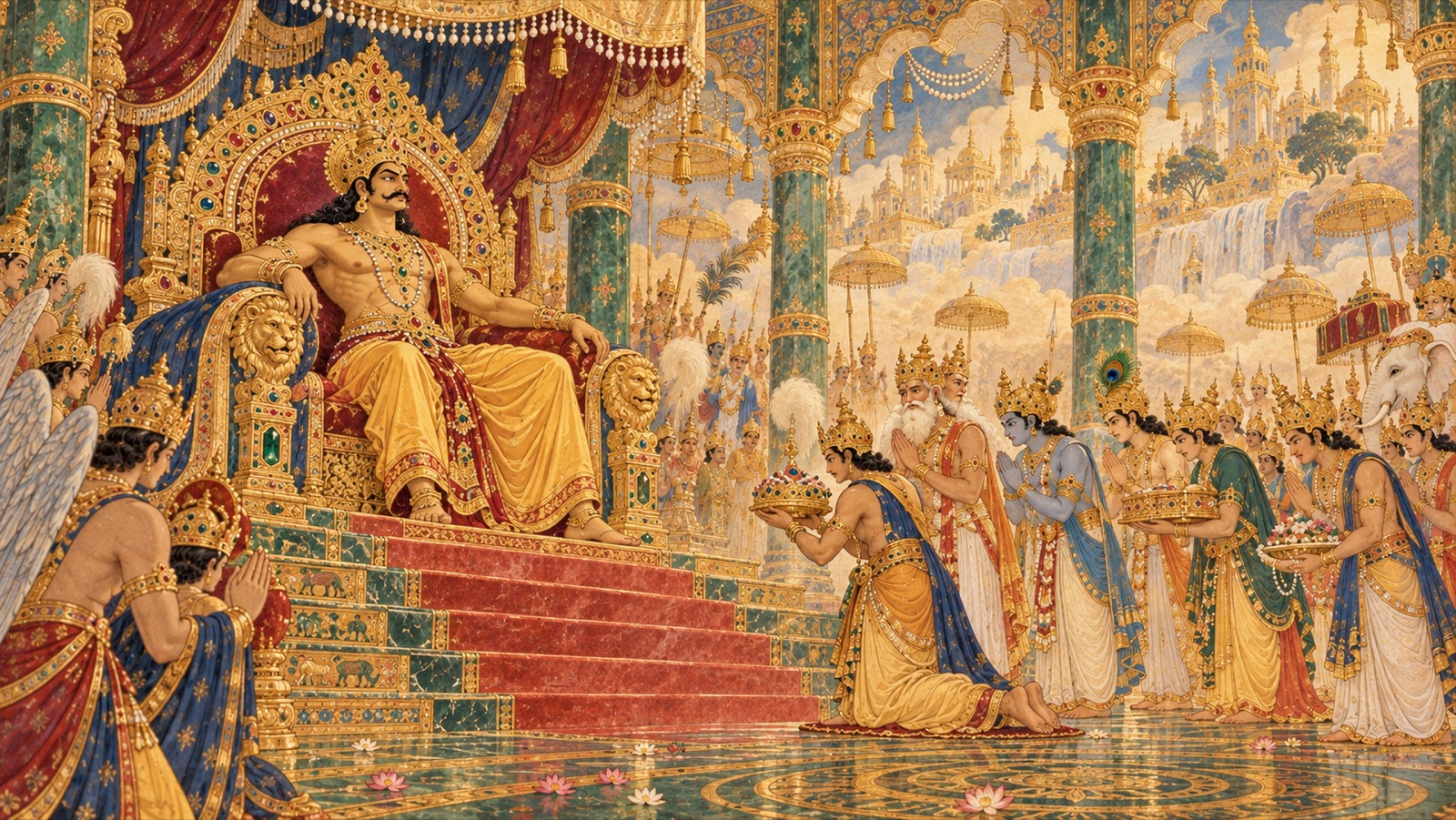
He has conquered the sun and the wind, the sea and the sky; the guardians of the worlds wait upon him with folded hands; he sits at last upon the throne of Indra himself. And still he is not satisfied — because the one enemy he cannot conquer is the restlessness of his own heart.
Om Namo Bhagavate Vasudevaya.
Om Namo Bhagavate Vasudevaya.
Om Namo Bhagavate Vasudevaya.
Welcome to Srimad Bhagavatam Wisdom, a devotional journey through the sacred histories and teachings of the Srimad Bhagavat Mahapurana. In the previous chapter the demon king Hiranyakasipu won from Brahma an intricately worded boon that seemed to place him beyond the reach of death. This fourth chapter follows him to the height of that power and, in the same household, introduces the son whose devotion will answer it: Prahlada.
Chapter Information
- Scripture: Śrīmad Bhāgavata Mahāpurāṇa
- Canto: 7 (Book Seven)
- Chapter: 4
- Chapter title: Hiranyakasipu Terrorizes the Universe and Prahlada Is Born
- Principal speaker: The sage Narada (narrating to Emperor Yudhishthira); within his account, Brahma and the Lord’s own voice from the sky
- Principal listener: Emperor Yudhishthira; within the narration, Hiranyakasipu and the assembled gods
- Main setting: The three worlds under Hiranyakasipu’s conquest; the celestial palace of Indra; and the realm to which the frightened gods appeal to Lord Vishnu
- Central subject: Hiranyakasipu’s total conquest and tyranny over the universe, the Lord’s promise of deliverance, and the birth and saintly qualities of Prahlada
- Principal verse range: Canto 7, Chapter 4, verses 1–46
- Primary edition: Gita Press Śrīmad Bhāgavata Mahāpurāṇa
The Boon Fulfilled, the Grudge Renewed
Narada takes up his account again. Pleased with Hiranyakasipu’s austerities, Brahma granted him the boons so difficult for any being to obtain, and then, worshipped by the demon and still extolled by the lords of creation, returned to his own abode. Now unassailable and clad in a body of golden splendour, Hiranyakasipu did not soften. He nursed his old grudge against the Lord, brooding constantly on the death of his younger brother Hiranyaksa at the hands of Sri Hari, and turned all his newfound might toward vengeance and dominion.
The Conquest of the Three Worlds
What followed was a conquest without parallel. Hiranyakasipu subdued all the quarters and the three spheres — heaven, earth, and the region between. He brought under his control gods and demons, the rulers of men, the Gandharvas and the serpents, the Siddhas, Charanas, and Vidyadharas, the seers and the progenitors of mankind, the lords of the Yakshas and the leaders of every order of beings. Having conquered the whole universe, he seized the thrones and glories of the guardians of the spheres for himself.
He took up residence in heaven, in the very palace of Indra built by Vishvakarma — a mansion adorned with stairs of coral, floors of emerald, walls of crystal and pillars of cat’s-eye gems, canopies of wondrous design and thrones of ruby. There the proud demon revelled as sole monarch of the worlds, his feet tended by the very gods he had oppressed. All the protectors of the worlds, save only Brahma, Vishnu, and Shiva, waited upon him with tribute in their hands. The earth yielded her produce unploughed, the heavens showered every desired thing, the oceans bore heaps of jewels upon their waves, and the mountains and trees gave him flowers and fruit in every season. He had gathered into his single hand the powers of all the guardians of the universe.
Power Without Peace
And yet, the chapter tells us, this master of all the worlds found no contentment. Enjoying his beloved objects of sense exactly as he pleased, he still felt no satisfaction — for he had never subdued his own senses and mind. Drunk with a strong-smelling wine, his reddened eyes forever rolling, he ruled with an iron hand, arrogant and lawless, defying the very scriptures. Here the Bhagavatam draws its quiet contrast: outward conquest of everything, inward mastery of nothing. The tyrant who owns the universe is owned by his own cravings.
The Worlds Cry Out, and the Lord Answers
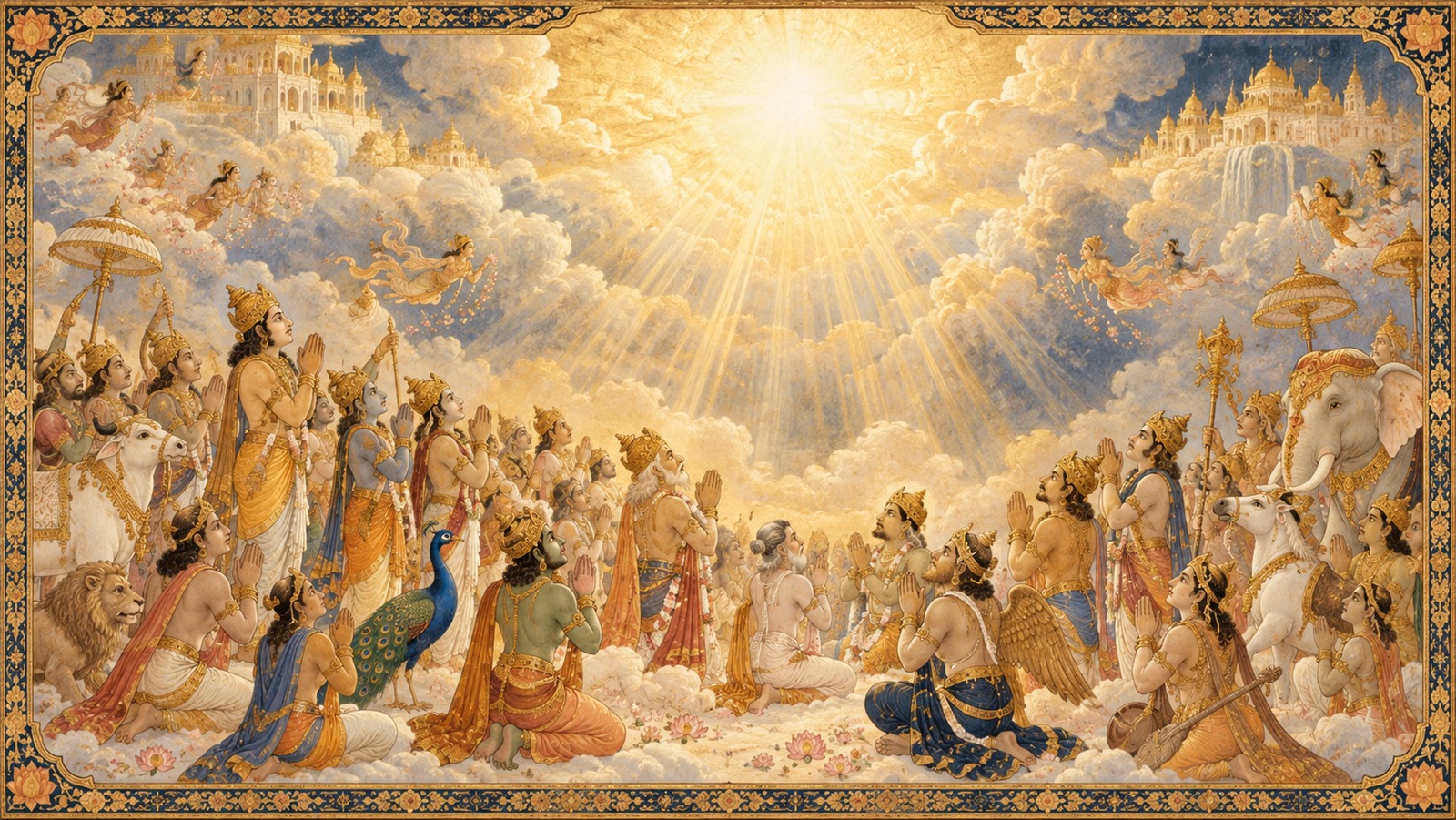
Unable to bear his rule and finding no shelter anywhere else, the inhabitants of all the worlds, together with their guardian deities, turned for protection to the immortal Lord Vishnu. With minds cleansed and controlled, foregoing sleep and subsisting on air, they lifted their hearts in an ancient prayer of surrender:
तस्यै नमोऽस्तु काष्ठायै यत्रात्मा हरिरीश्वर: । यद्गत्वा न निवर्तन्ते शान्ता: संन्यासिनोऽमला: ॥ २२ ॥
tasyai namo ‘stu kāṣṭhāyai yatrātmā harir īśvaraḥ yad gatvā na nivartante śāntāḥ sannyāsino ‘malāḥ
Meaning: Our homage to that transcendental abode where the Supreme Lord Himself dwells — the goal which, once reached by peaceful and purified souls in the renounced order, they never leave again for the round of birth and death. (SB 7.4.22)
Then a voice, deep as the rumbling of clouds and belonging to no visible form, filled the quarters and brought assurance to the righteous. “Do not fear, O jewels among the gods; may all be well with you,” it said. The Lord declared that He already knew the wickedness of this vile demon and would surely put an end to it; they had only to wait. When hatred toward the gods, the Vedas, the cow, the brahmanas, the saints, toward righteousness itself and toward the Lord, takes root in a heart, He said, that one perishes before long. And then He named the hour of the demon’s fall:
निर्वैराय प्रशान्ताय स्वसुताय महात्मने । प्रह्रादाय यदा द्रुह्येद्धनिष्येऽपि वरोर्जितम् ॥ २८ ॥
nirvairāya praśāntāya sva-sutāya mahātmane prahrādāya yadā druhyed dhaniṣye ‘pi varorjitam
Meaning: When that demon turns in enmity against his own son Prahlada — a great soul free from all hatred and perfectly at peace — then, powerful though he is by the boons he has won, I shall slay him. (SB 7.4.28)
Here the Bhagavatam quietly makes one of its deepest points about grace and offense. Hiranyakasipu had won his power from Brahma through the fiercest austerities, and it seemed to place him beyond every ordinary danger. Yet the Lord’s own words show that no benediction, however hard-won, can shelter a soul the moment it turns against a pure devotee. The instant Hiranyakasipu directs his cruelty at Prahlada, every boon of Brahma becomes as nothing before the Lord who protects His own. Material power and opulence are gifts that can be withdrawn in a moment; a heart dear enough to be called great by the Lord cannot be touched. This is why an offense against a devotee is counted among the gravest of falls, and why the Lord, patient even with great sinners, moves without delay once Prahlada is threatened (verses 27–28).
Reassured by these words and bowing to the Lord, the gods returned free from anxiety, counting the demon as already slain.
A Radiant Child in the House of Darkness
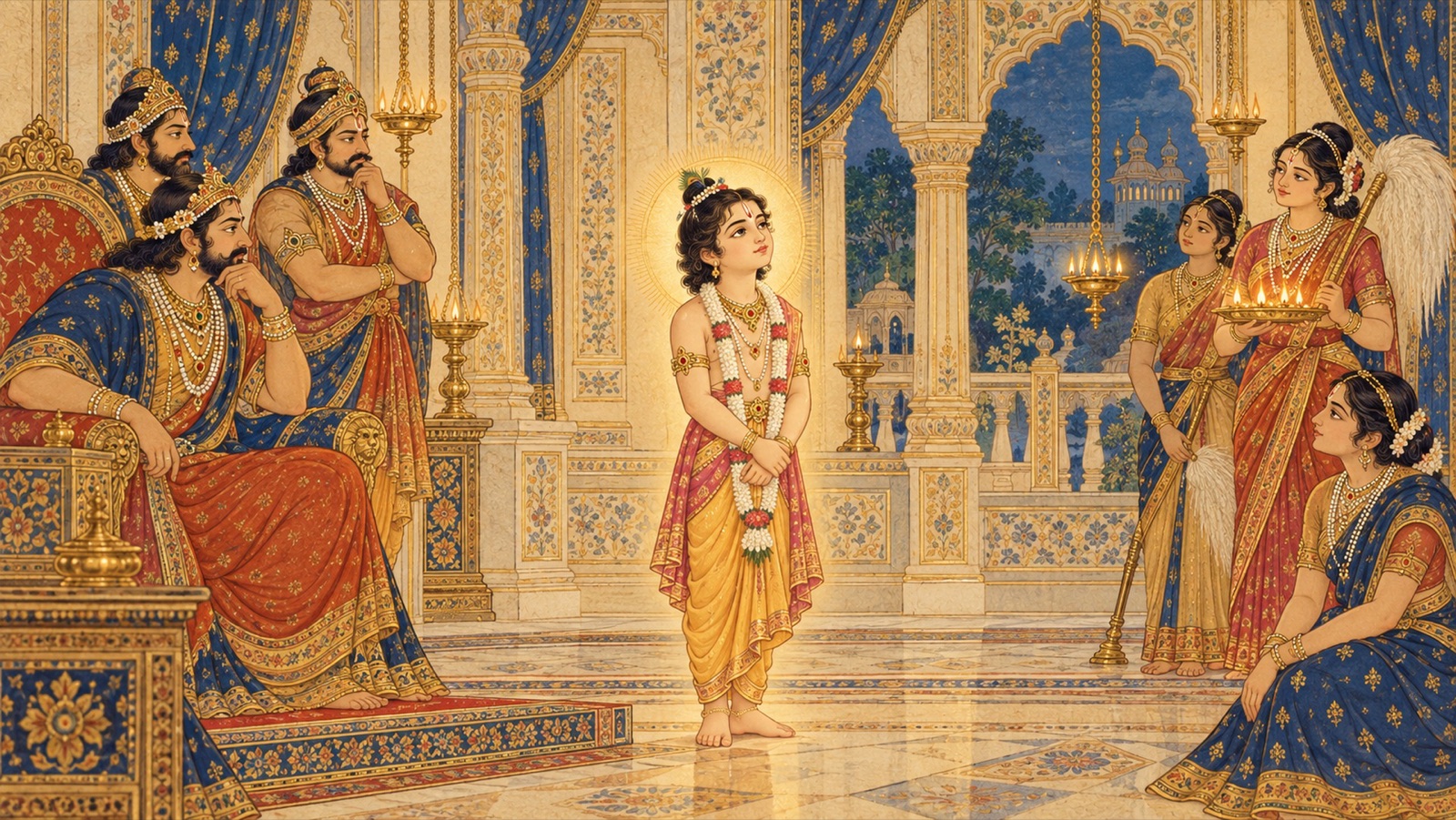
Four sons were born to the ruler of the Daityas, and among them one shone with a virtue the others could not match: Prahlada, a lover of exalted souls and a treasury of noble qualities. Devoted to the brahmanas, gentle, truthful, and master of his senses, he was the dearest friend and truest well-wisher of every living being, whom he regarded as his own self.
ब्रह्मण्य: शीलसम्पन्न: सत्यसन्धो जितेन्द्रिय: । आत्मवत्सर्वभूतानामेकप्रियसुहृत्तम: । दासवत्सन्नतार्याङ्घ्रि: पितृवद्दीनवत्सल: ॥ ३१ ॥ भ्रातृवत्सदृशे स्निग्धो गुरुष्वीश्वरभावन: । विद्यार्थरूपजन्माढ्यो मानस्तम्भविवर्जित: ॥ ३२ ॥
brahmaṇyaḥ śīla-sampannaḥ satya-sandho jitendriyaḥ ātmavat sarva-bhūtānām eka-priya-suhṛttamaḥ dāsavat sannatāryāṅghriḥ pitṛvad dīna-vatsalaḥ bhrātṛvat sadṛśe snigdho guruṣv īśvara-bhāvanaḥ vidyārtha-rūpa-janmāḍhyo māna-stambha-vivarjitaḥ
Meaning: Devoted to the brahmanas, of noble character, truthful, and self-controlled, he was the dearest friend of all beings, regarding them as his own self. Like a servant he bowed at the feet of the noble; like a father he was tender to the poor; like a brother he was affectionate to his equals; and he looked upon his teachers as God Himself. Though rich in learning, wealth, beauty, and high birth, he was utterly without the pride of vanity. (SB 7.4.31-32)
Unshaken by calamity, indifferent to the pleasures of the senses whether seen or merely heard of, he had conquered not only his senses and breath but his very desires; and though born a demon, he had wholly cast off the nature of a demon. His virtues, Narada tells Yudhishthira, are still cherished by the wise, undimmed by the passing of ages.
Lost in the Love of God
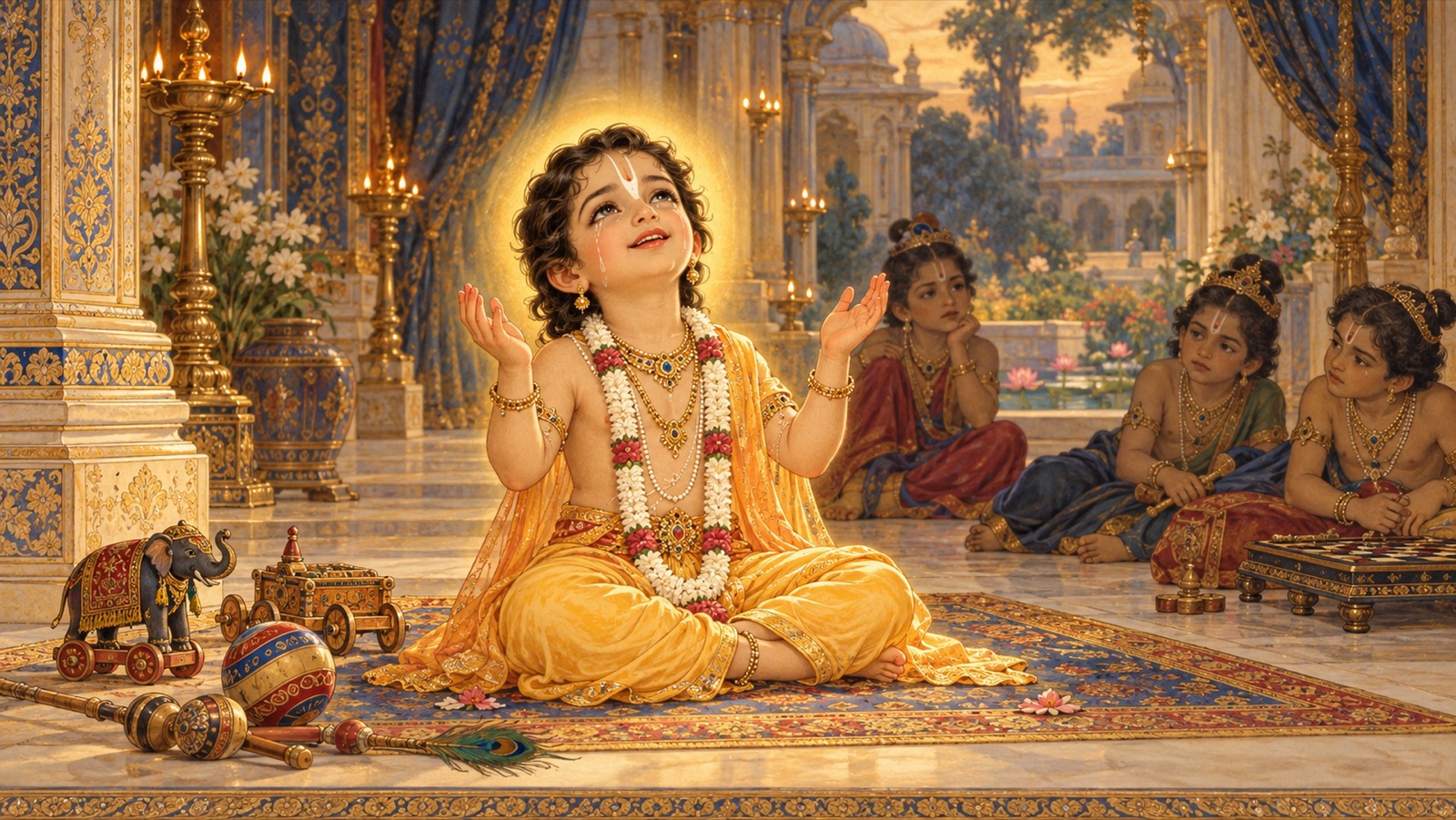
From his earliest childhood Prahlada’s heart was captured by the Lord. So completely was his mind seized by Krishna that he moved through the world like one dull to it, unaware of the ordinary business of living.
न्यस्तक्रीडनको बालो जडवत्तन्मनस्तया । कृष्णग्रहगृहीतात्मा न वेद जगदीदृशम् ॥ ३७ ॥
nyasta-krīḍanako bālo jaḍavat tan-manastayā kṛṣṇa-graha-gṛhītātmā na veda jagad īdṛśam
Meaning: Setting aside his playthings, the child — his mind so wholly absorbed, his very self as though seized and possessed by Krishna — became like one indifferent to the world and no longer noticed the world around him. (SB 7.4.37)
Whether sitting or walking, eating or lying down, he was never conscious of his own body, so entirely was he lost in the thought of Govinda. At times, at the sudden fading of that inward vision, he would weep in agony; then, catching the thought of the Lord again, he would laugh aloud; now he would sing His praises at the top of his voice, now dance without a trace of bashfulness; sometimes, imagining himself one with his beloved Lord, he would imitate His deeds; and sometimes he would sit utterly still, the hair of his body standing on end and his half-closed eyes brimming with tears of joy. By such loving service he had won the treasure of pure devotion, and his serenity soothed even the minds of the other demon boys who were his companions.
Yudhishthira’s Wonder
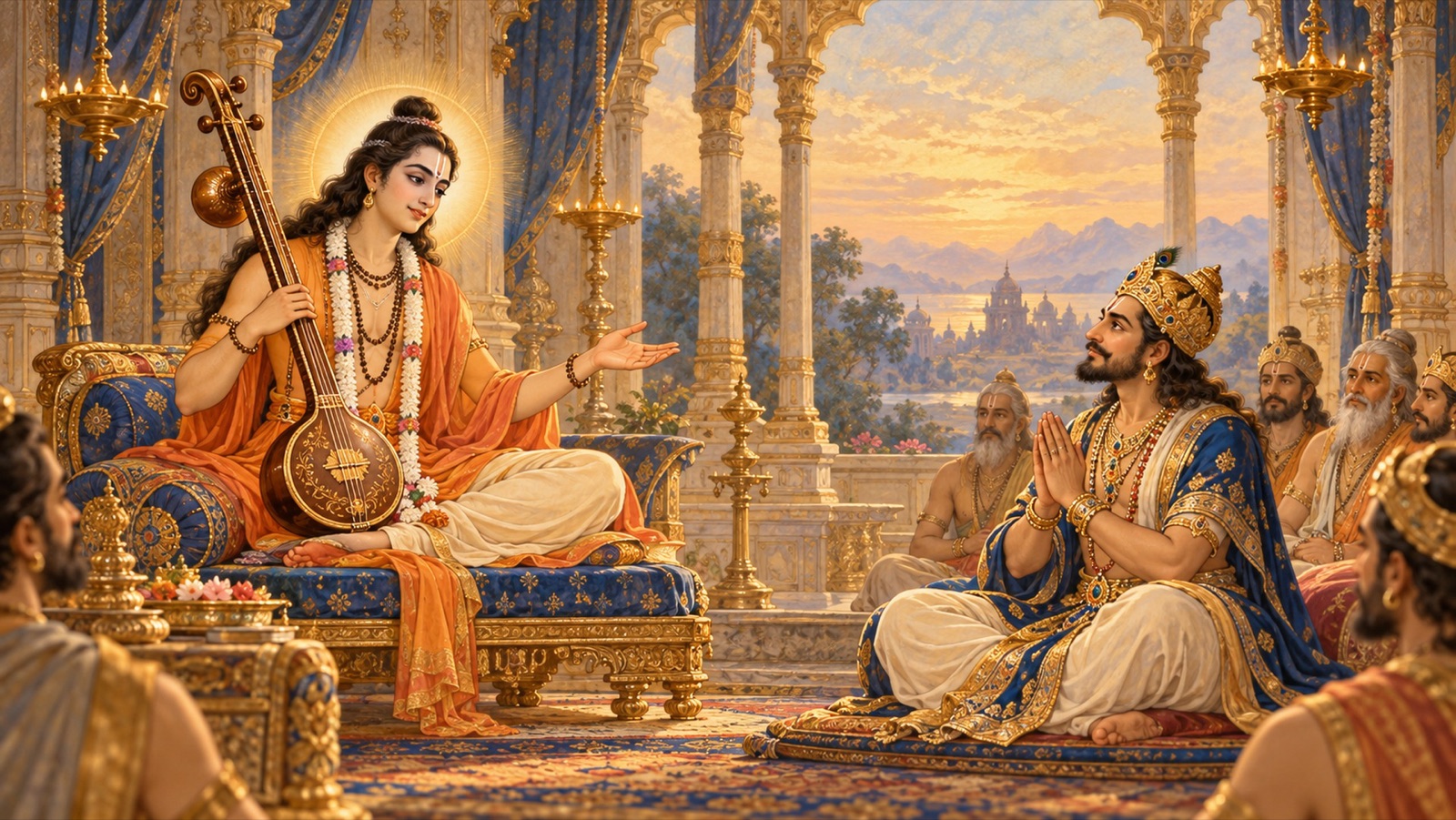
Hearing of such a son born in such a house, Yudhishthira was moved to wonder. How, he asked Narada, could a father come to hate his own child — a son so obedient, so gentle, and so devoted — and pursue him even to the point of seeking his death? Ordinary fathers, whatever their faults, do not turn murderously upon dutiful sons who honour them as God. He begged the sage to remove his curiosity and reveal how the father’s hatred was directed toward the destruction of the boy.
Principal Teachings of This Chapter
1. Conquest of the world cannot conquer the self. Hiranyakasipu masters heaven, earth, and every order of being, yet finds no peace, because he has never subdued his own senses and mind. The Bhagavatam quietly teaches that true sovereignty is inward, and the soul that rules everything but itself remains a slave (SB 7.4.19).
2. The Lord marks the hour, not the fear. When the worlds cry out, the Lord does not act in panic; He assures the righteous, names the precise moral moment of the demon’s fall, and bids them wait. Divine deliverance comes in its own perfect time (SB 7.4.25-28).
3. Devotion can bloom in the least likely soil. Prahlada is born a demon, in a demon’s palace, to the greatest enemy of God — and yet he becomes one of the supreme devotees in all of scripture. No birth, no circumstance, can shut out the grace of the Lord (SB 7.4.30-33).
4. Pure love makes one indifferent to the world. Prahlada sets aside his toys and forgets his own body, so wholly is he seized by the thought of the Lord. His absorption shows that the highest goal of life is not to win the world but to be captured by God (SB 7.4.37-42).
5. No worldly power can shield an offense against a devotee. Hiranyakasipu’s boons came from Brahma himself, yet the Lord declares they will not save him once he turns against his own devoted son. Austerity and opulence protect nothing once a pure heart is wounded (SB 7.4.27-28).
A Devotional Reflection
The chapter sets two lives side by side, and lets us choose which one we are building. The father has everything the world can give and cannot enjoy any of it; the son has renounced even his childhood toys and is drowning in joy. Hiranyakasipu’s restlessness is not really about heaven or Indra’s throne — it is the restlessness of every heart that seeks fullness in what it can seize and control. Prahlada’s peace is not about his circumstances either — he is, after all, a child in the house of a tyrant. His peace comes from the direction his heart is turned. We rarely have the choice of Hiranyakasipu’s empire, but we always have the choice of Prahlada’s direction: to remember the Lord in the midst of ordinary things, to let the thought of Him interrupt our getting and keeping, and to discover that the treasure we were chasing outwardly has been waiting, all along, within.
A Daily Devotional Practice
Today, choose one ordinary activity — a meal, a walk, a task at hand — and offer it inwardly to the Lord before you begin, as Prahlada carried the thought of Govinda into everything he did. As you go through it, gently return your mind, again and again, to His presence, repeating within: “Om Namo Bhagavate Vasudevaya.” Let a small part of your day be lived, like Prahlada’s, not for what you can gain from it, but simply in the remembrance of God.
Conclusion
The fourth chapter of the Seventh Canto stands as the great hinge of the Prahlada story: the terrible completeness of a tyrant’s conquest set beside the quiet completeness of a child absorbed in God. Hiranyakasipu’s empire proves that dominion over the whole universe cannot buy peace for a heart that has never mastered itself, while Prahlada’s forgotten toys reveal a treasure no empire can purchase. The Lord has already spoken the one promise that will govern everything that follows: whatever boons a soul may hold, they crumble the instant that soul turns against His devotee. May Hiranyakasipu’s throne and Prahlada’s tears teach our own hearts where true wealth is found.
May the divine wisdom of Srimad Bhagavatam awaken pure devotion within our hearts.
Om Namo Bhagavate Vasudevaya.
Jay Shree Madhav.
References and Attribution
- Primary edition: Gita Press, Śrīmad Bhāgavata Mahāpurāṇa (English, complete), Book Seven, Discourse 4, pages 661–666.
- Series: Srimad Bhagavatam Wisdom · Biswa Sanatan Dharma Seva Trust.
- Presented following the spiritual guidance and recommendation of Pandit Dr. Shri Kashinath Mishra.
This is an original, faithful retelling in the writer’s own words, with brief quoted verses shown in Devanāgarī and transliteration and their meanings given as summaries. It is not a reproduction of any single publisher’s continuous translation or commentary. No affiliation with or endorsement by any publisher is implied.
Jay Shree Madhav