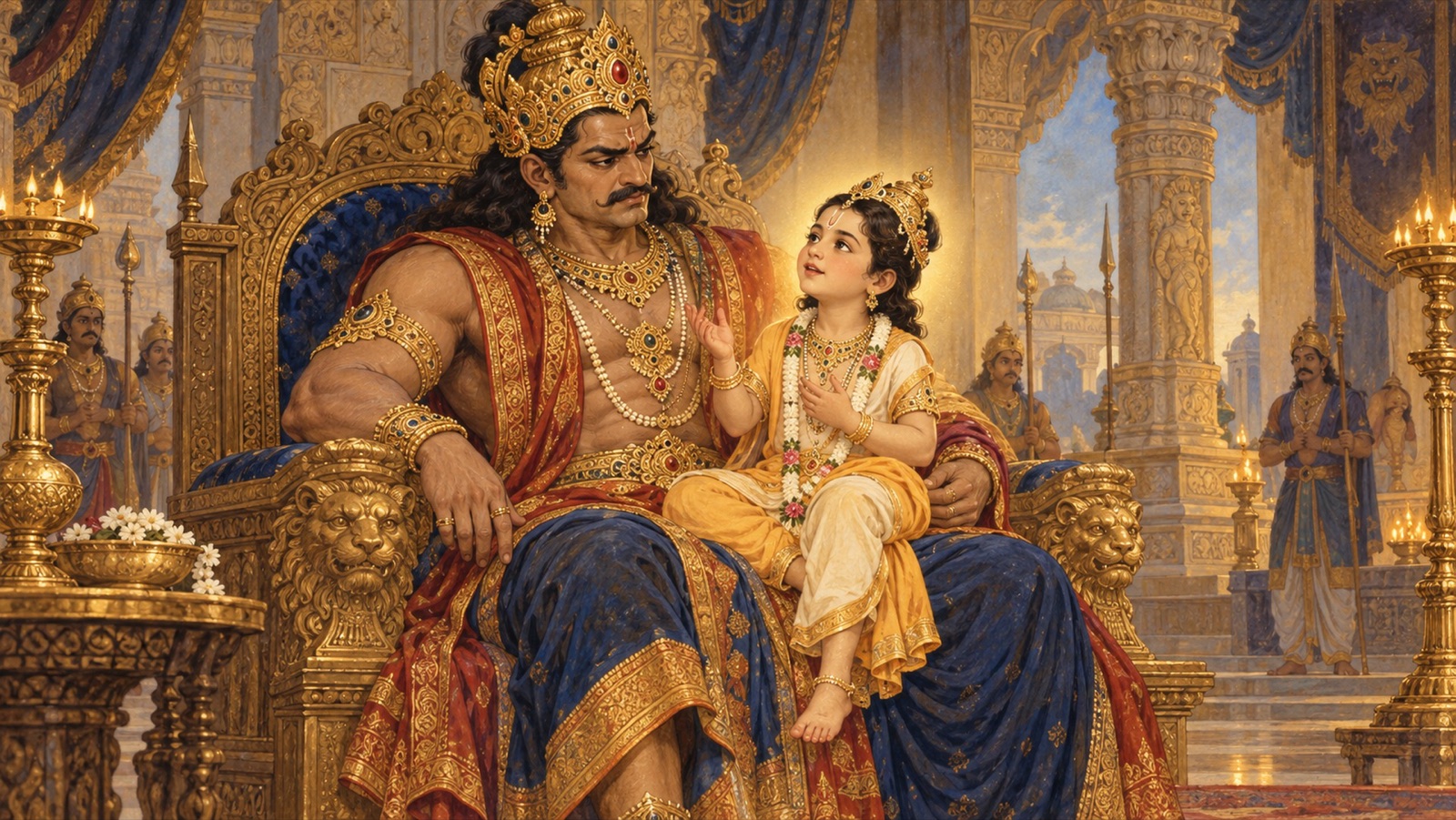
A demon king sets his little son upon his lap, smells his head with fatherly love, and asks him to say what he has learned. The child answers with the one word the father cannot bear to hear: Hari. And so begins the most famous trial of devotion in all of scripture.
Om Namo Bhagavate Vasudevaya.
Om Namo Bhagavate Vasudevaya.
Om Namo Bhagavate Vasudevaya.
Welcome to Srimad Bhagavatam Wisdom, a devotional journey through the sacred histories and teachings of the Srimad Bhagavat Mahapurana. In the previous chapter the saintly child Prahlada was born in the household of the demon king Hiranyakasipu, so absorbed in the love of God that he seemed a stranger to the world. This fifth chapter of the Seventh Canto tells the story that generations of devotees have loved above almost any other: a father’s love collides with a father’s faith when he asks his little son to say, in a word, where his heart has gone. This is the chapter in which pure devotion meets naked power, and devotion does not flinch.
Chapter Information
- Scripture: Śrīmad Bhāgavata Mahāpurāṇa
- Canto: 7 (Book Seven)
- Chapter: 5
- Chapter title: Prahlada’s Fearless Devotion and His Father’s Wrath
- Principal speaker: The sage Narada (narrating to Emperor Yudhishthira); within his account, Prahlada and Hiranyakasipu
- Principal listener: Emperor Yudhishthira; within the narration, Hiranyakasipu, the demon teachers, and Prahlada’s fellow students
- Main setting: The palace of Hiranyakasipu and the school of the demon preceptors Sanda and Amarka
- Central subject: Prahlada’s unwavering devotion to Lord Vishnu, his teaching of the nine forms of devotion, and his father’s failed attempts to take his life
- Principal verse range: Canto 7, Chapter 5, verses 1–57
- Primary edition: Gita Press Śrīmad Bhāgavata Mahāpurāṇa
The Child at School
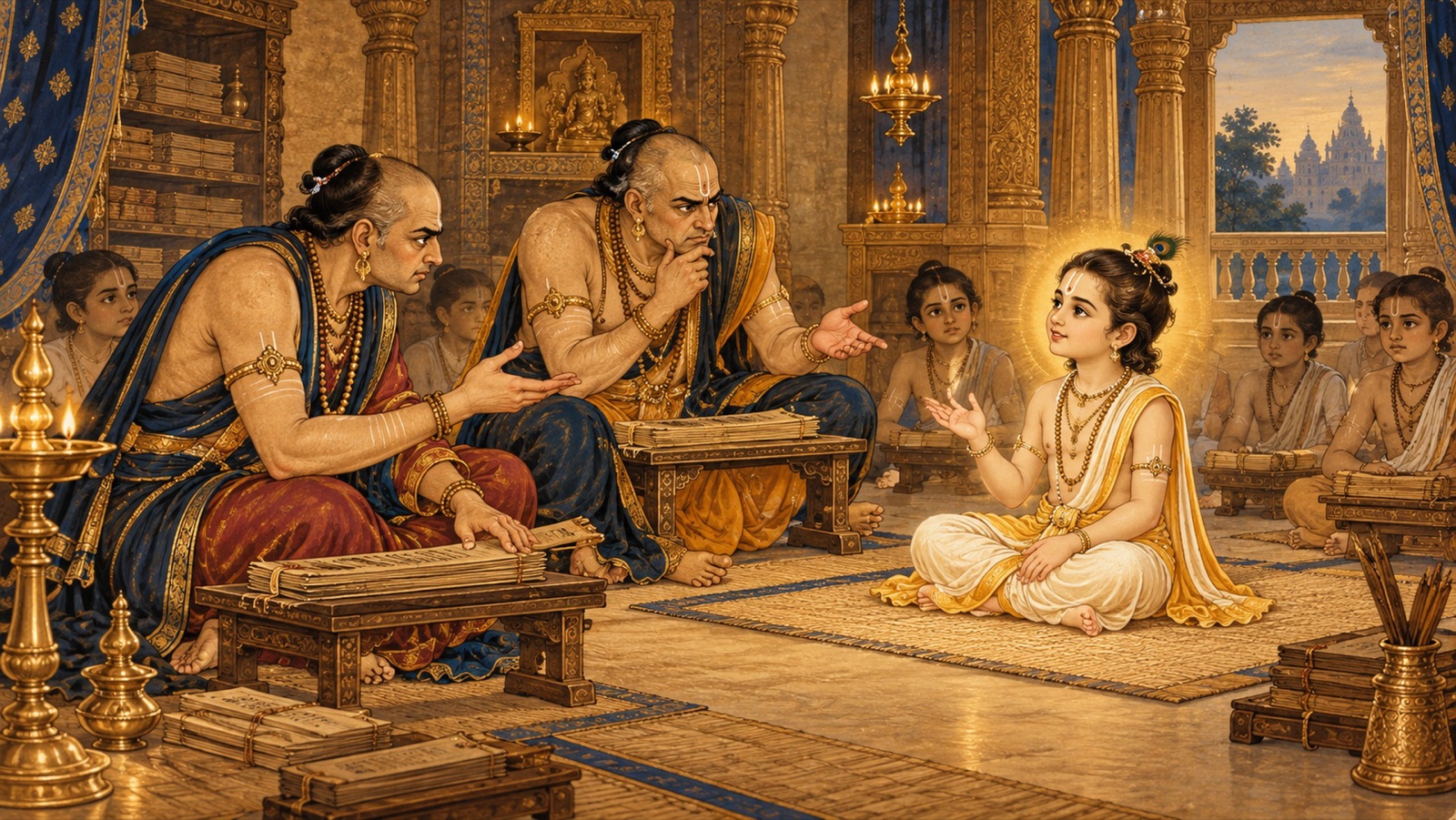
Narada continues. Sukracarya, the learned sage of the Bhrigu line, served as priest to the demons, and his two sons, Sanda and Amarka, lived near the palace and became Prahlada’s teachers. They instructed him, along with the other Asura boys, in every worldly subject worth knowing. Prahlada could repeat perfectly whatever he was taught — but in his heart he did not accept it, for it rested on the false division of the world into friends to be favoured and foes to be crushed.
One day Hiranyakasipu set his son upon his lap and, with genuine affection, asked him to say what he considered best of all that he had learned. The boy’s answer went straight to the heart of things — and straight against everything his father lived for:
श्रीप्रह्लाद उवाच तत्साधु मन्येऽसुरवर्य देहिनां सदा समुद्विग्नधियामसद्ग्रहात् । हित्वात्मपातं गृहमन्धकूपं वनं गतो यद्धरिमाश्रयेत ॥ ५ ॥
śrī-prahlāda uvāca tat sādhu manye ‘sura-varya dehināṁ sadā samudvigna-dhiyām asad-grahāt hitvātma-pātaṁ gṛham andha-kūpaṁ vanaṁ gato yad dharim āśrayeta
Meaning: Prahlada said: O best of the Asuras, for embodied souls whose minds are forever anxious because of clinging to the unreal, I regard this as the true good — that, abandoning the home which drags the soul downward like a hidden, covered well, one should go to the forest and take refuge in Sri Hari. (SB 7.5.5)
Hiranyakasipu only laughed, certain that enemies had tampered with the boy’s mind, and ordered that Prahlada be closely guarded from any brahmanas secretly devoted to Vishnu.
“Like Iron to a Magnet”
Back at the teachers’ house, Sanda and Amarka questioned the boy gently, coaxing him to reveal who had corrupted his thinking. Prahlada’s reply was not the confession they expected but a serene testimony to grace. The false notion that “this one is mine and that one is other,” he said, is the work of the Lord’s Maya, and it is dispelled only when the Lord is pleased — even great souls like Brahma are sometimes bewildered on this point, he added, so it was no wonder that his own father could not see it. His change of heart, he made clear, was not his own doing at all:
यथा भ्राम्यत्ययो ब्रह्मन् स्वयमाकर्षसन्निधौ । तथा मे भिद्यते चेतश्चक्रपाणेर्यदृच्छया ॥ १४ ॥
yathā bhrāmyaty ayo brahman svayam ākarṣa-sannidhau tathā me bhidyate cetaś cakra-pāṇer yadṛcchayā
Meaning: Just as iron drawn near a magnet moves toward it entirely of its own accord, he said, so his heart — changed by the Lord’s will, not by his own — is drawn toward Sri Vishnu, who bears the discus in His hand. (SB 7.5.14)
Furious that his son claimed no credit at all for this change of heart, the teacher threatened him with the cane, called him a thorn among the sandalwood sons of Diti, and thereafter taught him only the worldly aims of wealth, pleasure, and religious formality.
The Nine Forms of Devotion
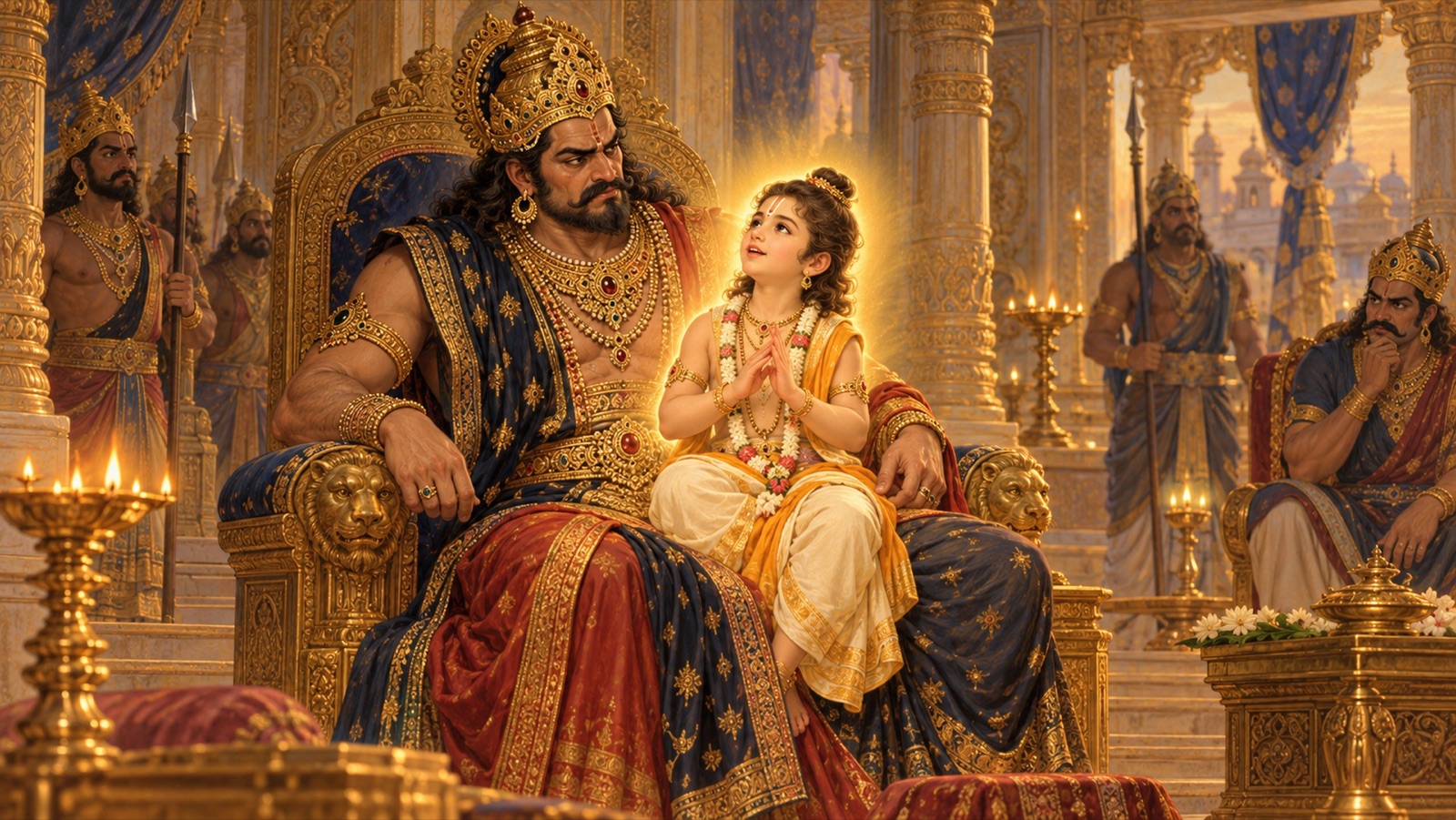
Believing the boy reformed, the teachers washed and adorned him and presented him again to his father. Overjoyed, Hiranyakasipu embraced him, placed him on his lap, smelled his head, and bathed him in tears of affection, then asked him to repeat the finest thing he had learned. Prahlada answered with words that have become the very charter of devotional life:
श्रीप्रह्राद उवाच श्रवणं कीर्तनं विष्णो: स्मरणं पादसेवनम् । अर्चनं वन्दनं दास्यं सख्यमात्मनिवेदनम् ॥ २३ ॥ इति पुंसार्पिता विष्णौ भक्तिश्चेन्नवलक्षणा । क्रियेत भगवत्यद्धा तन्मन्येऽधीतमुत्तमम् ॥ २४ ॥
śrī-prahrāda uvāca śravaṇaṁ kīrtanaṁ viṣṇoḥ smaraṇaṁ pāda-sevanam arcanaṁ vandanaṁ dāsyaṁ sakhyam ātma-nivedanam iti puṁsārpitā viṣṇau bhaktiś cen nava-lakṣaṇā kriyeta bhagavaty addhā tan manye ‘dhītam uttamam
Meaning: Prahlada said: Hearing and chanting the glories of Lord Vishnu, remembering Him, serving His feet, worshipping Him, offering prayers to Him, becoming His servant, befriending Him, and surrendering one’s whole self to Him — if devotion of these nine kinds is offered directly to Lord Vishnu, that, I consider, is the highest learning of all. (SB 7.5.23-24)
At this, Hiranyakasipu turned in fury upon the teacher’s son, accusing him of teaching such things. The teacher’s son protested truthfully that no one had taught the boy — this outlook was simply natural to him. When the father demanded of Prahlada where else it could have come from, the boy replied that those attached to home and unable to control their senses fall again and again into the whirlpool of transmigration, blind souls led by the blind — and he told his father plainly why such people never draw near the Lord:
नैषां मतिस्तावदुरुक्रमाङ्घ्रिं स्पृशत्यनर्थापगमो यदर्थ: । महीयसां पादरजोऽभिषेकं निष्किञ्चनानां न वृणीत यावत् ॥ ३२ ॥
naiṣāṁ matis tāvad urukramāṅghriṁ spṛśaty anarthāpagamo yad-arthaḥ mahīyasāṁ pāda-rajo-‘bhiṣekaṁ niṣkiñcanānāṁ na vṛṇīta yāvat
Meaning: The mind of such worldly people cannot touch the feet of the Lord — whose touch removes all evil — so long as they have not bathed in the dust of the feet of the great souls who claim nothing as their own. (SB 7.5.32)
Only the shelter of such devotees, Prahlada said, can open that door at all.
A Father Turns Murderous
This was more than the demon king could bear. Blinded by wrath, he flung the child from his lap to the ground and commanded his Rakshasas to kill him at once. Prahlada, he raged, was a traitor who worshipped Vishnu, the slayer of his own uncle; a diseased limb must be cut off so that the body may live; the boy must be destroyed by any means — poison, or while sleeping, or sitting unguarded.
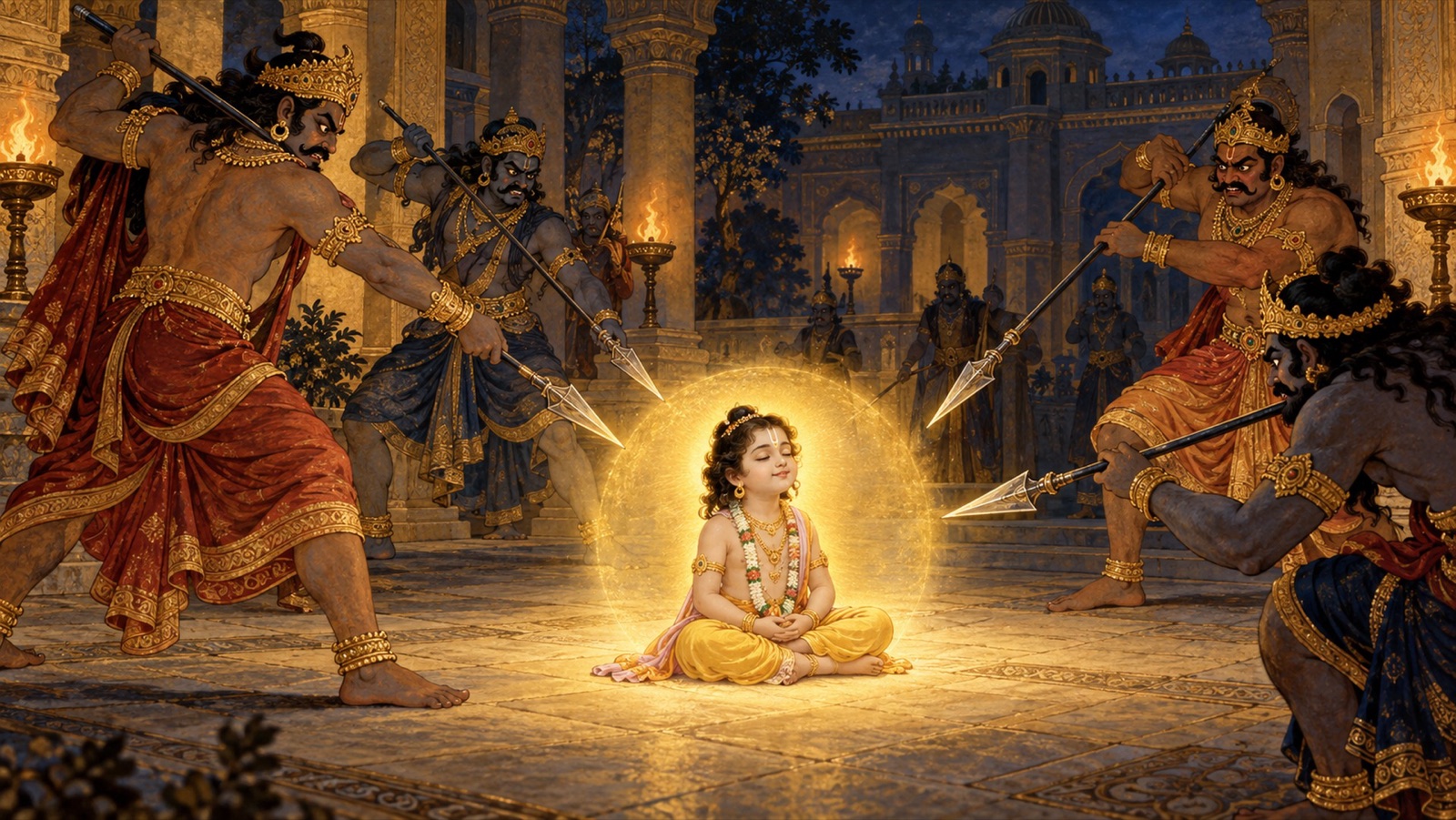
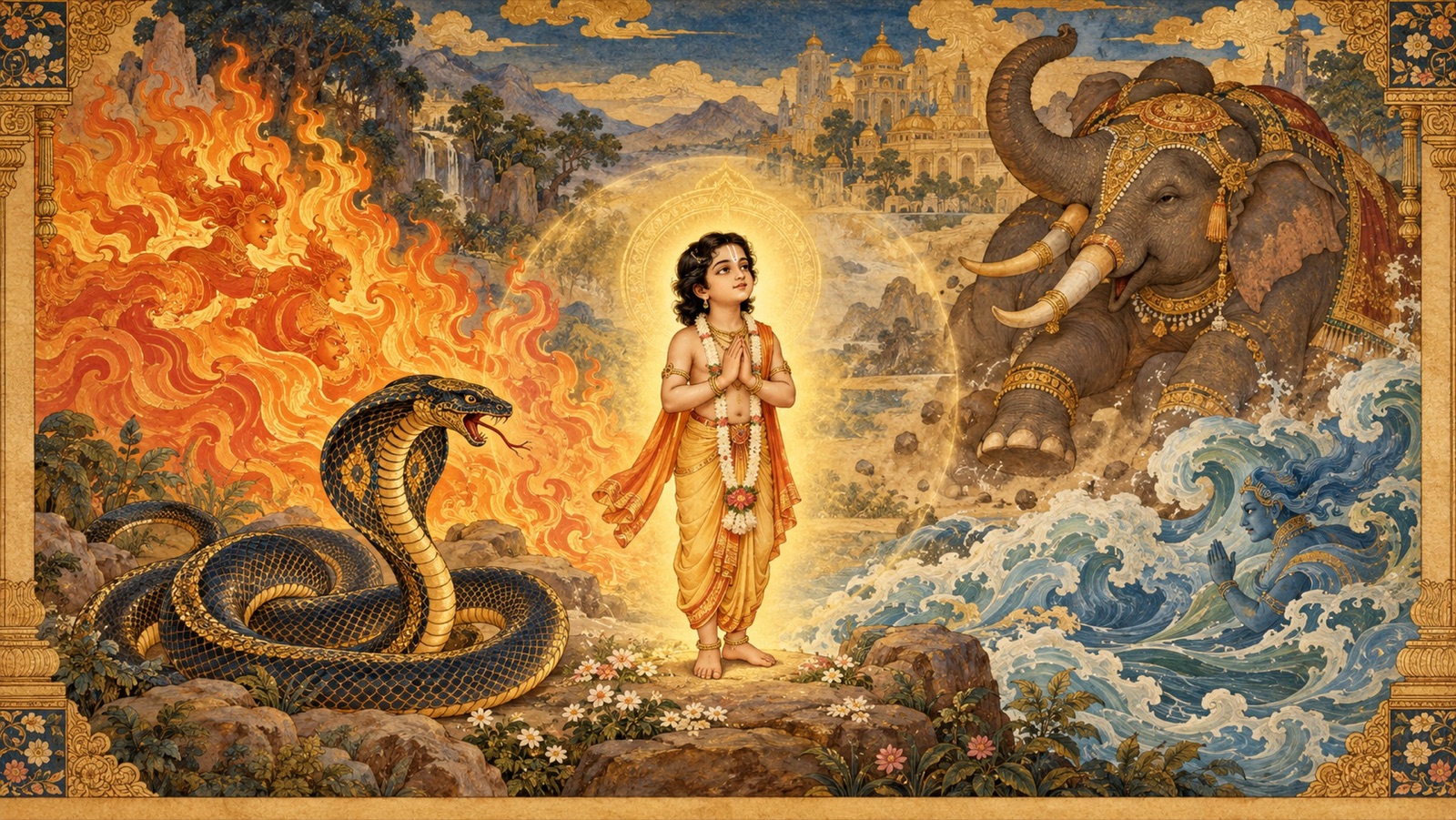
At their master’s command the fierce demons fell upon the boy who sat perfectly still, striking at him with their spears and shouting to cut him down. But their blows had no more effect than the good deeds of an unlucky man, for Prahlada’s mind was wholly absorbed in the Supreme Soul of the universe, and no weapon could reach where his heart had gone.
Every Weapon Fails
Alarmed that his sinless son could not be killed, Hiranyakasipu resorted to device after device. He had the boy trampled by the great elephants that guard the quarters, bitten by serpents, struck with destructive spells, hurled from mountain heights, confined and starved, given poison, exposed to frost and scorching fire and drowning floods, and crushed beneath heavy rocks. Not one of these could so much as touch him. Sunk in the deepest anxiety, the demon king began to fear that this fearless, seemingly immortal child would one day be the cause of his own downfall.
His teachers, Sanda and Amarka, counselled patience: let the boy be bound with the cords of Varuna until their father Sukracarya returned, for a person’s reason often matures with age and with the service of the wise. Hiranyakasipu agreed, and directed that Prahlada be taught only the duties proper to a householder king — dharma, artha, and kama. Yet the boy accepted none of these worldly aims. And when the teacher was away and his young companions gathered around him to play, Prahlada, ever compassionate and friendly, began instead to speak to them of the Lord — the teaching that fills the chapter to come.
Principal Teachings of This Chapter
1. Devotion is not learned; it is awakened by grace. Prahlada insists that no teacher gave him his love of God — it is the Lord’s own gift, dispelling the illusion of “mine” and “other.” True devotion is not manufactured by effort but received by grace (SB 7.5.11-14).
2. The nine forms of devotion are the highest learning. Hearing, chanting, remembering, serving, worshipping, praying, serving as a servant, befriending, and full self-surrender — these nine, offered to the Lord, are declared by Prahlada to be the goal of all knowledge (SB 7.5.23-24).
3. We cannot approach the Lord without the grace of His devotees. Prahlada teaches that the road to the Lord runs through those who have already reached Him — until the heart takes shelter of a great soul possessing nothing of his own, it cannot draw near the Lord’s feet at all (SB 7.5.32).
4. The Lord’s protection is not a miracle worked from outside; it is what naturally follows when the soul has already gone where matter cannot reach. Spear, poison, fire, flood, serpent, and stone all fail against Prahlada not because each is separately blocked, but because his mind rests entirely in the Supreme Soul, who lies beyond the reach of any material instrument (SB 7.5.41). This is also why no teacher could plant his devotion and no father could uproot it: as Sanda himself admitted to Hiranyakasipu, no one had taught the boy anything — his love of Hari was self-arisen, a gift of grace rather than an achievement of effort, birth, or upbringing (SB 7.5.28-29). Devotion of this kind simply lies outside the jurisdiction of worldly power, however absolute.
A Devotional Reflection
What makes Prahlada’s story so beloved is not chiefly the miracles — the spears that will not pierce, the poison that will not kill. It is the steadiness of a small child who has simply stopped being afraid. He sits on the lap of the most powerful and terrible being in the universe and says, gently, that the best thing in life is to take shelter in Hari. He is thrown down, threatened, attacked, and he neither argues nor trembles; his mind has already gone where no weapon can follow. We are not asked to face spears, but we are asked, daily, to choose between the pressures around us and the refuge within. Prahlada shows that the refuge is real, and that it is available even to a child, even in the house of an enemy. The heart fixed on the Lord is the one place in all the worlds that fear cannot enter.
A Daily Devotional Practice
Today, take up just one of the nine forms of devotion that Prahlada named. You might simply hear or read a passage in praise of the Lord (śravaṇam), or softly chant one of His names (kīrtanam), or pause to remember Him in the middle of your work (smaraṇam). Choose one, and do it with attention, offering it directly to Him, repeating within: “Om Namo Bhagavate Vasudevaya.” Let this single thread of devotion be, as it was for Prahlada, a refuge that the anxieties of the day cannot break.
Conclusion
The fifth chapter of the Seventh Canto is the beating heart of the Prahlada narrative, and its real subject is not the miracle of survival but the nature of devotion itself. A child too young to have earned anything by his own effort already possesses what his father’s whole kingdom cannot buy: a heart the Lord Himself has claimed. That is why no weapon, no teacher, and no tyrant can reach him — devotion received as grace lies simply beyond their jurisdiction. Hiranyakasipu’s fury only proves the very point he refuses to see. As the chapter closes, Prahlada turns from his tormentors to his young companions, ready to carry this same fearless refuge into the teaching we will hear next.
May the divine wisdom of Srimad Bhagavatam awaken pure devotion within our hearts.
Om Namo Bhagavate Vasudevaya.
Jay Shree Madhav.
References and Attribution
- Primary edition: Gita Press, Śrīmad Bhāgavata Mahāpurāṇa (English, complete), Book Seven, Discourse 5, pages 666–671.
- Series: Srimad Bhagavatam Wisdom · Biswa Sanatan Dharma Seva Trust.
- Presented following the spiritual guidance and recommendation of Pandit Dr. Shri Kashinath Mishra.
This is an original, faithful retelling in the writer’s own words, with brief quoted verses shown in Devanāgarī and transliteration and their meanings given as summaries. It is not a reproduction of any single publisher’s continuous translation or commentary. No affiliation with or endorsement by any publisher is implied.
Jay Shree Madhav