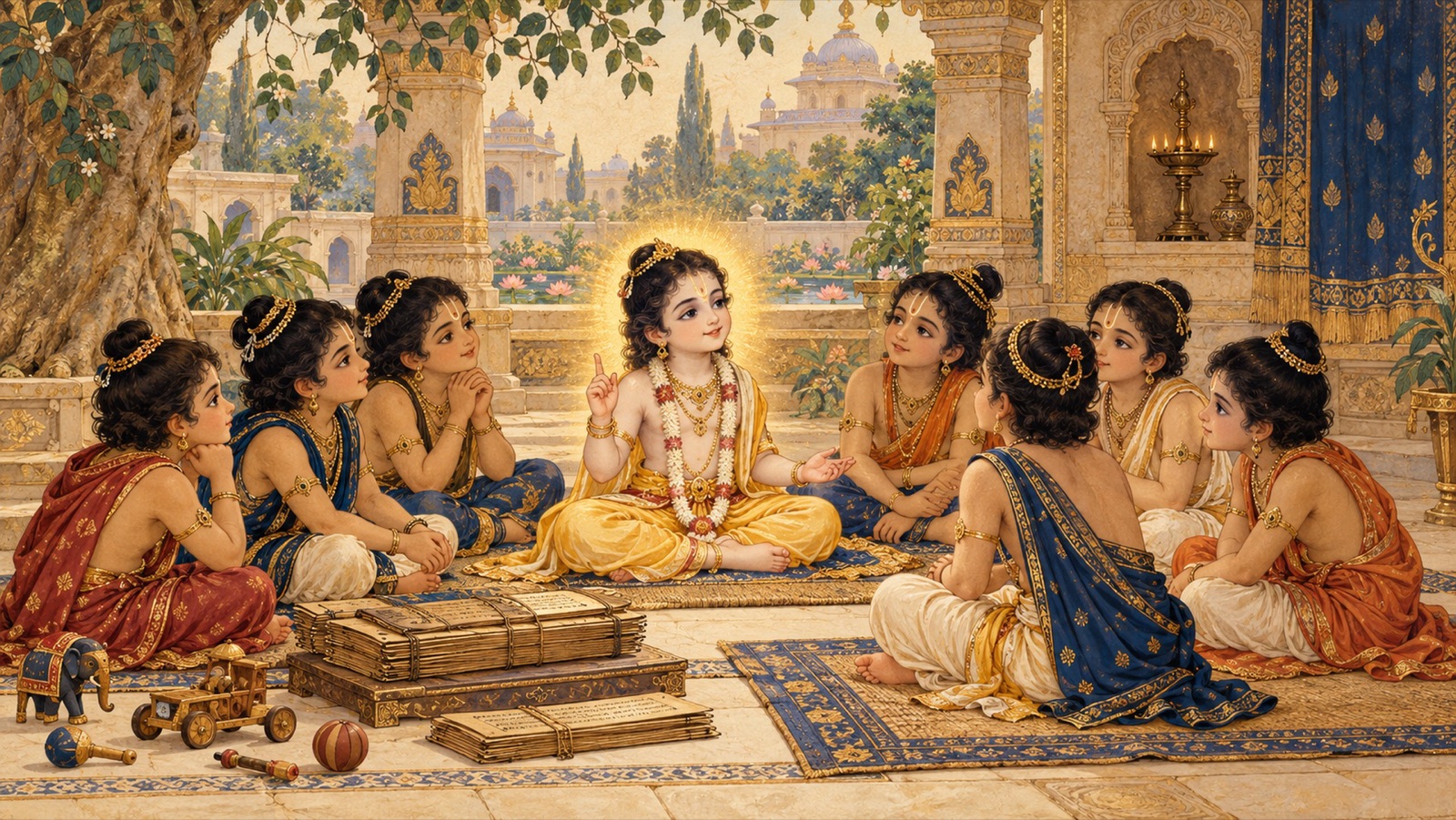
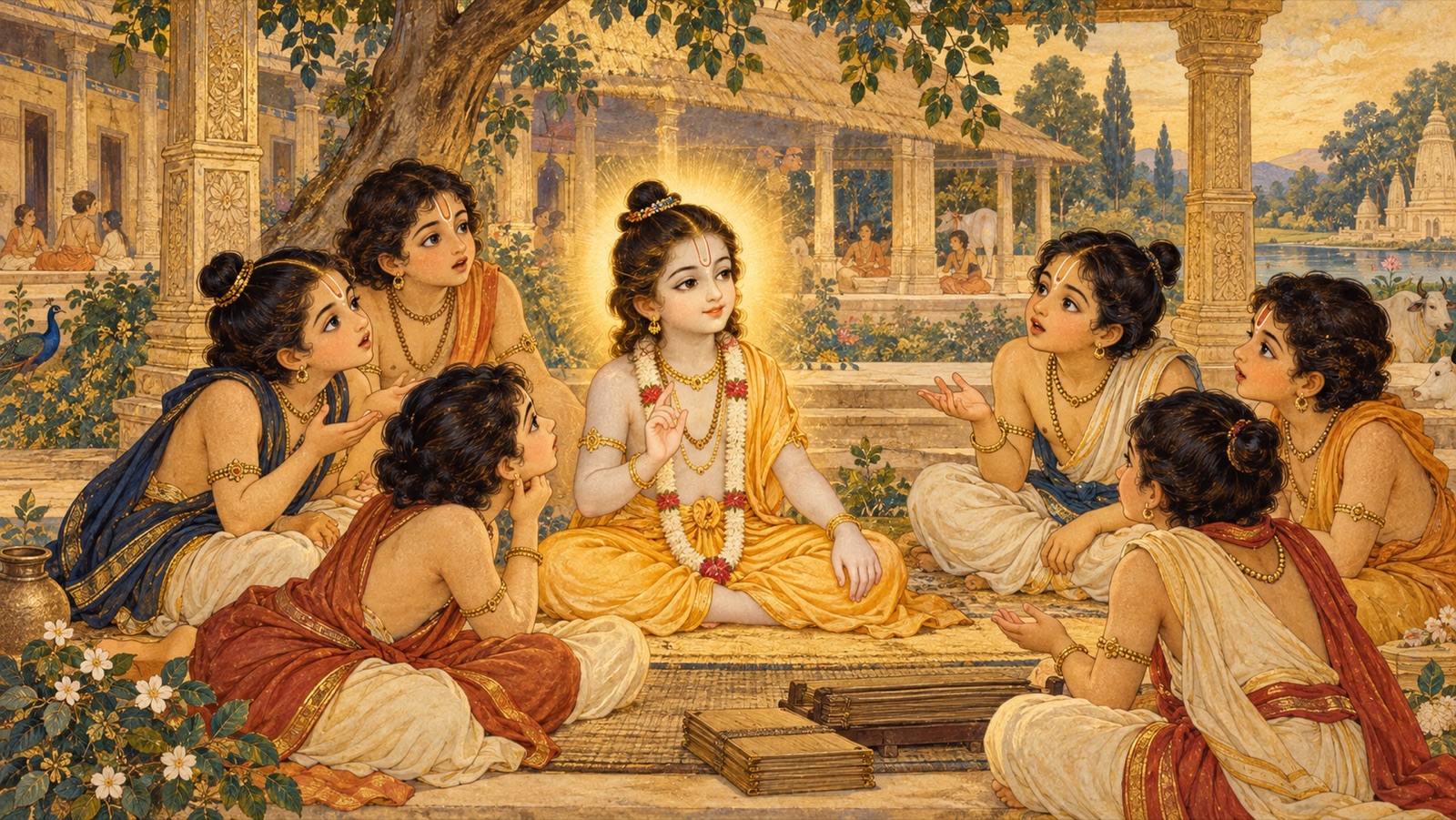
While their teachers are away, the sons of the demons gather around one small boy — not to play, but to listen. And the child of Hiranyakasipu, who cannot yet be killed by fire or sword, begins to teach the highest wisdom of all: begin now, begin young, and take refuge in God.
Om Namo Bhagavate Vasudevaya.
Om Namo Bhagavate Vasudevaya.
Om Namo Bhagavate Vasudevaya.
Welcome to Srimad Bhagavatam Wisdom, a devotional journey through the sacred histories and teachings of the Srimad Bhagavat Mahapurana. In the previous chapter young Prahlada survived every attempt on his life; here, with his teachers away, he turns to his fellow schoolboys and delivers one of the clearest and most tender teachings on devotion in all of scripture — a boy teaching boys.
Chapter Information
- Scripture: Śrīmad Bhāgavata Mahāpurāṇa
- Canto: 7 (Book Seven)
- Chapter: 6
- Chapter title: Prahlada Instructs His Schoolmates in the Path of Devotion
- Principal speaker: Prahlada (within the narration of the sage Narada to Emperor Yudhishthira)
- Principal listener: The young sons of the Daityas, Prahlada’s schoolmates; and, in the frame, Emperor Yudhishthira
- Main setting: The school of the demon preceptors, while the teachers are away
- Central subject: Prahlada’s teaching that devotion should be begun in childhood, that worldly life is a bondage, and that one should take refuge in Lord Narayana and be compassionate to all beings
- Principal verse range: Canto 7, Chapter 6, verses 1–30
- Primary edition: Gita Press Śrīmad Bhāgavata Mahāpurāṇa
Begin in Childhood
Questioned by his companions, Prahlada, the great young devotee, smiled and began to teach. His opening words are among the most quoted in all the Bhagavatam — a call to begin the spiritual life at once, while the rare gift of a human birth is still fresh:
श्रीप्रह्राद उवाच कौमार आचरेत्प्राज्ञो धर्मान्भागवतानिह । दुर्लभं मानुषं जन्म तदप्यध्रुवमर्थदम् ॥ १ ॥
śrī-prahrāda uvāca kaumāra ācaret prājño dharmān bhāgavatān iha durlabhaṁ mānuṣaṁ janma tad apy adhruvam arthadam
Meaning: Prahlada said: A wise person should practise the principles of devotion to the Lord from his very childhood; for a human birth — though rare and difficult to attain, and though itself impermanent — is the one birth that can bestow the true goal of life. (SB 7.6.1)
The only worthy course in this world, he told them, is to take shelter at the feet of Lord Vishnu, who is the ruler, the dearest friend, and the very Self of every living being.
The Emptiness of Chasing Pleasure
Prahlada then dismantled, gently but completely, the whole enterprise of a life spent seeking enjoyment. Sensual pleasure, he explained, comes to embodied beings of its own accord in every birth, exactly as suffering does — by destiny, without any effort, simply through having a body.
सुखमैन्द्रियकं दैत्या देहयोगेन देहिनाम् । सर्वत्र लभ्यते दैवाद्यथा दु:खमयत्नत: ॥ ३ ॥
sukham aindriyakaṁ daityā deha-yogena dehinām sarvatra labhyate daivād yathā duḥkham ayatnataḥ
Meaning: O sons of the Daityas, just as suffering comes to embodied beings everywhere without effort, by destiny, so too does sense pleasure come of its own accord simply through possessing a body. (SB 7.6.3)
To strive for pleasure, therefore, is only to waste a life; and one who spends himself in that pursuit never reaches the lotus feet of the Lord, the true source of bliss. Better to strive for the eternal good while the body is still sound. A hundred years, he reminded them, is a full human span — yet half is lost in sleep, twenty years slip by in childhood and play, twenty more in the helplessness of old age, and what remains is squandered in the anxieties of family and home.
The Bondage of Home and Family
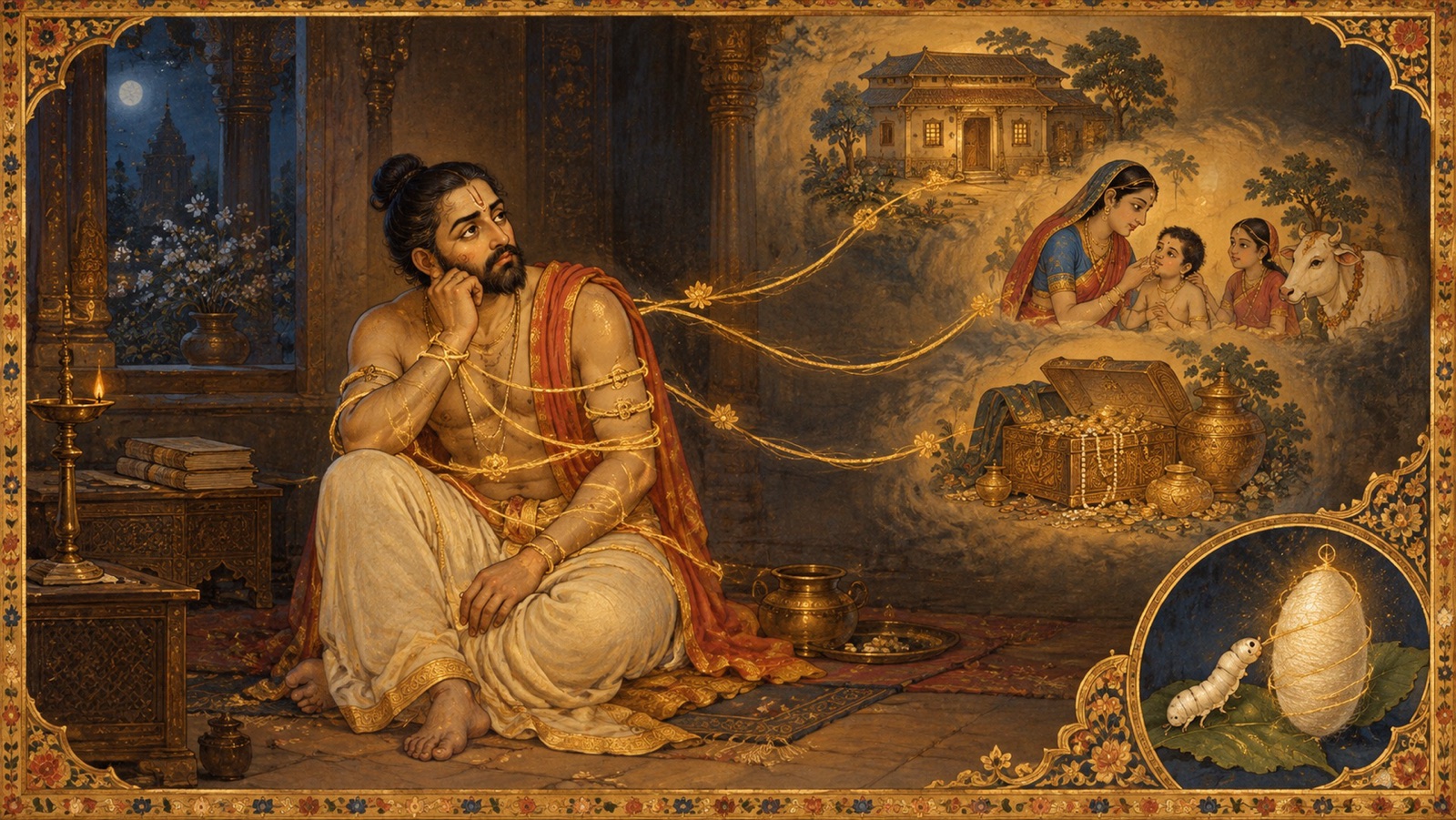
With unflinching clarity, the boy described how attachment binds the soul. Who, he asked, that has not conquered his senses can free himself while clinging to home and bound by the cords of affection? Who can give up the thirst for wealth, coveted more than life itself; the sweet company of loved ones; the pull of children, kin, and possessions? Pursuing gain like a silkworm spinning its own prison, the careless person never notices his life wearing away, nor his true purpose being lost, and never grows weary of the very things that torment him. Such a soul, seeing only “mine” and “another’s,” cannot realize the Self, however learned he may be.
Take Refuge in Lord Narayana
Having shown them the trap, Prahlada showed them the way out. From a respectful distance, he counselled, avoid the company of those whose minds are fixed on the objects of the senses, and take refuge instead in Lord Narayana, the most ancient Deity, who is the final goal sought even by those who have renounced all else. To serve Him, he said, requires no great external exertion, for He is the Self of all beings and present everywhere.
Why should turning to Narayana ask so little, when turning away from family, wealth, and community can consume an entire lifetime and still leave the heart unsatisfied? Prahlada’s answer here is quietly radical: society, family, and nation are bonds we ourselves manufacture and must labor endlessly to please, and even then they may turn against us; but the bond between the living being and Narayana is not manufactured at all. The Lord is the original well-wisher of every soul and its very source, so that relationship is already there, waiting only to be remembered, not created. This is why even a small act of devotion, offered in childhood or old age, in wealth or want, is enough to please Him — while a whole life spent trying to please the world may still end in disappointment (SB 7.6.17-19).
The One Lord in All Beings
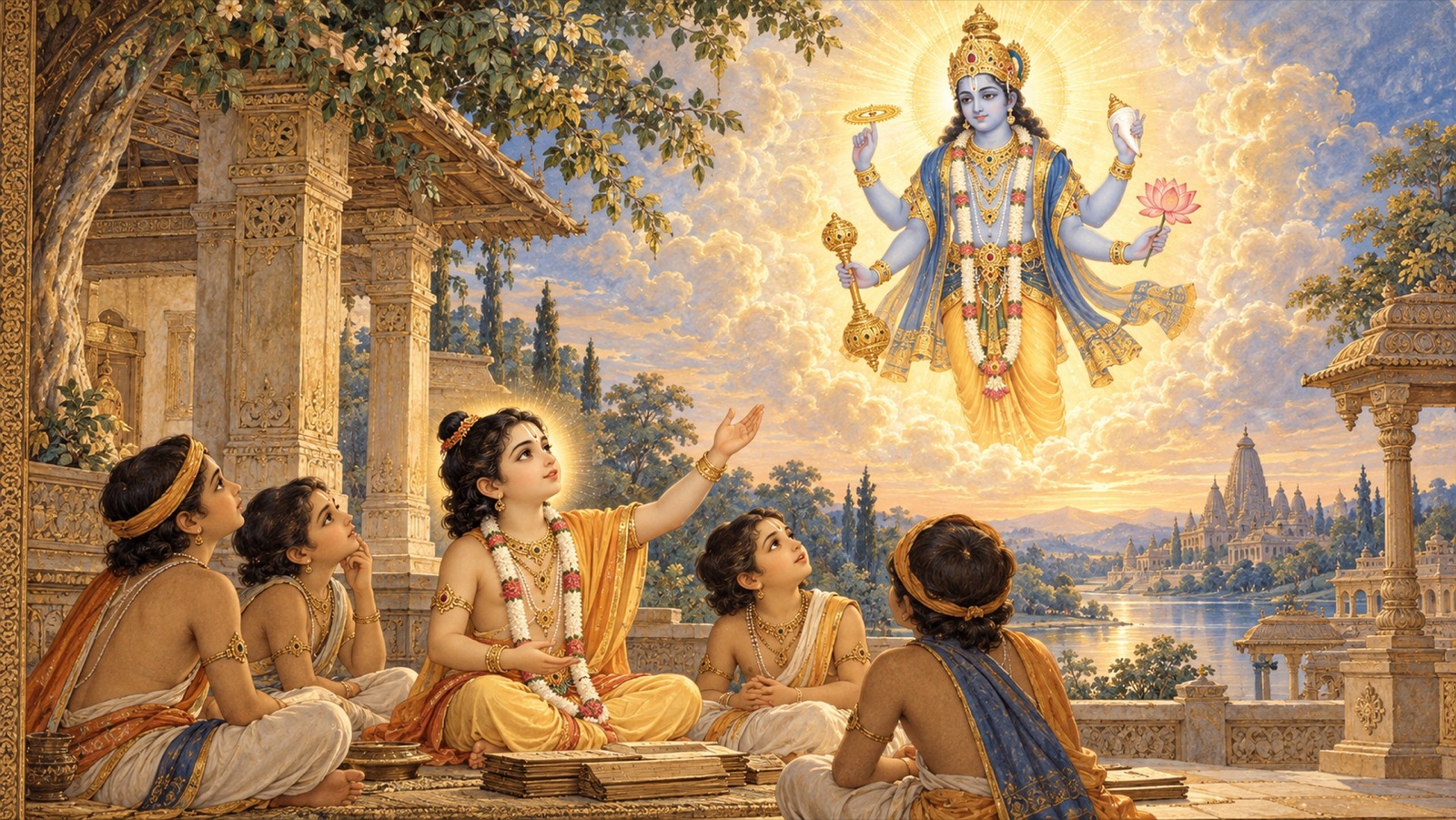
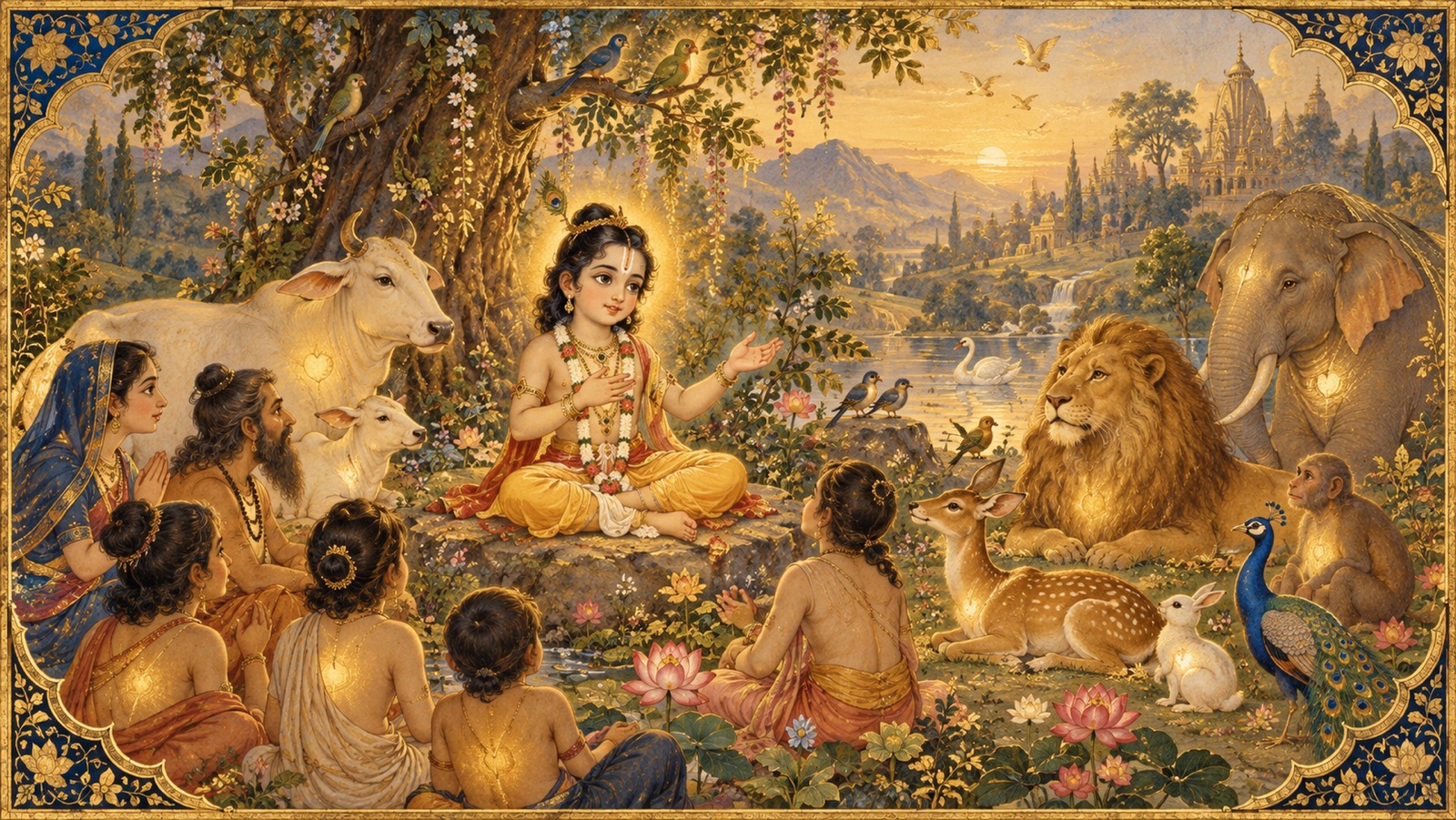
Prahlada then lifted their gaze to a vision of the divine presence pervading all things. The one supreme Spirit, imperishable and all-powerful, dwells in every created being, high and low — from the motionless plants up to Brahma the creator — and in all the elements and modes of nature, whether those modes are rising, in balance, or in conflict (SB 7.6.20-21):
गुणेषु गुणसाम्ये च गुणव्यतिकरे तथा । एक एव परो ह्यात्मा भगवानीश्वरोऽव्यय: ॥ २१ ॥
guṇeṣu guṇa-sāmye ca guṇa-vyatikare tathā eka eva paro hy ātmā bhagavān īśvaro ‘vyayaḥ
Meaning: Whether the modes of nature are rising, balanced, or clashing, only the one transcendent Self stands behind every condition — the Supreme Personality of Godhead, the imperishable controller of all. (SB 7.6.21)
Though beyond description and change, He can be recognized as the seer within and the seen without, and He is known as pure consciousness and bliss, His divinity veiled by Maya. Therefore, Prahlada urged, cast off the demoniac disposition and show compassion and friendship to every living being; this is what pleases the Lord.
तस्मात्सर्वेषु भूतेषु दयां कुरुत सौहृदम् । भावमासुरमुन्मुच्य यया तुष्यत्यधोक्षज: ॥ २४ ॥
tasmāt sarveṣu bhūteṣu dayāṁ kuruta sauhṛdam bhāvam āsuram unmucya yayā tuṣyaty adhokṣajaḥ
Meaning: Therefore, giving up the demoniac nature, show mercy and friendliness toward all living beings; for by such compassion the Lord, who lies beyond the reach of the senses, is pleased. (SB 7.6.24)
When that infinite Being is pleased, he added, what is there that cannot be attained? For those who drink the nectar of His feet and sing His praises, there is no need even to hanker after liberation.
The Source of This Wisdom
Prahlada was careful to name the source of his teaching. This pure and precious knowledge, he said, was imparted long ago by the divine sage Narayana to the sage Narada, and it can be attained by any embodied being who bathes in the dust of the feet of those wholly devoted to the Lord. He himself, Prahlada confessed, had received both this realization and the innocent path of devotion by hearing it from the mouth of Narada, who has seen the Lord face to face.
At this the demon boys were puzzled. They knew of no teacher but the two sons of Sukracarya, who had taught them from infancy; and Prahlada, they pointed out, had been an infant shut away in the palace when he could hardly have met so great a sage as Narada. How, then, could his words be believed? Their honest question sets the stage for the wonderful answer of the next chapter — the story of what Prahlada heard while still in his mother’s womb.
Principal Teachings of This Chapter
1. Begin the spiritual life now, in your youth. Prahlada’s opening counsel is not to postpone devotion to old age but to practise it from childhood, because human birth is rare, precious, and fleeting. The time to turn to God is always the present (SB 7.6.1).
2. Pleasure and pain both come by destiny; do not chase them. Since sense enjoyment arrives on its own simply through having a body, striving for it merely wastes a life. Human effort is best spent on the eternal good (SB 7.6.3-5).
3. Worldly attachment is a self-made prison. Like a silkworm spinning its cocoon, the soul entangled in wealth, home, and family binds itself and loses sight of its true purpose. Freedom begins with recognizing the trap (SB 7.6.9-16).
4. Take refuge in Narayana and be kind to all. The heart of Prahlada’s message is twofold: shelter in the Lord who dwells in all beings, and show compassion and friendship to every creature — for this is the worship that truly pleases Him (SB 7.6.17-24).
A Devotional Reflection
There is something quietly astonishing about who is speaking here. This is not a world-weary elder who has tried everything and found it empty; it is a small boy who has never tasted the pleasures he so calmly sets aside. And that is precisely the point. Prahlada is not renouncing the world out of disappointment, but out of clear sight — he simply sees, from the start, where each road leads. His teaching invites us to that same clarity: not to wait until wealth and pleasure have exhausted us before turning to God, but to see, now, that the human life we hold is rare and short, and to spend it on what does not perish. And his final word keeps the path from ever becoming cold or self-absorbed: take refuge in the Lord, yes — but let that refuge overflow as mercy and friendship toward every living being. Devotion that pleases God is never separate from kindness to His creatures.
A Daily Devotional Practice
Today, act on the two halves of Prahlada’s teaching together. First, set aside a few minutes — as though you were a child laying down a toy — to remember the Lord with full attention, repeating within: “Om Namo Bhagavate Vasudevaya.” Then carry that remembrance outward into one deliberate act of kindness or compassion toward another living being — a person, an animal, anyone in need — offering it silently to the Lord who dwells within them. Let your devotion and your kindness be a single movement of the heart.
Conclusion
Prahlada’s discourse leaves his schoolmates — and us — with a single, luminous point: real freedom begins with plainly recognizing that a human life is fleeting, and that only refuge in Narayana, joined with compassion for all beings, is worth spending it on. Every other pursuit, however sweetly it presents itself, only tightens the same silken cord. As his puzzled classmates press him to explain how a sheltered child came to know such secrets, the way opens to the next chapter’s remarkable answer: the story of what Prahlada heard even before his birth.
May the divine wisdom of Srimad Bhagavatam awaken pure devotion within our hearts.
Om Namo Bhagavate Vasudevaya.
Jay Shree Madhav.
References and Attribution
- Primary edition: Gita Press, Śrīmad Bhāgavata Mahāpurāṇa (English, complete), Book Seven, Discourse 6, pages 671–675.
- Series: Srimad Bhagavatam Wisdom · Biswa Sanatan Dharma Seva Trust.
- Presented following the spiritual guidance and recommendation of Pandit Dr. Shri Kashinath Mishra.
This is an original, faithful retelling in the writer’s own words, with brief quoted verses shown in Devanāgarī and transliteration and their meanings given as summaries. It is not a reproduction of any single publisher’s continuous translation or commentary. No affiliation with or endorsement by any publisher is implied.
Jay Shree Madhav