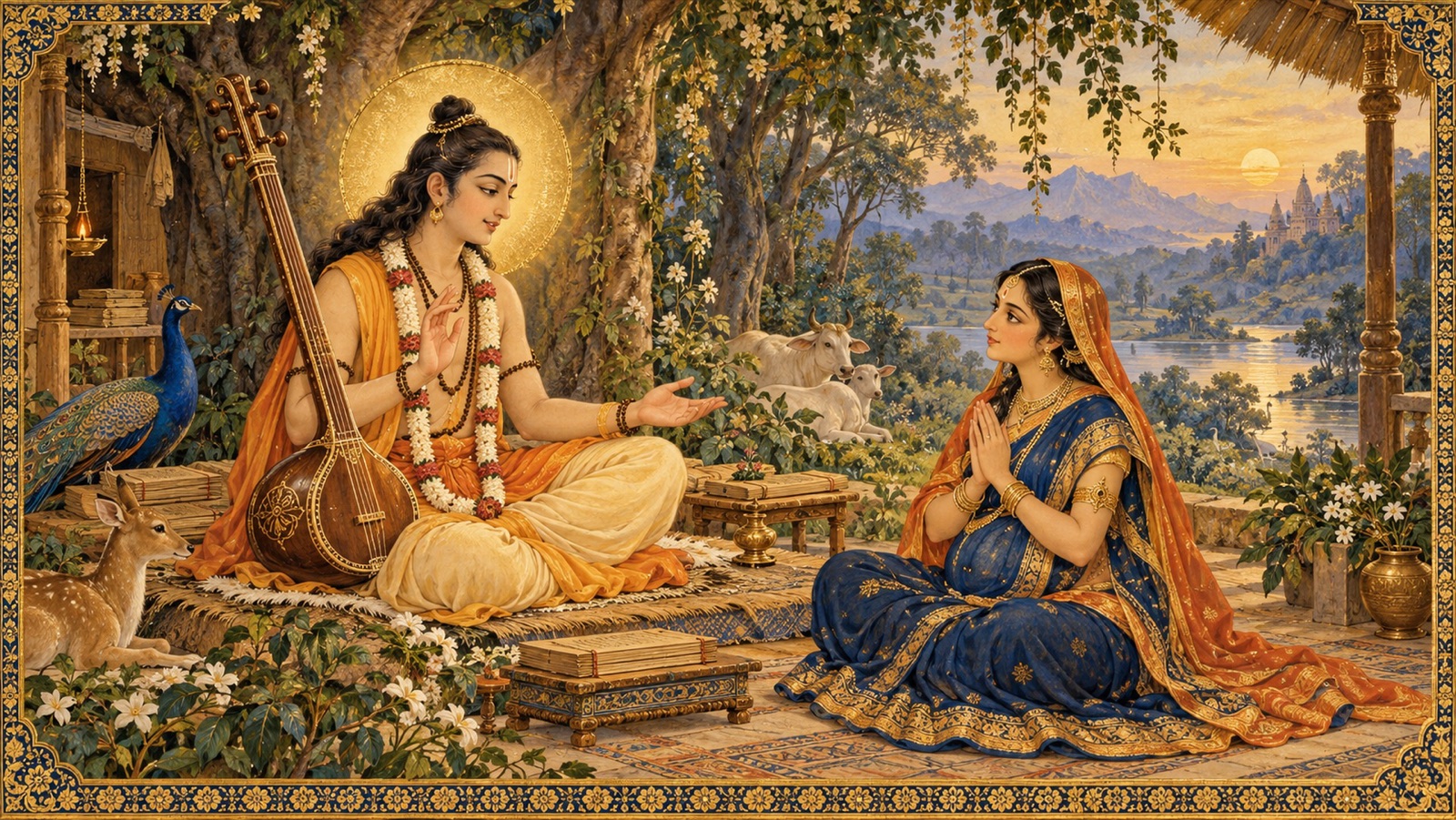
How could an infant have learned the highest wisdom? Prahlada answers with a wonder: while he was still in his mother’s womb, the sage Narada sheltered her and taught her the science of the soul — and the unborn child was listening.
Om Namo Bhagavate Vasudevaya.
Om Namo Bhagavate Vasudevaya.
Om Namo Bhagavate Vasudevaya.
Welcome to Srimad Bhagavatam Wisdom, a devotional journey through the sacred histories and teachings of the Srimad Bhagavat Mahapurana. In the previous chapter Prahlada’s schoolmates asked how, as an infant shut away in the palace, he could possibly have received wisdom from the sage Narada; this seventh chapter of the Seventh Canto is his astonishing reply, tracing his fearless faith back to a teaching he received before he was ever born.
Chapter Information
- Scripture: Śrīmad Bhāgavata Mahāpurāṇa
- Canto: 7 (Book Seven)
- Chapter: 7
- Chapter title: What Prahlada Learned in the Womb
- Principal speaker: Prahlada, recalling the teaching of the sage Narada (within Narada’s narration to Emperor Yudhishthira)
- Principal listener: The young sons of the Daityas; and, in the frame, Emperor Yudhishthira
- Main setting: The battlefield and the road where Indra seized the queen; the hermitage of Narada; and the demons’ school
- Central subject: How Narada protected Prahlada’s mother and taught her the science of the soul, which the unborn Prahlada absorbed; and the essence of that teaching on the eternal soul and pure devotion
- Principal verse range: Canto 7, Chapter 7, verses 1–55
- Primary edition: Gita Press Śrīmad Bhāgavata Mahāpurāṇa
The Queen in Peril
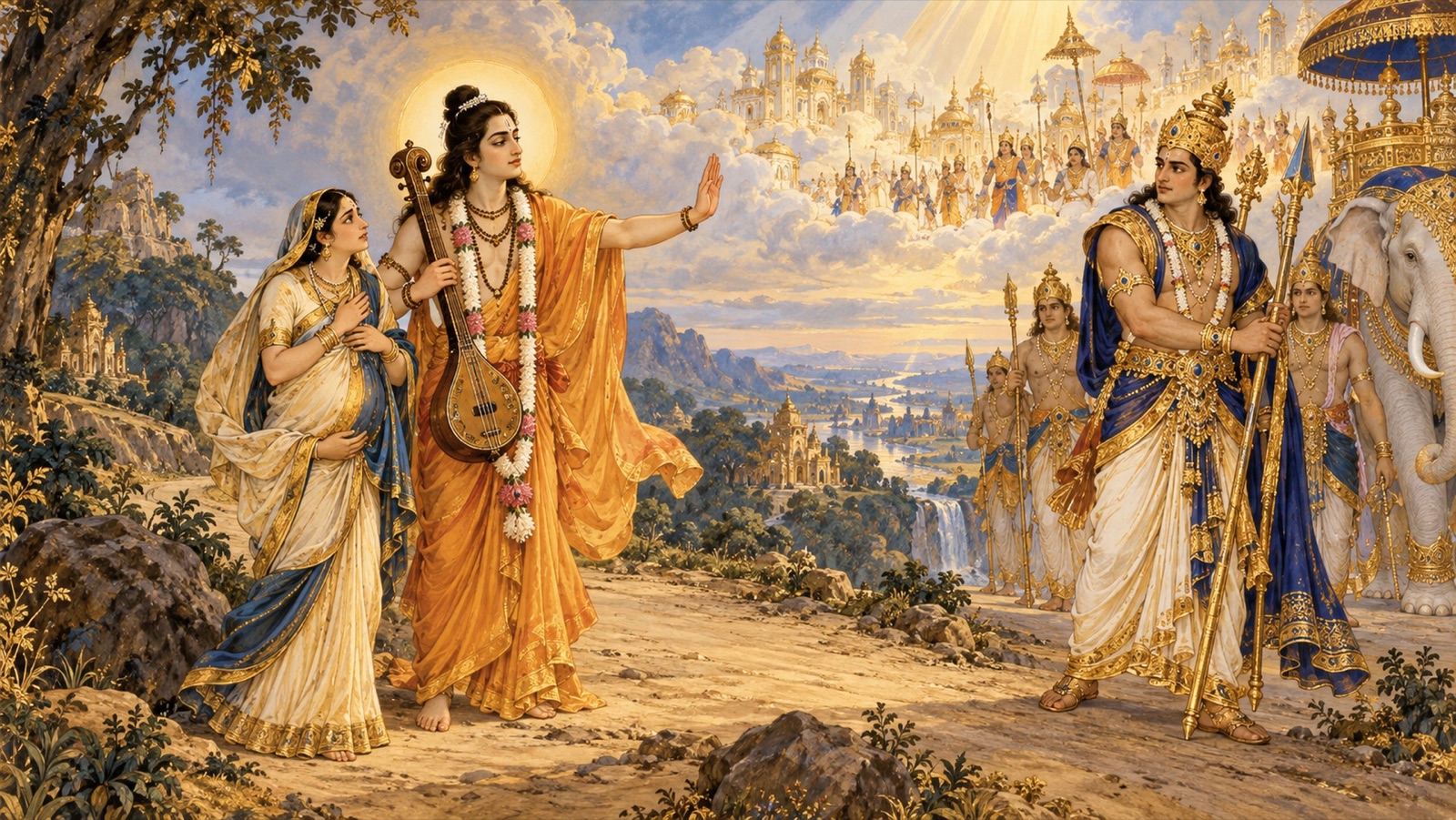
Prahlada began his answer with a story from before his birth. While his father Hiranyakasipu was away on Mount Mandara, performing the terrible austerities that left him buried under ant-hills, Indra and the gods seized their chance and launched a great campaign against the demons. The Asura generals, thinking only of their own lives, fled in every direction, abandoning home and family. The victorious gods plundered the palace, and Indra himself took captive the queen — Prahlada’s own mother — as she was carried away, trembling and weeping.
At that moment the celestial sage Narada happened along the road and saw her distress. He commanded Indra to release her at once: she was innocent, he said, and another’s wedded wife. Indra objected that she carried within her womb the seed of Hiranyakasipu, the enemy of the gods, and meant to hold her until the child was born so that he could destroy it. But Narada revealed the truth about the child:
श्रीनारद उवाच अयं निष्किल्बिष: साक्षान्महाभागवतो महान् । त्वया न प्राप्स्यते संस्थामनन्तानुचरो बली ॥ १० ॥
śrī-nārada uvāca ayaṁ niṣkilbiṣaḥ sākṣān mahā-bhāgavato mahān tvayā na prāpsyate saṁsthām anantānucaro balī
Meaning: Narada said: This child is entirely sinless — indeed a great and exalted devotee of the Lord, a mighty servant of the infinite Lord. He will never meet his death at your hands. (SB 7.7.10)
Accepting the sage’s words, Indra released the queen and, out of reverence for the great devotee she carried, circled her respectfully before returning to heaven.
Wisdom Heard in the Womb
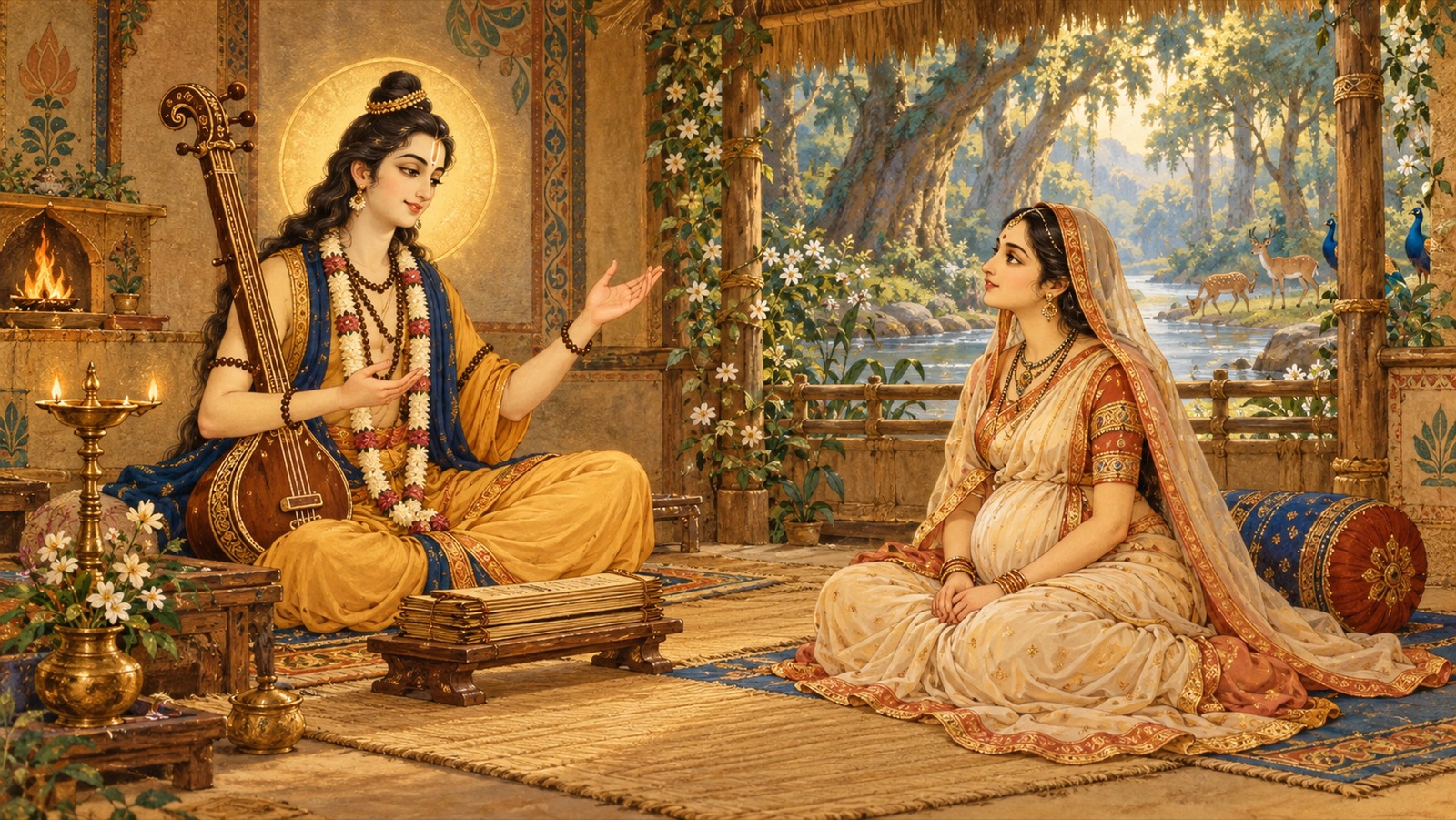
Narada then took the queen with all honour to his own hermitage and comforted her, bidding her stay until her husband returned. There she lived free from fear, serving the sage with devotion, waiting for the safe birth of her child. To ease her sorrow — and, Prahlada adds, for his own sake — the compassionate sage taught her both the essence of religion, which is devotion to the Lord, and pure wisdom, the discrimination between the Self and all that is not the Self. In time that teaching faded from his mother’s memory; but it never left the child who had heard it in the womb.
The Eternal Soul
Prahlada then shared that wisdom with his companions. The changing states of birth, growth, decay, and death, he explained, belong to the body, not to the soul, just as the ripening and falling of fruit belong to the fruit and not to the tree. The Spirit itself is eternal, undecaying, pure, one without a second, the knowing witness, changeless and self-luminous — and Prahlada set out these very marks of the soul for his friends:
आत्मा नित्योऽव्यय: शुद्ध एक: क्षेत्रज्ञ आश्रय: । अविक्रिय: स्वदृग् हेतुर्व्यापकोऽसङ्ग्यनावृत: ॥ १९ ॥ एतैर्द्वादशभिर्विद्वानात्मनो लक्षणै: परै: । अहं ममेत्यसद्भावं देहादौ मोहजं त्यजेत् ॥ २० ॥
ātmā nityo ‘vyayaḥ śuddha ekaḥ kṣetra-jña āśrayaḥ avikriyaḥ sva-dṛg hetur vyāpako ‘saṅgy anāvṛtaḥ
etair dvādaśabhir vidvān ātmano lakṣaṇaiḥ paraiḥ ahaṁ mamety asad-bhāvaṁ dehādau mohajaṁ tyajet
Meaning: The self — whether the individual soul or the Supreme — is eternal and imperishable, untouched by matter, singular, the knower standing apart from the body, the unmoving foundation of all things, self-luminous, the cause of all causes, present everywhere, free of attachment, and never veiled. Knowing the self by these twelve transcendental marks, the wise give up the illusion, rooted in the body, of thinking “I am this” and “this is mine.” (SB 7.7.19-20)
Just as a skilled goldsmith knows how to extract gold hidden within its ore, so one versed in the science of the soul, freed from that illusion, can discover the true Self hidden within the body.
He spoke, too, of the three states of waking, dream, and deep sleep, which are functions of the intellect — and of the witness who is aware of all three and is therefore beyond them. The seed of action born of the modes of nature, he said, must be burnt away by that yoga which stills the restless intellect; and the surest means to this is simply to develop love for the Lord — by serving one’s teacher, keeping the company of devotees, hearing and singing the Lord’s glories, meditating on His feet, and honouring every living being as the abode of Sri Hari.
The Ecstasy of the Devotee
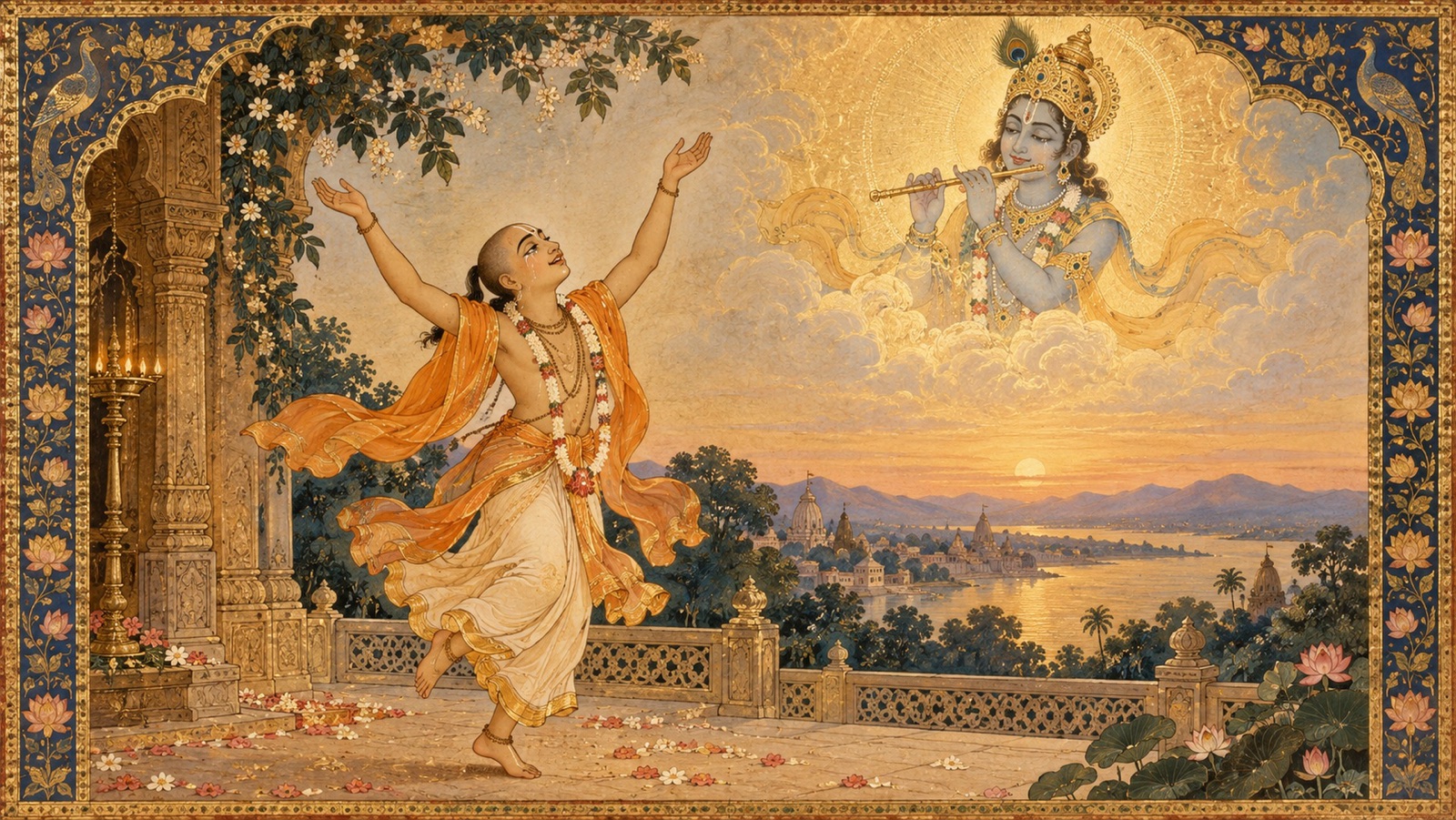
Prahlada described what happens when such love awakens. Hearing of the Lord’s matchless deeds and playful incarnations, the devotee sings aloud in a voice choked with tears, dances, and cries out, his hair standing on end with joy; now laughing, now weeping, now sitting rapt in meditation, and calling without any shame, “O Hari! O Lord of the universe! O Narayana!” In that state his bonds are loosened, his ignorance and hidden desires are burnt away, and, his mind and body wholly attuned to the Lord, he attains Him. Therefore, Prahlada urged, worship the Ruler of your heart within the very lotus of your heart — for what great effort does it take to worship Sri Hari, who dwells within you like the space in your own being?
Devotion Is Open to All
Finally Prahlada turned to the great equalizing truth of devotion. Wealth, family, land, and luxury, he said, are fleeting and cannot satisfy the soul, which is itself an ocean of eternal bliss; even the heavenly worlds won by sacrifice are perishable. What truly pleases the Lord is not high birth, nor learning, nor charity, nor austerity, nor ritual, but pure and unalloyed devotion:
नालं द्विजत्वं देवत्वमृषित्वं वासुरात्मजा: । प्रीणनाय मुकुन्दस्य न वृत्तं न बहुज्ञता ॥ ५१ ॥ न दानं न तपो नेज्या न शौचं न व्रतानि च । प्रीयतेऽमलया भक्त्या हरिरन्यद् विडम्बनम् ॥ ५२ ॥
nālaṁ dvijatvaṁ devatvam ṛṣitvaṁ vāsurātmajāḥ prīṇanāya mukundasya na vṛttaṁ na bahu-jñatā na dānaṁ na tapo nejyā na śaucaṁ na vratāni ca prīyate ‘malayā bhaktyā harir anyad viḍambanam
Meaning: O sons of the Asuras, neither birth in a noble family, nor godhood, nor sagehood, nor good conduct, nor vast learning, nor charity, nor austerity, nor sacrifice, nor purity, nor sacred vows can by themselves please the Lord Mukunda. Sri Hari is pleased by pure, unalloyed devotion alone; everything else is mere show. (SB 7.7.51-52)
Here lies the reason this teaching matters beyond its own moment. Prahlada is no brahmana, elder, or renunciant — he is a small child born in a demon’s house, instructing other demon children. Were the Lord’s favour reserved for noble birth, ritual purity, or years of austerity, Prahlada himself would have no standing to teach, and his mother’s devotion in Narada’s hermitage would have counted for nothing. By insisting that unmotivated love alone wins the Lord, Prahlada is explaining his own position even as he states the doctrine: divine grace was never waiting for anyone to first become qualified. This is also why Narada could instruct an unborn child and a demon’s wife with equal seriousness, and why the Lord, unasked, had already claimed Prahlada before his birth (verses 9-17, 51-52).
Because that same Lord dwells equally within every heart, Prahlada added, one should regard every other living being’s good exactly as one regards one’s own, and worship Him there as the Supersoul of all (verse 53). Many demons, Yakshas, women, laborers, cowherds, birds, and beasts, he reminded them, have attained immortality through such devotion. And he summed up the whole path in a single verse:
एतावानेव लोकेऽस्मिन्पुंस: स्वार्थ: पर: स्मृत: । एकान्तभक्तिर्गोविन्दे यत्सर्वत्र तदीक्षणम् ॥ ५५ ॥
etāvān eva loke ‘smin puṁsaḥ svārthaḥ paraḥ smṛtaḥ ekānta-bhaktir govinde yat sarvatra tad-īkṣaṇam
Meaning: This alone is declared to be the highest good of a human being in this world: exclusive devotion to Lord Govinda, which is the very same as beholding Him present in every creature. (SB 7.7.55)
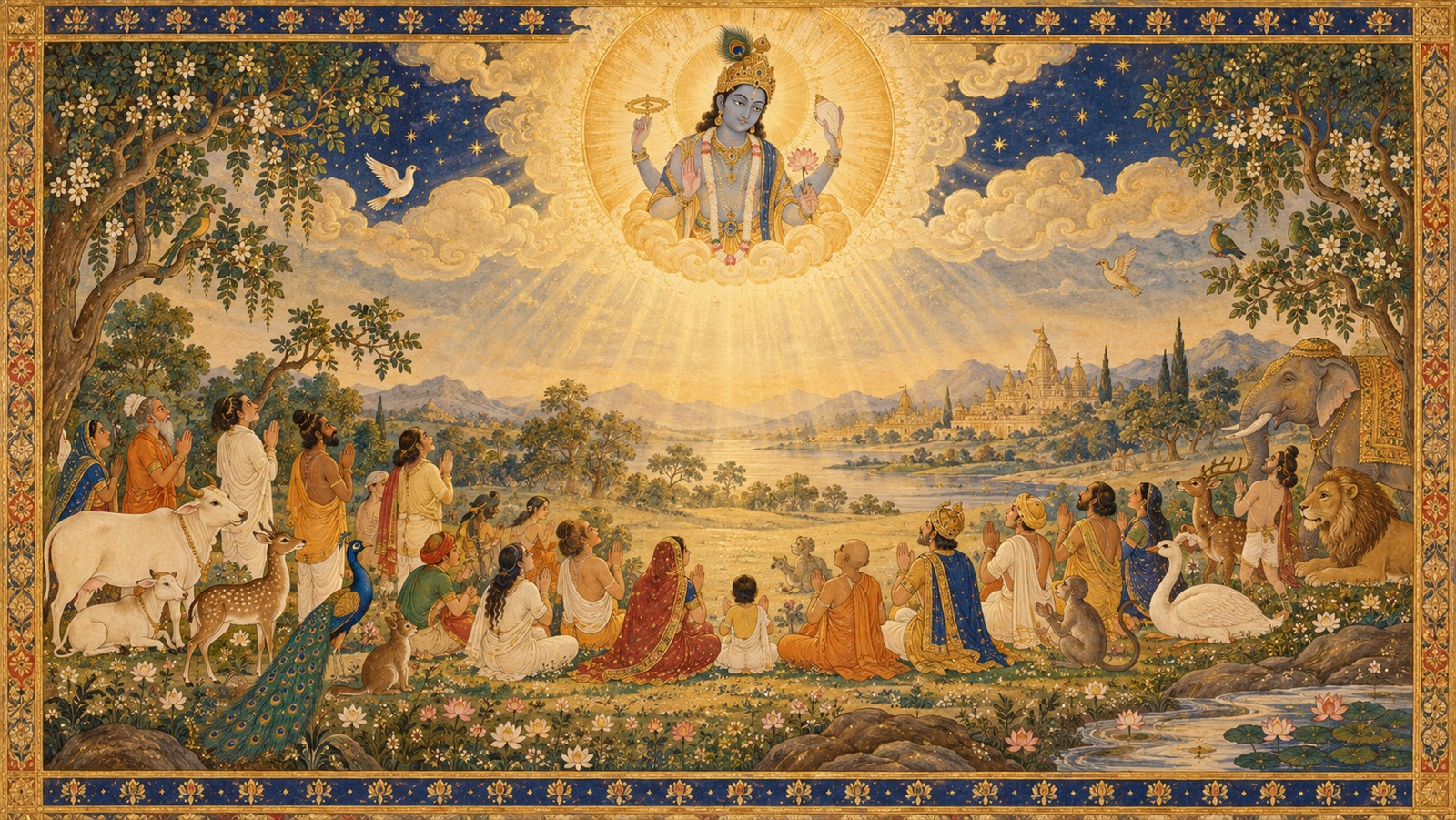
Principal Teachings of This Chapter
1. Grace protects the devotee even before birth. Prahlada’s mother is delivered from danger, and the unborn child is declared a great devotee whom none can slay. The Lord’s protection reaches His servant even in the womb (SB 7.7.9-11).
2. Spiritual truth can be received by anyone, even a child in the womb. The wisdom Narada spoke took root in the unborn Prahlada and never left him. Sincere faith, he says, can awaken discernment even in women and children — no one is excluded (SB 7.7.15-17).
3. The soul is eternal; the body and its states are not. Birth, growth, and decay belong to the body, as ripening belongs to fruit and not to the tree. Realizing the deathless Self within is the aim of all true knowledge (SB 7.7.18-21).
4. The Lord is won by pure devotion alone. Not birth, learning, charity, or austerity, but unalloyed love pleases Sri Hari; and that love is nothing other than seeing the Lord in every creature. This is the highest good of human life (SB 7.7.51-55).
A Devotional Reflection
There is a beautiful humility in the way Prahlada answers his friends. He does not claim his wisdom as his own achievement; he traces it back, gratefully, to a sage’s kindness and a mother’s devotion, and beyond them to the grace of the Lord who arranged it all. The child who could not be killed by fire or sword turns out to have been formed, before birth, by love — a sage who protected the helpless, a mother who served with faith, a teaching received in the dark quiet of the womb. It is a picture of how the spiritual life really comes to us: not manufactured by our cleverness, but received through the kindness of those who carry the truth, and rooted by our own faith. And Prahlada’s conclusion keeps that grace from ever becoming exclusive. If the Lord is pleased by pure devotion alone, then no one — however lowly their birth or circumstance — is shut out; and if devotion means seeing Him in every creature, then the path itself makes us gentle. To love God and to look upon all beings with reverence are, in the end, the same movement of the heart.
A Daily Devotional Practice
Today, practise seeing the Lord in others. Choose one or two people you meet — perhaps someone easy to overlook — and silently remind yourself that Sri Hari dwells within them as He dwells within you, offering them a moment of genuine respect or kindness. As you do, repeat within: “Om Namo Bhagavate Vasudevaya.” Let this be a small enactment of Prahlada’s final teaching — that exclusive devotion to the Lord and the vision of Him in every creature are one and the same.
Conclusion
The seventh chapter of the Seventh Canto answers what had puzzled Prahlada’s companions and uncovers the hidden root of his courage: a teaching received before birth, sheltered by a sage’s compassion, and sealed by a truth that grace never asks anyone to earn first. Its one lasting word for us is Prahlada’s own closing verse — that unmotivated devotion, not birth or attainment, is what wins the Lord, and that such devotion is simply the readiness to behold Him in every living being. With this foundation laid, the story now turns toward its great climax, when the Lord Himself descends to defend the devotee He has already claimed.
May the divine wisdom of Srimad Bhagavatam awaken pure devotion within our hearts.
Om Namo Bhagavate Vasudevaya.
Jay Shree Madhav.
References and Attribution
- Primary edition: Gita Press, Śrīmad Bhāgavata Mahāpurāṇa (English, complete), Book Seven, Discourse 7, pages 675–680.
- Series: Srimad Bhagavatam Wisdom · Biswa Sanatan Dharma Seva Trust.
- Presented following the spiritual guidance and recommendation of Pandit Dr. Shri Kashinath Mishra.
This is an original, faithful retelling in the writer’s own words, with brief quoted verses shown in Devanāgarī and transliteration and their meanings given as summaries. It is not a reproduction of any single publisher’s continuous translation or commentary. No affiliation with or endorsement by any publisher is implied.
Jay Shree Madhav