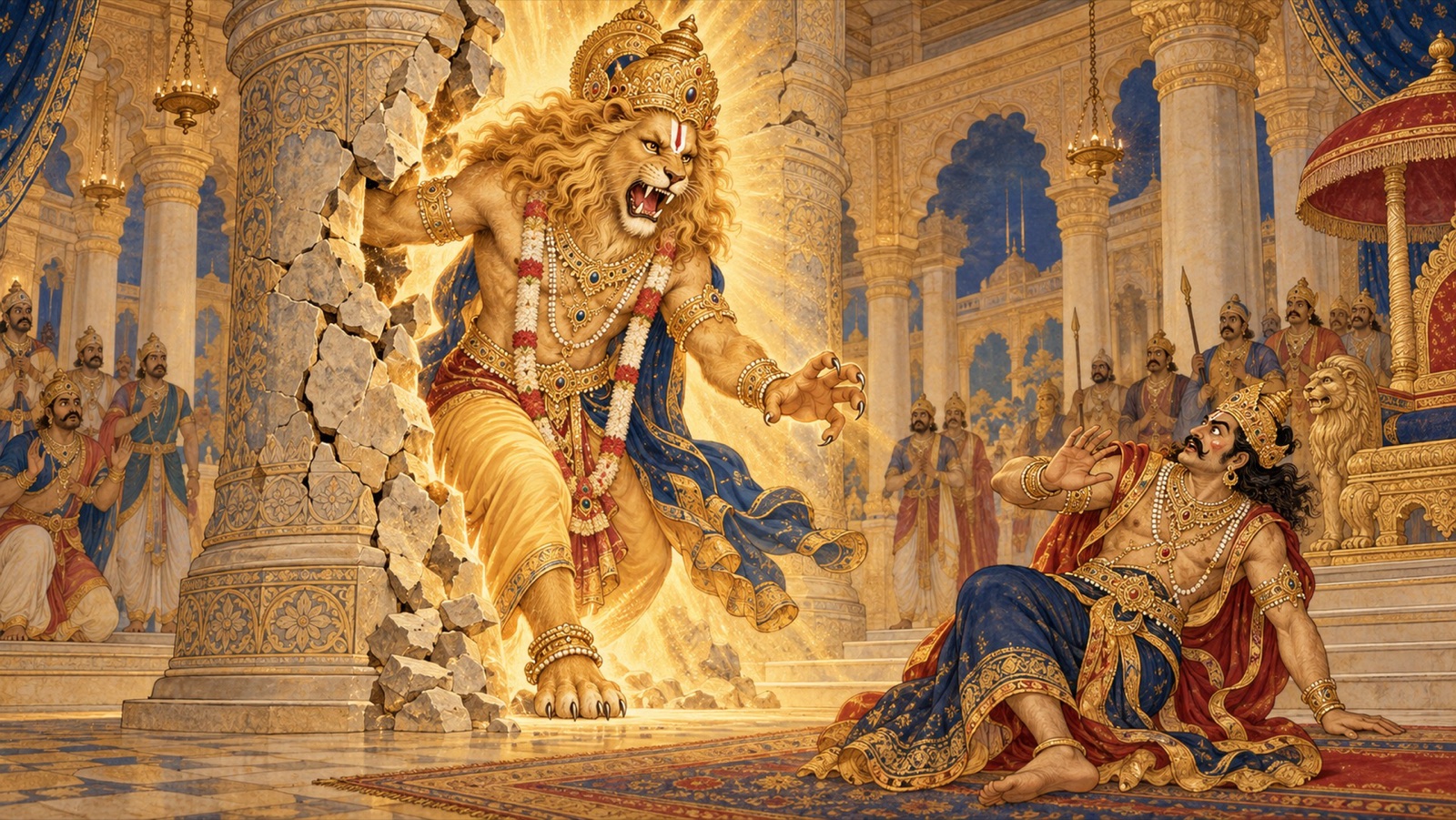
The tyrant demanded to know where God could be. “Is He in this pillar?” he sneered, and struck it with his fist. In that instant the Lord Himself came forth — in a form that was neither beast nor man — to keep the word of His servant and protect the devotee who had never doubted Him.
Om Namo Bhagavate Vasudevaya.
Om Namo Bhagavate Vasudevaya.
Om Namo Bhagavate Vasudevaya.
Welcome to Srimad Bhagavatam Wisdom, a devotional journey through the sacred histories and teachings of the Srimad Bhagavat Mahapurana. This eighth chapter of the Seventh Canto brings Prahlada’s story to its climax, as a boy’s unshaken trust in the Lord’s constant nearness calls forth Narasimha Himself.
Chapter Information
- Scripture: Śrīmad Bhāgavata Mahāpurāṇa
- Canto: 7 (Book Seven)
- Chapter: 8
- Chapter title: The Lord Appears as Narasimha
- Principal speaker: The sage Narada, narrating to Emperor Yudhishthira; with the words of Prahlada and Hiranyakasipu, and the prayers of the gods
- Principal listener: Emperor Yudhishthira
- Main setting: The royal court and assembly hall of Hiranyakasipu
- Central subject: Hiranyakasipu’s final rage against Prahlada, and the appearance of the Lord as Narasimha to protect His devotee and destroy the tyrant
- Principal verse range: Canto 7, Chapter 8, verses 1–56
- Primary edition: Gita Press Śrīmad Bhāgavata Mahāpurāṇa
A Father’s Wrath
The demon boys, Narada continued, embraced Prahlada’s flawless teaching and set aside the instruction of their preceptor. Alarmed to see their minds turning wholly toward devotion to the Lord, the preceptor’s son reported the matter to the king. Hearing that his own son had once again led the young Daityas away from the family’s path, Hiranyakasipu shook with anger and resolved to be rid of him. He reproached Prahlada in harsh words — though the boy stood before him disciplined, humble, and with folded palms, wholly undeserving of such treatment — and, hissing like a trodden serpent, threatened to send him that very day to the abode of death. “By whose strength,” he demanded, “have you grown so bold as to defy my authority, when the three worlds and their guardians tremble before me?”
By Whose Strength
Prahlada’s reply was fearless and serene. The strength by which he stood, he said, was not his own but the Lord’s — the very same power that upholds his father and every other being, high and low, moving and unmoving, from Brahma downward.
श्रीप्रह्राद उवाच न केवलं मे भवतश्च राजन् स वै बलं बलिनां चापरेषाम् । परेऽवरेऽमी स्थिरजङ्गमा ये ब्रह्मादयो येन वशं प्रणीता: ॥ ७ ॥
śrī-prahrāda uvāca na kevalaṁ me bhavataś ca rājan sa vai balaṁ balināṁ cāpareṣām pare ‘vare ‘mī sthira-jaṅgamā ye brahmādayo yena vaśaṁ praṇītāḥ
Meaning: Prahlada said: He is the strength not only of mine but of yours as well, O king, and of all other mighty beings too. It is He by whom all these creatures — high and low, moving and unmoving, from Brahma downward — are held under sway. (SB 7.8.7)
That Lord, Prahlada went on, is the supreme Ruler, the mighty Time-Spirit, and the controller of all the modes of nature; He alone creates, protects, and dissolves the universe.
Prahlada then turned to his father’s own heart. Give up this demoniac nature, he urged him, and hold the mind equal toward everyone, for there is no enemy anywhere except the mind itself, straying unconquered from its own true path — and to master that mind alone is the highest offering a soul can make to the limitless Lord.
जह्यासुरं भावमिमं त्वमात्मन: समं मनो धत्स्व न सन्ति विद्विष: । ऋतेऽजितादात्मन उत्पथे स्थितात् तद्धि ह्यनन्तस्य महत्समर्हणम् ॥ ९ ॥
jahy āsuraṁ bhāvam imaṁ tvam ātmanaḥ samaṁ mano dhatsva na santi vidviṣaḥ ṛte ‘jitād ātmana utpathe sthitāt tad dhi hy anantasya mahat samarhaṇam
Meaning: Prahlada said: Give up this demoniac nature; hold the mind equal toward all, for there is no enemy anywhere except the mind that has wandered, unconquered, from its own true course. To subdue that mind alone is the highest worship a soul can offer the boundless Lord. (SB 7.8.9)
Those who boast that they have conquered enemies in every direction, he added, while remaining slaves to the six inner foes of lust, anger, and the rest, only flatter themselves; the one who has mastered the self and looks upon every creature with equal eyes finds, in truth, no enemy left to fear (verses 9–10).
Is Your God in This Pillar?
Hiranyakasipu only mocked him. Where, he demanded, was this Lord of the universe other than himself? If He was truly everywhere, why was He not seen in the pillar standing before them?
यस्त्वया मन्दभाग्योक्तो मदन्यो जगदीश्वर: । क्वासौ यदि स सर्वत्र कस्मात् स्तम्भे न दृश्यते ॥ १२ ॥
yas tvayā manda-bhāgyokto mad-anyo jagad-īśvaraḥ kvāsau yadi sa sarvatra kasmāt stambhe na dṛśyate
Meaning: Hiranyakasipu said: This Lord of the universe other than me, of whom you speak, O unfortunate one — where is He? If He is truly everywhere, why is He not seen in this pillar before us? (SB 7.8.12)
Boasting that he would himself sever the head of his prattling son, he challenged the boy’s cherished Lord to come to his rescue:
सोऽहं विकत्थमानस्य शिर: कायाद्धरामि ते । गोपायेत हरिस्त्वाद्य यस्ते शरणमीप्सितम् ॥ १३ ॥
so ‘haṁ vikatthamānasya śiraḥ kāyād dharāmi te gopāyeta haris tvādya yas te śaraṇam īpsitam
Meaning: So let me now sever your head from your body, boaster that you are; let this Hari, whom you have sought as your shelter, protect you today. (SB 7.8.13)
With that, the mighty demon sprang from his throne, sword in hand, and struck the pillar with his fist.
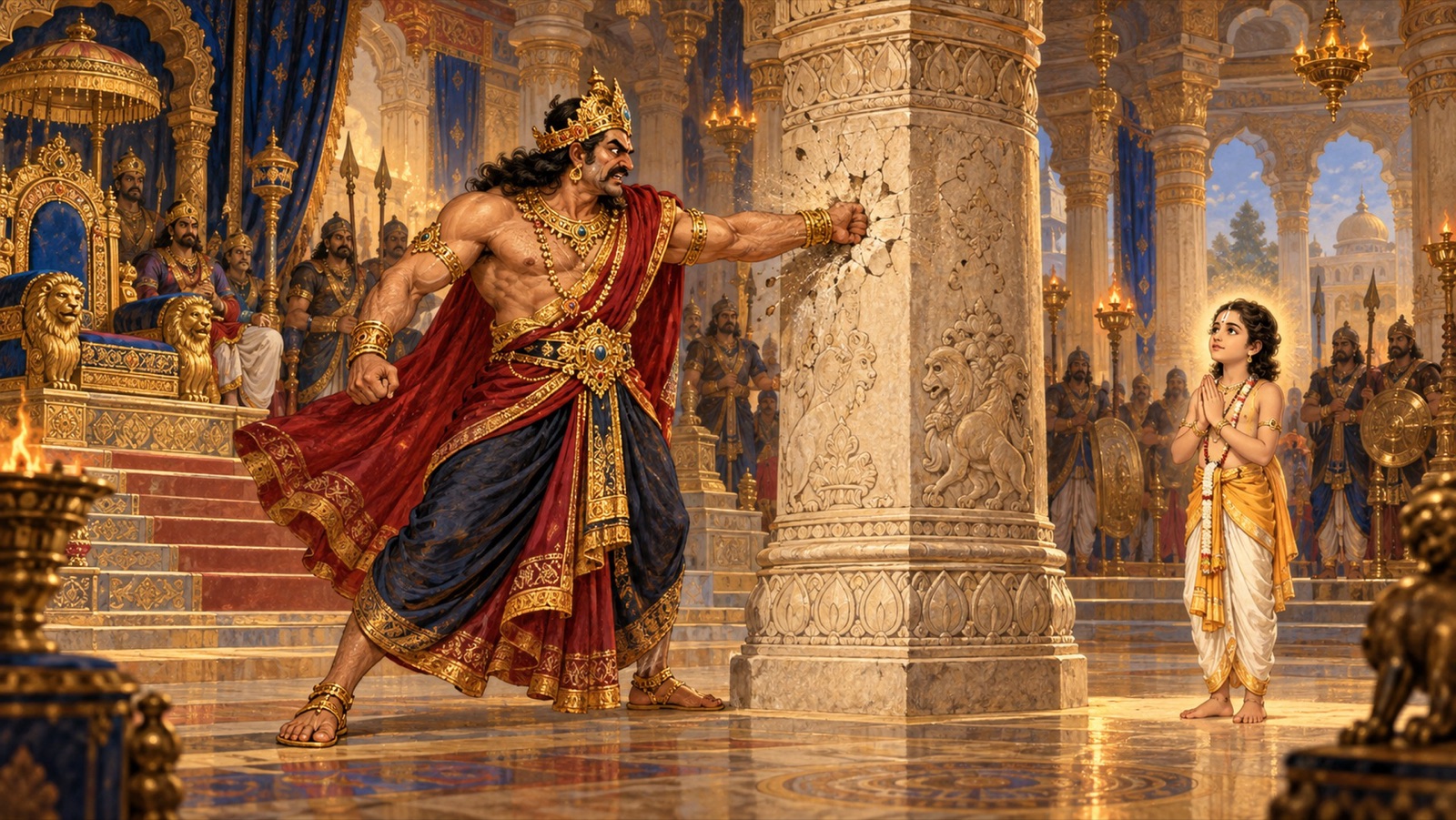
The Lord Appears
At once a terrible sound rang out from within the pillar, as if the very shell of the cosmos had cracked. To vindicate the words of His servant and His presence in all things, the Lord came forth from the pillar in a wondrous form that was neither beast nor man. Gazing all around, Hiranyakasipu beheld the strange being emerging before him and marvelled at what it could be:
स सत्त्वमेनं परितो विपश्यन् स्तम्भस्य मध्यादनुनिर्जिहानम् । नायं मृगो नापि नरो विचित्र- महो किमेतन्नृमृगेन्द्ररूपम् ॥ १८ ॥
sa sattvam enaṁ parito vipaśyan stambhasya madhyād anunirjihānam nāyaṁ mṛgo nāpi naro vicitram aho kim etan nṛ-mṛgendra-rūpam
Meaning: Looking intently on all sides, he beheld that being issuing from the midst of the pillar, neither beast nor man. “How wondrous,” he thought, “what strange form is this, of a man and a lion together?” (SB 7.8.18)
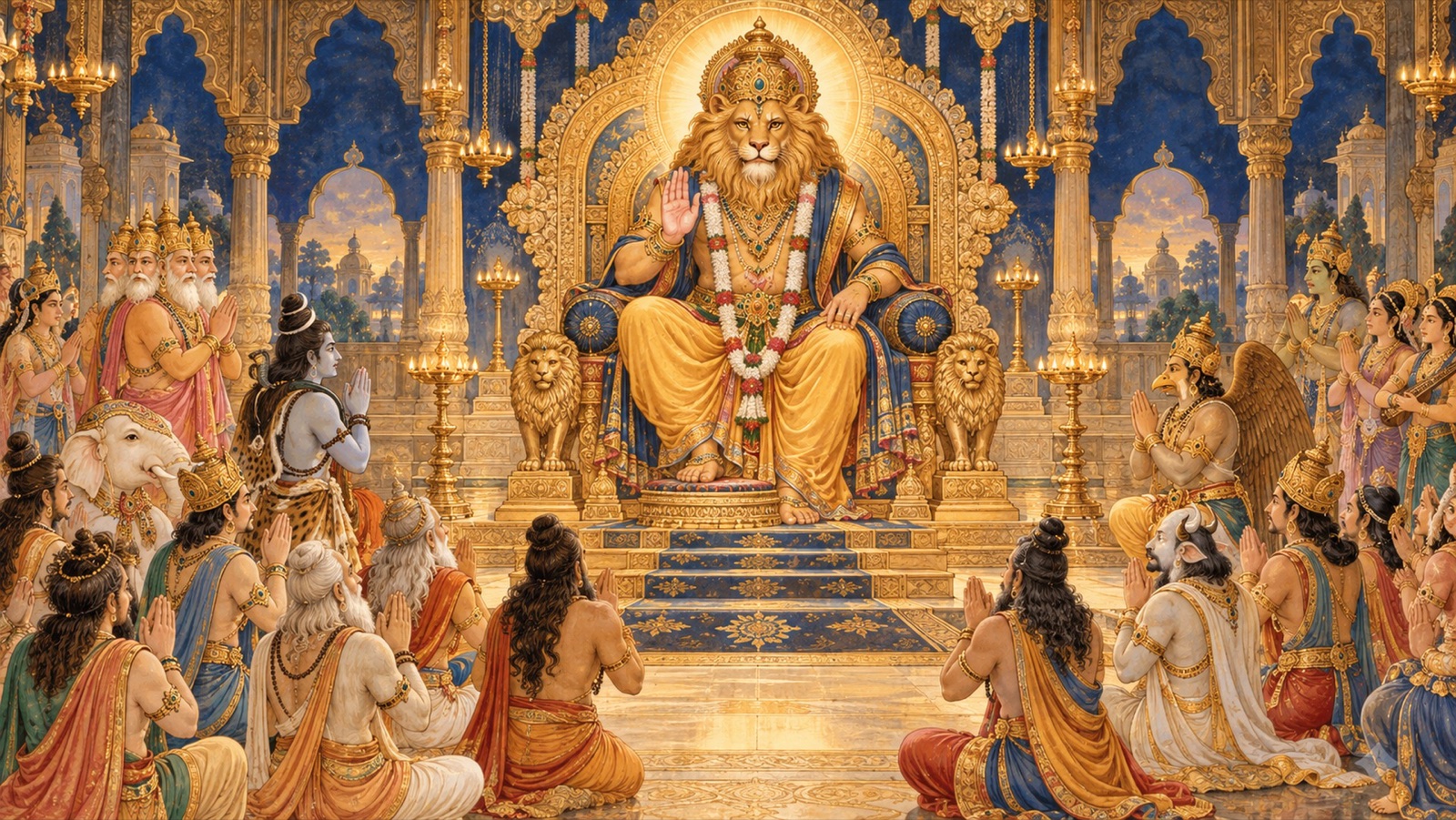
The Lord had appeared as Narasimha, the Man-Lion — radiant, majestic, and terrible to His enemy — precisely to fulfil the boon Hiranyakasipu had once won: that he could not be slain by man or beast, by day or by night, on the earth or in the sky, indoors or outdoors, by any weapon. In a form that was neither wholly man nor beast, the Lord had come.
The Fall of the Tyrant
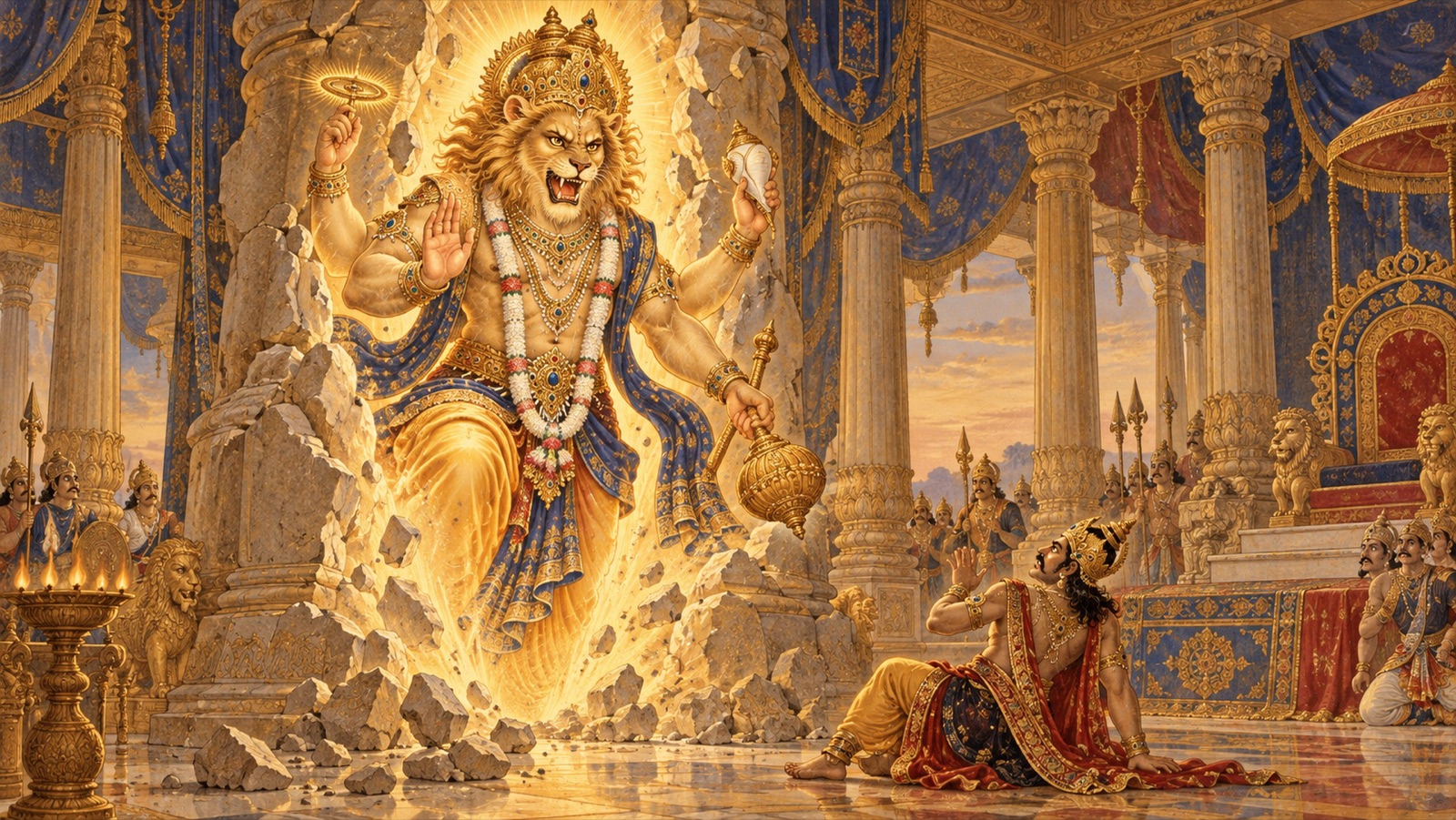
Roaring, the demon king seized his mace and rushed upon the Lord; but before that infinite splendour his strength was as a moth before a flame. The Lord caught him with ease, and at the threshold of the hall — neither inside nor outside — as the sun set at twilight — neither day nor night — He laid the demon across His lap — neither on earth nor in the sky — and with His nails — no weapon at all — brought the tyrant’s life to its end. Thus every condition of the boon was honoured, and the oppressor of the three worlds, who had terrorized gods, sages, and his own gentle son, was no more. Even in this the compassion of the Lord was at work: the demon, slain while gazing upon the divine form, was released from a long curse and lifted at last beyond his enmity.
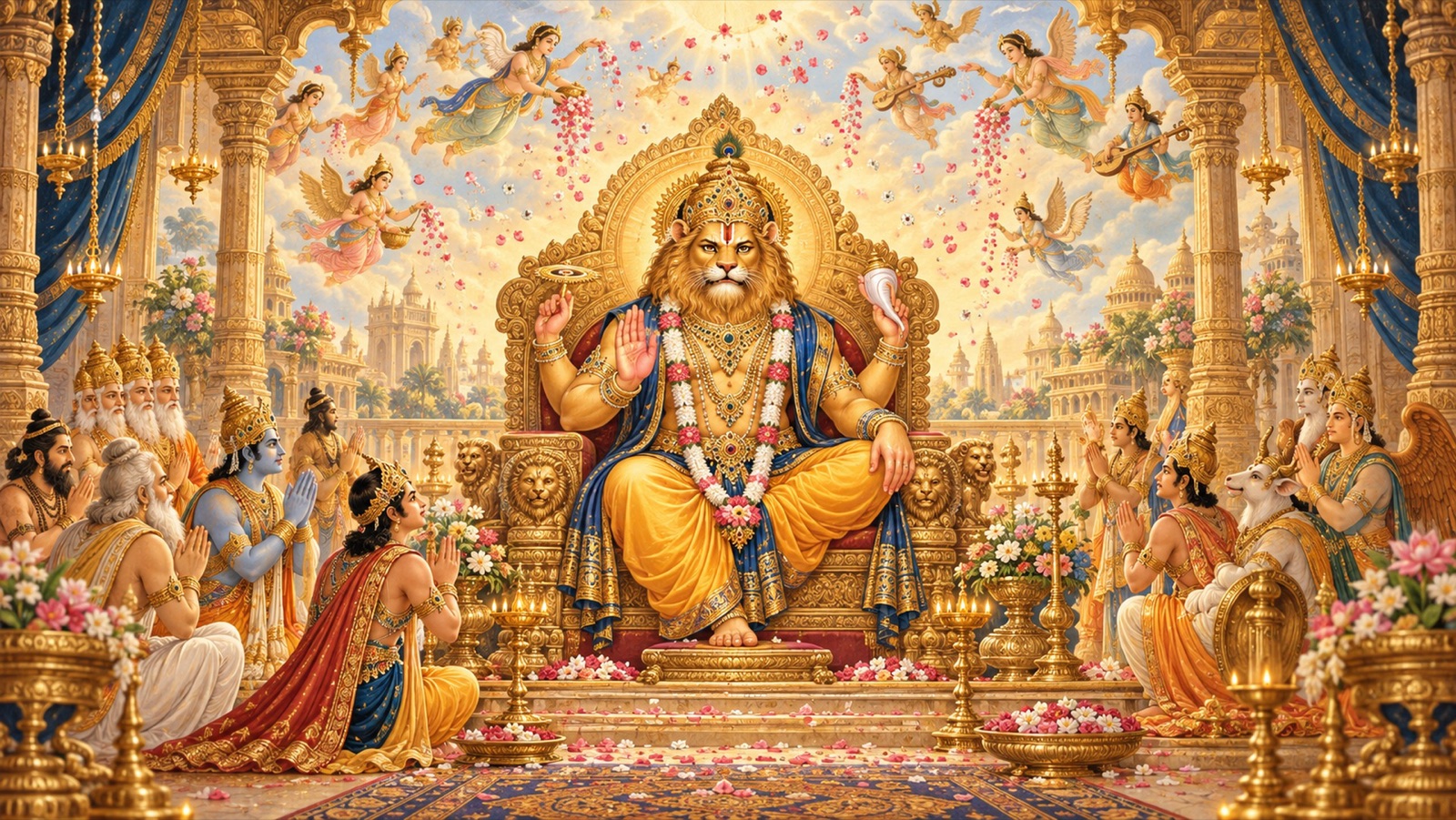
Yet after the deed the Lord remained wrathful, and none dared approach Him. He took His seat upon the royal throne, His anger not yet stilled, while from the heavens the celestial women rained down flowers, drums sounded, and the Gandharvas sang.
The Prayers of the Gods
Then the great ones of creation drew near, each offering praise from a little distance, palms joined upon their heads. Brahma bowed to the infinite Lord of wondrous power, whose potency none can fathom, who carries on creation, preservation, and dissolution through the modes of nature and yet remains unchanging. Rudra prayed that the Lord, His wrath now spent, would protect the devotee Prahlada who had taken refuge in Him. Indra gave thanks that the lotus of the heart, the Lord’s true abode, long usurped by the demon, had been restored. The sages, the manes, the Siddhas, the Vidyadharas, the Nagas, the Manus, the Prajapatis, the Gandharvas, and all the hosts of heaven each praised the Lord in turn, recalling how the tyrant had oppressed them and how the Lord had set them free. Last of all, the personal attendants of the Lord declared that this fierce form, a joy to all the world, had been assumed for the world’s good, and that even the demon’s death was an act of grace. It is a chorus of gratitude that gathers the whole of creation into thanksgiving.
Principal Teachings of This Chapter
1. The Lord is truly present everywhere. Hiranyakasipu’s mocking question is answered in the most direct way possible: the Lord appears from within the pillar. He is not confined to temple or heaven, but dwells in all things and can manifest wherever there is need (SB 7.8.12-18).
2. God keeps the word of His devotee. Prahlada had declared the Lord to be the strength of all and present everywhere; the Lord appears precisely to vindicate His servant’s faith. The devotee’s trust is never disappointed (SB 7.8.17-18).
3. No boon can shield one who opposes the divine will. Hiranyakasipu’s cleverly worded boon seemed to make him invincible, yet the Lord fulfilled every condition and still prevailed. Ingenuity against God only reveals its own limits (SB 7.8.19-29).
4. Even divine wrath is an outworking of a prior mercy. In their closing prayer, the Lord’s own attendants reveal that Hiranyakasipu was, in an earlier life, Jaya, a gatekeeper of Vaikuntha, whose fall into a demon’s body — and even his enmity toward the Lord — had been set in motion by a curse the Lord Himself permitted, so that a brief life of fierce opposition could return him home faster than years of ordinary worship (SB 7.8.56). Nothing in this chapter, then, is a contest between rival powers, or cruelty simply repaid with cruelty. The Man-Lion’s terrible form is mercy wearing its sternest face — proof that even the Lord’s fiercest enemies are never outside His care, only, for a season, cast in the role of opposing Him so that grace can reach them sooner.
A Devotional Reflection
It is worth noticing what actually summons the Lord in this chapter. It is not an elaborate ritual, nor a mountain of austerity, but a boy’s simple, unwavering conviction — repeated even in the face of death — that God is the strength of all beings and is present everywhere. When that faith is challenged, the Lord answers not with an argument but with His own presence. There is great comfort in this for us. We may feel that God is far away, hidden behind the pillars of ordinary life; but the story insists that He is nearer than we imagine, present in the very things we look at without seeing. The chapter also gives us a mature picture of the divine: the same Lord who is infinitely gentle to the humble is fierce toward cruelty and oppression, and even that fierceness is a form of love — protecting the helpless and, in the end, releasing even the one it strikes down. To take refuge in such a Lord is to be safe on every side.
A Daily Devotional Practice
Today, practise Prahlada’s confidence in the nearness of God. When some fear or difficulty rises before you like an immovable pillar, pause, place your trust in the Lord who is present within it and within you, and quietly say: “Om Namo Bhagavate Vasudevaya.” Let this be a small act of the same faith that called forth Narasimha — a reminder that the Lord is never absent, and that those who take shelter in Him are protected in ways they cannot foresee.
Conclusion
The eighth chapter of the Seventh Canto rests on one towering assurance: the Lord is truly present everywhere, and He never fails the devotee who trusts Him without reserve. Hiranyakasipu’s carefully worded boon, meant to place him beyond every danger, could not stand for a moment against the Lord’s will, for cleverness turned against grace only exposes its own limits. May Prahlada’s simple, unwavering faith become our own, so that whatever pillar of fear or doubt stands before us, we remember that the Lord we cannot always see is, in truth, never absent.
May the divine wisdom of Srimad Bhagavatam awaken pure devotion within our hearts.
Om Namo Bhagavate Vasudevaya.
Jay Shree Madhav.
References and Attribution
- Primary edition: Gita Press, Śrīmad Bhāgavata Mahāpurāṇa (English, complete), Book Seven, Discourse 8, pages 681–688.
- Series: Srimad Bhagavatam Wisdom · Biswa Sanatan Dharma Seva Trust.
- Presented following the spiritual guidance and recommendation of Pandit Dr. Shri Kashinath Mishra.
This is an original, faithful retelling in the writer’s own words, with brief quoted verses shown in Devanāgarī and transliteration and their meanings given as summaries. It is not a reproduction of any single publisher’s continuous translation or commentary. No affiliation with or endorsement by any publisher is implied.
Jay Shree Madhav