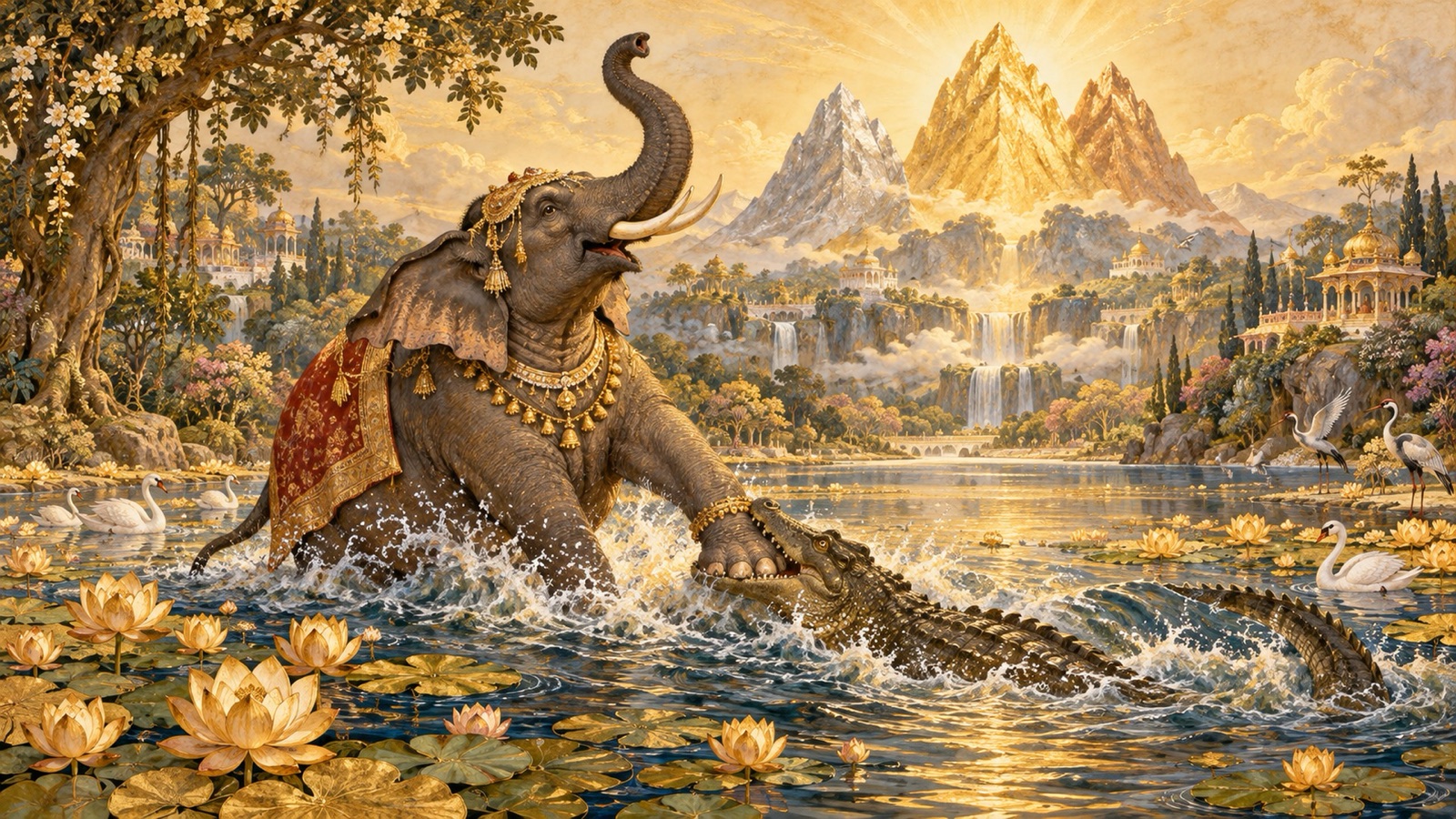
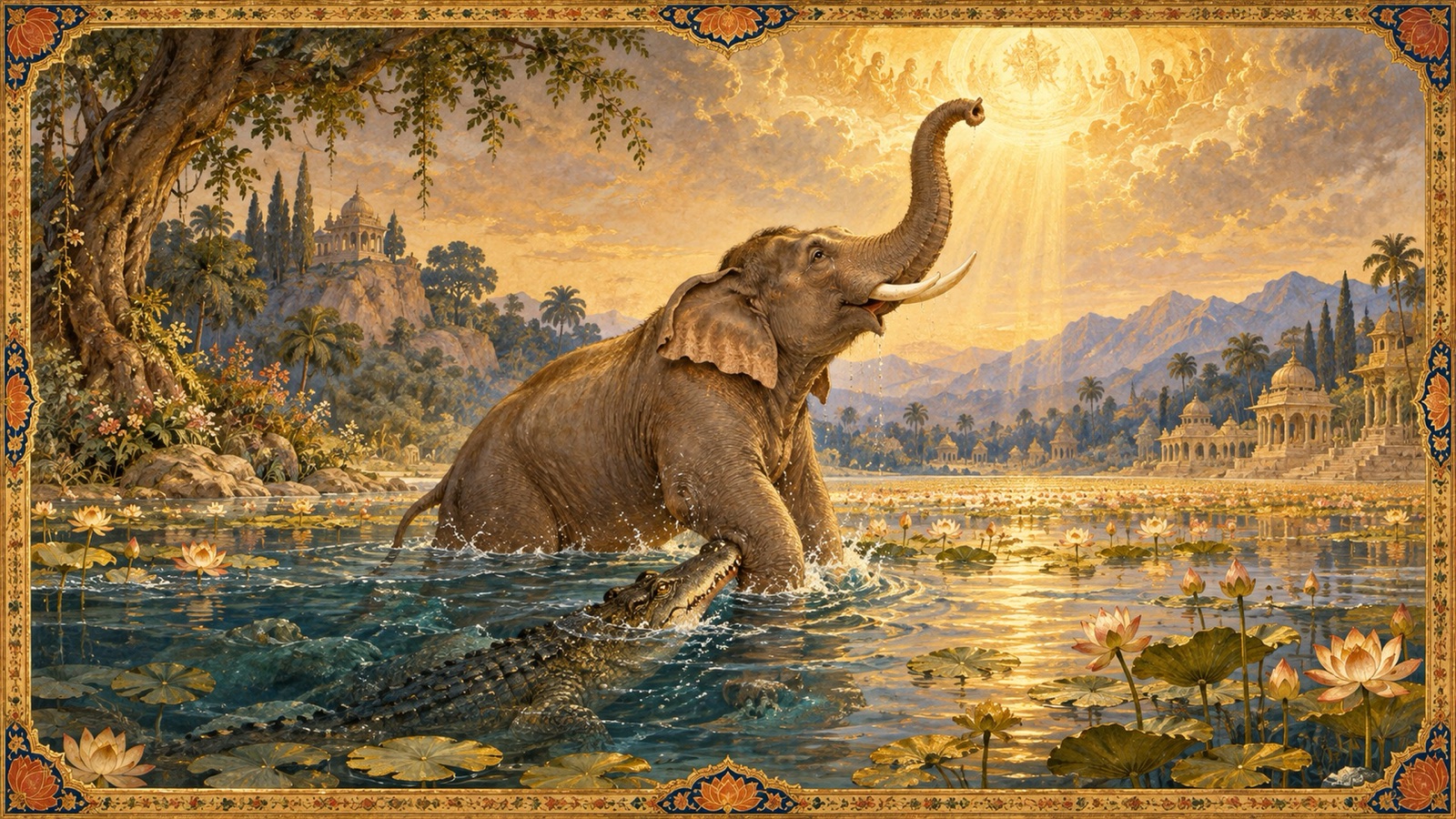
In a lake of golden lotuses at the foot of a shining mountain, the mightiest of elephants is seized by an alligator — and a thousand-year struggle begins that will end only when the great beast turns, at last, to God.
Om Namo Bhagavate Vasudevaya.
Om Namo Bhagavate Vasudevaya.
Om Namo Bhagavate Vasudevaya.
Welcome back to Srimad Bhagavatam Wisdom, a devotional journey through the sacred histories and teachings of the Srimad Bhagavat Mahapurana. In this second chapter of the Eighth Canto, Sukadeva Gosvami opens one of scripture’s most beloved stories — the crisis of Gajendra, king of the elephants, whose worldly supports will fail one by one until only surrender to the Lord remains.
Chapter Information
- Scripture: Śrīmad Bhāgavata Mahāpurāṇa
- Canto: 8 (Book Eight)
- Chapter: 2 (Discourse 2)
- Chapter title: The Elephant Gajendra’s Crisis
- Principal speaker: Sukadeva Gosvami, narrating to King Parikshit — the whole related by Suta Gosvami to the sages at Naimisharanya
- Principal listener: King Parikshit
- Main setting: Mount Trikuta in the Ocean of Milk; the garden and lake of Varuna upon its slopes
- Central subject: The king of the elephants, seized by an alligator, struggles in vain until he resolves to seek shelter in the Supreme Lord
- Principal verse range: Canto 8, Chapter 2, verses 1–33
- Primary edition: Gita Press Śrīmad Bhāgavata Mahāpurāṇa
Context From the Previous Chapter
In the first discourse, Sukadeva described the succession of Manus and the Lord’s descent in every age to protect the righteous, mentioning that in the fourth Manvantara the Lord appeared as Sri Hari, “by whom the king of the elephants was delivered from the alligator’s grip.” King Parikshit begged to hear that story in full, and Sukadeva, pleased by the fasting king’s earnest request, joyfully began — the promise this chapter now takes up.
The Shining Mountain in the Ocean of Milk
Sukadeva begins by painting the setting on a grand scale. In the Ocean of Milk there rises a great mountain named Trikuta, ten thousand yojanas high, encircled on every side by the milky sea. It has three principal peaks — one of silver, one of iron, and one of gold — and countless lesser peaks bright with jewels and minerals, adorned with trees and creepers and the murmuring music of its cascading streams.
श्रीशुक उवाच आसीद् गिरिवरो राजंस्त्रिकूट इति विश्रुत: । क्षीरोदेनावृत: श्रीमान्योजनायुतमुच्छ्रित: ॥ १ ॥
śrī-śuka uvāca āsīd girivaro rājaṁs trikūṭa iti viśrutaḥ kṣīrodenāvṛtaḥ śrīmān yojanāyutam ucchritaḥ
Meaning: Sukadeva said: O King, there was a lordly mountain named Trikuta, ten thousand yojanas in height, surrounded on all sides by the Ocean of Milk. (Canto 8, Chapter 2, verse 1)
Its caves resound with the songs of Siddhas, Gandharvas, and celestial beings; its valleys shelter herds of wild creatures; and its gardens ring with the sweet warble of birds. Here is a paradise so perfect that it seems no sorrow could ever touch it — and it is precisely here that sorrow will strike, reminding us that no earthly beauty, however heavenly, is beyond the reach of danger.

Varuna’s Garden and the Lake of Golden Lotuses
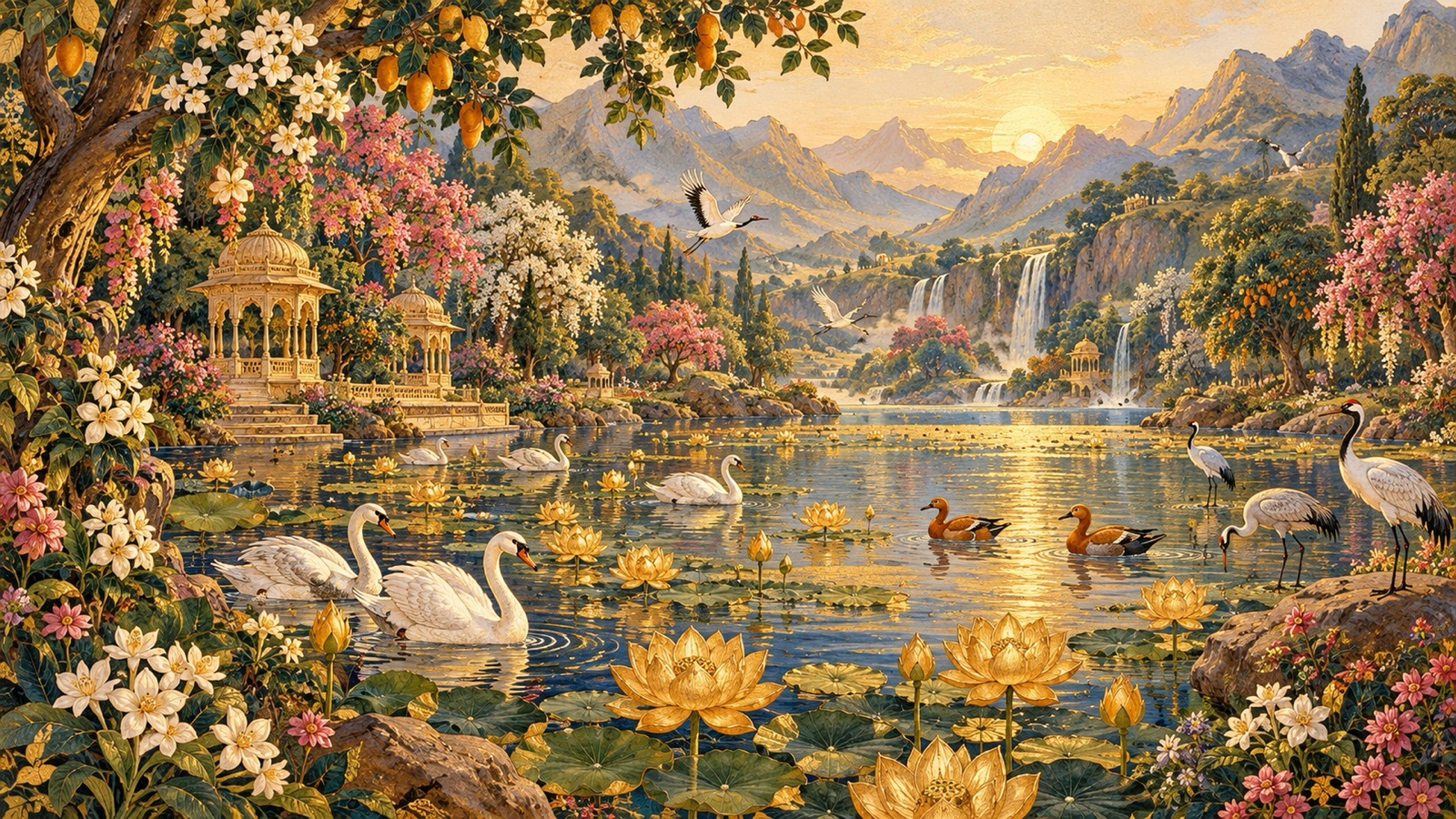
In a valley of that mountain lies a celestial garden called Rtuman, belonging to Varuna, the god of the waters, and beloved of the celestial ladies who sport there. It is graced on every side with heavenly trees ever laden with flowers and fruit — mango and coral, sandal and asoka, plantain and date-palm and a hundred more. At its heart lies a vast lake studded with golden lotuses, its waters resonant with the humming of intoxicated bees, alive with swans and ruddy geese and cranes, fragrant with pollen, and fringed with fragrant blossoms of every season.
The King of Elephants Comes to the Lake
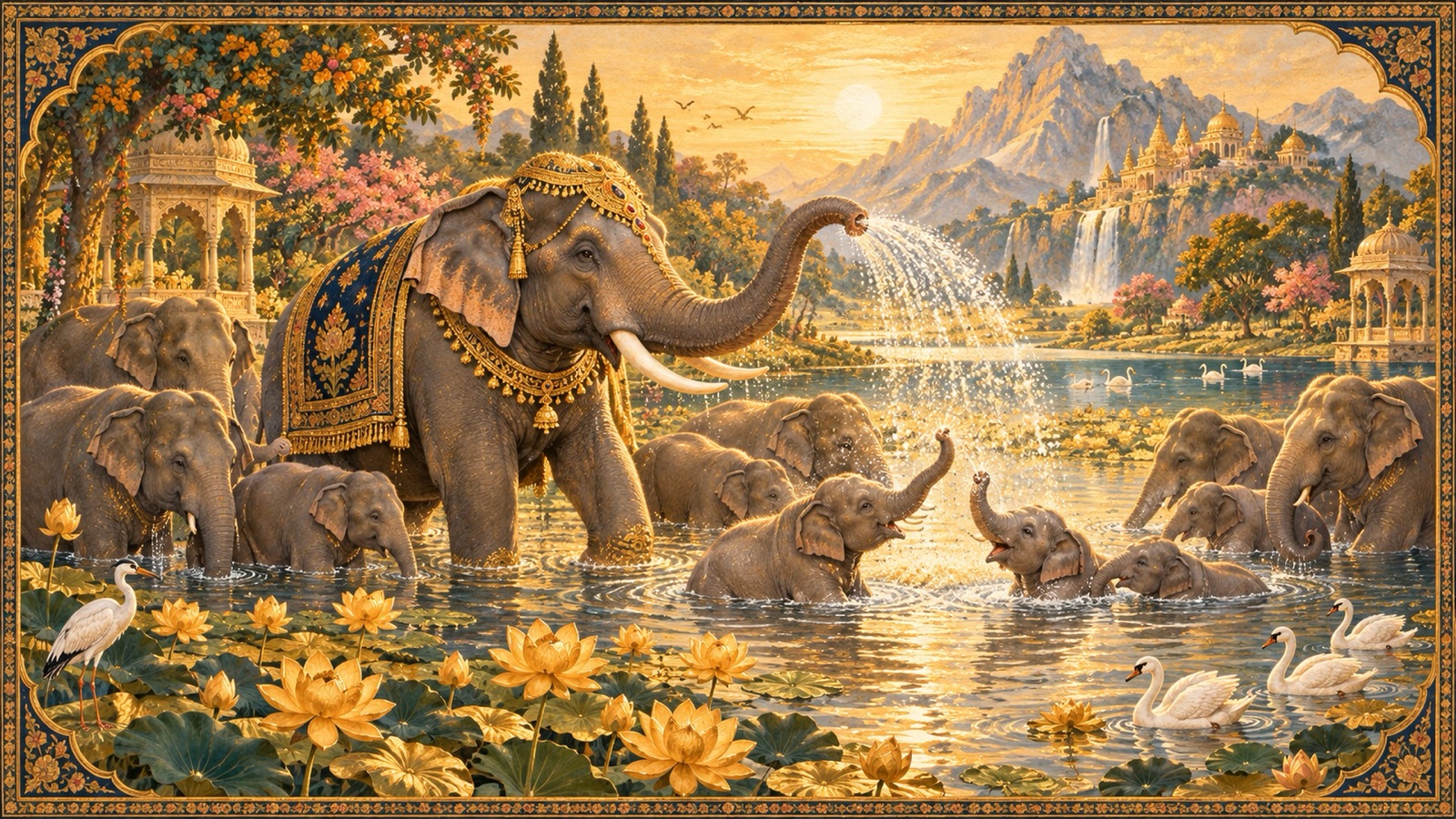
Into this garden one day comes the leader of a herd of elephants, master of the mountain forest, roaming with his many companions and breaking through thickets of bamboo and thorn. So mighty is he that at the mere scent of him, lions and tigers, rhinoceroses and serpents, and even the fabled sarabhas flee in fear, while the weaker creatures wander unharmed by his sufferance. Surrounded by his herd and their young, oppressed by heat and thirst, he catches from afar the cool, lotus-scented breeze off the lake and rushes toward it. Plunging in, he bathes, drinks the clear nectar-like water to his fill, and lovingly sprays his companions and their calves with water drawn up in his trunk — caring for his herd like a devoted householder, yet, deluded by the Lord’s illusory power, blind to the danger drawing near.
The Alligator’s Grip
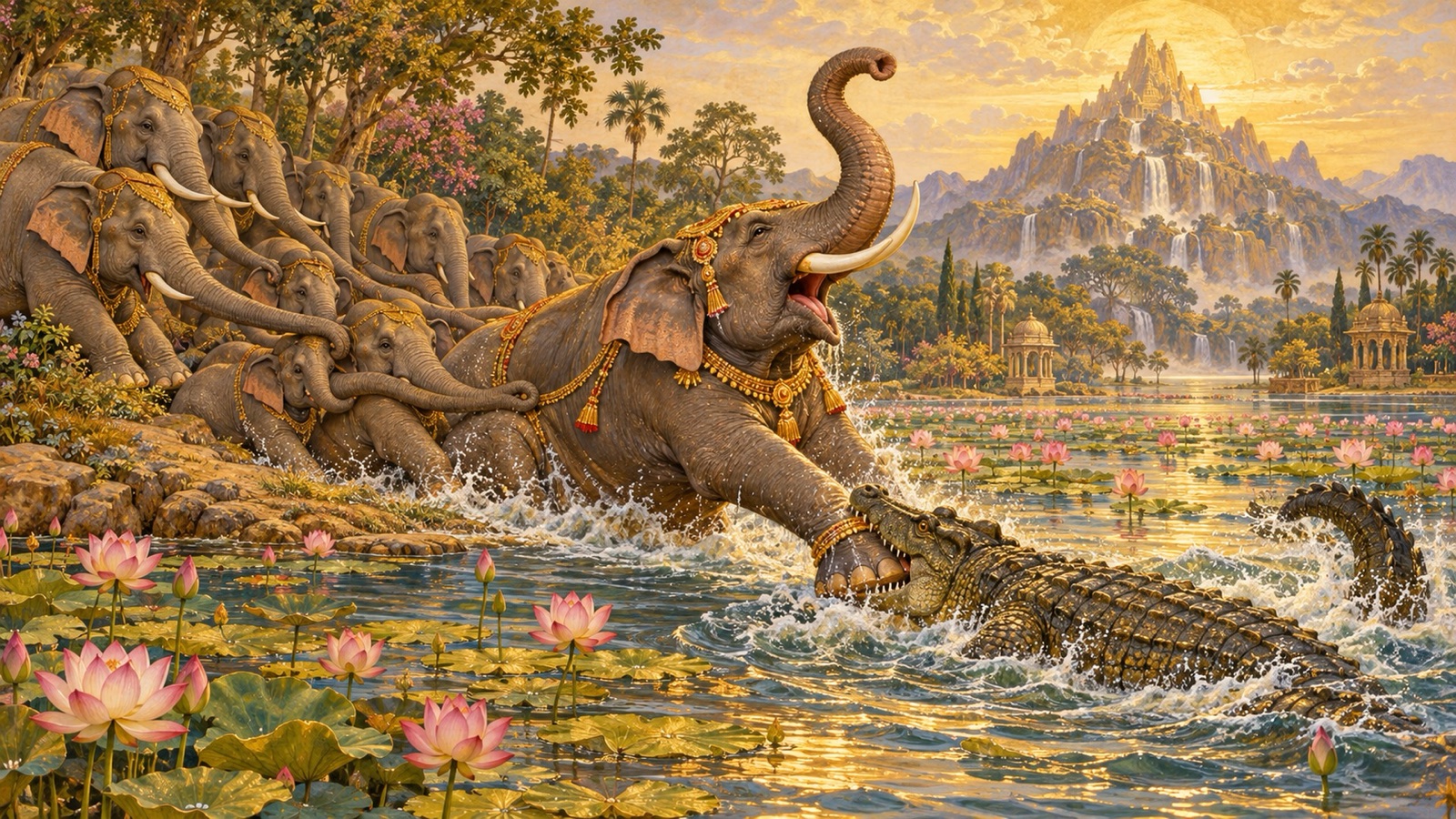
Then, directed by destiny, a powerful alligator seizes the elephant by the foot. The great beast, fallen suddenly into adversity by the will of Providence, struggles with all his strength to break free.
तं तत्र कश्चिन्नृप दैवचोदितो ग्राहो बलीयांश्चरणे रुषाग्रहीत् । यदृच्छयैवं व्यसनं गतो गजो यथाबलं सोऽतिबलो विचक्रमे ॥ २७ ॥
taṁ tatra kaścin nṛpa daiva-codito grāho balīyāṁś caraṇe ruṣāgrahīt yadṛcchayaivaṁ vyasanaṁ gato gajo yathā-balaṁ so ’tibalo vicakrame
Meaning: O King, by the arrangement of destiny a mighty alligator angrily seized the elephant by the leg in the water. Thus caught in calamity, the powerful elephant struggled with all his might to free himself. (Canto 8, Chapter 2, verse 27)
The female elephants, seeing their leader dragged away, can only shriek in helpless grief; the other bulls try with all their strength to pull him back from behind, but cannot loosen the alligator’s hold. And so, one pulling from the water and the other from the land, elephant and alligator contend — and a thousand years roll by, a struggle so strange that even the gods look on in wonder.
A Thousand Years, and the Turning of the Heart
As the years pass, the balance shifts. Dragged endlessly through the water, far from his food and his strength, the king of elephants begins to fail; while the alligator, at home in the water and nourished by it, only grows stronger. At last the great beast — who had always looked upon his body as his very self — comes face to face with death and finds himself utterly powerless. He ponders long, and arrives at a conclusion that changes everything: his kinsmen and companions, for all their love, cannot save him; and if the strong bulls cannot, how could the females? Entrapped in the snare of Providence, he resolves that even he, a mere beast, will flee for protection to the Supreme Lord, the ultimate refuge of all.
य: कश्चनेशो बलिनोऽन्तकोरगात् प्रचण्डवेगादभिधावतो भृशम् । भीतं प्रपन्नं परिपाति यद्भया- न्मृत्यु: प्रधावत्यरणं तमीमहि ॥ ३३ ॥
yaḥ kaścaneśo balino ’ntakoragāt pracaṇḍa-vegād abhidhāvato bhṛśam bhītaṁ prapannaṁ paripāti yad-bhayān mṛtyuḥ pradhāvaty araṇaṁ tam īmahi
Meaning: There is surely some Supreme Lord who protects the frightened soul who surrenders to Him from the mighty serpent of death rushing on with terrible speed — the Lord from fear of whom Death himself flees. Let us take shelter of Him. (Canto 8, Chapter 2, verse 33)
With these words the chapter turns from despair to hope. The elephant’s worldly supports have all fallen away, and in their absence the one true support is revealed. His crisis has become the doorway to his prayer — the great hymn that the next chapter will unfold.
Principal Teachings of This Chapter
1. No worldly beauty or strength is beyond the reach of danger. Even the strongest of beasts, one whose mere scent sent lions fleeing, is seized without warning at the water’s edge. The chapter gently punctures our confidence in position, power, and pleasant surroundings (verses 20-27).
2. Family and friends have their limits. The elephant’s herd loves him and strains to save him, yet cannot. Human relationships are precious, but they cannot deliver us from death; recognizing this is the beginning of wisdom (verses 28, 32).
3. Crisis can be the birthplace of surrender. It is only when every other hope is exhausted that the king of elephants turns to the Lord. Adversity, painful as it is, can strip away our illusions and lead us to our true refuge (verses 31-33).
4. Even a beast can take shelter of God. That an animal, not a sage or a king, becomes the hero of this story tells us that the door of divine refuge is open to every soul, however lowly it may seem. Sincerity, not status, is what the Lord answers (verse 33).
5. Attachment to the body invites suffering. The elephant suffers most because he “looked upon the body alone as his self.” His awakening begins when he looks beyond the body to the Lord who is the refuge even of the dying (verses 30-31).
6. The trial itself is Providence’s mercy. Sukadeva names the same power twice: it is “by the arrangement of providence” that the alligator seizes the elephant’s leg (verse 27), and it is “by the will of providence” that the elephant, reflecting, understands his ordeal (verse 32). The very blindness that let him wade in unaware, “deluded by the Lord’s illusory power” (verse 26), is broken by the same higher will that sent the danger. Read rightly, the crisis is not a random misfortune striking an unlucky beast — it is providence’s own method of returning a proud soul, however unwillingly, to its one true shelter. What feels like calamity is mercy wearing a fierce face.
A Devotional Reflection
There is something almost unbearable, and yet deeply comforting, in the image of that great elephant sinking slowly in the water while his family stands helpless on the shore. It is a picture of every soul caught in the grip of time. We too are strong for a season; we too are surrounded by those who love us; and we too will one day discover that no strength and no love of ours can loosen the grip of death. The Bhagavata does not tell this story to frighten us but to redirect us. The elephant’s greatness was never in his tusks or his herd — it was in the moment he stopped struggling on his own terms and cried out for the One who is stronger than death. That cry is available to us at any moment, in any crisis, long before the water rises. We need not wait a thousand years. The refuge the elephant found at the end of his strength is the same refuge waiting quietly at the center of ours.
A Daily Devotional Practice
Today, call to mind one worldly support you quietly depend on — your health, your work, a relationship, your own capability — and gently offer it back to the Lord, acknowledging that He, not it, is your true shelter. Repeat softly: “Om Namo Bhagavate Vasudevaya.” Let the elephant’s discovery become yours before the crisis comes: that the Supreme Lord is the one refuge that never fails, the protector even of those from whom every other help has fallen away.
Conclusion
The second discourse of the Eighth Canto sets the stage for one of scripture’s tenderest dramas. From the shining peaks of Trikuta and the golden-lotus lake of Varuna’s garden, to the sudden seizing of the king of elephants and the long, exhausting struggle that follows, every scene moves toward a single moment: the great beast’s realization that his only hope is the Supreme Lord. Here the Bhagavata teaches, through the plight of an animal, the universal truth that all worldly supports fail and only surrender to God endures. With the elephant’s heart now turned toward the divine, the stage is set for the immortal prayer of Gajendra that fills the next chapter.
May the divine wisdom of Srimad Bhagavatam awaken pure devotion within our hearts.
Om Namo Bhagavate Vasudevaya.
Jay Shree Madhav.
References and Attribution
- Primary edition: Gita Press, Śrīmad Bhāgavata Mahāpurāṇa (English, complete), Book Eight, Discourse 2, pages 738–740.
- Series: Srimad Bhagavatam Wisdom · Biswa Sanatan Dharma Seva Trust.
- Presented following the spiritual guidance and recommendation of Pandit Dr. Shri Kashinath Mishra.
This is an original, faithful retelling in the writer’s own words, with brief quoted verses shown in Devanāgarī and transliteration and their meanings given as summaries. It is not a reproduction of any single publisher’s continuous translation or commentary. No affiliation with or endorsement by any publisher is implied.
Jay Shree Madhav