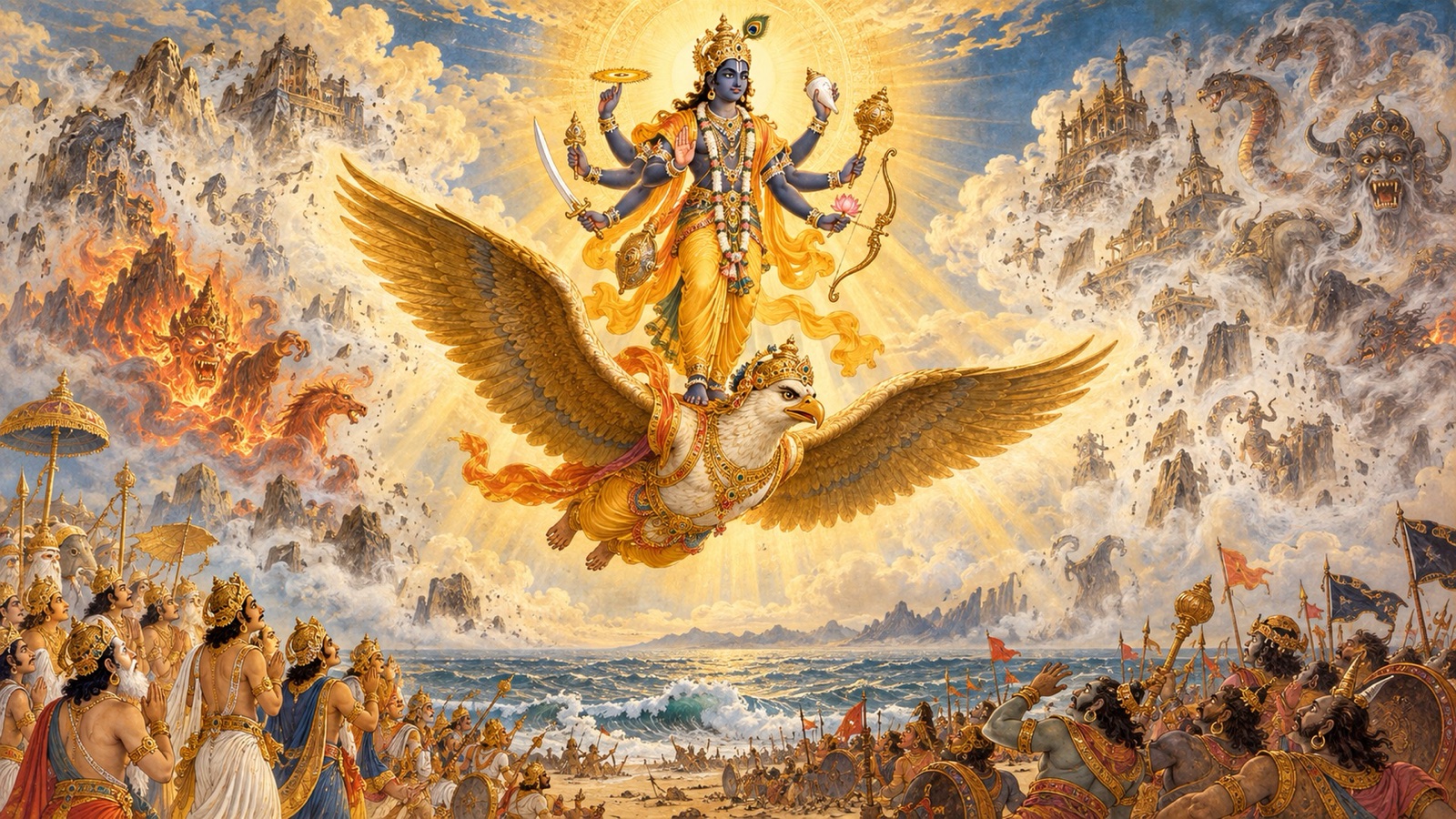
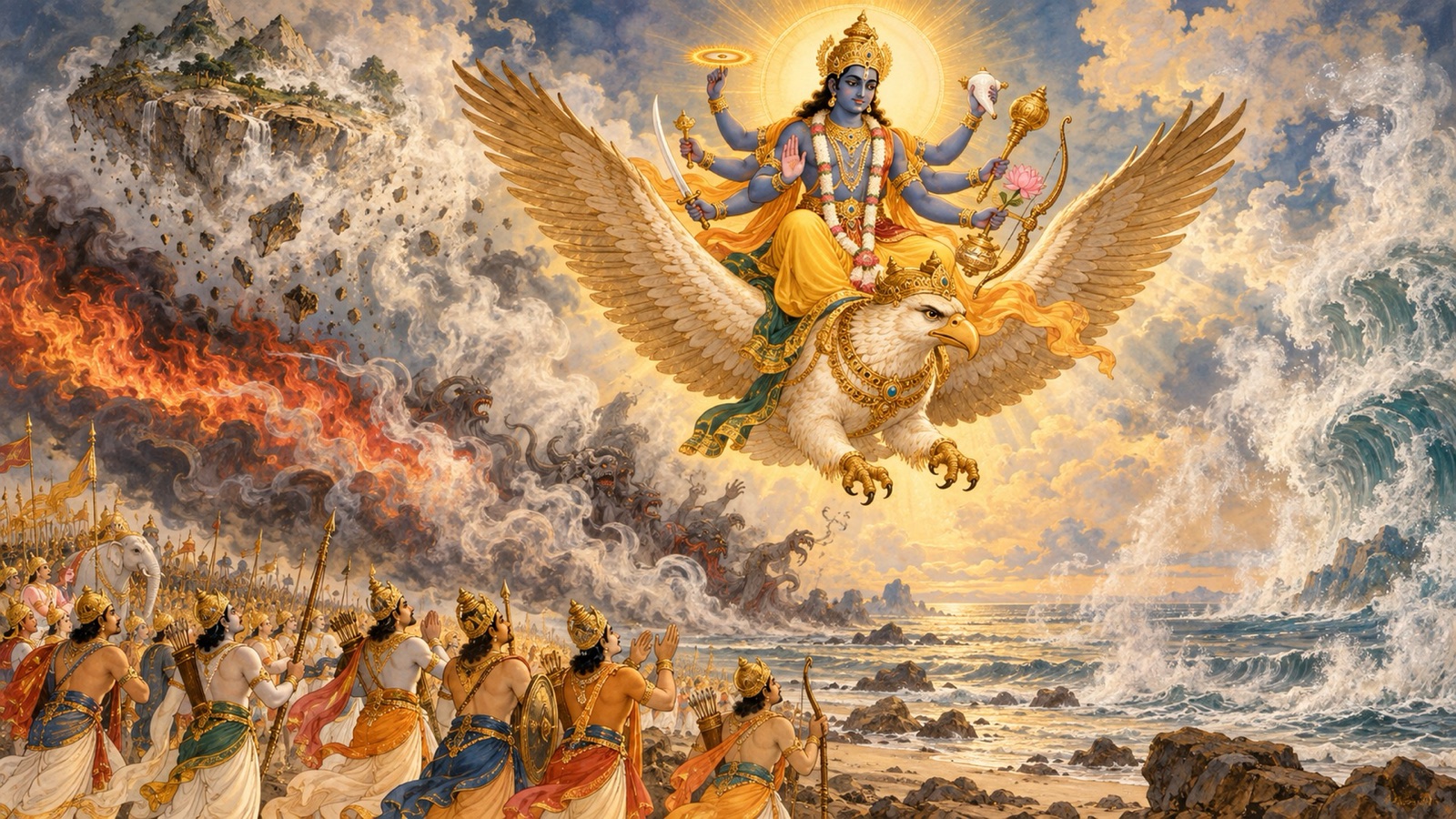
When the demons’ conjured illusions overwhelm the celestial army — mountains, fire, and floods rising out of nowhere — the gods remember the Lord. At once He appears, eight-armed upon Garuda, and the illusions vanish like a dream at waking.
Om Namo Bhagavate Vasudevaya.
Om Namo Bhagavate Vasudevaya.
Om Namo Bhagavate Vasudevaya.
Welcome back to Srimad Bhagavatam Wisdom, a devotional journey through the sacred histories and teachings of the Srimad Bhagavat Mahapurana. With the nectar of immortality won by the gods and denied to the demons, the uneasy alliance of the great churning collapses into open war on the seashore. At the heart of this tenth discourse of the Eighth Canto lies a single, luminous truth: that when human strength and stratagem fail utterly, the remembrance of the Lord dispels every danger, as waking dissolves a dream.
Chapter Information
- Scripture: Śrīmad Bhāgavata Mahāpurāṇa
- Canto: 8 (Book Eight)
- Chapter: 10 (Discourse 10)
- Chapter title: The Battle Between the Gods and the Demons
- Principal speaker: Sukadeva Gosvami, narrating to King Parikshit
- Principal listener: King Parikshit
- Main setting: The seashore near the Ocean of Milk, the field of battle
- Central subject: The outbreak of war between the gods and the demons after the churning; the demons’ magical illusions; the manifestation of the Lord, who dispels the illusions and protects the gods
- Principal verse range: Canto 8, Chapter 10, verses 1–57
- Primary edition: Gita Press Śrīmad Bhāgavata Mahāpurāṇa
Context From the Previous Chapter
In the ninth discourse, the Lord in His enchanting form delivered the nectar of immortality to the gods and denied it to the demons, and the disguised Rahu was beheaded. Sukadeva concluded that the gods triumphed because they took shelter at the Lord’s lotus feet. This chapter takes up what followed: robbed of the nectar and consumed by envy, the demons take up arms against the gods.
The Demons March and the Battle Begins
Because they had turned their faces away from Lord Vasudeva, Sukadeva tells King Parikshit, the demons could not obtain the nectar, even though they had laboured united and hard for it.
श्रीशुक उवाच इति दानवदैतेया नाविन्दन्नमृतं नृप । युक्ता: कर्मणि यत्ताश्च वासुदेवपराङ्मुखा: ॥ १ ॥
śrī-śuka uvāca iti dānava-daiteyā nāvindann amṛtaṁ nṛpa yuktāḥ karmaṇi yattāś ca vāsudeva-parāṅmukhāḥ
Meaning: Sri Suka said: In this way, O king, the demons — though united and diligent in their work — did not obtain the nectar, because they had turned their faces away from Lord Vasudeva. (Canto 8, Chapter 10, verse 1)
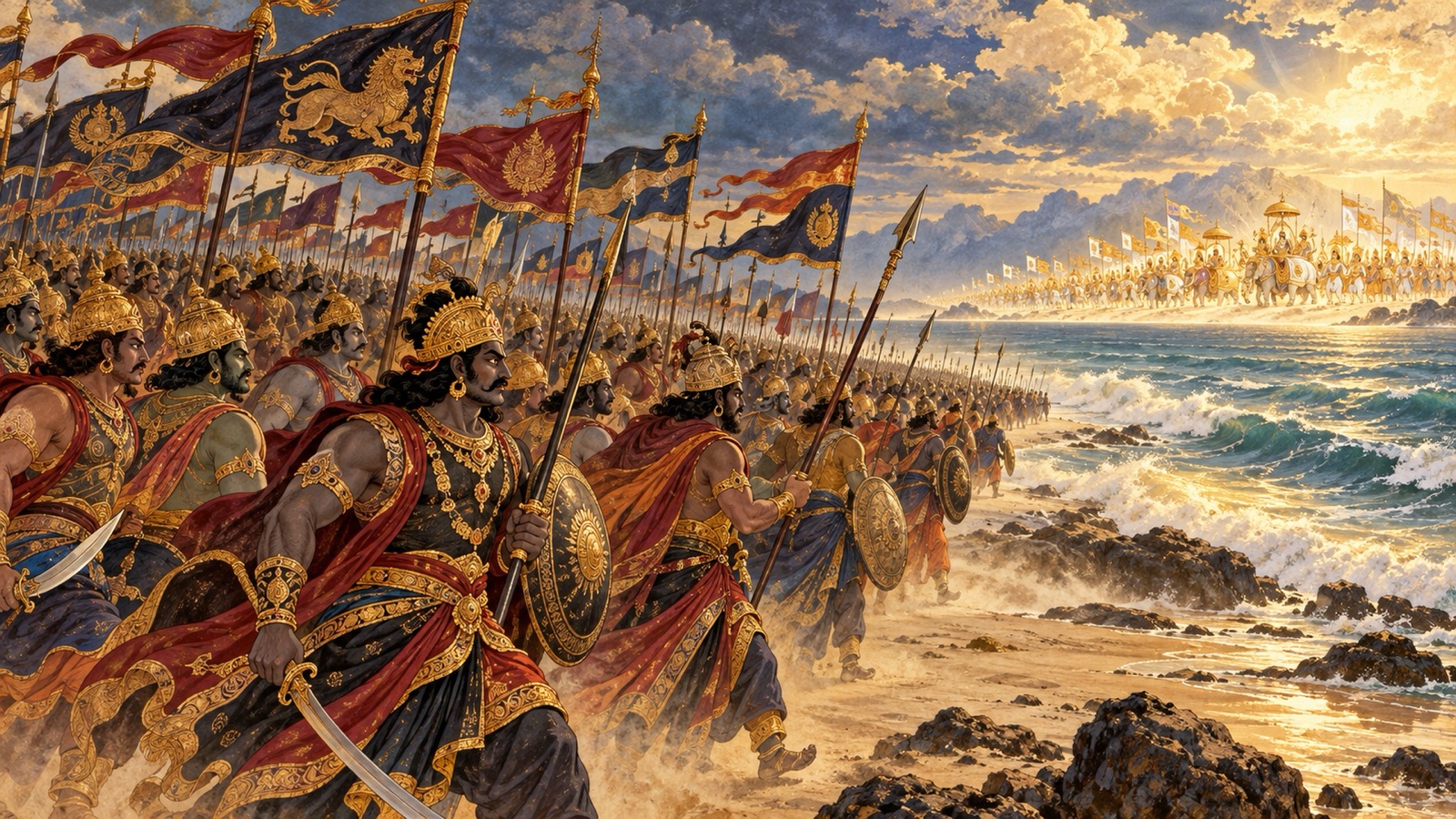
Having enabled the gods to drink the nectar, the Lord mounted Garuda and departed as all beings gazed after Him. Then the demons, unable to bear the great fortune of their rivals and burning with envy, marched upon the gods with weapons raised.
Reinvigorated by the Nectar, the Gods Take Shelter
The gods, strengthened by the nectar they had drunk, did not meet the assault with pride in their own power. They took shelter at the feet of Lord Narayana and offered a united resistance.
तत: सुरगणा: सर्वे सुधया पीतयैधिता: । प्रतिसंयुयुधु: शस्त्रैर्नारायणपदाश्रया: ॥ ४ ॥
tataḥ sura-gaṇāḥ sarve sudhayā pītayaidhitāḥ pratisaṁyuyudhuḥ śastrair nārāyaṇa-padāśrayāḥ
Meaning: Then all the gods, strengthened by the nectar they had drunk and taking shelter at the feet of Lord Narayana, fought back with their weapons. (Canto 8, Chapter 10, verse 4)
There on the seashore raged a dreadful, hand-to-hand conflict, the famous battle between the gods and the demons. With minds full of rage, the two hosts met at close quarters, striking one another with swords, arrows, and every kind of weapon, amid the thunder of conches, drums, trumpeting elephants, neighing horses, and rattling chariots. Warrior met warrior, chariot met chariot, and the two armies — arrayed with bright banners of many colours, white umbrellas, waving chowries, gleaming armour, and burnished weapons flashing in the sun — shone like two great oceans meeting.
The Champions Meet in Single Combat
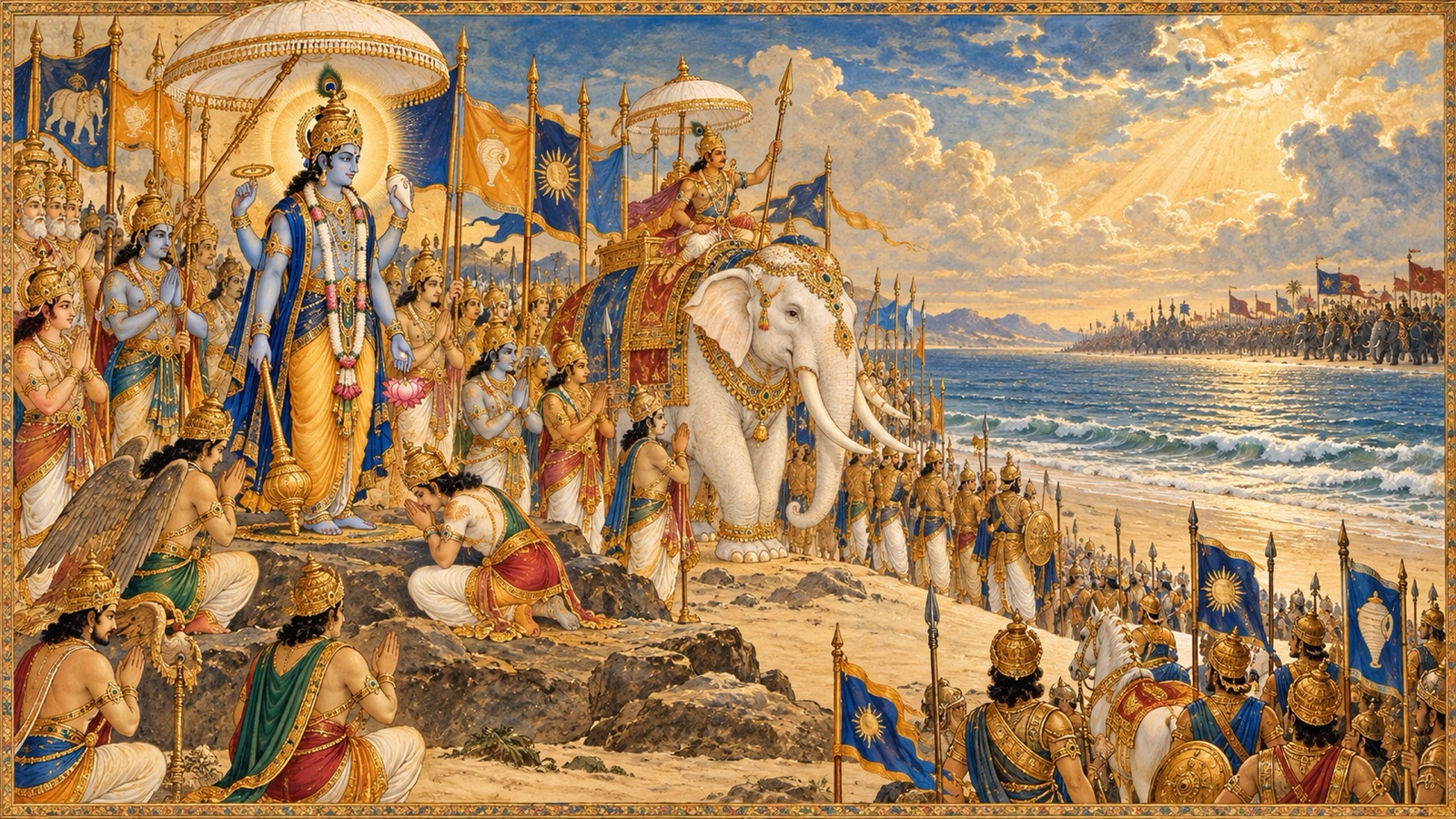
Leading the demon forces as commander-in-chief was the mighty Bali, son of Virochana, seated in his wondrous aerial car Vaihayasa, surrounded by his troop-commanders. About him ranged the great demon generals — Namuci, Shambara, Bana, Viprachitti, and many more — who, having received no share of the nectar for all their toil, roared like lions and blew their conches. Seeing his foes so filled with pride, Indra grew enraged; mounted upon the great elephant Airavata, and encircled by the guardians of the worlds — Vayu, Agni, Varuna, and the rest — he shone like the sun rising over the eastern hill.
Then the champions closed in single combat, pair against pair: Bali contended with Indra; Varuna with Heti; Yama with Kalanabha; the sun-god with the sons of Bali; the moon-god with Rahu; and Lord Siva with Jambha. Approaching one another with challenges and cutting words, the leaders of both hosts struck with sharp arrows, swords, and iron clubs, each eager to prevail.
Bali’s Illusions and the Despair of the Gods
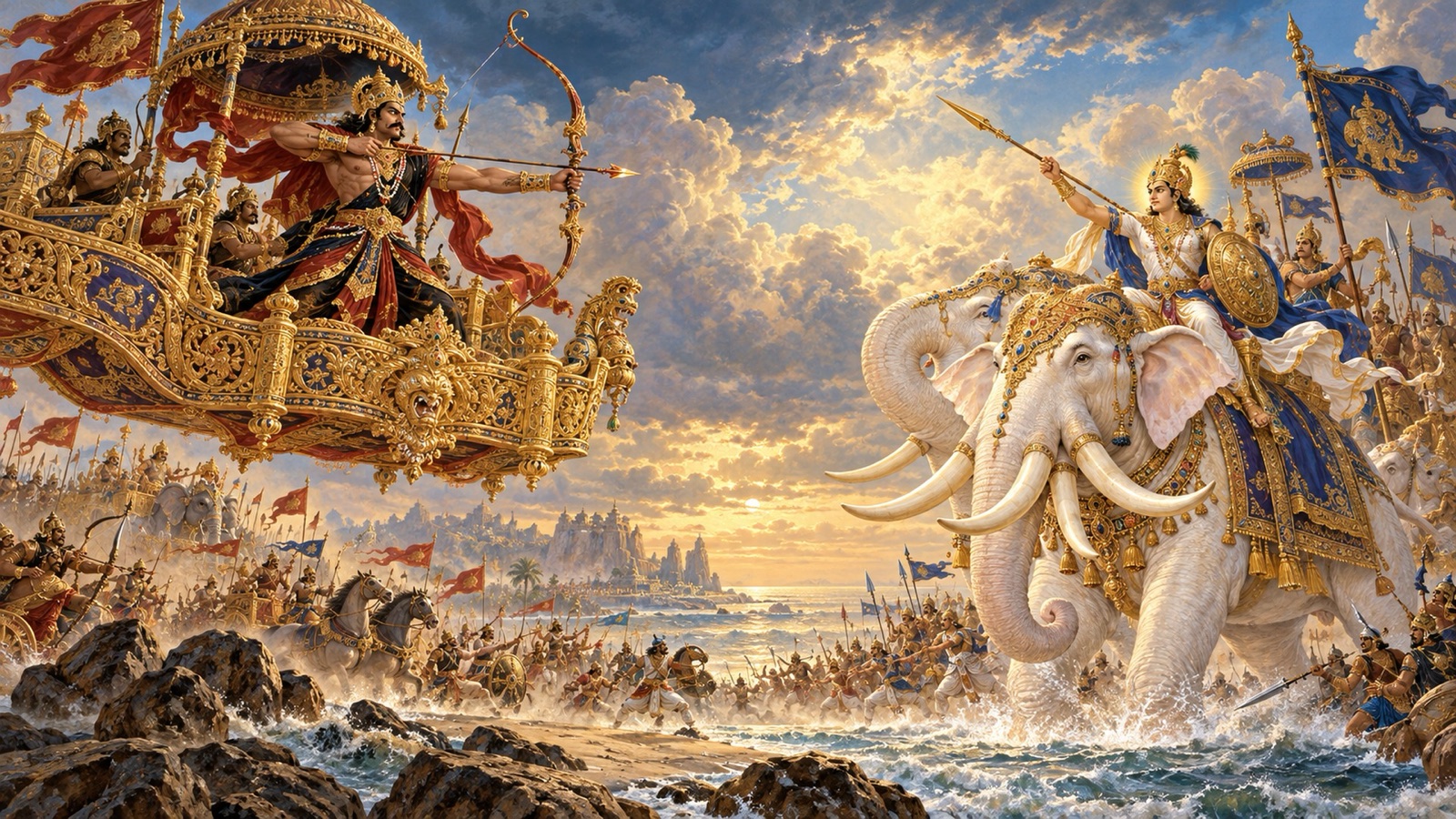
Bali assailed Indra with volleys of arrows, but Indra, quick and smiling, cut down every weapon Bali took up — spear, dart, club, and sword alike. Frustrated, Bali vanished from sight and unleashed his demoniac power of illusion. Suddenly a mountain appeared above the celestial forces, raining down blazing trees and jagged rocks; then fierce beasts and serpents rushed forth; then fearsome ogres and dread apparitions cried out on every side. Thundering clouds rained live coals; a vast, all-consuming fire, fanned by the wind, began to burn the celestial army as if at the end of the world; and an ocean of terrible whirlpools and towering waves engulfed them. Beset by these conjured horrors, and by the illusions of other demon-adepts whose movements could not even be perceived, the celestial warriors grew despondent and helpless.
The Lord Manifests and the Illusions Vanish
When Indra and the gods could find no way to counter this evil, they remembered the Lord, the Protector of the universe — and at once He manifested Himself upon the battlefield.
तत: सुपर्णांसकृताङ्घ्रिपल्लव: पिशङ्गवासा नवकञ्जलोचन: । अदृश्यताष्टायुधबाहुरुल्लस- च्छ्रीकौस्तुभानर्घ्यकिरीटकुण्डल: ॥ ५४ ॥
tataḥ suparṇāṁsa-kṛtāṅghri-pallavaḥ piśaṅga-vāsā nava-kañja-locanaḥ adṛśyatāṣṭāyudha-bāhur ullasac- chrī-kaustubhānarghya-kirīṭa-kuṇḍalaḥ
Meaning: Then the Lord appeared, His tender lotus-like feet resting upon the shoulders of Garuda, clad in yellow robes, His eyes like a pair of fresh lotuses, His eight arms bearing weapons, and radiant with Goddess Sri, the Kaustubha gem, a priceless crown, and glittering earrings. (Canto 8, Chapter 10, verse 54)
The instant the Lord entered the field, the illusions conjured by the demons’ magic vanished before His glory — as a dream is broken the moment a sleeping man awakes.
तस्मिन्प्रविष्टेऽसुरकूटकर्मजा माया विनेशुर्महिना महीयस: । स्वप्नो यथा हि प्रतिबोध आगते हरिस्मृति: सर्वविपद्विमोक्षणम् ॥ ५५ ॥
tasmin praviṣṭe ’sura-kūṭa-karmajā māyā vineśur mahinā mahīyasaḥ svapno yathā hi pratibodha āgate hari-smṛtiḥ sarva-vipad-vimokṣaṇam
Meaning: As soon as He entered, the illusions produced by the demons’ tricks were destroyed by the power of that mighty Lord, just as a dream ends when one awakens; for the very remembrance of Sri Hari is the deliverance from all dangers. (Canto 8, Chapter 10, verse 55)
Here lies the deeper point Sukadeva is making for Parikshit, and for us. The nectar had already made the gods immortal and strong, yet that very strength could not save them from Bali’s illusions; only the Lord’s remembrance could. The chapter’s whole arc turns on this one arrangement: the demons lost their claim to the nectar because they had turned away from Vasudeva (verse 1), and the gods very nearly lost the battle despite having drunk it, until, finding no strategy of their own sufficient, they turned their minds back to Him (verses 53–55). Even the highest boon is no substitute for a heart that keeps remembering its giver; strength secures nothing that surrender does not first secure.
Seeing the Lord upon Garuda, the demon Kalanemi hurled his dart, but the Lord caught it in play and sent it back to destroy him along with his lion mount. And when the demon Malyavan rushed to strike Garuda, the Lord severed the roaring enemy’s head with His discus, as He had already felled the mighty Mali and Sumali. The demons’ onslaught was broken by the presence of the Lord.
Principal Teachings of This Chapter
1. The remembrance of the Lord dispels every danger. When no strategy of the gods could counter the demons’ illusions, the mere memory of Sri Hari brought His presence, and the illusions vanished. Turning the mind to God is itself deliverance (verse 55).
2. Strength is safe only when it takes shelter. The gods were reinvigorated by the nectar, yet they fought “taking shelter at the feet of Narayana.” Power held in refuge at the Lord’s feet does not become pride (verse 4).
3. Illusion cannot survive the light of truth. The demons’ conjured mountains, fires, and floods were terrifying but unreal, and they dissolved instantly before the Lord — as a dream ends at waking. What frightens us in forgetfulness loses its power in His presence (verse 55).
4. Envy turns effort against itself. The demons had laboured as hard as the gods, but envy of others’ fortune drove them to war and ruin. Resentment of another’s blessing is its own undoing (verse 3).
5. To turn away from God is to lose the fruit. The demons gained no nectar because they had turned their faces from Vasudeva. However great the effort, forgetfulness of the Lord empties it of its reward (verse 1).
A Devotional Reflection
The most powerful moment in this crowded battle is not a clash of weapons but a change of mind. For most of the chapter the gods rely, understandably, on their arms and their champions; they are strong, freshly immortal, and well led. Yet against the demons’ illusions all of that proves useless. Mountains fall from an empty sky, fire rages out of nothing, oceans rise where there is no sea — and the gods, for all their strength, grow helpless and afraid. What finally saves them is not a better weapon but a turning of the heart: they remember the Lord. And the moment they do, He is there, and the whole terrifying spectacle collapses like a dream at dawn. Sukadeva states the lesson without disguise: simply calling Hari to mind is enough to set us free from whatever threatens us. Our own illusions can be just as overwhelming: fears that tower over us, troubles that seem to come from nowhere, anxieties that burn and flood the mind. This chapter promises that they, too, are dreams that cannot survive the waking light of God’s remembrance. The strongest thing we can do, when illusion presses hardest, is simply to turn the mind to Him.
A Daily Devotional Practice
Today, when some worry or fear rises up and seems to tower over you, pause and gently turn your mind to the Lord, remembering that the demons’ vast illusions vanished the instant He appeared. Quietly repeat “Om Namo Bhagavate Vasudevaya,” and let that remembrance be your refuge, as the gods took shelter at the feet of Narayana. Notice how a fear held up to the light of His remembrance begins to lose its terrible solidity, like a dream fading upon waking.
Conclusion
Weapons, illusions, even a whole army’s despair — none of it could stand once the gods turned their minds to the Lord, and none of it can stand against us either, whenever we do the same. Whatever mountain of fear rises in our own life, however dark and sourceless it seems, it is no sturdier than the one Bali conjured; it too dissolves the instant we truly remember Him. May that remembrance never leave us, in battle or in peace. With the demons’ magic broken and their generals felled, the tide of this battle has turned — and the unfinished duel between Indra and Bali carries forward into the chapter that follows.
May the divine wisdom of Srimad Bhagavatam awaken pure devotion within our hearts.
Om Namo Bhagavate Vasudevaya.
Jay Shree Madhav.
References and Attribution
- Primary edition: Gita Press, Śrīmad Bhāgavata Mahāpurāṇa (English, complete), Book Eight, Discourse 10, pages 775–780.
- Series: Srimad Bhagavatam Wisdom · Biswa Sanatan Dharma Seva Trust.
- Presented following the spiritual guidance and recommendation of Pandit Dr. Shri Kashinath Mishra.
This is an original, faithful retelling in the writer’s own words, with brief quoted verses shown in Devanāgarī and transliteration and their meanings given as summaries. It is not a reproduction of any single publisher’s continuous translation or commentary. No affiliation with or endorsement by any publisher is implied.
Jay Shree Madhav