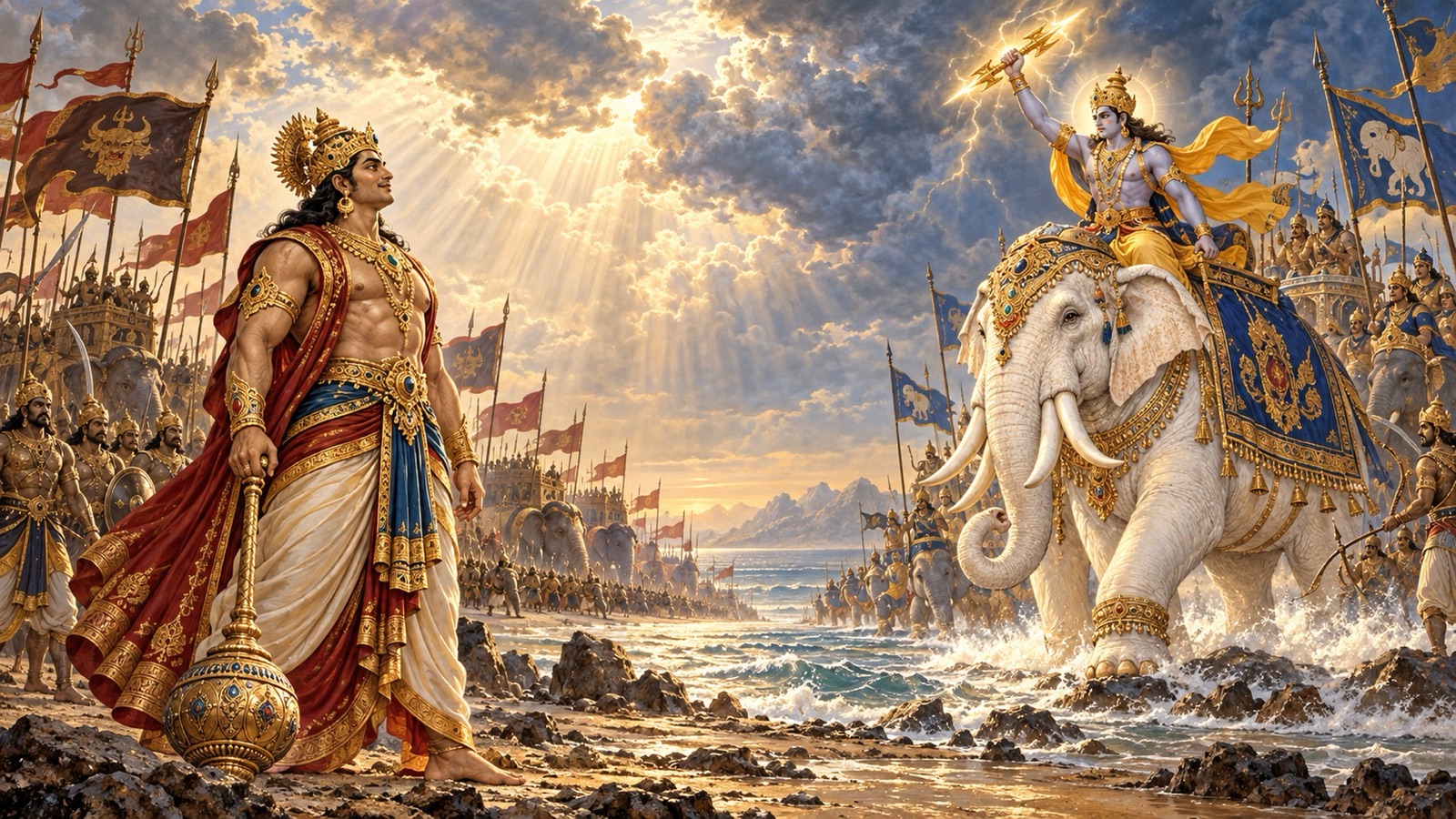
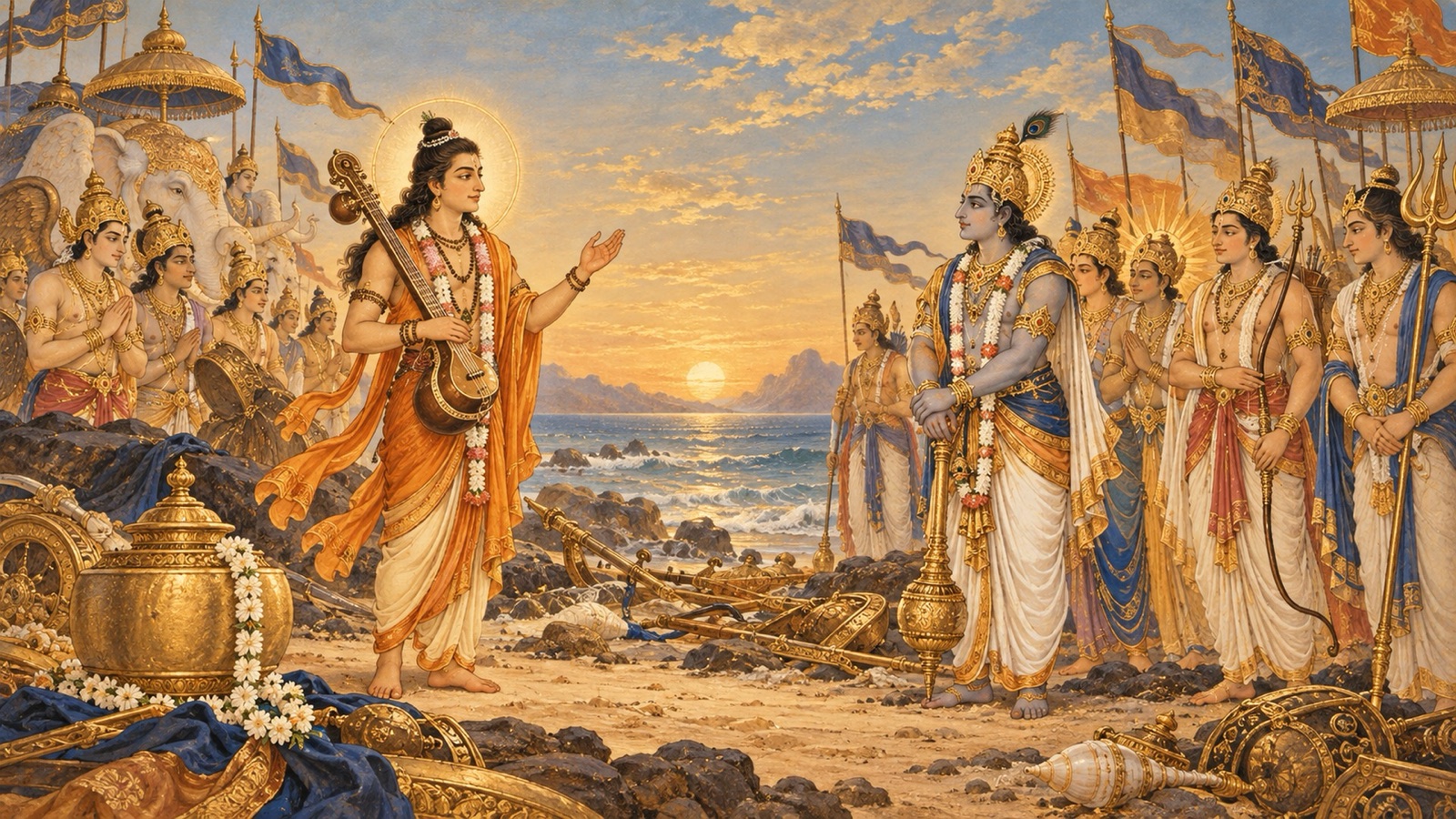
Thunderbolt raised, Indra taunts the demon king. But Bali answers without fear or anger, for he sees every triumph and every fall alike as Time’s own turning, and the wise are moved by neither. It is the vanquished, not the victor, who speaks the deepest wisdom of this chapter.
Om Namo Bhagavate Vasudevaya.
Om Namo Bhagavate Vasudevaya.
Om Namo Bhagavate Vasudevaya.
Welcome back to Srimad Bhagavatam Wisdom, a devotional journey through the sacred histories and teachings of the Srimad Bhagavat Mahapurana. With the demons’ illusions dispelled by the presence of the Lord, the gods regain their courage and the great battle rushes to its conclusion — yet the true heart of this eleventh discourse is not the triumph of the gods but the astonishing composure of the defeated demon king Bali, who meets the thunderbolt itself without a trace of fear or sorrow.
Chapter Information
- Scripture: Śrīmad Bhāgavata Mahāpurāṇa
- Canto: 8 (Book Eight)
- Chapter: 11 (Discourse 11)
- Chapter title: The Conclusion of the War and Bali’s Equanimity
- Principal speaker: Sukadeva Gosvami, narrating to King Parikshit — with the words of Indra, Bali, and Narada
- Principal listener: King Parikshit
- Main setting: The battlefield on the seashore; the western hill where the demons are revived
- Central subject: The conclusion of the war between the gods and the demons; Bali’s fall and his equanimity; the slaying of the demon generals and of Namuci; Narada’s intervention; the reviving of the fallen demons
- Principal verse range: Canto 8, Chapter 11, verses 1–48
- Primary edition: Gita Press Śrīmad Bhāgavata Mahāpurāṇa
Context From the Previous Chapter
In the tenth discourse, the demons made war on the gods and, through the illusions of the mighty Bali, nearly overwhelmed the celestial army — until the gods remembered the Lord, who appeared upon Garuda and dispelled the illusions like a dream at waking. This chapter takes up the battle from that turning point, as the gods, their courage restored, press the demons hard.
The Gods Strike Back and Indra Confronts Bali
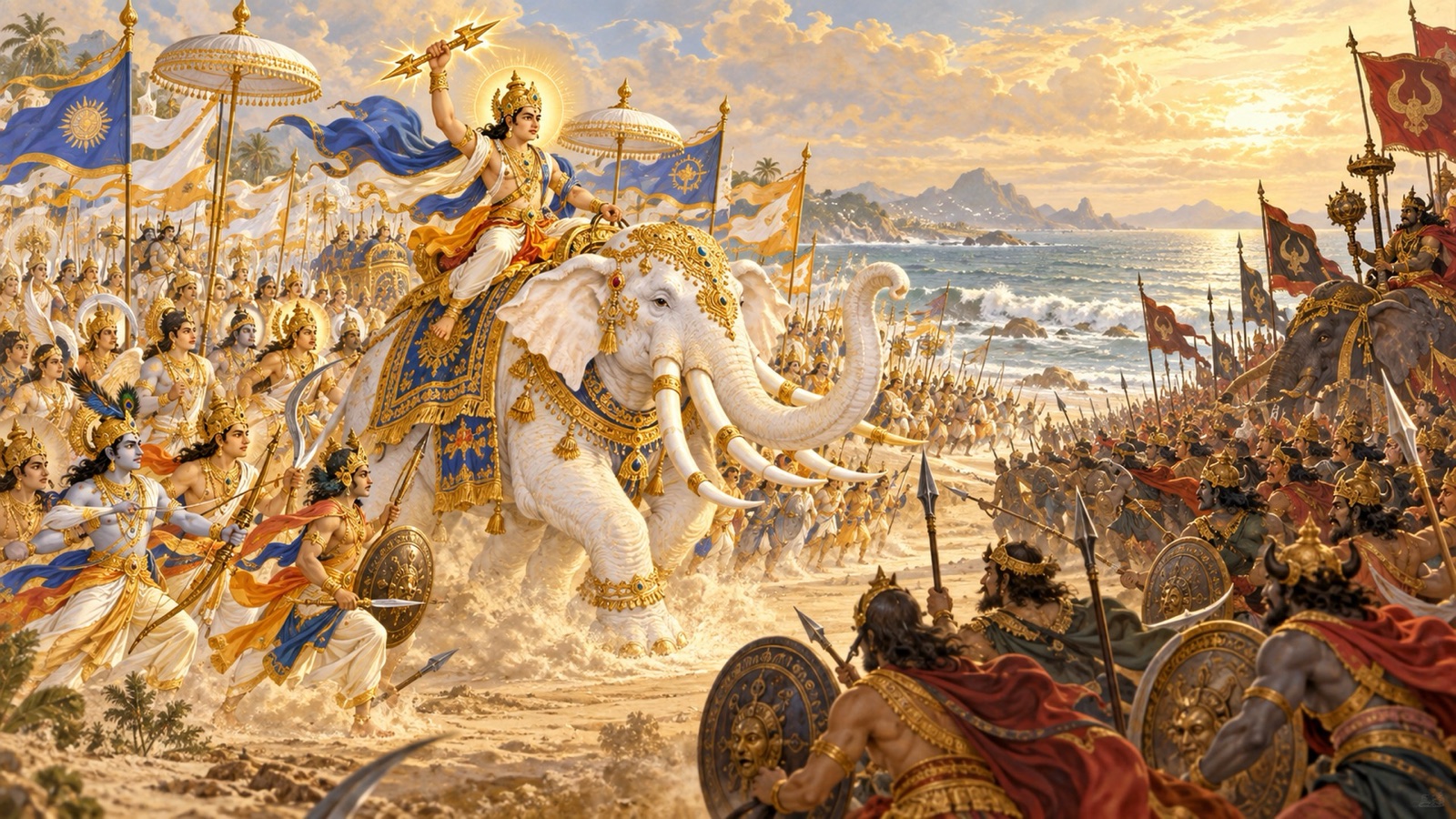
Having regained their presence of mind by the grace of Lord Vishnu, the gods, led by Indra and the wind-god, struck hard at each of the demons who had earlier assailed them. When Indra, full of anger, raised his thunderbolt against Bali, the demon’s followers cried out in alarm. Indra taunted Bali, calling him a mere conjurer who sought to overpower the true lords of power by tricks. But Bali answered with a calm that his enemy could not match.
श्रीबलिरुवाच सङ्ग्रामे वर्तमानानां कालचोदितकर्मणाम् । कीर्तिर्जयोऽजयो मृत्यु: सर्वेषां स्युरनुक्रमात् ॥ ७ ॥
śrī-balir uvāca saṅgrāme vartamānānāṁ kāla-codita-karmaṇām kīrtir jayo ’jayo mṛtyuḥ sarveṣāṁ syur anukramāt
Meaning: Bali said: For all who engage in battle, their deeds impelled by Time, fame, victory, defeat, and death come one after another in their turn. (Canto 8, Chapter 11, verse 7)
Therefore, Bali continued, the wise, seeing all this as governed by Time, neither rejoice nor lament — a truth of which Indra remained ignorant. He would not take Indra’s stinging words to heart, he said, for one who imagines himself the cause of victory and fame deserves the pity of the pious.
Bali Falls, and the Demon Generals Are Slain
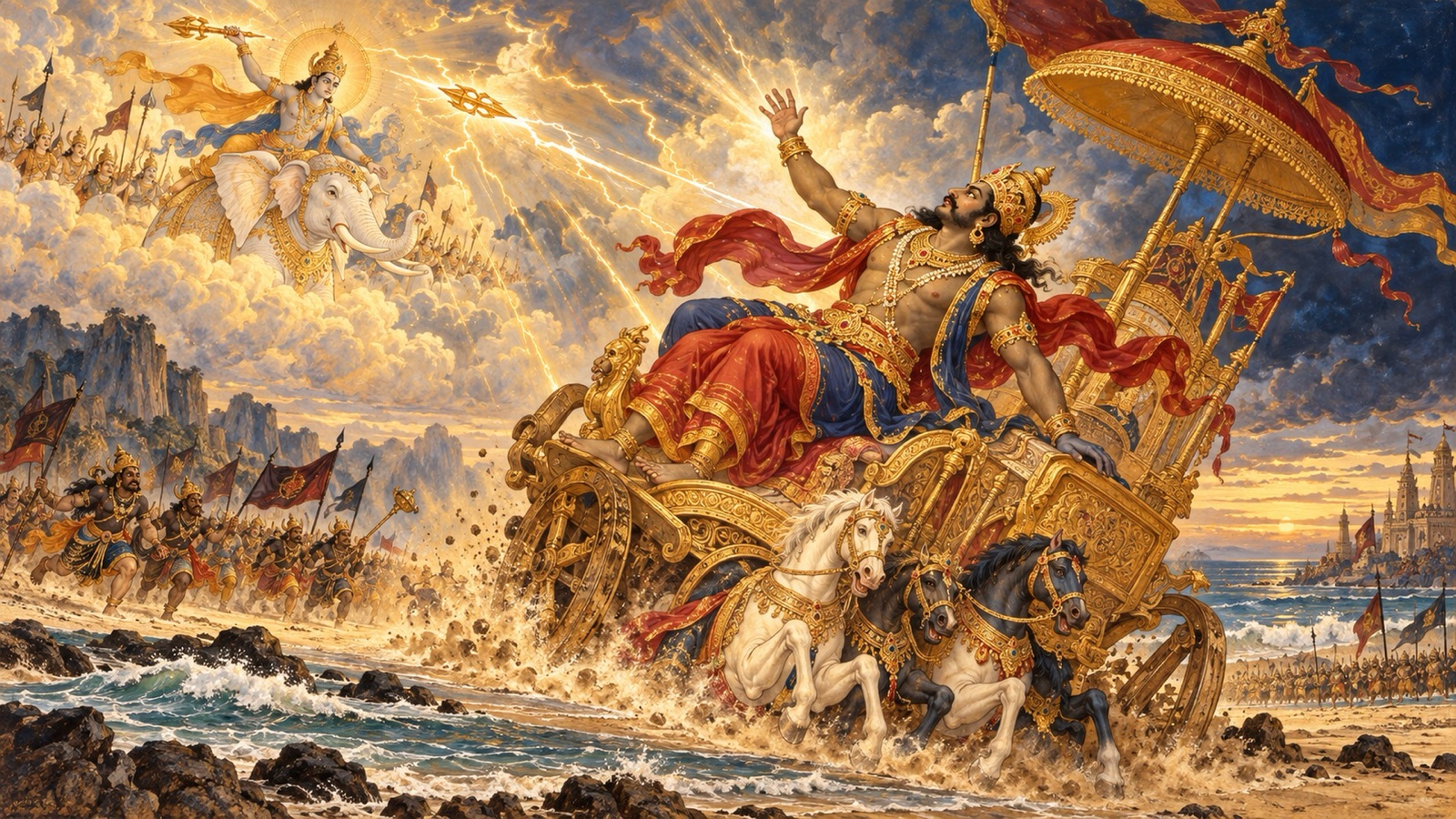
Having spoken, the valiant Bali struck Indra again with arrows drawn to the ear. Stung by taunts that were nonetheless true, Indra could bear it no longer and hurled his unfailing thunderbolt.
प्राहरत् कुलिशं तस्मा अमोघं परमर्दन: । सयानो न्यपतद् भूमौ छिन्नपक्ष इवाचल: ॥ १२ ॥
prāharat kuliśaṁ tasmā amoghaṁ para-mardanaḥ sayāno nyapatad bhūmau chinna-pakṣa ivācalaḥ
Meaning: Indra, the crusher of foes, hurled his unfailing thunderbolt at him, and Bali fell to the ground, chariot and all, like a mountain whose wings had been clipped. (Canto 8, Chapter 11, verse 12)
Seeing his friend fallen, the demon Jambha rushed to Indra’s attack and struck him and his elephant with a mace, but Indra severed Jambha’s head with the thunderbolt. Then Namuci, Bala, and Paka — kinsmen of Jambha — arrived and covered Indra with a network of arrows, hiding him from sight until the leaderless gods wailed like merchants whose ship had wrecked. But Indra broke free, shining like the sun at the close of night, and severed the heads of Bala and Paka before the eyes of their kinsmen.
The Boon-Protected Namuci and the Foam of the Sea
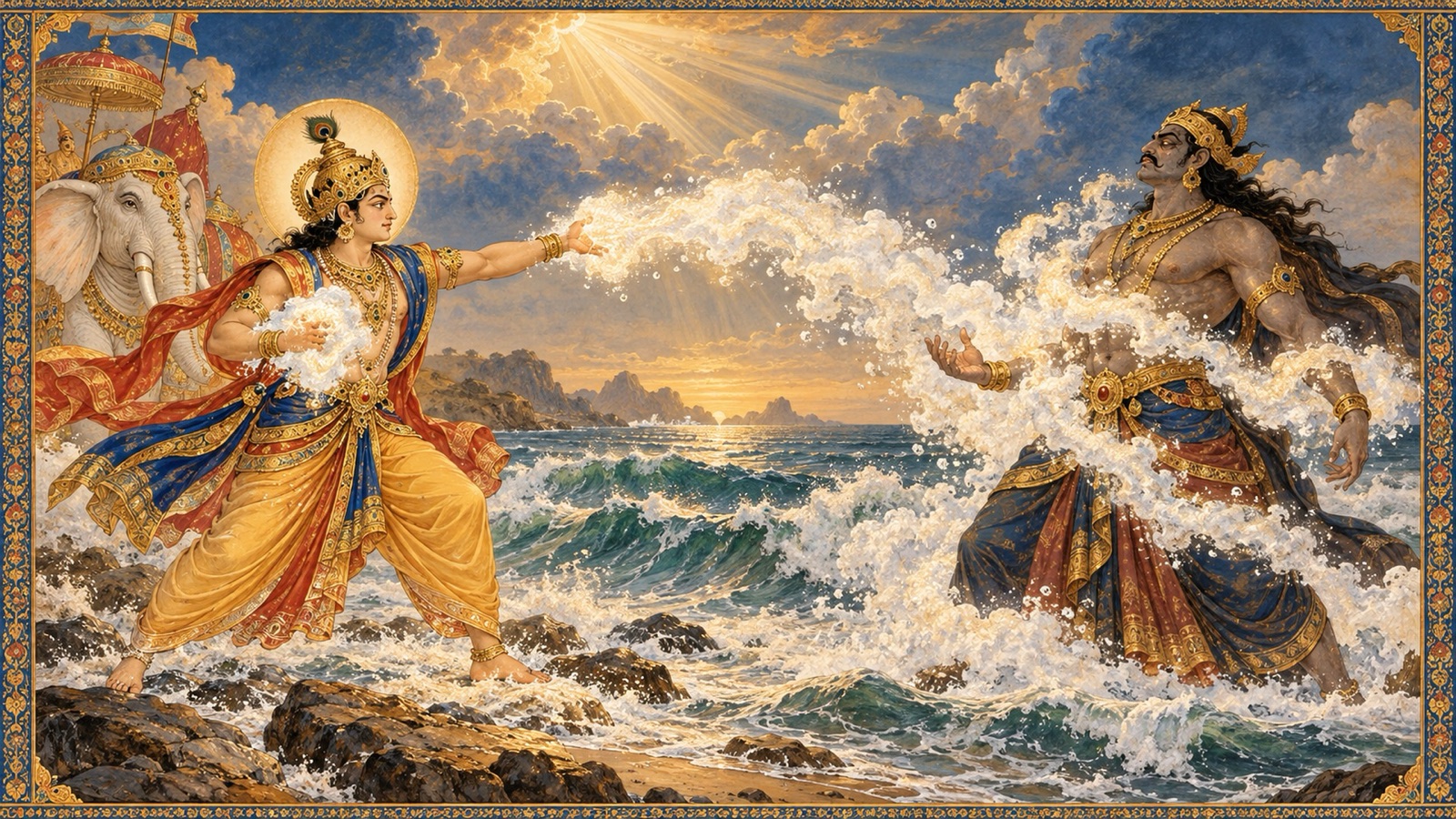
Grief-stricken and enraged at the death of his kinsmen, Namuci flung a great steel lance at Indra, but Indra cut it to pieces and struck Namuci’s neck with the thunderbolt — the very weapon that had slain the mighty Vritra. To Indra’s astonishment, it did not even pierce Namuci’s skin. Afraid, and wondering what fate had bewildered the world, Indra despaired. Then an unseen voice from the sky spoke to him.
इति शक्रं विषीदन्तमाह वागशरीरिणी । नायं शुष्कैरथो नार्द्रैर्वधमर्हति दानव: ॥ ३७ ॥
iti śakraṁ viṣīdantam āha vāg aśarīriṇī nāyaṁ śuṣkair atho nārdrair vadham arhati dānavaḥ
Meaning: To Indra, who was thus despairing, an incorporeal voice said: This demon cannot be slain by anything dry or wet. (Canto 8, Chapter 11, verse 37)
The voice explained that Namuci had been granted a boon that no dry or wet substance could bring him death; Indra must therefore find another means. Composing his mind, Indra discovered the foam of the sea, which is neither dry nor wet, and with it he severed Namuci’s head. The sages glorified him and showered him with flowers, the Gandharvas sang, and the celestial drums sounded. The other gods, led by Vayu, Agni, and Varuna, likewise destroyed their remaining foes.
Narada Stops the War, and Bali Is Revived
Seeing the demons being exterminated, Brahma sent the sage Narada to the gods, who counselled them to lay down their arms now that their purpose was accomplished.
श्रीनारद उवाच भवद्भिरमृतं प्राप्तं नारायणभुजाश्रयै: । श्रिया समेधिता: सर्व उपारमत विग्रहात् ॥ ४४ ॥
śrī-nārada uvāca bhavadbhir amṛtaṁ prāptaṁ nārāyaṇa-bhujāśrayaiḥ śriyā samedhitāḥ sarva upāramata vigrahāt
Meaning: Narada said: You have obtained the nectar by taking shelter in the arms of Lord Narayana, and you have all been blessed by Goddess Sri; now cease from hostilities. (Canto 8, Chapter 11, verse 44)
Accepting Narada’s advice, the gods gave up their anger and their zeal for battle and returned to heaven. The surviving demons, with Narada’s concurrence, carried the lifeless Bali to the western hill, where Shukracharya, their preceptor, revived by his secret science all those whose limbs and necks were still whole. Bali, too, was revived at the touch of the sage — and, though defeated, he felt no sorrow, for he was fully conversant with the truth of the world.
बलिश्चोशनसा स्पृष्ट: प्रत्यापन्नेन्द्रियस्मृति: । पराजितोऽपि नाखिद्यल्लोकतत्त्वविचक्षण: ॥ ४८ ॥
baliś cośanasā spṛṣṭaḥ pratyāpannendriya-smṛtiḥ parājito ’pi nākhidyal loka-tattva-vicakṣaṇaḥ
Meaning: Touched by Shukracharya, Bali had his senses and memory restored; and though vanquished, he did not grieve, for he was well versed in the truth of the world. (Canto 8, Chapter 11, verse 48)
Principal Teachings of This Chapter
1. The wise neither exult in victory nor grieve in defeat. Bali sees fame, victory, defeat, and death as the successive turns of Time, and so remains unmoved. Equanimity toward outcomes is the mark of true wisdom (verses 7-8).
2. Defeat need not bring sorrow. Revived after his fall, Bali carried no grief at all, for his grasp of the world ran deeper than the outcome of any single battle. One who sees this deeper reality is not crushed by loss (verse 48).
3. To claim oneself the cause of success is to be pitied. Bali gently observes that one who imagines himself the author of his own fame deserves the pity of the pious. Pride in our victories forgets the hand of Time and of God (verse 9).
4. No boon can outlast the Lord’s arrangement. Namuci’s boon made him proof against dry and wet, yet the Lord’s own guidance revealed the sea-foam that was neither. Divine wisdom always finds the way (verses 37-40).
5. Victory won by grace calls for restraint, not vengeance. Once the nectar was secured through Narayana’s arms, Narada told the gods to stop. Grace received should end in peace, not in the pursuit of the fallen (verse 44).
6. Bali’s peace is devotion, not detached philosophy. His stillness is not the calm of a thinker who has merely reasoned his way past disappointment; it is the composure of a devotee who knows that the entire contest — his rise, his fall, the crushing blow of Indra’s thunderbolt — unfolds only by the arrangement of the Lord he serves. A devotee’s part is to act and to leave every outcome, triumph or ruin alike, at the Lord’s feet; this alone explains how a king who has just lost his throne and his life can wake with his memory restored and feel nothing but peace. What reads here as detachment is in truth surrender — the same surrender that will one day lead this same Bali to place everything he owns, without a moment’s hesitation, into the hands of a small Brahmin boy (verses 7-9, 48).
A Devotional Reflection
It is one of the quiet wonders of this chapter that its deepest teaching comes not from the victorious gods but from the defeated demon king. Bali stands with a thunderbolt aimed at his life, and instead of boasting or trembling he speaks like a sage: fame and defeat, victory and death, all come in their turn, moved by Time; the wise neither rejoice nor lament. And when he has fallen and is brought back to life, Sukadeva tells us plainly that he felt no sorrow, because he understood the truth of the world. Here is equanimity of a kind most of us find hard even to imagine — to lose everything, and not to be broken by it. Bali’s calm does not come from indifference; it comes from seeing clearly that outcomes are not finally in his hands, that the play of victory and loss unfolds by a will greater than his own. There is deep freedom in that vision. So much of our suffering is not the loss itself but our resistance to it, our insistence that things should have gone another way. Bali shows us a heart at peace within the turning of Time — receiving fame and defeat alike as they come, and grieving over neither.
A Daily Devotional Practice
Today, when something does not go your way — a plan that fails, a setback, a small defeat — pause before reacting, and gently remember Bali’s words: that victory and defeat come in their turn, moved by Time, and the wise grieve over neither. Offer the outcome to the Lord with the words “Om Namo Bhagavate Vasudevaya,” releasing your insistence that it should have been otherwise. Let this be a small practice in equanimity: to meet a loss without being broken by it, resting in the truth that its turning is not finally in your hands.
Conclusion
The war ends here, but the chapter’s real gift is not this victory — it is Bali’s example. Struck down, humiliated, and revived only by his guru’s grace, the fallen king holds no grief at all, because he has surrendered the outcome of every battle, won or lost, to the will of the Lord who ordains it. That is the equanimity this chapter asks us to carry away: not indifference, but trust — the same trust that will one day let Bali offer everything he owns, without hesitation, to a small Brahmin boy who comes asking.
May the divine wisdom of Srimad Bhagavatam awaken pure devotion within our hearts.
Om Namo Bhagavate Vasudevaya.
Jay Shree Madhav.
References and Attribution
- Primary edition: Gita Press, Śrīmad Bhāgavata Mahāpurāṇa (English, complete), Book Eight, Discourse 11, pages 780–784.
- Series: Srimad Bhagavatam Wisdom · Biswa Sanatan Dharma Seva Trust.
- Presented following the spiritual guidance and recommendation of Pandit Dr. Shri Kashinath Mishra.
This is an original, faithful retelling in the writer’s own words, with brief quoted verses shown in Devanāgarī and transliteration and their meanings given as summaries. It is not a reproduction of any single publisher’s continuous translation or commentary. No affiliation with or endorsement by any publisher is implied.
Jay Shree Madhav