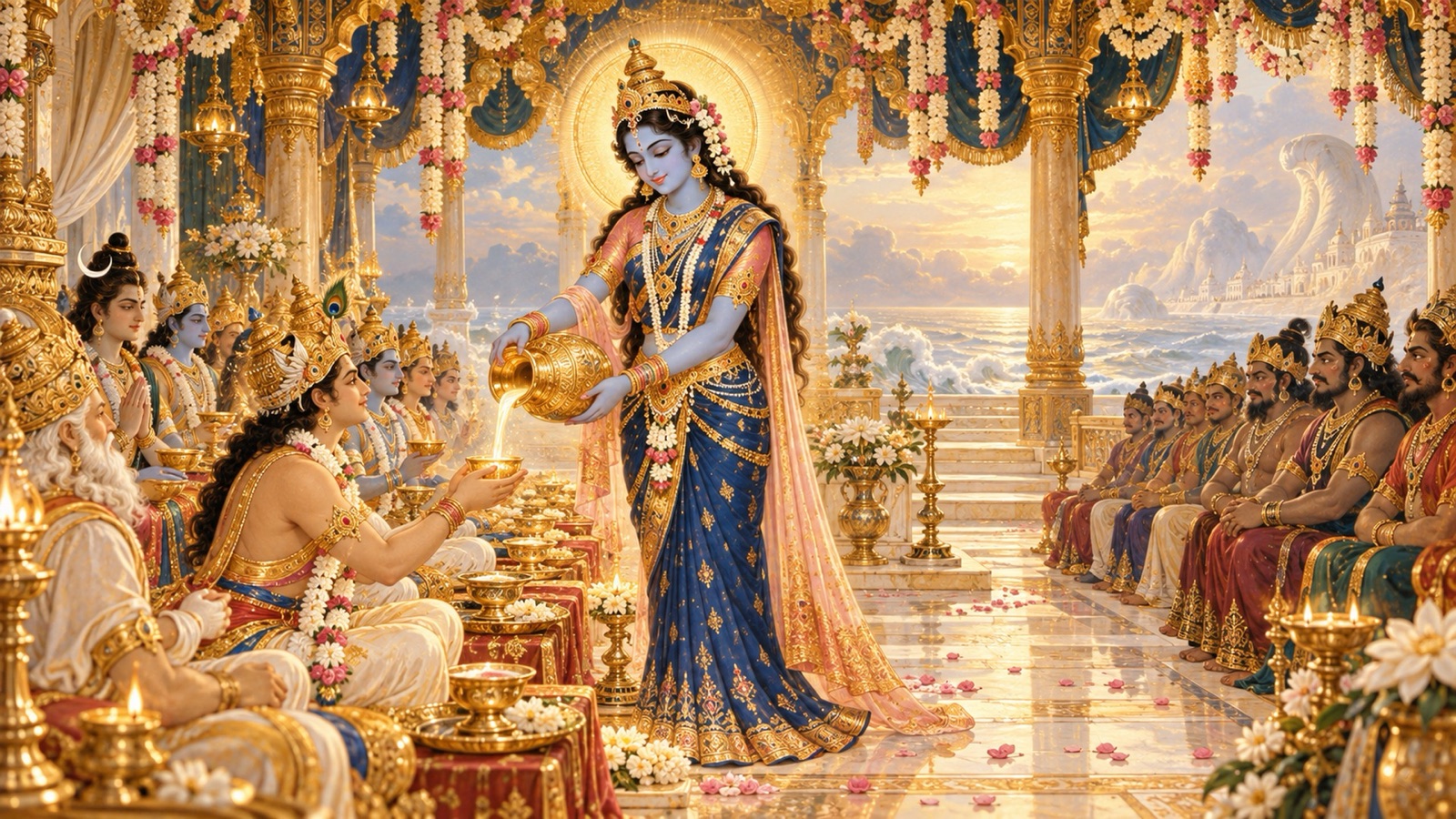
The demons have seized the nectar and set to quarrelling — until a wondrous damsel appears and, with their own consent, takes the jar into her hands. Seating gods and demons in separate rows, she serves the immortal nectar to the gods who had earned it through devotion.
Om Namo Bhagavate Vasudevaya.
Om Namo Bhagavate Vasudevaya.
Om Namo Bhagavate Vasudevaya.
Welcome back to Srimad Bhagavatam Wisdom, a devotional journey through the sacred histories and teachings of the Srimad Bhagavat Mahapurana. This ninth discourse of the Eighth Canto uncovers why the very same labour, in the very same hour, brought life to one side and nothing at all to the other.
Chapter Information
- Scripture: Śrīmad Bhāgavata Mahāpurāṇa
- Canto: 8 (Book Eight)
- Chapter: 9 (Discourse 9)
- Chapter title: The Lord as Mohini Distributes the Nectar
- Principal speaker: Sukadeva Gosvami, narrating to King Parikshit — with the words of the Lord in His enchanting form
- Principal listener: King Parikshit
- Main setting: The shore of the Ocean of Milk; the hall prepared for the distribution of the nectar
- Central subject: The Lord in His enchanting form wins the demons’ trust and distributes the nectar to the gods; the beheading of Rahu; the teaching that refuge at the Lord’s feet makes all the difference
- Principal verse range: Canto 8, Chapter 9, verses 1–29
- Primary edition: Gita Press Śrīmad Bhāgavata Mahāpurāṇa
Context From the Previous Chapter
In the eighth discourse, the churned ocean yielded its treasures, culminating in the appearance of Goddess Lakshmi, who chose Lord Vishnu alone. Then the nectar of immortality arose, borne by a wonderful personage, and the demons seized the jar and began to quarrel over it, each crying “I first!” To resolve their strife, the Lord assumed a most amazing enchanting form. This chapter takes up what that form accomplishes.
The Demons Behold the Enchanting Damsel
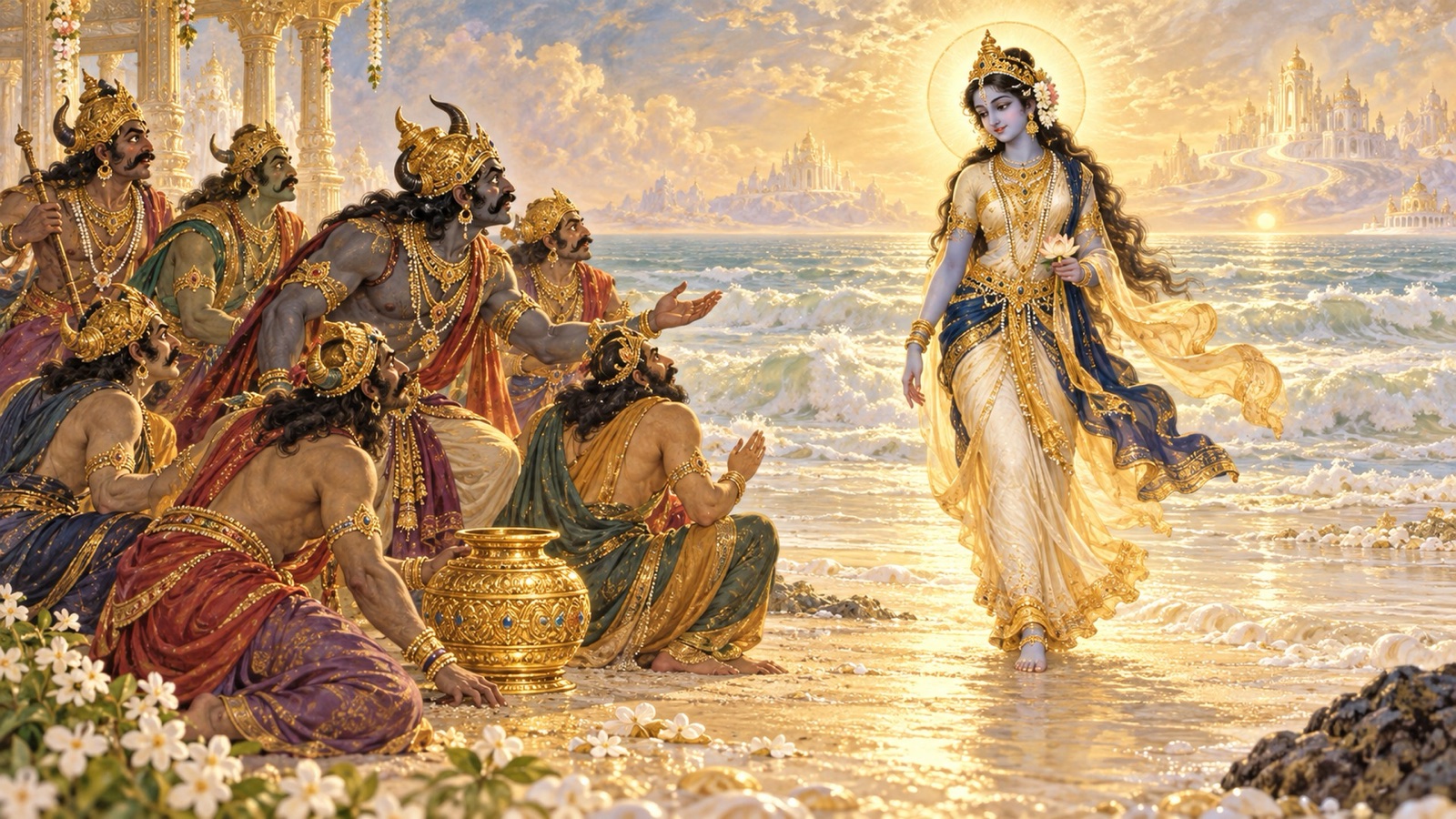
Having abandoned all friendship and adopted the ways of robbers, snatching the jar from and abusing one another, the demons suddenly caught sight of the wondrous damsel approaching.
श्रीशुक उवाच तेऽन्योन्यतोऽसुरा: पात्रं हरन्तस्त्यक्तसौहृदा: । क्षिपन्तो दस्युधर्माण आयान्तीं ददृशु: स्त्रियम् ॥ १ ॥
śrī-śuka uvāca te ’nyonyato ’surāḥ pātraṁ harantas tyakta-sauhṛdāḥ kṣipanto dasyu-dharmāṇa āyāntīṁ dadṛśuḥ striyam
Meaning: Sri Suka said: The demons, having cast off all friendship and taken to the ways of robbers, snatching the jar from one another and reviling each other, beheld a woman approaching. (Canto 8, Chapter 9, verse 1)
Their passion kindled, the demons ran up to her, praising her marvellous beauty, and questioned her: who was she, whose daughter, and why had she come? Perhaps, they said, the merciful creator had sent her to delight all embodied souls. Then, addressing her as sons of the sage Kasyapa who were all brothers, they begged her to bring them peace and to divide their prize equitably, so that the quarrelling among them might cease.
Trust Misplaced — the Lord’s Gentle Warning
The Lord, in His feminine form, laughed beautifully and answered them with words of striking irony — a warning they were too enchanted to heed.
श्रीभगवानुवाच कथं कश्यपदायादा: पुंश्चल्यां मयि सङ्गता: । विश्वासं पण्डितो जातु कामिनीषु न याति हि ॥ ९ ॥
śrī-bhagavān uvāca kathaṁ kaśyapa-dāyādāḥ puṁścalyāṁ mayi saṅgatāḥ viśvāsaṁ paṇḍito jātu kāminīṣu na yāti hi
Meaning: The Lord said: O sons of Kasyapa, how is it that you have placed your trust in me, a wanton woman? A wise man never reposes faith in such women. (Canto 8, Chapter 9, verse 9)
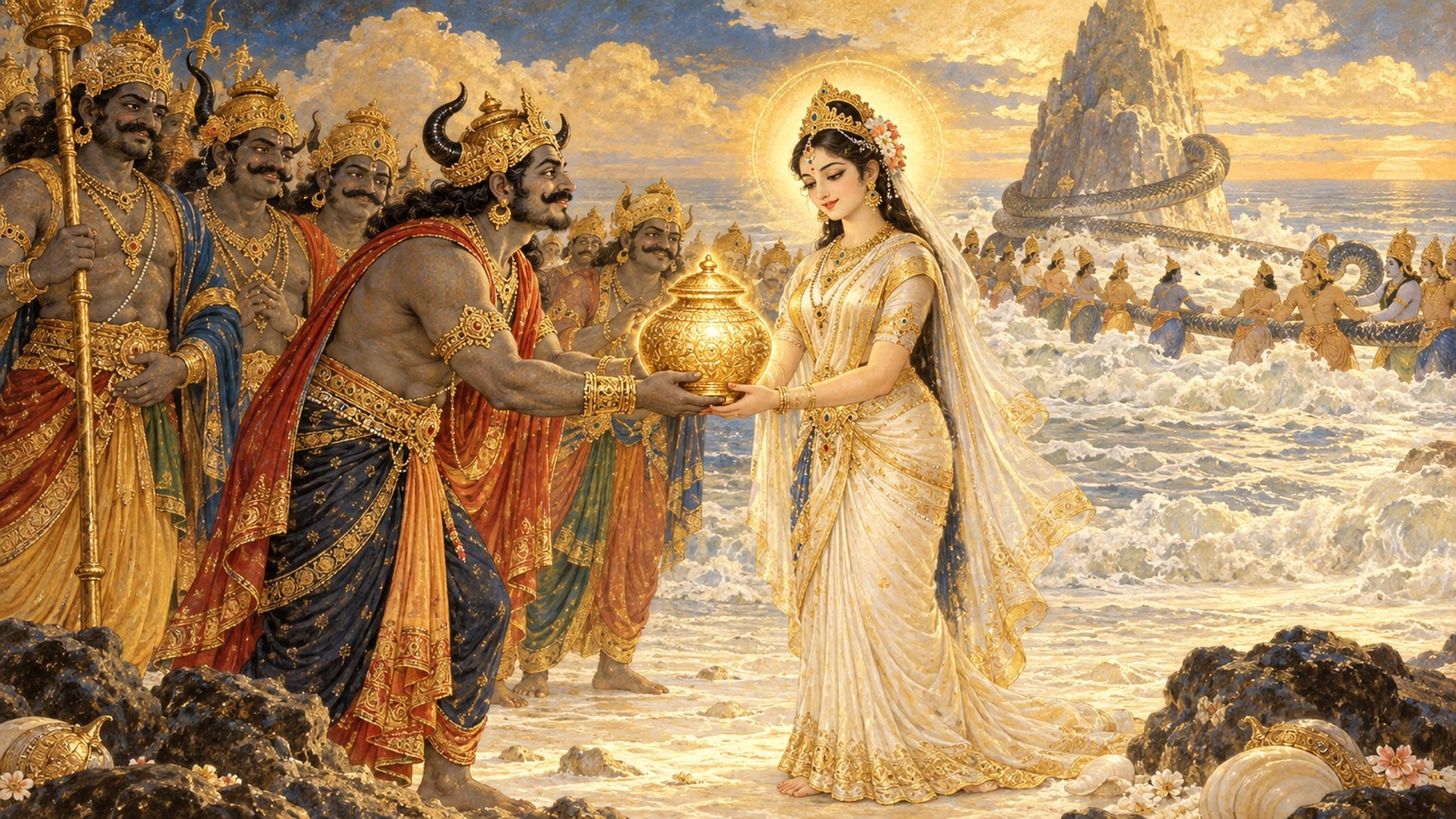
Such is the way of a woman who lives unguarded, she added — restless in friendship, like the monkey, the jackal, and the dog, each quick to leave one companion for the next. But the demons, reassured rather than warned by these playful words, laughed and handed her the jar of nectar. Taking possession of it, the Lord then said, with a gentle smile, that He would divide the nectar among them only on one condition: that they accept whatever He might do, whether it seemed right or wrong. Having no idea of her true greatness, the demon leaders agreed.
The Nectar Given to the Gods
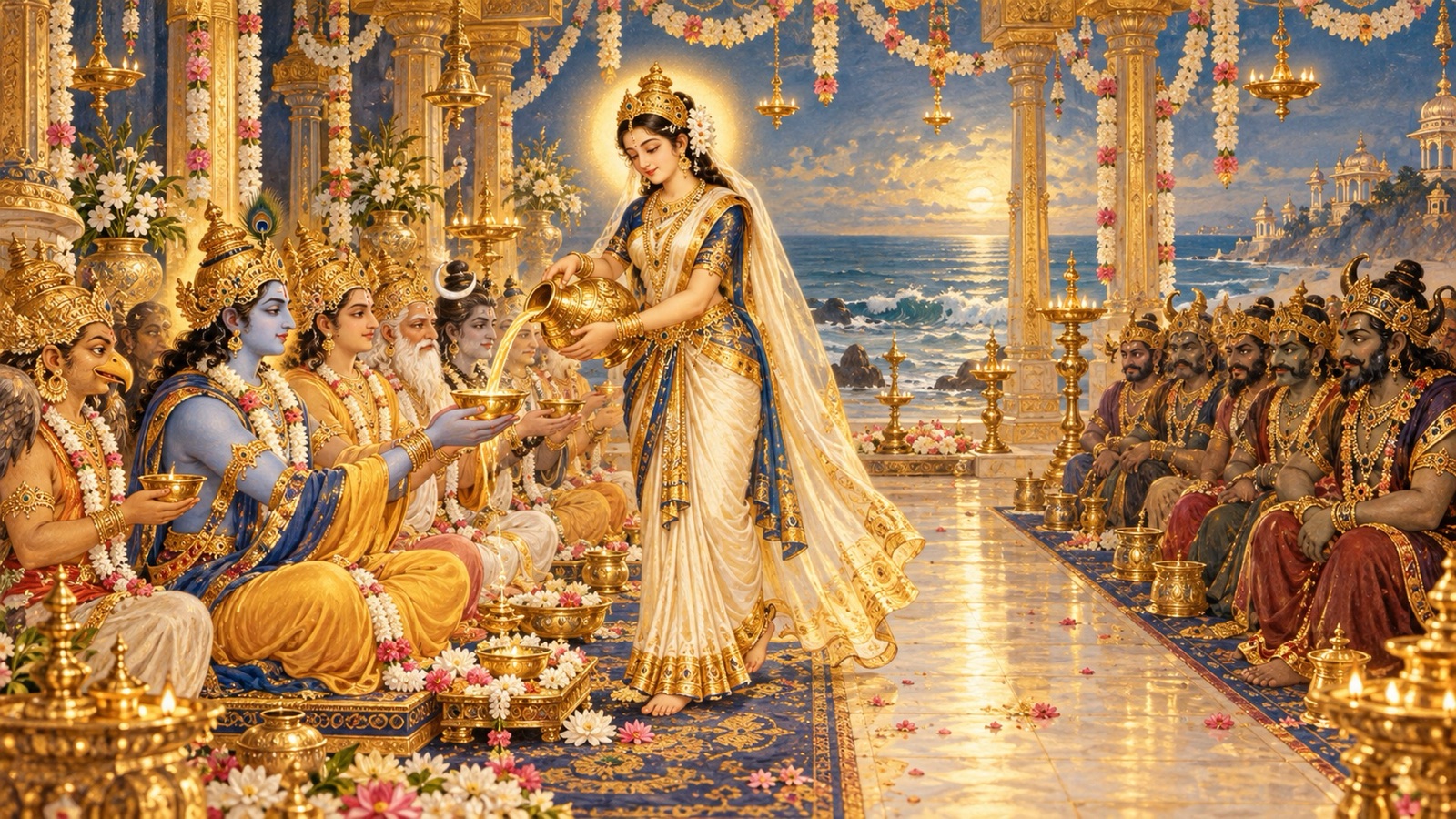
Then, having fasted and bathed, propitiated the sacred fire, and given gifts to the brahmanas and to living beings, gods and demons alike put on fresh garments and took their seats on blades of kusha grass, their faces turned to the east, in a hall fragrant with incense and adorned with flowers and lamps. Into that chamber the beautiful damsel made her way, jar in hand, and all present — gods and demons alike — were completely enchanted by her graceful presence and her smiling glances.
Judging it unwise to give nectar to the demons — as unwise as feeding milk to serpents — Lord Achyuta seated the two races in separate rows, each among its own people. Then, beguiling the demons with winning attentions and polite words, He carried the jar to the gods seated apart and gave them to drink the nectar that wards off old age and death. Out of their love for her and their regard for the promise they had made, and because they disdained to quarrel with a woman, the demons kept silent and said nothing unpleasant.
Rahu Beheaded, and the Lord’s Original Form
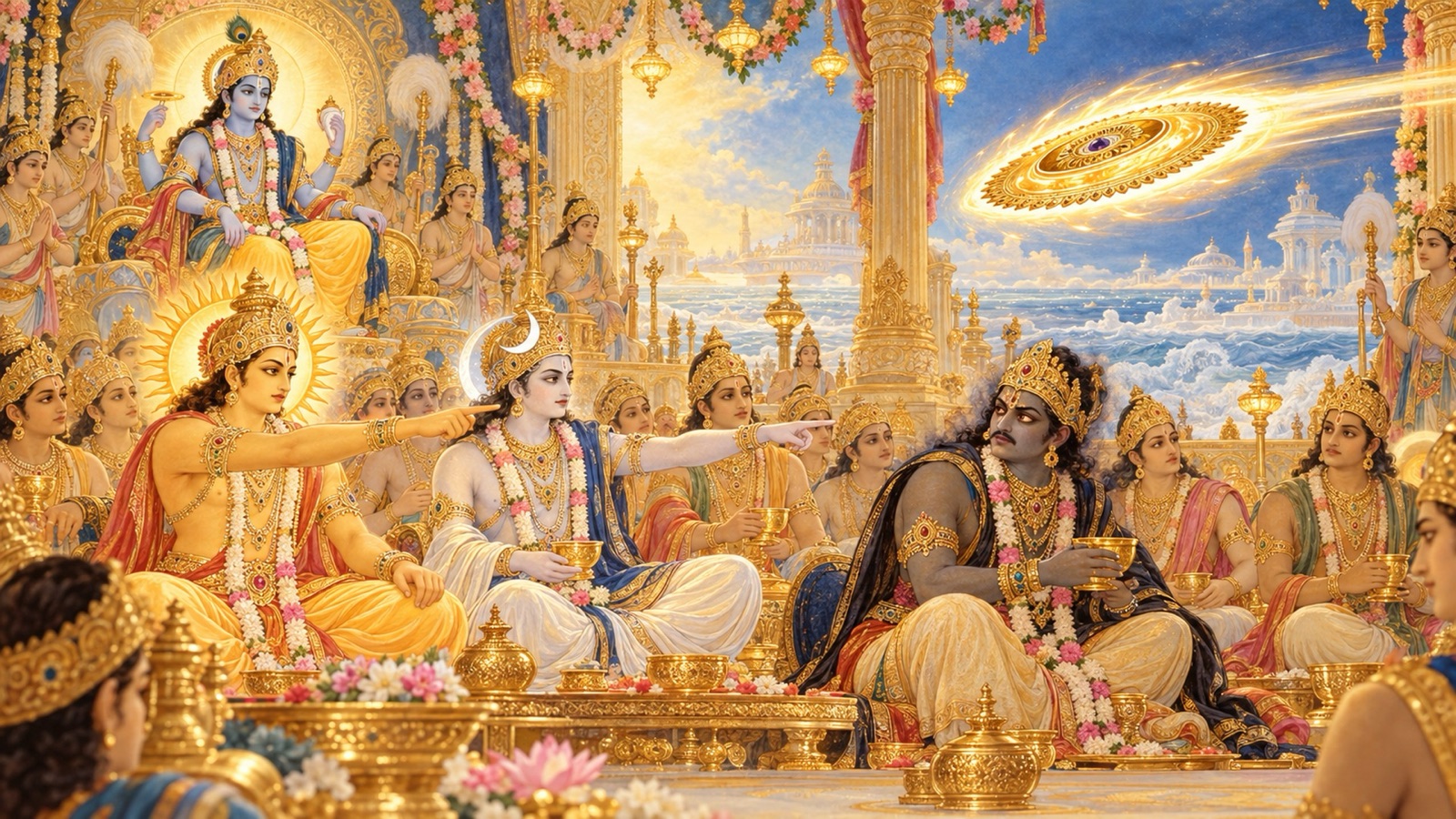
While this was happening, a demon named Swarbhanu — Rahu — disguised himself in the garb of a god and slipped into the row of the gods to drink the nectar. But the moon-god and the sun-god, between whom he had placed himself, recognized him and pointed him out.
देवलिङ्गप्रतिच्छन्न: स्वर्भानुर्देवसंसदि । प्रविष्ट: सोममपिबच्चन्द्रार्काभ्यां च सूचित: ॥ २४ ॥
deva-liṅga-praticchannaḥ svarbhānur deva-saṁsadi praviṣṭaḥ somam apibac candrārkābhyāṁ ca sūcitaḥ
Meaning: Disguised in the garb of a god, Swarbhanu entered the assembly of the gods and drank the nectar; but he was pointed out by the moon-god and the sun-god. (Canto 8, Chapter 9, verse 24)
At once the Lord severed his head with His razor-sharp discus, even as he was drinking. His trunk, untouched by the nectar, fell down lifeless; but his head, which the nectar had already reached, became immortal. Brahma then made that head a planet — Rahu — who cherishes enmity toward the sun and moon and assails them at the times of eclipse. When the nectar had been nearly consumed by the gods, the Lord, the Protector of the universe, resumed His original form before the eyes of the demon generals.
The Same Effort, Opposite Fruits
Sukadeva closes the chapter with a teaching drawn from all that has happened. Gods and demons had laboured in the same place, at the same time, by the same means and materials, with the same intention — and yet they reaped utterly different fruits.
एवं सुरासुरगणा: समदेशकाल- हेत्वर्थकर्ममतयोऽपि फले विकल्पा: । तत्रामृतं सुरगणा: फलमञ्जसापु- र्यत्पादपङ्कजरज:श्रयणान्न दैत्या: ॥ २८ ॥
evaṁ surāsura-gaṇāḥ sama-deśa-kāla- hetv-artha-karma-matayo ’pi phale vikalpāḥ tatrāmṛtaṁ sura-gaṇāḥ phalam añjasāpur yat-pāda-paṅkaja-rajaḥ-śrayaṇān na daityāḥ
Meaning: Though the gods and demons acted in the same place and time, with the same effort, means, and intention, their results differed: the gods readily obtained the nectar as their fruit, because they took shelter at the dust of the Lord’s lotus feet — but the demons did not. (Canto 8, Chapter 9, verse 28)
This is more than a passing detail of the story: it is the chapter’s whole point. The Lord is not an impersonal law that pays out identical wages for identical labour; He is a Person, and He answers according to how He is approached, not merely how hard the hands work. Nothing made the gods more able or more clever than the demons — what set them apart was that their hearts had already turned toward the Lord’s feet long before their hands ever gripped the churning rope. That single difference is what the demons, for all their strength, could never buy or seize, however tightly they closed their fingers around the jar of nectar (verse 28).
Whatever we do for the sake of body, wealth, and progeny alone, He teaches, is ultimately fruitless; but the very same acts, done with our eye upon our divine nature and offered to the Lord, become fruitful and benefit all — just as watering the root of a tree nourishes every branch.
Principal Teachings of This Chapter
1. What we take shelter in decides the fruit. Gods and demons did the identical work, yet only the gods, who took refuge at the Lord’s feet, gained the nectar. Effort alone does not determine the result; the refuge of the heart does (verse 28).
2. Enchantment blinds us to plain warnings. The Lord openly told the demons not to trust “a wanton woman,” yet, captivated, they handed Him the very nectar. When desire rules, even the truth spoken aloud goes unheard (verses 9-11).
3. The Lord protects those who are truly His. Without breaking His word, the Lord ensured that the nectar reached the devoted gods. Divine grace safeguards the sincere, even amid overwhelming odds (verses 20-21).
4. Deception for a divine purpose is the Lord’s own play. The Lord’s enchanting form is not falsehood but the working of His Yogamaya to uphold righteousness and restore order without open war (verses 8, 12).
5. Action offered to God bears lasting fruit. Work done only for the body and its wants perishes; the same work offered to the Lord, like watering a tree’s root, nourishes everything (verse 29).
A Devotional Reflection
This chapter turns on a single, quiet distinction. The gods and the demons are, in this moment, almost mirror images: both churned the same ocean, both endured the same labour, both sat in the same fragrant hall awaiting the same reward. From the outside, nothing separates them. And yet one group drinks the nectar of immortality and the other is left with nothing. Sukadeva tells us exactly why — the gods had taken shelter at the dust of the Lord’s lotus feet, and the demons had not. It is a striking reminder that the spiritual life is not finally measured by the visible scale of our efforts. Two people may perform the very same duty, side by side, with equal diligence; what makes one act fruitful and the other empty is the direction of the heart — whether the work is offered up to God or grasped for oneself. The demons trusted their own strength and cleverness, and even seized the nectar first; but because they took refuge in themselves, it slipped through their fingers. To water the root, and not merely the leaves, is to live every ordinary act as an offering to the Lord.
A Daily Devotional Practice
Today, choose one ordinary task — your work, a chore, a duty you would perform anyway — and before beginning it, consciously take shelter at the Lord’s feet, offering the act to Him with the words “Om Namo Bhagavate Vasudevaya.” As you work, remember that it is not the scale of what you do but the refuge of your heart that makes it fruitful. Let this be your “watering of the root”: the same act you would have done regardless, now quietly turned into an offering.
Conclusion
This chapter leaves us with a single, luminous truth: it is not effort but refuge that decides the fruit of our labour. Gods and demons churned the same ocean and sat in the same fragrant hall, yet only those who had already turned their hearts to the Lord’s lotus feet received the nectar — for the Lord Himself, working through Mohini’s wondrous form, protects and provides for whoever surrenders to Him, without ever breaking His own word. May we, too, offer every ordinary act at those same lotus feet, so that what we do returns to us, at last, as nectar.
May the divine wisdom of Srimad Bhagavatam awaken pure devotion within our hearts.
Om Namo Bhagavate Vasudevaya.
Jay Shree Madhav.
References and Attribution
- Primary edition: Gita Press, Śrīmad Bhāgavata Mahāpurāṇa (English, complete), Book Eight, Discourse 9, pages 772–774.
- Series: Srimad Bhagavatam Wisdom · Biswa Sanatan Dharma Seva Trust.
- Presented following the spiritual guidance and recommendation of Pandit Dr. Shri Kashinath Mishra.
This is an original, faithful retelling in the writer’s own words, with brief quoted verses shown in Devanāgarī and transliteration and their meanings given as summaries. It is not a reproduction of any single publisher’s continuous translation or commentary. No affiliation with or endorsement by any publisher is implied.
Jay Shree Madhav