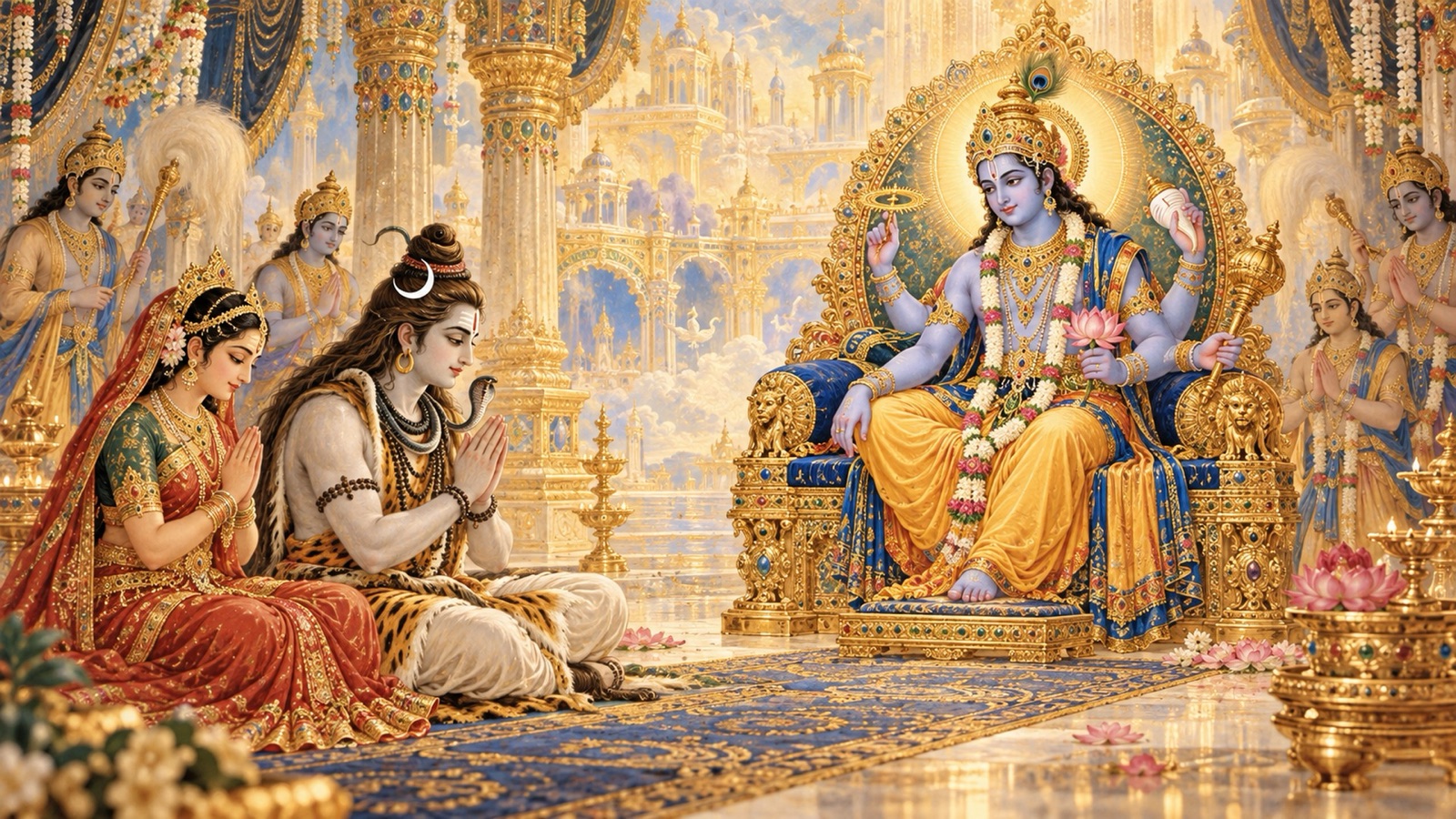
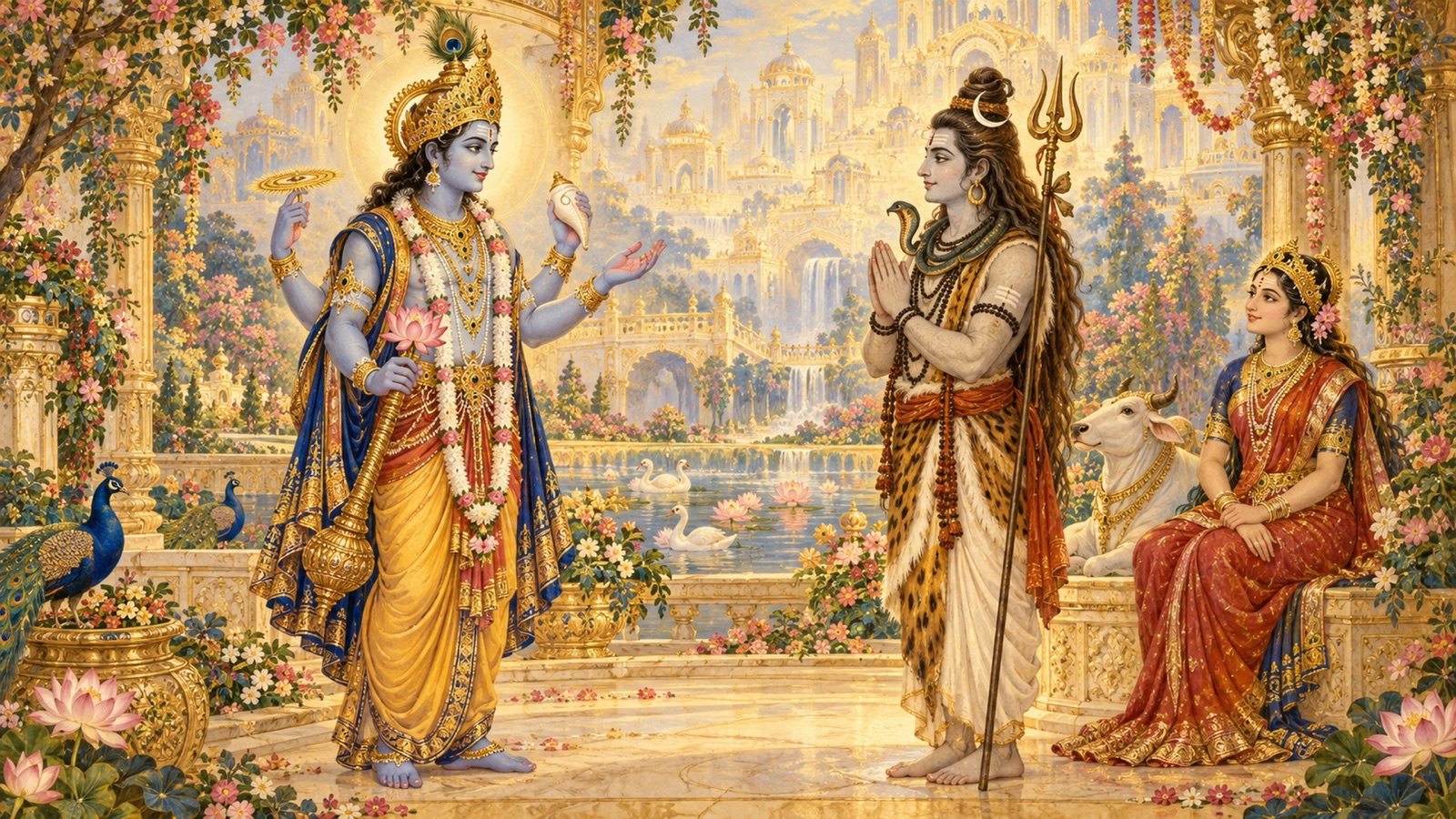
Lord Siva comes to Vaikuntha with Goddess Parvati to behold the Lord who, as an enchanting damsel, gave the gods the nectar. Received with reverence, the great god offers a prayer of surpassing depth — and then asks to see, with his own eyes, the Lord’s bewildering divine potency.
Om Namo Bhagavate Vasudevaya.
Om Namo Bhagavate Vasudevaya.
Om Namo Bhagavate Vasudevaya.
Welcome back to Srimad Bhagavatam Wisdom, a devotional journey through the sacred histories and teachings of the Srimad Bhagavat Mahapurana. Having heard how the Lord, by assuming the form of an enchanting damsel, bewildered the demons and gave the nectar to the gods, Lord Siva comes with Goddess Parvati to Vaikuntha to behold that wondrous form for himself. This twelfth discourse of the Eighth Canto is one of the most profound in the whole book: it contains Lord Siva’s magnificent prayer glorifying Vishnu as the Absolute, and then shows how even Siva — the foremost of yogis — is momentarily overcome when the Lord reveals His deluding potency, Maya. The story is told not to diminish Lord Siva but to reveal a great truth: that the Lord alone stands beyond Maya, while all others, however exalted, are subject to it — and that recognizing this is itself a form of liberation.
Chapter Information
- Scripture: Śrīmad Bhāgavata Mahāpurāṇa
- Canto: 8 (Book Eight)
- Chapter: 12 (Discourse 12)
- Chapter title: Siva’s Humbling and the Lord’s Enchanting Potency
- Principal speaker: Sukadeva Gosvami, narrating to King Parikshit — with the prayers of Lord Siva and the words of Lord Vishnu
- Principal listener: King Parikshit
- Main setting: Vaikuntha, the abode of Lord Vishnu; a blossoming garden nearby
- Central subject: Lord Siva’s prayer to Vishnu; the Lord’s revealing of His enchanting form; Siva’s momentary bewilderment by Maya and his recovery; the glory of the Lord’s deluding potency
- Principal verse range: Canto 8, Chapter 12, verses 1–47
- Primary edition: Gita Press Śrīmad Bhāgavata Mahāpurāṇa
Context From the Previous Chapter
In the eleventh discourse, the war between the gods and the demons came to its close, and the sage Narada halted the gods once the nectar had been secured. Word of how the Lord, in His enchanting form, had beguiled the demons and delivered the nectar to the gods spread through the worlds. This chapter takes up how that news reached Lord Siva on Mount Kailasa, and drew him to Vaikuntha.
Lord Siva Comes to Vaikuntha
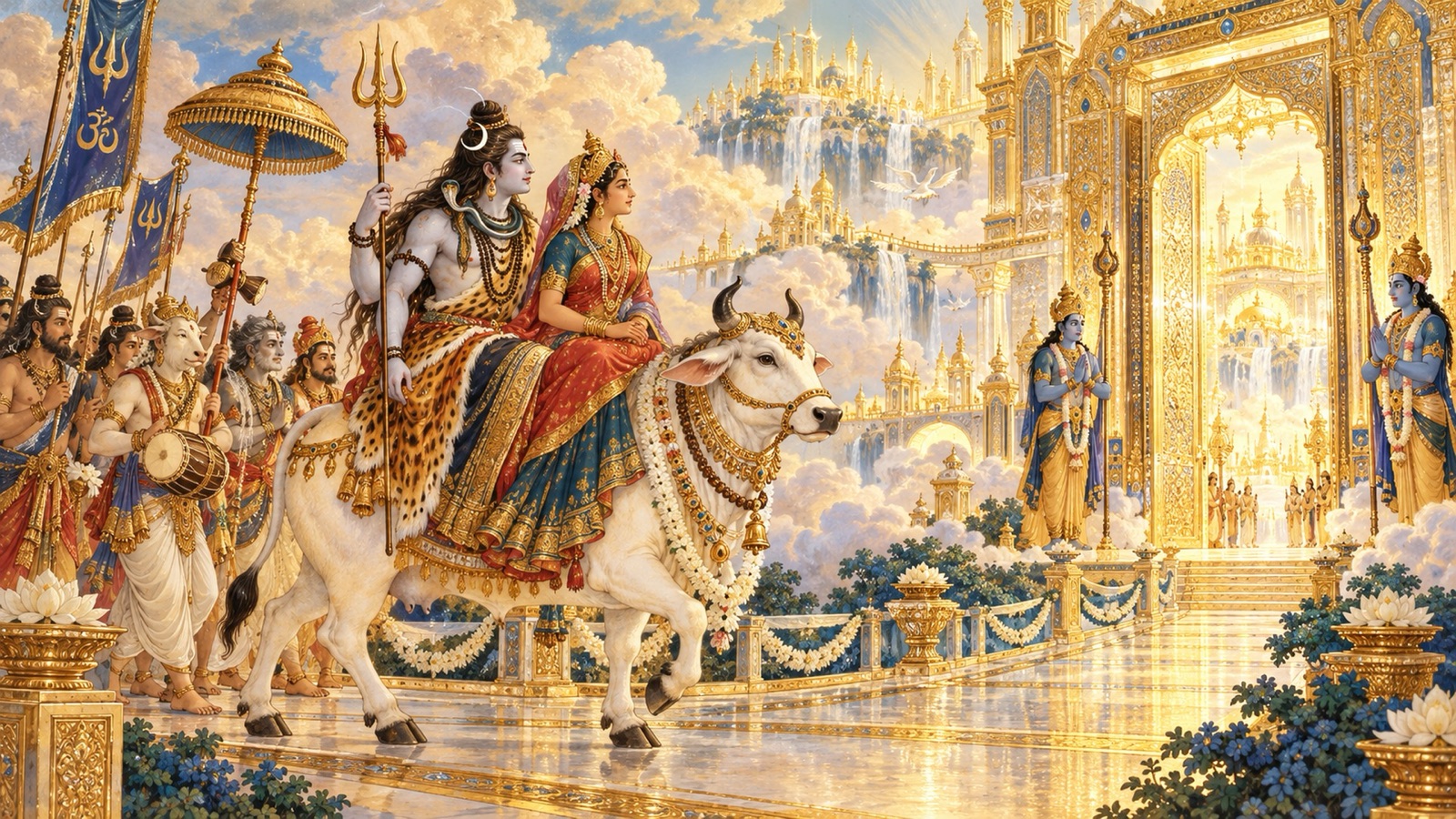
Having heard how Sri Hari, by assuming the form of a bewitching damsel, had enchanted the demons and given nectar to the hosts of heaven, Lord Siva mounted his bull with Goddess Parvati and, surrounded by his retinue, went to Vaikuntha, the abode of Lord Vishnu, to see Him. Received with due reverence and comfortably seated, Lord Siva smilingly offered homage to Sri Hari and prayed.
श्रीमहादेव उवाच देवदेव जगद्वयापिञ्जगदीश जगन्मय । सर्वेषामपि भावानां त्वमात्मा हेतुरीश्वर: ॥ ४ ॥
śrī-mahādeva uvāca deva-deva jagad-vyāpiñ jagad-īśa jagan-maya sarveṣām api bhāvānāṁ tvam ātmā hetur īśvaraḥ
Meaning: Lord Mahadeva said: O God of gods, O Lord pervading and constituting the universe, O Ruler of the universe, You are the Self, the Cause, and the Controller of all things. (Canto 8, Chapter 12, verse 4)
Siva praised the Lord as Brahman, all truth and all consciousness, from whom the universe arises, in whom it abides, and into whom it dissolves — the changeless Absolute, of the nature of pure bliss, one without a second. As gold shaped into an ornament is still nothing but gold, he said, so the apparent diversity of the world is only the Lord in His many aspects; men attribute difference to Him only through ignorance. Neither he himself, nor Brahma, nor the great sages, he confessed — all creatures of Sattva whose understanding is yet veiled by the Lord’s Maya — can fully know the universe the Lord has created, much less His own essential nature.
Yet Siva’s own hymn hints at why such words could not shield him. The various schools, he acknowledged, understand the Lord differently — some as impersonal Brahman, some as the power behind sacred duty, some as the transcendent Person beyond nature and soul, others as the possessor of manifold potencies (verse 9) — each holding only a fragment of the truth. It is not the philosopher’s learning that reaches Him, Siva says in this same prayer, but the pure devotee who, wanting nothing for himself, remains constantly engaged in loving service at His feet (verse 6). This is the lesson folded quietly into the story that follows: Sankara, who could compose so exalted a hymn on the Absolute, is nonetheless the very one who moments later loses himself completely. However vast the learning or the yogic mastery, only surrender carries a soul beyond the Lord’s own Maya.
The Request to Behold the Enchanting Form
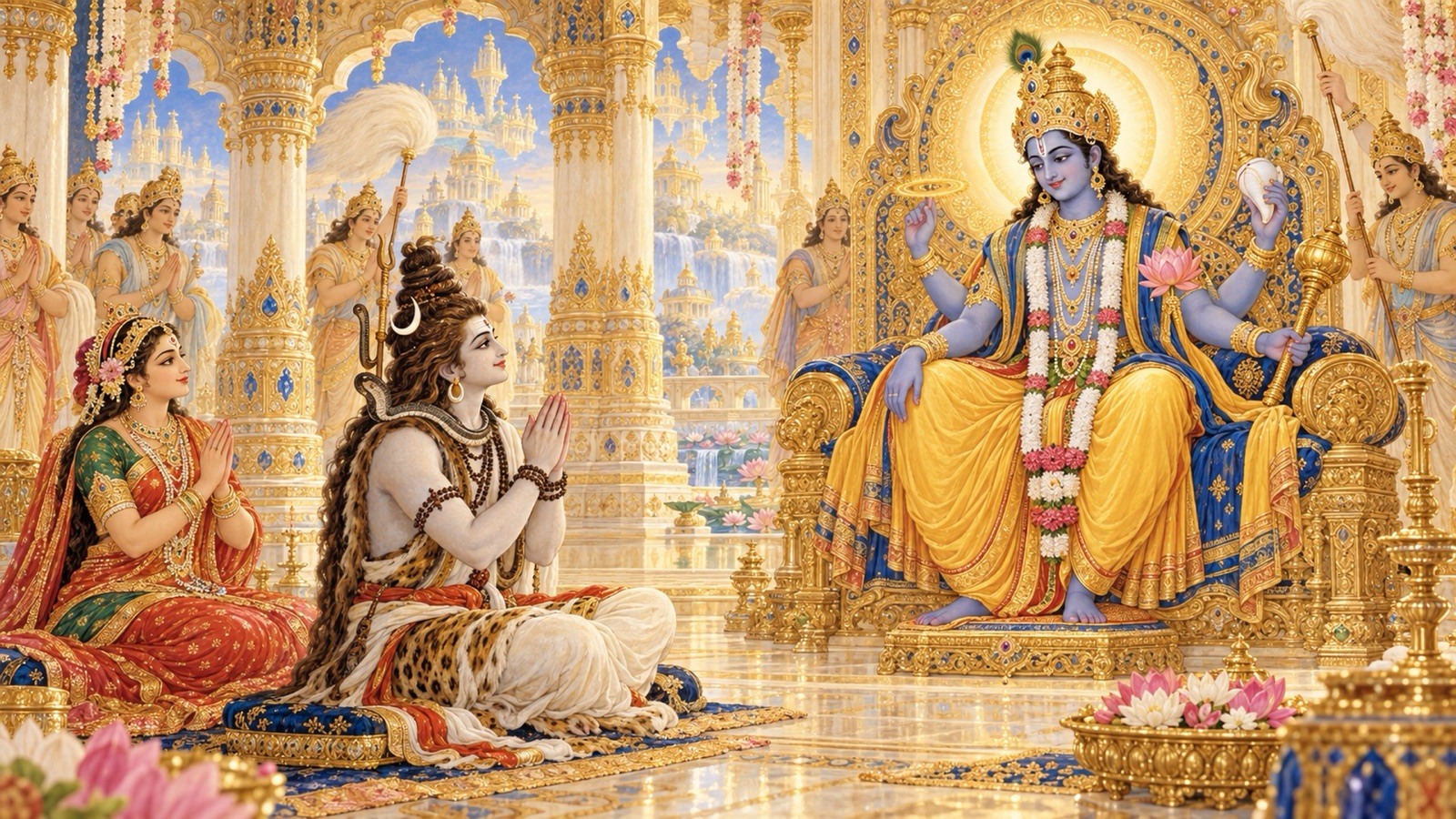
Having offered his prayer, Lord Siva made his request. He had seen the Lord’s many descents, he said, in which He sported with the modes of nature; now he longed to behold that particular form of a damsel by which the demons had been so enchanted.
अवतारा मया दृष्टा रममाणस्य ते गुणै: । सोऽहं तद्द्रष्टुमिच्छामि यत् ते योषिद्वपुर्धृतम् ॥ १२ ॥
avatārā mayā dṛṣṭā ramamāṇasya te guṇaiḥ so ’haṁ tad draṣṭum icchāmi yat te yoṣid-vapur dhṛtam
Meaning: I have seen Your descents in which You sport with the modes of nature; now I wish to behold that form of a damsel which You assumed. (Canto 8, Chapter 12, verse 12)
Hearing this, Lord Vishnu laughed a laugh pregnant with meaning and replied that He had assumed that form only to bewilder the greedy demons and to serve the interests of the gods. Then, telling Siva that He would reveal the form he was so eager to see, the Lord vanished on that very spot, while Lord Siva waited with Goddess Uma, looking all around.
The Bewildering of the Great God
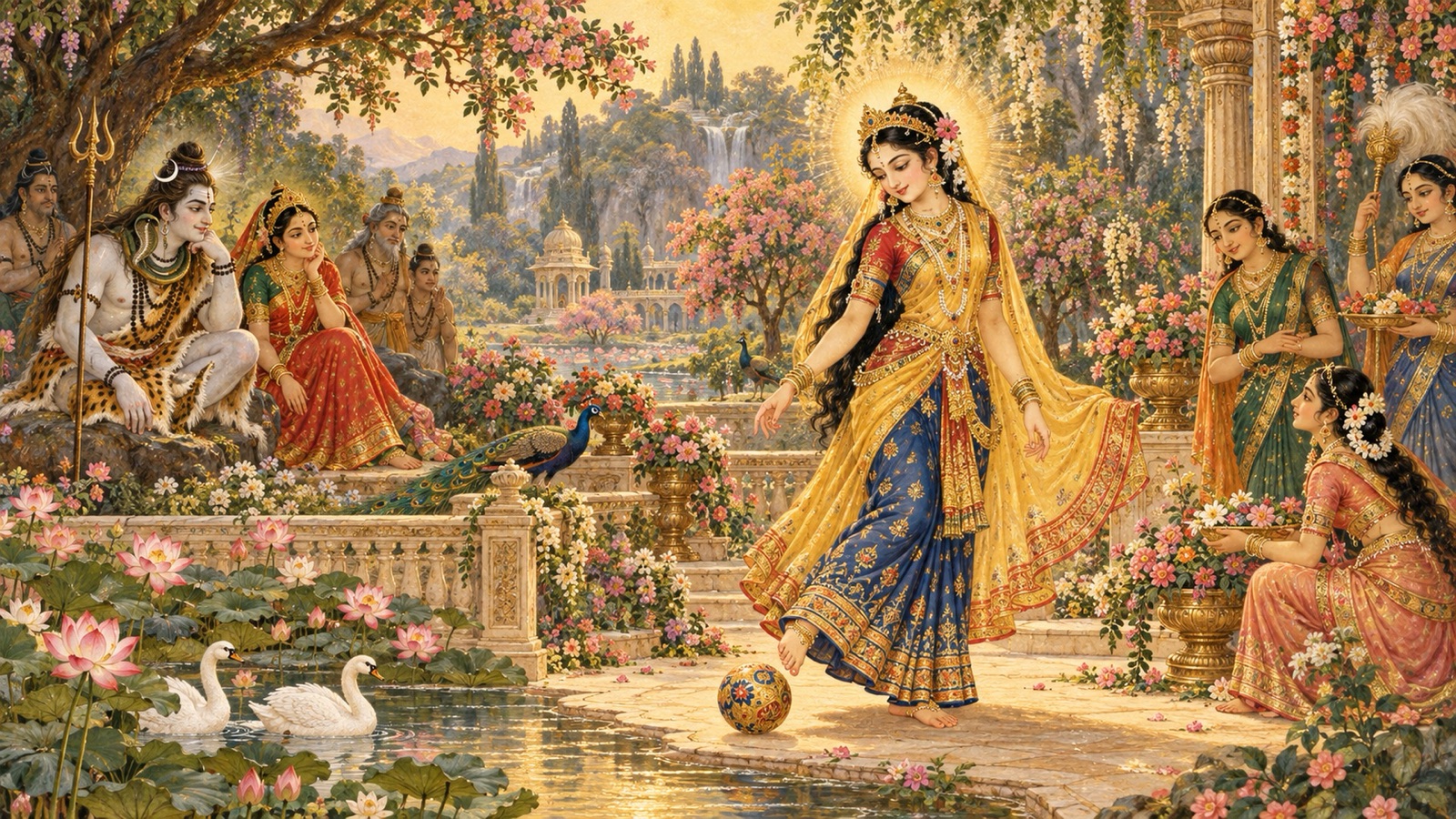
Presently, in a garden rich with blossoms, there appeared a most beautiful divine damsel, playing gracefully with a ball, enchanting the world by the Lord’s own Maya. Gazing upon her, Lord Siva — the foremost of yogis — was overpowered by her presence and, for a time, lost awareness even of himself, of Goddess Parvati beside him, and of his own attendants. So completely was his mind captivated that he followed after the form, until, the Lord’s illusory power having run its course, he recognized himself as befooled by the Lord’s Maya and at once recovered from the bewilderment.
Far from being ashamed, Siva realized anew the glory of Lord Vishnu, whose power cannot be fully known, and did not consider his bewilderment a wonder at all — for who could withstand the Lord’s Maya? This, indeed, is the deep purpose of the episode as the tradition understands it: to show that the deluding potency of the Lord is so overwhelming that even Sankara, the crown-jewel of yogis, was drawn by it, so that no other soul should ever imagine himself immune, and all should take refuge in the Lord alone, who stands beyond Maya.
The Lord’s Praise and Siva’s Recovery
Delighted to find Lord Siva unperturbed and unabashed, Lord Vishnu resumed His original form and spoke to him with affection.
श्रीभगवानुवाच दिष्टया त्वं विबुधश्रेष्ठ स्वां निष्ठामात्मना स्थित: । यन्मे स्त्रीरूपया स्वैरं मोहितोऽप्यङ्ग मायया ॥ ३८ ॥
śrī-bhagavān uvāca diṣṭyā tvaṁ vibudha-śreṣṭha svāṁ niṣṭhām ātmanā sthitaḥ yan me strī-rūpayā svairaṁ mohito ’py aṅga māyayā
Meaning: The Lord said: O best of the gods, it is fortunate that, though bewildered by My Maya in the form of a woman, you have by your own strength returned to your natural, steadfast state. (Canto 8, Chapter 12, verse 38)
What other male, the Lord asked, once caught in His Maya, could overcome it? This Maya of the three modes, He assured Siva, would never again overpower him. Thus honoured, Lord Siva took his leave, circled the Lord in reverence, and returned with his retinue to Kailasa. There, before the assembled sages, he lovingly spoke to Parvati of what they had witnessed: that even he, the foremost of the Lord’s own rays, had helplessly fallen under the spell of Vishnu’s deluding potency — and what wonder, then, that others, who are not masters of themselves, should do so.
The Glory of the Story
Sukadeva concludes by telling King Parikshit that he has now narrated the exploits of Lord Vishnu, who as the divine Tortoise bore Mount Mandara during the churning. The effort of one who recites or hears this story again and again is never wasted, for the narration of the Lord’s glories relieves the whole fatigue of birth and death. He closes with a salutation.
असदविषयमङ्घ्रिं भावगम्यं प्रपन्ना- नमृतममरवर्यानाशयत् सिन्धुमथ्यम् । कपटयुवतिवेषो मोहयन्य: सुरारीं- स्तमहमुपसृतानां कामपूरं नतोऽस्मि ॥ ४७ ॥
asad-aviṣayam aṅghriṁ bhāva-gamyaṁ prapannān amṛtam amara-varyān āśayat sindhu-mathyam kapaṭa-yuvati-veṣo mohayan yaḥ surārīṁs tam aham upasṛtānāṁ kāma-pūraṁ nato ’smi
Meaning: I bow to Him whose feet, unattainable by the impious and reached only through devotion, are the refuge of the surrendered; who, assuming the guise of a damsel, bewildered the enemies of the gods and gave the churned nectar to the foremost of the gods; and who fulfils the desires of all who take shelter in Him. (Canto 8, Chapter 12, verse 47)
Principal Teachings of This Chapter
1. The Lord alone stands beyond Maya. Even Lord Siva, the foremost of yogis, was momentarily overcome, while the Lord who wields Maya is never touched by it. Refuge is safe only in Him who is Maya’s master (verses 35, 39).
2. Humility before Maya is wisdom, not shame. Siva was not embarrassed by his bewilderment but saw in it the Lord’s glory, and told Parvati of it openly. To acknowledge our vulnerability is itself a mark of greatness (verses 36, 43).
3. The greatest prayer begins in surrender. Siva approaches the Lord not with a demand but with a hymn of pure glorification, seeing Him as the Self and cause of all. Worship rooted in surrender is the truest approach to God (verses 4-6).
4. No one should presume immunity to delusion. If even Sankara could be drawn by Maya, no soul should imagine itself safe by its own power. Vigilance and dependence on the Lord are always needed (verse 43).
5. Hearing the Lord’s glories relieves the fatigue of birth and death. Sukadeva promises that reciting or hearing this narration is never in vain. The remembrance of the Lord’s deeds is itself purifying and liberating (verse 46).
A Devotional Reflection
There is something deeply reassuring in this chapter, and it comes precisely from its most surprising moment: that even Lord Siva, the supreme master of meditation, the god who drank poison without harm and sits unmoved in eternal austerity, could be overcome, if only for a while, by the Lord’s Maya. If we read this as a story of Siva’s failing, we miss its heart entirely. It is told, the tradition says, so that none of us should ever imagine ourselves beyond the reach of illusion — and so that we should place our trust not in our own strength, however great, but in the Lord who alone is Maya’s master. What is most beautiful is Siva’s response. He is not crushed, not ashamed; he recovers his composure by his own steadfastness, recognizes the Lord’s glory, and speaks of the whole thing openly to Parvati, drawing from it not humiliation but wisdom. This is how a great soul meets its own vulnerability — without denial and without despair, but with honesty and renewed devotion. For us, the lesson is gentle and freeing: we need not pretend to be invulnerable to the pulls of the world. We need only, when we are caught, turn back — as Siva did — to the Lord who stands beyond it all.
A Daily Devotional Practice
Today, notice one small way in which your mind is pulled off course — a distraction, a craving, a fascination that quietly captures your attention — and, without shame or self-reproach, gently turn back, as Lord Siva did, to the Lord who is beyond all illusion. Repeat softly “Om Namo Bhagavate Vasudevaya,” taking refuge not in your own strength to resist but in Him who alone is the master of Maya. Let the moment of being caught become, as it did for Siva, an occasion for renewed humility and devotion rather than for despair.
Conclusion
The twelfth discourse of the Eighth Canto brings the churning narrative to a profound close. Lord Siva comes to Vaikuntha, offers a magnificent prayer to Vishnu as the Absolute, and asks to behold the Lord’s enchanting form — only to be momentarily overcome by the very Maya he wished to see. Yet the episode humbles without disgracing: Siva recovers by his own steadfastness, realizes the Lord’s unfathomable glory, and speaks of it openly, teaching that no one is beyond illusion and that the Lord alone is its master. Sukadeva ends with the promise that hearing this story relieves the fatigue of birth and death, and with a salutation to the Lord who grants the wishes of every soul who takes refuge in Him. With the great tale of the churning complete, the narration now turns to the remaining Manvantaras and the ages yet to come.
May the divine wisdom of Srimad Bhagavatam awaken pure devotion within our hearts.
Om Namo Bhagavate Vasudevaya.
Jay Shree Madhav.
References and Attribution
- Primary edition: Gita Press, Śrīmad Bhāgavata Mahāpurāṇa (English, complete), Book Eight, Discourse 12, pages 784–790.
- Series: Srimad Bhagavatam Wisdom · Biswa Sanatan Dharma Seva Trust.
- Presented following the spiritual guidance and recommendation of Pandit Dr. Shri Kashinath Mishra.
This is an original, faithful retelling in the writer’s own words, with brief quoted verses shown in Devanāgarī and transliteration and their meanings given as summaries. It is not a reproduction of any single publisher’s continuous translation or commentary. No affiliation with or endorsement by any publisher is implied.
Jay Shree Madhav