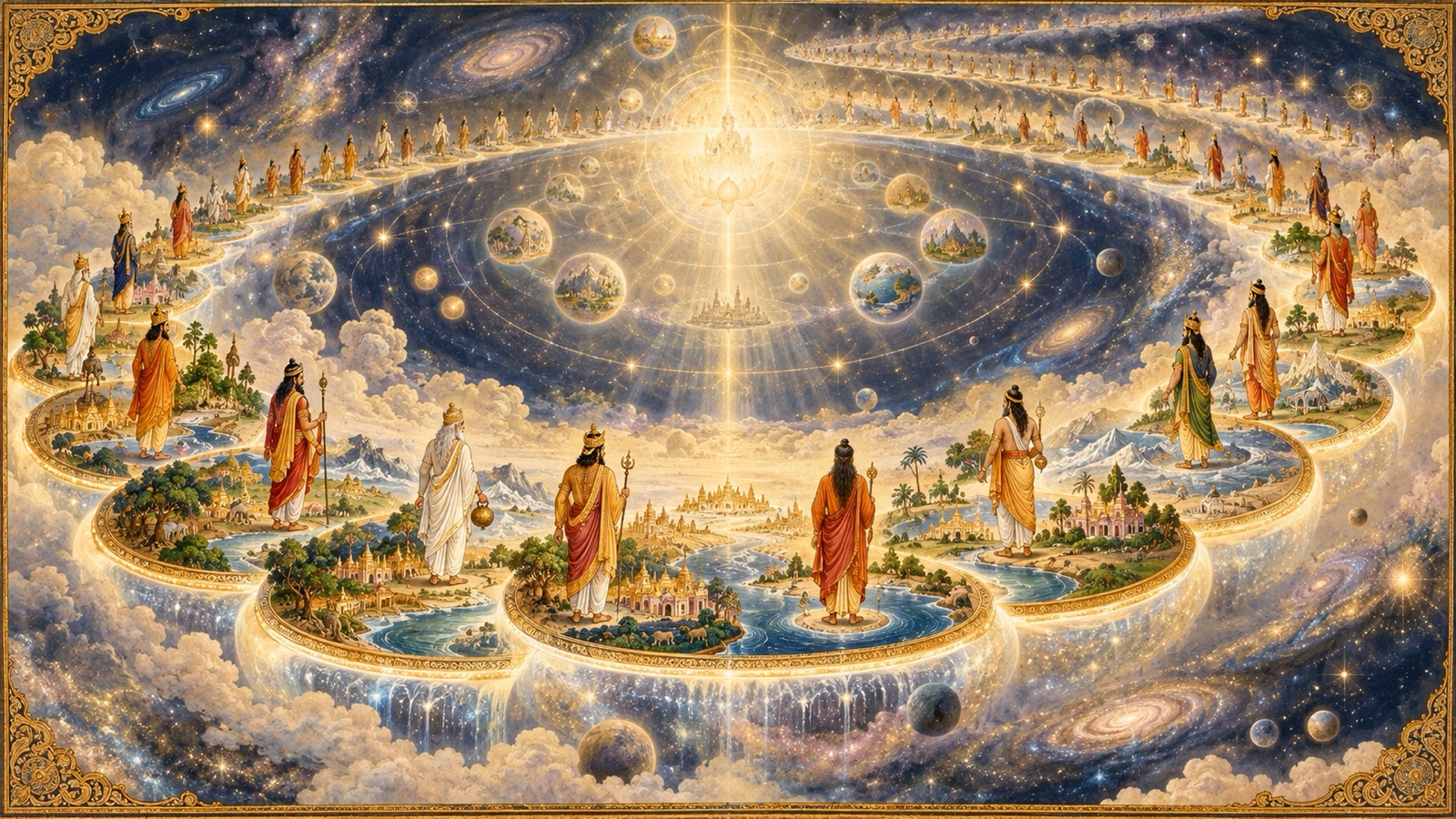
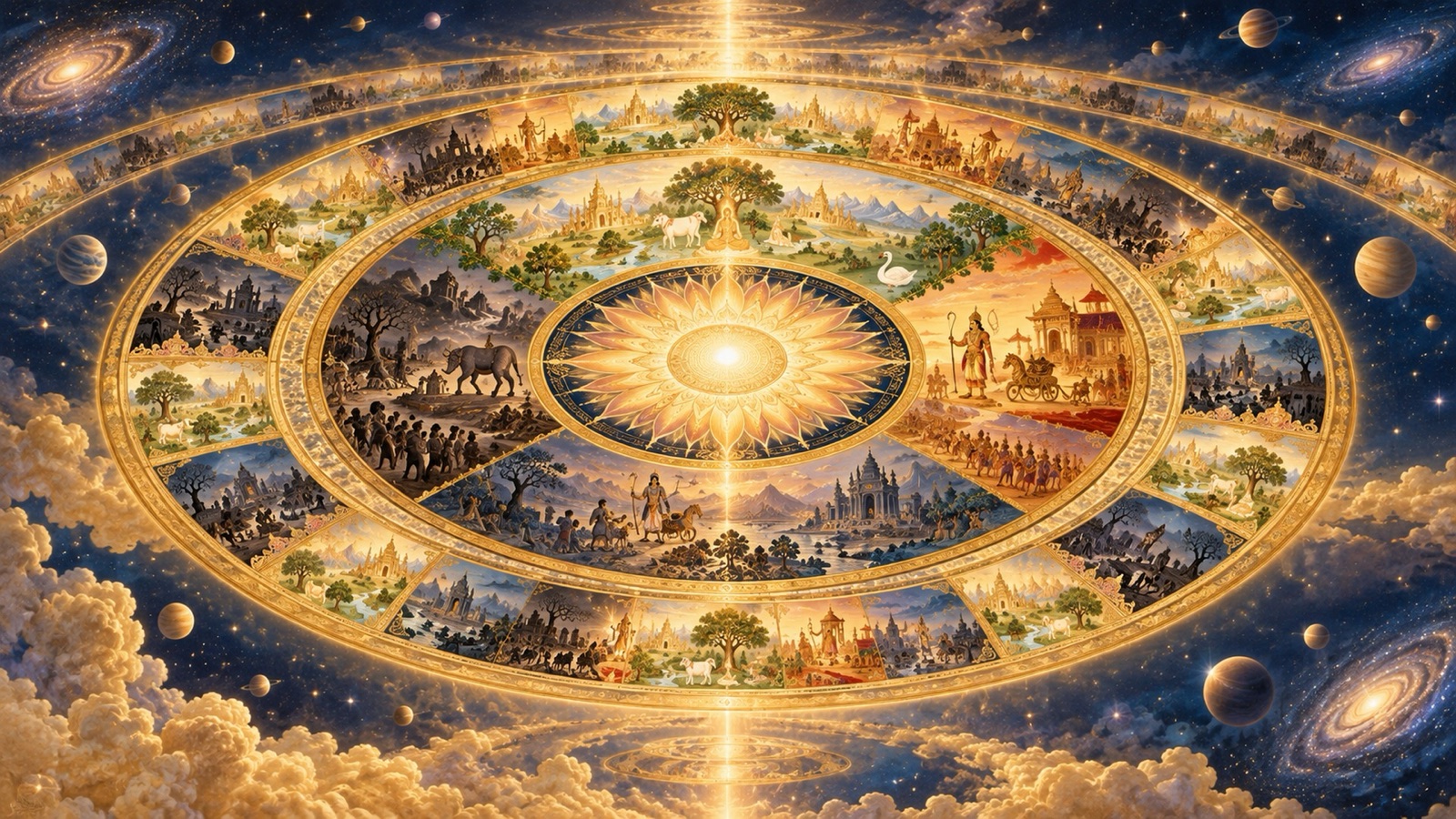
Age gives way to age, and Manu succeeds Manu across the vast wheel of time. Sukadeva unveils the coming Manvantaras — the future rulers, their sages and gods, and, in every one of them, the descent of the Lord to sustain the world.
Om Namo Bhagavate Vasudevaya.
Om Namo Bhagavate Vasudevaya.
Om Namo Bhagavate Vasudevaya.
Welcome back to Srimad Bhagavatam Wisdom, a devotional journey through the sacred histories and teachings of the Srimad Bhagavat Mahapurana. Having described the first six great cosmic ages and heard the wondrous tale of the churning of the ocean, Sukadeva Gosvami now completes his account of the Manvantaras by looking forward across time. This thirteenth discourse of the Eighth Canto describes the present, seventh Manu and his descendants, and then unveils the seven Manvantaras yet to come — each with its own Manu, sages, gods, and Indra, and, in every single one, a descent of the Supreme Lord to protect the righteous and uphold the eternal order. It is a chapter of names and successions, but its deeper music is unmistakable: while every ruler and every age passes in turn, the Lord alone remains, appearing again and again to sustain His creation.
Chapter Information
- Scripture: Śrīmad Bhāgavata Mahāpurāṇa
- Canto: 8 (Book Eight)
- Chapter: 13 (Discourse 13)
- Chapter title: The Future Manus and the Coming Manvantaras
- Principal speaker: Sukadeva Gosvami, narrating to King Parikshit
- Principal listener: King Parikshit
- Main setting: The narration continues at Sukatirtha on the bank of the Ganga, encompassing the whole sweep of cosmic time
- Central subject: The present seventh Manu and his line; the eight remaining Manvantaras, their Manus, sages, gods, and Indras; and the Lord’s descent in each age
- Principal verse range: Canto 8, Chapter 13, verses 1–36
- Primary edition: Gita Press Śrīmad Bhāgavata Mahāpurāṇa
Context From the Previous Chapter
In the twelfth discourse, Lord Siva came to Vaikuntha, offered a profound prayer to Lord Vishnu, and asked to behold the Lord’s enchanting form — only to be momentarily overcome by the Lord’s Maya, from which he recovered by his own steadfastness. With the great narrative of the churning of the ocean thus complete, Sukadeva now returns to the framework of the Manvantaras, resuming the account of the cosmic ages that he had begun in the first discourse of this canto.
The Present, Seventh Manu and His Line
Sukadeva begins with the age we ourselves inhabit. The seventh and present Manu, he says, is Sraddhadeva, the son of Vivasvan, the sun-god; this is the Vaivasvata Manvantara.
श्रीशुक उवाच मनुर्विवस्वत: पुत्र: श्राद्धदेव इति श्रुत: । सप्तमो वर्तमानो यस्तदपत्यानि मे शृणु ॥ १ ॥
śrī-śuka uvāca manur vivasvataḥ putraḥ śrāddhadeva iti śrutaḥ saptamo vartamāno yas tad-apatyāni me śṛṇu
Meaning: Sukadeva said: The present, seventh Manu, known as Sraddhadeva, is the son of Vivasvan. Now hear from me about his sons. (Canto 8, Chapter 13, verse 1)
He names the ten sons of the Vaivasvata Manu — Ikshvaku, Nabhaga, Dhrishta, Saryati, Narishyanta, Nabhaga, Dishta, Karusha, Prishadhra, and Vasuman — and lists the presiding gods of this age (the Adityas, Vasus, Rudras, Vishvedevas, Maruts, Ashvins, and Ribhus), whose Indra is Purandara, and the seven great seers: Kashyapa, Atri, Vasishtha, Vishvamitra, Gautama, Jamadagni, and Bharadvaja. Then he adds the truth that gives the whole list its meaning — that in this present age too, the Lord has descended.
अत्रापि भगवज्जन्म कश्यपाददितेरभूत् । आदित्यानामवरजो विष्णुर्वामनरूपधृक् ॥ ६ ॥
atrāpi bhagavaj-janma kaśyapād aditer abhūt ādityānām avarajo viṣṇur vāmana-rūpa-dhṛk
Meaning: In this Manvantara too the Lord took birth, from Kashyapa and Aditi: the youngest of the Adityas, Lord Vishnu, who assumed the form of a dwarf. (Canto 8, Chapter 13, verse 6)
Having thus briefly described the first seven Manvantaras, Sukadeva says he will now tell of the seven to come, which are likewise bound up with the descents of the Lord.
The Eighth Manvantara: Bali Becomes Indra
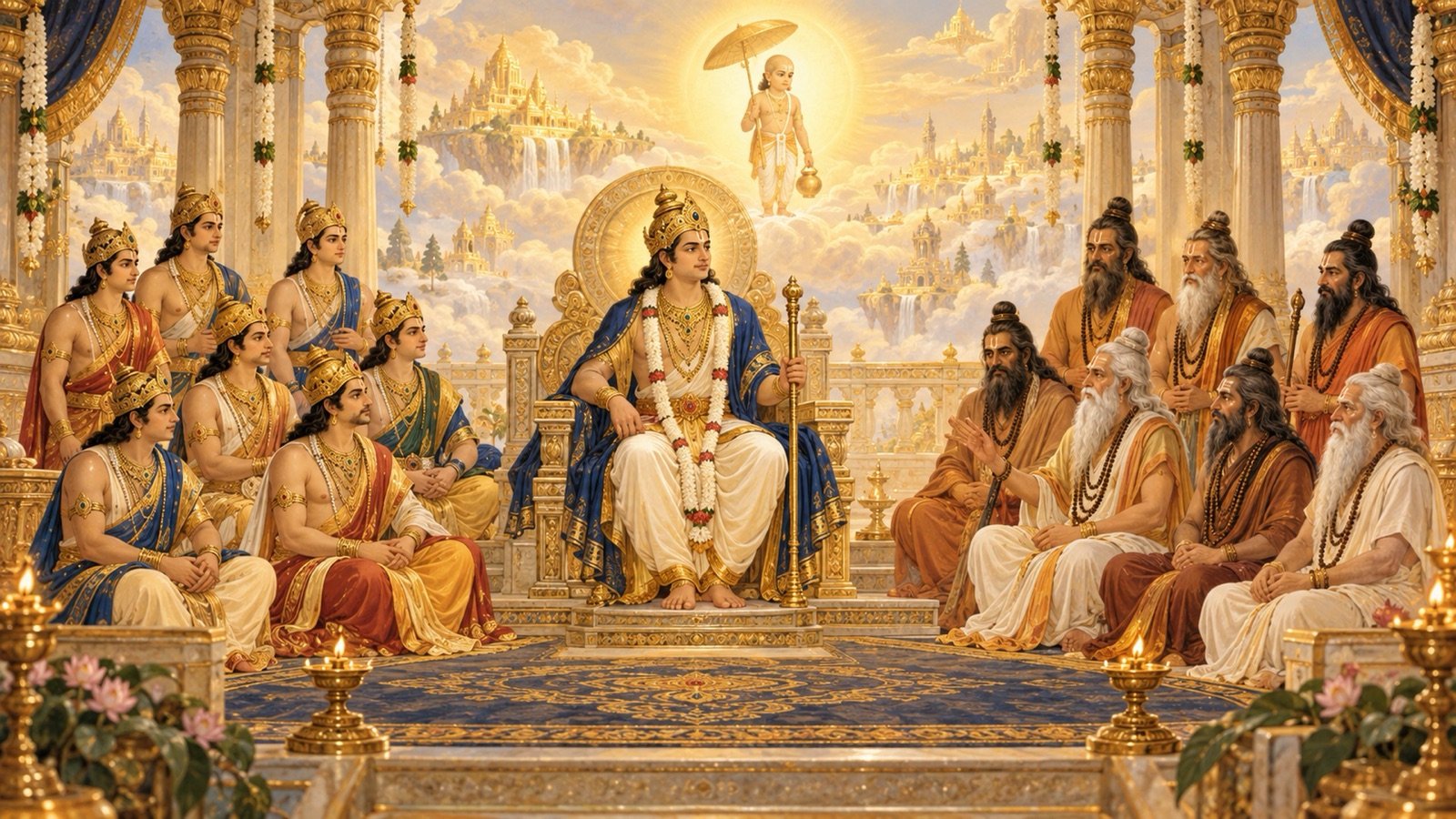
Turning to the future, Sukadeva describes the eighth Manu, Savarni, son of Vivasvan through Chaya, whose sons will be Nirmoka, Virajaska, and others. In that age the gods will be the Sutapas, Virajas, and Amritaprabhas, and — remarkably — their Indra will be Bali, the very demon king whose story fills the chapters ahead.
दत्त्वेमां याचमानाय विष्णवे य: पदत्रयम् । राद्धमिन्द्रपदं हित्वा तत: सिद्धिमवाप्स्यति ॥ १३ ॥
dattvemāṁ yācamānāya viṣṇave yaḥ pada-trayam rāddham indra-padaṁ hitvā tataḥ siddhim avāpsyati
Meaning: Having given this earth to Lord Vishnu, who begged of him three paces of land, Bali will in due course relinquish even the attained post of Indra and thereby achieve final perfection. (Canto 8, Chapter 13, verse 13)
This is the same Bali, Sukadeva notes, who was bound by the Lord as a mark of favour and then installed in Sutala, a realm richer than heaven, where he flourishes to this day. The seven seers of that age will be Galava, Diptiman, Parashurama, Ashvatthama, Kripacharya, Rishyashringa, and Vyasa — presently living each in his own hermitage. And the Lord Himself will descend as Sarvabhauma, born of Devaguhya through Sarasvati, who will wrest the throne of heaven from the present Indra and bestow it upon Bali.
From the Ninth to the Fourteenth Manus
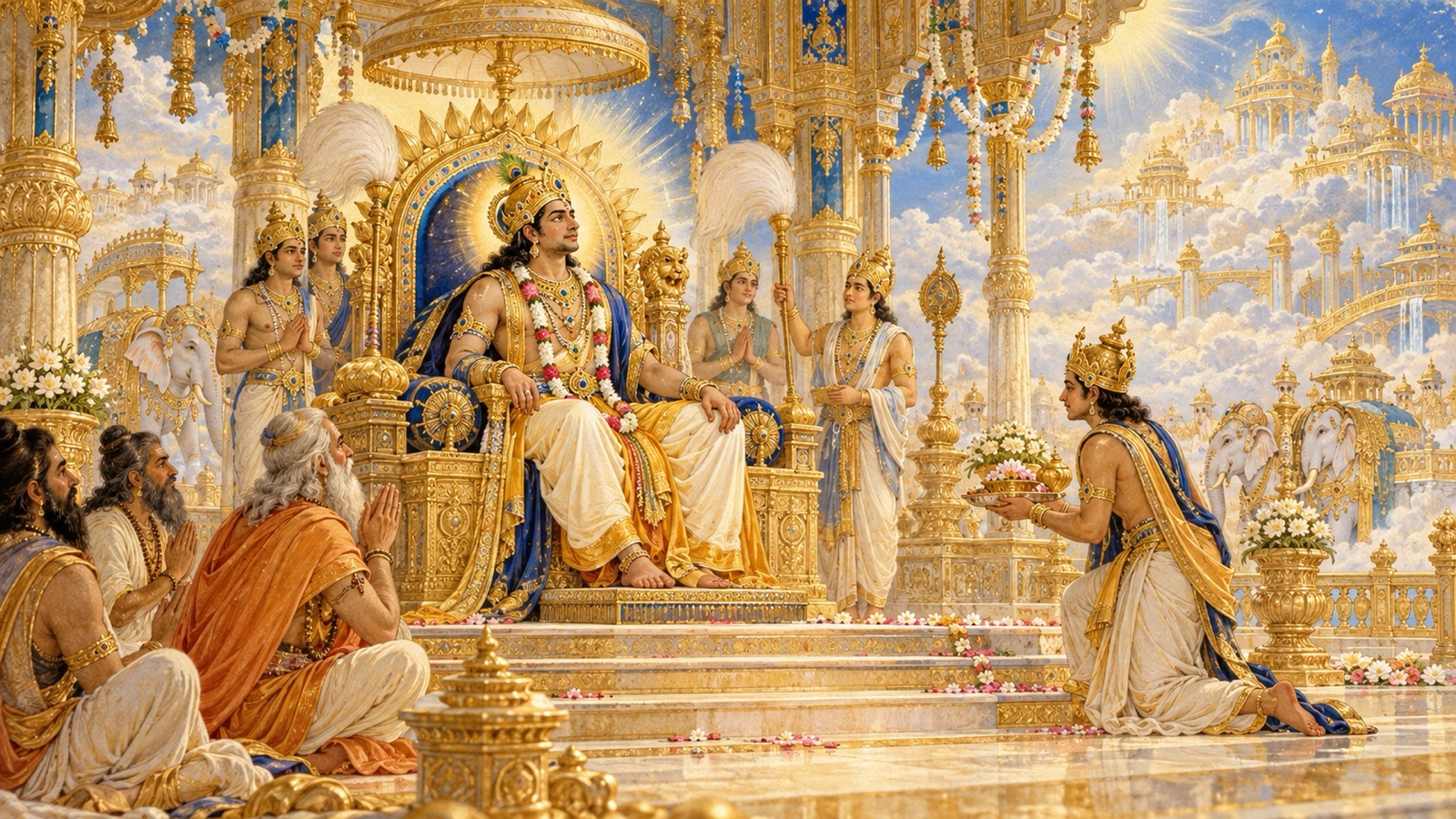
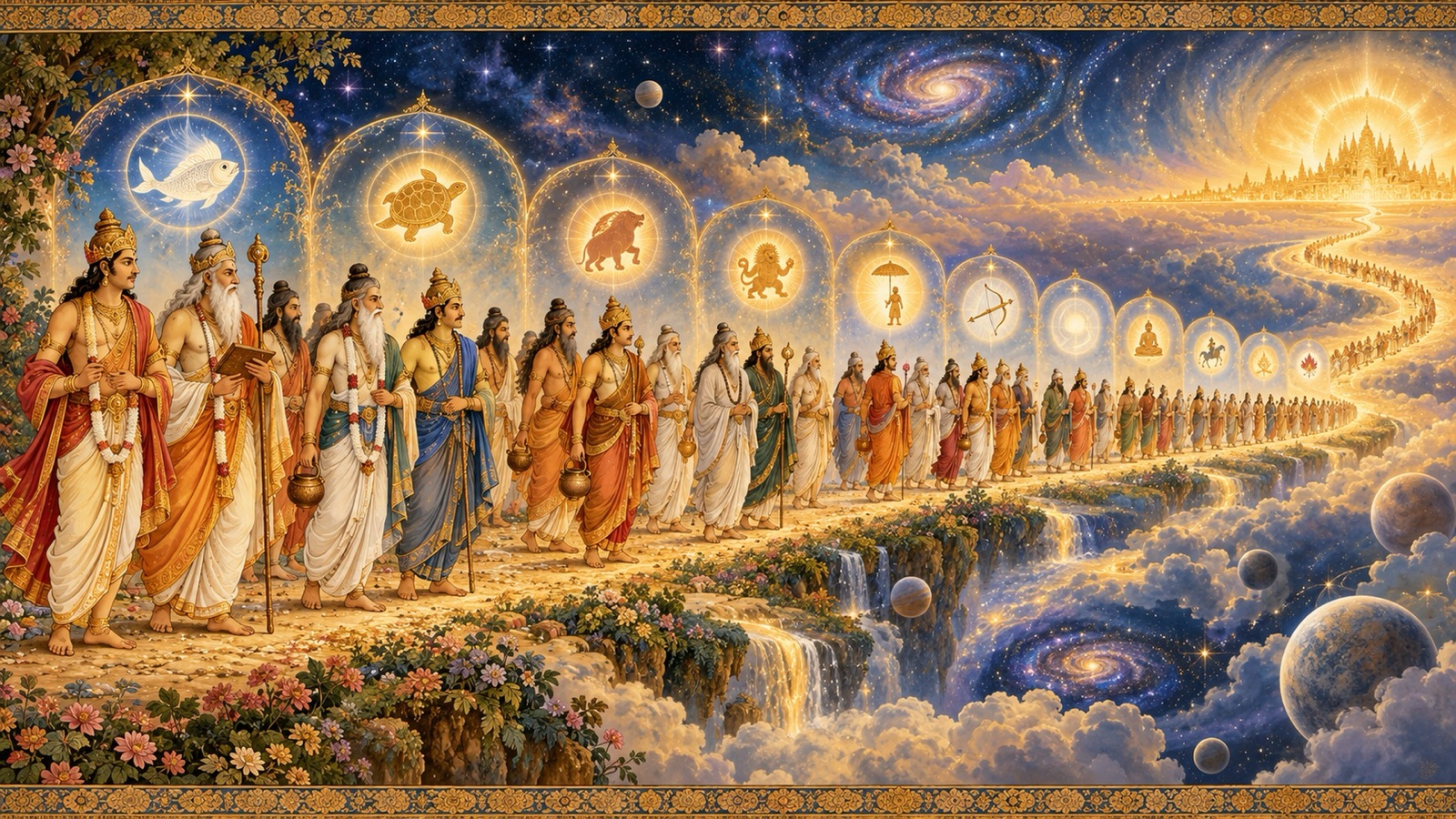
Sukadeva then unfolds the remaining ages in swift succession, each with its Manu, gods, Indra, seers, and divine descent. The ninth Manu will be Daksha-savarni, son of Varuna, in whose age the Lord will appear as Rishabha. The tenth will be Brahma-savarni, son of Upashloka, when the Lord will appear as Vishvaksena and befriend the Indra Shambhu. The eleventh will be Dharma-savarni, in whose time the Lord will appear as Dharmasetu to maintain the three worlds. The twelfth will be Rudra-savarni, when the Lord will appear as Svadhama; the thirteenth, Deva-savarni, when He will appear as Yogeshvara; and the fourteenth, Indra-savarni, when He will appear as Brihadbhanu to propagate the sacred rituals. Age after age, the rulers and sages change, but the descent of the Lord is the one constant thread woven through them all.
The Measure of a Kalpa
Having named all fourteen Manvantaras — those past, present, and yet to come — Sukadeva closes with their cosmic significance.
राजंश्चतुर्दशैतानि त्रिकालानुगतानि ते । प्रोक्तान्येभिर्मित: कल्पो युगसाहस्रपर्यय: ॥ ३६ ॥
rājaṁś caturdaśaitāni tri-kālānugatāni te proktāny ebhir mitaḥ kalpo yuga-sāhasra-paryayaḥ
Meaning: O King, these fourteen Manvantaras, spanning past, present, and future, have been described to you. By them a Kalpa — comprising a thousand cycles of the four Yugas — is measured. (Canto 8, Chapter 13, verse 36)
Thus the fourteen Manus together measure out a single day of Brahma, a Kalpa within the vast lifetime of the creator — a scale of time so immense that it quietly dissolves every human notion of permanence.
Principal Teachings of This Chapter
1. Every age passes; the Lord alone endures. Fourteen Manus, countless sages, gods, and Indras rise and fall, but in every Manvantara the Lord descends. Rulers and ages are temporary; the divine presence sustaining them is eternal (verses 6, 36).
2. The Lord descends in every age. From Vamana in the present age to Rishabha, Vishvaksena, and Brihadbhanu in the ages to come, the chapter shows that God is never absent from His creation. His care is continuous across all of time (verses 6, 17-35).
3. Surrender exalts even a demon king. Bali, who gave everything to the Lord, is destined to become Indra and then to attain final perfection. What raised him was not his power but his surrender (verse 13).
4. True perfection lies beyond even the highest post. Bali will relinquish even the coveted throne of Indra to attain liberation. The chapter teaches that the goal of life is not high position but freedom in God (verse 13).
5. The scale of time humbles our pride. A single day of Brahma spans a thousand cycles of the four Yugas. Set against such immensity, our anxieties about status and permanence gently fall into perspective (verse 36).
A Devotional Reflection
At first glance this chapter can seem like a mere catalogue of unfamiliar names — Manus and sages and gods succeeding one another across ages we will never see. Yet if we listen more closely, something profoundly reassuring emerges from the list. Every one of these ages, however glorious, comes to an end. Every ruler, however mighty, eventually gives way to another. Nothing in the whole sweep of cosmic time holds still. And into this endless succession the Bhagavata inserts one unchanging refrain: in every age, the Lord descends. He is the one presence that does not pass away, appearing again and again — as a dwarf, as a sage, as a teacher of yoga, as the propagator of dharma — to protect the good and restore the world. There is deep comfort in this for a heart that clings to things that must change. The chapter gently loosens our grip on permanence and points us to the only permanence there is. And in the destiny of Bali, it offers a further hope: that even one who has lost everything to the Lord loses nothing at all, but is raised higher than he ever stood, and finally freed altogether.
A Daily Devotional Practice
Today, take a quiet moment to place your own concerns against the scale of this chapter — a single day of Brahma spanning a thousand ages. Notice how many of your worries are bound up with things that, like the Manvantaras, must pass. Then gently turn your heart toward the one presence that does not pass, repeating softly “Om Namo Bhagavate Vasudevaya.” Let the vastness of time not frighten you but free you, resting your trust in the Lord who descends in every age and abides through them all.
Conclusion
The thirteenth discourse of the Eighth Canto completes Sukadeva’s account of the Manvantaras, carrying us from the present, seventh age of the Vaivasvata Manu across the seven ages yet to come. Manus, sages, gods, and Indras succeed one another in a stately procession, and in every age the Lord descends to sustain the world — as the Dwarf in our own time, and as Rishabha, Sarvabhauma, Vishvaksena, Dharmasetu, Svadhama, Yogeshvara, and Brihadbhanu in the ages ahead. Fourteen such Manvantaras measure a single day of Brahma, a scale that dwarfs every human reckoning of time. Above all, the chapter reveals the destiny of Bali, who by his surrender will one day rule as Indra and then attain perfection — a promise that prepares us for his great story, which the coming chapters will unfold.
May the divine wisdom of Srimad Bhagavatam awaken pure devotion within our hearts.
Om Namo Bhagavate Vasudevaya.
Jay Shree Madhav.
References and Attribution
- Primary edition: Gita Press, Śrīmad Bhāgavata Mahāpurāṇa (English, complete), Book Eight, Discourse 13, pages 790–794.
- Series: Srimad Bhagavatam Wisdom · Biswa Sanatan Dharma Seva Trust.
- Presented following the spiritual guidance and recommendation of Pandit Dr. Shri Kashinath Mishra.
This is an original, faithful retelling in the writer’s own words, with brief quoted verses shown in Devanāgarī and transliteration and their meanings given as summaries. It is not a reproduction of any single publisher’s continuous translation or commentary. No affiliation with or endorsement by any publisher is implied.
Jay Shree Madhav