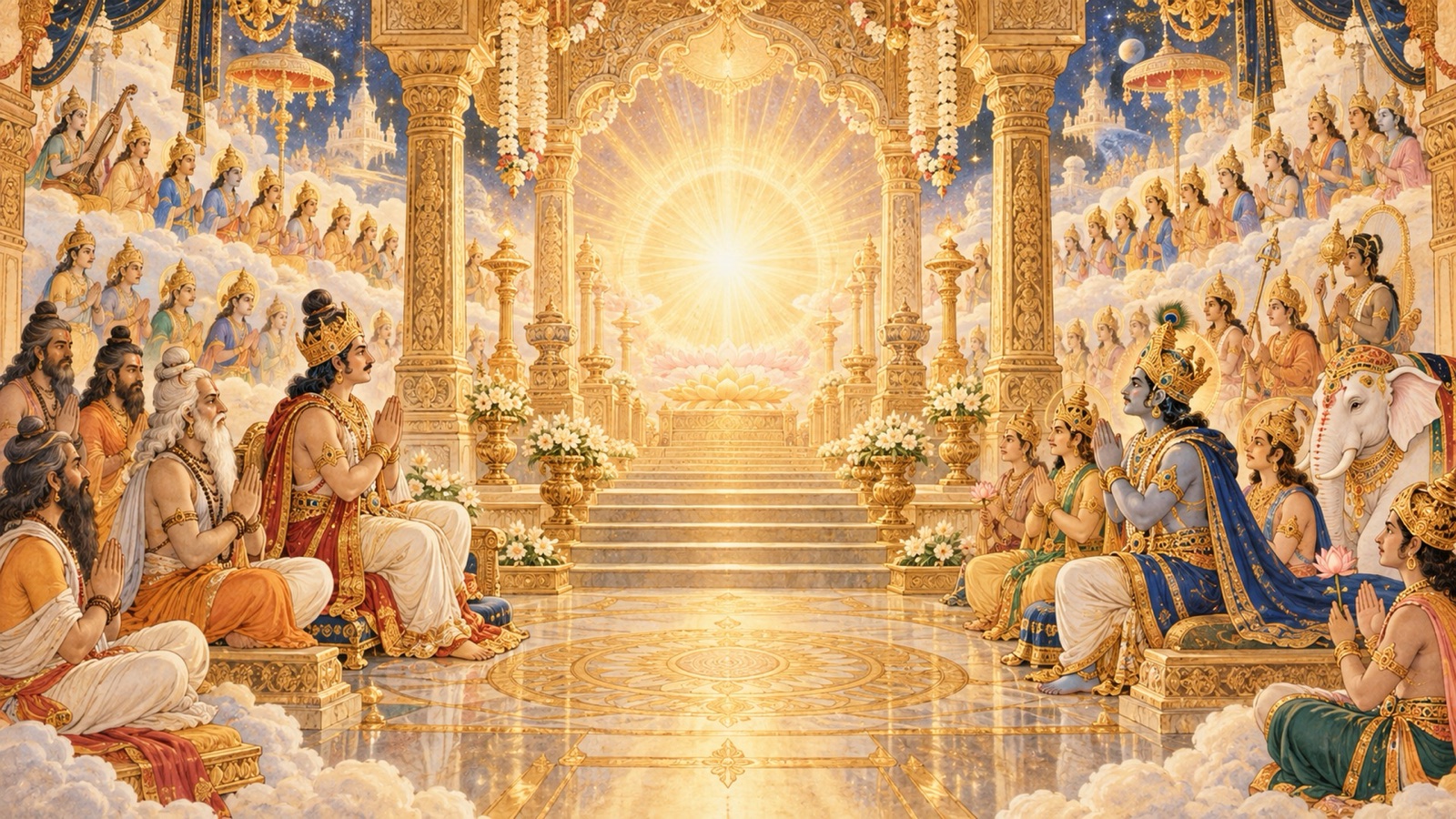
Who governs the vast machinery of a cosmic age — the Manu, the sages, the gods, the Indra? King Parikshit asks, and Sukadeva answers: all of them act, but all of them act under the command of the one Supreme Person.
Om Namo Bhagavate Vasudevaya.
Om Namo Bhagavate Vasudevaya.
Om Namo Bhagavate Vasudevaya.
Welcome back to Srimad Bhagavatam Wisdom, a devotional journey through the sacred histories and teachings of the Srimad Bhagavat Mahapurana. Having heard the long roll of the Manus, past, present, and to come, King Parikshit now asks a practical question — how, exactly, is the universe administered across these ages, and who does what — and in this brief but illuminating fourteenth discourse of the Eighth Canto, Sukadeva Gosvami answers by lifting the veil on the whole system of cosmic management.
Chapter Information
- Scripture: Śrīmad Bhāgavata Mahāpurāṇa
- Canto: 8 (Book Eight)
- Chapter: 14 (Discourse 14)
- Chapter title: How the Manu and His Officers Govern the Universe
- Principal speaker: Sukadeva Gosvami, narrating to King Parikshit
- Principal listener: King Parikshit
- Main setting: The narration on the bank of the Ganga, describing the governance of each Manvantara
- Central subject: How the Manu, sages, gods, and Indra administer the universe under the direction of the Supreme Lord, who acts through many forms in every age
- Principal verse range: Canto 8, Chapter 14, verses 1–11
- Primary edition: Gita Press Śrīmad Bhāgavata Mahāpurāṇa
Context From the Previous Chapter
In the thirteenth discourse, Sukadeva completed his account of the fourteen Manvantaras, naming the Manus, sages, gods, and Indras of every age, and the descent of the Lord in each. That great catalogue naturally raised a question about how such a vast system actually functions — and it is this question that King Parikshit now puts to his teacher, opening the present chapter.
The King’s Question
King Parikshit asks his teacher to explain the workings of cosmic administration: how, and by whom, are the Manus and the other functionaries employed in their various duties across the Manvantaras? It is the question of a thoughtful ruler, one who knows something of governance himself and wishes to understand the divine order that lies behind the turning of the ages.
All Under the Command of the Supreme Person
Sukadeva’s reply goes at once to the heart of the matter: every rank of universal administration, from the Manu down to the gods themselves, answers to one and the same authority.
श्रीऋषिरुवाच मनवो मनुपुत्राश्च मुनयश्च महीपते । इन्द्रा: सुरगणाश्चैव सर्वे पुरुषशासना: ॥ २ ॥
śrī-ṛṣir uvāca manavo manu-putrāś ca munayaś ca mahī-pate indrāḥ sura-gaṇāś caiva sarve puruṣa-śāsanāḥ
Meaning: Sukadeva said: O ruler of the earth, the Manus, the sons of the Manus, the sages, the Indras, and the hosts of gods are all under the command of the Supreme Person. (Canto 8, Chapter 14, verse 2)
Directed by the various forms of the Lord — Yajna and the others named earlier — the Manu and the rest carry on the administration of the universe. However exalted their offices, they remain instruments of a higher will, executing the purpose of the one who appointed them.
The Renewal of the Vedas and Dharma in Every Age
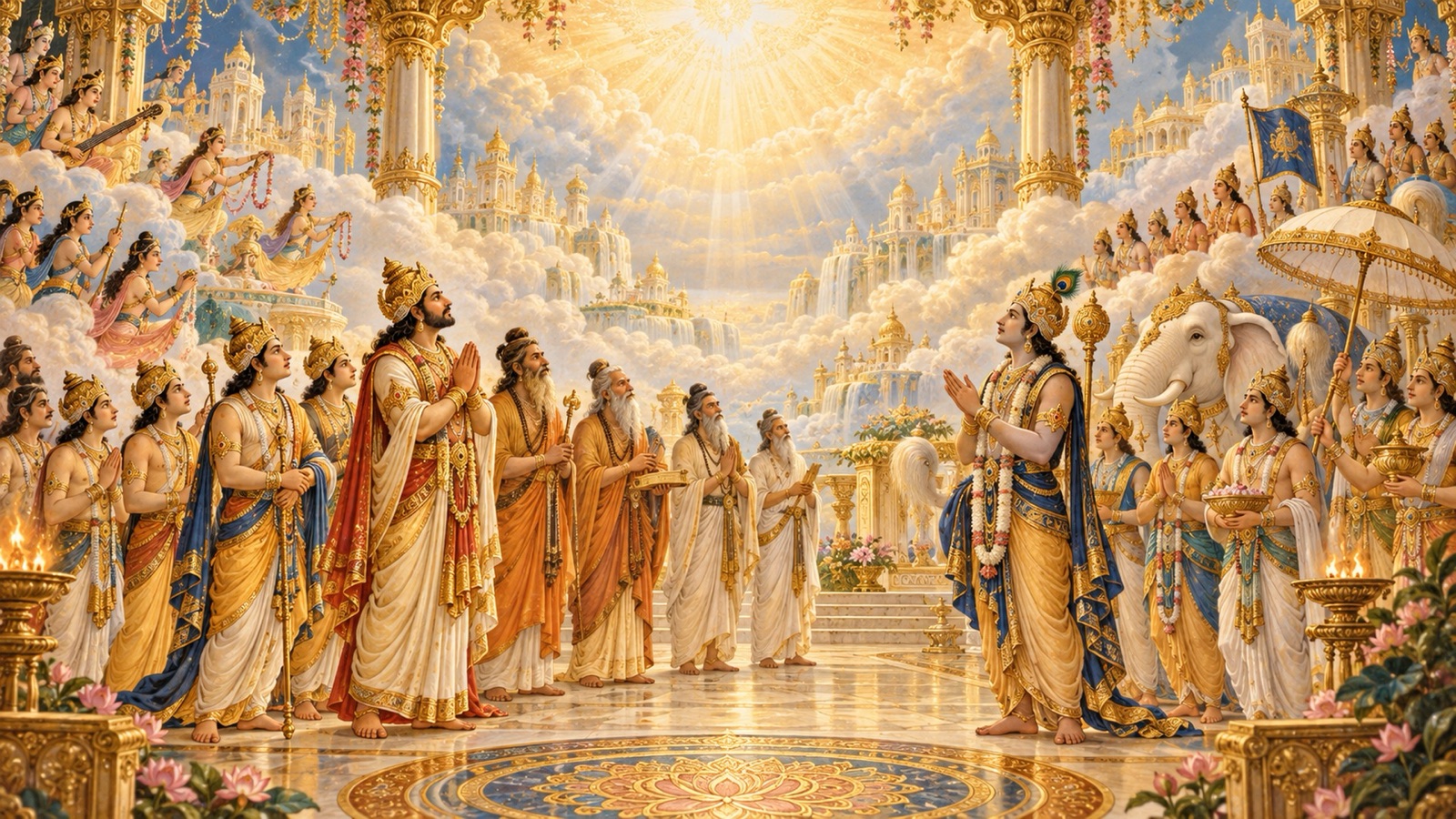
Sukadeva then describes how the eternal order is kept alive across time. At the end of each cycle of the four Yugas, the great seers, by the power of their austerity, recover the collections of Vedic texts that had been lost to Time, and through these the truth of the eternal religion is perceived anew. The Manus, instructed within their hearts by Sri Hari and fully alert, then propagate on the earth, in their own time, the fourfold practice of piety — austerity, purity, compassion, and truth. The protectors of created beings, the sons of the Manus and their descendants generation after generation, uphold religion and the earth by parts until the end of the Manvantara, while the gods and all who share in the great sacrifices enjoy their portion and thereby sustain the sacred order.
How the Lord Governs Through Many Forms
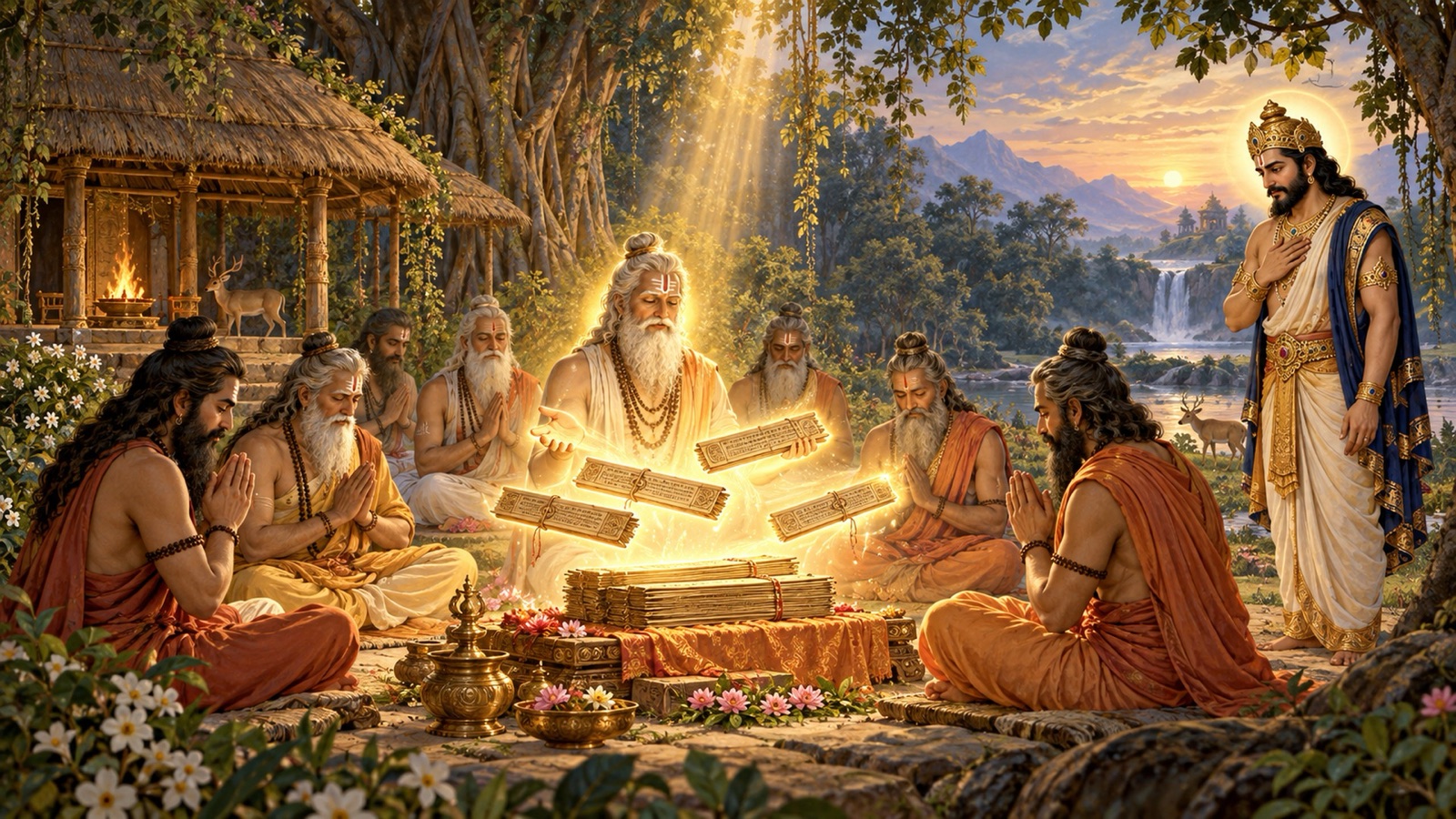
Behind all these appointed guardians stands the Lord Himself, working through an endless variety of forms. Enjoying the wealth of the three worlds conferred upon him by the Lord, Indra protects those worlds and sends down the rains. And in every age Sri Hari appears in many guises to guide the world.
ज्ञानं चानुयुगं ब्रूते हरि: सिद्धस्वरूपधृक् । ऋषिरूपधर: कर्म योगं योगेशरूपधृक् ॥ ८ ॥
jñānaṁ cānuyugaṁ brūte hariḥ siddha-svarūpa-dhṛk ṛṣi-rūpa-dharaḥ karma yogaṁ yogeśa-rūpa-dhṛk
Meaning: In every age Sri Hari, assuming the form of perfected beings, imparts spiritual knowledge; taking the form of sages, He teaches the path of sacred action; and taking the form of masters of yoga, He teaches the practice of yoga. (Canto 8, Chapter 14, verse 8)
Taking the form of lords of creation, Sukadeva continues, the Lord carries on the work of creation; as an independent sovereign, He restrains the wicked; and, appearing as Time itself with its changing conditions, it is He who brings about the disappearance of all things. Though philosophers describe Him variously through their many systems, their understanding clouded by the Maya of names and forms, the Lord is not truly grasped by such reasoning alone.
The Measure of a Kalpa
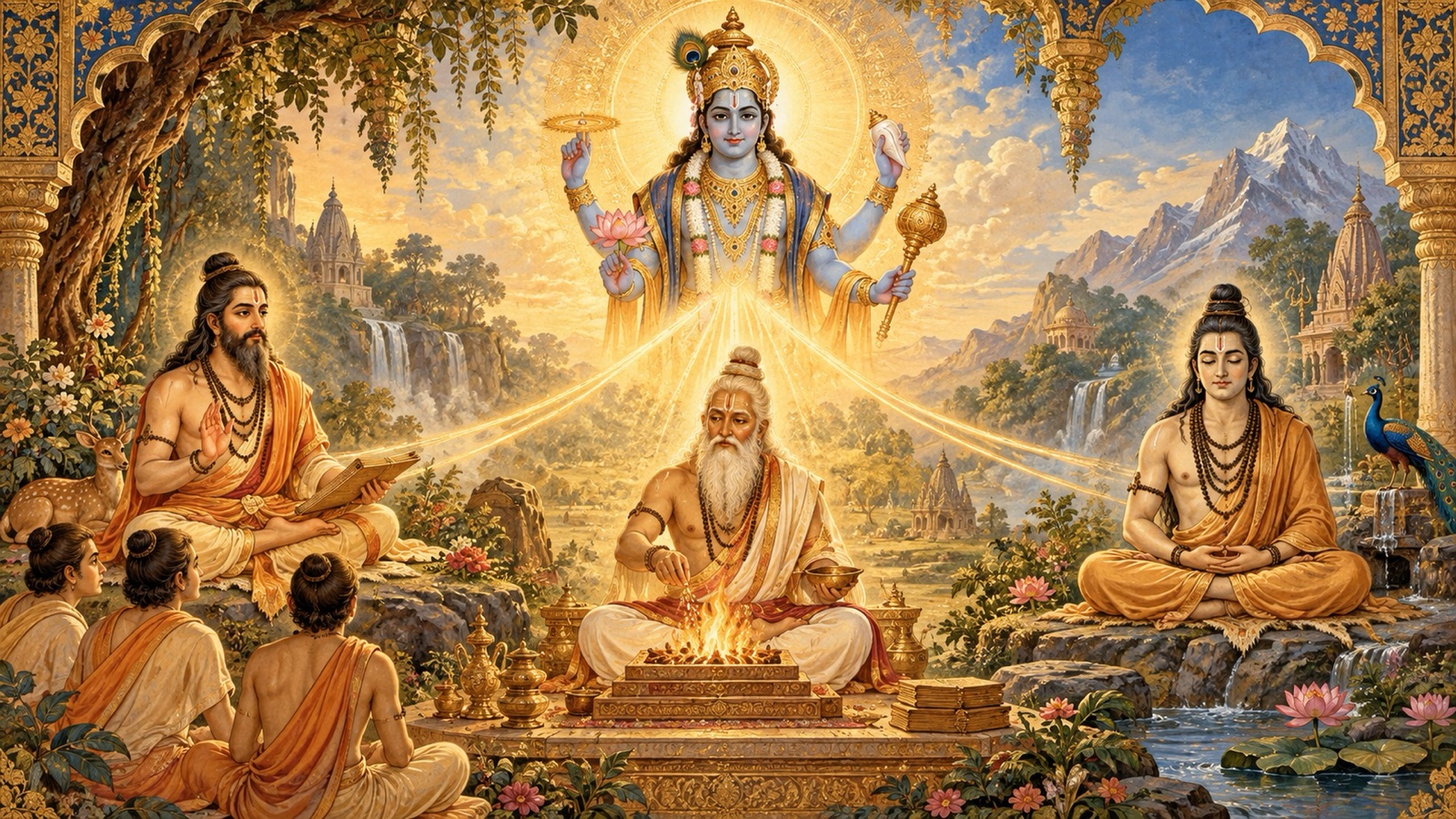
Sukadeva closes this concise chapter as he closed the last, with the vast measure of cosmic time.
एतत् कल्पविकल्पस्य प्रमाणं परिकीर्तितम् । यत्र मन्वन्तराण्याहुश्चतुर्दश पुराविद: ॥ ११ ॥
etat kalpa-vikalpasya pramāṇaṁ parikīrtitam yatra manvantarāṇy āhuś caturdaśa purāvidaḥ
Meaning: This has been declared to be the measure of a minor Kalpa, forming part of a great Kalpa, within which the knowers of ancient lore say there are fourteen Manvantaras. (Canto 8, Chapter 14, verse 11)
This span, comprising fourteen Manvantaras, constitutes a single day of Brahma — a minor Kalpa within the vast lifetime of the creator, and one more reminder of the scale on which the divine order unfolds.
Principal Teachings of This Chapter
1. Every authority serves a higher authority. Manus, sages, Indras, and gods all hold real offices, yet all act under the command of the Supreme Person. No power in creation is finally independent (verses 2-3).
2. The eternal truth is never truly lost. Though the Vedic knowledge is swallowed by Time, the seers recover it in every cycle, and the Manus renew dharma on the earth. God ensures that the path back to Him is always available (verses 4-5).
3. God works through countless forms. As perfected beings, sages, masters of yoga, lords of creation, and even as Time itself, the Lord sustains, guides, and dissolves the world. His activity pervades every corner of existence (verses 8-9).
4. Piety has four limbs. The Manus propagate austerity, purity, compassion, and truth. These four together form the practical shape of a righteous life in every age (verse 5).
5. God is not grasped by argument alone. Philosophers describe the Lord in many conflicting ways, their vision clouded by Maya; He is truly known only through devotion, not through reasoning divorced from surrender (verse 10).
A Devotional Reflection
This short chapter quietly answers a question we all carry, whether or not we ever put it into words: who is really in charge? The world can seem to run on the strength of its many powers — rulers and institutions, natural forces, the sheer momentum of events. The Bhagavata gently corrects that impression. Behind every office and every force, from the Indra who sends the rains to the sages who preserve the scriptures, stands one Person whose will they all carry out. There is something deeply steadying in this. It means that no part of the vast machinery of the world is running loose, unattended, or at the mercy of chance. The same Lord who appoints the Manus and instructs them within their hearts is the Lord who dwells within our own hearts, guiding us if we will listen. And the chapter’s closing caution is worth keeping: He is not finally known by clever argument, however learned, but by the humble turning of the heart in devotion. To live well within the divine order is not first to understand it fully, but to trust and serve the One who upholds it.
A Daily Devotional Practice
Today, in whatever responsibility falls to you — at work, at home, in some small duty — pause before you begin and quietly remember that you, like the Manus and the sages, are meant to act as an instrument of a higher will. Offer your task to the Lord with the words “Om Namo Bhagavate Vasudevaya,” asking to be guided from within as the Manus were guided by Sri Hari in their hearts. Let even ordinary work become a small act of service within the great order that God Himself sustains.
Conclusion
The fourteenth discourse, though brief, leaves one certainty: nothing in the cosmic order runs on its own authority. The Manu, the sages, the Indras, and the gods each carry out their office, but every office answers to the one Supreme Person, who wears countless forms to sustain, instruct, and in time dissolve what He has made. Philosophers may reason about Him endlessly and still miss Him; He is found only where the heart bows in devotion. With the framework of cosmic government now complete, the telling turns next to a story it has long been preparing — Bali, and the Lord’s descent as the Dwarf.
May the divine wisdom of Srimad Bhagavatam awaken pure devotion within our hearts.
Om Namo Bhagavate Vasudevaya.
Jay Shree Madhav.
References and Attribution
- Primary edition: Gita Press, Śrīmad Bhāgavata Mahāpurāṇa (English, complete), Book Eight, Discourse 14, pages 794–795.
- Series: Srimad Bhagavatam Wisdom · Biswa Sanatan Dharma Seva Trust.
- Presented following the spiritual guidance and recommendation of Pandit Dr. Shri Kashinath Mishra.
This is an original, faithful retelling in the writer’s own words, with brief quoted verses shown in Devanāgarī and transliteration and their meanings given as summaries. It is not a reproduction of any single publisher’s continuous translation or commentary. No affiliation with or endorsement by any publisher is implied.
Jay Shree Madhav