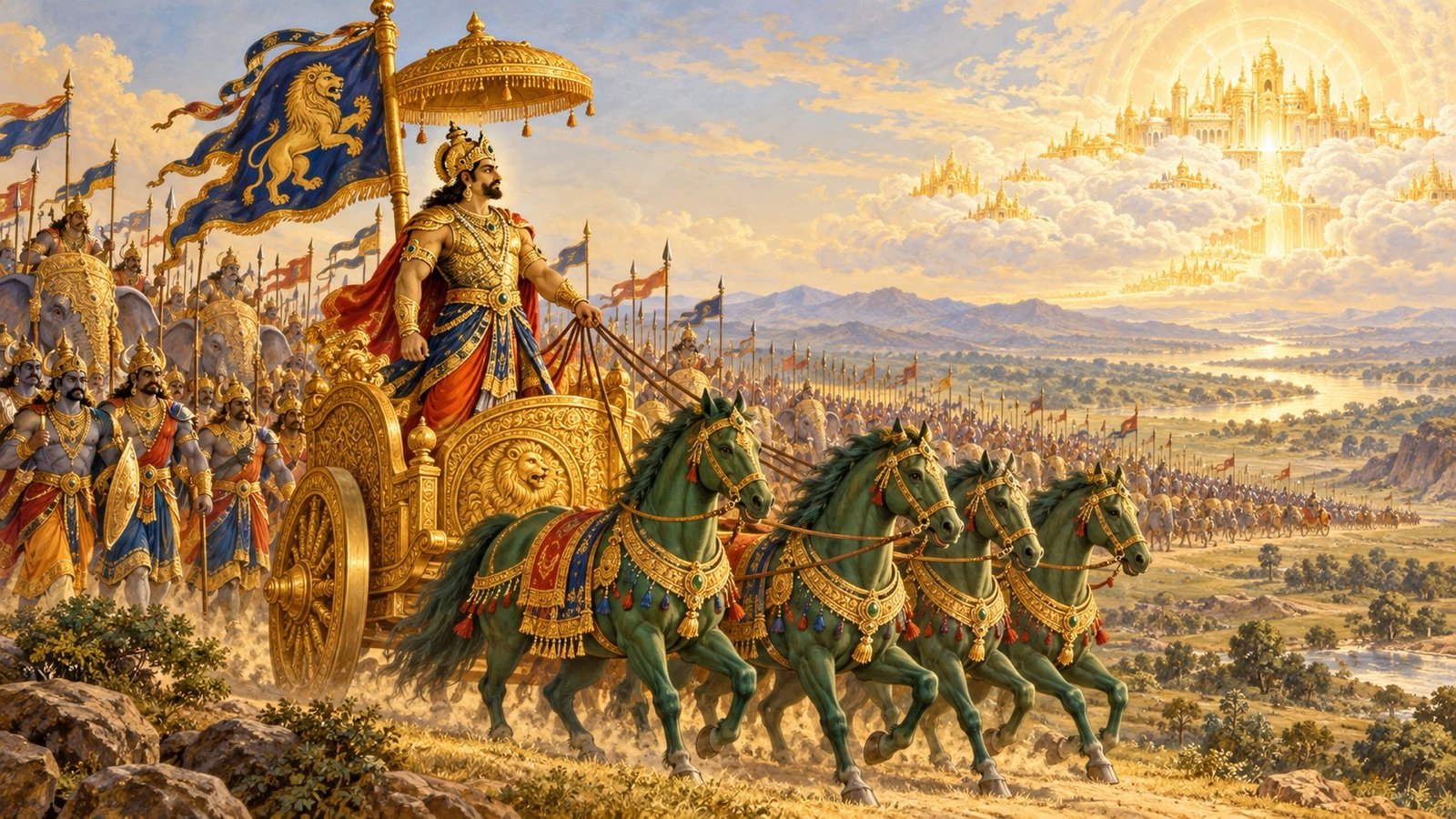
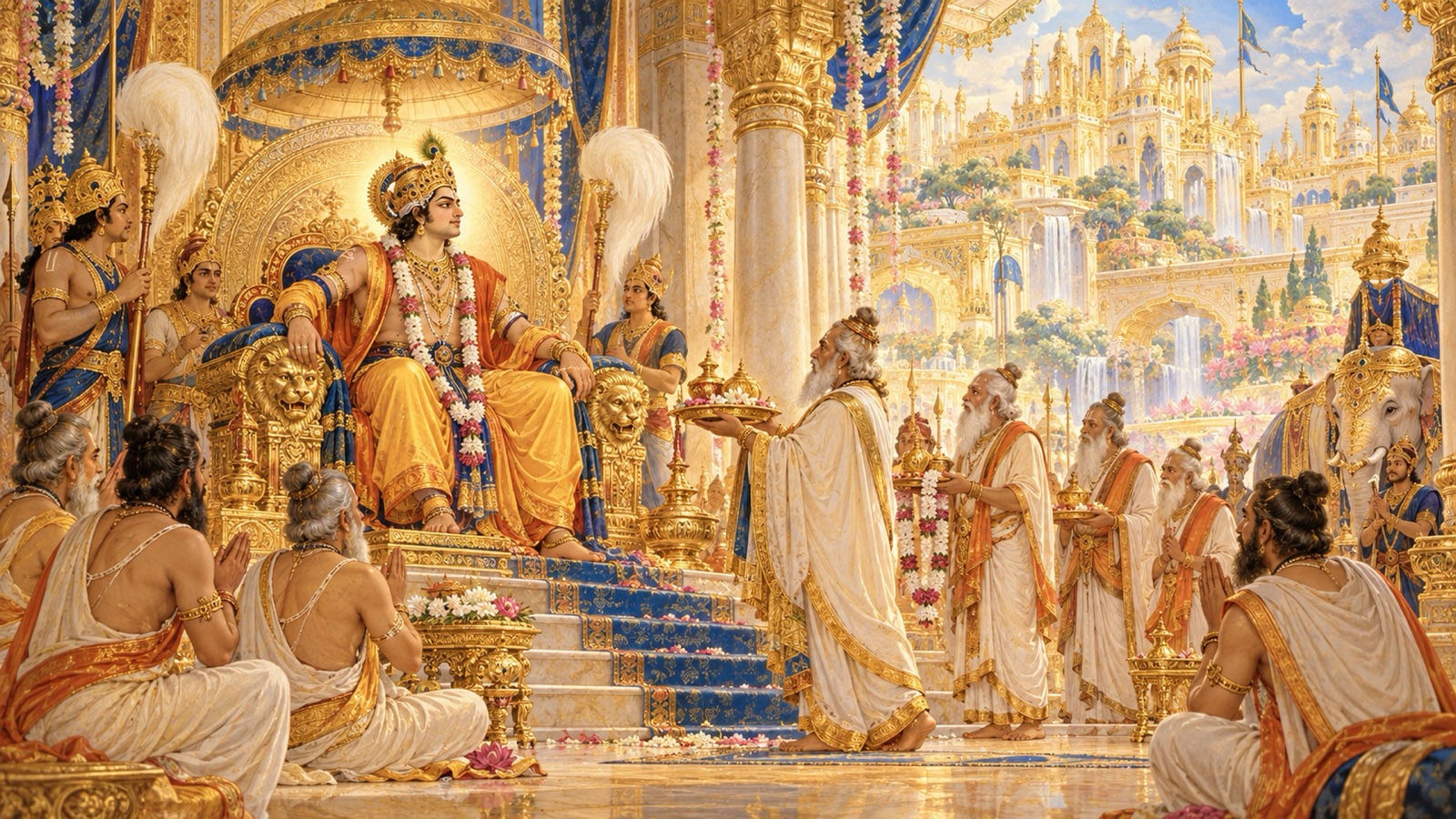
Revived by his preceptors and empowered by their sacrifice, the demon king Bali marches upon the shining capital of heaven itself — and the gods, counselled to await a better hour, quietly withdraw before him.
Om Namo Bhagavate Vasudevaya.
Om Namo Bhagavate Vasudevaya.
Om Namo Bhagavate Vasudevaya.
Welcome back to Srimad Bhagavatam Wisdom, a devotional journey through the sacred histories and teachings of the Srimad Bhagavat Mahapurana. Now begins the great story of Bali and the Lord’s Dwarf incarnation, opening with the question that puzzles King Parikshit: why should the almighty Lord beg three paces of land from Bali, and then bind him?
Chapter Information
- Scripture: Śrīmad Bhāgavata Mahāpurāṇa
- Canto: 8 (Book Eight)
- Chapter: 15 (Discourse 15)
- Chapter title: Bali Conquers the Heavens
- Principal speaker: Sukadeva Gosvami, narrating to King Parikshit — with the words of Indra and Brihaspati
- Principal listener: King Parikshit
- Main setting: The hermitage of the Bhrgus; Amaravati, the celestial capital of Indra
- Central subject: Bali, revived and empowered by the Bhrgus, marches upon heaven; the gods withdraw on Brihaspati’s counsel; Bali conquers the three worlds
- Principal verse range: Canto 8, Chapter 15, verses 1–36
- Primary edition: Gita Press Śrīmad Bhāgavata Mahāpurāṇa
Context From the Previous Chapter
In the fourteenth discourse, Sukadeva explained how the Manus, sages, Indras, and gods administer the universe under the command of the Supreme Person, who works through many forms in every age. With the cosmic framework complete, the narration now turns to the beloved story of Bali and the Lord’s descent as Vamana, the divine Dwarf — the very tale foretold in the account of the coming Manvantaras.
King Parikshit’s Question
The chapter opens not with the story but with a wonder. King Parikshit asks how it could be that the Supreme Lord, complete and wanting nothing, should approach Bali like a beggar to ask for three paces of land — and then bind the innocent demon after His purpose was accomplished.
श्रीराजोवाच बले: पदत्रयं भूमे: कस्माद्धरिरयाचत । भूतेश्वर: कृपणवल्लब्धार्थोऽपि बबन्ध तम् ॥ १ ॥ एतद् वेदितुमिच्छामो महत्कौतूहलं हि न: । याच्ञेश्वरस्य पूर्णस्य बन्धनं चाप्यनागस: ॥ २ ॥
śrī-rājovāca baleḥ pada-trayaṁ bhūmeḥ kasmād dharir ayācata bhūteśvaraḥ kṛpaṇa-val labdhārtho ’pi babandha tam etad veditum icchāmo mahat kautūhalaṁ hi naḥ yācñeśvarasya pūrṇasya bandhanaṁ cāpy anāgasaḥ
Meaning: The King said: Why did Sri Hari, the Lord of all beings, beg three paces of land from Bali like a poor man; and why, though His object was attained, did He bind him? We long to understand this, for it is a great wonder to us that the perfect Lord of sacrifices should beg, and then bind an innocent one. (Canto 8, Chapter 15, verses 1-2)
Sukadeva, pleased by the question, begins the story from its roots — from the moment Bali rose again after his defeat.
Bali Revived and Empowered by the Bhrgus
Sukadeva recalls that Bali had been worsted in battle by Indra, stripped of his splendour, and even deprived of life — and then revived by the Bhrgus, the descendants of the sage Bhrgu, led by his preceptor Shukracharya. In gratitude, the great-souled demon served his preceptors with his whole being, offering them all they desired.
श्रीशुक उवाच पराजितश्रीरसुभिश्च हापितो हीन्द्रेण राजन्भृगुभि: स जीवित: । सर्वात्मना तानभजद् भृगून्बलि: शिष्यो महात्मार्थनिवेदनेन ॥ ३ ॥
śrī-śuka uvāca parājita-śrīr asubhiś ca hāpito hīndreṇa rājan bhṛgubhiḥ sa jīvitaḥ sarvātmanā tān abhajad bhṛgūn baliḥ śiṣyo mahātmārtha-nivedanena
Meaning: Sukadeva said: O King, Bali, who had lost his fortune and even his life to Indra, was brought back to life by the Bhrgus; and that great-souled demon, their disciple, served them with all his being, offering them everything they wished. (Canto 8, Chapter 15, verse 3)
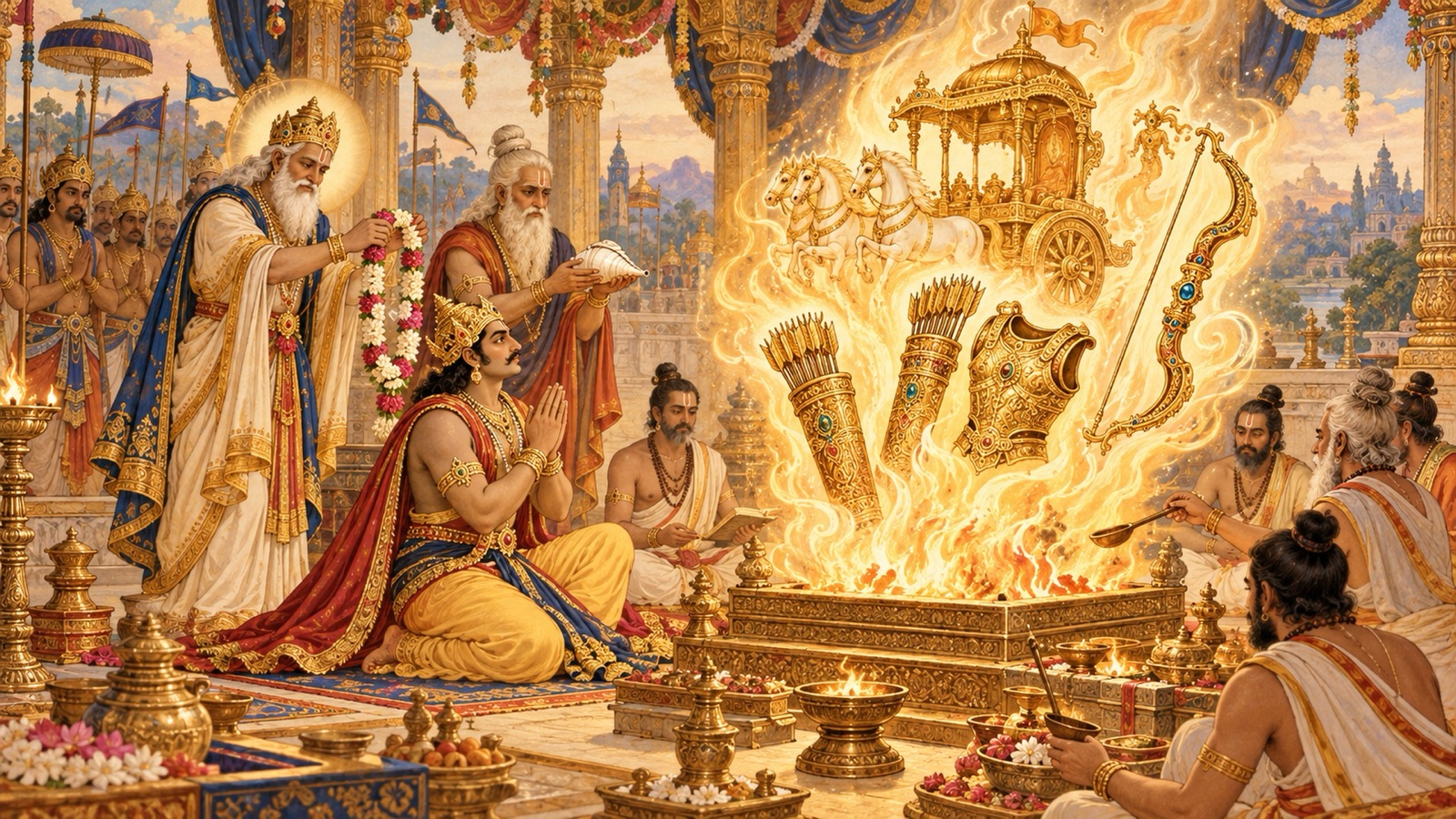
Pleased with him, the Bhrgus consecrated him with a grand ablution fit for an Indra and helped him propitiate the Lord through the Vishvajit sacrifice, in which all one’s possessions are given away. From the sacred fire arose a golden chariot, horses the colour of Indra’s own, a lion-emblazoned banner, a celestial bow, two inexhaustible quivers, and a coat of mail. His grandfather Prahlada gave him a garland of never-fading flowers, and his preceptor Shukracharya gave him a conch. Thus equipped, Bali reverently circled the Brahmanas, bowed to them, took the leave of Prahlada, and mounted his shining chariot, radiant as a fire burning in the sacrificial pit.
Bali Marches Against Heaven
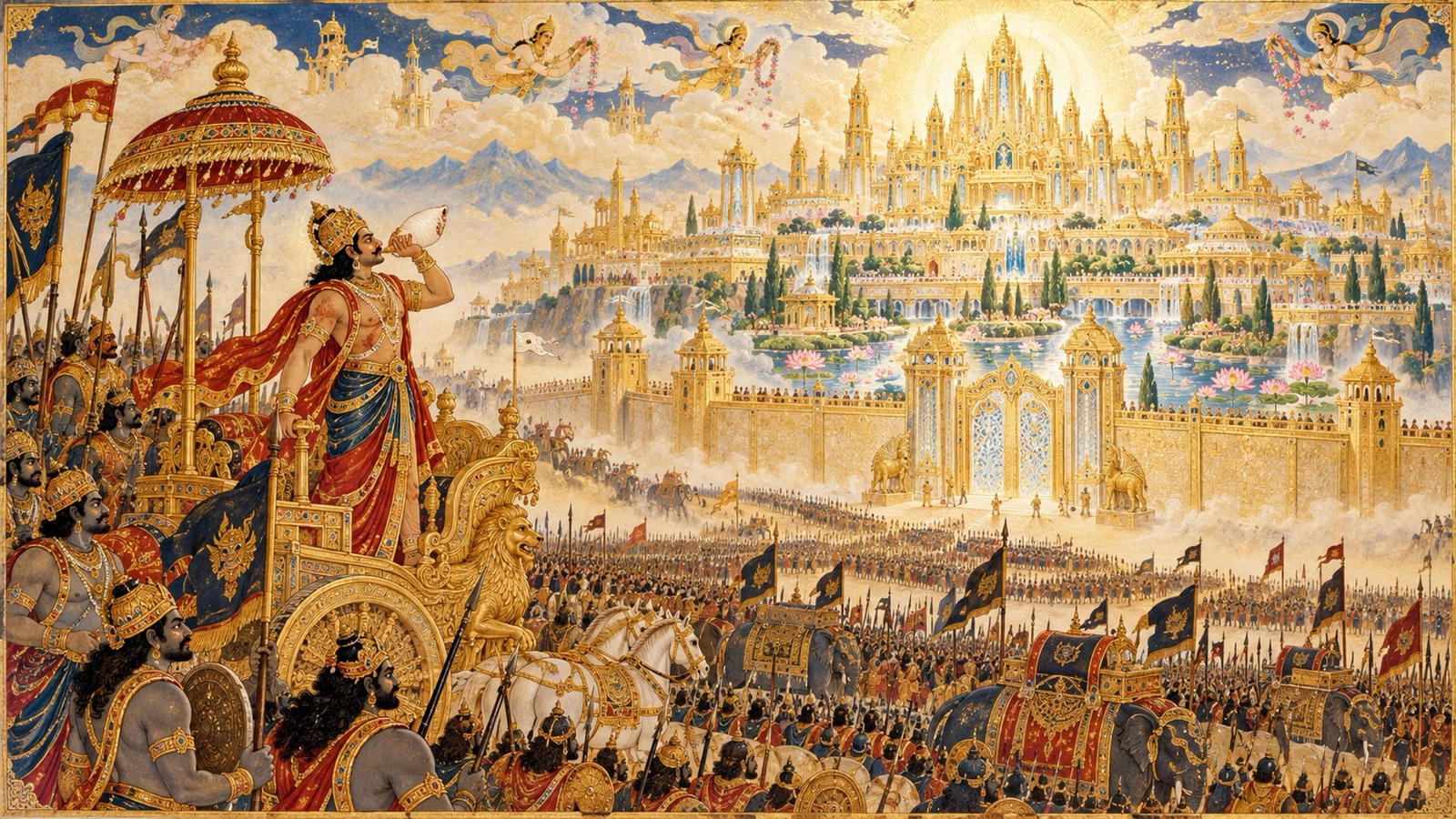
Surrounded by demon generals equal to him in strength and splendour, and leading a vast army, the powerful Bali marched upon the most prosperous city of Indra, seeming to shake heaven and earth. Amaravati was a place of surpassing beauty — its Nandana gardens loud with birdsong and humming bees, its lotus ponds bright with swans and cranes, its walls of gold built by Vishvakarma, its gates of crystal, its streets paved with gems, its air fragrant with celestial flowers and alive with music and song. Only the pure could enter there; the cruel, the fraudulent, the proud, and the greedy found no access. Reaching this city, Bali besieged it on every side and blew the sonorous conch given by his preceptor, striking fear into the ladies of Indra’s household.
Indra Consults Brihaspati, and the Gods Withdraw
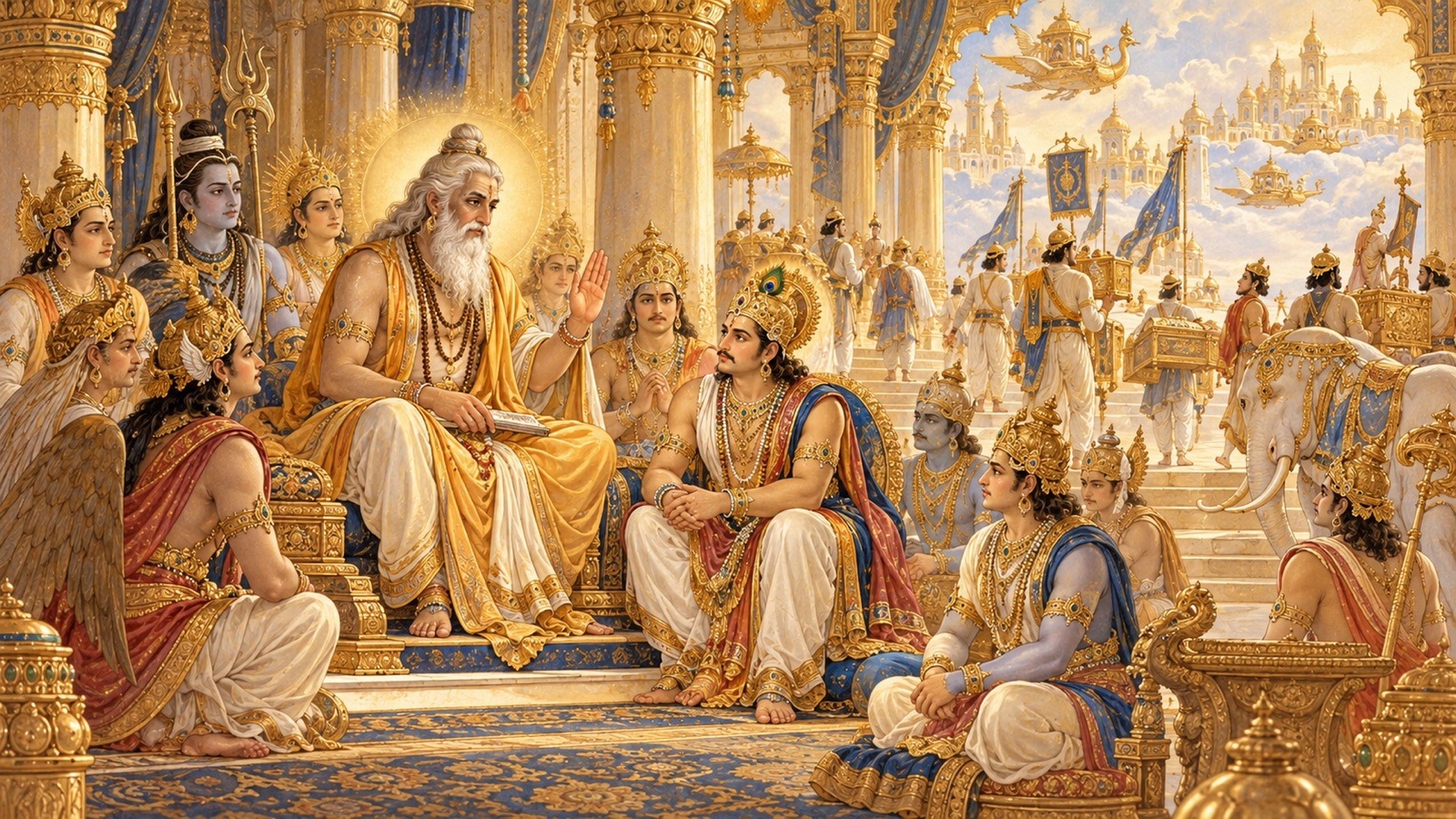
Perceiving the gravity of Bali’s assault, Indra approached his preceptor Brihaspati and asked from where his old enemy had gained such irresistible power. Brihaspati answered that Bali had been filled with the spiritual energy of the Bhrgus, who had infused their own power into their devoted disciple. None but the almighty Lord Himself, he said, could now stand before Bali. Therefore he counselled the gods to quit heaven and remain out of sight, awaiting a favourable turn of fortune.
This is the doctrine at the heart of the encounter: a soul’s strength before the whole universe is nothing beside the strength that flows from a satisfied spiritual master. Bali could not have out-fought Indra by his own valour; his invincibility was entirely borrowed, poured into him by Shukracharya and the Bhrgus because he had surrendered himself to their service without reserve. Brihaspati therefore does not counsel Indra to test his own strength against Bali’s, but to recognise that only the Supreme Lord’s own power — never anyone’s power borrowed from Him — can meet such strength directly. The lesson holds for every devotee: real advancement is never won by personal effort alone but received as the guru’s grace, and it must be handled as a trust, not treated as one’s own achievement (verse 28).
एष विप्रबलोदर्क: सम्प्रत्यूर्जितविक्रम: । तेषामेवापमानेन सानुबन्धो विनङ्क्ष्यति ॥ ३१ ॥
eṣa vipra-balodarkaḥ sampraty ūrjita-vikramaḥ teṣām evāpamānena sānubandho vinaṅkṣyati
Meaning: His prowess, now at its height, has arisen from the power of the Brahmanas; yet by insulting those very Brahmanas he will one day perish, together with all his followers and fortune. (Canto 8, Chapter 15, verse 31)
Heeding this wise counsel from one who could foresee things as they truly are, the gods — able to assume any form at will — departed from paradise and vanished from sight.
Bali Conquers the Three Worlds
With the gods gone, Bali, the son of Virochana, took possession of Amaravati and brought all three worlds under his sway. His preceptors, full of affection, then had him perform a hundred horse-sacrifices to stabilize his dominion, and his renown spread through the worlds and beyond, so that he shone like the moon among the stars.
बुभुजे च श्रियं स्वृद्धां द्विजदेवोपलम्भिताम् । कृतकृत्यमिवात्मानं मन्यमानो महामना: ॥ ३६ ॥
bubhuje ca śriyaṁ svṛddhāṁ dvija-devopalambhitām kṛta-kṛtyam ivātmānaṁ manyamāno mahāmanāḥ
Meaning: And the high-minded Bali, considering himself to have accomplished all his aims, enjoyed the abundant prosperity bestowed upon him by the Brahmanas, the adored among the twice-born. (Canto 8, Chapter 15, verse 36)
Thus the stage is set. Bali stands at the summit of power and prosperity, blessed by holy men and seemingly complete in his triumph — and it is precisely here, at the height of the demon king’s fortune, that the Lord will soon appear as the divine Dwarf.
Principal Teachings of This Chapter
1. The blessings of holy people carry immense power. Bali’s irresistible strength came not from himself but from the spiritual energy of the Bhrgus. To serve and honour the devout is to receive a strength greater than one’s own (verses 3, 28).
2. Surrender of one’s all invites the Lord’s favour. Bali gave away everything in the Vishvajit sacrifice, and from that surrender came his splendour. What we offer wholly to God is returned to us multiplied (verse 4).
3. Wisdom knows when to withdraw. Brihaspati counselled the gods not to fight a battle they could not win, but to wait for a better hour. Patience and right timing are themselves a form of strength (verses 30-32).
4. Power gained through grace can be lost through pride. Brihaspati foresaw that Bali would one day fall by insulting the very Brahmanas who raised him. The source of our blessings must never be dishonoured (verse 31).
5. Worldly triumph is never truly complete. Bali thought he had accomplished all his aims, yet the greatest turn of his life was still to come. No earthly victory is the final word (verse 36).
A Devotional Reflection
It is striking that this chapter, which sets in motion the story of Bali’s downfall, spends most of its length describing his rise. We watch him revived by his teachers, empowered by sacrifice, marching in glory, conquering the heavens — and at the very moment he believes he has accomplished everything, Sukadeva quietly reminds us that he only thought so. There is a gentle warning here for all of us who measure our lives by achievement. Bali was not a wicked man; he was generous, devoted to his preceptors, willing to give away all he had. His strength came from genuine grace. And yet even such a one could mistake the summit of worldly success for the goal of life itself. The Bhagavata does not condemn Bali for his triumph; it simply lets us feel how incomplete that triumph is, so that when the Lord appears to him as a small brahmana boy asking for three steps of ground, we are ready to see that what looks like Bali’s undoing is in truth his greatest blessing. The heights we reach are never the destination. The real gift is the One who comes to meet us there.
A Daily Devotional Practice
Today, if you find yourself measuring your worth by some success or achievement, pause and gently hold it more lightly, remembering Bali at the summit of the three worlds — who thought he had accomplished everything, and whose truest blessing was still to come. Offer your accomplishments back to the Lord with the words “Om Namo Bhagavate Vasudevaya,” thanking Him for the grace behind them and asking that they never become a source of pride. Let no height you reach make you forget the One who lifts you.
Conclusion
The fifteenth discourse of the Eighth Canto traces Bali’s rise to the height of worldly glory — yet its real teaching is that such a triumph, however dazzling, still waits for something greater to complete it. Bali only thinks he has accomplished all his aims; the true fulfillment of his life is the Lord Himself, about to enter the story as the divine Dwarf. May we learn from this to hold every success we reach with open hands, offering it back to the One who alone completes it. The next chapter turns to the grieving mother of the gods, Aditi, and the sacred vow by which she will draw the Supreme Lord to be born as her own son.
May the divine wisdom of Srimad Bhagavatam awaken pure devotion within our hearts.
Om Namo Bhagavate Vasudevaya.
Jay Shree Madhav.
References and Attribution
- Primary edition: Gita Press, Śrīmad Bhāgavata Mahāpurāṇa (English, complete), Book Eight, Discourse 15, pages 795–800.
- Series: Srimad Bhagavatam Wisdom · Biswa Sanatan Dharma Seva Trust.
- Presented following the spiritual guidance and recommendation of Pandit Dr. Shri Kashinath Mishra.
This is an original, faithful retelling in the writer’s own words, with brief quoted verses shown in Devanāgarī and transliteration and their meanings given as summaries. It is not a reproduction of any single publisher’s continuous translation or commentary. No affiliation with or endorsement by any publisher is implied.
Jay Shree Madhav