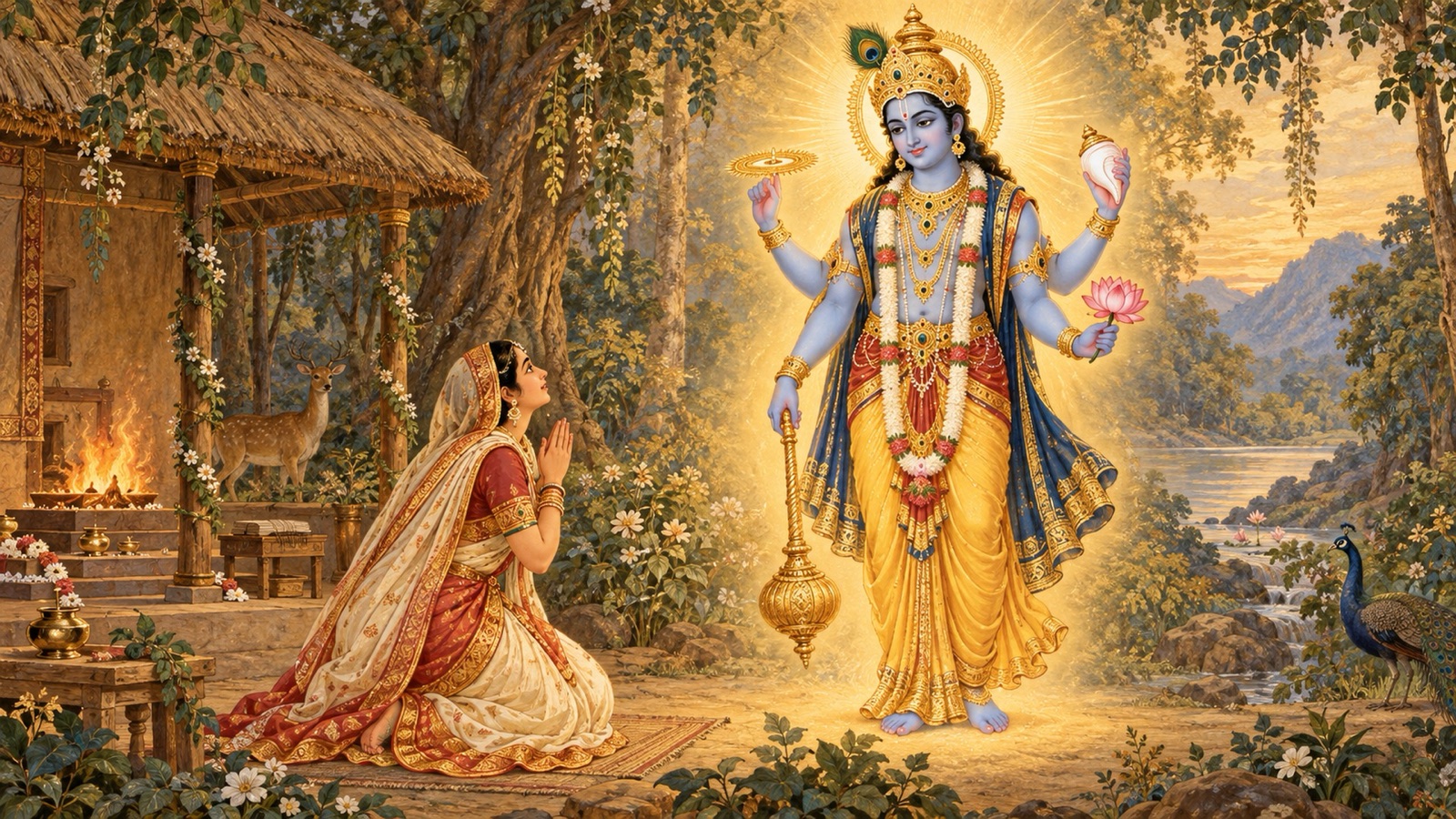
After twelve days of pure devotion, the Supreme Lord Himself appears before Aditi — four-armed, clad in yellow, bearing conch, disc, and mace — and, moved by a mother’s love, agrees to be born as her own son.
Om Namo Bhagavate Vasudevaya.
Om Namo Bhagavate Vasudevaya.
Om Namo Bhagavate Vasudevaya.
Welcome back to Srimad Bhagavatam Wisdom, a devotional journey through the sacred histories and teachings of the Srimad Bhagavat Mahapurana. In the previous chapter the sage Kashyapa taught the grieving Aditi the sacred Payovrata vow; this seventeenth discourse of the Eighth Canto shows what that devotion brings, and the surprising way in which the Lord chooses to answer it.
Chapter Information
- Scripture: Śrīmad Bhāgavata Mahāpurāṇa
- Canto: 8 (Book Eight)
- Chapter: 17 (Discourse 17)
- Chapter title: The Lord Agrees to Become Aditi’s Son
- Principal speaker: Sukadeva Gosvami, narrating to King Parikshit — with the prayers of Aditi and Brahma and the words of the Lord
- Principal listener: King Parikshit
- Main setting: The hermitage of the sage Kashyapa
- Central subject: Aditi’s observance of the Payovrata; the appearance of the Lord; her prayer; the Lord’s promise to become her son; His entering the womb of Aditi and Brahma’s praise
- Principal verse range: Canto 8, Chapter 17, verses 1–28
- Primary edition: Gita Press Śrīmad Bhāgavata Mahāpurāṇa
Context From the Previous Chapter
In the sixteenth discourse, the sage Kashyapa consoled the grieving Aditi and taught her the sacred Payovrata vow — twelve days of devotion, self-restraint, and charity offered to Lord Vishnu — assuring her that the Lord, well pleased, would grant her heart’s desire. This chapter shows how faithfully she kept that vow, and how the Lord answered.
Aditi Keeps the Vow
Thus instructed by her husband, Aditi observed the Payovrata unwearied and in full accord with its rules for twelve consecutive days, contemplating the almighty Lord with an undivided intellect. Curbing the unruly horses of her senses with the rein of her mind, and steadying her mind with one-pointed reason upon Lord Vasudeva, the Soul of all, she kept the vow with perfect devotion.
The Lord Appears
Then, at the conclusion of her vow, the Supreme Lord Himself appeared before her.
तस्या: प्रादुरभूत्तात भगवानादिपुरुष: । पीतवासाश्चतुर्बाहु: शङ्खचक्रगदाधर: ॥ ४ ॥
tasyāḥ prādurabhūt tāta bhagavān ādi-puruṣaḥ pīta-vāsāś catur-bāhuḥ śaṅkha-cakra-gadā-dharaḥ
Meaning: O dear one, the Supreme Lord, the Primeval Person, appeared before her, clad in yellow, with four arms, bearing the conch, the discus, and the mace. (Canto 8, Chapter 17, verse 4)
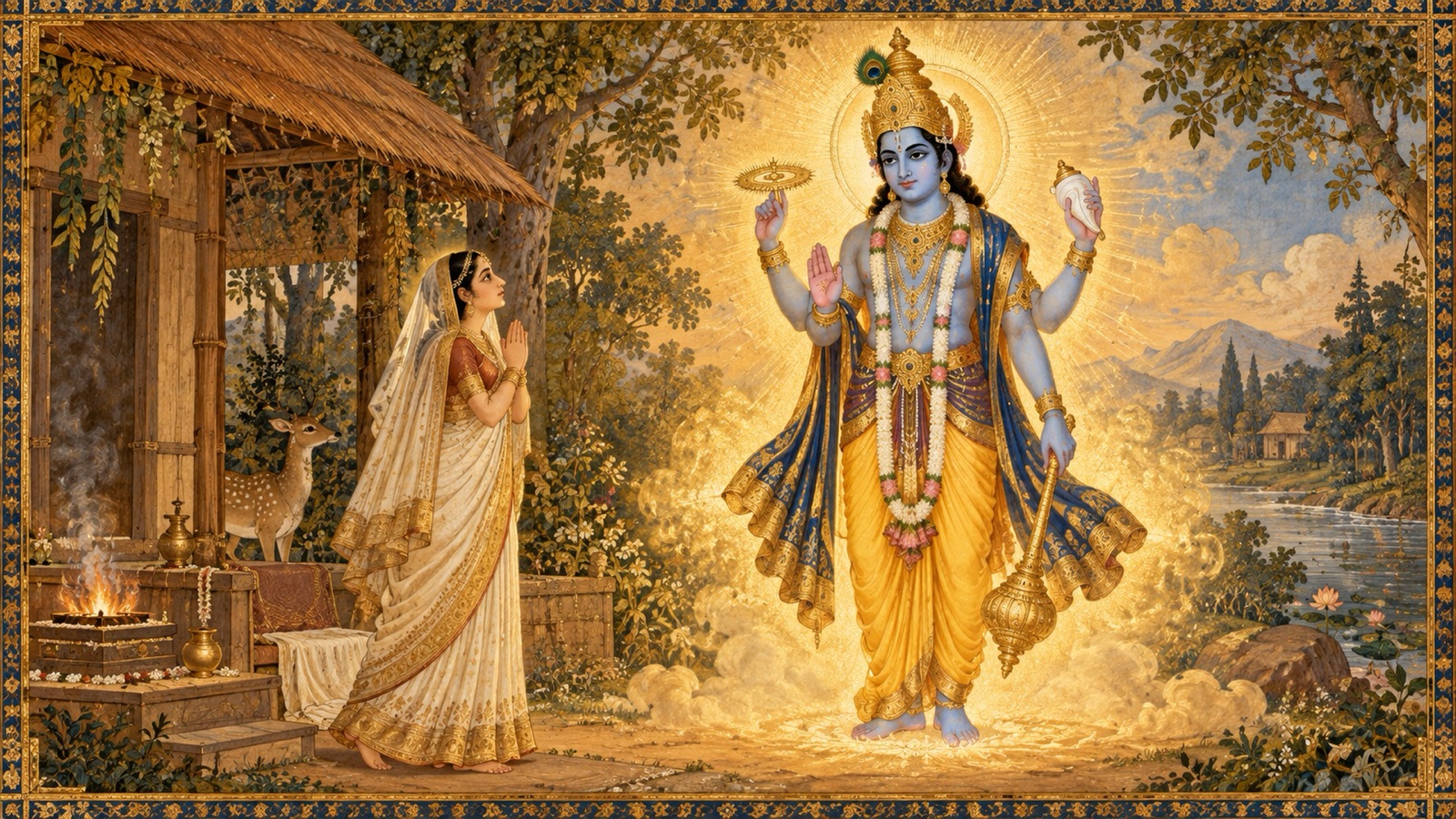
Seeing Him suddenly before her very eyes, Aditi was overwhelmed with love. She rose and bowed to the ground in reverence, then stood with folded palms to glorify Him — but for a while she could not speak, her eyes flooded with tears of joy, her body thrilling and her limbs trembling at the sight of Him.
Aditi’s Prayer
Recovering a little, in a faltering voice the heavenly lady lovingly extolled Sri Hari, gazing up as though drinking Him in with her eyes.
श्रीअदितिरुवाच यज्ञेश यज्ञपुरुषाच्युत तीर्थपाद तीर्थश्रव: श्रवणमङ्गलनामधेय । आपन्नलोकवृजिनोपशमोदयाद्य शं न: कृधीश भगवन्नसि दीननाथ: ॥ ८ ॥
śrī-aditir uvāca yajñeśa yajña-puruṣācyuta tīrtha-pāda tīrtha-śravaḥ śravaṇa-maṅgala-nāmadheya āpanna-loka-vṛjinopaśamodayādya śaṁ naḥ kṛdhīśa bhagavann asi dīna-nāthaḥ
Meaning: Aditi prayed: O Lord of sacrifice, O infallible Soul of sacrifice, whose feet are a place of pilgrimage, whose glories are worth hearing and whose very name is auspicious to hear, who appear to relieve the distress of those who take refuge in You — bring us happiness, O Lord, for You are the protector of the afflicted. (Canto 8, Chapter 17, verse 8)
She glorified Him as the all-pervading form who freely assumes the modes of Maya to create, sustain, and dissolve the universe, yet who remains ever established in His own true nature, untouched and never deluded by that very illusion (verse 9). From Him, she sang, when He is pleased, every blessing flows — long life, wealth, dominion, the powers of yoga, and even the immediate perception of truth — to say nothing of such small things as victory over enemies (verse 10).
The Lord’s Promise
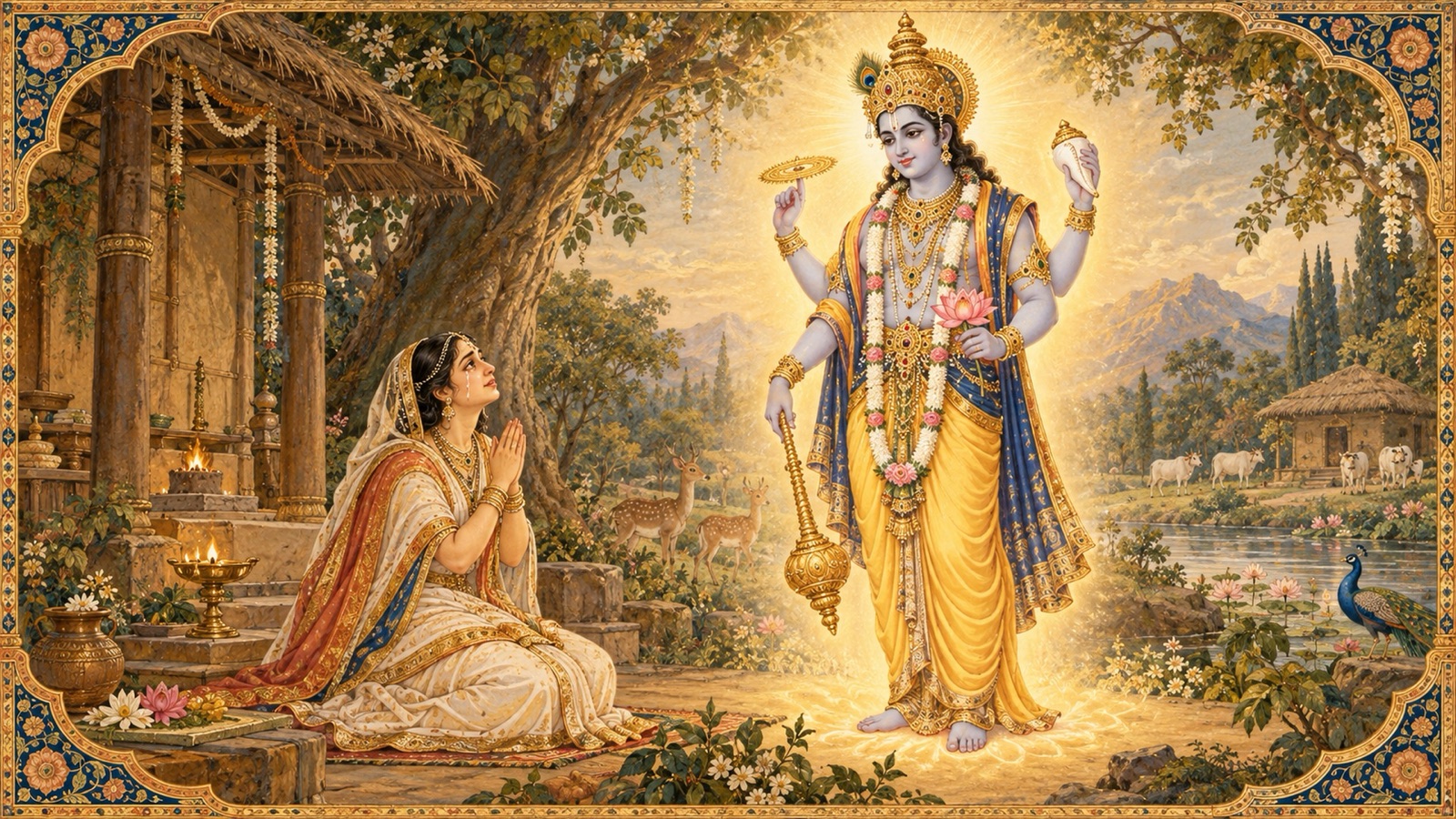
Thus hymned by Aditi, Lord Vishnu, the inner Controller of all beings, replied to her with tender assurance.
श्रीभगवानुवाच देवमातर्भवत्या मे विज्ञातं चिरकाङ्क्षितम् । यत् सपत्नैर्हृतश्रीणां च्यावितानां स्वधामत: ॥ १२ ॥
śrī-bhagavān uvāca deva-mātar bhavatyā me vijñātaṁ cira-kāṅkṣitam yat sapatnair hṛta-śrīṇāṁ cyāvitānāṁ sva-dhāmataḥ
Meaning: The Lord said: O mother of the gods, I fully know your long-cherished desire, which concerns your sons, whose fortune has been usurped by their rivals and who have been driven from their own abode. (Canto 8, Chapter 17, verse 12)
He knew, too, what she longed to see: her sons victorious at last over their arrogant rivals, those rivals’ wives left weeping in their turn, and her own children restored to their rightful splendour in the heavens (verses 13–15). Yet the Lord tempered her hope with a sobering truth.
प्रायोऽधुना तेऽसुरयूथनाथा अपारणीया इति देवि मे मति: । यत्तेऽनुकूलेश्वरविप्रगुप्ता न विक्रमस्तत्र सुखं ददाति ॥ १६ ॥
prāyo ‘dhunā te ‘sura-yūtha-nāthā apāraṇīyā iti devi me matiḥ yat te ‘nukūleśvara-vipra-guptā na vikramas tatra sukhaṁ dadāti
Meaning: In My judgment, O goddess, the chieftains of the demons can scarcely be overpowered just now, for they stand shielded by the goodwill of brahmanas who are always dear to Me; where such shelter guards an enemy, force alone brings no true happiness. (Canto 8, Chapter 17, verse 16)
This is why the Lord chose a wholly different path. Worship offered to Him, He said, is never spent in vain; since her vow had truly satisfied Him, He would find another means to help — not the sword of the demigods, but His own descent. Agreeing to fulfil her longing in the most intimate way imaginable, He would take birth, through a portion of His own being, as her very son, so that in due course her other sons too would be shielded and safe (verses 17–18). Until then, He told her, she should return to her husband Kashyapa with that same devotion, honouring him as the very seat in which the Lord now resided, and keep this wondrous secret closely guarded, for what is most sacred is best kept veiled (verses 19–20).
The Descent Begins, and Brahma’s Praise
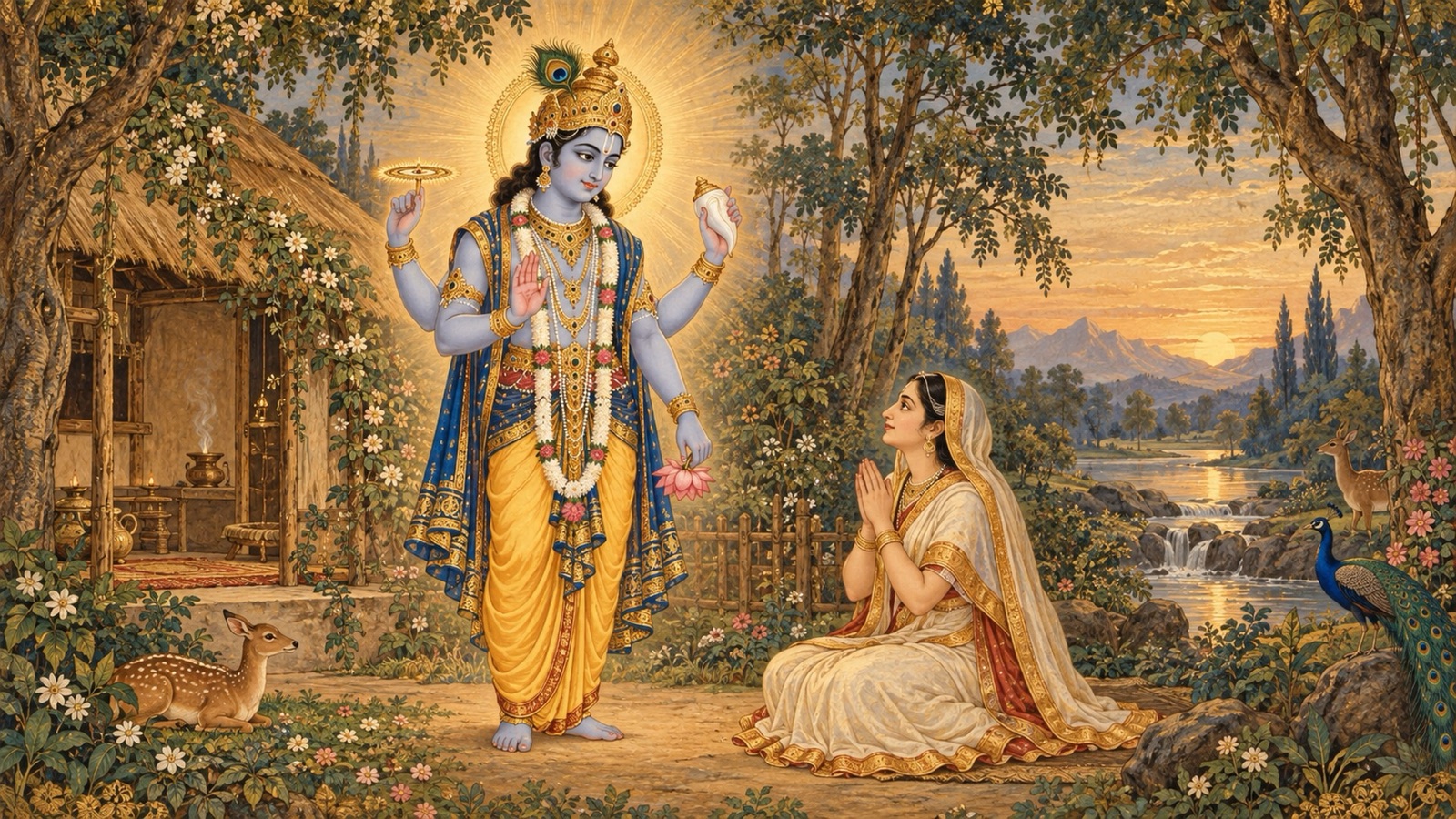
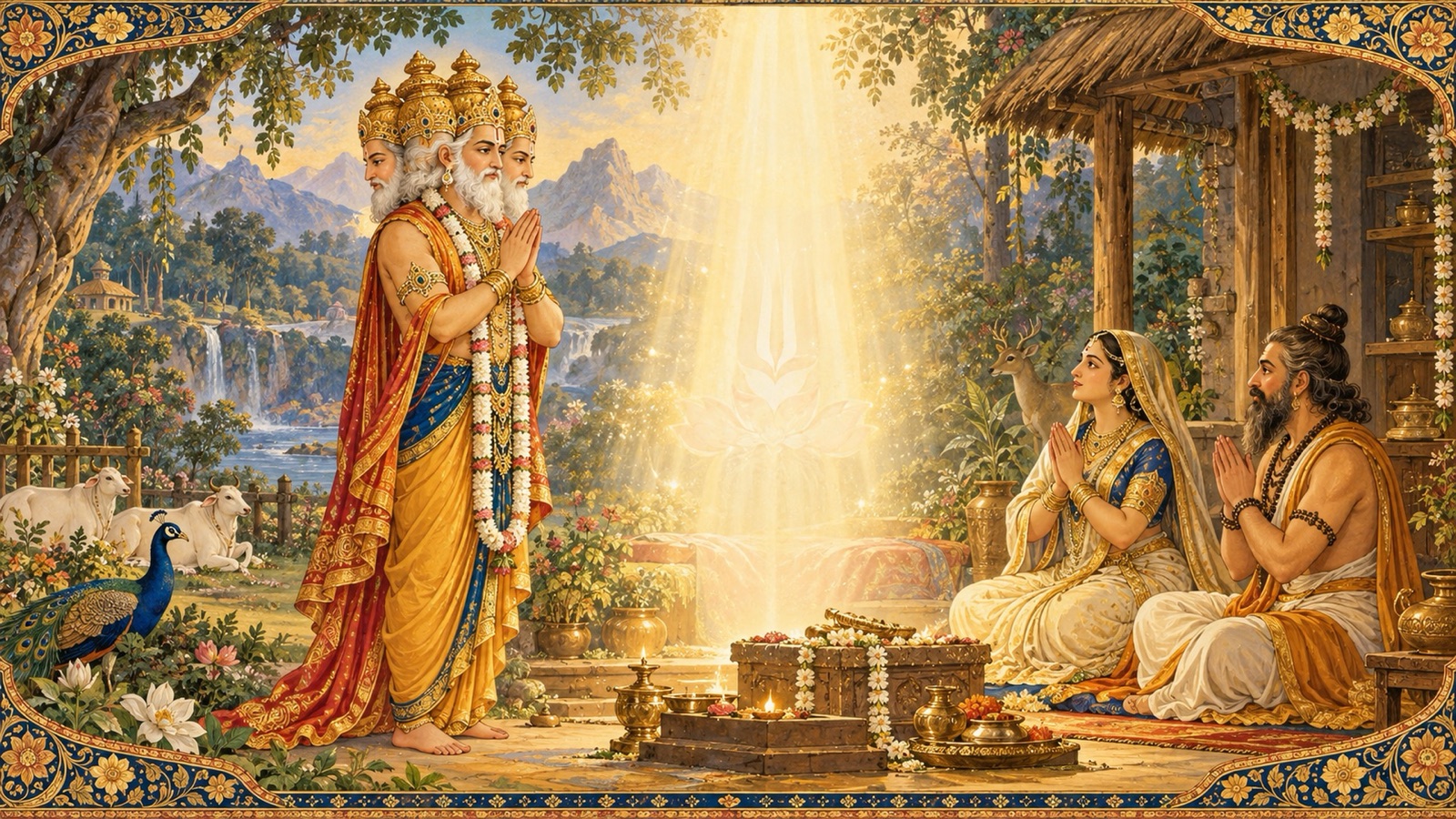
Then, having concentrated his mind fully, the sage Kashyapa — himself radiant with austerity — perceived a portion of Sri Hari having entered his mind, and in due course that divine energy was conveyed to Aditi. Perceiving that the eternal Lord had entered the womb of Aditi, Brahma came and praised Him with sacred and mysterious epithets.
नमस्ते पृश्निगर्भाय वेदगर्भाय वेधसे । त्रिनाभाय त्रिपृष्ठाय शिपिविष्टाय विष्णवे ॥ २६ ॥
namas te pṛśni-garbhāya veda-garbhāya vedhase tri-nābhāya tri-pṛṣṭhāya śipi-viṣṭāya viṣṇave
Meaning: Salutations to You, O Vishnu, who once appeared as the son of Prishni, in whom the Vedas abide, the creator, who hold the three worlds within Yourself and pervade all embodied beings as their inner controller. (Canto 8, Chapter 17, verse 26)
Brahma glorified Him as the beginning, middle, and end of the universe, the supreme refuge of the gods fallen from heaven, as a boat is to one about to drown. With the Lord thus descended into the womb of Aditi, the stage is set for His appearance as the divine Dwarf.
Principal Teachings of This Chapter
1. Sincere devotion is answered by the Lord Himself. Aditi’s humble vow drew the Supreme Lord in person before her eyes. When we turn to God with a whole heart, He responds (verses 3-4).
2. The Lord already knows our deepest desire. Before Aditi could fully speak, the Lord told her that He knew her long-cherished wish. God understands the heart even before we express it (verse 12).
3. Grace succeeds where force cannot. The Lord tells Aditi plainly that the demon chiefs, shielded by the goodwill of brahmanas, cannot now be beaten down by power — but worship offered in true faith is never wasted, so He chooses a quieter, surer way, becoming her own son (verses 16-18).
4. God gives more than we ask. Aditi hoped for help for her sons; the Lord gave her Himself, agreeing to be born as her own child. The Lord’s response often exceeds our prayers (verses 12-20).
5. Devotion transforms the devotee. At the sight of the Lord, Aditi trembled, wept, and could not speak for joy. True darshan of the Lord overwhelms the heart with love (verses 5-6).
6. The Lord is the refuge of the fallen. Brahma praises Him as a boat for those about to drown. However far we have fallen, the Lord remains our sure shelter (verse 28).
A Devotional Reflection
There is a tenderness in this chapter that is easy to miss amid its grandeur. A mother has lost her children’s home and fortune, and after twelve days of humble, milk-fed worship, the Lord of all the worlds stands before her. But notice how He answers. He does not simply promise to fix her problem from a distance. He tells her that He already knows the desire she has carried so long — and then He gives her not merely victory, but Himself, agreeing to be born as her own son. This is the astonishing generosity of God. We come to Him with our small requests, asking for this help or that relief, and He answers by drawing us into the deepest intimacy, giving Himself where we asked only for a gift. Aditi’s tears, her trembling, her inability even to speak, are the natural response of a heart that suddenly finds itself loved beyond all expectation. The chapter invites us to bring our own longings to the Lord not as demands but as prayers, trusting that the One who already knows our hearts will answer not merely with what we asked, but with the nearness of His own presence.
A Daily Devotional Practice
Today, bring one long-held desire of your heart quietly before the Lord — not as a demand, but as a prayer offered in trust. Remember Aditi, whose humble vow was answered by the Lord in person, and who received not just help but His very presence. Repeat softly “Om Namo Bhagavate Vasudevaya,” placing your longing in His hands and trusting that the One who already knows your heart will answer in the way that is truly best — often with far more than you asked.
Conclusion
This chapter’s deepest teaching is easy to miss amid its wonder: when force could bring the gods no true happiness, the Lord did not send an army — He drew nearer instead, entering Aditi’s own womb rather than fighting her sons’ battles from afar. Grace, not conquest, is His chosen instrument, and worship offered in unwavering faith is never spent in vain. As Brahma’s praise settles over Kashyapa’s hermitage, the way stands prepared for the Lord to walk among the worlds once more — this time as Vamana, the divine Dwarf, whose quiet request will accomplish what no war could.
May the divine wisdom of Srimad Bhagavatam awaken pure devotion within our hearts.
Om Namo Bhagavate Vasudevaya.
Jay Shree Madhav.
References and Attribution
- Primary edition: Gita Press, Śrīmad Bhāgavata Mahāpurāṇa (English, complete), Book Eight, Discourse 17, pages 806–810.
- Series: Srimad Bhagavatam Wisdom · Biswa Sanatan Dharma Seva Trust.
- Presented following the spiritual guidance and recommendation of Pandit Dr. Shri Kashinath Mishra.
This is an original, faithful retelling in the writer’s own words, with brief quoted verses shown in Devanāgarī and transliteration and their meanings given as summaries. It is not a reproduction of any single publisher’s continuous translation or commentary. No affiliation with or endorsement by any publisher is implied.
Jay Shree Madhav