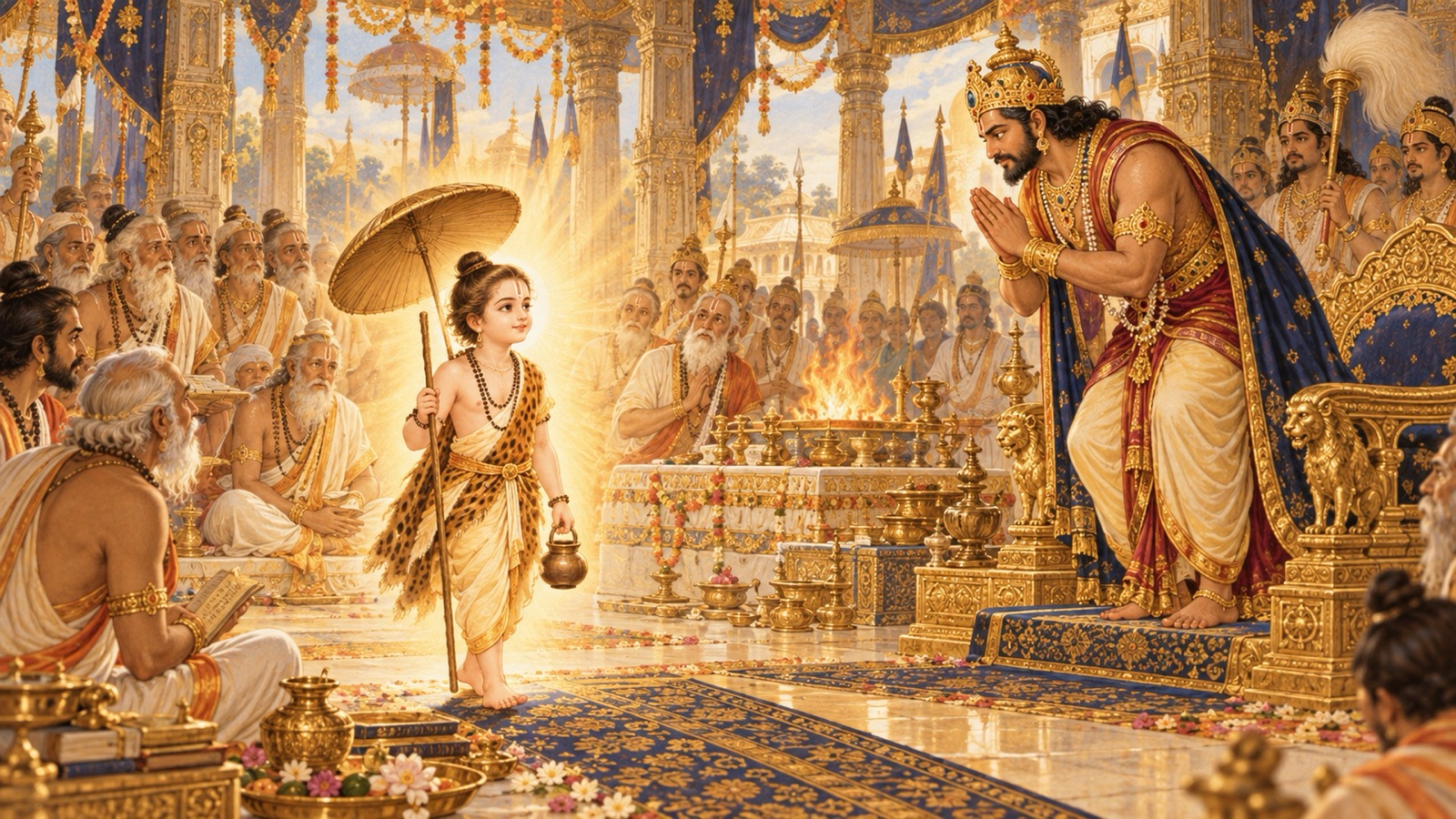
The Supreme Lord, born to Aditi, takes the form of a small brahmana boy and walks to the great sacrifice of Bali — and the mighty demon king, dazzled by His radiance, rises to welcome Him and offer Him whatever He desires.
Om Namo Bhagavate Vasudevaya.
Om Namo Bhagavate Vasudevaya.
Om Namo Bhagavate Vasudevaya.
Welcome back to Srimad Bhagavatam Wisdom, a devotional journey through the sacred histories and teachings of the Srimad Bhagavat Mahapurana. Having entered the womb of Aditi, the Lord now appears in the world: this eighteenth discourse of the Eighth Canto tells how Lord Vamana, the fifth of the ten principal descents of the Lord, is born to Aditi and Kashyapa, becomes in an instant a small brahmana boy, and sets out toward a sacrifice that is about to be transformed by His arrival.
Chapter Information
- Scripture: Śrīmad Bhāgavata Mahāpurāṇa
- Canto: 8 (Book Eight)
- Chapter: 18 (Discourse 18)
- Chapter title: Lord Vamana, the Divine Dwarf, Appears
- Principal speaker: Sukadeva Gosvami, narrating to King Parikshit — with the words of Bali
- Principal listener: King Parikshit
- Main setting: The hermitage of Kashyapa; Bhrgukaccha on the northern bank of the Narmada, where Bali performs his sacrifice
- Central subject: The birth of Lord Vamana; His appearance as a dwarf brahmana boy; His sacred-thread ceremony; His arrival at Bali’s sacrifice and Bali’s reverent welcome
- Principal verse range: Canto 8, Chapter 18, verses 1–32
- Primary edition: Gita Press Śrīmad Bhāgavata Mahāpurāṇa
Context From the Previous Chapter
In the seventeenth discourse, the Lord appeared before Aditi at the close of her Payovrata vow and agreed to be born as her son; a portion of His presence entered the sage Kashyapa and then the womb of Aditi, and Brahma praised the descending Lord. This chapter takes up His actual appearance in the world as the divine Dwarf.
The Birth of the Lord
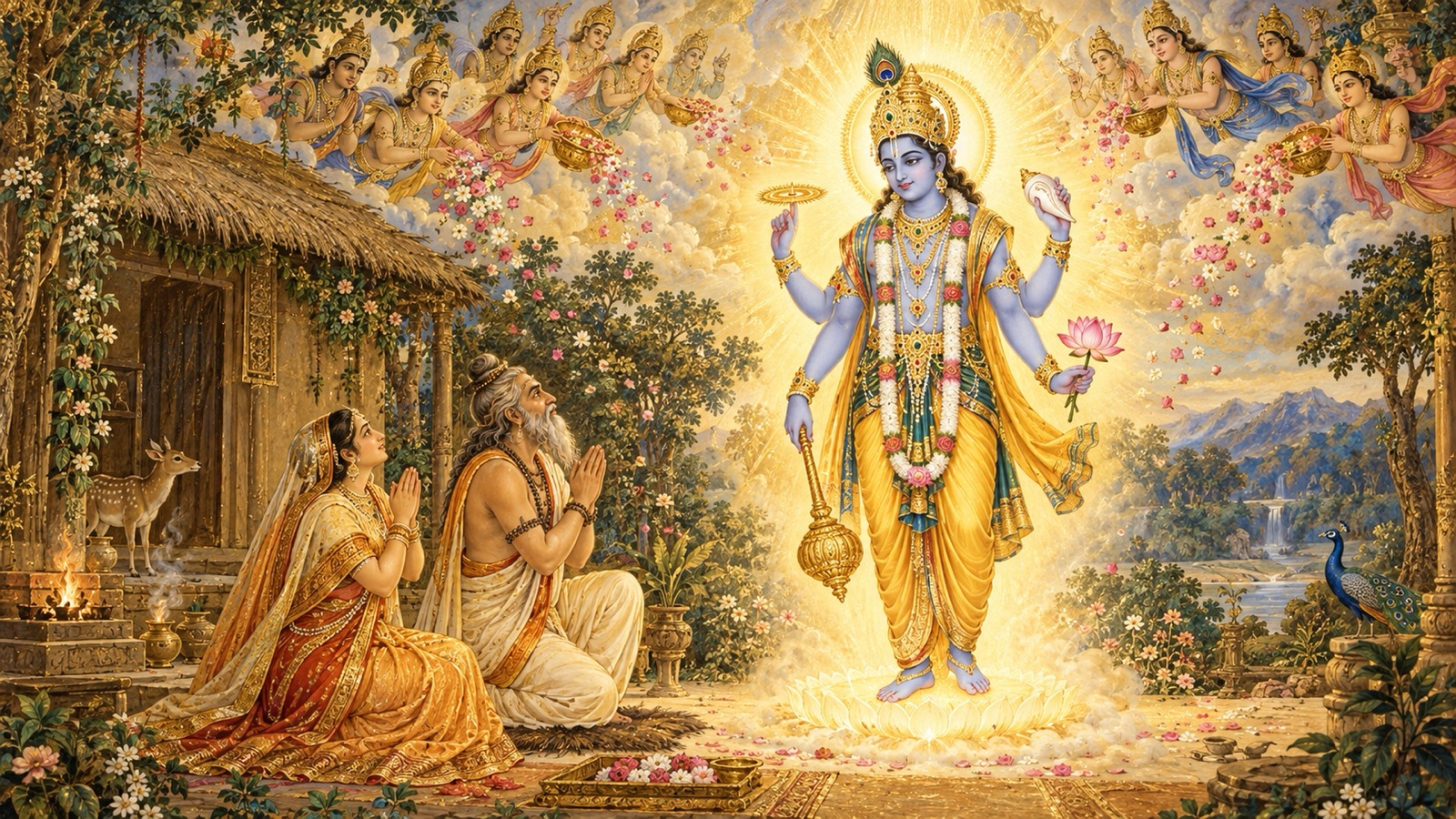
Thus glorified by Brahma, the Lord appeared from Aditi in His full splendour.
श्रीशुक उवाच इत्थं विरिञ्चस्तुतकर्मवीर्य: प्रादुर्बभूवामृतभूरदित्याम् । चतुर्भुज: शङ्खगदाब्जचक्र: पिशङ्गवासा नलिनायतेक्षण: ॥ १ ॥
śrī-śuka uvāca itthaṁ viriñca-stuta-karma-vīryaḥ prādurbabhūvāmṛta-bhūr adityām catur-bhujaḥ śaṅkha-gadābja-cakraḥ piśaṅga-vāsā nalināyatekṣaṇaḥ
Meaning: Sukadeva said: Thus, His deeds and prowess glorified by Brahma, the Lord — the abode of immortality — appeared from Aditi, four-armed, bearing conch, mace, lotus, and discus, clad in yellow, with eyes broad as lotus petals. (Canto 8, Chapter 18, verse 1)
At His birth the quarters brightened, the waters grew clear, and all creatures felt delight; the seasons displayed their beauty, and heaven, earth, and sky rejoiced. He appeared on the auspicious twelfth day of the bright half of Bhadrapada, at the victory-bringing hour of Abhijit, under the star Shravana — a day known ever after as Vijaya-Dvadashi. Celestial drums sounded, Apsaras danced, Gandharvas sang, and the gods rained flowers upon the hermitage of Aditi.
The Lord Becomes the Dwarf Boy
Then, as Aditi and Kashyapa gazed in wonder, the Lord who had appeared resplendent with jewels and weapons transformed Himself, like a wondrous actor, into a small brahmana boy.
यत् तद् वपुर्भाति विभूषणायुधै- रव्यक्तचिद्वयक्तमधारयद्धरि: । बभूव तेनैव स वामनो वटु: सम्पश्यतोर्दिव्यगतिर्यथा नट: ॥ १२ ॥
yat tad vapur bhāti vibhūṣaṇāyudhair avyakta-cid-vyaktam adhārayad dhariḥ babhūva tenaiva sa vāmano vaṭuḥ sampaśyator divya-gatir yathā naṭaḥ
Meaning: That form, radiant with ornaments and weapons, which the unmanifest Lord of pure consciousness had assumed, He now changed — becoming, before their very eyes, a small brahmana boy, like an actor of wondrous movements. (Canto 8, Chapter 18, verse 12)
There is a quiet doctrine folded into this double appearance. The infant seen at Aditi’s side is called here the very abode of immortality: He does not enter and leave a body as ordinary souls do, bound by birth, ageing, and death. When that same form changes at once into a small, dependent-looking boy, sages have always read it as proof, not contradiction — like a gifted actor who is fully present in every part he plays, the Lord’s unlimited appearances are each complete, each fully Him, none more or less real than another. To grasp this is no small thing: it is precisely the understanding that frees a soul from mistaking the Lord’s forms for material births, and draws that soul, in time, to His own eternal home (verses 1, 12).
The Sacred-Thread Ceremony
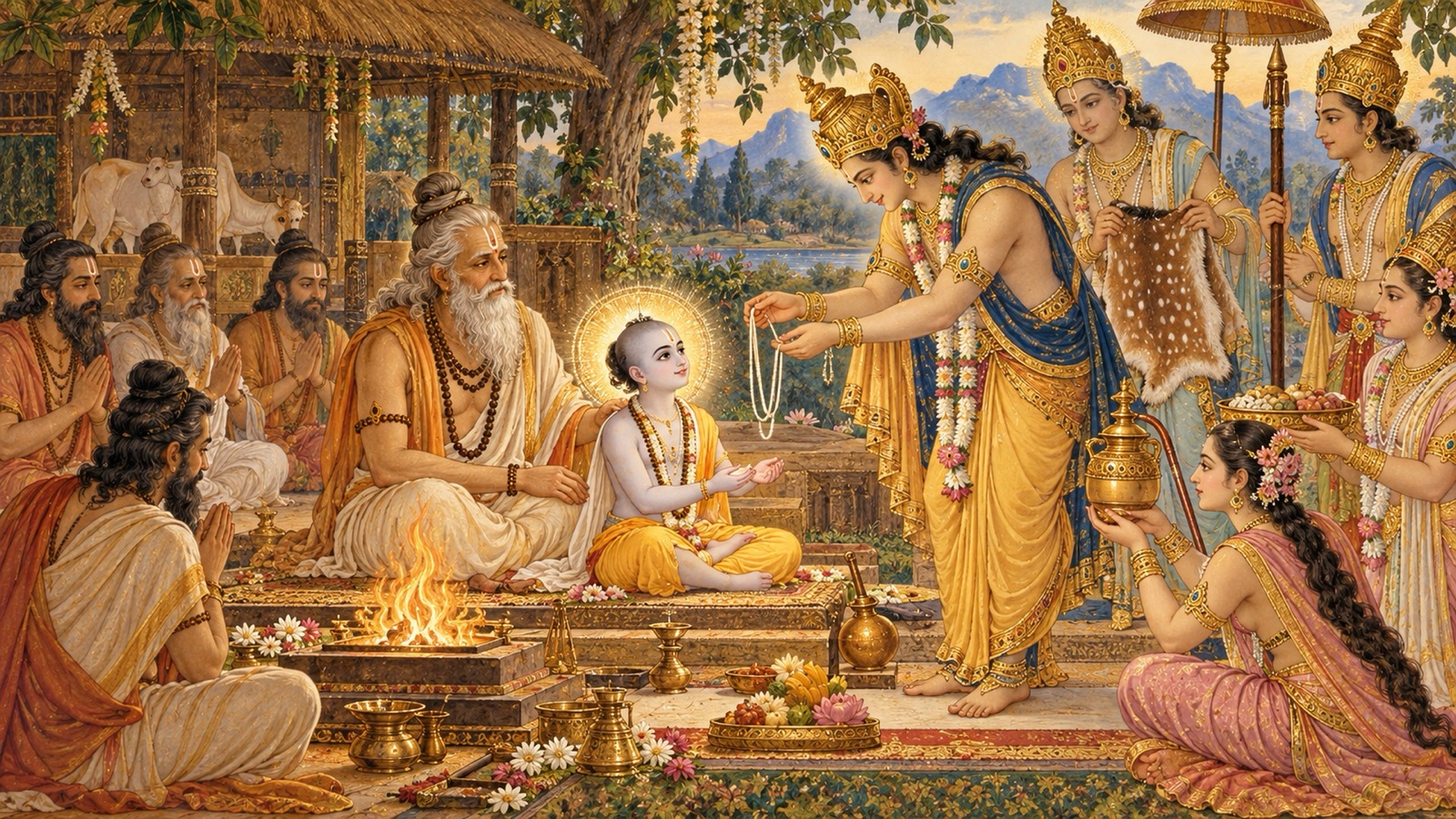
The sages, placing Kashyapa at their head, performed all the sacred rites for the divine Boy. At His investiture with the sacred thread, the sun-god taught Him the Gayatri-Mantra, Brihaspati gave Him the sacred thread, and Kashyapa a girdle of munja grass. Goddess Earth gave a deerskin, the moon-god a brahmachari’s staff, and His mother Aditi a cloth for His loins. Brahma gave a water-pot, the seven seers blades of kusha grass, Sarasvati a rosary, Kubera a begging bowl, and the Goddess Uma herself gave Him alms. Thus honoured by all, the little Brahmana boy outshone the whole assembly of sages by His radiance, and duly worshipped the sacred fire.
Vamana Goes to Bali’s Sacrifice
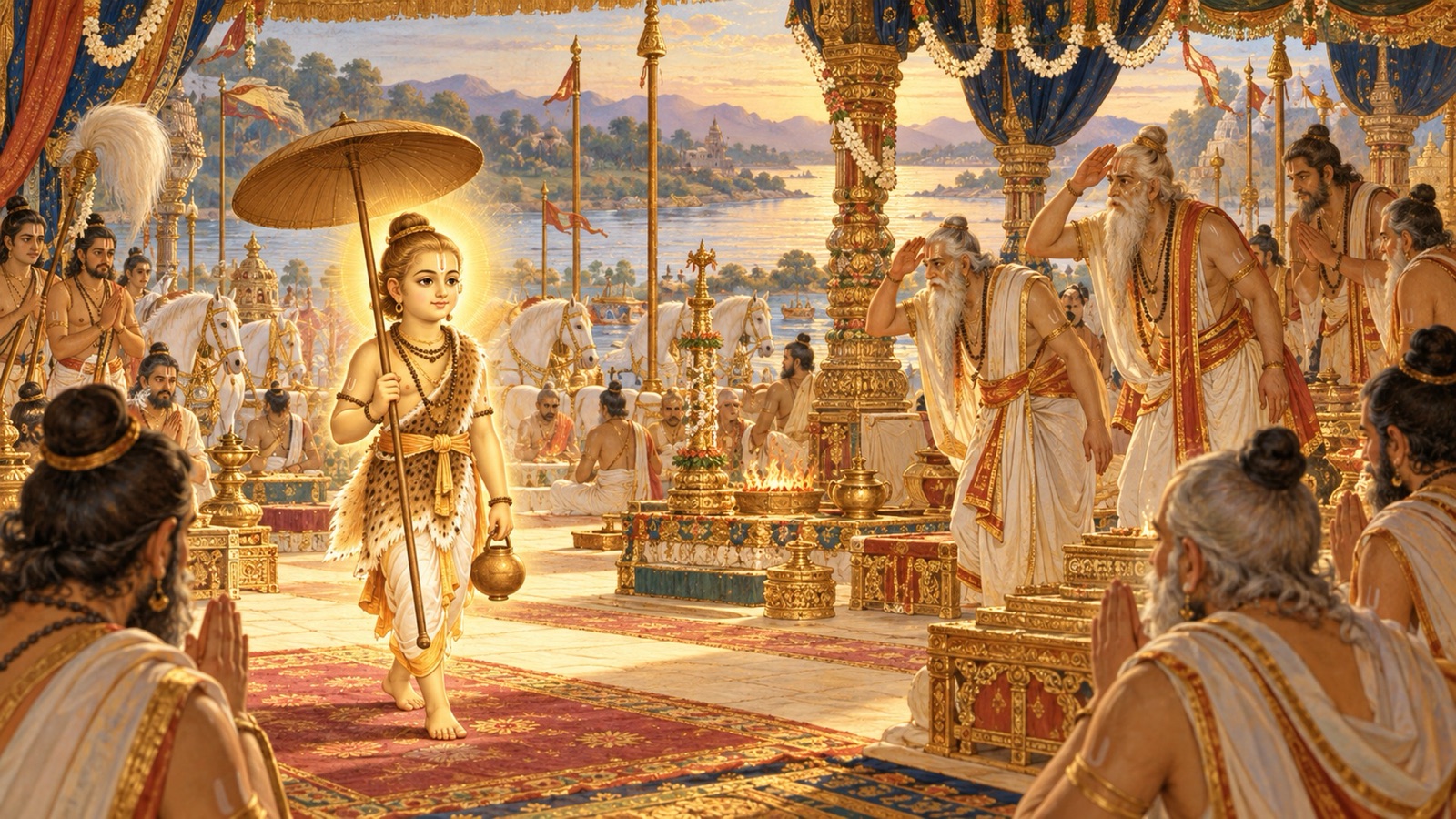
Having heard that the mighty Bali was propitiating the Lord through horse-sacrifices conducted by the Bhrgus, Lord Vamana set out for the sacrificial grounds at Bhrgukaccha, on the northern bank of the Narmada, His small form seeming to bend the earth at every step. As He entered, the Bhrgu priests and Bali himself, eclipsed by His splendour, wondered whether the sun-god, the fire-god, or the sage Sanatkumara had come to witness the sacrifice.
मौञ्ज्या मेखलया वीतमुपवीताजिनोत्तरम् । जटिलं वामनं विप्रं मायामाणवकं हरिम् ॥ २४ ॥ प्रविष्टं वीक्ष्य भृगव: सशिष्यास्ते सहाग्निभि: । प्रत्यगृह्णन्समुत्थाय सङ्क्षिप्तास्तस्य तेजसा ॥ २५ ॥
mauñjyā mekhalayā vītam upavītājinottaram jaṭilaṁ vāmanaṁ vipraṁ māyā-māṇavakaṁ harim praviṣṭaṁ vīkṣya bhṛgavaḥ saśiṣyās te sahāgnibhiḥ pratyagṛhṇan samutthāya saṅkṣiptās tasya tejasā
Meaning: Seeing the Lord Hari enter as a small brahmana boy — girded with a munja belt, a deerskin over His shoulder, with matted hair — the Bhrgus, with their disciples and the fire-priests, overpowered by His radiance, rose from their seats and welcomed Him. (Canto 8, Chapter 18, verses 24-25)
Bali Welcomes and Worships the Lord
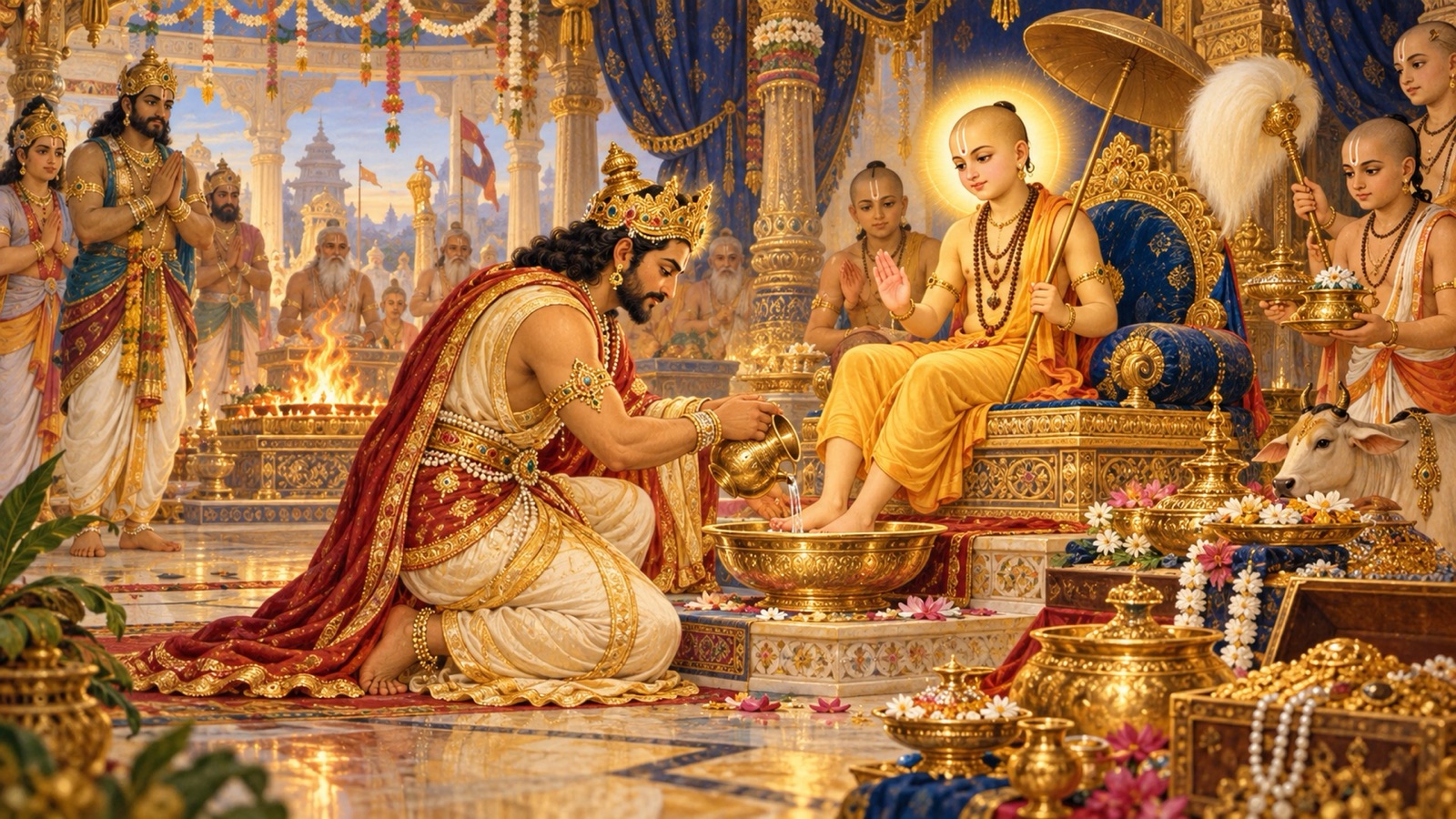
Overjoyed to see the charming Vamana, Bali fetched Him a seat, inquired after His welfare, washed His feet, and worshipped Him. Knowing what was right, the demon king placed on his head the water that had washed the Lord’s feet — the same auspicious water that Lord Siva bears with devotion on his own head. Then, generous and gracious, Bali offered the little Brahmana whatever He might desire.
यद् वटो वाञ्छसि तत्प्रतीच्छ मे त्वामर्थिनं विप्रसुतानुतर्कये । गां काञ्चनं गुणवद् धाम मृष्टं तथान्नपेयमुत वा विप्रकन्याम् । ग्रामान् समृद्धांस्तुरगान् गजान् वा रथांस्तथार्हत्तम सम्प्रतीच्छ ॥ ३२ ॥
yad yad vaṭo vāñchasi tat pratīccha me tvām arthinaṁ vipra-sutānutarkaye gāṁ kāñcanaṁ guṇavad dhāma mṛṣṭaṁ tathānna-peyam uta vā vipra-kanyām grāmān samṛddhāṁs turagān gajān vā rathāṁs tathārhattama sampratīccha
Meaning: Bali said: O boy, whatever you wish, accept it from me; I take you to be a brahmana’s son come in need. Accept a cow, gold, a well-furnished house, delicious food and drink, or a brahmana maiden; prosperous villages, horses, elephants, or chariots — accept, O most worthy one. (Canto 8, Chapter 18, verse 32)
With this open-handed offer, the scene is set. The mighty conqueror of the three worlds stands ready to give, and the Lord of the universe stands before him as a small boy, about to ask for the smallest of gifts — three paces of land. The next chapter will unfold that famous request.
Principal Teachings of This Chapter
1. The Supreme Lord descends in humility. The infinite Lord, born in four-armed splendour, at once becomes a small brahmana boy. God’s greatness is shown not in grandeur alone but in His willingness to appear small and humble (verses 1, 12).
2. The whole of creation rejoices at the Lord’s coming. At Vamana’s birth the quarters brighten, the seasons flower, and the gods rain flowers. The advent of the Lord brings joy and harmony to all creation (verses 4-10).
3. Even the Lord honours the sacred order. Vamana undergoes the sacred-thread ceremony and accepts the traditional gifts and duties of a brahmachari. The Lord Himself dignifies the practices of a righteous life (verses 13-19).
4. True radiance eclipses worldly power. The little Brahmana’s splendour overpowers the mighty Bali and his priests. Spiritual light outshines every outward greatness (verses 22-25).
5. Generosity and reverence prepare the heart for grace. Bali welcomes the Lord, washes His feet, and offers Him everything — and this very openness becomes the doorway to his greatest blessing. A giving, reverent heart draws the Lord near (verses 27-32).
A Devotional Reflection
There is a beautiful irony at the heart of this chapter. The Lord who holds the three worlds in His navel chooses to appear as a small brahmana boy, so slight that His weight seems to bend the earth at every step. The demon king Bali, master of all three worlds, sits enthroned at his sacrifice in the fullness of his power — and yet, when the little Brahmana enters, it is Bali who rises, Bali who fetches the seat, Bali who kneels to wash the small feet before him. The scene quietly overturns our usual measures of greatness. The one who seems to have everything bows before the one who seems to have nothing; the mighty conqueror serves the humble boy. And Bali does this not knowing who the boy truly is, simply out of his own reverence for a brahmana and his open-handed generosity. That is what makes his welcome so beautiful: he honours the Lord before he has any idea of the Lord’s identity. It is a gentle reminder that we, too, meet the Lord most often in humble and unexpected forms — in the small, the needy, the overlooked — and that the reverence and generosity we offer them is offered, in truth, to Him.
A Daily Devotional Practice
Today, welcome someone humble or in need as Bali welcomed the little Brahmana — with genuine respect, attention, and open-handed kindness, not knowing what grace may be hidden in the encounter. As you do, remember that the Lord Himself came once as a small boy to a king’s door, and offer your kindness to Him with the words “Om Namo Bhagavate Vasudevaya.” Let reverence for the humble become, in your life as in Bali’s, a doorway to the presence of God.
Conclusion
The eighteenth discourse of the Eighth Canto has shown us two miracles in one: a birth that is no ordinary birth, and a Lord content to stand small before the very king He has come to bless. Every form Vamana wears — four-armed infant, radiant brahmachari, dust-covered traveller at Bali’s gate — is the same complete Godhead, never other than Himself. May we learn from Him to recognise divinity in what looks humble, and to offer, as Bali did, a heart ready to give before it even knows to whom. The three small steps that will change everything are still to come.
May the divine wisdom of Srimad Bhagavatam awaken pure devotion within our hearts.
Om Namo Bhagavate Vasudevaya.
Jay Shree Madhav.
References and Attribution
- Primary edition: Gita Press, Śrīmad Bhāgavata Mahāpurāṇa (English, complete), Book Eight, Discourse 18, pages 810–814.
- Series: Srimad Bhagavatam Wisdom · Biswa Sanatan Dharma Seva Trust.
- Presented following the spiritual guidance and recommendation of Pandit Dr. Shri Kashinath Mishra.
This is an original, faithful retelling in the writer’s own words, with brief quoted verses shown in Devanāgarī and transliteration and their meanings given as summaries. It is not a reproduction of any single publisher’s continuous translation or commentary. No affiliation with or endorsement by any publisher is implied.
Jay Shree Madhav