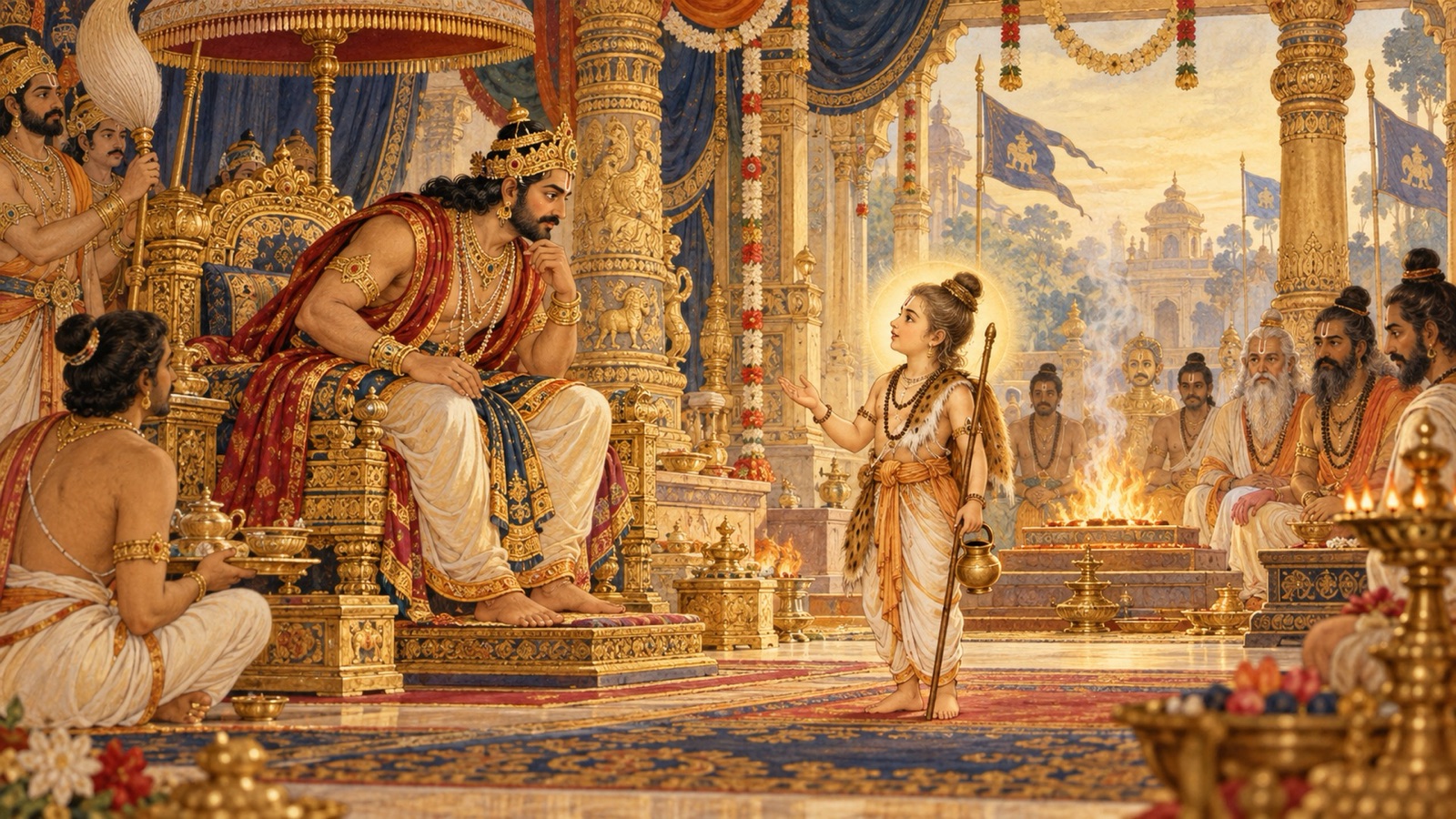
Before the throne of the mighty Bali, the small brahmana boy asks for the smallest of gifts — only three paces of land, measured by His own stride — and in that humble request the fate of the three worlds is quietly decided.
Om Namo Bhagavate Vasudevaya.
Om Namo Bhagavate Vasudevaya.
Om Namo Bhagavate Vasudevaya.
Welcome back to Srimad Bhagavatam Wisdom, a devotional journey through the sacred histories and teachings of the Srimad Bhagavat Mahapurana. In this nineteenth discourse, the Lord who owns the three worlds asks Bali for almost nothing, and in His answer teaches the king — and every listener — the true meaning of contentment, even as Sukracarya warns that the vow will cost everything.
Chapter Information
- Scripture: Śrīmad Bhāgavata Mahāpurāṇa
- Canto: 8 (Book Eight)
- Chapter: 19 (Discourse 19)
- Chapter title: Lord Vamana Begs Three Paces of Land from Bali
- Principal speaker: Sukadeva Gosvami, narrating to King Parikshit — with the words of Lord Vamana, Bali, and Sukracarya
- Principal listener: King Parikshit
- Main setting: The sacrificial grounds of Bali at Bhrgukaccha, on the northern bank of the Narmada
- Central subject: Lord Vamana’s request for three paces of land; His teaching on contentment; Bali’s pledge; and Sukracarya’s warning
- Principal verse range: Canto 8, Chapter 19, verses 1–43
- Primary edition: Gita Press Śrīmad Bhāgavata Mahāpurāṇa
Context From the Previous Chapter
In the eighteenth discourse, the Lord was born to Aditi as the divine Dwarf, took the form of a small brahmana boy, received the sacred thread with gifts from all the gods, and walked to the horse-sacrifice of the mighty Bali at Bhrgukaccha on the Narmada. There Bali welcomed Him, washed His feet, worshipped Him, and generously offered Him anything He might desire. This chapter takes up the Lord’s reply to that offer.
The Lord Honours Bali’s Noble Lineage
Delighted by Bali’s just and truthful words, the Lord welcomed his offer and began to speak.
श्रीशुक उवाच इति वैरोचनेर्वाक्यं धर्मयुक्तं स सूनृतम् । निशम्य भगवान्प्रीत: प्रतिनन्द्येदमब्रवीत् ॥ १ ॥
śrī-śuka uvāca iti vairocaner vākyaṁ dharma-yuktaṁ sa sūnṛtam niśamya bhagavān prītaḥ pratinandyedam abravīt
Meaning: Sukadeva said: Hearing this speech of Bali, the son of Virocana — a speech righteous, agreeable, and full of truth — the Lord was delighted, and welcoming it, He spoke as follows. (Canto 8, Chapter 19, verse 1)
The Lord praised the king’s words as worthy of his glorious race. He recalled that in secular matters Bali’s authority was the Bhrgus, while in matters of duty concerning the next world his guide was his grandfather Prahlada, eldest of the line and free from passion. In this race, He said, no one had ever been so lacking in charity as to refuse a brahmana at the door, nor so mean as to withhold a thing once promised; nor had its kings ever turned their faces from a mendicant seeking a gift or a warrior seeking a fight. Born in this very race, the Lord recalled, was Hiranyaksa, who once roamed the earth alone with his mace, unable to find a rival. Yet when Vishnu later slew this same Hiranyaksa in the course of rescuing the earth, He did not consider Himself truly victorious even then, recalling again and again the fallen demon’s rare valour — for the Lord honours courage even in a foe (verse 6).
The Tale of Hiranyakasipu’s Vain Search
To show how the enmities of this world come to nothing, the Lord recounted an old tale. When Hiranyaksa was slain, his elder brother Hiranyakasipu, burning with rage, went spear in hand to the abode of Hari to kill the slayer of his brother. Seeing him approach like Death itself, the Lord withdrew His form to a subtle state and, hiding in the very breath of Hiranyakasipu, entered through his nostril into his heart. Ransacking his own palace and finding it empty of Vishnu, the demon roared and searched the heavens, the earth, the quarters, the subterranean regions, and the seven seas — yet nowhere could he find the Lord who was hidden within his own body. At last he concluded that his brother’s slayer had fled to the realm from which none return, and gave up his pursuit.
The Lord drew the lesson gently: the hatred of embodied souls endures only until death, and wrath, rooted in ignorance and fed by egotism, has no lasting ground. He reminded Bali that his own father Virocana, so fond of the brahmanas, had once given away his very life to the gods when they came to him disguised as brahmanas — even though he knew who they truly were — and that Bali himself had faithfully observed the noble conduct of his forbears.

The Lord Asks for Three Paces of Land
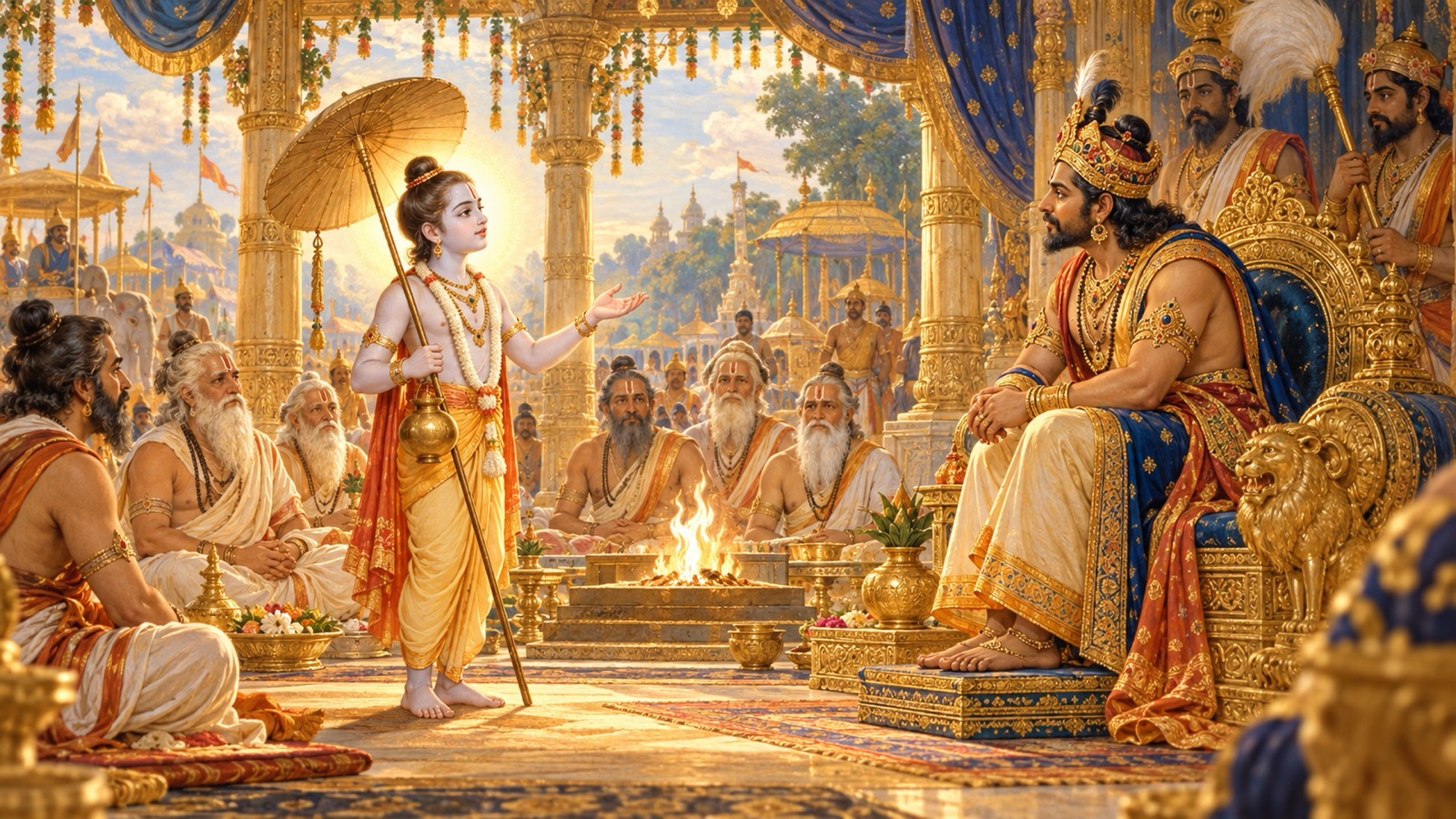
Then came the Lord’s celebrated request — small in measure, yet vast in meaning.
तस्मात् त्वत्तो महीमीषद् वृणेऽहं वरदर्षभात् । पदानि त्रीणि दैत्येन्द्र सम्मितानि पदा मम ॥ १६ ॥
tasmāt tvatto mahīm īṣad vṛṇe ’haṁ varadarṣabhāt padāni trīṇi daityendra sammitāni padā mama
Meaning: Therefore, O ruler of the Daityas, O foremost of the bestowers of boons, I ask of you only a small strip of land — three paces long, as measured by My own stride. (Canto 8, Chapter 19, verse 16)
He asked for nothing more, He said, for a learned man who accepts only as much as he truly needs incurs no fault at all.
नान्यत् ते कामये राजन्वदान्याज्जगदीश्वरात् । नैन: प्राप्नोति वै विद्वान्यावदर्थप्रतिग्रह: ॥ १७ ॥
nānyat te kāmaye rājan vadānyāj jagad-īśvarāt nainaḥ prāpnoti vai vidvān yāvad-artha-pratigrahaḥ
Meaning: I desire nothing else from you, O king, munificent lord of the world; for a wise man who accepts only as much as he needs never incurs sin. (Canto 8, Chapter 19, verse 17)
Bali’s Generous Protest
Bali smiled at the request. He told the boy that although his words were worthy in the eyes of the wise, he showed a childlike intellect, unaware of his own interest: having won over the undisputed ruler of all the worlds — one able to bestow an entire continent — he asked for a mere three paces of land. Once a man has approached a giver, Bali said, he should not have to beg again; and so he urged the boy to accept, freely and at will, land enough to afford him a decent living.
The Lord’s Teaching on Contentment
The Lord answered Bali’s generosity not by taking more, but with a teaching on the true nature of contentment. All the dearest treasures of the three worlds, He said, cannot satisfy a person who has not subdued his senses and mind.
त्रिभि: क्रमैरसन्तुष्टो द्वीपेनापि न पूर्यते । नववर्षसमेतेन सप्तद्वीपवरेच्छया ॥ २२ ॥
tribhiḥ kramair asantuṣṭo dvīpenāpi na pūryate nava-varṣa-sametena sapta-dvīpa-varecchayā
Meaning: One who is not content with three paces of land cannot be satisfied even by a whole continent of nine sub-regions, for he will only long for all seven islands of the earth. (Canto 8, Chapter 19, verse 22)
He recalled how even great sovereigns like Prthu and Gaya, lords of all seven islands, never reached the end of their thirst for wealth and enjoyment. A contented person lives at ease on whatever comes by fortune, while a discontented one, though he win the three worlds, is never happy. Discontent with wealth and pleasure, the Lord taught, drives the soul from birth to birth, while contentment with what comes of its own accord leads toward liberation; the spiritual lustre of a contented brahmana grows, but through greed it is extinguished as fire is quenched by water. For this reason alone, He said, He asked only three paces — for wealth is worth desiring only to the measure of one’s need.
Bali Gives His Word
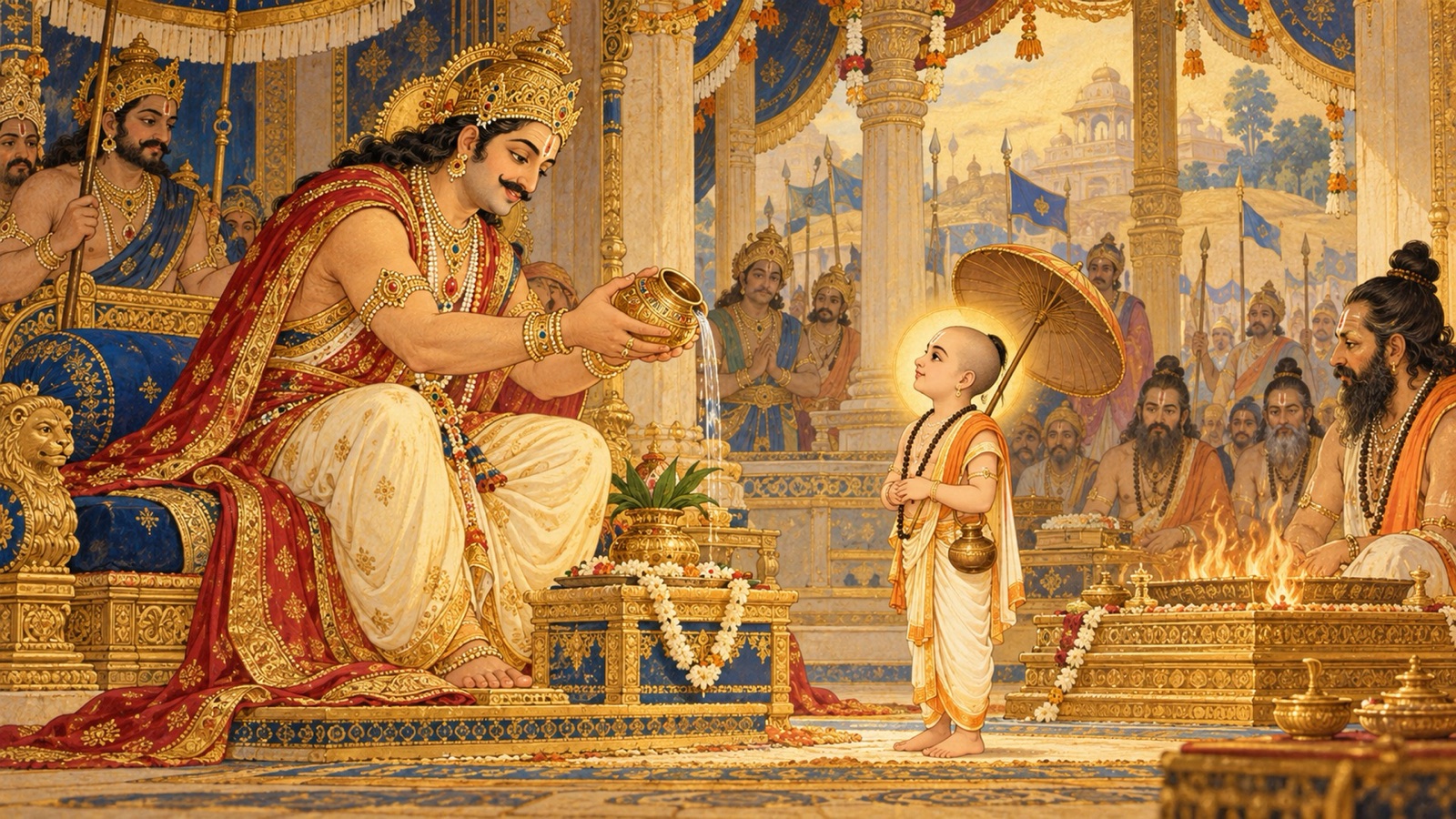
Moved and amused, Bali resolved to grant the gift.
श्रीशुक उवाच इत्युक्त: स हसन्नाह वाञ्छात: प्रतिगृह्यताम् । वामनाय महीं दातुं जग्राह जलभाजनम् ॥ २८ ॥
śrī-śuka uvāca ity uktaḥ sa hasann āha vāñchātaḥ pratigṛhyatām vāmanāya mahīṁ dātuṁ jagrāha jala-bhājanam
Meaning: Sukadeva said: Thus addressed, Bali laughed and said, “Take as much as you wish”; and to give the land to the divine Dwarf, he took up his water-pot to solemnise the vow. (Canto 8, Chapter 19, verse 28)
Sukracarya’s Warning
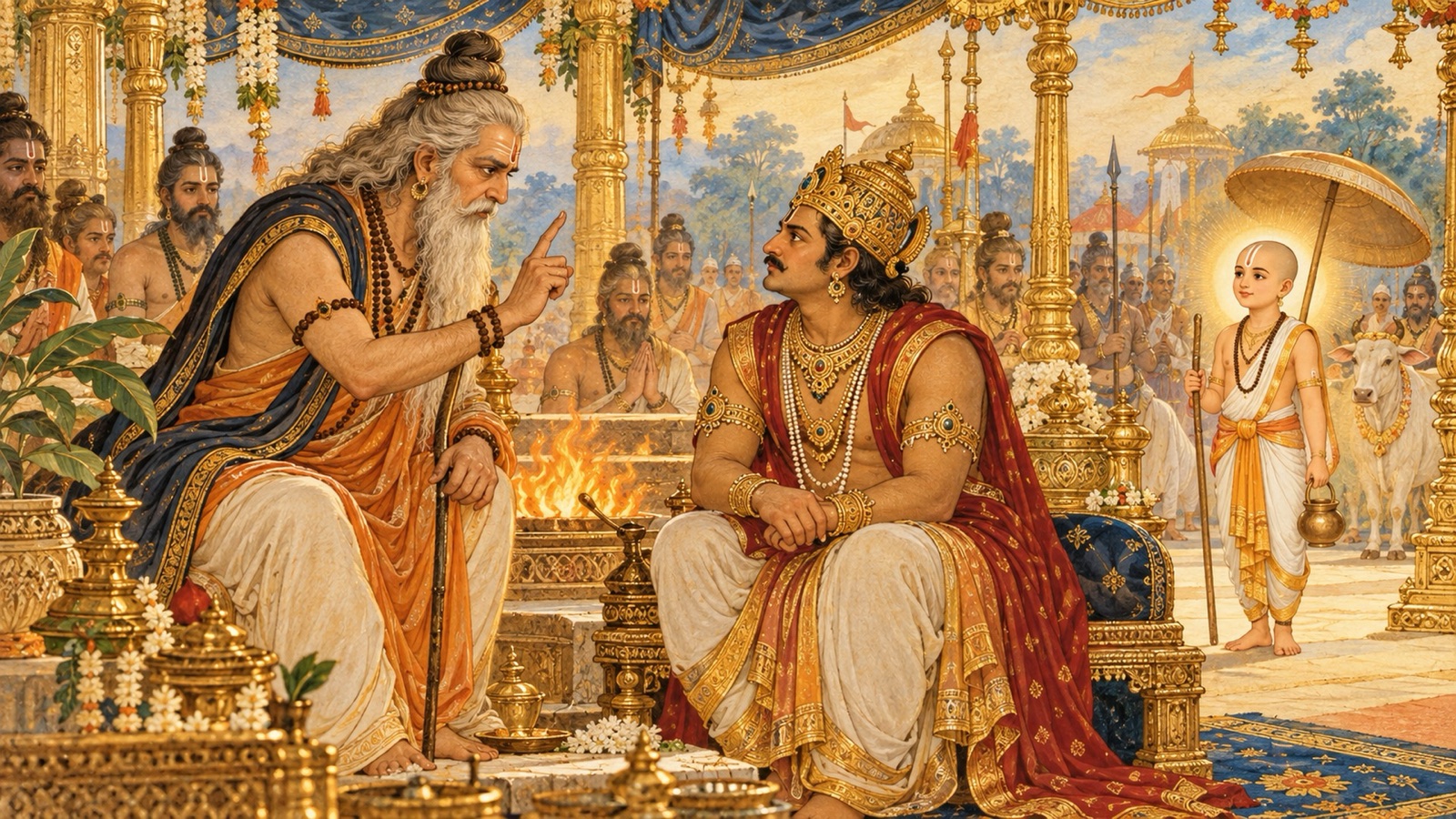
But Bali’s preceptor, the sage Usana — Sukracarya, foremost of the learned and knower of Lord Vishnu’s purpose — at once saw the danger and warned his disciple.
श्रीशुक्र उवाच एष वैरोचने साक्षाद् भगवान्विष्णुरव्यय: । कश्यपाददितेर्जातो देवानां कार्यसाधक: ॥ ३० ॥
śrī-śukra uvāca eṣa vairocane sākṣād bhagavān viṣṇur avyayaḥ kaśyapād aditer jāto devānāṁ kārya-sādhakaḥ
Meaning: Sukracarya said: O son of Virocana, this dwarf is none other than the imperishable Lord Vishnu Himself, born of Kashyapa through Aditi to accomplish the purpose of the gods. (Canto 8, Chapter 19, verse 30)
Sukracarya said he could not approve of what Bali had promised, for the king was unaware of the harm to come: a great calamity had befallen the demons. Appearing as a religious student through His own Maya, this Hari would snatch away Bali’s throne, dominion, fortune, splendour, and fame, and bestow them upon His brother Indra. Assuming a form co-extensive with the universe, He would cover all three worlds in three strides — and then how, Sukracarya asked, could Bali keep body and soul together, having given everything away?
क्रमतो गां पदैकेन द्वितीयेन दिवं विभो: । खं च कायेन महता तार्तीयस्य कुतो गति: ॥ ३४ ॥
kramato gāṁ padaikena dvitīyena divaṁ vibhoḥ khaṁ ca kāyena mahatā tārtīyasya kuto gatiḥ
Meaning: With one step the Lord will cover the earth, with the second the heavens, and with His vast body the sky — where, then, will there be any place for His third step? (Canto 8, Chapter 19, verse 34)
Unable to fulfil so great a promise, Sukracarya warned, Bali would win only a firm footing in the infernal regions, for the wise do not commend a charity that costs one’s own livelihood. A person of true knowledge, he counselled, should instead divide his wealth into five — for religious duty, for reputation, for enjoyment, for opulence, and for the support of his family — rather than surrender it all at once (verse 37). He then instructed Bali on truth and untruth, citing the seers of the Veda: truth is the flower and fruit of the tree of the body, but if the tree itself does not survive, its flower and fruit are lost — and so, in the rarest extremities, an untruth that preserves life may be permitted: when courting a woman, in jest, at a wedding, in earning one’s livelihood, when life is in danger, in protecting cows and brahmanas, or in saving someone from an enemy’s hand (verses 38-43). With these words he pressed Bali to reconsider his pledge.
Principal Teachings of This Chapter
1. The Lord honours a devotee’s lineage and virtue. Before asking anything, the Lord praises Bali’s noble race and its unbroken tradition of charity and truth. Grace often begins with the recognition of the good already present in a devout heart (verses 2-6).
2. Worldly enmity ends in emptiness. The tale of Hiranyakasipu searching the whole universe for a Lord hidden within his own heart shows that hatred lasts only until death and, rooted in ignorance, finds nothing in the end (verses 7-13).
3. The Lord asks only for what is needed. The Lord of all the worlds asks for a mere three paces of land, teaching that a wise person who accepts only as much as he needs incurs no fault (verses 16-17).
4. Contentment is the true wealth. One who is not satisfied with three paces will not be satisfied with the whole earth; a restless heart wanders through repeated birth and death, but a heart at peace with what providence gives moves toward liberation (verses 21-27).
5. Truthfulness is the flower and fruit of life. Even in warning against a rash vow, Sukracarya upholds truth as the essence of righteousness, permitting untruth only in the rarest circumstances to protect life, cows, and brahmanas (verses 38-43).
6. Taking away is the Lord’s mercy. Sukracarya warns that this Hari will strip Bali of his throne, wealth, and glory (verses 32-33), and to a priest guarding his disciple’s security this looks like ruin. But the very name Hari means the one who takes away — and the Vaishnava tradition teaches that when the Lord removes a devotee’s possessions, it is not loss but grace, clearing away the attachments that stand between the soul and Him. What frightens Sukracarya becomes, for Bali, the doorway to a glory far beyond any earthly throne.
A Devotional Reflection
There is a quiet grandeur in the Lord’s request. He who owns the three worlds, who will presently span them in three strides, stands before Bali as a small boy and asks for the least thing imaginable — three paces of earth. He could have demanded a continent, and Bali would gladly have given it; instead He asks for almost nothing, and then, when Bali protests, He does not enlarge His request but enlarges Bali’s understanding, teaching him that the whole earth cannot satisfy a restless heart, while three paces are more than enough for a contented one. This is how the Lord deals with those He means to bless: He asks little of us outwardly, but uses the asking to draw us inward, toward the one treasure that never fails — a heart at peace with what God provides. Bali’s greatness is that he gives his word anyway, laughing and unafraid; even Sukracarya’s warning, true as it is in worldly terms, cannot outweigh the beauty of a devotee who would rather keep his promise to the Lord than keep his kingdom. The three paces the Lord asks for are, in the end, the whole of Bali’s life laid willingly at His feet.
A Daily Devotional Practice
Today, practise the contentment the Lord teaches to Bali. Choose one thing you have been restlessly wanting — some possession, recognition, or comfort — and consciously set it down, resolving to live at ease with whatever comes of its own accord. As you release it, offer the longing itself to the Lord with the words “Om Namo Bhagavate Vasudevaya,” trusting that three paces given in peace are richer than the whole earth grasped in anxiety. Let a small act of contentment become, as it did for Bali, a doorway to the grace of God.
Conclusion
The nineteenth discourse carries the heart of the Vamana story: the Lord of the three worlds asks for only three paces of land, and in that small request lies a teaching greater than any kingdom — that contentment, not possession, is the true wealth of a soul. Bali’s laughing pledge, given even as Sukracarya warns of ruin, shows that a devotee’s word to the Lord outweighs every earthly treasure. What looks like loss to the fearful eye is, in truth, the Lord’s own mercy, clearing the way to a glory no throne can equal. May we, too, learn to ask for little, keep our word to the Lord, and trust that what He removes, He returns a hundredfold.
May the divine wisdom of Srimad Bhagavatam awaken pure devotion within our hearts.
Om Namo Bhagavate Vasudevaya.
Jay Shree Madhav.
References and Attribution
- Primary edition: Gita Press, Śrīmad Bhāgavata Mahāpurāṇa (English, complete), Book Eight, Discourse 19, pages 812–816.
- Series: Srimad Bhagavatam Wisdom · Biswa Sanatan Dharma Seva Trust.
- Presented following the spiritual guidance and recommendation of Pandit Dr. Shri Kashinath Mishra.
This is an original, faithful retelling in the writer’s own words, with brief quoted verses shown in Devanāgarī and transliteration and their meanings given as summaries. It is not a reproduction of any single publisher’s continuous translation or commentary. No affiliation with or endorsement by any publisher is implied.
Jay Shree Madhav