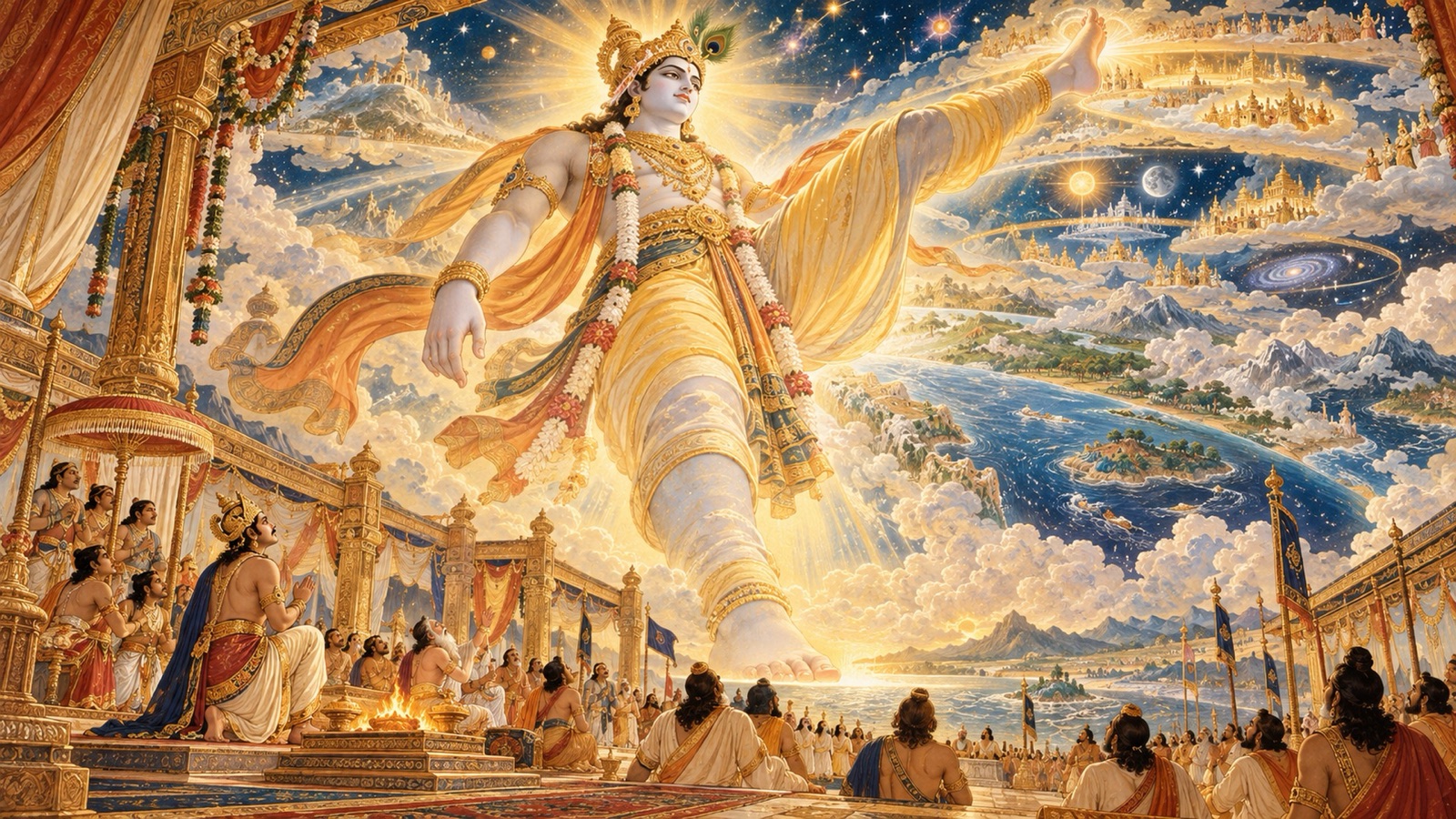
The little brahmana boy grows before the eyes of the assembly into a form that holds the whole of creation — earth and sky, heavens and oceans, gods, sages, and all living beings — while Bali gazes up in wonder at the infinite Lord he has just tried to gift a mere three paces of land.
Om Namo Bhagavate Vasudevaya.
Om Namo Bhagavate Vasudevaya.
Om Namo Bhagavate Vasudevaya.
Welcome back to Srimad Bhagavatam Wisdom, a devotional journey through the sacred histories and teachings of the Srimad Bhagavat Mahapurana. This twentieth discourse carries the Vamana story forward, taking up Bali’s reply to his preceptor’s warning and the wonder that follows from it.
Chapter Information
- Scripture: Śrīmad Bhāgavata Mahāpurāṇa
- Canto: 8 (Book Eight)
- Chapter: 20 (Discourse 20)
- Chapter title: Bali’s Surrender of the Three Worlds and Vision of the Lord’s Universal Form
- Principal speaker: Sukadeva Gosvami, narrating to King Parikshit — with the words of Bali
- Principal listener: King Parikshit
- Main setting: The sacrificial grounds of Bali at Bhrgukaccha, on the northern bank of the Narmada
- Central subject: Bali’s steadfast truthfulness, the gift of the land, Sukracarya’s curse, the worship of the Lord’s feet, and the manifestation of the Lord’s cosmic form and His mighty strides
- Principal verse range: Canto 8, Chapter 20, verses 1–34
- Primary edition: Gita Press Śrīmad Bhāgavata Mahāpurāṇa
Context From the Previous Chapter
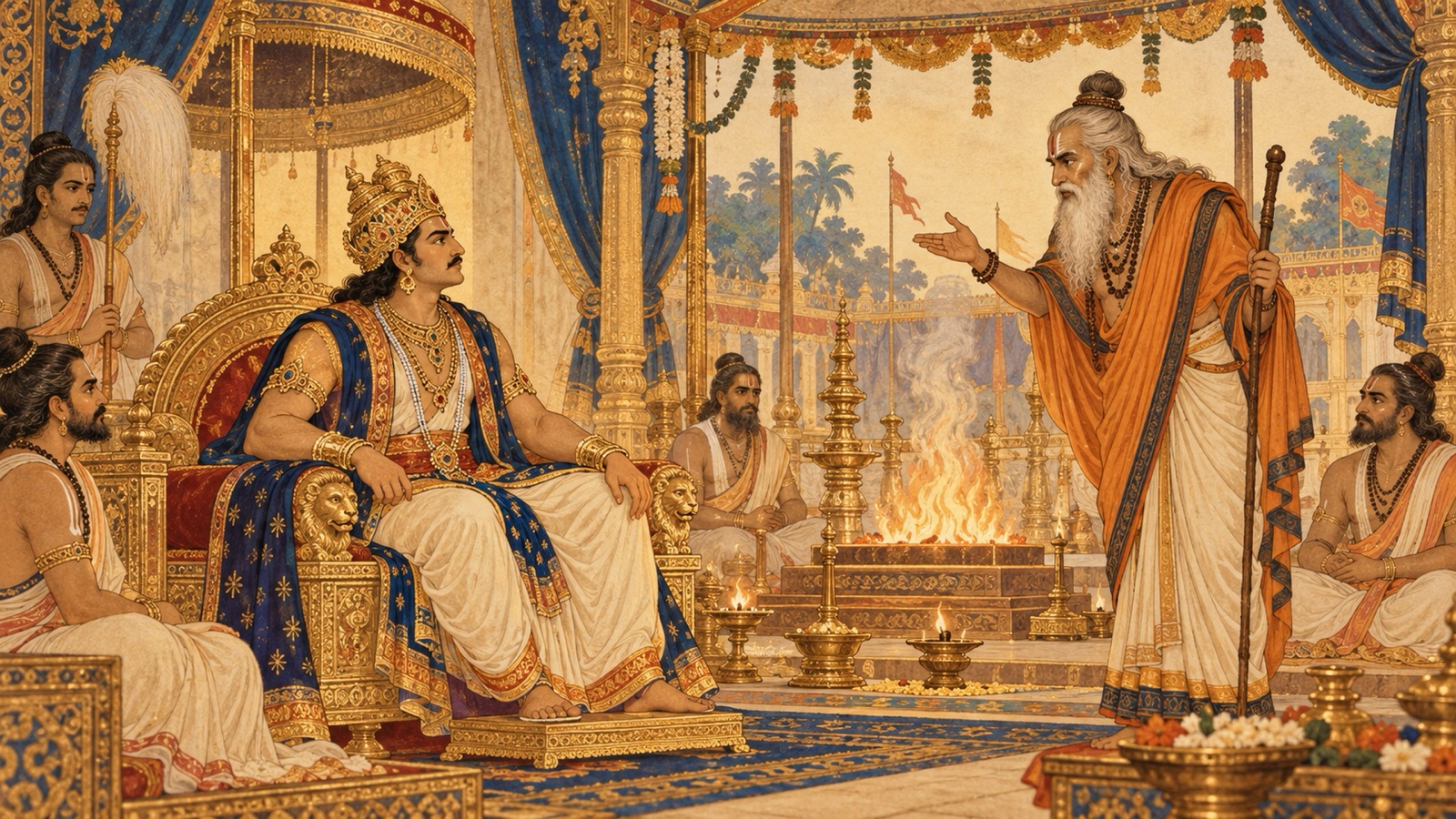
In the nineteenth discourse, pleased by Bali’s generosity, the Lord praised the king’s noble lineage and asked only for three paces of land, answering Bali’s offer of more with a teaching on contentment. Laughing, Bali gave his word and took up his water-pot to seal the vow — whereupon Sukracarya recognised the Dwarf as Lord Vishnu and warned that the promise would cost Bali the three worlds. This chapter opens with Bali’s reply.
Bali Chooses Truth Over His Kingdom
Addressed in this way by the preceptor of his family, Bali kept quiet for a moment, and then, with a composed mind, replied to his teacher. He agreed that the wise householder’s duty is indeed to pursue wealth, enjoyment, fame, and livelihood without harming any of them — but, having once promised a gift to a brahmana, how could the celebrated son of Prahlada’s line refuse like a cheat, out of greed for wealth? Nothing, he said, frightened him so much as breaking faith with a brahmana.
श्रीबलिरुवाच न ह्यसत्यात् परोऽधर्म इति होवाच भूरियम् । सर्वं सोढुमलं मन्ये ऋतेऽलीकपरं नरम् ॥ ४ ॥
śrī-balir uvāca na hy asatyāt paro ’dharma iti hovāca bhūr iyam sarvaṁ soḍhum alaṁ manye ṛte ’līka-paraṁ naram
Meaning: Bali said: This very Earth once declared, “There is no unrighteousness greater than falsehood; I feel able to bear every burden except a man given to lying.” (Canto 8, Chapter 20, verse 4)
He was not afraid, he said, of hell, of poverty, of an ocean of misery, of losing his position, or even of death itself, as much as he feared deceiving a brahmana. Wealth that a dying man must in any case abandon should surely be given away freely while one lives; and if pious souls like the sage Dadhici and King Sibi gave even their own bodies for the good of others, what hesitation could there be in parting with mere land? Time had swallowed the enjoyments of the greatest of the Daitya kings, he observed, but not the fame they had earned by their generosity on earth.
The Gift Given Despite a Curse
Impelled by providence, Sukracarya then cursed his own high-minded disciple for disregarding his command — telling Bali that, conceited fool that he had become, he would soon fall from his high position. Yet even under his teacher’s curse the great soul did not waver from the truth.
There is a deeper principle behind Bali’s quiet defiance. A teacher’s true office is to carry the disciple toward loving service to the Lord; when a teacher instead stands between the disciple and that service, his word can no longer command the disciple’s obedience, however honoured his seat. Sukracarya, for all his learning, counselled Bali here as a priest guarding wealth, fame and reputation, not as one eager to see his disciple’s devotion flourish. Bali did not scorn his teacher’s chair — in the silence before he answered, he had already understood that no instruction, however ancient its authority, could outweigh a soul’s surrender to Vishnu (verses 1–2, 14–16).
एवं शप्त: स्वगुरुणा सत्यान्न चलितो महान् । वामनाय ददावेनामर्चित्वोदकपूर्वकम् ॥ १६ ॥
evaṁ śaptaḥ sva-guruṇā satyān na calito mahān vāmanāya dadāv enām arcitvodaka-pūrvakam
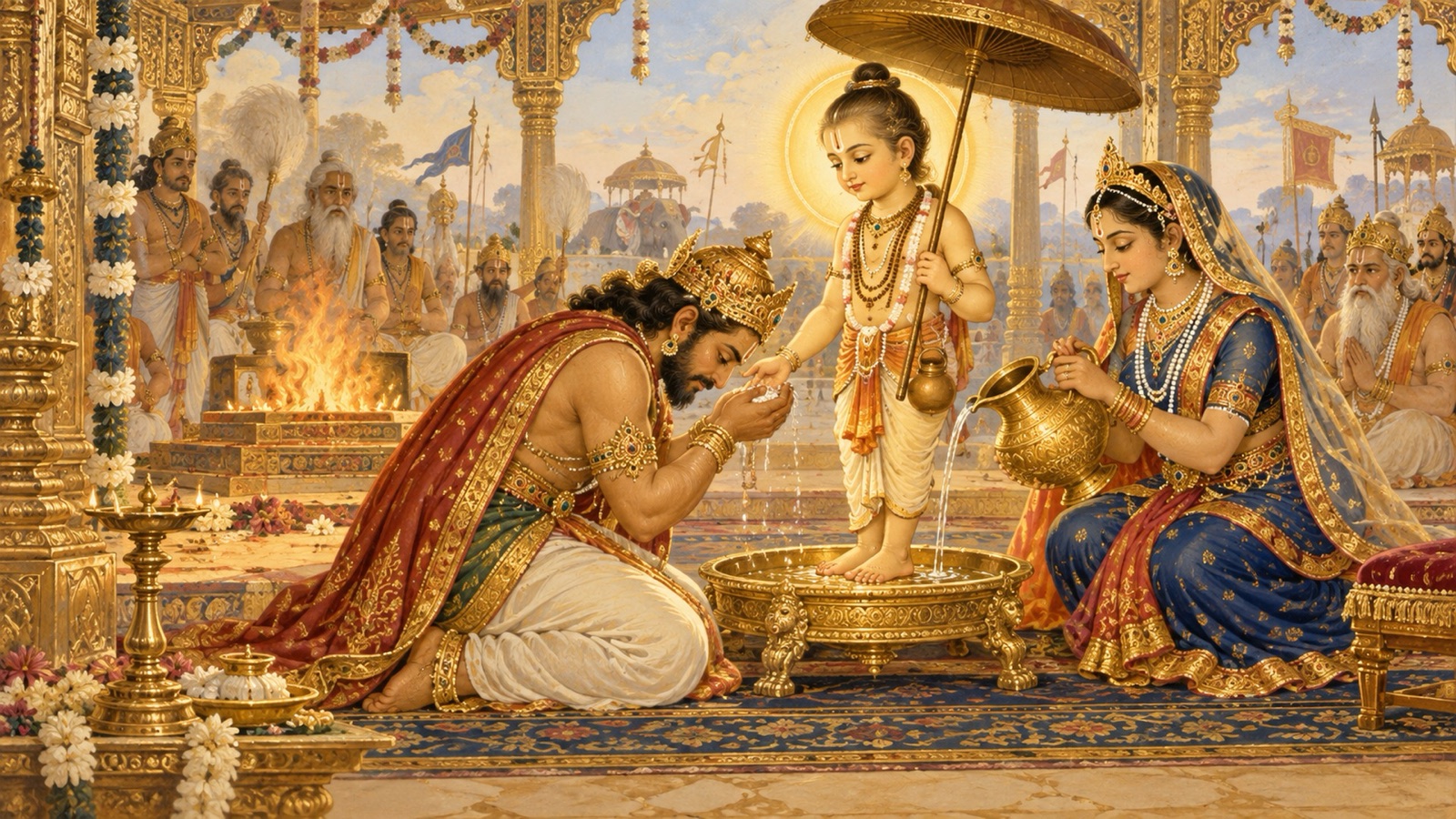
Meaning: Though thus cursed by his own preceptor, the great soul did not deviate from truth; and, having worshipped the Lord and poured out water to solemnise the gift, he bestowed the land upon the divine Dwarf. (Canto 8, Chapter 20, verse 16)
Then Bali’s wife, Vindhyavali, adorned with a pearl necklace, came forward and brought a golden pitcher full of water to wash the Lord’s feet.
यजमान: स्वयं तस्य श्रीमत् पादयुगं मुदा । अवनिज्यावहन्मूर्ध्नि तदपो विश्वपावनी: ॥ १८ ॥
yajamānaḥ svayaṁ tasya śrīmat pāda-yugaṁ mudā avanijyāvahan mūrdhni tad apo viśva-pāvanīḥ
Meaning: The performer of the sacrifice, Bali himself, joyfully washed the glorious feet of the Lord and bore upon his own head that water, which is able to sanctify the entire universe. (Canto 8, Chapter 20, verse 18)
Heaven Applauds the Generous King
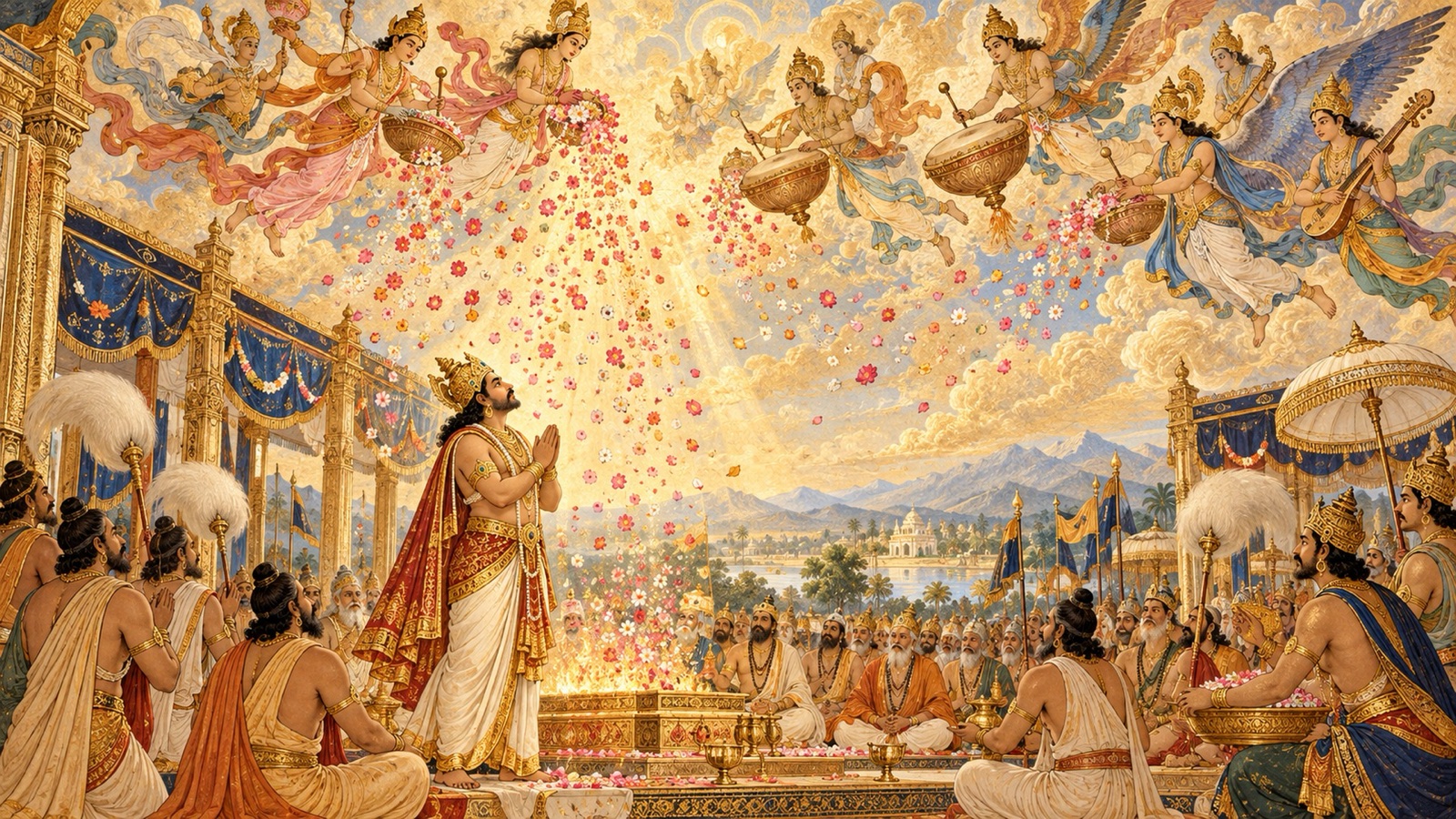
Seeing this, the hosts of the gods in heaven — along with the Gandharvas, Vidyadharas, Siddhas, and Caranas — praised Bali’s action and his guilelessness and, though he was their enemy, rained down showers of flowers upon the lord of the demons in sheer delight. Kettledrums sounded again and again in their thousands, and the celestial singers sang of the wonder that this noble soul had knowingly given away all three worlds to his adversary.
नेदुर्मुहुर्दुन्दुभय: सहस्रशो गन्धर्वकिम्पूरुषकिन्नरा जगु: । मनस्विनानेन कृतं सुदुष्करं विद्वानदाद् यद् रिपवे जगत्त्रयम् ॥ २० ॥
nedur muhur dundubhayaḥ sahasraśo gandharva-kimpūruṣa-kinnarā jaguḥ manasvinānena kṛtaṁ suduṣkaraṁ vidvān adād yad ripave jagat-trayam
Meaning: Kettledrums sounded in their thousands again and again, while the Gandharvas, Kimpurusas, and Kinnaras sang: “A most difficult deed has been done by this noble soul, who, knowing full well, has given away all three worlds to his enemy.” (Canto 8, Chapter 20, verse 20)
The Dwarf Becomes the Cosmic Form
Then, in that very moment, the small form of the infinite Lord — which held within itself the three gunas and the whole of creation — began to grow to an astonishing extent.
तद् वामनं रूपमवर्धताद्भुतं हरेरनन्तस्य गुणत्रयात्मकम् । भू: खं दिशो द्यौर्विवरा: पयोधय- स्तिर्यङ्नृदेवा ऋषयो यदासत ॥ २१ ॥
tad vāmanaṁ rūpam avardhatādbhutaṁ harer anantasya guṇa-trayātmakam bhūḥ khaṁ diśo dyaur vivarāḥ payodhayas tiryaṅ-nṛ-devā ṛṣayo yad-āsata
Meaning: That dwarf form of the infinite Lord grew wondrously, encompassing the three modes of nature; and within it the earth, the sky, the quarters, the heavens, the subterranean regions, the oceans, and all beings — animals, human beings, gods, and sages — found their place. (Canto 8, Chapter 20, verse 21)
Within the body of that Lord of boundless powers, Bali, together with the officiating priests, the preceptors, and the members of the sacrificial assembly, beheld the whole of the universe. In that cosmic form he saw the subterranean regions in the soles of the Lord’s feet, the earth in His feet, the mountains in His shanks, the birds in His knees, and the hosts presiding over the air in His thighs. He beheld the Prajapatis in the Lord’s loins, the firmament in His navel, the seven oceans in His sides, and the host of stars upon His chest. Higher still he saw righteousness in the Lord’s heart, the moon in His mind, the goddess Sri with a lotus at His bosom, the sacred Sama hymns in His throat, the gods with Indra at their head in His arms, the quarters in His ears, the clouds in His hair, the sun in His eyes, and the Vedas in His speech. Bali beheld further still that even the shadowed and difficult things of this world have their place in the Lord: anger on His brow, greed upon His lips, desire in His touch, unrighteousness at His back, and the fire of sacrifice in His very stride; death lived in His shadow, and the illusory energy, Maya, played in His smile, while every herb, river, and stone found its origin in His hair, veins, and nails. Even Brahma, the gods, and the great sages rested in His intelligence, and every moving and unmoving being in creation stirred within His limbs — until, in that single vision, the entire cosmos, its very light and its very shadow together, stood revealed within the person of the Lord (verses 22-29).
The Two Great Strides
Beholding the whole universe within the all-sustaining Lord, the demons were seized with fear. The Lord’s own divine weapons and attendants appeared in living form — His discus Sudarsana of unbearable splendour, His conch Pancajanya of thunderous roar, His mace Kaumodaki, His bow, His sword, and His chief attendants headed by Sunanda. Resplendent with crown, armlets, and glittering earrings, marked with the Srivatsa and the Kaustubha gem, and garlanded with sylvan flowers, the wide-striding Lord shone in glory. With a single stride He measured the earth that belonged to Bali, covering the sky with His body and the quarters with His arms. Then He raised His foot for the second stride.
पदं द्वितीयं क्रमतस्त्रिविष्टपं न वै तृतीयाय तदीयमण्वपि । उरुक्रमस्याङ्घ्रिरुपर्युपर्यथो महर्जनाभ्यां तपस: परं गत: ॥ ३४ ॥
padaṁ dvitīyaṁ kramatas triviṣṭapaṁ na vai tṛtīyāya tadīyam aṇv api urukramasyāṅghrir upary upary atho mahar-janābhyāṁ tapasaḥ paraṁ gataḥ
Meaning: As He took His second step, the heavens were covered, and not even an atom of space remained for a third; for the foot of the wide-striding Lord rose higher and higher, past Maharloka and Janaloka, beyond even Tapoloka. (Canto 8, Chapter 20, verse 34)

Principal Teachings of This Chapter
1. Truthfulness is dearer than dominion. Warned that his vow will cost him the three worlds, Bali does not flinch; he fears deceiving a brahmana more than hell, poverty, or death itself, holding that no unrighteousness is greater than falsehood (verses 3-5).
2. A teacher who blocks the path of devotion forfeits his claim to obedience. Sukracarya’s curse cannot move Bali, who already understands that a guru’s authority ends where loyalty to God begins (verses 14-16).
3. Loving service is offered with joy, not reluctance. Bali and his queen Vindhyavali wash the Lord’s feet with delight and bear the sacred water upon their heads, showing that surrender, when it is real, is full of gladness (verses 17-18).
4. Even one’s enemies honour genuine virtue. The gods, though Bali’s adversaries, shower him with flowers and praise, for true magnanimity commands reverence beyond the divisions of friend and foe (verses 19-20).
5. The Lord contains the whole of creation. In the cosmic form, the entire universe — worlds, beings, and powers — is seen resting within the person of the Lord, revealing that all things live and move within Him (verses 21-29).
A Devotional Reflection
There is a divine irony at the heart of this chapter. A king believes he is the giver and the Lord the beggar; he means to bestow a little land upon a small boy. And then the small boy grows, and the whole earth that Bali imagined he was granting is revealed to be already contained within a single foot of the one he thought he was helping. The giver discovers he was always the receiver. Yet the Lord does not humble Bali to shame him — He humbles him to free him. Everything Bali surrenders, he surrenders willingly, and everything he loses in the eyes of the world he gains in the eyes of heaven, which rains flowers on him even as his kingdom slips away. This is the quiet teaching hidden in the cosmic form: that we possess nothing we can truly give, for all things already rest within the Lord; and that the only offering He desires is the one Bali makes so gladly — a truthful heart that would rather keep faith with God than keep the three worlds.
A Daily Devotional Practice
Today, make one promise to the Lord and keep it, however small — a fixed time for prayer, a name to chant, a kindness to offer without fail. When keeping it grows inconvenient, remember Bali, who kept his word even under a curse and at the cost of his crown, and let your steadfastness become your worship. As you honour your resolve, offer it at the Lord’s feet with the words “Om Namo Bhagavate Vasudevaya,” trusting that a truthful heart, given wholly to God, is dearer to Him than all the treasures of the three worlds.
Conclusion
The twentieth discourse is the turning point of the Vamana story: warned that his vow would cost him everything, Bali held to truth over his throne, and the little Dwarf he meant to gift a few paces of land grew until the whole universe stood revealed within Him. His steadfastness teaches that no one truly gives the Lord anything He does not already possess; what pleases Him is the sincerity of a promise kept. May this understanding prepare us for the next discourse, where the Lord’s third step still waits to fall.
May the divine wisdom of Srimad Bhagavatam awaken pure devotion within our hearts.
Om Namo Bhagavate Vasudevaya.
Jay Shree Madhav.
References and Attribution
- Primary edition: Gita Press, Śrīmad Bhāgavata Mahāpurāṇa (English, complete), Book Eight, Discourse 20, pages 816–820.
- Series: Srimad Bhagavatam Wisdom · Biswa Sanatan Dharma Seva Trust.
- Presented following the spiritual guidance and recommendation of Pandit Dr. Shri Kashinath Mishra.
This is an original, faithful retelling in the writer’s own words, with brief quoted verses shown in Devanāgarī and transliteration and their meanings given as summaries. It is not a reproduction of any single publisher’s continuous translation or commentary. No affiliation with or endorsement by any publisher is implied.
Jay Shree Madhav