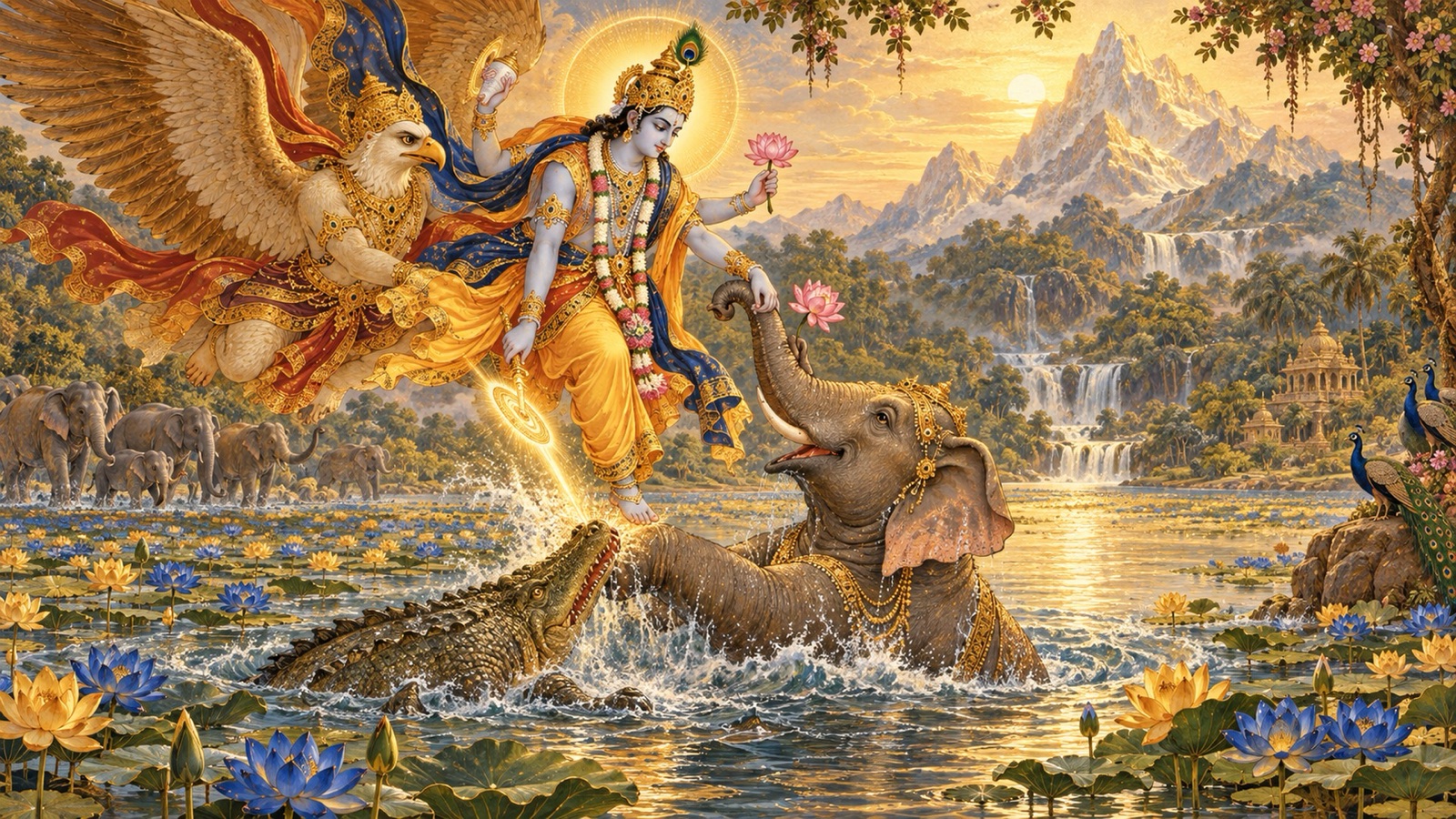
From the water rises a cry of surrender, and from the sky descends the Lord Himself — Garuda-borne, discus in hand — to lift the dying elephant and tear open the jaws of death.
Om Namo Bhagavate Vasudevaya.
Om Namo Bhagavate Vasudevaya.
Om Namo Bhagavate Vasudevaya.
Welcome back to Srimad Bhagavatam Wisdom, a devotional journey through the sacred histories and teachings of the Srimad Bhagavat Mahapurana. This third discourse of the Eighth Canto gives us one of the most treasured hymns in all of scripture — Gajendra’s prayer of surrender to the formless, all-pervading Supreme who is the refuge of every soul.
Chapter Information
- Scripture: Śrīmad Bhāgavata Mahāpurāṇa
- Canto: 8 (Book Eight)
- Chapter: 3 (Discourse 3)
- Chapter title: Gajendra’s Prayers of Surrender
- Principal speaker: Sukadeva Gosvami, narrating to King Parikshit — the prayer itself spoken by Gajendra, the king of the elephants
- Principal listener: King Parikshit
- Main setting: The lake in Varuna’s garden upon Mount Trikuta in the Ocean of Milk
- Central subject: Trapped and dying, the king of the elephants offers a profound prayer of surrender to the Supreme Lord, who appears at once to deliver him
- Principal verse range: Canto 8, Chapter 3, verses 1–33
- Primary edition: Gita Press Śrīmad Bhāgavata Mahāpurāṇa
Context From the Previous Chapter
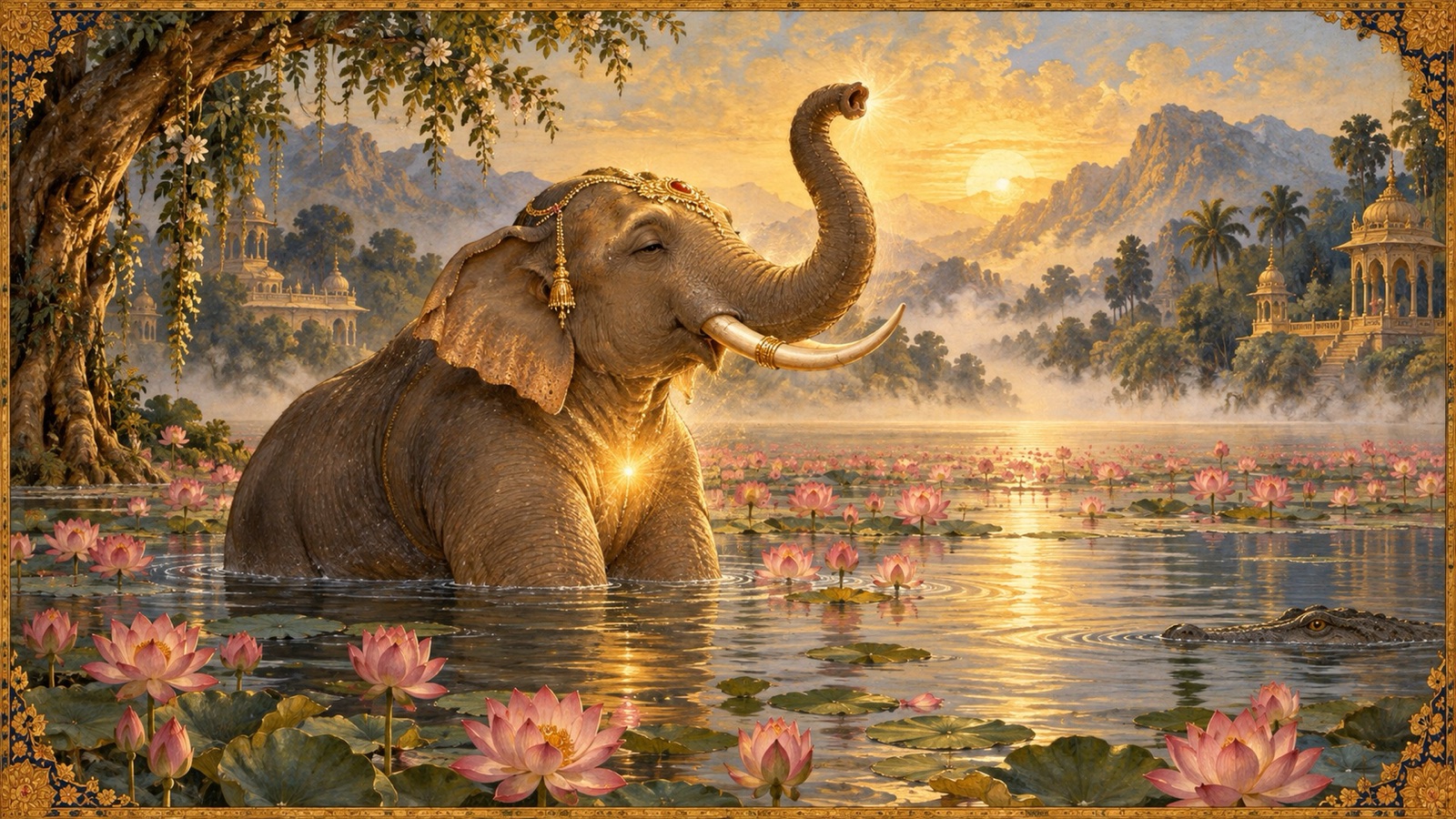
In the second discourse, the mighty leader of a herd of elephants entered the lake of Varuna’s garden to drink and was seized by the foot by a powerful alligator. For a thousand years the two contended, until his strength failed and he understood that neither kinsmen nor his own power could save him. Entrapped in the snare of Providence, he resolved that even he, a mere beast, would flee for protection to the Supreme, the ultimate refuge of all.
The Prayer Remembered From a Former Life
Sukadeva tells King Parikshit that, having steadied his mind in his heart by force of reason, the king of the elephants began to recite an excellent prayer — one he had learned by heart in a previous birth, when he had been the human king Indradyumna. Though now clothed in the body of a beast and unable even to remember clearly who he had been, the sacred words rose within him from that earlier life of devotion.
श्रीबादरायणिरुवाच एवं व्यवसितो बुद्ध्या समाधाय मनो हृदि । जजाप परमं जाप्यं प्राग्जन्मन्यनुशिक्षितम् ॥ १ ॥
śrī-bādarāyaṇir uvāca evaṁ vyavasito buddhyā samādhāya mano hṛdi jajāpa paramaṁ jāpyaṁ prāg-janmany anuśikṣitam
Meaning: Sukadeva said: Having thus resolved in his intellect and steadied his mind within his heart, the king of the elephants began to recite the supreme prayer that he had learned in his previous life. (Canto 8, Chapter 3, verse 1)
There is a quiet wonder in this verse. The devotion cultivated in one lifetime is not lost; it waits within the soul and rises again in the hour of greatest need. What Indradyumna once learned as a king, Gajendra now remembers as an elephant, and it becomes the instrument of his salvation.
Salutation to the Supreme Denoted by Om
The prayer itself opens not with a plea for rescue but with pure adoration. Gajendra offers his salutation to the Supreme Lord indicated by the mystical syllable Om — the Person because of whom this psycho-physical body appears conscious, the primal seed of all, who enters into every being in the forms of primordial Matter and Spirit.
श्रीगजेन्द्र उवाच ॐ नमो भगवते तस्मै यत एतच्चिदात्मकम् । पुरुषायादिबीजाय परेशायाभिधीमहि ॥ २ ॥
śrī-gajendra uvāca oṁ namo bhagavate tasmai yata etac cid-ātmakam puruṣāyādi-bījāya pareśāyābhidhīmahi
Meaning: The king of the elephants prayed: We offer our reverent meditation and salutation to that Supreme Lord, denoted by Om, by whose presence this body appears endowed with consciousness — the primal cause, the original seed, the supreme Ruler beyond all. (Canto 8, Chapter 3, verse 2)
From here the prayer unfolds as a sustained meditation on the nature of the Absolute. Gajendra approaches the self-existent Lord in whom the universe rests, from whom it emanates, by whom it is sustained, who is the universe and yet transcends both it and its unmanifest cause. He glorifies the One who shines beyond the fathomless darkness of dissolution, whose reality even gods and seers cannot fully comprehend — as an ordinary onlooker cannot recognize an actor beneath his many disguises.

Hymning the One Beyond Name and Form
Gajendra’s praise rises higher still. He salutes the all-perfect Lord of infinite potencies and wondrous activity — formless yet possessed of innumerable forms, without birth or action, without name or form when conceived as the Absolute, in whom there is neither merit nor demerit, and who nevertheless assumes these from time to time by His own will for the world’s welfare. He bows to the One who lies beyond the reach of speech and mind, attainable only by a purified heart through devotion and detachment; to the One who is wisdom itself, undifferentiated and serene; to the source toward whom all scriptures flow as rivers to the sea; and to the fire of consciousness hidden within the kindling-wood of the modes of nature, blazing forth in the hearts of the enlightened.
Gajendra states this most directly, in words that strip the Absolute of every worldly marker:
न विद्यते यस्य च जन्म कर्म वा न नामरूपे गुणदोष एव वा । तथापि लोकाप्ययसम्भवाय यः स्वमायया तान्यनुकालमृच्छति ॥ ८ ॥ तस्मै नमः परेशाय ब्रह्मणेऽनन्तशक्तये । अरूपायोरुरूपाय नम आश्चर्यकर्मणे ॥ ९ ॥
na vidyate yasya ca janma karma vā na nāma-rūpe guṇa-doṣa eva vā tathāpi lokāpyaya-sambhavāya yaḥ sva-māyayā tāny anukālam ṛcchati
tasmai namaḥ pareśāya brahmaṇe ‘nanta-śaktaye arūpāyoru-rūpāya nama āścarya-karmaṇe
Meaning: He has no material birth or activity of His own, no name or form, no merit or fault — yet to bring this world into being and dissolve it again He accepts these very things, age after age, by His own creative power. Gajendra bows to that transcendent Ruler of boundless potency, formless in His own being yet vast in the many forms He assumes, every one of whose acts is a wonder. (Canto 8, Chapter 3, verses 8-9)
He glorifies the Lord of boundless compassion who cuts the cords of ignorance binding beast-like souls such as himself, and who, being utterly free from attachment, cannot be reached by those still bound to body, children, wealth, and kin — yet who is ever contemplated by liberated souls and grants them even the boon of an undecaying divine body in which to sport with Him. Those exclusively devoted to Him, Gajendra sings, ask for no boon at all, but remain immersed in an ocean of bliss while singing His most auspicious stories.
“I Do Not Long Merely to Live”
Now the prayer reaches its most striking turn. Gajendra declares that the Lord is neither god nor demon, neither human nor animal, neither male nor female nor sexless, neither attribute nor action, neither cause nor effect — He is that which remains when all else has been negated, and yet constitutes all. And then the trapped elephant says something astonishing: he does not pray to be extricated from the alligator’s grip at all.
नायं वेद स्वमात्मानं यच्छक्त्याहंधिया हतम् । तं दुरत्ययमाहात्म्यं भगवन्तमितोऽस्म्यहम् ॥ २९ ॥
nāyaṁ veda svam ātmānaṁ yac-chaktyāhaṁ-dhiyā hatam taṁ duratyaya-māhātmyaṁ bhagavantam ito ’smy aham
Meaning: The individual soul, its understanding overcome by the ego born of the Lord’s deluding power, cannot even know its own true self. I take refuge in that Supreme Lord, whose glory is impossible to overcome. (Canto 8, Chapter 3, verse 29)
He seeks not survival but liberation — the lifting of the veil of ignorance that binds the spirit to the body. “What have I to do with this elephant-life,” he reflects, “enveloped in ignorance within and without? I seek only the tearing away of that ignorance, which no mere passage of time can remove, but only spiritual awakening.” His is the pure prayer of surrender, asking nothing of the world and everything of God.

The Lord Who Has No Partial Form Appears
Sukadeva then explains something profound about the answer to this prayer. Because Gajendra had glorified the Lord not as any particular deity but as the impersonal, all-pervading Supreme devoid of any single form, the great gods who are identified with their own distinctive forms — Brahma, Siva, and the rest — did not come. It was the Supreme Lord Himself, Hari, the Soul of all gods and the essence of every form, who manifested upon that very spot.
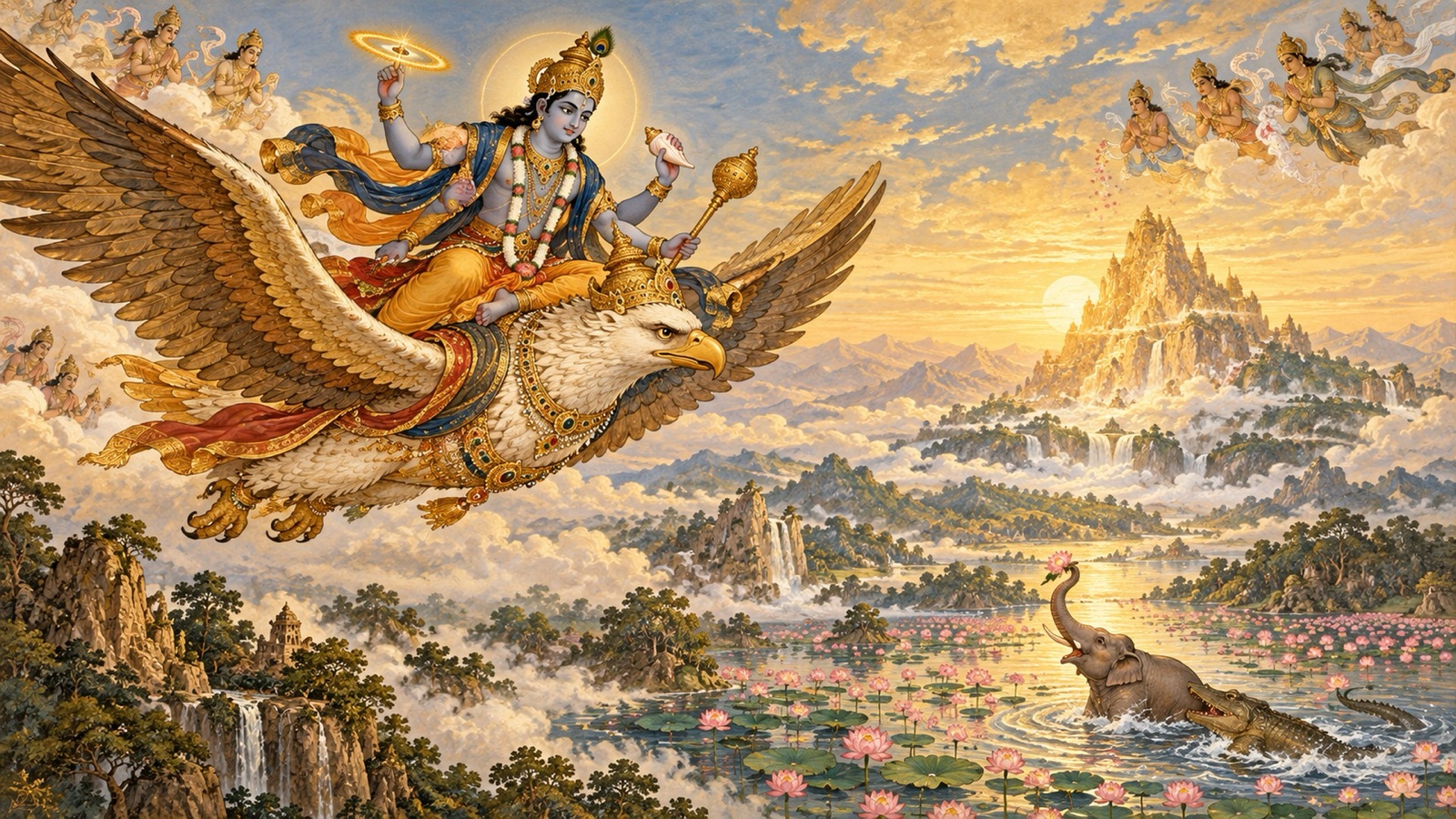
Hearing the hymn and seeing the elephant’s distress, the Lord of the universe mounted His carrier Garuda, king of birds, and swiftly arrived where the king of the elephants lay, His discus uplifted and celestial beings extolling Him as He came.
Here lies the chapter’s deeper reason for Gajendra’s ordeal. By the time the prayer was offered, the elephant had already been stripped of every lesser shelter — his herd could not help him, his own great strength had failed, and he named no single deity to petition. Because his surrender reached past every partial form to the Absolute alone, the presiding gods, sensing the call was addressed above their own stations, did not move; only the Supreme Himself could answer it. The crocodile’s grip, which seemed to be Gajendra’s undoing, was in truth the very pressure that completed his surrender — and it is undivided surrender of this kind, not the invoking of any particular power, that draws the Lord’s own direct and personal response (verses 30-31).
The Cry of Surrender and the Deliverance
Beholding Sri Hari in the sky upon Garuda, discus raised, the elephant lifted up its trunk with a lotus held out as an offering — for one should never approach the Lord empty-handed — and uttered, with great difficulty and pain, the words of complete surrender.
सोऽन्त:सरस्युरुबलेन गृहीत आर्तो दृष्ट्वा गरुत्मति हरिं ख उपात्तचक्रम् । उत्क्षिप्य साम्बुजकरं गिरमाह कृच्छ्रा- न्नारायणाखिलगुरो भगवन् नमस्ते ॥ ३२ ॥
so ’ntaḥ-sarasy urubalena gṛhīta ārto dṛṣṭvā garutmati hariṁ kha upātta-cakram utkṣipya sāmbuja-karaṁ giram āha kṛcchrān nārāyaṇākhila-guro bhagavan namas te
Meaning: Seized within the lake by the powerful alligator and greatly afflicted, the elephant saw Sri Hari in the sky upon Garuda with His discus uplifted. Raising his trunk holding a lotus, he uttered with great difficulty: “O Narayana, Preceptor of the universe, O Lord, obeisance unto You!” (Canto 8, Chapter 3, verse 32)
At that cry the birthless Lord, moved by compassion, alighted at once from Garuda. He pulled the king of the elephants, together with the alligator, out of the water, and there before the gazing gods He tore open the alligator’s jaws with His discus and set the great beast free.
तं वीक्ष्य पीडितमज: सहसावतीर्य सग्राहमाशु सरस: कृपयोज्जहार । ग्राहाद् विपाटितमुखादरिणा गजेन्द्रं संपश्यतां हरिरमूमुचदुच्छ्रियाणाम् ॥ ३३ ॥
taṁ vīkṣya pīḍitam ajaḥ sahasāvatīrya sa-grāham āśu sarasaḥ kṛpayojjahāra grāhād vipāṭita-mukhād ariṇā gajendraṁ saṁpaśyatāṁ harir amūmucad ucchriyāṇām
Meaning: Seeing him so afflicted, the unborn Lord swiftly descended and, out of compassion, drew the elephant along with the alligator up out of the lake. Then, before the assembled gods, He tore open the alligator’s mouth with His discus and delivered Gajendra. (Canto 8, Chapter 3, verse 33)
Thus the prayer offered from the depths of helplessness was answered from the heights of heaven, and the long ordeal ended in the embrace of grace.
Principal Teachings of This Chapter
1. Devotion carries over from life to life. Gajendra prays with words learned in a former human birth as King Indradyumna. Spiritual effort is never wasted; the devotion of one lifetime becomes the refuge of the next (verse 1).
2. The highest prayer asks for God, not from God. Gajendra does not beg to be saved from the alligator; he prays for the lifting of ignorance and takes shelter in the Lord Himself. Pure devotion seeks the Giver above every gift (verses 25, 29).
3. The Supreme is beyond all name and form, yet the refuge of all. The hymn glorifies the Lord as formless, beyond speech and mind, neither god nor demon nor human nor animal — the ground of all existence in whom every soul may take shelter (verses 2-24).
4. God answers surrender personally. Because Gajendra called upon the all-pervading Supreme, no partial deity came; the Lord Himself descended. Sincere surrender draws the direct response of the Lord (verses 30-32).
5. No soul is beyond the reach of grace. An animal, trapped and dying, is lifted by the hand of God before the assembled gods. Divine mercy answers the cry of the humblest heart (verse 33).
A Devotional Reflection
The prayer of Gajendra is beloved precisely because it is spoken by one who has nothing left. Stripped of strength, abandoned by every earthly help, sinking in the water, he does not bargain with God or ask for his old life back. He asks, instead, to be freed from the deeper bondage he had not even noticed until now — the bondage of forgetting who he truly is. This is the astonishing generosity of surrender: when the soul stops clinging to the body and its supports and turns wholly toward the Lord, it discovers that its real crisis was never the alligator at all, but the veil of ignorance over the spirit. And to that turned heart, the Lord comes in person. We may never face an alligator in a celestial lake, but we all face the slow grip of time. Gajendra teaches us that the same refuge is always within reach, waiting only for the words, learned or remembered, that turn us toward home.
A Daily Devotional Practice
Today, take a moment to offer a prayer that asks nothing of the world — no rescue, no gain, no removal of any particular trouble — but only for nearness to the Lord and the lifting of forgetfulness from your heart. Hold, like Gajendra, the simple offering of your attention, and say softly: “Om Namo Bhagavate Vasudevaya.” Let your prayer be, for once, purely for God and not for what God can give, and notice how that turning itself becomes a kind of deliverance.
Conclusion
Gajendra’s stotra endures because it shows surrender in its purest shape: a soul with nothing left to bargain asks not to be rescued but for the Lord Himself, and the Lord who is beyond every name and form answers that undivided call in person, before any partial power can move. Whatever crocodile holds us — fear, loss, or the slow current of time — the same refuge remains near, waiting only for a heart willing to release every lesser shelter and turn wholly toward Him.
May the divine wisdom of Srimad Bhagavatam awaken pure devotion within our hearts.
Om Namo Bhagavate Vasudevaya.
Jay Shree Madhav.
References and Attribution
- Primary edition: Gita Press, Śrīmad Bhāgavata Mahāpurāṇa (English, complete), Book Eight, Discourse 3, pages 743–748.
- Series: Srimad Bhagavatam Wisdom · Biswa Sanatan Dharma Seva Trust.
- Presented following the spiritual guidance and recommendation of Pandit Dr. Shri Kashinath Mishra.
This is an original, faithful retelling in the writer’s own words, with brief quoted verses shown in Devanāgarī and transliteration and their meanings given as summaries. It is not a reproduction of any single publisher’s continuous translation or commentary. No affiliation with or endorsement by any publisher is implied.
Jay Shree Madhav