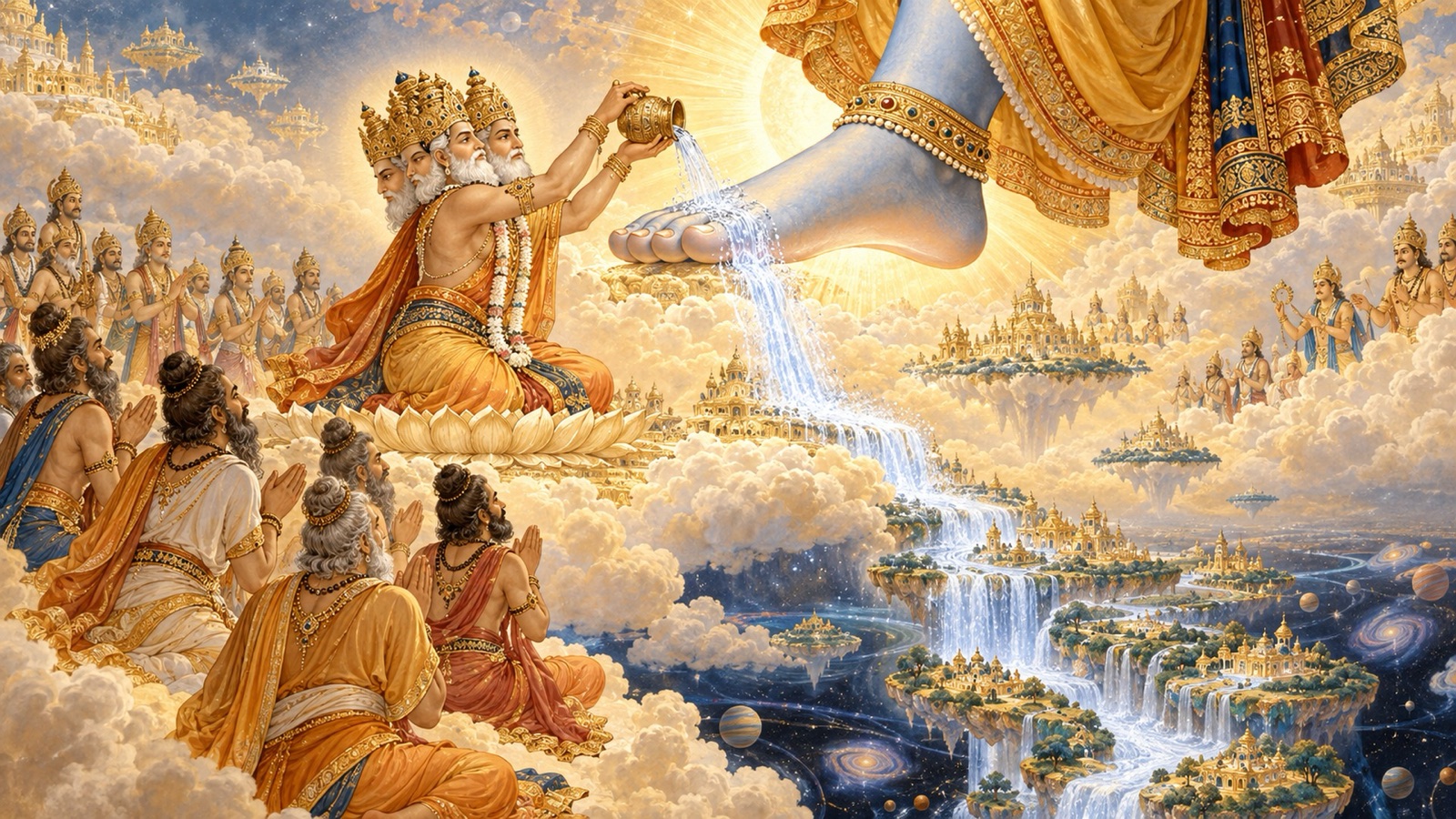
As the Lord’s foot rises to the summit of creation, Brahma comes forth to greet it, worships it with water poured from his own pitcher — and from that washing of the divine foot the sacred Ganga is born, to purify the three worlds forever.
Om Namo Bhagavate Vasudevaya.
Om Namo Bhagavate Vasudevaya.
Om Namo Bhagavate Vasudevaya.
Welcome back to Srimad Bhagavatam Wisdom, a devotional journey through the sacred histories and teachings of the Srimad Bhagavat Mahapurana. This twenty-first discourse follows Lord Vamana’s foot to the very summit of creation, and brings the Vamana story to the moment of Bali’s binding.
Chapter Information
- Scripture: Śrīmad Bhāgavata Mahāpurāṇa
- Canto: 8 (Book Eight)
- Chapter: 21 (Discourse 21)
- Chapter title: Lord Vamana Takes His Strides and Bali Is Bound
- Principal speaker: Sukadeva Gosvami, narrating to King Parikshit — with the words of Bali and the demons
- Principal listener: King Parikshit
- Main setting: The heights of creation above Bali’s sacrificial grounds at Bhrgukaccha, on the Narmada
- Central subject: Brahma’s worship of the Lord’s foot, the birth of the Ganga, the demons’ anger, Bali’s restraint before the power of Time, and the binding of Bali
- Principal verse range: Canto 8, Chapter 21, verses 1–34
- Primary edition: Gita Press Śrīmad Bhāgavata Mahāpurāṇa
Context From the Previous Chapter
In the twentieth discourse, cursed by his own preceptor for keeping his promise, Bali gave the land to the divine Dwarf and washed His feet with joy while heaven showered him with flowers. The little Dwarf then grew into the cosmic form and took two great strides, covering the earth and the heavens, until no space remained for a third. This chapter follows the Lord’s foot as it rises further, to the realm of Brahma.
Brahma Worships the Lord’s Foot and the Ganga Is Born
Seeing the Lord’s foot reach as far as Satyaloka, his own realm eclipsed by the moon-like radiance of its nails, Brahma came forth to greet it. With him came Marici and the other great seers, the lifelong celibates and yogis headed by Sanandana, and the deities presiding over the Vedas and the sacred sciences — all who had burnt away the impurities of their karma in the fire of wisdom. Brahma then offered water in worship to the upraised foot of the Lord from whose navel-lotus he had himself been born, and sang His praises with devotion. And that water, hallowed by the washing of the Lord’s foot, became the heavenly river.
धातु: कमण्डलुजलं तदुरुक्रमस्य पादावनेजनपवित्रतया नरेन्द्र । स्वर्धुन्यभून्नभसि सा पतती निमार्ष्टि लोकत्रयं भगवतो विशदेव कीर्ति: ॥ ४ ॥
dhātuḥ kamaṇḍalu-jalaṁ tad urukramasya pādāvanejana-pavitratayā narendra svardhuny abhūn nabhasi sā patatī nimārṣṭi loka-trayaṁ bhagavato viśadeva kīrtiḥ
Meaning: O ruler of men, the water from Brahma’s pitcher, sanctified by washing the foot of the wide-striding Lord, became the celestial river Ganga; falling through the heavens, it purifies the three worlds, even as the untarnished glory of the Lord does. (Canto 8, Chapter 21, verse 4)
The Worlds Rejoice and Jambavan Proclaims the Victory
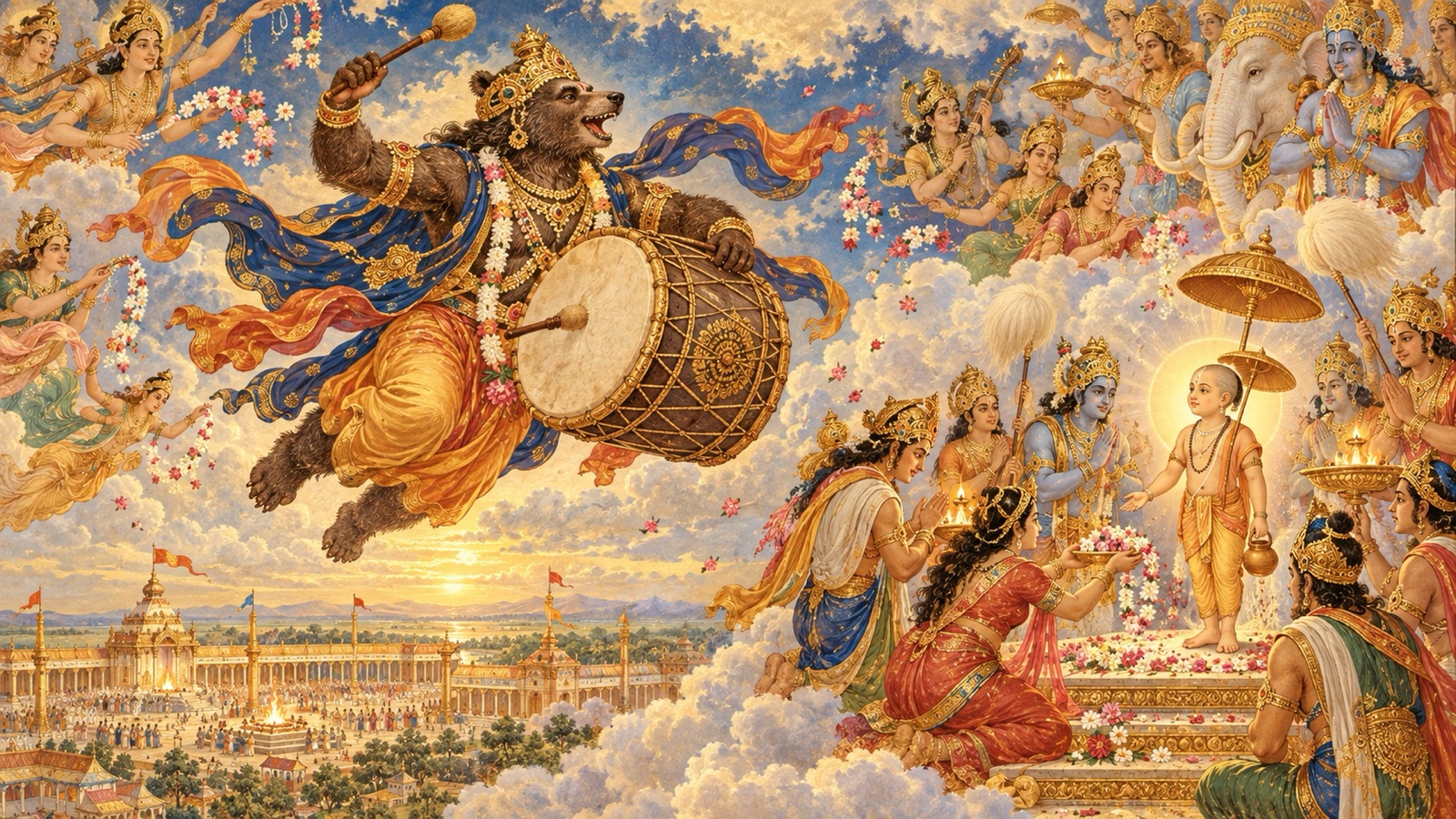
Full of reverence, Brahma and the other guardians of the worlds, along with their followers, worshipped their own Lord — who had now drawn His dimensions back into His small form once more — with fragrant flowers, incense, lamps, songs of praise, dances, and the sound of conches and kettledrums. And Jambavan, the king of the bears, swift as thought, joyfully proclaimed the great festival of victory throughout all the quarters, sounding his drum as he ran.
जाम्बवानृक्षराजस्तु भेरीशब्दैर्मनोजव: । विजयं दिक्षु सर्वासु महोत्सवमघोषयत् ॥ ८ ॥
jāmbavān ṛkṣa-rājas tu bherī-śabdair mano-javaḥ vijayaṁ dikṣu sarvāsu mahotsavam aghoṣayat
Meaning: Jambavan, the king of the bears, swift as thought, proclaimed the triumph — marked by great festivity — through all the quarters with repeated sounds of his drum. (Canto 8, Chapter 21, verse 8)
The Demons Rise in Anger
But the demons, seeing the whole earth that had belonged to their master wrested away under the pretext of a prayer for three paces of land, were filled with fury. They said among themselves that this was no begging brahmana but Vishnu himself, foremost of conjurers, come disguised to accomplish the purpose of the gods; that under the pretext of begging, an enemy in the guise of a brahmana boy had stripped their master — who had laid down all violence for the sake of his sacrifice — of everything he had. It was their duty and their service to their lord, they declared, to kill this fellow; and, taking up their spears and weapons, the demon hosts ran forward to strike the divine Dwarf, though Bali himself did not wish it.
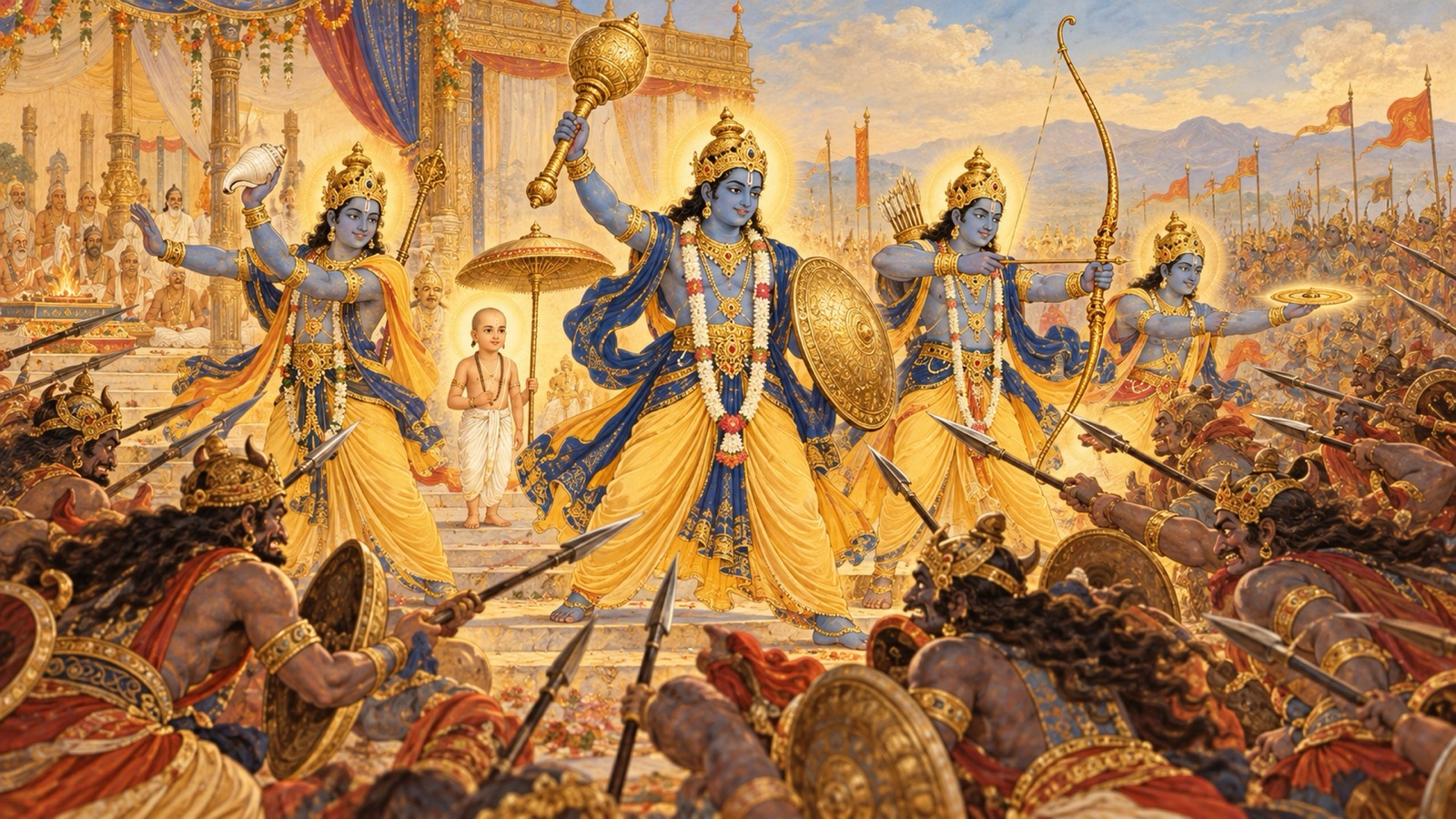
Seeing the Daitya generals rushing upon the Lord, the attendants of Vishnu laughed and rose to meet them, weapons uplifted. Nanda and Sunanda, Jaya and Vijaya, Garuda the lord of birds, and the other mighty attendants — each with the strength of ten thousand elephants — set out to scatter the demon army.
Bali Restrains His Army Before the Power of Time
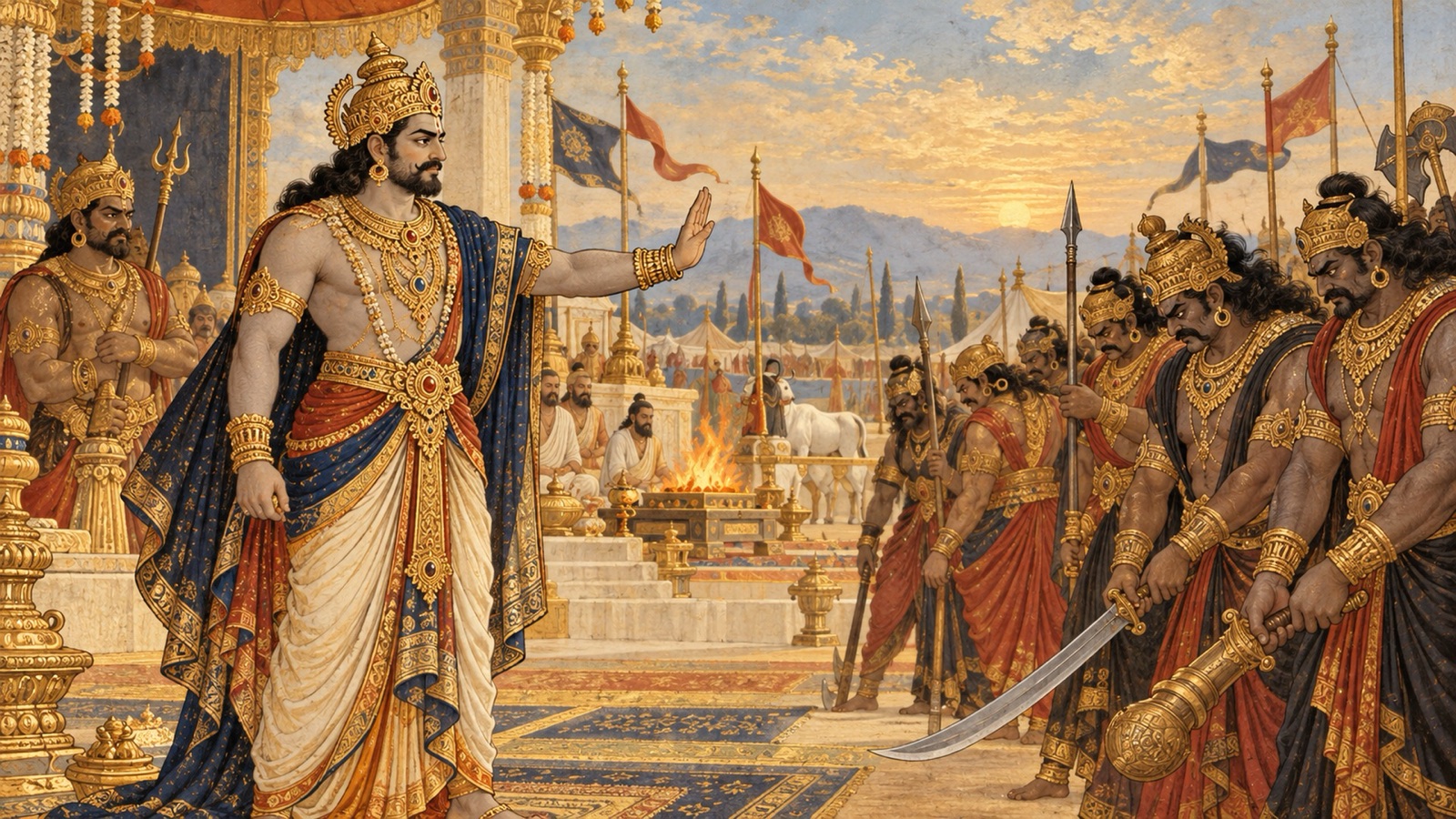
Seeing his own people struck down by the Lord’s attendants, and remembering the curse pronounced by his preceptor Sukracarya, Bali stopped his enraged soldiers. He called them by name — Vipracitti, Rahu, Nemi — and bade them cease the fight and withdraw, for the present time was not in their favour. No one, he taught, can prevail by personal strength over the Lord of all beings, who dispenses joy and sorrow to every creature.
य: प्रभु: सर्वभूतानां सुखदु:खोपपत्तये । तं नातिवर्तितुं दैत्या: पौरुषैरीश्वर: पुमान् ॥ २० ॥
yaḥ prabhuḥ sarva-bhūtānāṁ sukha-duḥkhopapattaye taṁ nātivartituṁ daityāḥ pauruṣair īśvaraḥ pumān
Meaning: O Daityas, no person can, by his own prowess, transcend the Lord — the mighty controller who ordains the joy and sorrow of all living beings. (Canto 8, Chapter 21, verse 20)
The very Lord who had once favoured their rise and the decline of the gods, Bali said, was now doing the reverse; and no created being can override the Time-Spirit through strength, counsel, intellect, fortifications, spells, or diplomacy. It is providence alone, he taught, that turns the scale of every such contest, and no worldly power can force it to turn before its hour. These same attendants of Hari, whom the demons had defeated many times when fortune favoured them, were now victorious because destiny had turned. Therefore, he counselled, they should withdraw and await a time that would again redound to their advantage.
Bali Bound by the Cords of Varuna
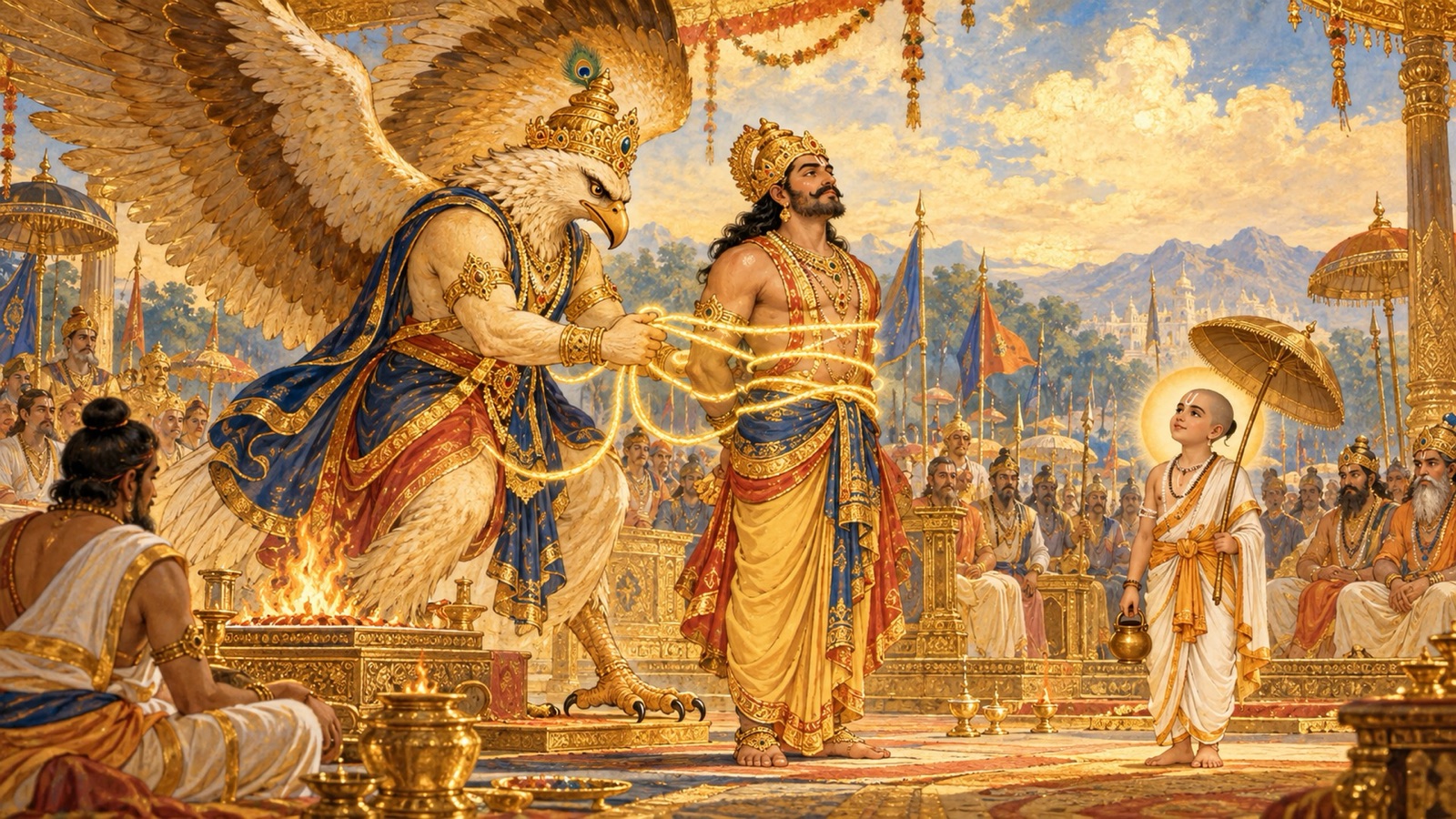
Hearing their master’s words, the leaders of the Daityas and Danavas, beaten back by the attendants of Vishnu, withdrew into the lower regions of the universe. Then Garuda, son of Kashyapa, reading what the Lord in His universal form silently wished, moved at once to seize the fallen king, securing him fast as the sacrificial rite drew to its close.
अथ तार्क्ष्यसुतो ज्ञात्वा विराट्प्रभुचिकीर्षितम् । बबन्ध वारुणै: पाशैर्बलिं सूत्येऽहनि क्रतौ ॥ २६ ॥
atha tārkṣya-suto jñātvā virāṭ prabhu-cikīrṣitam babandha vāruṇaiḥ pāśair baliṁ sūtye ’hani kratau
Meaning: Then Garuda, the son of Kashyapa, knowing the will of the Lord of the cosmic form, bound Bali with the cords of Varuna on the final day of the sacrifice. (Canto 8, Chapter 21, verse 26)
A great cry of lamentation arose through heaven and earth and in every direction as the renowned lord of the demons was taken prisoner — yet Bali, whose presence of mind was unshaken, did not waver.
This binding is not the Lord’s anger but His deepest favour. To an ordinary king such a fall would be pure calamity; for a devotee who has fully surrendered, it is the Lord’s own hand drawing him nearer. It is said that when the Lord especially favours a soul, He first takes away, little by little, everything that soul calls its own — not to punish, but so that nothing may stand between them. Bali’s binding is that very mercy in action: by taking his kingdom, his army and his freedom, the Lord empties him of all but surrender itself, and readies him for the still greater gift that is about to unfold (verses 26-28).
The Lord Asks for the Third Step
Then the Lord, in His dwarf form, spoke to Bali — bound with Varuna’s cords, stripped of his fortune, steady of mind, and of noble fame.
पदानि त्रीणि दत्तानि भूमेर्मह्यं त्वयासुर । द्वाभ्यां क्रान्ता मही सर्वा तृतीयमुपकल्पय ॥ २९ ॥
padāni trīṇi dattāni bhūmer mahyaṁ tvayāsura dvābhyāṁ krāntā mahī sarvā tṛtīyam upakalpaya
Meaning: O Asura, three paces of land were given to Me by you; with two strides the whole earth has been covered — now provide the ground for the third. (Canto 8, Chapter 21, verse 29)
Everything warmed by the sun, lit by the moon and stars, and watered by the clouds, the Lord said, belonged to Bali; with one step He had covered the terrestrial region and the sky, and with the second the heavens — so where was the space for the third? Having failed to give what was promised, He observed, one earns a dwelling in the infernal regions; and Bali, so proud of his generosity, must now face the consequence of a promise he could not fulfil. With this the stage is set for Bali’s celebrated reply, in the next discourse, when he offers his own head for the Lord’s third step.
Principal Teachings of This Chapter
1. The Lord’s touch sanctifies forever. From the mere washing of the Lord’s foot the sacred Ganga is born, a river that purifies the three worlds — a sign that whatever comes into contact with the Divine is made holy (verses 3-4).
2. True victory is proclaimed with joy, not pride. Jambavan runs through the quarters sounding his drum, and the gods worship the Lord with song and celebration, for the triumph of righteousness is a cause for shared rejoicing (verses 5-8).
3. Devotion restrains anger. Though his people are struck down, Bali does not let wrath rule him; remembering his teacher’s word and reading the movement of Time, he calls his soldiers back from a battle they cannot win (verses 18-19).
4. No one can overcome the will of Time. Bali teaches that strength, counsel, intellect, and every human expedient are powerless against the Lord who ordains the joy and sorrow of all beings — a humbling wisdom that becomes the seed of his surrender (verses 20-24).
5. Adversity cannot shake a steadfast soul. Bound with the cords of Varuna and stripped of his kingdom, Bali remains unshaken in mind, showing that outward loss cannot disturb one whose heart is fixed on truth (verses 26-28).
A Devotional Reflection
This chapter turns on a single, quiet act of self-mastery. Bali’s soldiers are dying, his kingdom is gone, and his warrior’s blood cries out to fight — and it would be easy, even honourable by the world’s reckoning, to die sword in hand. But Bali sees further than his own anger. He remembers his teacher’s curse, he perceives the hand of Time, and he understands that what is happening to him is not defeat but the will of the Lord unfolding. So he does the hardest thing a proud king can do: he stops. He restrains his army, accepts the binding cords without protest, and stands unshaken as the worlds lament around him. In that stillness lies the secret of his greatness. The same river that was born from the Lord’s foot to purify the three worlds is, in its way, mirrored in Bali’s own heart — a stream of surrender that washes away the last of his pride, so that when the Lord asks for the third step, Bali is ready to give the only thing he has left: himself.
A Daily Devotional Practice
Today, when anger or the urge to force an outcome rises within you, practise Bali’s restraint. Pause before you react, and quietly ask whether this is your moment to act or a time to yield to the will of God. As you let the impulse settle, offer it to the Lord with the words “Om Namo Bhagavate Vasudevaya,” trusting, as Bali did, that no strength of ours can overrule the Time-Spirit, and that a heart which yields to the Divine loses nothing that is truly its own.
Conclusion
The twenty-first discourse closes at the threshold of Bali’s greatest hour. Bound and stripped of everything he called his own, he stands unshaken — for what looks like ruin is the Lord’s own mercy, clearing away all but surrender itself. May we learn from Bali that when the Time-Spirit turns against our plans, it is not defeat but an invitation to yield everything to the Lord, trusting that He alone knows what is truly for our good. The next discourse unfolds Bali’s fearless answer, offered with his own head at the Lord’s feet.
May the divine wisdom of Srimad Bhagavatam awaken pure devotion within our hearts.
Om Namo Bhagavate Vasudevaya.
Jay Shree Madhav.
References and Attribution
- Primary edition: Gita Press, Śrīmad Bhāgavata Mahāpurāṇa (English, complete), Book Eight, Discourse 21, pages 820–823.
- Series: Srimad Bhagavatam Wisdom · Biswa Sanatan Dharma Seva Trust.
- Presented following the spiritual guidance and recommendation of Pandit Dr. Shri Kashinath Mishra.
This is an original, faithful retelling in the writer’s own words, with brief quoted verses shown in Devanāgarī and transliteration and their meanings given as summaries. It is not a reproduction of any single publisher’s continuous translation or commentary. No affiliation with or endorsement by any publisher is implied.
Jay Shree Madhav