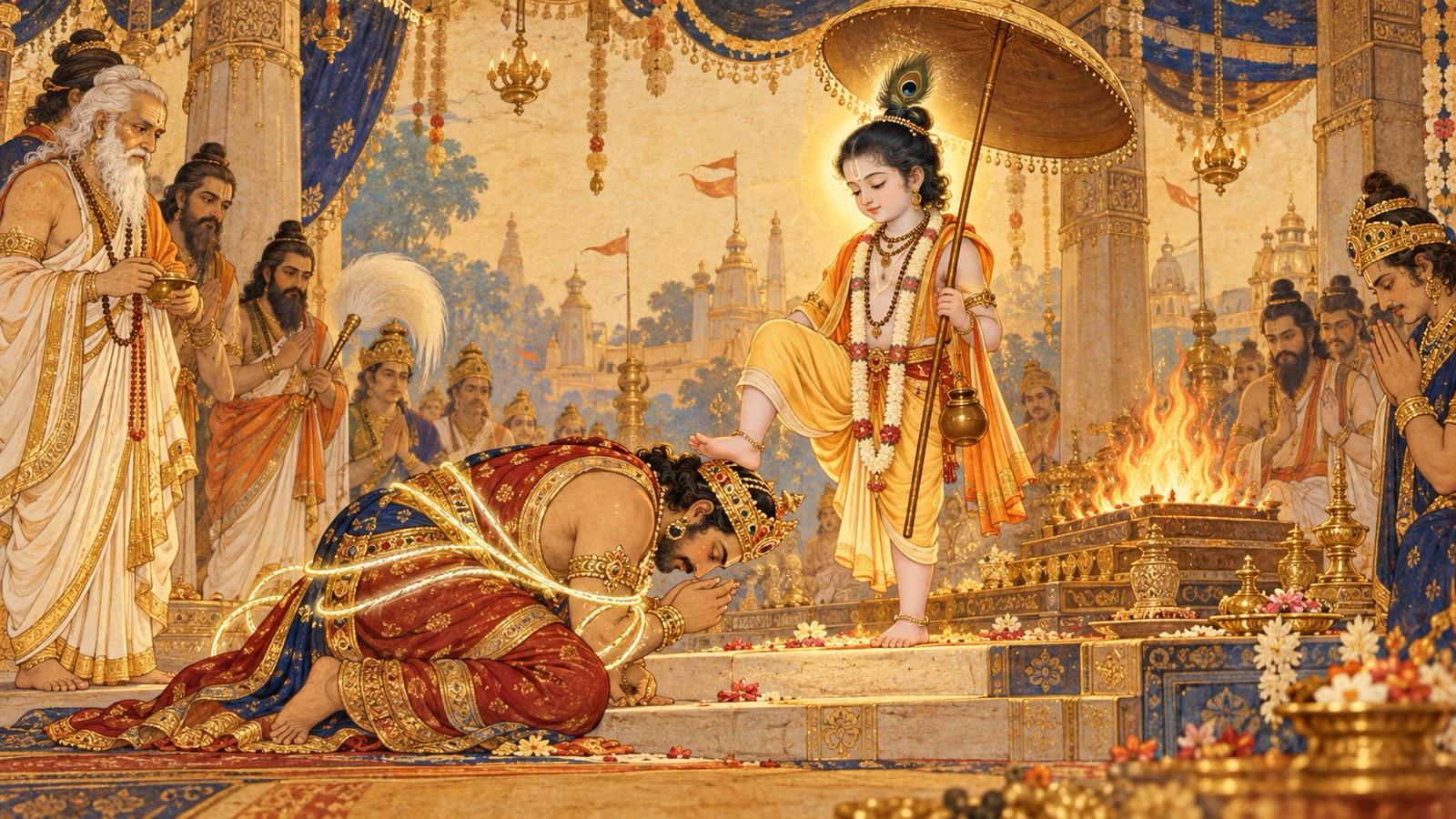
Bound with the cords of Varuna and stripped of the three worlds, the great king Bali bows his head before the divine Dwarf and offers the one thing still his to give — asking the Lord to set His third step upon it.
Om Namo Bhagavate Vasudevaya.
Om Namo Bhagavate Vasudevaya.
Om Namo Bhagavate Vasudevaya.
Welcome back to Srimad Bhagavatam Wisdom, a devotional journey through the sacred histories and teachings of the Srimad Bhagavat Mahapurana. This twenty-second discourse carries the Vamana story to its spiritual summit, as a bound and dispossessed king answers his Lord with fearless devotion — and the Lord, in turn, discloses why He empties His most cherished devotees of everything the world calls fortune.
Chapter Information
- Scripture: Śrīmad Bhāgavata Mahāpurāṇa
- Canto: 8 (Book Eight)
- Chapter: 22 (Discourse 22)
- Chapter title: Bali Surrenders His Life at the Lord’s Feet
- Principal speaker: Sukadeva Gosvami, narrating to King Parikshit — with the words of Bali, Prahlada, Vindhyavali, Brahma, and the Lord
- Principal listener: King Parikshit
- Main setting: The sacrificial grounds of Bali at Bhrgukaccha, on the Narmada
- Central subject: Bali’s fearless offer of his own head, the pleas of Prahlada, Vindhyavali, and Brahma, and the Lord’s revelation of the secret of His grace and the gift of Sutala
- Principal verse range: Canto 8, Chapter 22, verses 1–36
- Primary edition: Gita Press Śrīmad Bhāgavata Mahāpurāṇa
Context From the Previous Chapter
In the twenty-first discourse, the Lord’s foot rose to the realm of Brahma, who worshipped it as the sacred Ganga was born; the gods rejoiced as the demons were turned back, and Bali — remembering his teacher’s curse and bowing to the power of Time — restrained his army. Garuda then bound the king with the cords of Varuna, and the Lord asked him to provide the ground for His third step. This chapter opens with Bali’s reply.
Bali’s Fearless Reply
Though thus humiliated by the Lord, Bali the demon king was not shaken in spirit, and he gave a calm and fearless reply. If the Lord judged his promise to have fallen short, he said, he would make it good — and, since he had no more land to give, he offered the one thing that was still his own.
श्रीबलिरुवाच यद्युत्तमश्लोक भवान् ममेरितं वचो व्यलीकं सुरवर्य मन्यते । करोम्यृतं तन्न भवेत् प्रलम्भनं पदं तृतीयं कुरु शीर्ष्णि मे निजम् ॥ २ ॥
śrī-balir uvāca yady uttamaśloka bhavān mameritaṁ vaco vyalīkaṁ sura-varya manyate karomy ṛtaṁ tan na bhavet pralambhanaṁ padaṁ tṛtīyaṁ kuru śīrṣṇi me nijam
Meaning: Bali said: O Lord of glorious renown, foremost of the gods, if You consider my promise to have proven false, I shall make it true so that there be no deceit — please, set Your third step upon my own head. (Canto 8, Chapter 22, verse 2)
He was not afraid, he said, of falling from his position, of hell, of the cords that bound him, of any calamity, of financial ruin, or even of punishment at the Lord’s hands, as much as he shrank from being called ignoble.
बिभेमि नाहं निरयात् पदच्युतो न पाशबन्धाद् व्यसनाद् दुरत्ययात् । नैवार्थकृच्छ्राद् भवतो विनिग्रहा- दसाधुवादाद् भृशमुद्विजे यथा ॥ ३ ॥
bibhemi nāhaṁ nirayāt pada-cyuto na pāśa-bandhād vyasanād duratyayāt naivārtha-kṛcchrād bhavato vinigrahād asādhu-vādād bhṛśam udvije yathā
Meaning: I do not fear hell, nor my fall from power, nor bondage with cords, nor a calamity hard to overcome, nor financial ruin, nor even punishment from You, as much as I dread an ignoble name. (Canto 8, Chapter 22, verse 3)
The Lord Is the Demons’ Greatest Benefactor
Punishment inflicted by the most worthy, Bali declared, is the most praiseworthy thing for anyone — a blessing that no mother, father, brother, or friend could ever bestow. Disguised as an enemy, the Lord was in truth the supreme benefactor of the demons, for by granting them the gift of a fall from power He had opened their eyes, blinded as they were with the arrogance of wealth. Through nursing enmity toward Him, he recalled, many an Asura had attained the very perfection that exclusive devotees reach; so Bali felt neither shame nor sorrow at being bound with the cords of Varuna. He remembered his grandfather Prahlada, esteemed by the Lord’s devotees, who had been subjected to every torture by his own father Hiranyakasipu only because he was devoted to the Lord.
Then Bali turned to a harder question, and asked what any of it — body, family, kingdom — had ever truly been worth.
किमात्मनानेन जहाति योऽन्तत: किं रिक्थहारै: स्वजनाख्यदस्युभि: । किं जायया संसृतिहेतुभूतया मर्त्यस्य गेहै: किमिहायुषो व्यय: ॥ ९ ॥
kim ātmanānena jahāti yo ‘ntataḥ kiṁ riktha-hāraiḥ svajanākhya-dasyubhiḥ kiṁ jāyayā saṁsṛti-hetu-bhūtayā martyasya gehaiḥ kim ihāyuṣo vyayaḥ
Meaning: What use is a body that will abandon its owner at the appointed hour regardless of any care given it? What use are kinsmen, who under the name of family are little more than plunderers of what could have served the Lord? What use is a wife, who only draws the soul deeper into worldly attachment? And what use are home, nation, and community, on which the brief wealth of a lifetime is spent and lost? (Canto 8, Chapter 22, verse 9)
Everything that seemed to be his, Bali now understood, truly belonged to the Lord alone, and was worth keeping only so far as it could be offered in His service.
Prahlada Arrives
As Bali was speaking in this way, his grandfather Prahlada — dear to the Lord — arrived, radiant as the full moon rising.
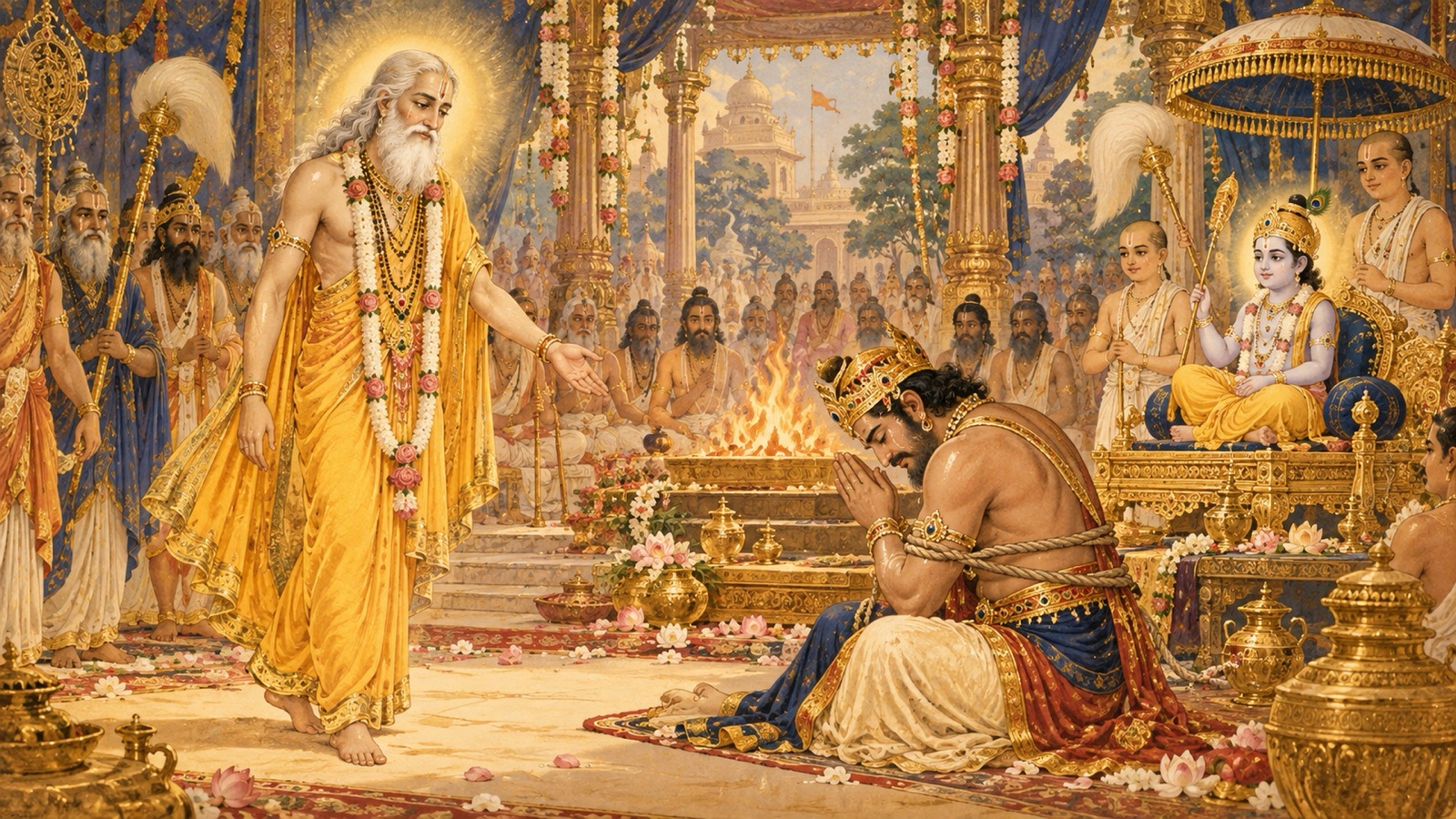
Bali beheld his grandfather, resplendent with glory, with lotus-like eyes, tall and long-armed, clad in yellow, and beautiful as the best of the blessed. Bound by Varuna’s cords, Bali could not offer him worship as before; he bowed his head, his eyes brimming with tears, and stood with his face lowered in shame. And Prahlada, seeing the Lord seated there and attended by Sunanda and the other companions, approached and fell to the ground, bowing his head, overcome with tears of loving joy.
Prahlada, Vindhyavali, and Brahma Plead
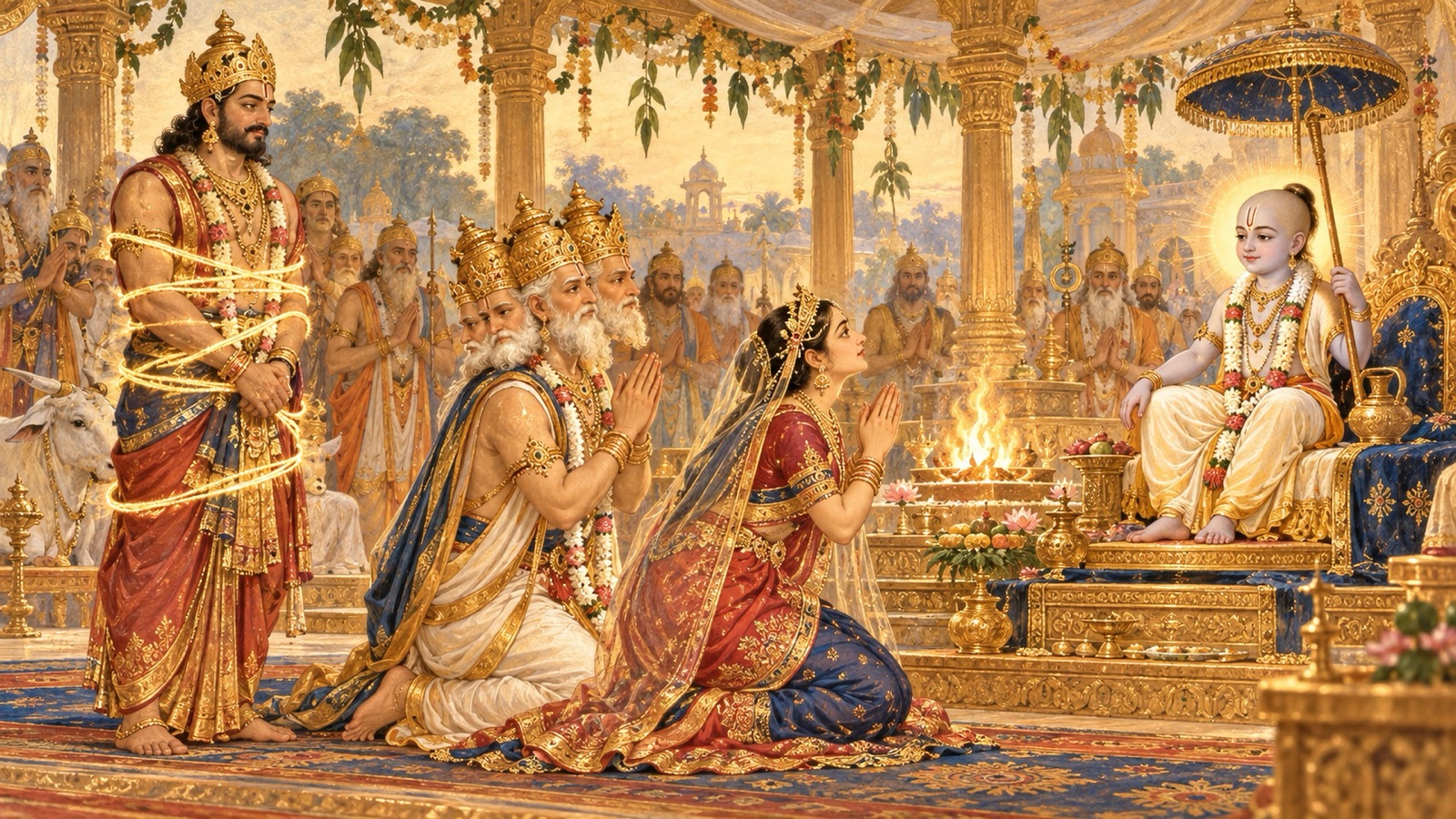
Prahlada then praised the Lord, saying that the dominion of Indra which the Lord Himself had once given Bali, and had now taken away, was equally auspicious in both acts — for in stripping Bali of the fortune that deludes the soul, the Lord had shown him the greatest possible grace. Then Bali’s saintly queen Vindhyavali, distressed to see her husband bound, came forward with joined palms and reminded the Lord that this whole universe was His own creation and plaything; whatever presumptuous person imagined himself its owner and giver was merely deluded. And Brahma too pleaded for the king’s release, declaring that Bali, who had surrendered everything with an unwavering mind, did not deserve to be bound.
The Lord Reveals the Secret of His Grace
Then the Lord Himself spoke, revealing the innermost secret of His dealings with those He loves.
श्रीभगवानुवाच ब्रह्मन् यमनुगृह्णामि तद्विशो विधुनोम्यहम् । यन्मद: पुरुष: स्तब्धो लोकं मां चावमन्यते ॥ २४ ॥
śrī-bhagavān uvāca brahman yam anugṛhṇāmi tad-viśo vidhunomy aham yan-madaḥ puruṣaḥ stabdho lokaṁ māṁ cāvamanyate
Meaning: The Lord said: O Brahma, the one on whom I bestow My grace I strip of his wealth; for, intoxicated with riches, a person grows arrogant and disregards the world and even Me. (Canto 8, Chapter 22, verse 24)
Passing through countless births according to its own deeds, the Lord explained, the dependent soul only rarely attains the human state — a birth of great responsibility, not to be squandered. One who is born into a noble family, or gifted with beauty, learning, youth, power, or wealth, and yet carries no pride in any of it, should be understood to bear a mark of special grace, for such freedom from arrogance is itself the rarest opulence. Birth and fortune may tempt a soul toward false prestige, the Lord said, but they never disturb one who is truly surrendered to Him; only the insincere devotee is undone by what he possesses.
Bali Has Conquered the Lord’s Maya
Then the Lord declared the true greatness of Bali.
एष दानवदैत्यानामग्रणी: कीर्तिवर्धन: । अजैषीदजयां मायां सीदन्नपि न मुह्यति ॥ २८ ॥
eṣa dānava-daityānām agranīḥ kīrti-vardhanaḥ ajaiṣīd ajayāṁ māyāṁ sīdann api na muhyati
Meaning: This Bali, foremost of the Danavas and Daityas and the enhancer of their glory, has conquered My invincible Maya; though fallen into distress, he is not bewildered. (Canto 8, Chapter 22, verse 28)
Impoverished and fallen from his position, reproached and bound by his enemies, forsaken by his kinsmen, subjected to hardship, and even cursed by his own preceptor, this demon of firm resolve had not abandoned truth.
Here the Lord made a striking admission: it was He Himself, He said, who had spoken of righteousness to Bali in a deceptive, testing way — and still Bali, true to his word, had not let go of what was right. This is the heart of the Lord’s method with those He loves most: He does not merely observe a devotee’s faith, He tests it, sometimes through what looks like His own deception, so that the devotee’s constancy may stand recorded for the glory of every generation that follows. Through this very trial Bali had all but been carried to the Lord’s own realm, difficult of access even to the gods.
The Gift of Sutala
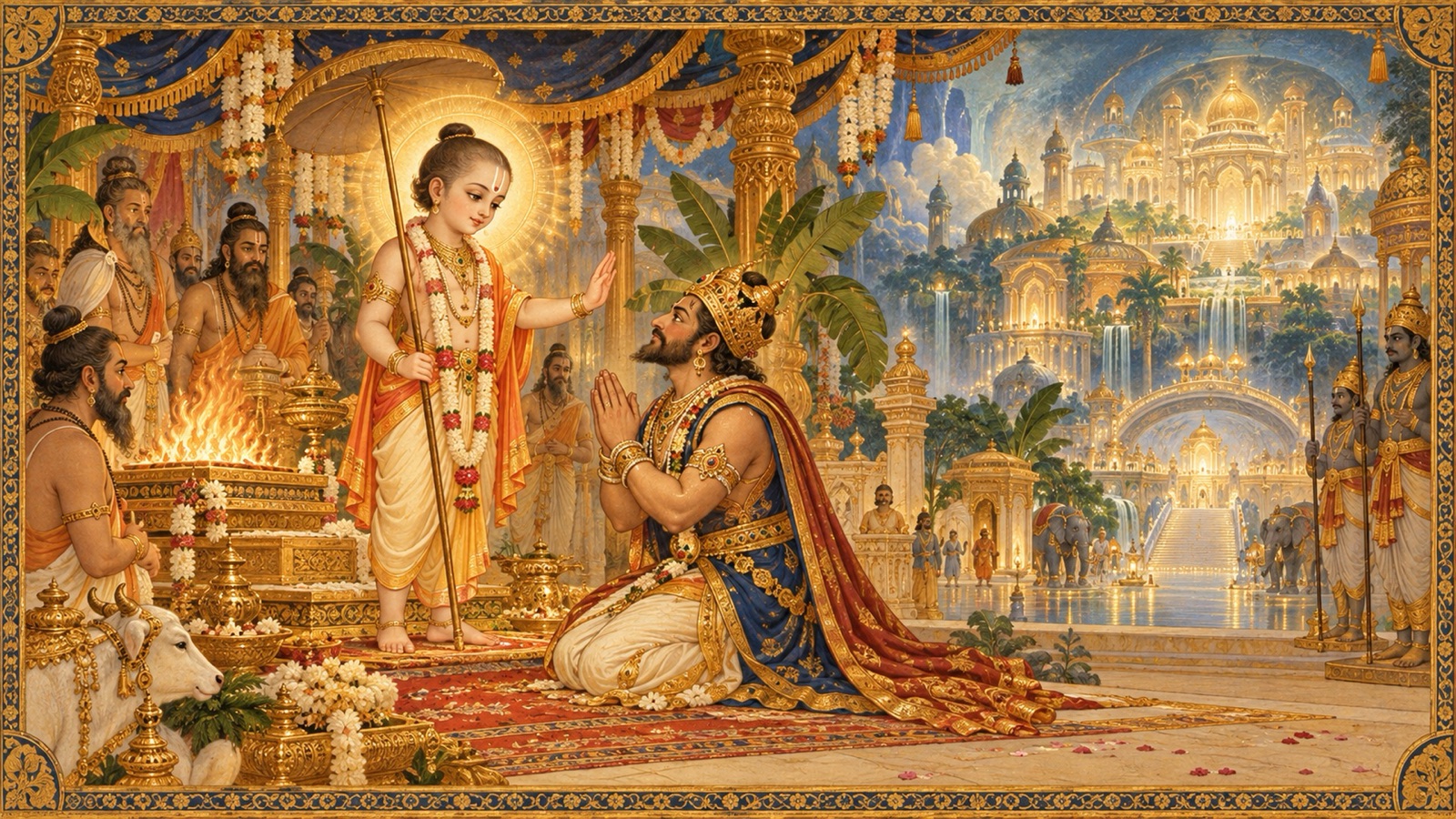
The Lord then bestowed upon Bali a boon greater than the kingdom he had lost. Bali would become Indra, He declared, in the coming age presided over by the Manu named Savarni; and until then he was to rule the beautiful subterranean region of Sutala, fashioned by Vishvakarma, where no anxiety, illness, weariness, or defeat would ever touch its dwellers, by the grace of the Lord’s own glance. No guardian of the worlds would be able to overpower him there, and the Lord’s own discus would guard him from any demon who defied his rule.
रक्षिष्ये सर्वतोऽहं त्वां सानुगं सपरिच्छदम् । सदा सन्निहितं वीर तत्र मां द्रक्ष्यते भवान् ॥ ३५ ॥
rakṣiṣye sarvato ’haṁ tvāṁ sānugaṁ saparicchadam sadā sannihitaṁ vīra tatra māṁ drakṣyate bhavān
Meaning: I shall protect you on every side, along with your followers and your possessions; and there, O hero, you will ever behold Me present at your side. (Canto 8, Chapter 22, verse 35)
Principal Teachings of This Chapter
1. The truest fear is the fear of dishonour before God. Bali dreads neither hell, bondage, nor loss, but only an ignoble name — for he measures himself not by comfort or power but by faithfulness to his word (verses 2-3).
2. Surrender offers the self when nothing else remains. With no land left to give, Bali offers his own head for the Lord’s third step, teaching that the final gift the devotee makes is the gift of himself (verse 2).
3. What looks like the Lord’s punishment is His deepest kindness. Bali blesses the Lord as the greatest benefactor of the demons, for the fall from power that seemed a calamity was in truth the opening of his eyes (verses 4-6).
4. The Lord removes wealth from those He loves most. He strips His dearest devotees of riches and power lest pride blind them, so that the very loss of fortune becomes a sign of His grace (verses 24-27).
5. One who conquers pride conquers the Lord’s Maya. Bali, unbewildered though fallen, impoverished, bound, and cursed, has conquered the invincible illusion — winning a place difficult of access even to the gods (verses 28-31).
A Devotional Reflection
There is a moment in every deep surrender when a person discovers that the thing being taken away was never the treasure at all. Bali loses the three worlds, and finds that he has lost nothing he needed; he is bound, mocked, and stripped bare, and out of that emptiness comes the freest, most fearless speech in all the Vamana story: set Your third step upon my head. He has understood what the proud can never see — that the Lord’s severity is His tenderness in disguise, that to be brought low by God is to be lifted beyond the reach of the gods. And so the great reversal of this chapter is not that a king is humbled, but that a devotee is crowned. The Lord takes Bali’s kingdom and gives him Sutala; takes his freedom and promises His own perpetual presence; takes everything the world calls fortune and leaves him the one wealth that cannot be lost — the nearness of the Lord, ever present at his side. This is the secret the chapter entrusts to us: that whatever God removes from a loving heart, He removes only to make room for Himself.
A Daily Devotional Practice
Today, reflect on one thing you have lost — an opportunity, a possession, a hope that did not come to pass — and, instead of grieving it, offer it back to the Lord as Bali offered his head. Say quietly, “This too I place at Your feet,” and consider whether the loss may have been making room for a grace you could not yet see. Seal the offering with the words “Om Namo Bhagavate Vasudevaya,” trusting, as Bali did, that whatever the Lord takes from a devoted heart He takes only to draw nearer, and that His presence is the one treasure no loss can ever touch.
Conclusion
The twenty-second discourse of the Eighth Canto is the spiritual summit of the Vamana story: a dispossessed king discovers that being emptied by God is His rarest mercy. Bali would rather surrender his own head than his word, and the Lord answers that fearless offering by disclosing why He so often empties His most loved devotees of wealth, pride, and everything the world prizes — to leave room, within them, for Himself alone. Prahlada’s arrival, Vindhyavali’s plea, and Brahma’s intercession all confirm what Bali already knows: nothing taken by the Lord’s own hand is ever truly lost. Crowned instead with Sutala and the abiding nearness of the Lord, Bali stands as living proof that surrender, not possession, is the one wealth that endures. The next discourse completes the story, as the gods regain the heavens.
May the divine wisdom of Srimad Bhagavatam awaken pure devotion within our hearts.
Om Namo Bhagavate Vasudevaya.
Jay Shree Madhav.
References and Attribution
- Primary edition: Gita Press, Śrīmad Bhāgavata Mahāpurāṇa (English, complete), Book Eight, Discourse 22, pages 824–828.
- Series: Srimad Bhagavatam Wisdom · Biswa Sanatan Dharma Seva Trust.
- Presented following the spiritual guidance and recommendation of Pandit Dr. Shri Kashinath Mishra.
This is an original, faithful retelling in the writer’s own words, with brief quoted verses shown in Devanāgarī and transliteration and their meanings given as summaries. It is not a reproduction of any single publisher’s continuous translation or commentary. No affiliation with or endorsement by any publisher is implied.
Jay Shree Madhav