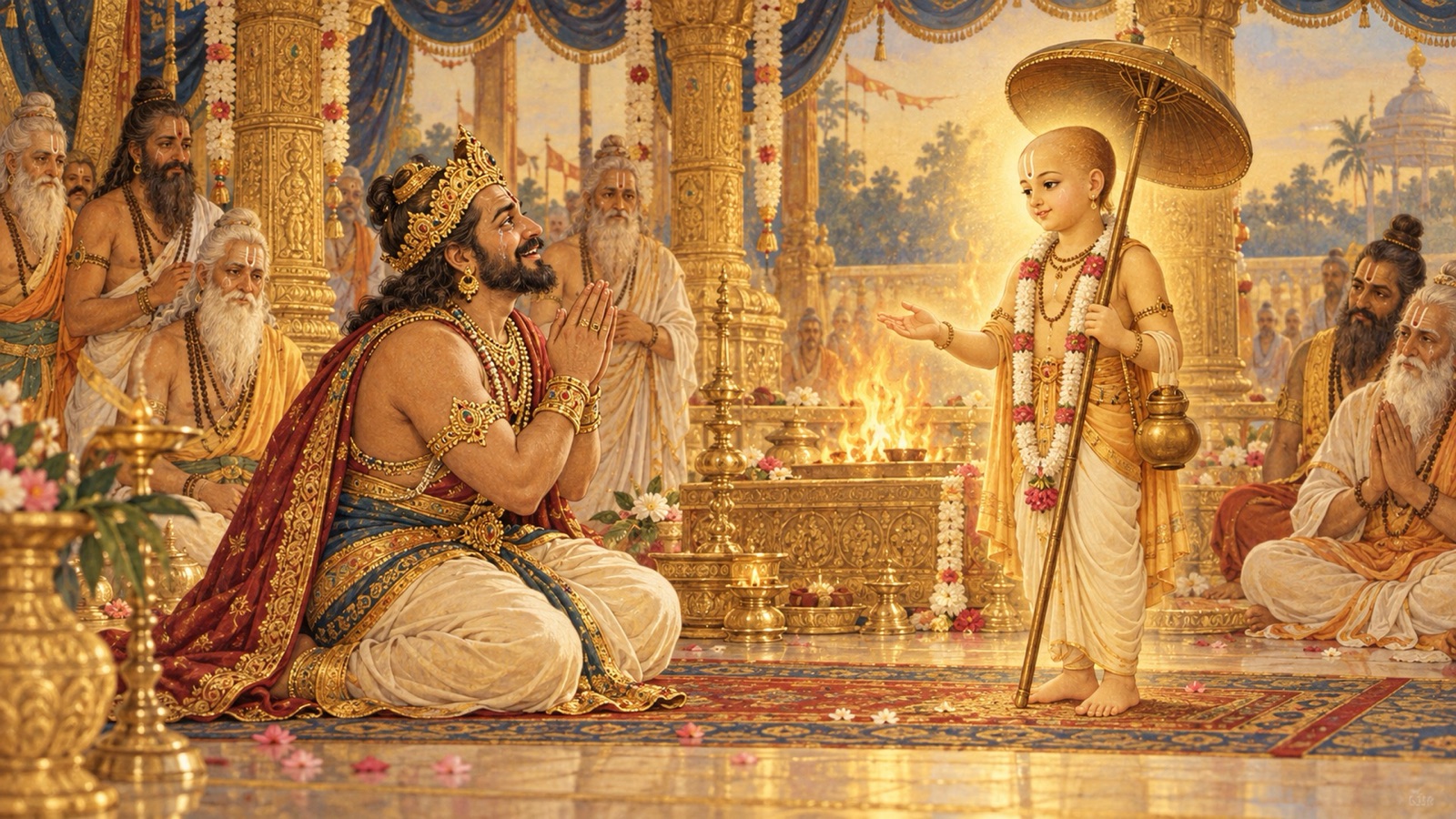
Freed from the cords of Varuna, his eyes brimming with tears and his voice choked with love, the great king Bali folds his palms before the Lord — humbled, blessed, and richer in his defeat than he ever was upon his throne.
Om Namo Bhagavate Vasudevaya.
Om Namo Bhagavate Vasudevaya.
Om Namo Bhagavate Vasudevaya.
Welcome back to Srimad Bhagavatam Wisdom, a devotional journey through the sacred histories and teachings of the Srimad Bhagavat Mahapurana. This twenty-third discourse brings the Vamana story to its serene and joyful close, as Bali’s gratitude, Prahlada’s wonder, and Sukracarya’s surrender unfold in the presence of the Lord’s boundless grace.
Chapter Information
- Scripture: Śrīmad Bhāgavata Mahāpurāṇa
- Canto: 8 (Book Eight)
- Chapter: 23 (Discourse 23)
- Chapter title: Freed from Bondage — Bali’s Entry into Sutala and Heaven’s Restoration to the Gods
- Principal speaker: Sukadeva Gosvami, narrating to King Parikshit — with the words of Bali, Prahlada, the Lord, and Sukracarya
- Principal listener: King Parikshit
- Main setting: Bali’s sacrificial grounds at Bhrgukaccha on the Narmada, and the realm of Sutala
- Central subject: Bali’s gratitude and release, his entry into Sutala, the restoration of heaven to Indra, the completion of the sacrifice, and the glory of hearing the Vamana story
- Principal verse range: Canto 8, Chapter 23, verses 1–31
- Primary edition: Gita Press Śrīmad Bhāgavata Mahāpurāṇa
Context From the Previous Chapter
In the twenty-second discourse, the bound Bali offered his own head for the Lord’s third step and blessed Him as the demons’ truest benefactor. His queen Vindhyavali and Brahma pleaded for his release, and the Lord revealed the secret of His grace — that He strips His dearest devotees of wealth from love alone. To the conquered king He granted Sutala, a future as Indra, and His own perpetual presence. This chapter opens with Bali’s grateful reply.
Bali’s Grateful Praise
To the Lord who had spoken thus, the magnanimous Bali, esteemed by all pious souls, replied with joined palms and a faltering voice, his eyes dimmed with tears and his throat choked with emotion.
श्रीबलिरुवाच अहो प्रणामाय कृत: समुद्यम: प्रपन्नभक्तार्थविधौ समाहित: । यल्लोकपालैस्त्वदनुग्रहोऽमरै- रलब्धपूर्वोऽपसदेऽसुरेऽर्पित: ॥ २ ॥
śrī-balir uvāca aho praṇāmāya kṛtaḥ samudyamaḥ prapanna-bhaktārtha-vidhau samāhitaḥ yal loka-pālais tvad-anugraho ’marair alabdha-pūrvo ’pasade ’sure ’rpitaḥ
Meaning: Bali said: Oh, a mere sincere effort to bow before You secures the boon sought by those who take refuge in You; for that very endeavour has won for a lowly demon like me a grace never before obtained even by the guardians of the worlds and the gods. (Canto 8, Chapter 23, verse 2)
Bali Enters Sutala and Heaven Is Restored to Indra
Having spoken thus, Bali bowed to Lord Hari, and then to Brahma and Lord Siva, and — now freed from bondage and full of joy — set out with the other demons to take up his rule in Sutala. And having thus restored the kingdom of heaven to Indra and fulfilled the desire of Aditi, the Lord governed the whole universe as the younger brother and protector of Indra.
एवमिन्द्राय भगवान् प्रत्यानीय त्रिविष्टपम् । पूरयित्वादिते: काममशासत् सकलं जगत् ॥ ४ ॥
evam indrāya bhagavān pratyānīya triviṣṭapam pūrayitvāditeḥ kāmam aśāsat sakalaṁ jagat
Meaning: Having thus returned the celestial kingdom to its rightful king and satisfied Aditi’s longing for her son’s welfare, the Lord took up the governance of all creation. (Canto 8, Chapter 23, verse 4)
Prahlada Praises the Lord’s Grace
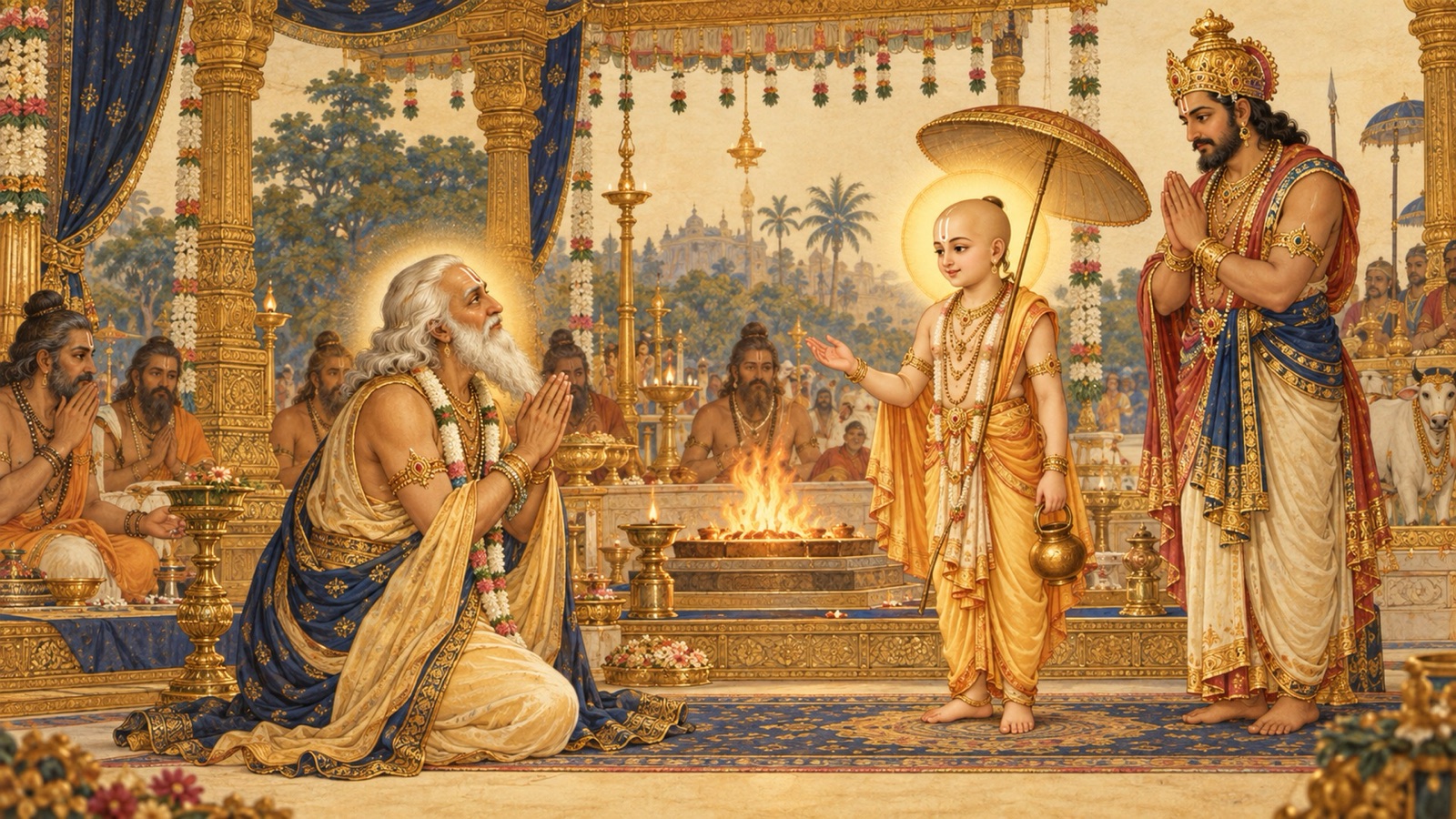
Seeing his grandson Bali — the preserver of his line — freed from all bondage and made a recipient of the Lord’s grace, Prahlada, steeped in devotion, spoke to the Lord in wonder.
श्रीप्रह्लाद उवाच नेमं विरिञ्चो लभते प्रसादं न श्रीर्न शर्व: किमुतापरेऽन्ये । यन्नोऽसुराणामसि दुर्गपालो विश्वाभिवन्द्यैरभिवन्दिताङ्घ्रि: ॥ ६ ॥
śrī-prahrāda uvāca nemaṁ viriñco labhate prasādaṁ na śrīr na śarvaḥ kim utāpare ’nye yan no ’surāṇām asi durga-pālo viśvābhivandyair abhivanditāṅghriḥ
Meaning: Prahlada said: This grace is not won by Brahma, nor by Sri, nor by Lord Siva, much less by others — that You, whose feet are adored even by those worthy of the universe’s worship, should become the protector of us demons. (Canto 8, Chapter 23, verse 6)
It is by devotion to the honey of the Lord’s lotus-feet, Prahlada said, that Brahma and the other guardians enjoy their powers; so he marvelled all the more that those born of a wicked race and given to evil ways should be made recipients of the Lord’s gracious look. In this, he understood, the Lord — who is the impartial Self of all — revealed the essential nature of a wish-yielding tree, which fulfils the desire of all who take shelter in it.
This raises a natural question every devotee eventually asks: if the Lord is equally present in every heart, why does He favour some and not others? The answer Prahlada’s wonder points to is that the Lord’s vision never wavers — He is the same impartial Witness seated within demon and demigod alike — yet a wish-yielding tree withholds nothing from the one who comes beneath its branches while it gives nothing to one who never approaches. The difference lies not in the tree’s partiality but in the seeker’s surrender. So here the Lord’s equal glance remains unbroken even as He becomes protector of the very demons who once opposed Him: it is Bali’s and Prahlada’s surrender, not their birth or rank, that draws forth a grace their birth could never have earned (verse 8).
The Lord Blesses Prahlada
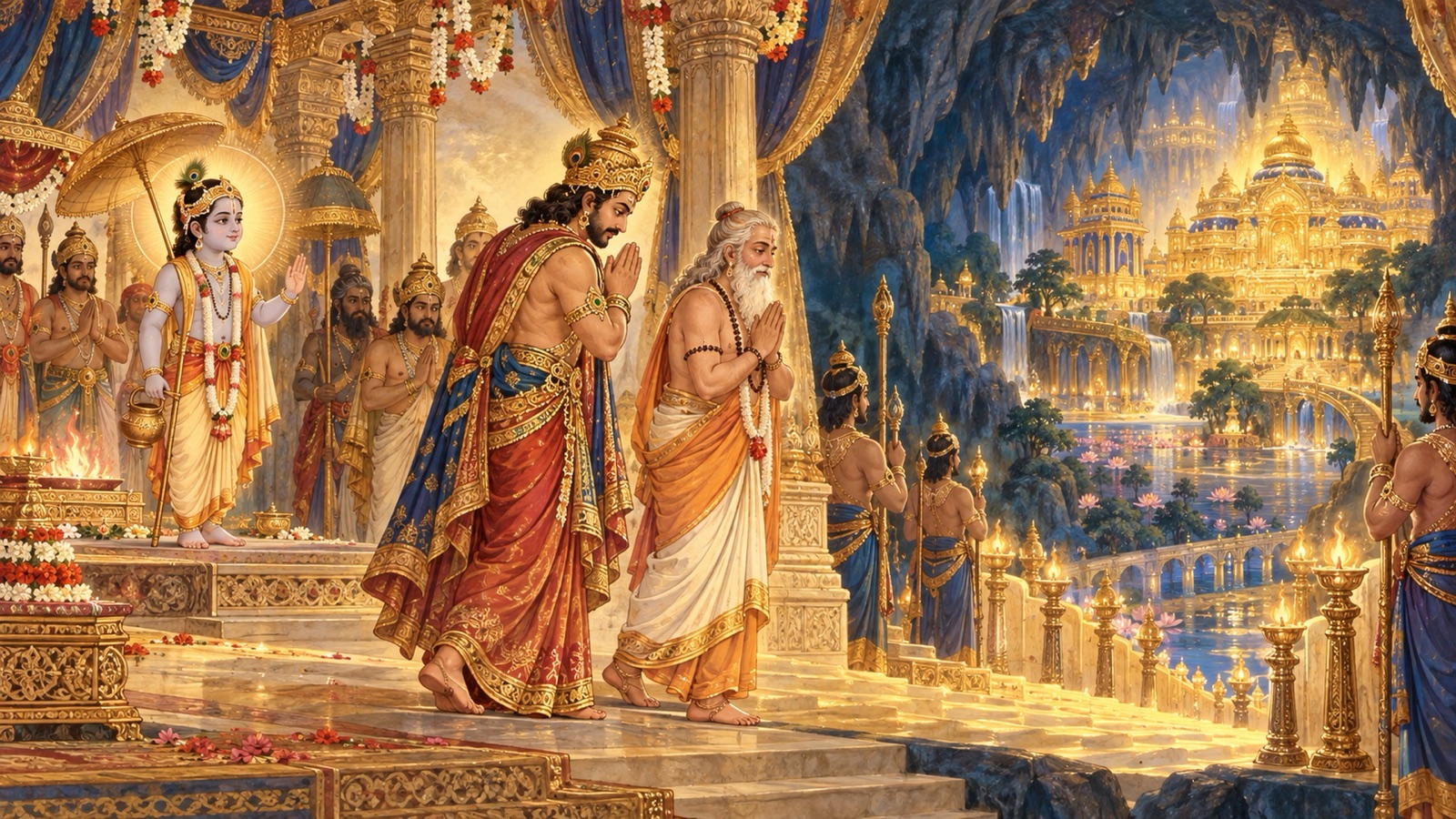
The Lord, well pleased, bade Prahlada depart to Sutala and rejoice there with his grandson, bringing delight to his kinsmen; and He promised that Prahlada would always behold Him present there, mace in hand, his ignorance wiped away by the infinite joy of that sight. Accepting the Lord’s command with joined palms and a bowed head, Prahlada — the generalissimo of all the Asura forces — circumambulated the Lord in reverence and, with the Lord’s leave, withdrew to the subterranean world along with Bali.
Sukracarya Completes the Sacrifice
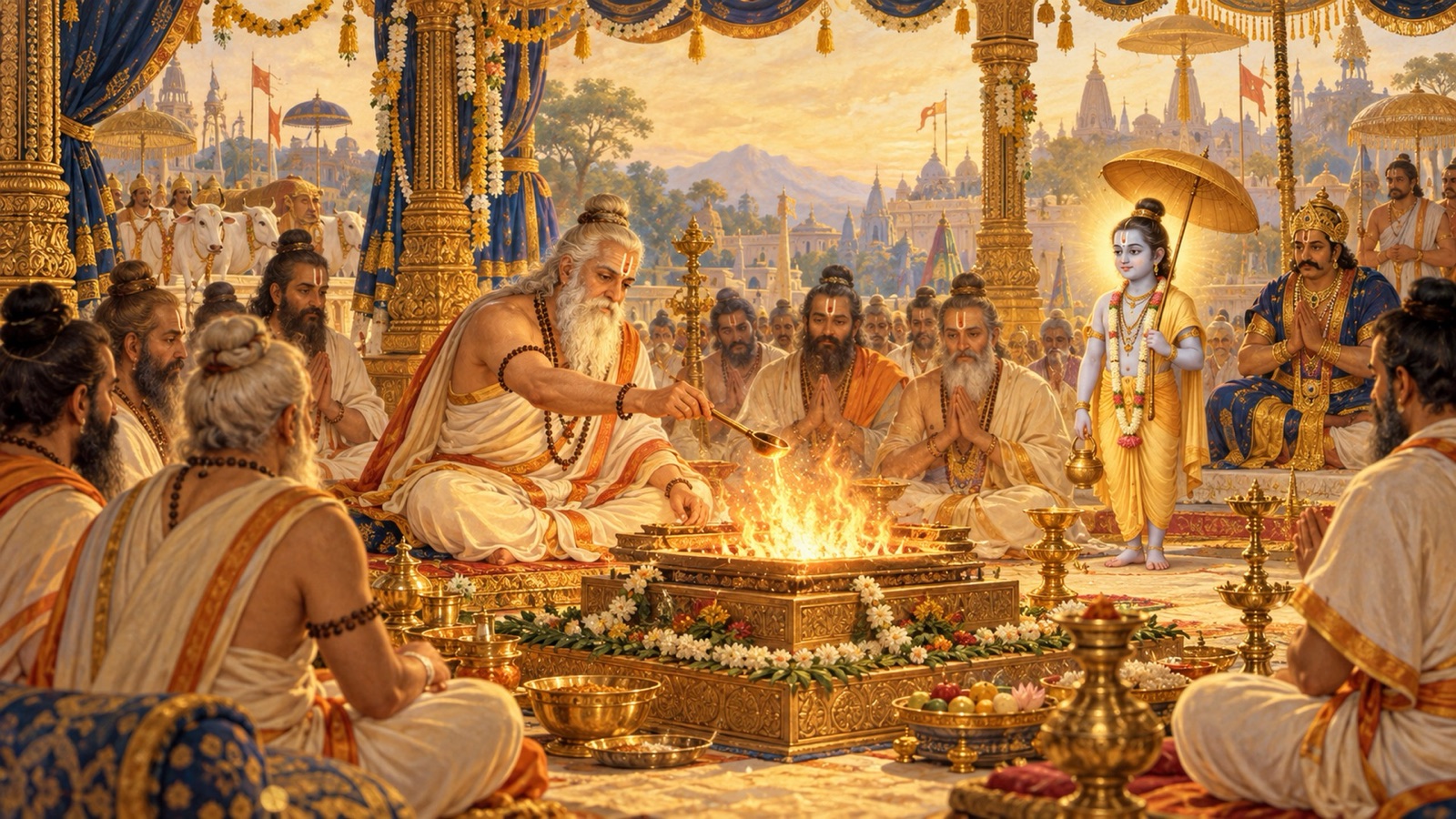
Then Lord Hari spoke to the sage Usana — Sukracarya, the preceptor of Bali — who was seated nearby among the priests in the assembly of the knowers of the Veda, and asked him to make good whatever had been left incomplete in his disciple’s sacrifice. Sukra replied that there could be no defect at all in the sacrifice of one who had worshipped the very Lord of sacrifices with all his substance, for the chanting of the Lord’s name makes good every lack.
मन्त्रतस्तन्त्रतश्छिद्रं देशकालार्हवस्तुत: । सर्वं करोति निश्छिद्रमनुसङ्कीर्तनं तव ॥ १६ ॥
mantratas tantrataś chidraṁ deśa-kālārha-vastutaḥ sarvaṁ karoti niśchidram anusaṅkīrtanaṁ tava
Meaning: The very chanting of Your name makes flawless every defect — in mantra, in procedure, in place and time, in the qualification of the priests, or in the materials used. (Canto 8, Chapter 23, verse 16)
Nevertheless, since it was the Lord Himself who bade him, Sukracarya declared that he would carry out the command, for to obey the Lord’s word is the highest good of all. And so, gladly accepting the behest of Sri Hari, the sage, with the help of the other brahmana seers, completed what was wanting in Bali’s sacrifice.
Lord Vamana Made Upendra and the Gods Regain Heaven
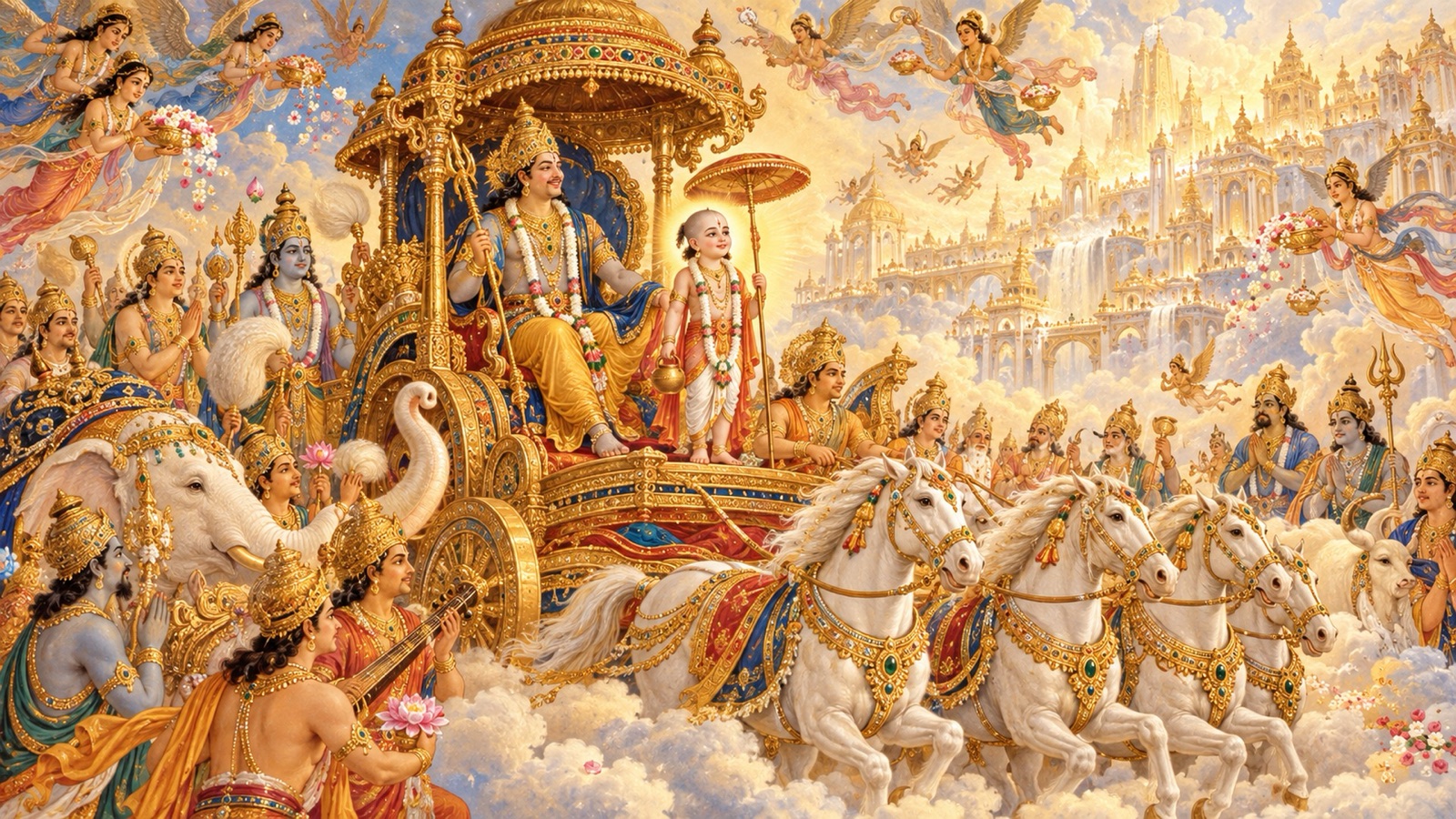
Having thus begged the earth from Bali and given it back to His elder brother, the mighty Indra, the Lord was honoured by Brahma, the lord of the Prajapatis, together with the gods, seers, forefathers, and Manus, and with Daksha, Bhrgu, Angira, Sanatkumara, and Lord Siva. For the delight of Kashyapa and Aditi and the welfare of all beings, they made the divine Dwarf the suzerain Lord of all the worlds and their guardians, the custodian of the Vedas, of righteousness, of glory, and of all blessings — Upendra, the younger brother of Indra. At this all created beings rejoiced greatly. Then, permitted by Brahma, Indra and the guardians of the worlds placed the Lord before them and bore Him in a heavenly car to heaven; and Indra, his fear now gone and protected by the arms of Lord Vamana, was invested with supreme glory and rejoiced.
The Glory of Hearing This Story
Brahma, Lord Siva, Sanatkumara, the seers headed by Bhrgu, the forefathers, and all created beings returned each to his own sphere, singing of the most wonderful deed of the Lord and extolling Aditi. Sukadeva then declared to Parikshit that the whole story of the wide-striding Lord, which takes away the sins of those who hear it, had now been narrated; that no mortal can ever reach the end of the Lord’s glory; and that whoever hears this holy story of His descent attains the highest state.
य इदं देवदेवस्य हरेरद्भुतकर्मण: । अवतारानुचरितं शृण्वन् याति परां गतिम् ॥ ३० ॥
ya idaṁ deva-devasya harer adbhuta-karmaṇaḥ avatārānucaritaṁ śṛṇvan yāti parāṁ gatim
Meaning: Whoever hears this account of the descent of the Lord of lords, Sri Hari, of wondrous deeds, attains the supreme state. (Canto 8, Chapter 23, verse 30)
Principal Teachings of This Chapter
1. The devotee counts God’s grace, not his loss. Freed but stripped of his kingdom, Bali speaks only of the wonder of a grace never granted even to the guardians of the worlds — measuring his fortune by nearness to the Lord (verse 2).
2. The Lord’s descents restore the balance of the world. Having begged the earth from Bali, the Lord returns the heavens to Indra and fulfils the desire of Aditi, showing that His play always works toward the welfare of all (verse 4).
3. Divine grace cannot be earned by rank. Prahlada marvels that a grace not won even by Brahma, Sri, or Siva is granted to the demons, teaching that the Lord bestows His kindness freely on all who take shelter in Him (verses 6-8).
4. The Lord’s name makes every act complete. Sukracarya declares that the chanting of the Lord’s name makes good every defect in a sacrifice, revealing the supreme purifying power of the holy name (verse 16).
5. Hearing the Lord’s story leads to the highest state. The discourse ends by promising that whoever hears the account of the Lord’s descent is freed from sin and attains the supreme goal (verses 28-30).
A Devotional Reflection
The Vamana story ends not with a conquest but with a homecoming. Bali, who began as the ruler of the three worlds and ends as the ruler of a subterranean realm, has in truth lost nothing and gained everything: the tears in his eyes are not tears of grief but of overwhelmed love, for he has received a grace that Brahma himself could not command. And here the deepest secret of the tale shines out through Prahlada’s wonder — that the Lord does not measure worthiness as the world does. He becomes the protector of the very demons, the guardian of their fort, the ever-present companion in their exile, because His grace is a wish-yielding tree that turns no sheltering heart away. Sukracarya’s words complete the teaching: what makes any offering whole is not the flawlessness of our ritual but the chanting of the Lord’s name, the turning of the heart toward Him. So the story that began with a beggar’s request for three paces of land closes with the assurance that the smallest sincere step toward God — a bow, a name, a story heard with love — is enough to win the highest of all destinations.
A Daily Devotional Practice
Today, take up the practice that Sukracarya praises and this chapter promises: the simple chanting of the Lord’s name. Set aside a few quiet minutes to repeat “Om Namo Bhagavate Vasudevaya” with attention and love, trusting, as the sage taught, that the holy name makes good every lack in our worship and every flaw in ourselves. And as you finish, hear again in your heart the promise with which the Vamana story ends — that whoever turns to the Lord’s story and name, however humbly, is drawn toward the highest state.
Conclusion
The twenty-third discourse closes the Vamana story not with a conqueror’s triumph but with a devotee’s homecoming: Bali counts his surrender as pure gain, Prahlada beholds the Lord turn protector of the very demons He once defeated, and Sukracarya finds every ritual lack dissolved in the chanting of the holy name. Together these threads point to one truth — that the Lord’s grace answers surrender, not rank or ritual perfection, and that even the humblest turning toward Him, a bow or a name repeated with love, opens the door to His presence. With this, the celebrated account of Lord Vamana is complete, and the Canto turns next to the story of the divine Fish, the first of the Lord’s descents.
May the divine wisdom of Srimad Bhagavatam awaken pure devotion within our hearts.
Om Namo Bhagavate Vasudevaya.
Jay Shree Madhav.
References and Attribution
- Primary edition: Gita Press, Śrīmad Bhāgavata Mahāpurāṇa (English, complete), Book Eight, Discourse 23, pages 828–832.
- Series: Srimad Bhagavatam Wisdom · Biswa Sanatan Dharma Seva Trust.
- Presented following the spiritual guidance and recommendation of Pandit Dr. Shri Kashinath Mishra.
This is an original, faithful retelling in the writer’s own words, with brief quoted verses shown in Devanāgarī and transliteration and their meanings given as summaries. It is not a reproduction of any single publisher’s continuous translation or commentary. No affiliation with or endorsement by any publisher is implied.
Jay Shree Madhav