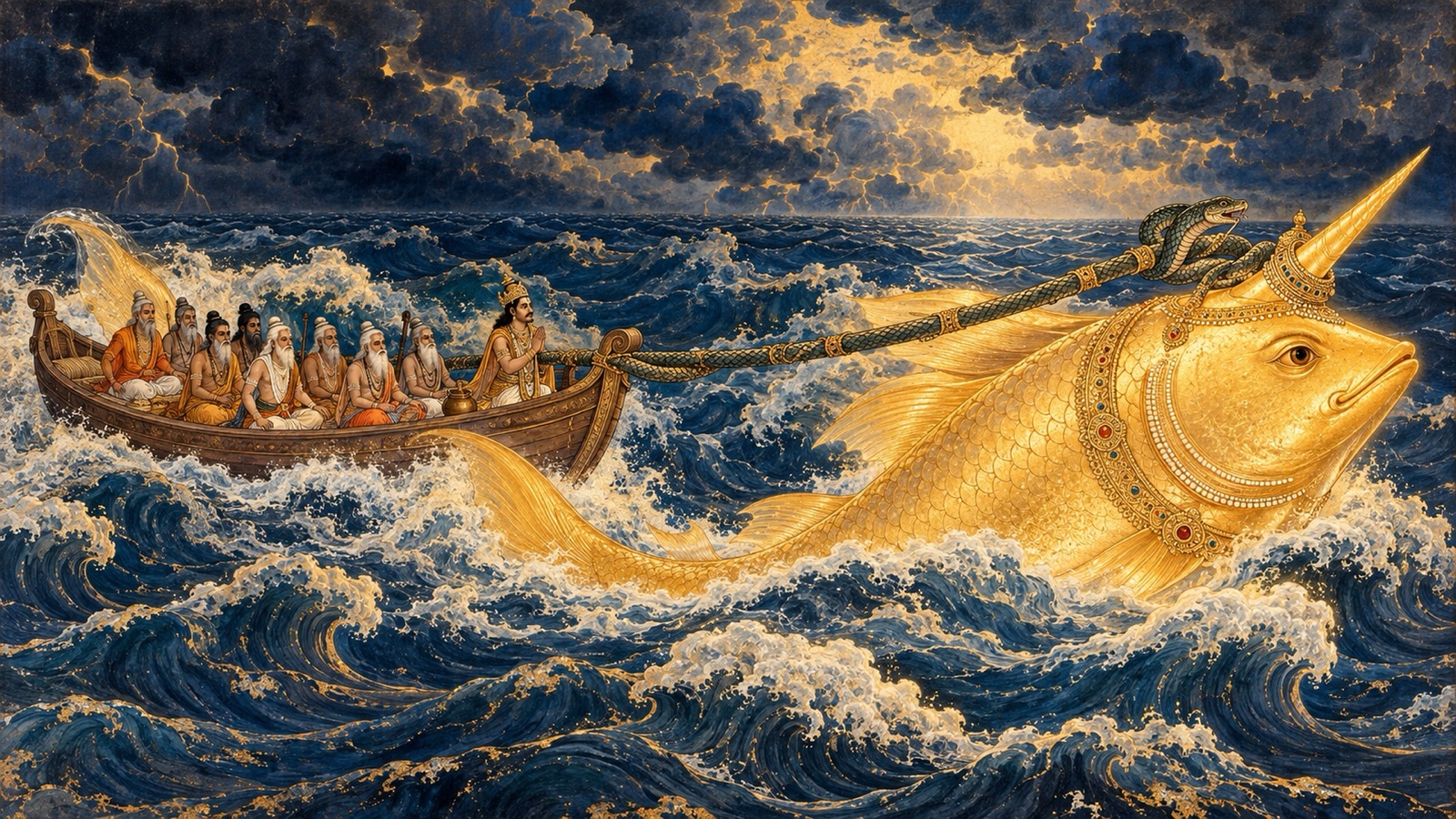
Through the boundless waters of the dissolution, a golden one-horned fish tows a great boat that carries the seven sages and the seeds of all life — the Lord Himself, guiding the world safely through the night of deluge to the dawn of a new creation.
Om Namo Bhagavate Vasudevaya.
Om Namo Bhagavate Vasudevaya.
Om Namo Bhagavate Vasudevaya.
Welcome back to Srimad Bhagavatam Wisdom, a devotional journey through the sacred histories and teachings of the Srimad Bhagavat Mahapurana. Having heard the whole story of Lord Vamana, King Parikshit now asks to hear of the Lord’s very first descent — the divine Fish, Matsya — and in this twenty-fourth and concluding discourse of the Eighth Canto, Sukadeva unfolds that ancient rescue for him in full.
Chapter Information
- Scripture: Śrīmad Bhāgavata Mahāpurāṇa
- Canto: 8 (Book Eight)
- Chapter: 24 (Discourse 24)
- Chapter title: Matsya and the Rescue of the Vedas
- Principal speaker: Sukadeva Gosvami, narrating to King Parikshit (with Suta’s framing verse)
- Principal listener: King Parikshit
- Main setting: The bank of the Kritamala river in the Dravida land, and the ocean of the universal dissolution
- Central subject: The theft of the Vedas by Hayagriva, the Lord’s descent as the divine Fish, His meeting with Satyavrata, the great deluge, and the rescue of the Vedas
- Principal verse range: Canto 8, Chapter 24, verses 1–61
- Primary edition: Gita Press Śrīmad Bhāgavata Mahāpurāṇa
Context From the Previous Chapter
In the twenty-third discourse, the Vamana story reached its serene close: the freed Bali entered Sutala, Prahlada marvelled at the Lord’s grace, Sukracarya completed the sacrifice, and the divine Dwarf, made Upendra, restored the heavens to Indra. Sukadeva then affirmed that whoever hears the Lord’s story attains the highest state. Here King Parikshit asks to hear of the Lord’s first descent — the divine Fish — and Sukadeva begins the account.
Why the Lord Assumes His Forms
Sukadeva began by explaining the purpose behind all the Lord’s descents. The Supreme Lord, he said, assumes His various forms whenever He seeks to protect what is worthy of protection.
श्रीशुक उवाच गोविप्रसुरसाधूनां छन्दसामपि चेश्वर: । रक्षामिच्छंस्तनूर्धत्ते धर्मस्यार्थस्य चैव हि ॥ ५ ॥
śrī-śuka uvāca go-vipra-sura-sādhūnāṁ chandasām api ceśvaraḥ rakṣām icchaṁs tanūr dhatte dharmasyārthasya caiva hi
Meaning: Sukadeva said: Desiring to protect the cows, the brahmanas, the gods, the saintly, and the Vedas too, as well as righteousness and all that is worth seeking, the Lord assumes His various forms. (Canto 8, Chapter 24, verse 5)
Though He functions within all creatures, high and low, as their inner controller, the Lord — like the air — never takes on the high or low status of the forms He enters, for He is ever beyond the three modes of nature.
Hayagriva Steals the Vedas
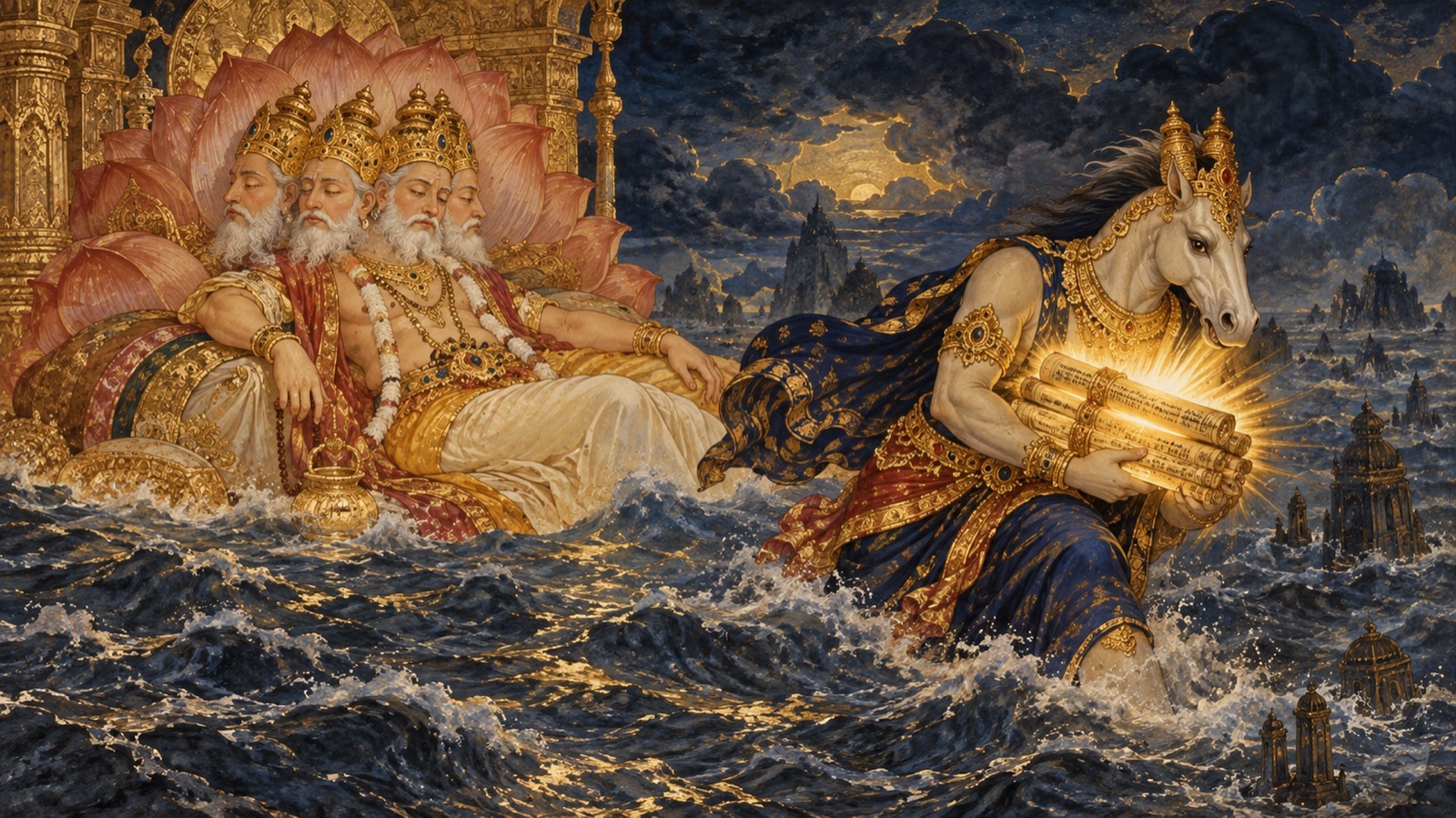
At the end of the previous cosmic day, Sukadeva recounted, there came an occasional dissolution when Brahma retired to rest, and the three worlds, including the earth, were flooded by the ocean. As Brahma grew drowsy under the influence of time, the Vedas slipped from his mouth, and the mighty demon Hayagriva — the horse-headed one — seized them and carried them away.
The Lord Becomes a Fish
Perceiving the deed of Hayagriva, the Lord assumed the form of a fish to recover the sacred texts and protect the worlds.
ज्ञात्वा तद् दानवेन्द्रस्य हयग्रीवस्य चेष्टितम् । दधार शफरीरूपं भगवान् हरिरीश्वर: ॥ ९ ॥
jñātvā tad dānavendrasya hayagrīvasya ceṣṭitam dadhāra śapharī-rūpaṁ bhagavān harir īśvaraḥ
Meaning: Understanding this act of Hayagriva, the chief of the Danavas, the almighty Lord Hari assumed the form of a fish. (Canto 8, Chapter 24, verse 9)
The Little Fish in Satyavrata’s Palms
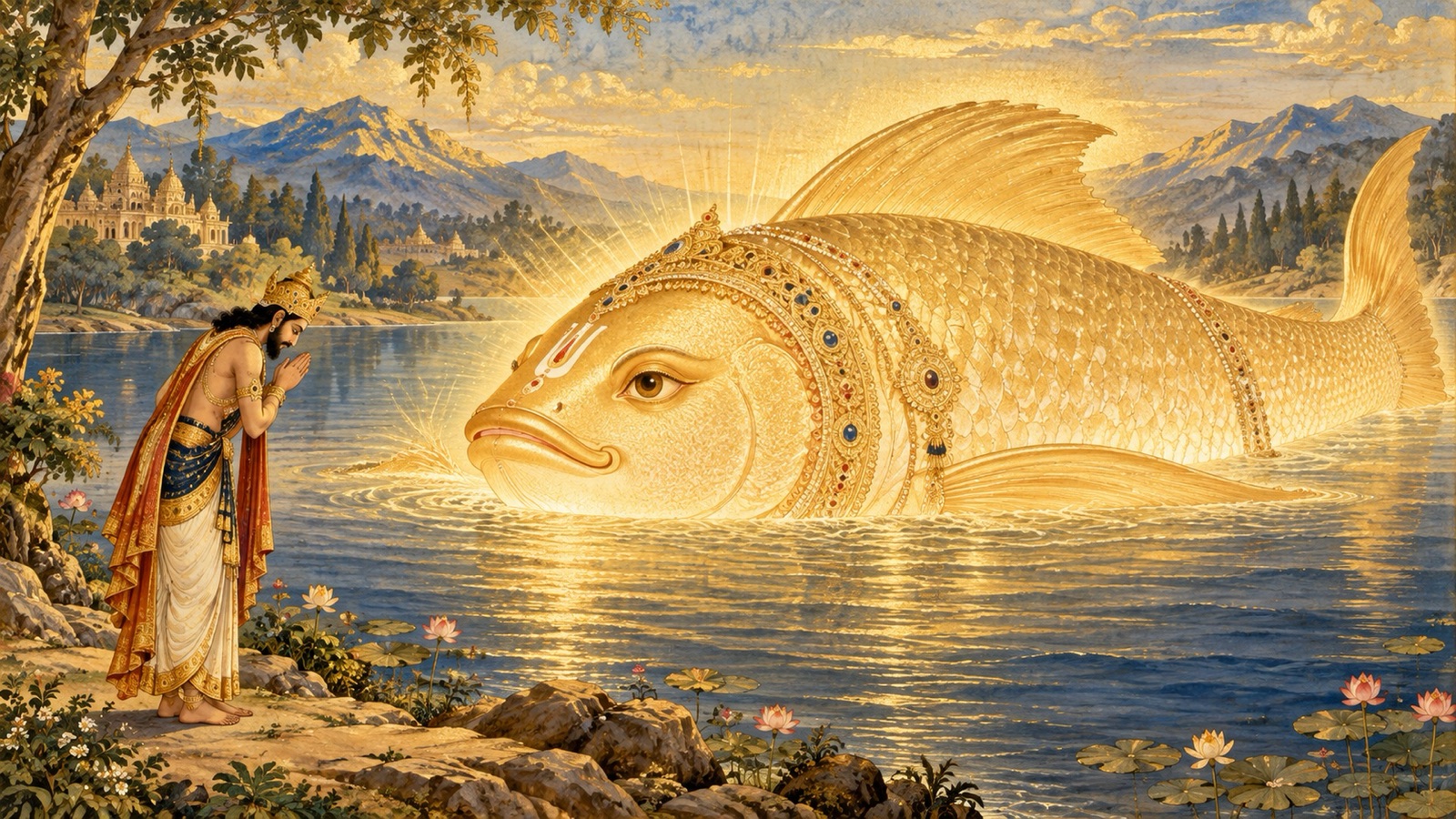
In that age there lived a royal sage named Satyavrata, a great soul devoted to Lord Narayana, who practised austerities subsisting only on water. This same king would become Sraddhadeva, the son of Vivasvan, and be raised by the Lord to the rank of Manu in the present age. One day, as Satyavrata offered handfuls of water to the forefathers on the bank of the Kritamala river, a tiny fish appeared in the water cupped in his palms. When he made to release it into the river along with the water, the little fish pitifully appealed to the compassionate king not to abandon it, helpless and afraid of the larger creatures that devour their own kind. Moved by its plea — and not yet knowing that the Lord Himself had lovingly taken this form to shower grace upon him — Satyavrata resolved to protect the fish and carried it home in his water-pot.

The Fish That Would Not Stop Growing
Overnight the fish grew until the water-pot could no longer hold it, and it asked the king for a more spacious home. He moved it to a larger vessel, but within an hour it grew to three cubits and pleaded for more room. He placed it in a pond, and it swelled to fill the whole pond; he moved it to lake after lake, each larger than the last, and each time the fish grew to match. At last, finding no water large enough, Satyavrata carried it toward the ocean — and even then the fish spoke, warning that the mighty creatures of the sea might devour it, and asking not to be left there.

Satyavrata Recognizes the Lord
Bewildered by a fish that spoke such charming words and grew beyond all nature, the king asked who this being truly was. No aquatic creature of such power had ever been seen or heard of, he said, that could grow in a single day to fill a lake hundreds of miles across. And then, in wonder and devotion, he recognized the truth.
नूनं त्वं भगवान् साक्षाद्धरिर्नारायणोऽव्यय: । अनुग्रहाय भूतानां धत्से रूपं जलौकसाम् ॥ २७ ॥
nūnaṁ tvaṁ bhagavān sākṣād dharir nārāyaṇo ’vyayaḥ anugrahāya bhūtānāṁ dhatse rūpaṁ jalaukasām
Meaning: Surely You are the imperishable Lord Narayana Himself, Sri Hari; for the grace of all beings You have assumed this form dwelling in the waters. (Canto 8, Chapter 24, verse 27)
He bowed to the Supreme Person, controller of creation, maintenance, and dissolution, the true Self and goal of His devotees, and asked to know the purpose for which this form had been assumed — for it is never fruitless to take shelter at the feet of the Lord, the friend and beloved Self of all.
The Lord Foretells the Deluge
To Satyavrata, who had spoken thus, the Lord of the universe — who desired to sport in the ocean of the coming dissolution — revealed what was to come. On the seventh day from that day, He said, the three worlds would be submerged in the ocean of dissolution; and when that flood arose, a spacious boat sent by Him would approach the king.
त्रिलोक्यां लीयमानायां संवर्ताम्भसि वै तदा । उपस्थास्यति नौ: काचिद् विशाला त्वां मयेरिता ॥ ३३ ॥
tri-lokyāṁ līyamānāyāṁ saṁvartāmbhasi vai tadā upasthāsyati nauḥ kācid viśālā tvāṁ mayeritā
Meaning: When the three worlds are dissolving in the waters of the deluge, a certain spacious boat, sent by Me, will come to you. (Canto 8, Chapter 24, verse 33)
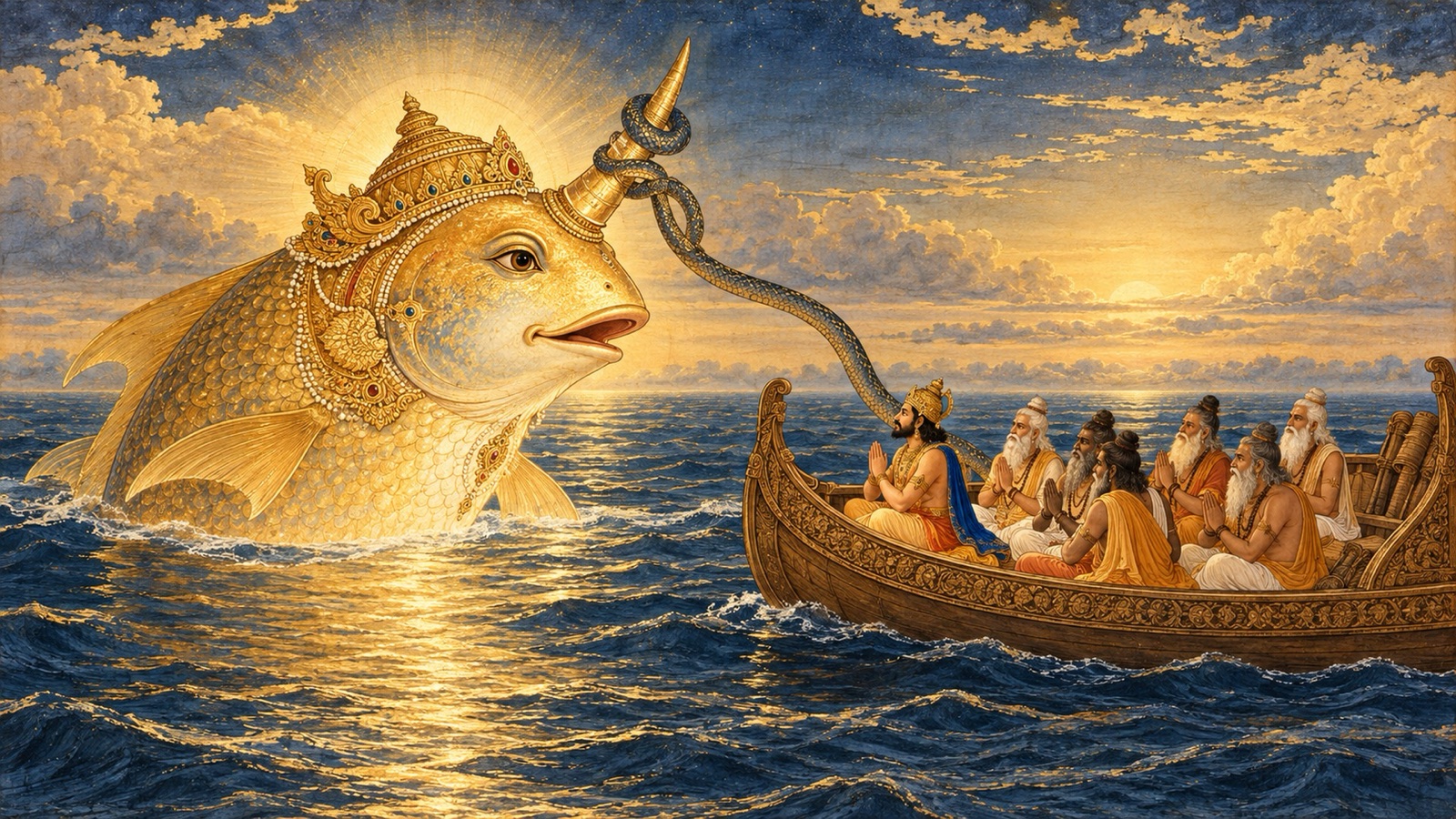
The king was to gather all the herbs and seeds, board that boat surrounded by the seven sages, and sail unafraid over the shoreless waters, guided only by the radiance of the seers. When the boat was tossed by the mighty gale, he was to tie it by the great serpent Vasuki to the Lord’s horn, and the Lord would tow him through the long night of Brahma. And through that voyage, the Lord promised, Satyavrata would come to know the glory of the Supreme, revealed within his own heart.
The Deluge and the Boat
Having instructed the king, the Lord vanished, and Satyavrata awaited the appointed time. Spreading blades of sacred kusha grass and sitting in meditation upon the feet of the Lord in His form as the divine Fish, he beheld the ocean rise, swollen by torrential clouds, and flood the earth on every side. Remembering the Lord’s command, he saw the boat arrive; taking the herbs and plants, he boarded it with the great sages, who lovingly urged him to meditate on the Lord who would surely deliver them from all danger. Thought of uninterruptedly, the Lord appeared in the vast waters as a golden one-horned fish, immeasurable in size; and Satyavrata, full of joy, fastened the boat to the horn with the serpent-king for a rope, as the Lord had enjoined, and hymned His praises.
The Lord Imparts Eternal Wisdom
Before that wisdom came, Satyavrata poured out a long prayer of surrender that ranks among the most searching passages in the whole Bhagavatam. He confessed that souls whose self-knowledge lies clouded by beginningless ignorance, worn down by the very toil that ignorance breeds, only rarely — by sheer good fortune — draw near one who can truly set them free; and that the Fish before him was exactly that supreme spiritual master.
श्रीराजोवाच अनाद्यविद्योपहतात्मसंविद- स्तन्मूलसंसारपरिश्रमातुरा: । यदृच्छयोपसृता यमाप्नुयु- र्विमुक्तिदो न: परमो गुरुर्भवान् ॥ ४६ ॥
śrī-rājovāca anādy-avidyopahatātma-saṁvidas tan-mūla-saṁsāra-pariśramāturāḥ yadṛcchayopasṛtā yam āpnuyur vimuktido naḥ paramo gurur bhavān
Meaning: The king said: Souls whose self-knowledge lies clouded by beginningless ignorance, and who are wearied by the very toil that ignorance breeds, only rarely come by fortune to one who can grant them liberation — You alone, my Lord, are that supreme spiritual master for us. (Canto 8, Chapter 24, verse 46)
Satyavrata then begged the Lord to cut the very knot of false desire from his heart, comparing devotional service to fire — the one force able to burn every impurity from gold or silver until its own natural lustre shines through — and calling Him guror guruh, the teacher of every teacher, from whom alone any genuine line of instruction can be said to descend. He drew the distinction that gives his prayer its lasting force: as a blind man led by another blind man only stumbles further, one who accepts a teacher ignorant of life’s true goal is left more lost than before, however clever that teacher’s words; and a guru who instructs only in worldly advancement and the satisfaction of the senses merely tightens the very bonds his disciple hoped to loosen. Only the Lord’s own instruction, Satyavrata prayed, is eternal, restoring the soul to its true and joyful nature — and so, setting aside every lesser refuge, he surrendered entirely, asking only that the Lord cut the knot from the core of his heart and reveal his true destination (verses 47-53).
Then the Lord, in His fish form, sporting in the great waters, imparted to the royal sage the eternal truth of the Self — the divine wisdom of Sankhya, Yoga, and sacred action — which Satyavrata, seated in the boat with the sages, heard without a doubt. When the dissolution had passed and Brahma rose again, the Lord slew the demon Hayagriva and restored the Vedas to him.
अतीतप्रलयापाय उत्थिताय स वेधसे । हत्वासुरं हयग्रीवं वेदान् प्रत्याहरद्धरि: ॥ ५७ ॥
atīta-pralayāpāya utthitāya sa vedhase hatvāsuraṁ hayagrīvaṁ vedān pratyāharad dhariḥ
Meaning: When the dissolution had ended and Brahma rose again, the Lord Hari slew the demon Hayagriva and restored the Vedas to the creator. (Canto 8, Chapter 24, verse 57)
By the grace of Lord Vishnu, King Satyavrata, endowed with knowledge and realization, became Vaivasvata Manu in the present age.
The Glory of Hearing This Story
Sukadeva concluded that whoever hears the dialogue of Satyavrata and the divine Fish is freed from all sin — and of the fruit awaiting anyone who keeps retelling this descent, he left no doubt:
अवतारं हरेर्योऽयं कीर्तयेदन्वहं नर: । सङ्कल्पास्तस्य सिध्यन्ति स याति परमां गतिम् ॥ ६० ॥
avatāraṁ harer yo ’yaṁ kīrtayed anvahaṁ naraḥ saṅkalpās tasya sidhyanti sa yāti paramāṁ gatim
Meaning: The person who daily recites this descent of Sri Hari finds the resolves of his heart fulfilled and attains the supreme goal. (Canto 8, Chapter 24, verse 60)
Principal Teachings of This Chapter
1. The Lord descends to protect what is sacred. Whenever cows, brahmanas, gods, saintly souls, the Vedas, and righteousness stand in need, the Lord assumes a form to protect them — the purpose behind His every descent (verse 5).
2. The Lord meets the seeker in the smallest of forms. He comes to Satyavrata not in majesty but as a tiny, helpless fish, teaching that God draws near even in the humblest guise to those who show compassion (verses 12-16).
3. The Divine cannot be contained. The fish that outgrows every vessel, pond, lake, and ocean reveals that the Lord is limitless, beyond all bounds our minds would place upon Him (verses 17-23).
4. Take refuge, and the Lord Himself becomes the boat. Through the deluge that swallows the worlds, the Lord provides the vessel, tows it by His own horn, and carries the devotee safely to the new creation (verses 33-45).
5. The Lord alone is the guru of every genuine teacher. Satyavrata’s prayer draws the sharp line between a true guide and a self-styled “guru”: one who teaches only worldly gain tightens the very bonds his disciple hoped to loosen, but the Lord’s own instruction is eternal, cutting the knot of ignorance and restoring the soul to its joyful, original nature (verses 46-53).
A Devotional Reflection
The Matsya story places two vast things side by side: the deluge that dissolves the worlds, and a fish small enough to rest in a man’s cupped hands. Between these two the whole teaching of the chapter lives. Satyavrata’s greatness is not power or learning but a simple compassion — he cannot bear to abandon a frightened creature — and it is precisely this tenderness that the Lord chooses to reward, coming to him disguised as the very helplessness that moved his heart. Then the little fish grows and grows, bursting every container the king can find, until Satyavrata understands that what he thought he was protecting is in truth the Protector of all. And when the flood comes at last, the God he sheltered becomes the one who shelters him, towing his fragile boat through the shoreless dark by nothing but His own horn and the devotee’s steady remembrance. Here is the pattern of all divine grace: we reach toward God in some small, imperfect way — a kindness, a prayer, a refuge sought — and He answers by becoming our whole salvation, carrying us through the deepest night into the dawn of a new life.
A Daily Devotional Practice
Today, practise Satyavrata’s twofold devotion: compassion and remembrance. Show one act of kindness to a helpless creature or person who can offer you nothing in return, remembering that the Lord Himself may draw near in the humblest of forms. Then, as the sages counselled the king aboard the boat, spend a few minutes meditating on the Lord as your refuge amid life’s floods, repeating “Om Namo Bhagavate Vasudevaya” and trusting that the God you turn to will become the very boat that carries you safely through every storm.
Conclusion
The twenty-fourth discourse closes the Eighth Canto with the Lord’s gentlest descent of all — not as a warrior or a giant, but as a small, frightened fish who grew until Satyavrata knew Him for Narayana Himself, and who then revealed the truth this whole story exists to teach: that He alone is the guru of every genuine teacher, and that surrender to Him alone can cut the knot of a bound heart. May we, like Satyavrata, recognize the Lord drawing near even in life’s humblest disguises, and take shelter of Him as our own supreme refuge.
May the divine wisdom of Srimad Bhagavatam awaken pure devotion within our hearts.
Om Namo Bhagavate Vasudevaya.
Jay Shree Madhav.
References and Attribution
- Primary edition: Gita Press, Śrīmad Bhāgavata Mahāpurāṇa (English, complete), Book Eight, Discourse 24, pages 832–837.
- Series: Srimad Bhagavatam Wisdom · Biswa Sanatan Dharma Seva Trust.
- Presented following the spiritual guidance and recommendation of Pandit Dr. Shri Kashinath Mishra.
This is an original, faithful retelling in the writer’s own words, with brief quoted verses shown in Devanāgarī and transliteration and their meanings given as summaries. It is not a reproduction of any single publisher’s continuous translation or commentary. No affiliation with or endorsement by any publisher is implied.
Jay Shree Madhav