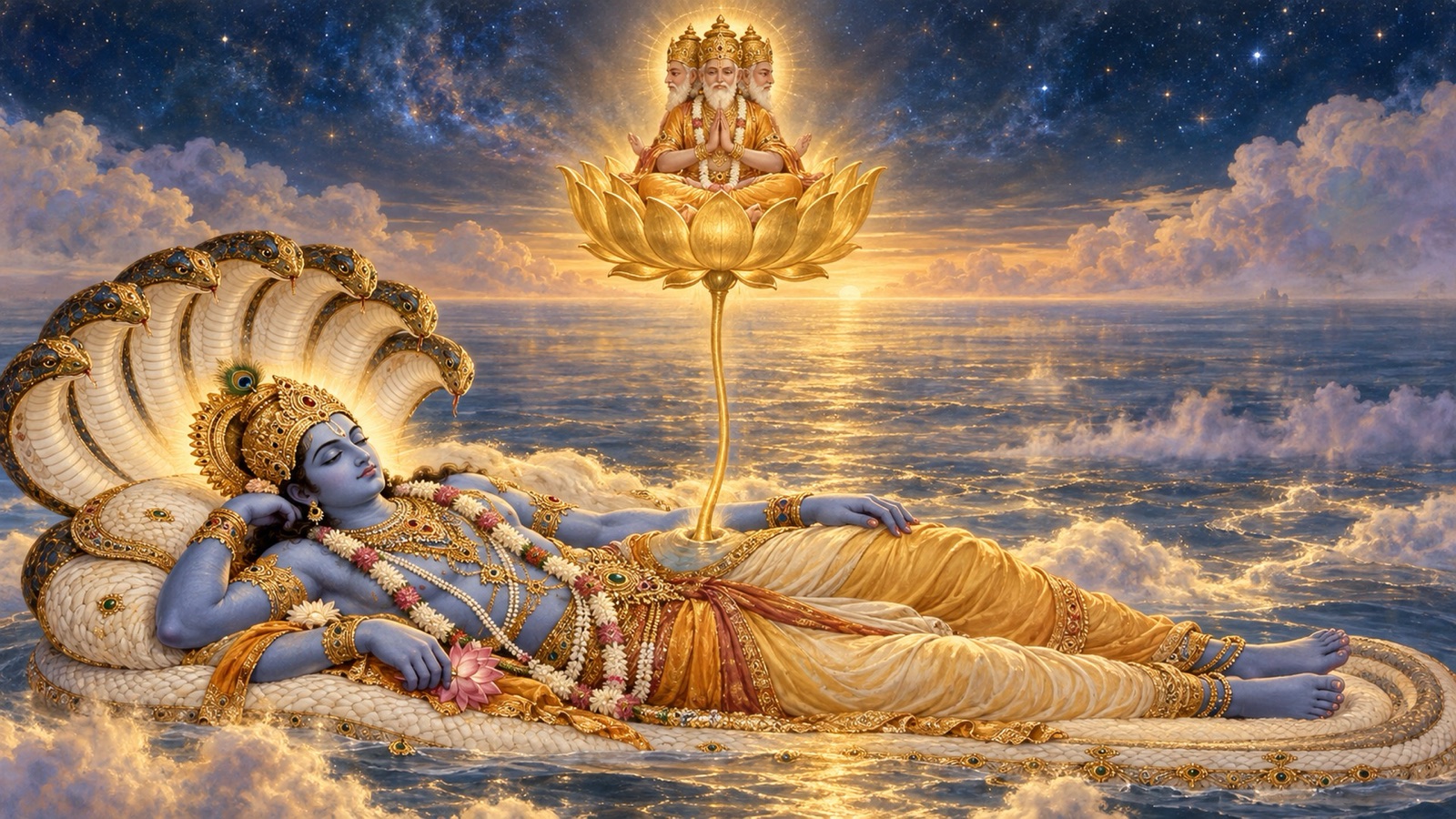
At the close of a cosmic night only the Supreme Person remains upon the waters — and from His navel a golden lotus rises bearing Brahma, the unseen fountainhead of every royal line whose story Book Nine is about to tell.
Om Namo Bhagavate Vasudevaya.
Om Namo Bhagavate Vasudevaya.
Om Namo Bhagavate Vasudevaya.
Welcome to Srimad Bhagavatam Wisdom, a devotional journey through the sacred histories and teachings of the Srimad Bhagavat Mahapurana. With this chapter Book Nine begins — the great dynastic history of the earth’s noblest kings — as Sukadeva traces that history to its source in the Supreme Person and then tells the tender, strange story of Manu’s daughter Ila, who became the prince Sudyumna.
Chapter Information
- Scripture: Śrīmad Bhāgavata Mahāpurāṇa
- Canto: 9 (Book Nine)
- Chapter: 1 (Discourse 1)
- Chapter title: The Story of King Sudyumna
- Principal speaker: Sukadeva Gosvami, narrating to King Parikshit — the whole related by Suta Gosvami to the sage Saunaka and the assembly of sages at Naimisaranya
- Principal listener: King Parikshit
- Main setting: The bank of the Ganga, where Sukadeva instructs Parikshit in his final days; the narrative itself ranges from the primeval causal waters to the kingdom of Pratishthana at the confluence of the Ganga and Yamuna
- Central subject: The opening of the dynastic histories of Book Nine — the descent of Vaivaswata Manu’s line from Lord Narayana, and the story of Manu’s child Sudyumna, born a daughter and transformed into a prince
- Principal verse range: Canto 9, Chapter 1, verses 1–42
- Primary edition: Gita Press Śrīmad Bhāgavata Mahāpurāṇa
Parikshit’s Request
Book Nine opens with the eager request of a listener who has already heard much and longs to hear more. King Parikshit, seated before Sukadeva in his final days, reminds the sage that he has been told the accounts of all the Manvantaras and the heroic deeds Sri Hari performed within them. He has heard, too, how the royal sage Satyavrata, ruler of the Dravida land, who had attained enlightenment through devotion to the Lord at the end of the previous age, was reborn as Sraddhadeva, son of the sun-god, and became the Manu of the present age. Now Parikshit asks for what comes next: the line of Ikshvaku and the other kings, and the deeds of those who have ruled, are ruling, and are yet to rule.
श्रीराजोवाच मन्वन्तराणि सर्वाणि त्वयोक्तानि श्रुतानि मे । वीर्याण्यनन्तवीर्यस्य हरेस्तत्र कृतानि च ॥ १ ॥
śrī-rājovāca manvantarāṇi sarvāṇi tvayoktāni śrutāni me vīryāṇy ananta-vīryasya hares tatra kṛtāni ca
Meaning: The King said: All the reigns of the Manus, and the mighty deeds performed within them by Sri Hari of boundless valour, have been heard by me just as you have narrated them. (Canto 9, Chapter 1, verse 1)
From the Navel of the Lord
Sukadeva begins his answer not with a king but with the Supreme Person. The posterity of Manu, he says, is so vast that it could not be told in full even in the course of hundreds of years; he will therefore recount its essential aspects. Then he sets the origin of the whole line at the beginning of creation itself. At the time of the great dissolution, when the universe was withdrawn, Lord Narayana alone remained — the inner Controller and sustainer of all beings, high and low; nothing else existed at all.
परावरेषां भूतानामात्मा य: पुरुष: पर: । स एवासीदिदं विश्वं कल्पान्तेऽन्यन्न किञ्चन ॥ ८ ॥
parāvareṣāṁ bhūtānām ātmā yaḥ puruṣaḥ paraḥ sa evāsīd idaṁ viśvaṁ kalpānte ’nyan na kiñcana
Meaning: He who is the Self and Supreme Person of all beings, higher and lower, alone remained as this universe at the end of the cosmic age; nothing else whatsoever existed. (Canto 9, Chapter 1, verse 8)
From the navel of that reclining Lord sprang a golden lotus-whorl, and within it appeared the self-born, four-faced Brahma. This is the fountainhead of the entire genealogy Book Nine will unfold.
तस्य नाभे: समभवत् पद्मकोषो हिरण्मय: । तस्मिञ्जज्ञे महाराज स्वयम्भूश्चतुरानन: ॥ ९ ॥
tasya nābheḥ samabhavat padma-koṣo hiraṇmayaḥ tasmiñ jajñe mahārāja svayambhūś catur-ānanaḥ
Meaning: From His navel arose a golden lotus-whorl, and within that whorl, O great king, appeared the self-born, four-faced Brahma. (Canto 9, Chapter 1, verse 9)
From Brahma’s mind came the sage Marici; from Marici came Kasyapa; and of Kasyapa, through Aditi the daughter of Daksha, was born Vivaswan, the sun-god. Of Vivaswan through his wife Samjna was born Sraddhadeva, the Manu of the present age. Thus, in a few swift steps, Sukadeva carries Parikshit from the causal waters down to the very father of the dynasty.
The Ten Sons of Manu
Through his wife Sraddha, the self-controlled Manu Sraddhadeva begot ten sons — the seed-heads of the royal families whose fortunes Book Nine will trace.
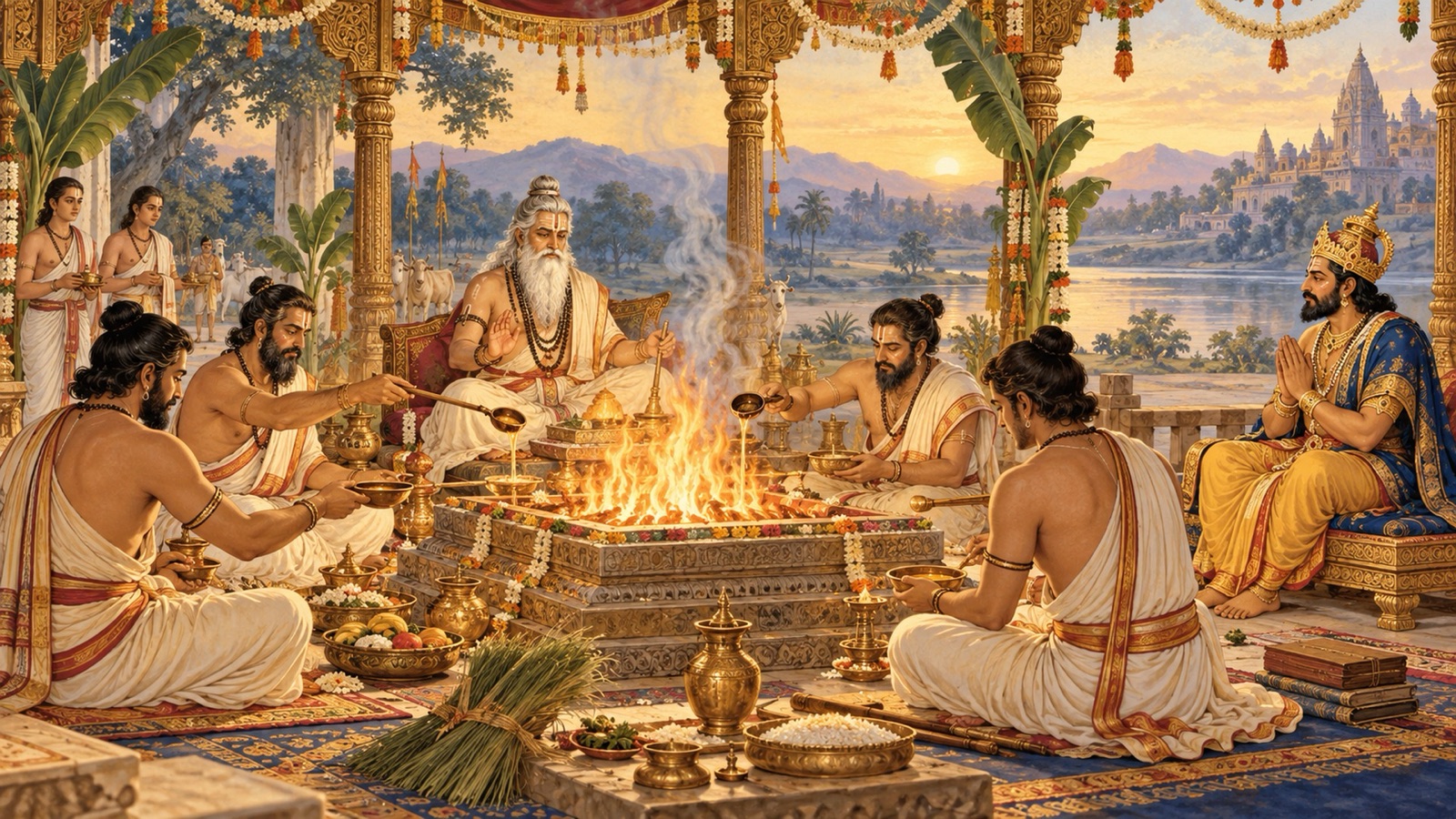
Their names are given in full in the verse below — foremost among them is Ikshvaku, through whom the Bhagavatam traces the solar dynasty’s greatest kings.
ततो मनु: श्राद्धदेव: संज्ञायामास भारत । श्रद्धायां जनयामास दश पुत्रान् स आत्मवान् ॥ ११ ॥ इक्ष्वाकुनृगशर्यातिदिष्टधृष्टकरूषकान् । नरिष्यन्तं पृषध्रं च नभगं च कविं विभु: ॥ १२ ॥
tato manuḥ śrāddhadevaḥ saṁjñāyām āsa bhārata śraddhāyāṁ janayām āsa daśa putrān sa ātmavān ikṣvāku-nṛga-śaryāti- diṣṭa-dhṛṣṭa-karūṣakān nariṣyantaṁ pṛṣadhraṁ ca nabhagaṁ ca kaviṁ vibhuḥ
Meaning: Then the self-controlled Manu Sraddhadeva begot through his wife Sraddha ten sons, O descendant of Bharata — Ikshvaku, Nrga, Saryati, Dishta, Dhrshta, Karushaka, Narishyanta, Prshadhra, Nabhaga and Kavi. (Canto 9, Chapter 1, verses 11-12)
A Daughter Instead of a Son
Before these sons were born, however, Manu had been childless, and it is here that the chapter’s central story begins. The sage Vasistha, preceptor of the solar race, undertook a sacrifice in honour of Mitra and Varuna to obtain a son for the king. But Manu’s queen, Sraddha, who was observing a vow and subsisting on milk alone, quietly approached the officiating priest and, prostrating herself, begged him instead to conduct the rite so that a daughter might be born. At the decisive moment, as the oblation was to be poured into the fire, the Hota — his mind still turning on the queen’s request — allowed that wish to shape his intention. Because of this deviation the child born was a daughter, who was named Ila.
Manu was not pleased. He turned to his preceptor and asked how men so self-controlled, so purified by austerity, whose very words never failed like a demigod’s own blessing, could have let their resolve go astray — such a reversal, he said, was a matter for real lament. Vasistha, hearing this, did not blame the Veda or the gods for any weakness; he located the fault with precision, in the priest’s own attention, which had bent for a moment toward the queen’s private request.
एतत् सङ्कल्पवैषम्यं होतुस्ते व्यभिचारत: । तथापि साधयिष्ये ते सुप्रजास्त्वं स्वतेजसा ॥ २० ॥
etat saṅkalpa-vaiṣamyaṁ hotus te vyabhicārataḥ tathāpi sādhayiṣye te suprajāstvaṁ sva-tejasā
Meaning: This unevenness in the outcome came about only through your priest’s wavering of intention; even so, by my own power I shall yet secure for you a son worthy of your line. (Canto 9, Chapter 1, verse 20)
The lesson tucked inside this small domestic drama is a large one. A Vedic rite is not a self-running machine that must yield its fruit the instant it is lit; its result still passes through the intention of the one who offers it, and beyond that, through the sanction of the Lord to whom every sacrifice ultimately belongs. Vasistha does not appeal to a formula a second time — he stakes his own austerity on setting the matter right, and, as the next verses show, turns in prayer to the very Person from whom all yajna draws its power.
Vasistha’s Prayer and the Birth of Sudyumna
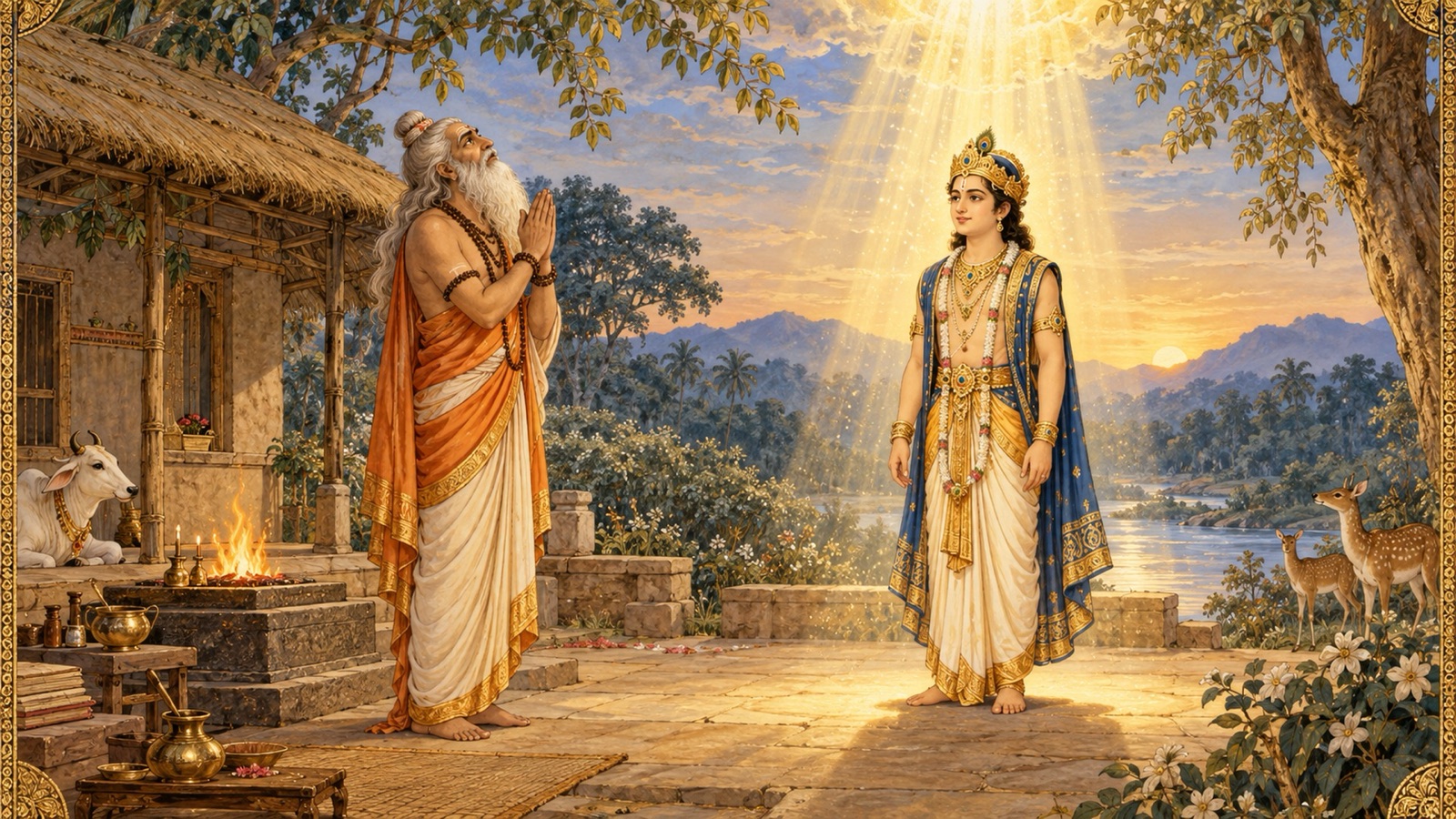
True to his word, the illustrious Vasistha extolled Lord Vishnu, the most ancient Person, praying that the child Ila might be transformed into a male. Pleased with the sage, the almighty Lord Sri Hari granted the boon — and thus Ila, daughter of Vaivaswata Manu, became Sudyumna, the foremost of men. In this quiet miracle the chapter makes its first great point: it is not ritual mechanics but the grace of the Lord, invoked through a pure devotee’s prayer, that finally shapes the outcome.
The Enchanted Forest at the Foot of Meru
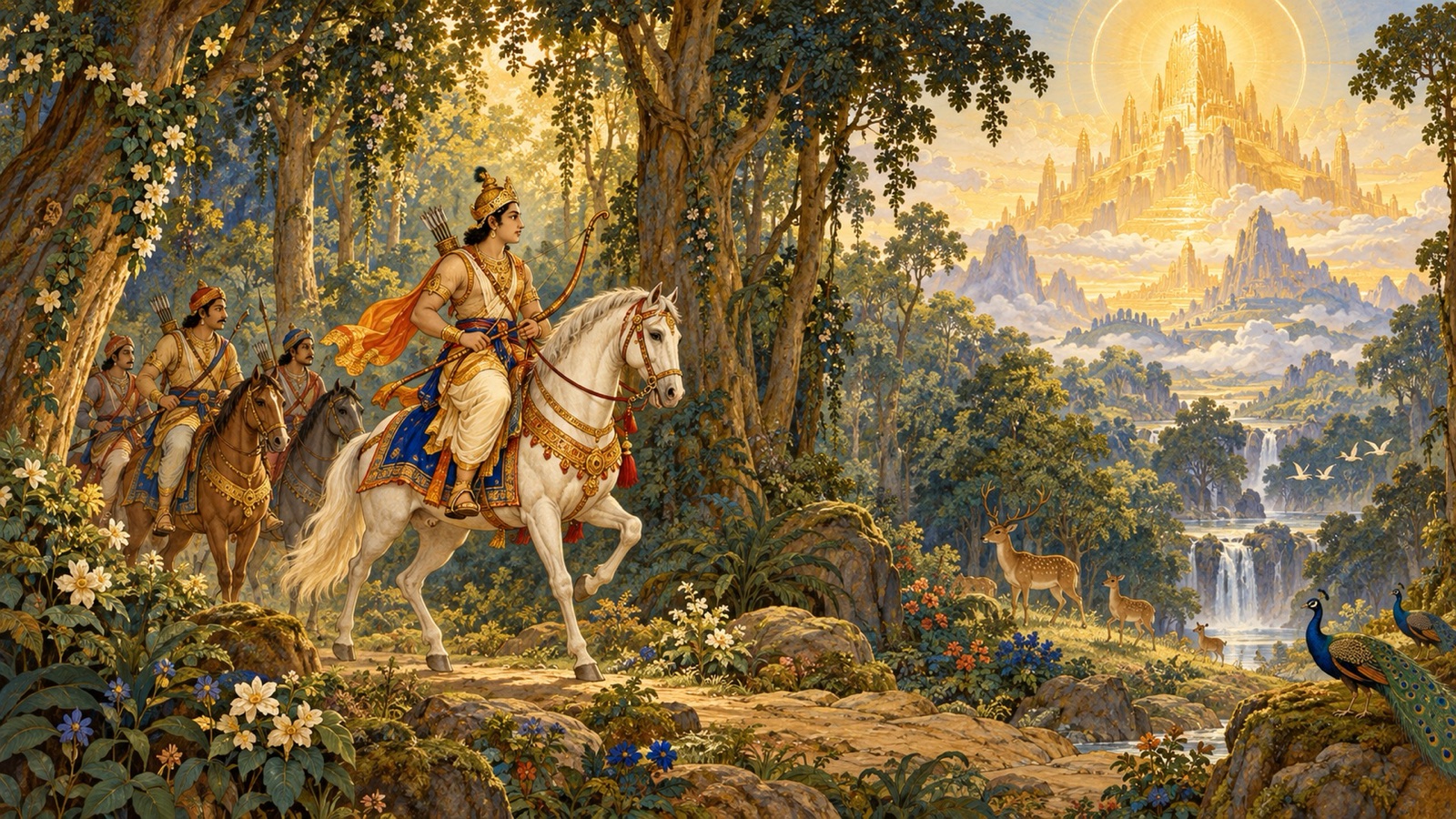
One day the young prince Sudyumna, armed with a fine bow and wonderful arrows, clad in armour and accompanied by a few followers, rode out hunting on a Saindhava horse, pressing northward through the wilds. In his pursuit of game he entered a forest at the foot of Mount Meru — the very grove where Lord Rudra was absorbed in loving sports with the Goddess Uma. The instant Sudyumna crossed into that forest, he found himself transformed into a woman, and his horse into a mare; and all his followers, likewise changed, stared at one another in dismay.
तस्मिन् प्रविष्ट एवासौ सुद्युम्न: परवीरहा । अपश्यत् स्रियमात्मानमश्वं च वडवां नृप ॥ २६ ॥
tasmin praviṣṭa evāsau sudyumnaḥ para-vīra-hā apaśyat striyam ātmānam aśvaṁ ca vaḍavāṁ nṛpa
Meaning: The moment he entered that forest, Sudyumna, the slayer of enemy heroes, beheld himself turned into a woman, and his horse into a mare, O king. (Canto 9, Chapter 1, verse 26)
Astonished, Parikshit interrupts to ask how any land could possess such a strange potency, and who had made it so. Sukadeva explains the reason. Once, sages of sacred vows had come to that grove to see Lord Siva, their splendour driving away all darkness. Goddess Parvati, taken by surprise, sprang from her Consort’s side and hastily drew on her raiment; and the sages, seeing the divine couple absorbed in their privacy, withdrew at once to the hermitage of Nara and Narayana. To spare his beloved any further disturbance, Lord Siva then declared that any male who entered that forest would thenceforth become a woman. From that day, men shunned the grove — and it was into this very forest that the unknowing Sudyumna had ridden.
Budha, Pururava, and a Kingdom Restored
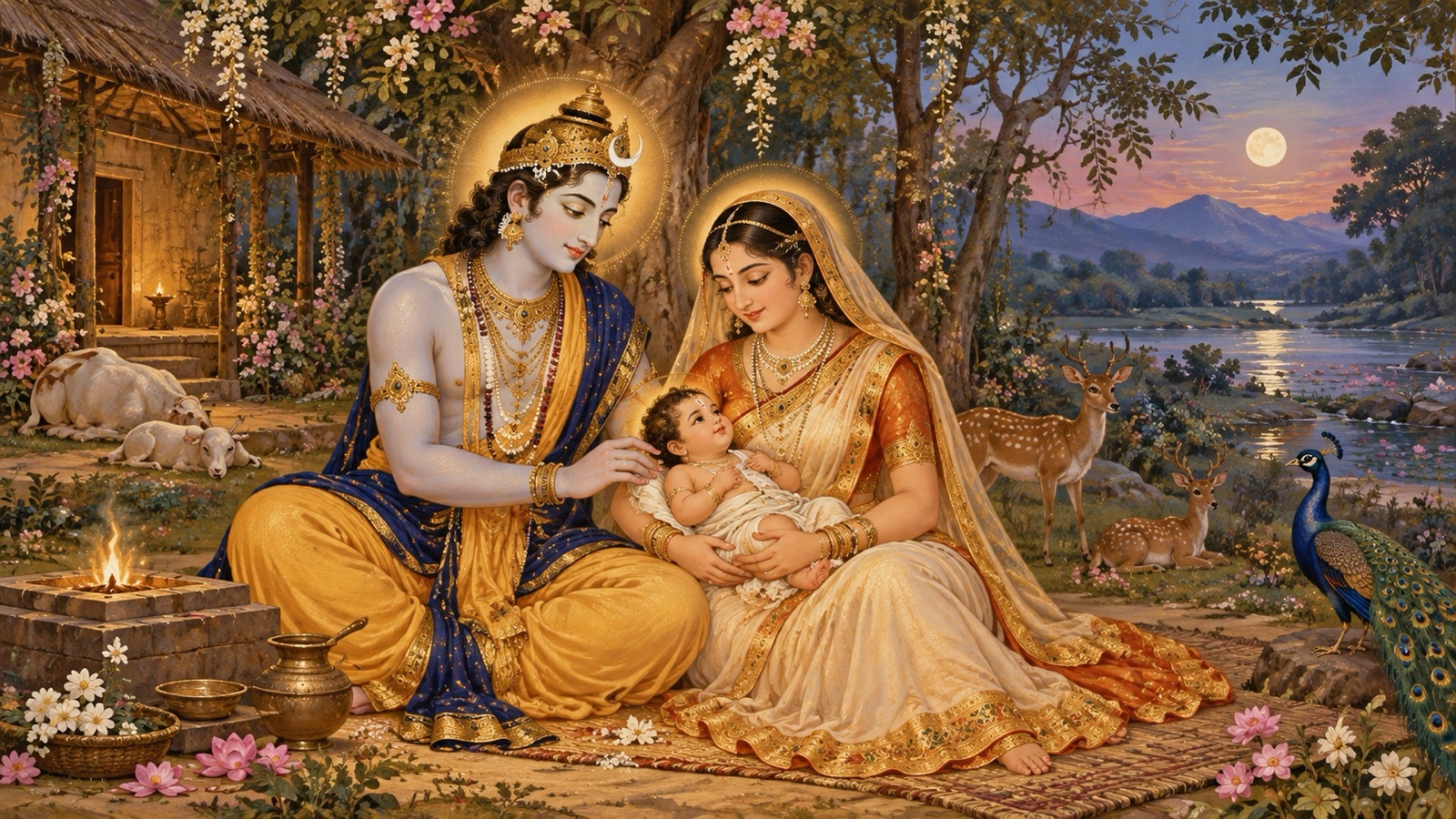
Transformed into a graceful young woman, Sudyumna wandered from grove to grove with her attendants. Near his hermitage, the god Budha — son of the moon-god, presiding over the planet we know as Mercury — beheld this lovely woman and was filled with love for her; she in turn desired him for her husband, and through their union was born a son, Pururava. Even in the midst of this altered life, the divine plan was quietly advancing: the child Pururava would become the founder of a great line.
At length Sudyumna remembered Vasistha, the preceptor of the race. Moved with compassion at the prince’s condition, the sage prayed once more to Lord Sankara for the restoration of Sudyumna’s manhood. Pleased with Vasistha, yet unwilling to make his own earlier word untrue, Siva granted a middle path.
तुष्टस्तस्मै स भगवानृषये प्रियमावहन् । स्वां च वाचमृतां कुर्वन्निदमाह विशाम्पते ॥ ३८ ॥ मासं पुमान् स भविता मासं स्री तव गोत्रज: । इत्थं व्यवस्थया कामं सुद्युम्नोऽवतु मेदिनीम् ॥ ३९ ॥
tuṣṭas tasmai sa bhagavān ṛṣaye priyam āvahan svāṁ ca vācam ṛtāṁ kurvann idam āha viśāmpate māsaṁ pumān sa bhavitā māsaṁ strī tava gotrajaḥ itthaṁ vyavasthayā kāmaṁ sudyumno ’vatu medinīm
Meaning: Pleased, and keeping His own word true, the Lord said this, O ruler of men: “Your descendant shall be a man for one month and a woman for another; under this arrangement let Sudyumna rule the earth as he pleases.” (Canto 9, Chapter 1, verses 38-39)
By his preceptor’s grace Sudyumna regained his manhood and ruled the earth, though — passing every alternate month in seclusion out of shame — the people did not fully approve of him. Three sons were born to him: Utkala, Gaya and Vimala, who became virtuous rulers of the southern region.
Sudyumna Retires to the Forest
In the fullness of time, King Sudyumna, lord of Pratishthana — the city at the confluence of the holy Ganga and Yamuna — relinquished the sovereignty of the earth to his son Pururava and withdrew to the forest, completing a life that had passed through the most extraordinary reversals with the outcome always in the Lord’s hands.
तत: परिणते काले प्रतिष्ठानपति: प्रभु: । पुरूरवस उत्सृज्य गां पुत्राय गतो वनम् ॥ ४२ ॥
tataḥ pariṇate kāle pratiṣṭhāna-patiḥ prabhuḥ purūravasa utsṛjya gāṁ putrāya gato vanam
Meaning: Then, when the due time had come, the lord of Pratishthana relinquished the earth to his son Pururava and departed for the forest. (Canto 9, Chapter 1, verse 42)
Principal Teachings of This Chapter
1. Every dynasty and every life traces back to the Lord. Sukadeva answers a question about kings by beginning with Narayana and the lotus-born Brahma — a reminder that no lineage, however proud, is self-made; all flow from the one Supreme Person (verses 8-10).
2. Grace, not mechanism, decides the outcome. The sacrifice for a son yielded a daughter through the Hota’s divided intention; it was only the Lord’s grace, invoked by Vasistha’s prayer, that finally granted the desired result (verses 13-22).
3. The devotee’s word is honoured, even when circumstances resist it. Vasistha twice intervenes — once to grant Manu a son, once to restore Sudyumna’s manhood — and each time the Lord, Vishnu and then Siva, upholds the sage’s wish (verses 20-22, 37-39).
4. Divine will works even through the strangest reversals. Sudyumna’s transformation, far from being a mere wonder, becomes the means by which Pururava — ancestor of a great line — is born (verses 34-35).
5. True kingship ends in renunciation. Like the ideal rulers of the Bhagavatam, Sudyumna finally hands his kingdom to his heir and retires to the forest, holding his sovereignty lightly to the last (verse 42).
A Devotional Reflection
There is something deeply reassuring in the way this chapter answers a simple question about ancestry. Parikshit asks about kings; Sukadeva replies by pointing first to the causal waters, to the Lord upon whom everything rests when everything else has dissolved. It is as if to say: before you count the generations, remember their source. And then the story that follows — a rite that goes “wrong,” a prince who becomes a woman, a woman who becomes a mother, a mother restored to manhood — refuses every attempt to read life as a machine that produces predictable results. At each turn, what looks like accident or misfortune turns out to be carrying the divine plan forward: the very daughter no one wanted becomes the ancestor, through Pururava, of a dynasty. For the devotee, this is not a tale of caprice but of trust. The outcomes of our own carefully laid plans are not finally in our hands; they rest with the same Lord from whose navel the lotus of all creation first unfolded.
A Daily Devotional Practice
Today, take one plan or hope of your own that has not turned out the way you intended — a disappointment, a reversal, a door that closed. Instead of replaying what went wrong, sit quietly for a few minutes and offer it up, as Vasistha offered Manu’s difficulty to the Lord. Repeat gently: “Om Namo Bhagavate Vasudevaya.” Let the chapter’s quiet lesson settle in — that the same hand which turned a childless king’s disappointment into the seed of a great dynasty is at work, unseen, in the reversals of your own life as well.
Conclusion
The first chapter of Book Nine opens the Bhagavatam’s dynastic history not with pomp but with perspective: before naming a single king, Sukadeva roots the entire line in Lord Narayana, from whose navel the lotus of creation first arose. The story of Sudyumna that follows makes the same point in miniature — a life of reversals so strange that only one thread holds them together, the quiet, constant working of the Lord’s will. It is the perfect doorway into Book Nine, teaching us to read every royal history still to come not as a record of human achievement, but as a chronicle of divine grace moving through the generations of the earth.
May the divine wisdom of Srimad Bhagavatam awaken pure devotion within our hearts.
Om Namo Bhagavate Vasudevaya.
Jay Shree Madhav.
References and Attribution
- Primary edition: Gita Press, Śrīmad Bhāgavata Mahāpurāṇa (English, complete), Book Nine, Discourse 1, pages 1–4.
- Series: Srimad Bhagavatam Wisdom · Biswa Sanatan Dharma Seva Trust.
- Presented following the spiritual guidance and recommendation of Pandit Dr. Shri Kashinath Mishra.
This is an original, faithful retelling in the writer’s own words, with brief quoted verses shown in Devanāgarī and transliteration and their meanings given as summaries. It is not a reproduction of any single publisher’s continuous translation or commentary. No affiliation with or endorsement by any publisher is implied.
Jay Shree Madhav