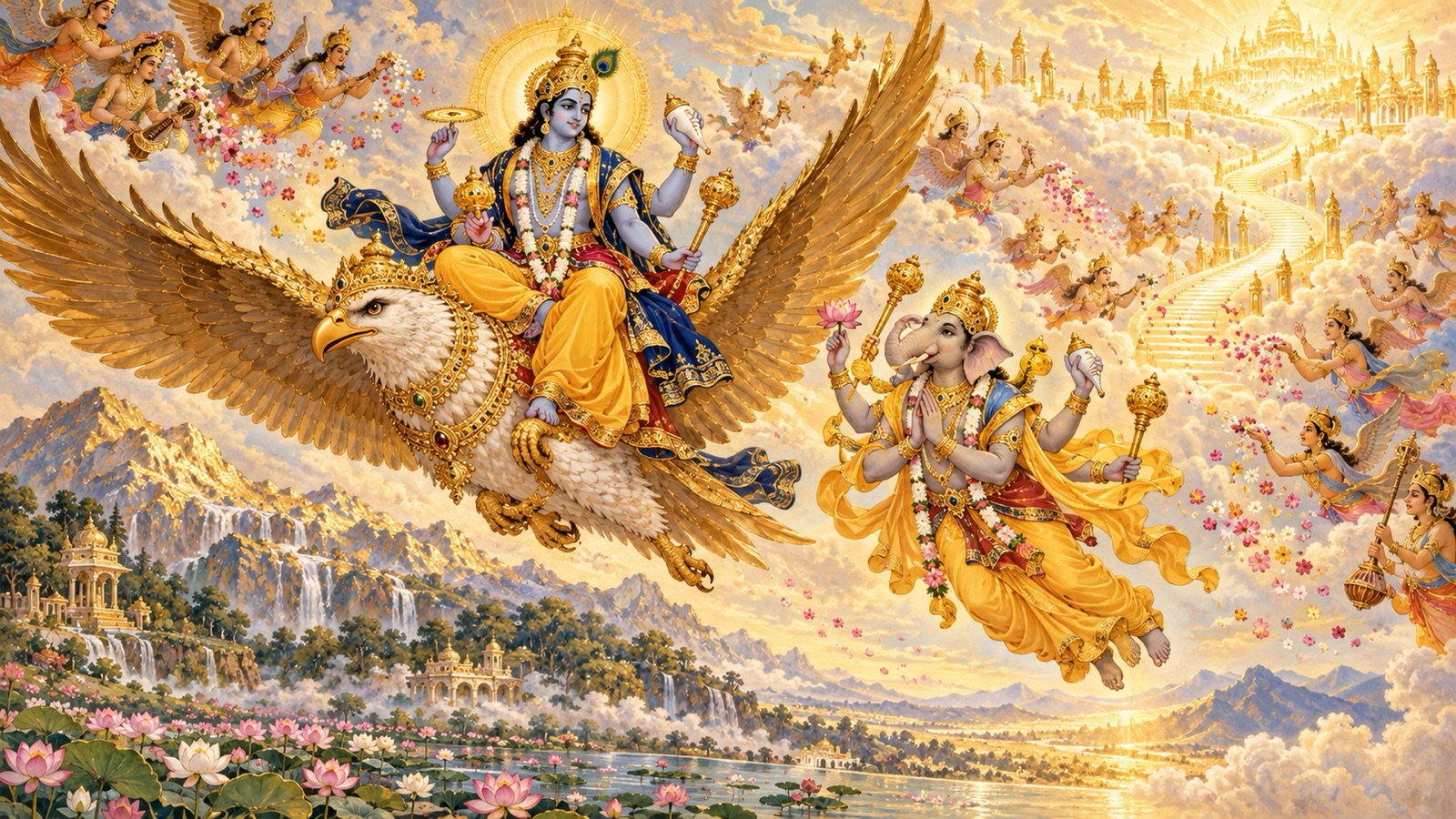
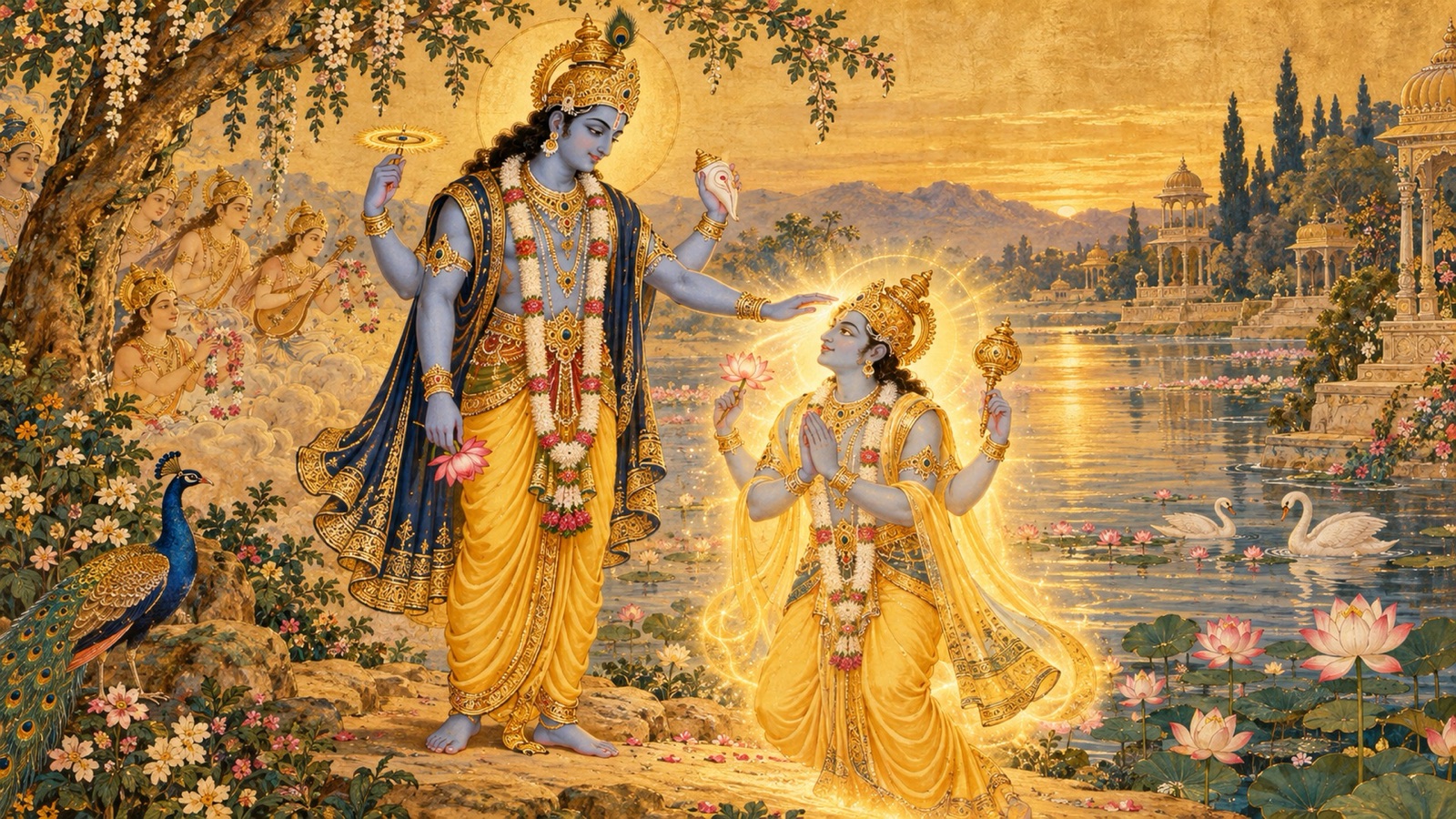
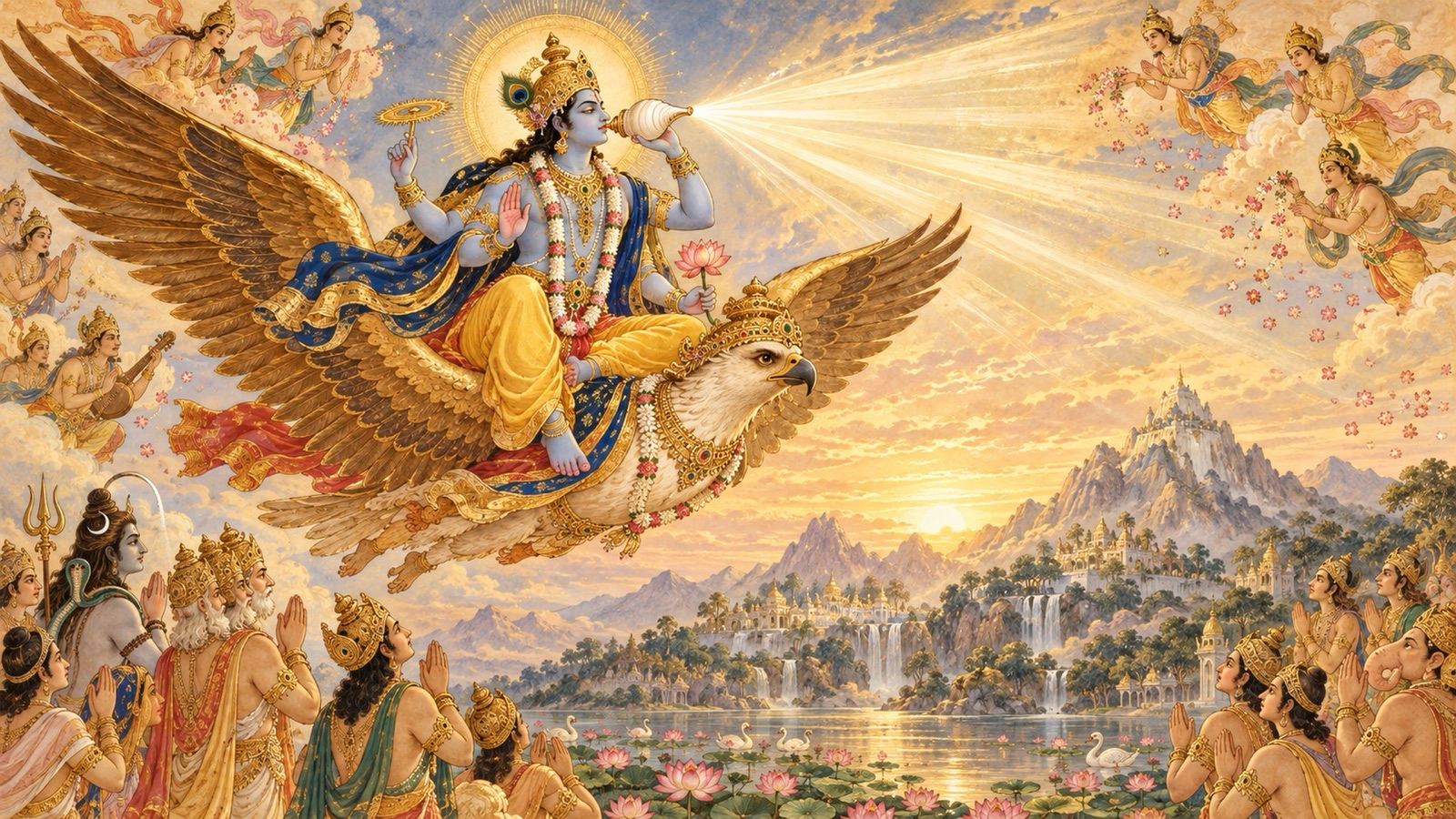
The elephant is free — and more than free. Touched by the Lord’s own hand, the great beast rises in a four-armed form of light and ascends with Him to the eternal realm, while heaven rains flowers upon them both.
Om Namo Bhagavate Vasudevaya.
Om Namo Bhagavate Vasudevaya.
Om Namo Bhagavate Vasudevaya.
Welcome back to Srimad Bhagavatam Wisdom, a devotional journey through the sacred histories and teachings of the Srimad Bhagavat Mahapurana. This fourth discourse of the Eighth Canto continues directly from Gajendra’s rescue, unveiling what lay behind the alligator’s and the elephant’s suffering and closing with the Lord’s own blessing to all who hear the tale.
Chapter Information
- Scripture: Śrīmad Bhāgavata Mahāpurāṇa
- Canto: 8 (Book Eight)
- Chapter: 4 (Discourse 4)
- Chapter title: The Deliverance of the King of Elephants
- Principal speaker: Sukadeva Gosvami, narrating to King Parikshit — with the closing blessing spoken by the Lord Himself
- Principal listener: King Parikshit
- Main setting: The lake in Varuna’s garden upon Mount Trikuta, and the Lord’s return to His eternal realm
- Central subject: The former lives of the alligator and the elephant are revealed; Gajendra is transformed and taken to the Lord’s abode; the Lord proclaims the blessings of hearing this story
- Principal verse range: Canto 8, Chapter 4, verses 1–26
- Primary edition: Gita Press Śrīmad Bhāgavata Mahāpurāṇa
Context From the Previous Chapter
In the third discourse, the trapped king of the elephants recited the immortal prayer of surrender, adoring the formless Supreme Lord and asking only for freedom from ignorance — and because he called upon the all-pervading Lord rather than any partial deity, Sri Hari Himself descended upon Garuda, drew him and the alligator from the lake, and freed him with His discus. This chapter opens where that moment left off, as heaven celebrates and the deeper story comes to light.
Heaven Celebrates, and the Alligator Is Redeemed
Sukadeva tells King Parikshit that as the deliverance was accomplished, the gods, sages, and Gandharvas, led by Brahma and Siva, rained down showers of flowers in praise of the Lord’s feat. Heavenly drums resounded, celestial musicians sang and danced, and the Siddhas and bards glorified the Supreme Person.
Then a wonder was revealed. The alligator was no ordinary creature: he had been the foremost of the Gandharvas, Huhu by name, cursed long ago by the sage Devala to take the body of an alligator. Released now from that curse by the Lord’s grace, he at once assumed a most beautiful form.
योऽसौ ग्राह: स वै सद्य: परमाश्चर्यरूपधृक् । मुक्तो देवलशापेन हूहूर्गन्धर्वसत्तम: ॥ ३ ॥
yo ’sau grāhaḥ sa vai sadyaḥ paramāścarya-rūpa-dhṛk mukto devala-śāpena hūhūr gandharva-sattamaḥ
Meaning: That which had been an alligator was in truth Huhu, the foremost of the Gandharvas, cursed by the sage Devala; released from that curse, he at once assumed a most wonderful form. (Canto 8, Chapter 4, verse 3)
Bowing his head, Huhu hymned the immortal Lord whose glories and sacred stories alone are worth celebrating. Freed of all his sins by the Lord’s favour, he circled Him in reverence, offered his salutations, and returned to his own realm while the whole assembly looked on in wonder.
Gajendra Transformed by the Lord’s Touch
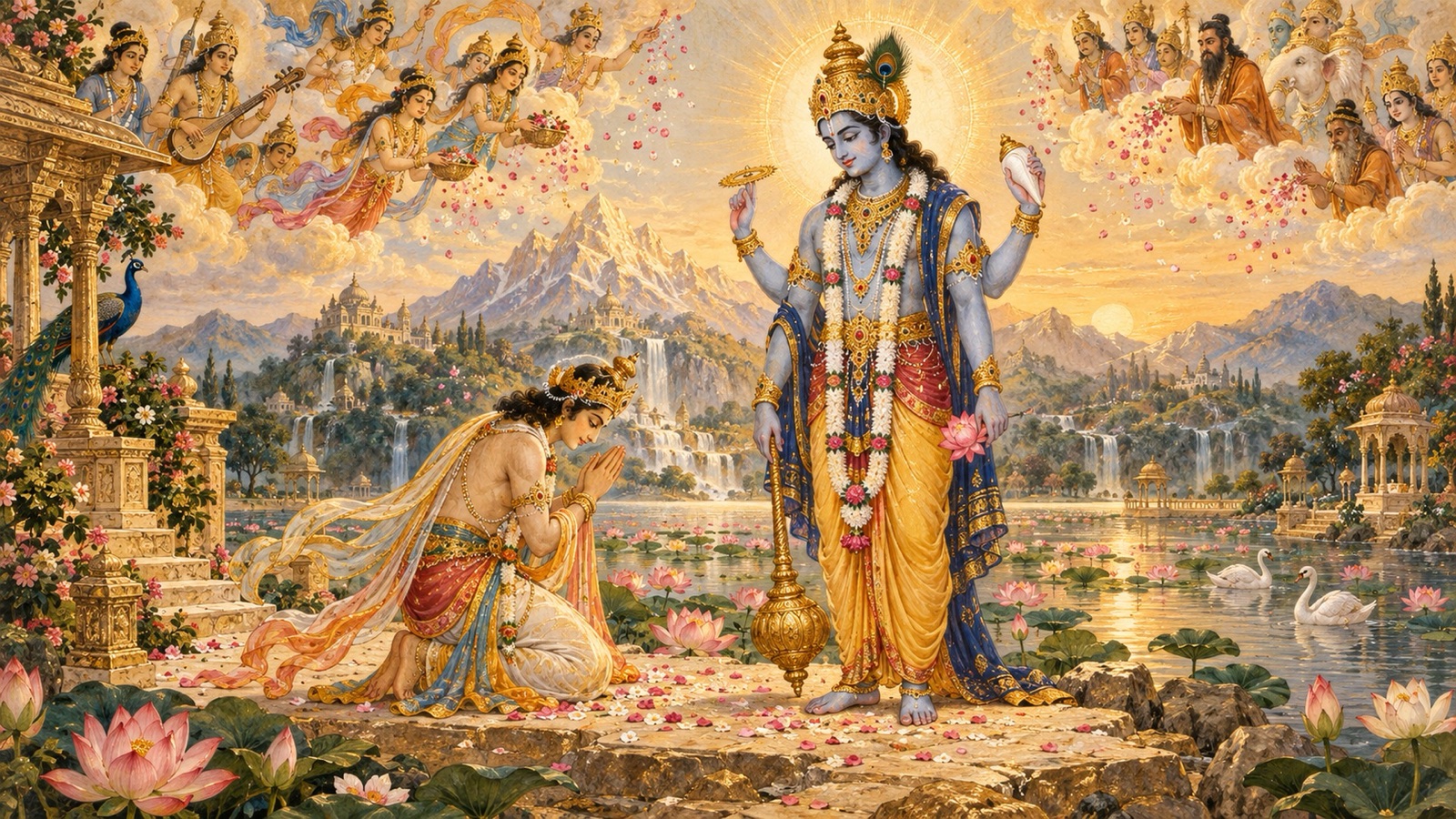
The elephant, too, was transformed. Freed by the very touch of the Lord’s hand from the bondage of ignorance, the king of the elephants attained a form resembling the Lord’s own — clad in yellow raiment and endowed with four arms.
गजेन्द्रो भगवत्स्पर्शाद् विमुक्तोऽज्ञानबन्धनात् । प्राप्तो भगवतो रूपं पीतवासाश्चतुर्भुज: ॥ ६ ॥
gajendro bhagavat-sparśād vimukto ’jñāna-bandhanāt prāpto bhagavato rūpaṁ pīta-vāsāś catur-bhujaḥ
Meaning: Freed from the bondage of ignorance by the touch of the Lord, Gajendra attained a form like the Lord’s own, clad in yellow garments and possessed of four arms. (Canto 8, Chapter 4, verse 6)
The prayer that had asked only for the lifting of ignorance was answered beyond all measure: not merely rescue from the water, but sarupya — a divine form like the Lord’s, the mark of one admitted to His eternal company.
This particular reward carries a deeper meaning. Vaishnava tradition distinguishes the devotee’s liberation from the impersonalist’s: to merge into the Lord’s undifferentiated effulgence is a dissolving without relationship, a peace that tradition warns does not always hold, since no service remains there to perform. Gajendra instead received sarupya — a form bearing the Lord’s own features, and with it permanent, personal engagement at His side as a beloved associate. The Lord could simply have released the elephant’s soul into liberation and let the matter end; instead He drew him into eternal companionship. Grace of this kind is not an exit from the world but an invitation into the Lord’s own household (verses 6, 13).
The Elephant’s Former Life as King Indradyumna
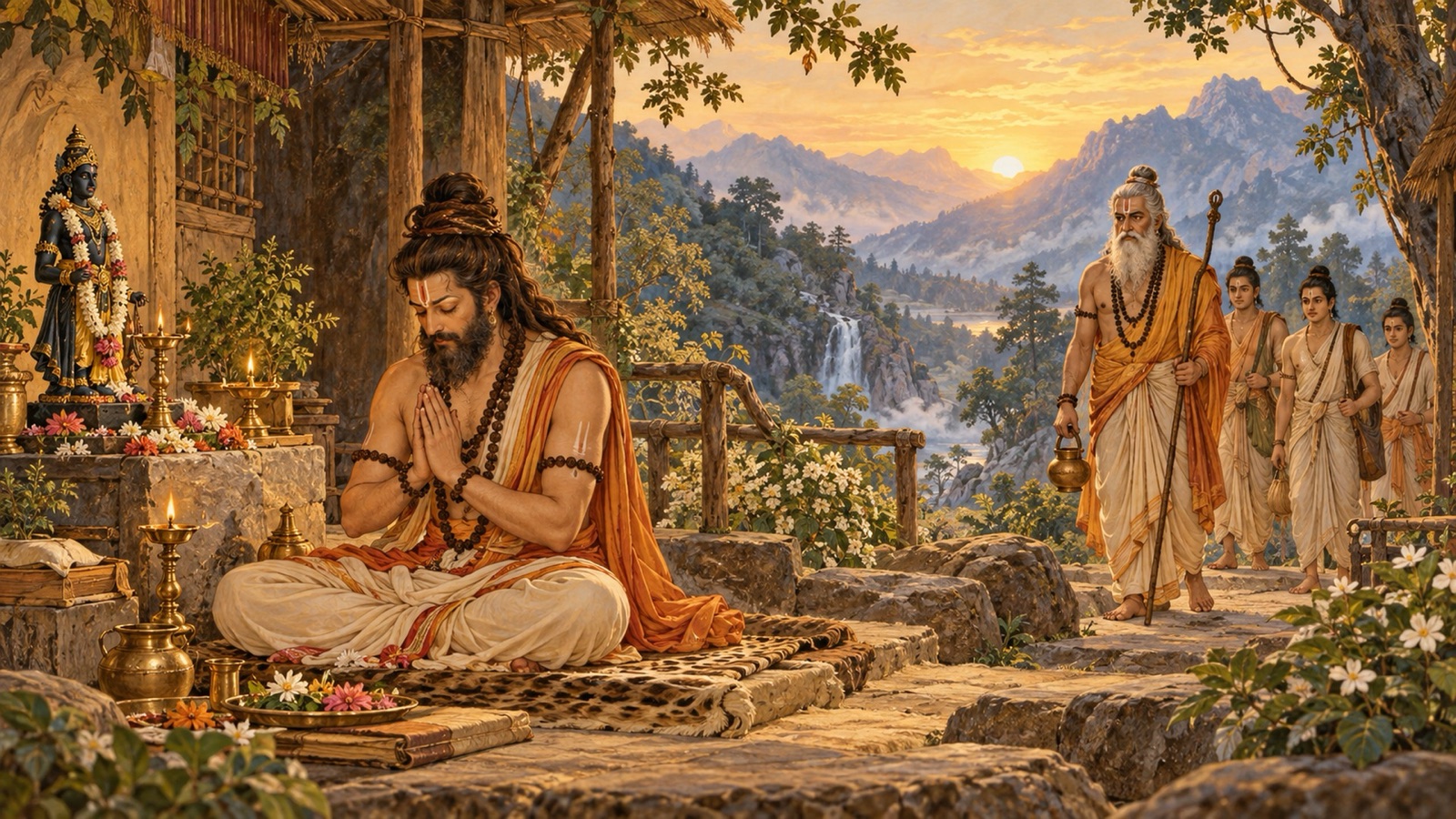
Sukadeva now unfolds the elephant’s earlier history. In a former birth he had been a Pandya king of the Dravida country, named Indradyumna, wholly devoted to the worship of Lord Vishnu.
स वै पूर्वमभूद् राजा पाण्ड्यो द्रविडसत्तम: । इन्द्रद्युम्न इति ख्यातो विष्णुव्रतपरायण: ॥ ७ ॥
sa vai pūrvam abhūd rājā pāṇḍyo draviḍa-sattamaḥ indradyumna iti khyāto viṣṇu-vrata-parāyaṇaḥ
Meaning: In his previous life he had been a king of the Pandya dynasty, the best among the people of the Dravida land, renowned as Indradyumna and devoted to the vow of worshipping Lord Vishnu. (Canto 8, Chapter 4, verse 7)
In time this king renounced his throne, became an ascetic with matted locks, took a vow of silence, and settled in a hermitage on the Kulacala mountain. One day, having bathed and begun his appointed worship of Sri Hari in seclusion, he did not notice the arrival of the great sage Agastya and his many pupils. Keeping his vow of silence and absorbed in devotion, the king failed to rise and offer the customary welcome. Taking this as an insult, the sage grew indignant and pronounced a curse: that this dull-minded man should be steeped in ignorance and, being dull like an elephant, should be born as one.
Yet even this curse became a hidden mercy. Indradyumna accepted it calmly as the play of destiny and entered the body of an elephant, which ordinarily obliterates all memory of the self — but because of his lifelong worship of Sri Hari, the remembrance of God awakened within him at the crucial moment, even in the body of a beast. So it was that the prayer of a former life rose to his lips in the alligator’s grip, and the curse itself carried him at last into the arms of the Lord.
The Lord’s Return and His Blessing to All Beings
Having thus liberated the king of the elephants once and for all — and accompanied now by that very elephant, transformed into a divine attendant — the Lord Sri Hari, from whose navel the lotus of creation springs, took His seat upon Garuda and withdrew to His transcendent realm of Vaikuntha, His feat celebrated by Gandharvas, Siddhas, and gods.
Sukadeva then tells Parikshit that this account of the deliverance of the king of the elephants is itself sanctifying: it leads to heaven, spreads good renown, washes away the impurities of the age of Kali, and frees those who hear it from bad dreams. The wise recite it in the early morning for their welfare. And before departing, the all-pervading Lord, full of joy, spoke a blessing in the hearing of all beings present. Those who rise in the last watch of the night, in the sacred hour before dawn, and remember Him — together with Gajendra, this lake and mountain, His realm and His companions, His discus and conch and carrier, His descents as the Fish, Tortoise, and Boar, and all His glorious manifestations — are freed from all sin. And to those who praise Him at that hour with this very hymn, He grants a priceless gift.
ये मां स्तुवन्त्यनेनाङ्ग प्रतिबुध्य निशात्यये । तेषां प्राणात्यये चाहं ददामि विपुलां गतिम् ॥ २५ ॥
ye māṁ stuvanty anenāṅga pratibudhya niśātyaye teṣāṁ prāṇātyaye cāhaṁ dadāmi vipulāṁ gatim
Meaning: O dear one, to those who wake at the close of night and praise Me with this hymn, I grant, at the moment when life departs, the supreme destination. (Canto 8, Chapter 4, verse 25)
Having spoken thus, the Lord blew His conch Panchajanya, delighting the host of gods, and mounted Garuda once more.
Principal Teachings of This Chapter
1. The Lord’s grace exceeds every request. Gajendra prayed only for freedom from ignorance; he received a divine form like the Lord’s and a place in His eternal company. God gives not according to our asking but according to His boundless love (verse 6).
2. A curse in the Lord’s hands becomes a blessing. Both the alligator and the elephant were bound by curses, yet both were carried through them to liberation. Nothing, not even apparent misfortune, is outside the reach of divine mercy (verses 3, 11-12).
3. Devotion preserves the soul through every birth. Even in the memory-erasing body of a beast, Indradyumna’s lifelong worship of Vishnu awakened God-remembrance at the decisive moment. Sincere devotion is never lost (verses 7, 12).
4. Hearing sacred stories purifies the heart. The Lord Himself declares that this account wipes away the impurities of Kali and blesses those who hear and recite it. The narratives of the Bhagavata are themselves a means of grace (verses 14-15).
5. Remembrance at the hour of death is the highest gift. The Lord’s promise is not merely worldly relief but unclouded remembrance of Him when life departs — the very fruit that Gajendra’s whole ordeal was leading toward (verse 25).
A Devotional Reflection
This chapter quietly answers a question the previous one may have left in our hearts: what became of the elephant after he was saved? The answer is far greater than survival. Gajendra is not simply returned to his herd and his forest; he is lifted into a form like the Lord’s and taken home. And the story pulls back the curtain to show us that the whole drama — the curse, the birth as a beast, the alligator, the thousand-year struggle — was, from a higher vantage, a single act of rescue long in the making. The sage’s angry curse, the crocodile’s cruel grip, the elephant’s helpless suffering: each was a thread the Lord was weaving toward deliverance. We rarely see this pattern in our own lives while we are inside it. But the story of Gajendra invites us to trust that the same hand is at work in us, and that the devotion we offer now, however imperfect, is being safely kept for the hour when we will need it most.
A Daily Devotional Practice
Following the Lord’s own instruction in this chapter, try rising a little earlier than usual, in the quiet hour before dawn, and begin your day by remembering the Lord and His deliverance of Gajendra. Even a few minutes of grateful remembrance, sealed with the words “Om Namo Bhagavate Vasudevaya,” aligns your heart with the Lord’s promise — that those who remember Him at that sacred hour will remember Him at the last.
Conclusion
The fourth discourse of the Eighth Canto closes the story of Gajendra not merely with rescue but with communion: a devotee’s lifelong worship, carried even through a curse and a beast’s body, is received by the Lord as though it had never lapsed, and rewarded with His own form and company. This is the chapter’s quiet promise — that the grace which freed Gajendra from the alligator’s grip is the same grace that will meet each of us at the hour our own struggle ends, if only our remembrance of Him has not ceased. In the next chapter, Sukadeva resumes the account of the Manvantaras with the age of the Manu Raivata.
May the divine wisdom of Srimad Bhagavatam awaken pure devotion within our hearts.
Om Namo Bhagavate Vasudevaya.
Jay Shree Madhav.
References and Attribution
- Primary edition: Gita Press, Śrīmad Bhāgavata Mahāpurāṇa (English, complete), Book Eight, Discourse 4, pages 749–751.
- Series: Srimad Bhagavatam Wisdom · Biswa Sanatan Dharma Seva Trust.
- Presented following the spiritual guidance and recommendation of Pandit Dr. Shri Kashinath Mishra.
This is an original, faithful retelling in the writer’s own words, with brief quoted verses shown in Devanāgarī and transliteration and their meanings given as summaries. It is not a reproduction of any single publisher’s continuous translation or commentary. No affiliation with or endorsement by any publisher is implied.
Jay Shree Madhav