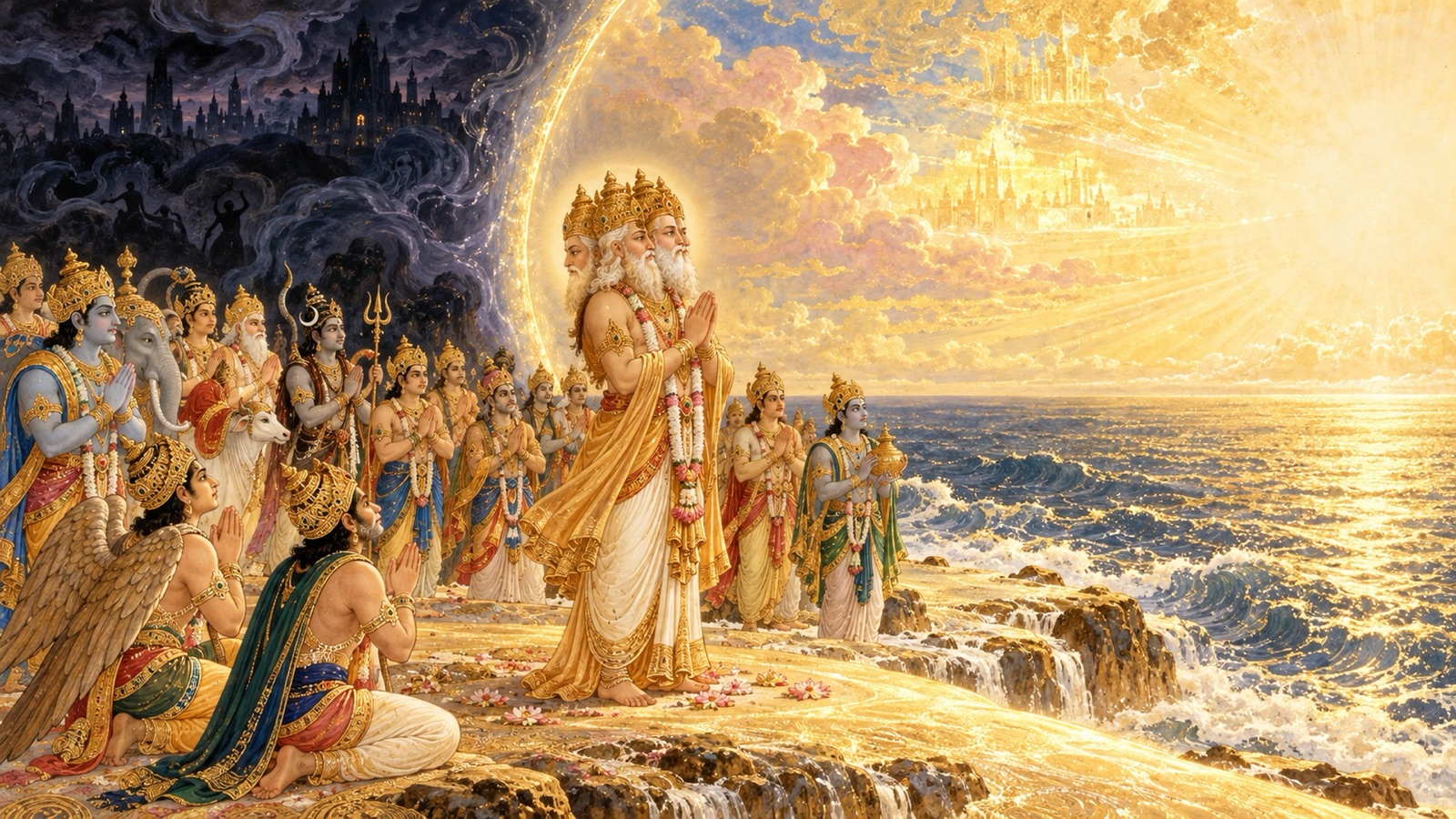
Their splendour stolen by a curse and their strength broken in battle, the gods follow Brahma to a shore beyond the darkness of illusion — and there the creator himself lifts a hymn to the Lord he has never seen but has always known.
Om Namo Bhagavate Vasudevaya.
Om Namo Bhagavate Vasudevaya.
Om Namo Bhagavate Vasudevaya.
Welcome back to Srimad Bhagavatam Wisdom, a devotional journey through the sacred histories and teachings of the Srimad Bhagavat Mahapurana. Having completed the beloved story of Gajendra, Sukadeva Gosvami now resumes his account of the cosmic ages and sets the stage for one of the grandest episodes in all of scripture — the churning of the Ocean of Milk. This fifth chapter of the Eighth Canto tells how the gods, stripped of their power by a sage’s curse and overwhelmed by the demons in battle, turned first to Brahma and then, guided by him, to the Supreme Lord Himself. Its heart is the majestic hymn that Brahma offers on the shore of the great ocean — a prayer to the Lord who dwells beyond all darkness, whom even the creator can approach only by faith.
Chapter Information
- Scripture: Śrīmad Bhāgavata Mahāpurāṇa
- Canto: 8 (Book Eight)
- Chapter: 5 (Discourse 5)
- Chapter title: The Gods Appeal to the Lord Through Brahma
- Principal speaker: Sukadeva Gosvami, narrating to King Parikshit — with Brahma’s hymn spoken by Brahma
- Principal listener: King Parikshit
- Main setting: The court of Brahma on Mount Meru, and the transcendent shore beyond the darkness of illusion
- Central subject: The Manvantaras of Raivata and Cakshusa are described; the gods, ruined by Durvasa’s curse and defeated by the demons, take refuge in Brahma, who leads them to the Lord and offers a great hymn of praise
- Principal verse range: Canto 8, Chapter 5, verses 1–50
- Primary edition: Gita Press Śrīmad Bhāgavata Mahāpurāṇa
Context From the Previous Chapter
In the fourth discourse, the Lord completed the deliverance of Gajendra, revealed the former lives of the elephant and the alligator, and ascended to His eternal realm, promising blessings to all who hear the story. Having narrated that sanctifying account, Sukadeva now turns back to the great framework of the Manvantaras, describing the fifth and sixth Manus and, within the age of the sixth, the Lord’s descent as Ajita — the descent through which the Ocean of Milk would be churned. This leads directly into King Parikshit’s eager request to hear that very story.
The Ages of Raivata and Cakshusa
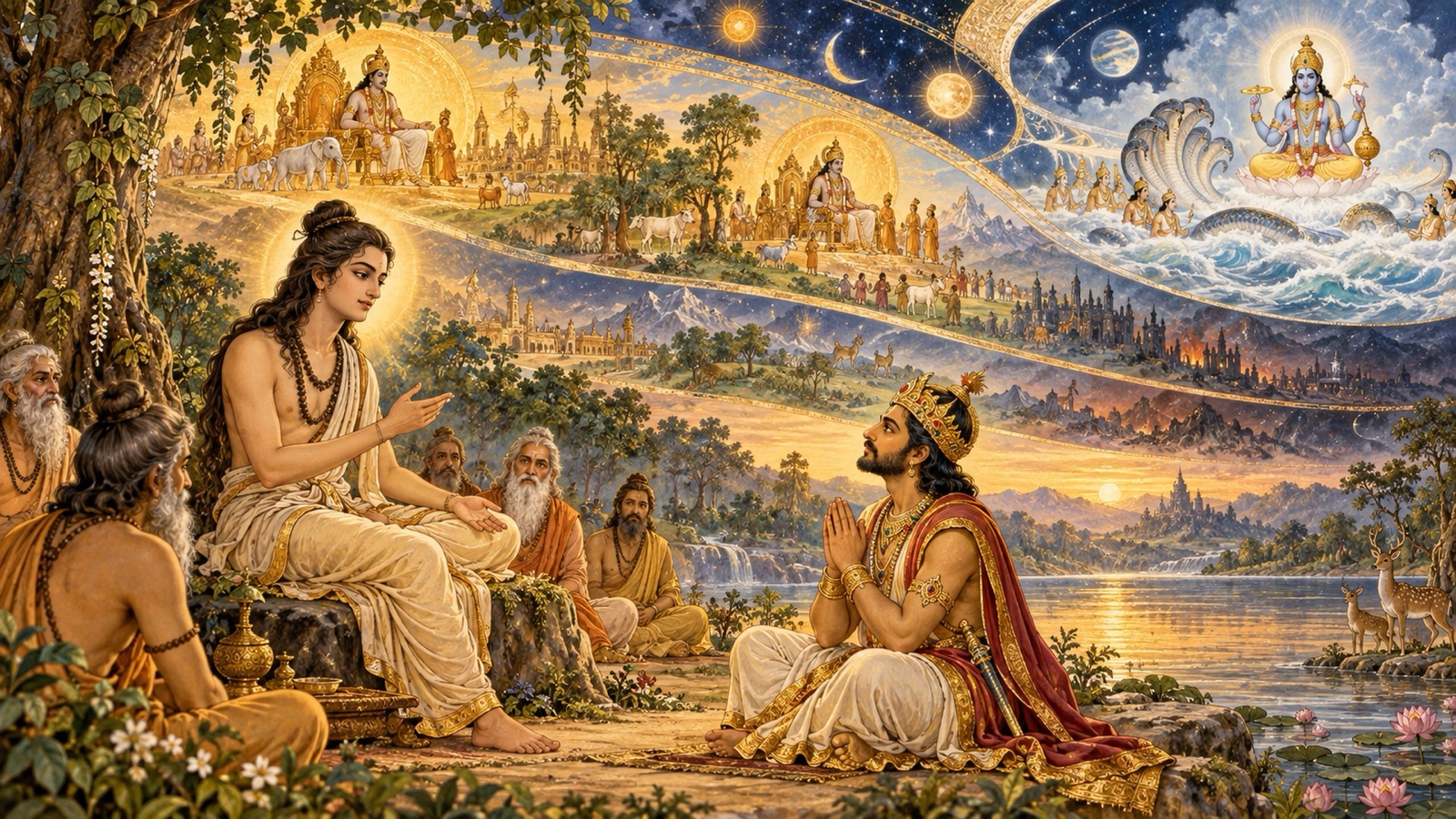
Sukadeva continues the account of the Manvantaras. The fifth Manu was Raivata, a brother of the fourth Manu, Tamasa. In his age Vibhu was the Indra, the Bhutarayas and others were the gods, and Hiranyaroma, Vedasira, Urdhvabahu, and others were the seven seers. In this period the Lord Himself appeared in a partial descent as Vaikuntha, born of the sage Subhra and his wife Vikuntha, and — at the request of the goddess Lakshmi and to please Her — brought into being the divine realm of Vaikuntha, adored by all the worlds.
The sixth Manu was Cakshusa, son of Caksu, whose sons were Puru, Purusa, Sudyumna, and others. Mantradruma was the Indra of that age, the Apyas were the gods, and Havisman, Viraka, and others were the seers. In this Manvantara the Protector of the universe appeared as Ajita, the son of Vairaja through his wife Sambhuti — and it was Ajita who made nectar available to the gods by churning the Ocean of Milk, and who, in the form of the divine Tortoise, upheld Mount Mandara as it revolved in the waters.
Parikshit’s Eager Question
At the mention of the churning of the ocean, King Parikshit’s heart is stirred. He asks Sukadeva to describe that most marvellous feat in full: how and why the Ocean of Milk was churned, how the Lord as the Tortoise supported Mount Mandara, how the gods obtained nectar, and what else came forth on that occasion. His mind, long afflicted by the sorrows of the world, cannot be satisfied with hearing the glories of the Lord — the more he hears, the more he longs to hear. Welcoming this inquiry, the omniscient Sukadeva begins to relate the great story.
The Gods Lose Their Splendour
Sukadeva sets the scene with a season of disaster. In a fierce battle the gods were struck down in great numbers by the sharp weapons of the demons and did not rise again.
श्रीशुक उवाच यदा युद्धेऽसुरैर्देवा बध्यमाना: शितायुधै: । गतासवो निपतिता नोत्तिष्ठेरन्स्म भूरिश: ॥ १५ ॥
śrī-śuka uvāca yadā yuddhe ’surair devā badhyamānāḥ śitāyudhaiḥ gatāsavo nipatitā nottiṣṭheran sma bhūriśaḥ
Meaning: Sukadeva said: When, struck by the sharp weapons of the demons in battle, the gods fell lifeless in great numbers and did not rise again… (Canto 8, Chapter 5, verse 15)
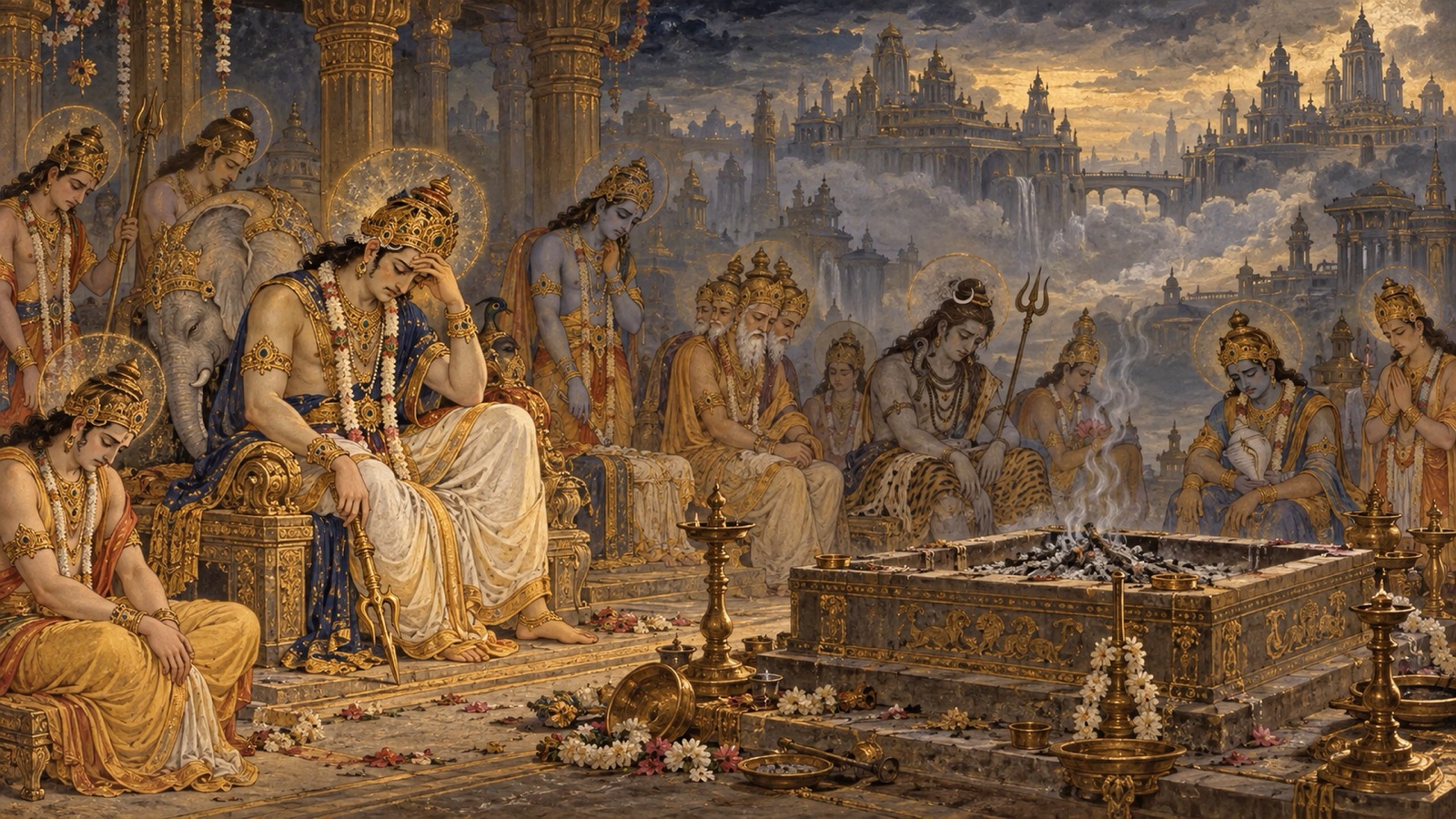
Behind this defeat lay a deeper cause. Because of a curse pronounced by the sage Durvasa — angered when Indra, in his pride, had slighted a garland the sage had given him — the three worlds together with Indra had been divested of their splendour, and all sacrifices and sacred rites had fallen away. Deprived of the strength that piety brings, heaven itself grew poor while the demons flourished.
The Gods Take Refuge in Brahma
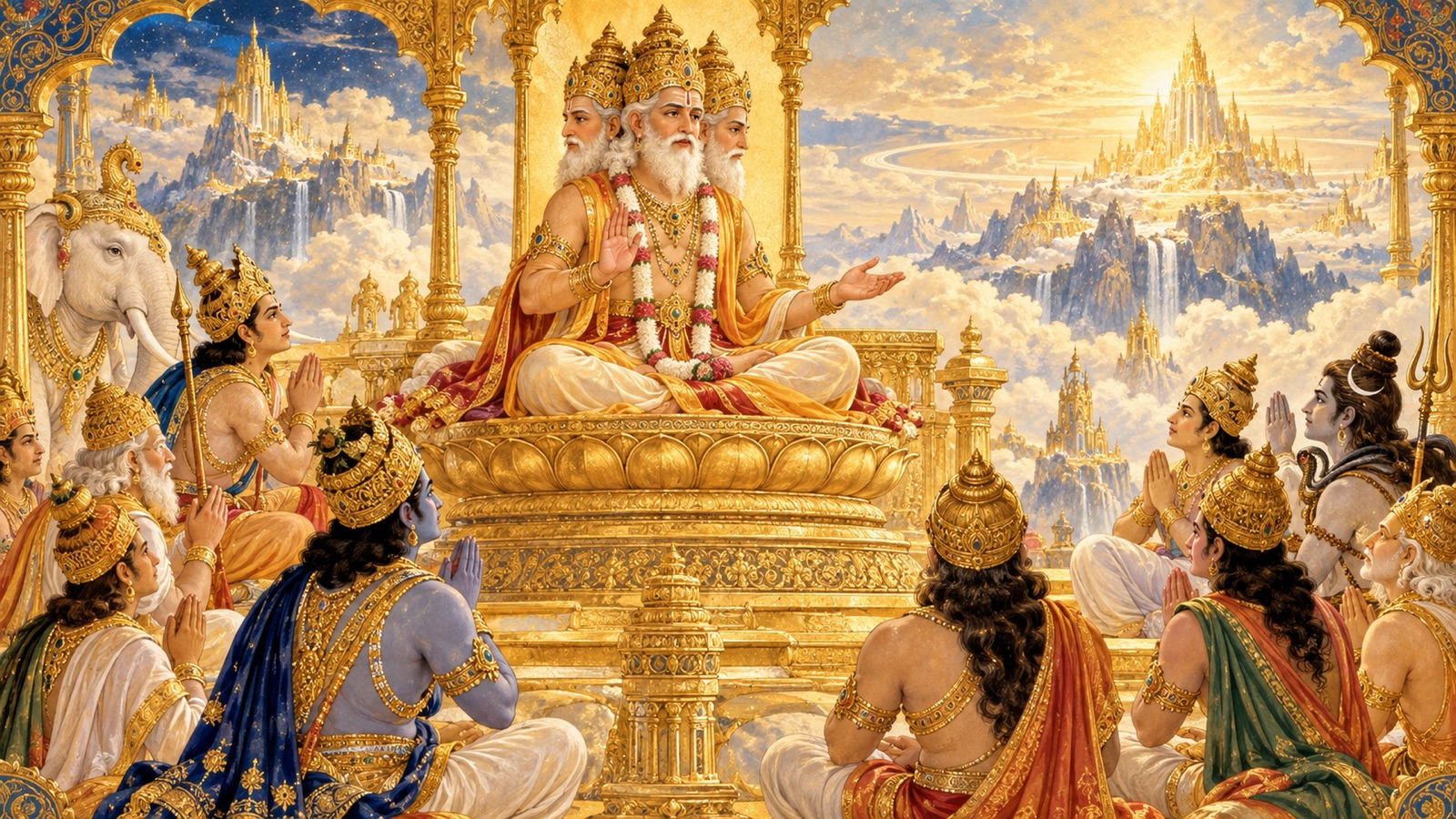
Seeing their plight, Indra, Varuna, and the other gods deliberated among themselves but could reach no conclusion. At last they all went to the court of Brahma on the summit of Mount Meru and humbly laid the whole matter before the creator. Beholding the gods drained of strength and splendour, the worlds robbed of auspiciousness, and the demons flourishing, Brahma fixed his mind in deep contemplation upon the Supreme Person, and then, with a cheerful countenance, addressed the gods with words of hope.
He reminded them that no being is independent of the Lord. Siva, Brahma himself, the gods, the demons, human beings, animals, plants, and the smallest creatures — all have come forth from the Supreme, whether from His first manifestation as the cosmic Being, or from Brahma who is His fraction, or from Brahma’s own agents of creation.
अहं भवो यूयमथोऽसुरादयो मनुष्यतिर्यग्द्रुमघर्मजातय: । यस्यावतारांशकलाविसर्जिता व्रजाम सर्वे शरणं तमव्ययम् ॥ २१ ॥
ahaṁ bhavo yūyam atho ’surādayo manuṣya-tiryag-druma-gharma-jātayaḥ yasyāvatārāṁśa-kalā-visarjitā vrajāma sarve śaraṇaṁ tam avyayam
Meaning: I, Siva, all of you, and the demons too, along with human beings, animals, plants, and creatures born of moisture, have been sent forth by His descents, His parts, and the portions of His parts. Let us all, therefore, take refuge in that imperishable Lord. (Canto 8, Chapter 5, verse 21)
The Lord, Brahma explained, has no one to kill and no one to protect out of partiality, no side to favour and none to neglect; yet for the creation, maintenance, and dissolution of the universe He assumes in turn the qualities of passion, goodness, and ignorance. And the present, Brahma said, is the very time when the Lord embraces the quality of goodness for the welfare of all embodied beings. He is the well-wisher of the gods, His own people — let us therefore seek shelter in Him, the preceptor of the universe.
Brahma’s Hymn on the Shore Beyond Darkness
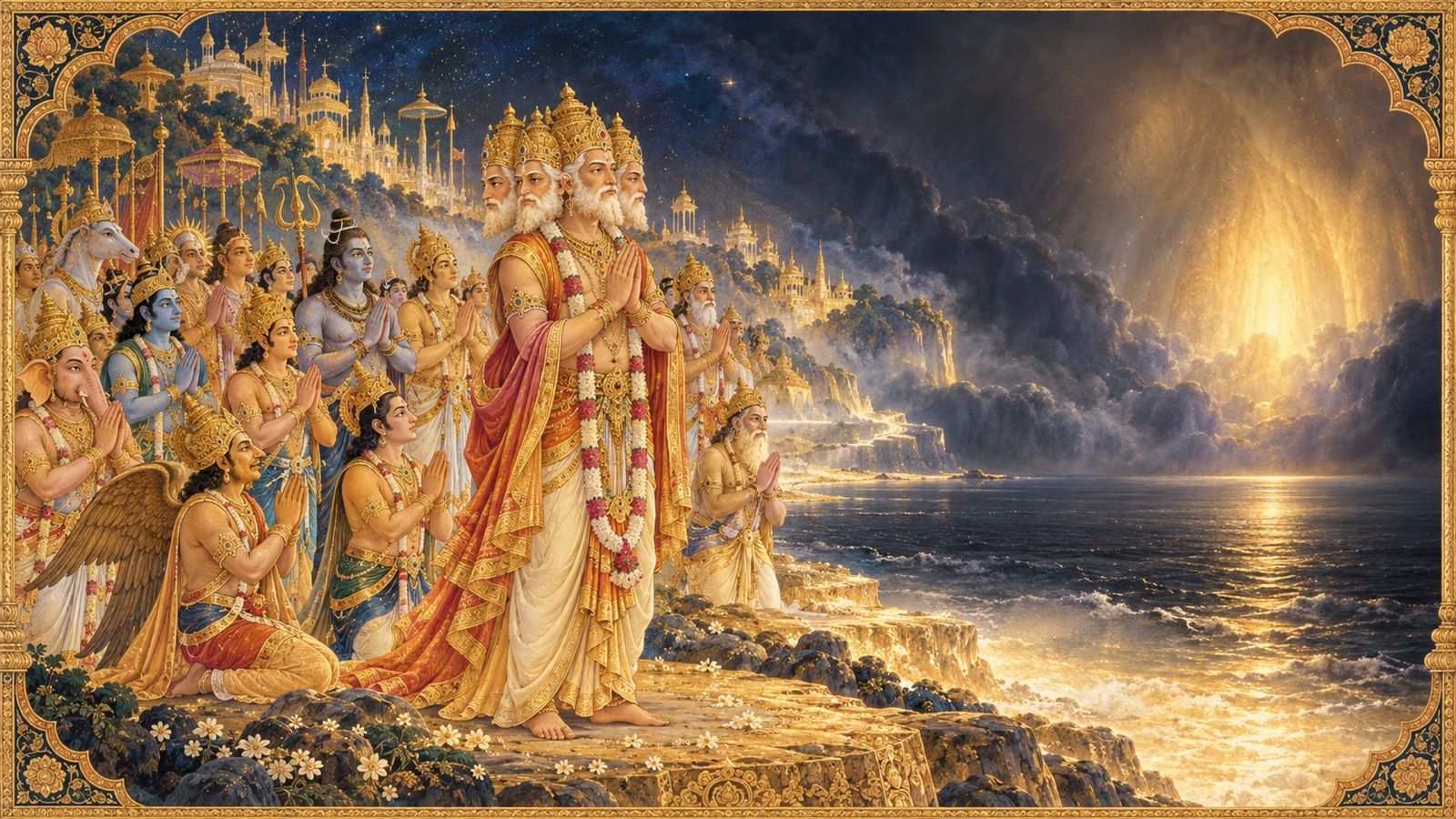
Having thus encouraged the gods, Brahma led them to the abode of Lord Ajita, which lies beyond the darkness of illusion. There, with a fully collected mind, Brahma offered a magnificent hymn in the sacred language of the Vedas, seeking to propitiate the Lord — the Lord whose true nature he had not directly perceived, but of whom he had long heard from the Vedic scriptures themselves (verse 25).
Brahma opens his prayer by naming the Lord as pure, changeless truth — not a form to be pointed to, but the ground of being itself, seated in the heart of every creature and beyond the reach of both reasoning and speech.
श्रीब्रह्मोवाच अविक्रियं सत्यमनन्तमाद्यं गुहाशयं निष्कलमप्रतर्क्यम् । मनोऽग्रयानं वचसानिरुक्तं नमामहे देववरं वरेण्यम् ॥ २६ ॥
śrī-brahmovāca avikriyaṁ satyam anantam ādyaṁ guhā-śayaṁ niṣkalam apratarkyam mano-‘grayānaṁ vacasāniruktaṁ namāmahe deva-varaṁ vareṇyam
Meaning: Lord Brahma began: We bow to You, the changeless and beginningless Truth, dwelling within the heart of every creature, free of all material attributes, unreachable by reasoning, outrunning even the mind, and defeated by every word that tries to describe You — most worshipable among all who are worshiped. (Canto 8, Chapter 5, verse 26)
As the hymn continues, Brahma describes this same Lord as the silent hub of the wheel of birth and death, the source of the elements, the sun and moon, and the orders of human society, and the witness who governs the three modes of nature while remaining untouched by them (verses 27-44). Yet, having praised this vast and formless truth, Brahma does not stop at abstraction.
Here the hymn turns to its most telling moment. Having called the Lord unreachable by mind and speech, Brahma does not conclude that such a Being is to be merely contemplated from afar — surrendered as he is, he confesses that he still longs to see.
स त्वं नो दर्शयात्मानमस्मत्करणगोचरम् । प्रपन्नानां दिदृक्षूणां सस्मितं ते मुखाम्बुजम् ॥ ४५ ॥
sa tvaṁ no darśayātmānam asmat-karaṇa-gocaram prapannānāṁ didṛkṣūṇāṁ sasmitaṁ te mukhāmbujam
Meaning: O Lord, we are surrendered unto You, and yet we still yearn to see: show us that same smiling lotus face, made visible to our eyes and our other senses, for we, though surrendered, still long to behold You. (Canto 8, Chapter 5, verse 45)
Brahma adds that it is by His own sweet will that the Lord assumes such forms, age after age, doing what none but He could do (verse 46). This is the quiet turning point of the whole hymn: the impersonal language of the opening prayer — the changeless truth beyond mind and word — is not devotion’s destination but its starting point. Real knowledge of the Absolute, in Brahma’s own experience, opens into longing for the Lord’s personal, smiling face; wisdom about God is not enough even for the creator of the universe — only the sight of God will satisfy him. It is this very longing that the Lord will soon answer, descending as Ajita to churn the Ocean of Milk (verses 45-46).
Near its close, Brahma gives a teaching that has become a cornerstone of devotional life — that to worship the Lord is to nourish all things at once, just as watering a tree’s root sustains its every branch and leaf.
यथा हि स्कन्धशाखानां तरोर्मूलावसेचनम् । एवमाराधनं विष्णो: सर्वेषामात्मनश्च हि ॥ ४९ ॥
yathā hi skandha-śākhānāṁ taror mūlāvasecanam evam ārādhanaṁ viṣṇoḥ sarveṣām ātmanaś ca hi
Meaning: Just as watering the root of a tree nourishes its trunk and branches, so the worship of Lord Vishnu is the nourishing of all beings and of one’s own self as well. (Canto 8, Chapter 5, verse 49)
Brahma reminds the gods that action offered to the Lord is never wasted, however small; for the Lord, being the very Self of the soul, is its beloved friend, and nothing entrusted to a beloved friend is ever lost. The chapter closes with Brahma’s salutation to the infinite Lord whose ways are hard to fathom — who transcends the modes of nature and yet, for the world’s protection, is now established in goodness (verse 50). With this prayer offered and the Lord’s help sought, the stage is set for His appearance and for the great churning to come.
Principal Teachings of This Chapter
1. Pride invites downfall. The gods lost heaven itself because Indra, in his pride, slighted a saint’s gift. Even the exalted are not safe from the consequences of arrogance (verse 16).
2. All beings depend upon the one Lord. Brahma teaches that gods, demons, humans, animals, and plants alike have come forth from the Supreme. Recognizing our common source in God dissolves both pride and despair (verse 21).
3. When our own counsel fails, take refuge in the Lord. The gods deliberated and found no answer; only when they turned, through Brahma, to the Supreme did the way open. Surrender begins where self-sufficiency ends (verses 17-23).
4. To worship the Lord is to serve all. Like watering the root of a tree, devotion to Vishnu nourishes every being and oneself as well. There is no more complete service than the service of God (verse 49).
5. Nothing offered to the Lord is ever lost. Even a small act resigned to God bears lasting fruit, because the Lord is the soul’s own beloved friend. Devotion is the one investment that can never fail (verses 47-48).
6. Knowledge of God matures into longing to see God. After naming the Lord the changeless truth beyond mind and speech, Brahma’s own prayer turns to a personal plea to behold His smiling face — devotion does not end in abstraction but in relationship (verses 26, 45).
A Devotional Reflection
There is deep comfort in the picture of Brahma, the creator of the universe, standing on the shore of the great ocean and praying to a Lord he cannot see. If even Brahma approaches the Supreme not by sight but by faith and hearing, then our own unseeing prayers are in the very best of company. This chapter also quietly corrects a common instinct. When trouble comes, we usually respond as the gods first did — we deliberate, we strategize, we try to think our way out. And often, like them, we arrive at no real answer. The turning point comes only when Brahma lifts their eyes above their own resources to the Lord who is the source of all. The teaching of the tree and its root gathers this into a single, memorable image: we spend so much effort watering separate branches — this worry, that need, this relationship — when the whole tree of our life is nourished at once the moment we water the root. To love and serve the Lord is not to neglect everything else; it is to care for everything else in the surest possible way.
A Daily Devotional Practice
Today, instead of scattering your prayers across a dozen separate anxieties, offer a single prayer at the root. Bring your whole life — its worries, its people, its needs — before the Lord together, and entrust them all to Him with the words “Om Namo Bhagavate Vasudevaya.” As you water the root, trust that every branch is being nourished, and let the effort of managing each leaf yourself gently fall away.
Conclusion
The fifth discourse of the Eighth Canto opens the grand narrative of the churning of the Ocean of Milk. After describing the ages of Raivata and Cakshusa and the Lord’s descent as Ajita, Sukadeva tells how the gods, ruined by Durvasa’s curse and defeated in battle, took refuge first in Brahma and then, through his guidance, in the Supreme Lord Himself. Brahma’s hymn on the shore beyond darkness — with its immortal image of watering the root of the tree — teaches that worship of the Lord is the nourishing of all beings and that nothing offered to Him is ever lost. With the creator’s prayer complete, the way is prepared for the Lord’s appearance and His counsel to the gods, which the next chapter will unfold.
May the divine wisdom of Srimad Bhagavatam awaken pure devotion within our hearts.
Om Namo Bhagavate Vasudevaya.
Jay Shree Madhav.
References and Attribution
- Primary edition: Gita Press, Śrīmad Bhāgavata Mahāpurāṇa (English, complete), Book Eight, Discourse 5, pages 751–757.
- Series: Srimad Bhagavatam Wisdom · Biswa Sanatan Dharma Seva Trust.
- Presented following the spiritual guidance and recommendation of Pandit Dr. Shri Kashinath Mishra.
This is an original, faithful retelling in the writer’s own words, with brief quoted verses shown in Devanāgarī and transliteration and their meanings given as summaries. It is not a reproduction of any single publisher’s continuous translation or commentary. No affiliation with or endorsement by any publisher is implied.
Jay Shree Madhav