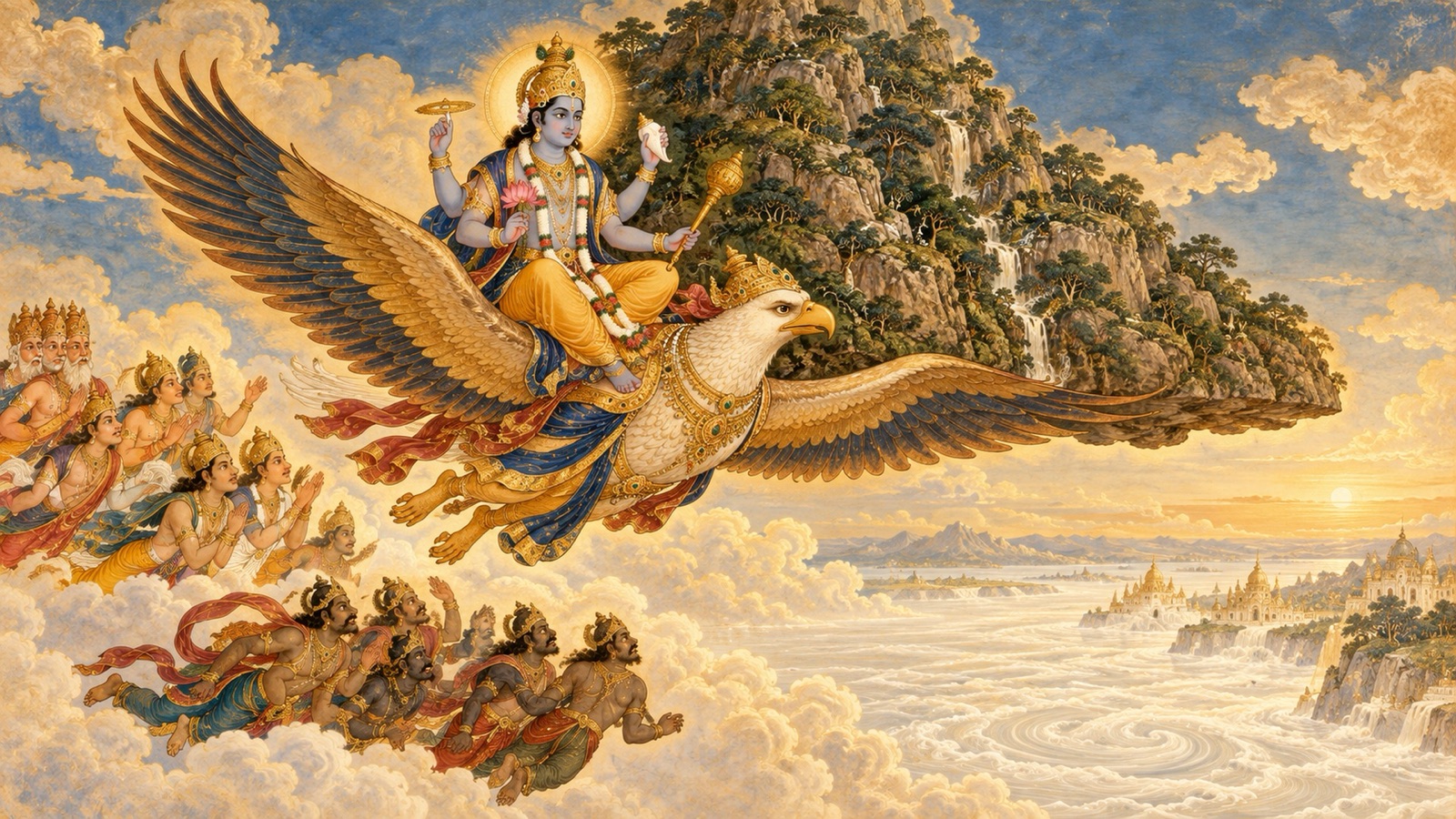
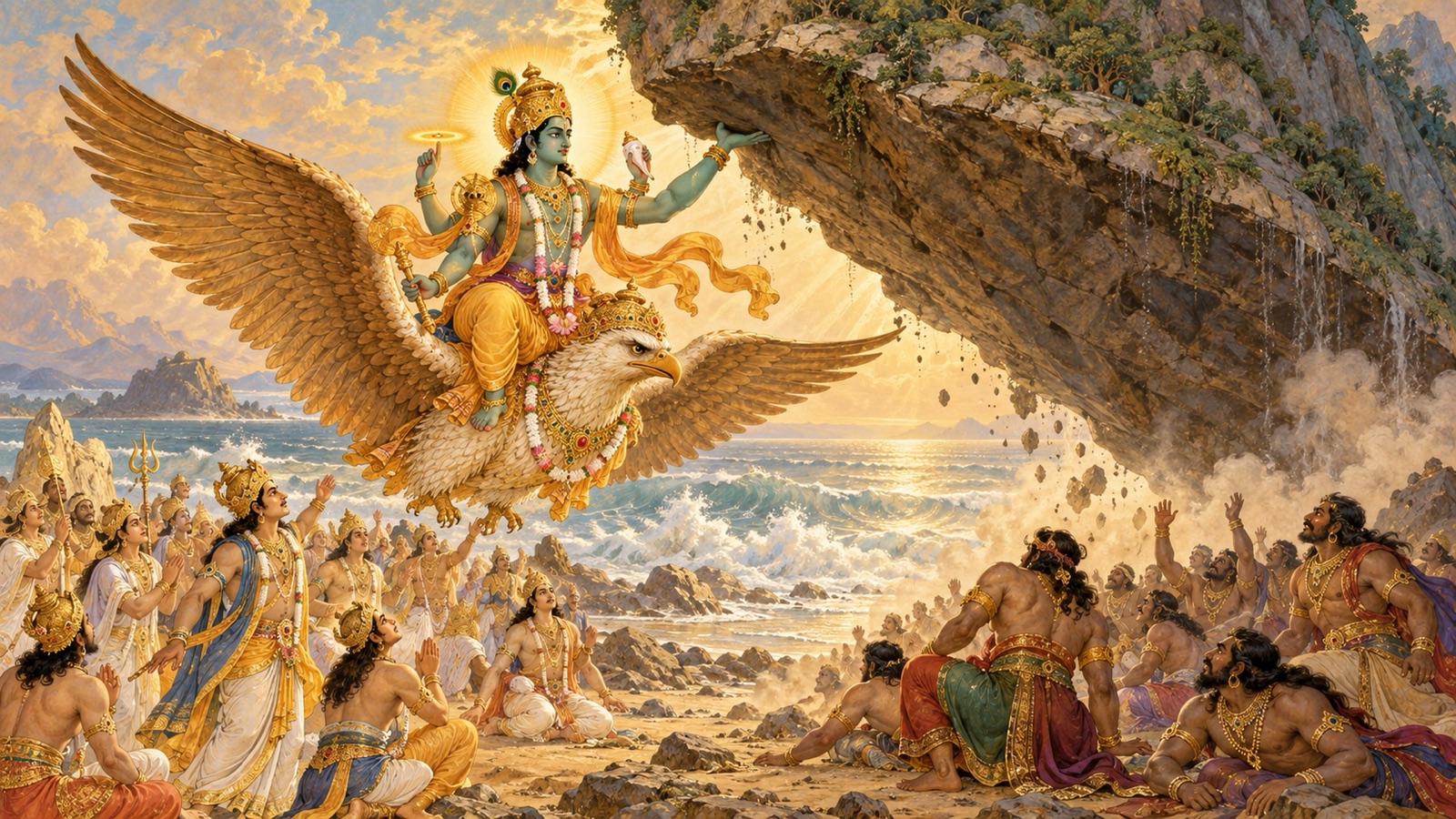
The great mountain, torn from the earth by gods and demons together, proves too heavy for them all — until the Lord lifts it upon Garuda with a single hand and bears it, as if in play, to the shore of the milky sea.
Om Namo Bhagavate Vasudevaya.
Om Namo Bhagavate Vasudevaya.
Om Namo Bhagavate Vasudevaya.
Welcome back to Srimad Bhagavatam Wisdom, a devotional journey through the sacred histories and teachings of the Srimad Bhagavat Mahapurana. In the previous chapter, Brahma led the gods to the shore beyond illusion and offered a great hymn to the unseen Supreme Lord. This sixth chapter of the Eighth Canto gives us the answer to that prayer: the Lord Himself appears, radiant as a thousand suns, and lays out the plan for the churning of the Ocean of Milk. He counsels the gods to make peace with the demons for a common purpose, names Mount Mandara as the churning-rod and Vasuki the serpent-king as the rope, and warns them of the poison and the temptations to come. Then, when the mighty mountain overwhelms the strength of gods and demons alike, the Lord carries it Himself upon Garuda to the sea.
Chapter Information
- Scripture: Śrīmad Bhāgavata Mahāpurāṇa
- Canto: 8 (Book Eight)
- Chapter: 6 (Discourse 6)
- Chapter title: The Lord Appears and Mount Mandara Is Carried
- Principal speaker: Sukadeva Gosvami, narrating to King Parikshit — with prayers by Brahma and counsel by the Lord
- Principal listener: King Parikshit
- Main setting: The transcendent shore where the Lord appears; the realm of Bali; the path to the shore of the Ocean of Milk
- Central subject: The Lord appears before the gods, instructs them to churn the Ocean of Milk in alliance with the demons using Mount Mandara and Vasuki, and carries the fallen mountain to the sea
- Principal verse range: Canto 8, Chapter 6, verses 1–39
- Primary edition: Gita Press Śrīmad Bhāgavata Mahāpurāṇa
Context From the Previous Chapter
In the fifth discourse, the gods — ruined by Durvasa’s curse and defeated by the demons — took refuge in Brahma, who led them to the realm beyond the darkness of illusion and offered a hymn to the Supreme Lord. That prayer now bears fruit. This chapter opens as the Lord, moved by the creator’s hymn, manifests before the assembled gods in His resplendent form and reveals the divine plan through which their fortune will be restored.
The Lord Appears, Radiant as a Thousand Suns
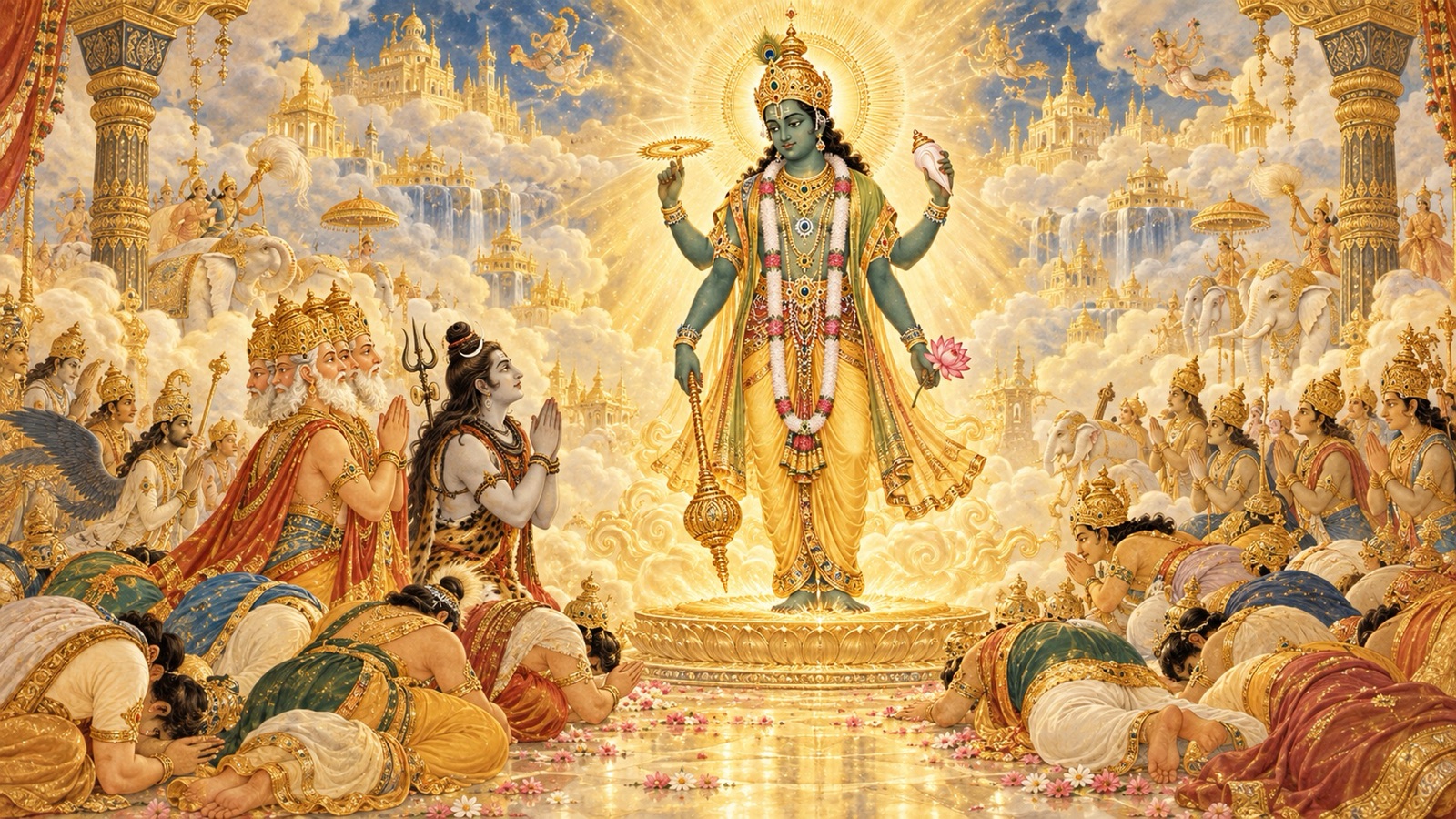
Sukadeva tells King Parikshit that, thus extolled by the gods, the almighty Lord Sri Hari appeared before them with the effulgence of a thousand suns rising together. So dazzling was that light that the gods could not see the sky, the directions, the earth, or even themselves — how then could they behold the Lord? Only Brahma and Siva could perceive that spotless form: dark as an emerald, eyes ruddy as the heart of a lotus, clad in silk yellow as burning gold, graceful in every limb, crowned with jewels and adorned with the Kaustubha gem, bearing the goddess Lakshmi upon His breast and attended by His own weapons in personal form. Falling prostrate with all their limbs upon the ground, Brahma and the gods hymned the Supreme Person.
श्रीब्रह्मोवाच अजातजन्मस्थितिसंयमाया- गुणाय निर्वाणसुखार्णवाय । अणोरणिम्नेऽपरिगण्यधाम्ने महानुभावाय नमो नमस्ते ॥ ८ ॥
śrī-brahmovāca ajāta-janma-sthiti-saṁyamāyā- guṇāya nirvāṇa-sukhārṇavāya aṇor aṇimne ’parigaṇya-dhāmne mahānubhāvāya namo namas te
Meaning: Brahma prayed: Salutations again and again to You, the ocean of the bliss of liberation, in whom there is no birth, maintenance, or dissolution, who transcends the modes of nature, who are subtler than the subtlest, whose abode is beyond all reckoning, and whose glory is immeasurable. (Canto 8, Chapter 6, verse 8)
Brahma’s hymn adores the Lord as the beginning, middle, and end of all — as clay is to the pot — who created the universe by His own power and then entered it as its inner controller, unaffected by the very modes He set in motion.
Brahma went further: those who genuinely seek the highest good, he said, worship this very form through the Vedic rites, and in seeing the Lord they see the three worlds entire (verse 9). Only through loving service — as fire is coaxed from dry wood, or milk drawn from a cow’s udder — can even the pious draw near Him, for no other path succeeds (verse 12). And since he himself, Siva, and every demigod are but sparks struck from that single blazing fire, Brahma confessed they could not, by their own understanding, know what was truly good for them, and so he begged the Lord to grant the brahmanas and gods a means of deliverance suited to them (verse 15).
Seeing the Lord they had so long sought now appearing before them, the gods felt a bliss like that of elephants scorched by a forest fire suddenly reaching the cool waters of the Ganga, and they begged Him to accomplish the purpose for which they had sought His feet.
The Lord’s Counsel: Churn the Ocean in Alliance
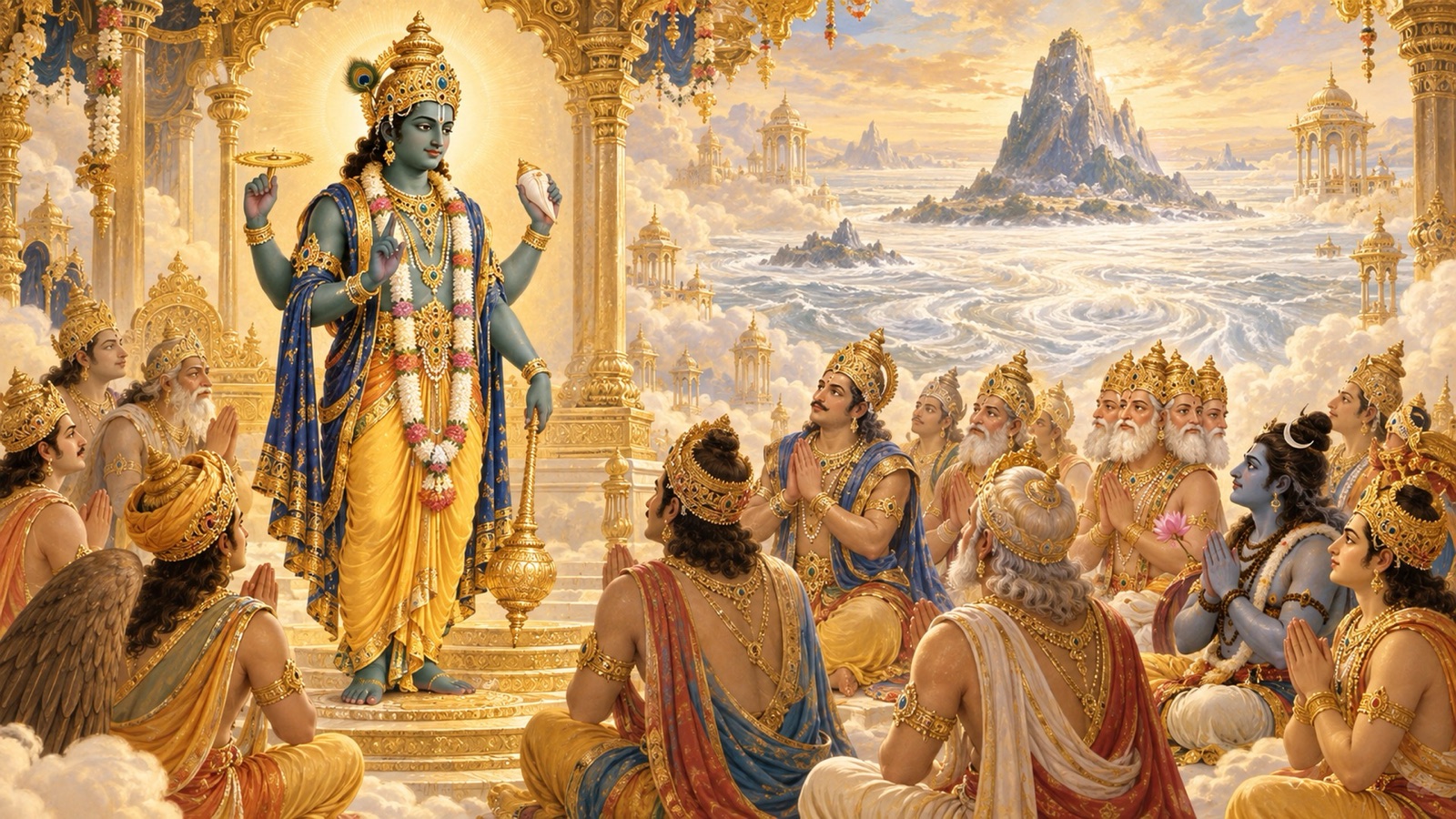
Knowing their hearts exactly as they were, the Lord spoke to the gods in a voice deep as the rumbling of clouds. Though fully able to accomplish their purpose alone, He wished to enact the churning of the ocean as His own divine sport, and so He gave them a plan.
श्रीभगवानुवाच हन्त ब्रह्मन्नहो शम्भो हे देवा मम भाषितम् । शृणुतावहिता: सर्वे श्रेयो व: स्याद् यथा सुरा: ॥ १८ ॥
śrī-bhagavān uvāca hanta brahmann aho śambho he devā mama bhāṣitam śṛṇutāvahitāḥ sarve śreyo vaḥ syād yathā surāḥ
Meaning: The Lord said: O Brahma, O Siva, O gods, listen all of you attentively to My words, that it may be well with you. (Canto 8, Chapter 6, verse 18)
His counsel was as much about wisdom as about method. For now, He said, make peace with the Danavas and Daityas, who are presently favoured by fortune, until prosperity returns to you of its own accord; when the goal is great, even enemies must be won over through alliance. He likened their position to the old counsel of the snake and the mouse trapped together in one basket: where a great purpose demands it, one may deal gently for a time even with a natural enemy (verse 20). Then He named the means for producing nectar — the drink by which even one in the jaws of death would become immortal.
क्षिप्त्वा क्षीरोदधौ सर्वा वीरुत्तृणलतौषधी: । मन्थानं मन्दरं कृत्वा नेत्रं कृत्वा तु वासुकिम् ॥ २२ ॥ सहायेन मया देवा निर्मन्थध्वमतन्द्रिता: । क्लेशभाजो भविष्यन्ति दैत्या यूयं फलग्रहा: ॥ २३ ॥
kṣiptvā kṣīrodadhau sarvā vīrut-tṛṇa-latauṣadhīḥ manthānaṁ mandaraṁ kṛtvā netraṁ kṛtvā tu vāsukim sahāyena mayā devā nirmanthadhvam atandritāḥ kleśa-bhājo bhaviṣyanti daityā yūyaṁ phala-grahāḥ
Meaning: Casting into the Ocean of Milk all kinds of herbs, grasses, creepers, and plants, and making Mount Mandara the churning-rod and Vasuki the churning-rope, churn the ocean tirelessly, O gods, with Me as your helper. The Daityas will bear the toil, while you shall reap the fruit. (Canto 8, Chapter 6, verses 22-23)
He added counsel of remarkable gentleness: approve of what the demons desire, for more is accomplished by kind words than by anger; do not fear the deadly Kalakuta poison that will rise from the ocean; and above all, when treasures emerge, give no room to greed and no room to anger. Having thus instructed them, the Lord vanished from their sight.
The Alliance With Bali and the Uprooting of Mandara
Bowing to the Lord, Brahma and Siva returned to their realms, and the gods went to call on Bali, the ruler of the Daityas. Bali was seated in the fullness of power, having conquered the three worlds, guarded by the chiefs of the demon armies — yet he was skilled in statecraft and knew when to fight and when to come to terms. Restraining his generals, who bristled at the mere sight of the gods, he received the conciliatory proposal, and it found favour with him and with the demon chiefs Sambara, Aristanemi, and the others. So gods and demons, former enemies, entered into a pact and joined their energies for the sake of nectar.
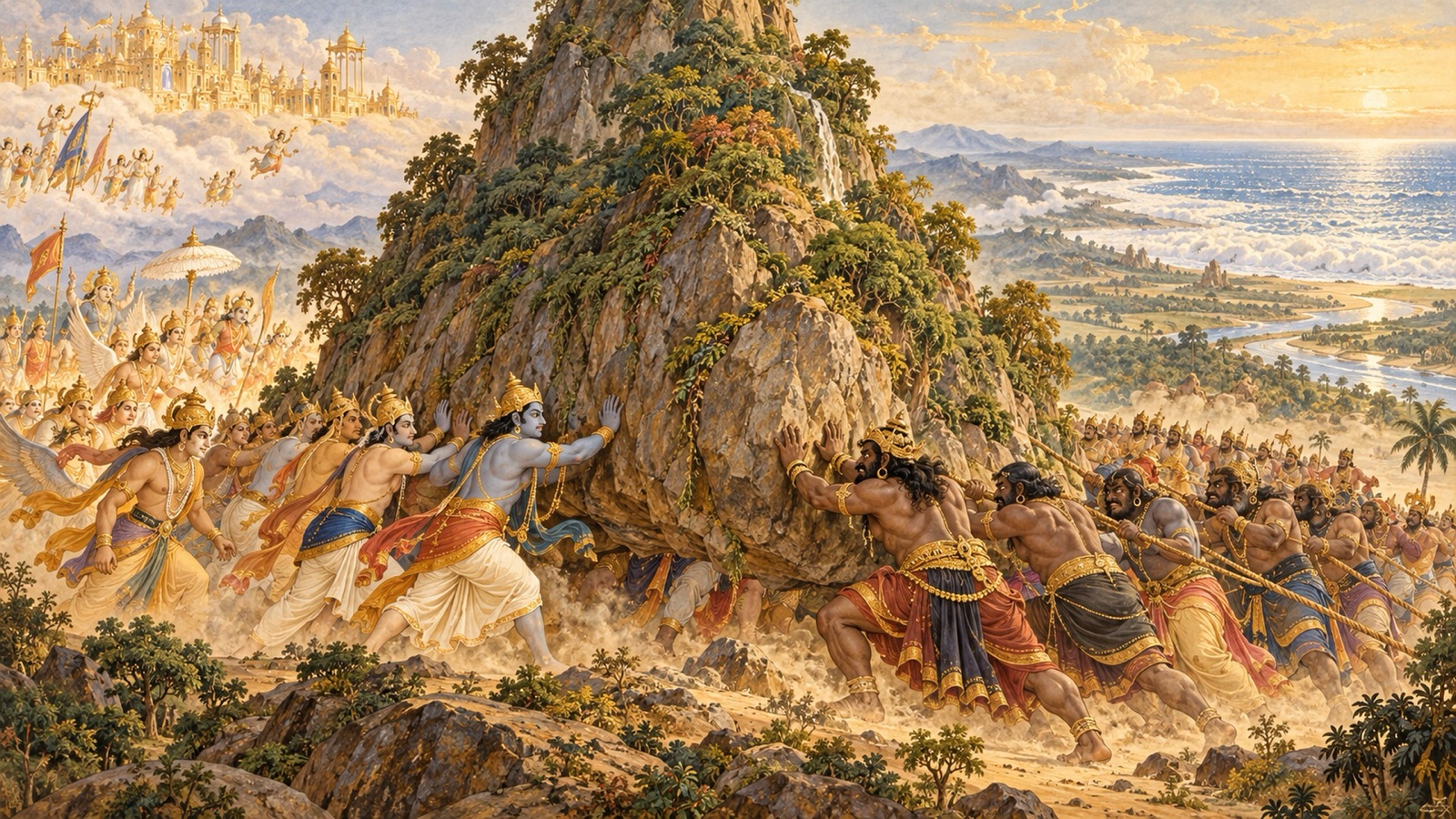
Together they uprooted Mount Mandara and, roaring like lions, set out to carry it to the seashore. But the mountain was as vast as golden Sumeru, and after bearing it a long way, Indra, Bali, and the rest were exhausted and could carry it no further. It slipped from their hands and fell, crushing many gods and demons beneath its enormous weight.
The Lord Carries the Mountain on Garuda
Seeing them disheartened, their arms and thighs and necks broken beneath the mountain, the Lord appeared at once upon Garuda.
तांस्तथा भग्नमनसो भग्नबाहूरुकन्धरान् । विज्ञाय भगवांस्तत्र बभूव गरुडध्वज: ॥ ३६ ॥
tāṁs tathā bhagna-manaso bhagna-bāhūru-kandharān vijñāya bhagavāṁs tatra babhūva garuḍa-dhvajaḥ
Meaning: Understanding the gods and demons to be so dispirited, their arms, thighs, and necks broken, the Lord, who bears Garuda on His banner, appeared there upon His carrier. (Canto 8, Chapter 6, verse 36)
With a single glance He revived the gods and demons as though they had never been hurt. Then, lifting the great mountain with one hand as if in play, He placed it upon Garuda, mounted the bird Himself, and flew to the shore of the ocean, surrounded by the gods and demons. Setting the mountain down at the seaside, He released Garuda — who withdrew so that Vasuki, the serpent-king who dreaded his mortal enemy the eagle, might safely approach for his part in the churning. Thus, by the Lord’s own strength and forethought, everything was made ready for the great churning to begin.
This careful sequencing — reviving the fallen exactly, then sending Garuda away at precisely the moment Vasuki’s safety required it — is itself a teaching. Where the demons who witness such events dismiss them as coincidence, the scriptures insist that nothing here is accidental: the Lord who directs the very workings of material nature timed each step Himself. A devotee sees providence in the ordinary arrangement of things; only the faithless call it chance. That the mountain fell and the Lord lifted it, that Garuda departed and Vasuki could come, are of a single divine design (verses 36-39).
Principal Teachings of This Chapter
1. The Lord answers sincere prayer in person. Brahma’s hymn draws the Lord forth in His own resplendent form. When the heart truly turns to God, He does not remain distant (verses 1-8).
2. Cooperation for a worthy end may require peace with adversaries. The Lord counsels the gods to ally even with the demons to obtain nectar. Wisdom sometimes lies in patience and alliance rather than conflict (verses 19-20).
3. Kind words accomplish more than anger. “Approve of what the demons desire,” the Lord says, “for more is done by gentle speech than by wrath.” Gentleness is not weakness but strategy in the hands of the wise (verse 24).
4. Guard against greed and anger when fortune comes. Even before the treasures rise, the Lord warns the gods not to covet or quarrel over them. Prosperity tests the heart as surely as adversity (verse 25).
5. Our efforts succeed only with the Lord’s help. The mightiest gods and demons together cannot even carry the mountain; the Lord lifts it with one hand. He is the true accomplisher behind every endeavour (verses 22-23, 36-38).
A Devotional Reflection
There is a gentle humour, and a deep lesson, in the sight of all the gods and all the demons — the mightiest beings in creation — heaving and roaring as they haul Mount Mandara toward the sea, only to collapse beneath it partway there. How like our own great projects: we gather our allies, summon our strength, and set out certain we can carry the weight ourselves, and somewhere along the road it comes crashing down on us. The Lord’s response is telling. He does not scold them for failing; He revives them with a look and then lifts the very mountain that crushed them as lightly as a child lifts a toy. The nectar they sought would indeed be churned — but not by their strength alone. This chapter quietly dismantles the illusion of self-sufficiency without ever shaming us for it. It simply shows us the Lord doing effortlessly what we cannot do at all, and inviting us to let Him be, as He told the gods, our helper in the work.
A Daily Devotional Practice
Today, choose one task or worry that feels too heavy to carry — a burden you have been straining under alone — and consciously hand it to the Lord as the gods handed Him the mountain. Before beginning your effort, pause and say, “Om Namo Bhagavate Vasudevaya,” inviting Him to be your helper rather than assuming the whole weight rests on you. Then do your part with a light heart, trusting that the One who carries mountains on a single hand is carrying you.
Conclusion
The sixth discourse of the Eighth Canto shows the mightiest beings in creation brought to a standstill beneath a single mountain, and the Supreme Lord raising it effortlessly with a single hand. Every part of His plan, from the alliance with the demons to the warning against greed and anger, points to the same truth: this whole undertaking is accomplished not by the strength of gods or demons, but by the Lord who stands quietly behind it. Every preparation for the great churning is now complete. In the next chapter, the ocean itself will be churned — and with it will rise the terrible poison and the compassion of Lord Siva.
May the divine wisdom of Srimad Bhagavatam awaken pure devotion within our hearts.
Om Namo Bhagavate Vasudevaya.
Jay Shree Madhav.
References and Attribution
- Primary edition: Gita Press, Śrīmad Bhāgavata Mahāpurāṇa (English, complete), Book Eight, Discourse 6, pages 758–761.
- Series: Srimad Bhagavatam Wisdom · Biswa Sanatan Dharma Seva Trust.
- Presented following the spiritual guidance and recommendation of Pandit Dr. Shri Kashinath Mishra.
This is an original, faithful retelling in the writer’s own words, with brief quoted verses shown in Devanāgarī and transliteration and their meanings given as summaries. It is not a reproduction of any single publisher’s continuous translation or commentary. No affiliation with or endorsement by any publisher is implied.
Jay Shree Madhav