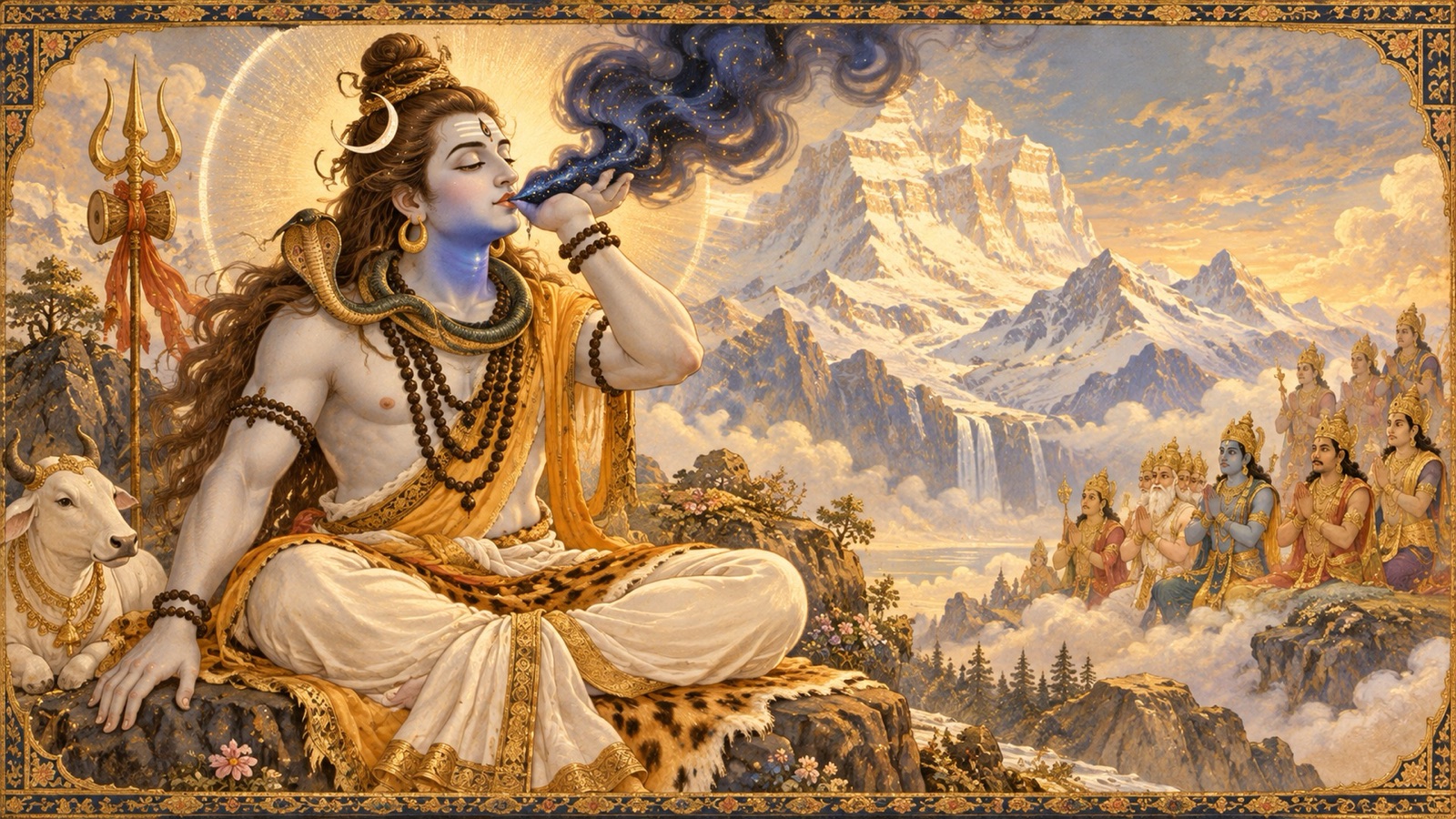
When a poison rises from the churning sea that could burn all three worlds, one figure steps forward — not to seize a treasure, but to swallow the danger. Lord Siva takes the poison into his own throat, and it turns forever blue.
Om Namo Bhagavate Vasudevaya.
Om Namo Bhagavate Vasudevaya.
Om Namo Bhagavate Vasudevaya.
Welcome back to Srimad Bhagavatam Wisdom, a devotional journey through the sacred histories and teachings of the Srimad Bhagavat Mahapurana. With Mount Mandara carried to the shore and Vasuki summoned as the rope, the great churning of the Ocean of Milk now begins in earnest — and this seventh chapter of the Eighth Canto takes us from the first turn of the mountain to the moment divine compassion meets its gravest test.
Chapter Information
- Scripture: Śrīmad Bhāgavata Mahāpurāṇa
- Canto: 8 (Book Eight)
- Chapter: 7 (Discourse 7)
- Chapter title: The Churning Begins and Lord Siva Drinks the Poison
- Principal speaker: Sukadeva Gosvami, narrating to King Parikshit — with prayers to Lord Siva and Siva’s own words to Sati
- Principal listener: King Parikshit
- Main setting: The shore of the Ocean of Milk; Mount Kailasa
- Central subject: The churning of the Ocean of Milk begins; the Lord supports the mountain as the Tortoise; the Halahala poison rises; Lord Siva drinks it to protect all beings
- Principal verse range: Canto 8, Chapter 7, verses 1–46
- Primary edition: Gita Press Śrīmad Bhāgavata Mahāpurāṇa
Context From the Previous Chapter
In the sixth discourse, the Lord appeared before the gods, revealed the plan for churning the Ocean of Milk with Mount Mandara and Vasuki, counselled alliance with the demons, and carried the fallen mountain to the sea upon Garuda. Every preparation was complete. This chapter takes up the churning itself — and the crisis that immediately follows when the sea yields its first and most dangerous gift.
The Churning Begins — and the Question of the Tail
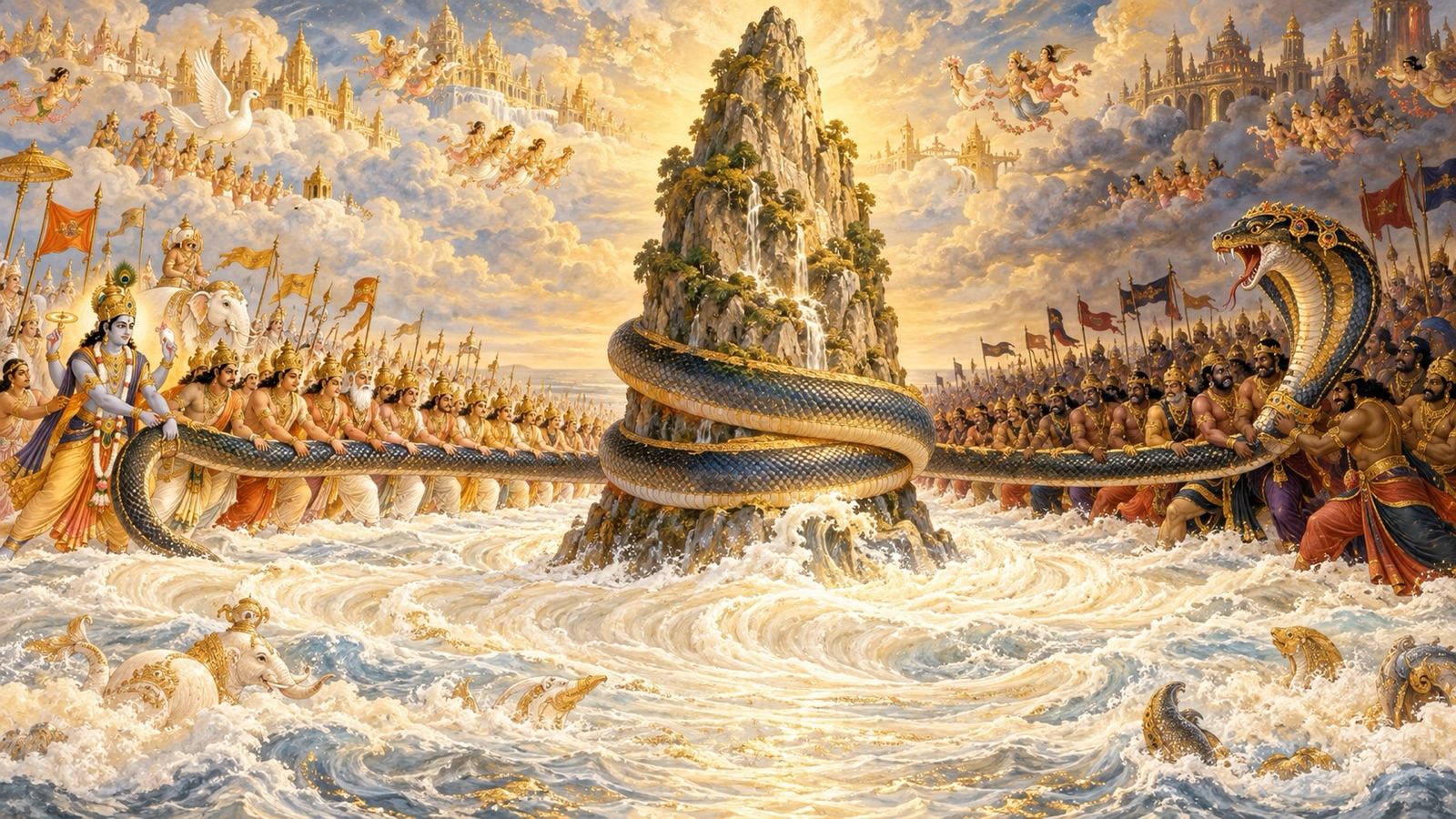
Sukadeva tells King Parikshit that, assuring Vasuki of his share in the nectar, the gods and demons twined the serpent-king around Mount Mandara and began to churn with great joy. The Lord first grasped the serpent near its head, and the gods ranged themselves on that side. But the demon generals were displeased. Proud of their learning and their noble birth, they refused to hold the tail — the inauspicious end of the serpent. Seeing them stand silent, the Lord smiled, relinquished the head, and with the gods took hold of the tail Himself. With their positions thus settled, gods and demons began to churn the ocean with all their might.
The Lord Bears the Mountain as the Divine Tortoise
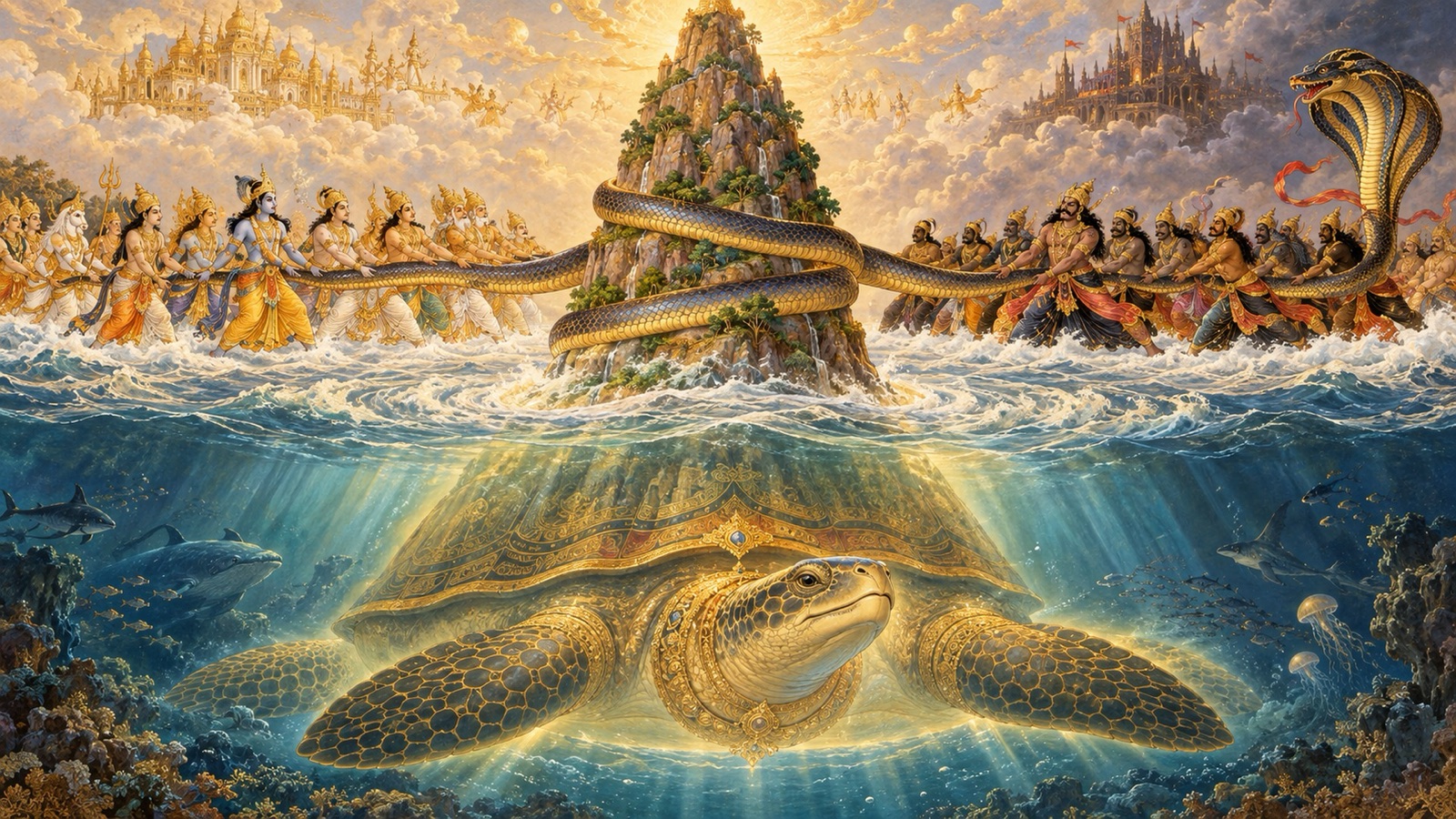
At once a difficulty arose: the great mountain, having nothing beneath it, sank into the ocean under its own weight, though held by the mightiest of gods and demons. Their effort frustrated, all grew dejected. Then the Lord of unfailing resolve assumed a wonderful and gigantic form — the divine Tortoise — plunged into the water, and raised the mountain upon His back.
विलोक्य विघ्नेशविधिं तदेश्वरो दुरन्तवीर्योऽवितथाभिसन्धि: । कृत्वा वपु: कच्छपमद्भुतं महत् प्रविश्य तोयं गिरिमुज्जहार ॥ ८ ॥
vilokya vighneśa-vidhiṁ tadeśvaro duranta-vīryo ’vitathābhisandhiḥ kṛtvā vapuḥ kacchapam adbhutaṁ mahat praviśya toyaṁ girim ujjahāra
Meaning: Perceiving the obstacle that had arisen, the Lord of boundless prowess and unfailing resolve assumed a wonderful, gigantic tortoise form, entered the water, and lifted up the mountain. (Canto 8, Chapter 7, verse 8)
So vast was that Tortoise — His back extending a hundred thousand yojanas like a great island — that the mountain resting upon it felt like nothing more than an itch being scratched. Nor did the Lord’s help end there. Through His own threefold energy He entered the demons in the mode of passion, the gods in the mode of goodness, and the exhausted Vasuki in the mode of ignorance, renewing the strength of all three so the great work would not fail; and, taking a thousand-armed form, He stood upon the summit pressing the mountain down so it would not spring up, while Brahma, Siva, and Indra sang His praises and rained flowers from the sky.
The Halahala Poison Rises
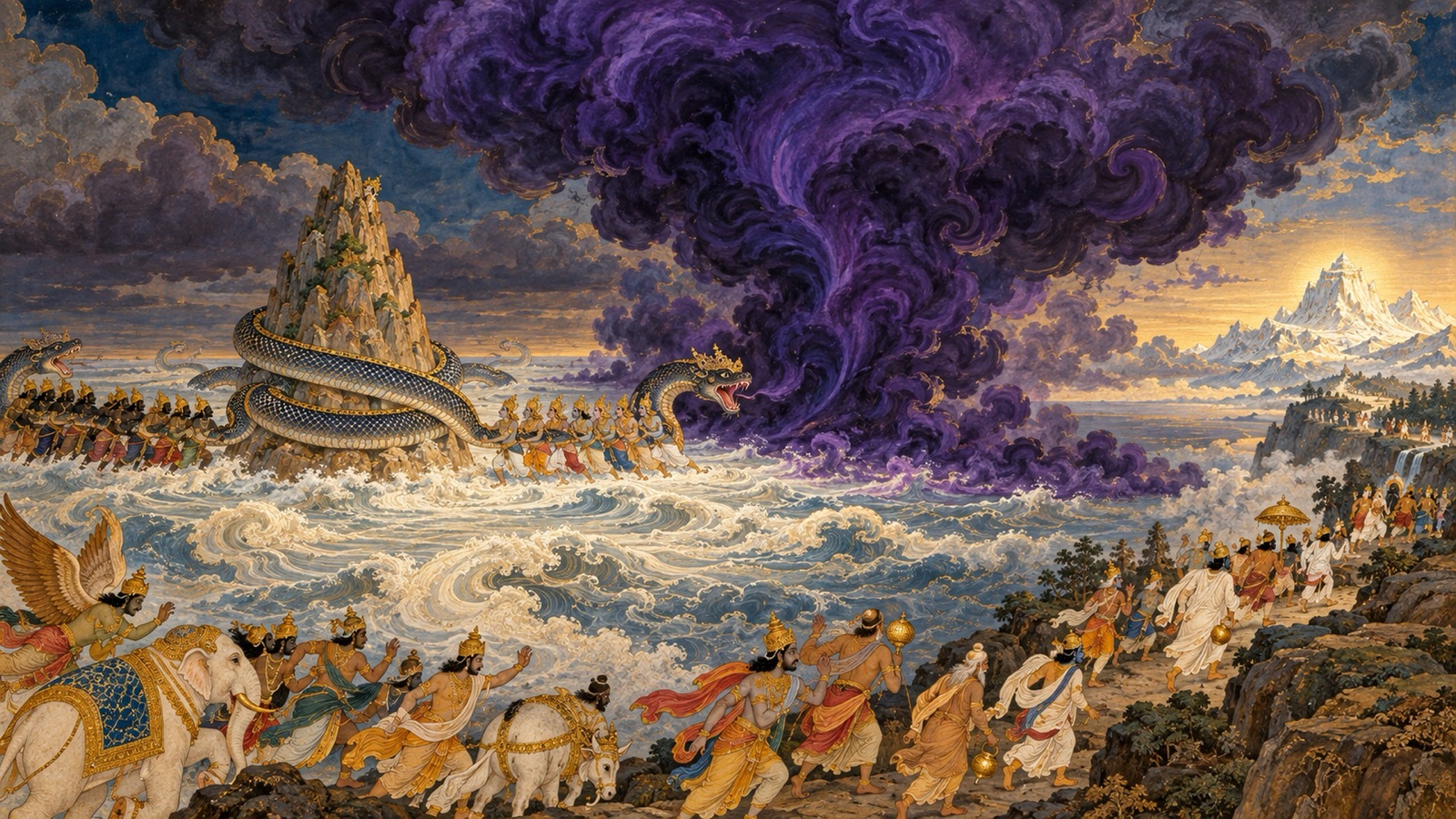
As the churning grew fierce, stirring the whales and sea-creatures of the deep, the ocean yielded its first gift — but it was not nectar. From the churning waters rose a most deadly poison called Halahala.
निर्मथ्यमानादुदधेरभूद्विषं महोल्बणं हालहलाह्वमग्रत: । सम्भ्रान्तमीनोन्मकराहिकच्छपात् तिमिद्विपग्राहतिमिङ्गिलाकुलात् ॥ १८ ॥
nirmathyamānād udadher abhūd viṣaṁ maholbaṇaṁ hālahalāhvam agrataḥ sambhrānta-mīnonmakarāhi-kacchapāt timi-dvipa-grāha-timiṅgilākulāt
Meaning: From the ocean being churned — its fishes, sea-monsters, serpents, and tortoises thrown into confusion — there first arose a most terrible poison named Halahala. (Canto 8, Chapter 7, verse 18)
Seeing the poison spread unbearably in every direction, above and below, and finding no refuge anywhere, all living beings and their leaders were terrified and fled for protection to Lord Sadasiva, the ever-auspicious, who dwelt on Mount Kailasa with His consort, absorbed in austerity for the welfare of the three worlds. Greeting Him with hymns, the lords of created beings prayed to Him as the one Lord able to enthral and to liberate the whole world — glorifying Him as the source of the Veda, the very form of the universe, whose three modes are His three eyes, whose absolute state is the supreme Brahman itself.
It is worth pausing on why the Lord — who had just borne the mountain on His own back and sustained every worker at the churning — did not remove this poison Himself, though He was fully able to. He held back, it is said, so that the credit for saving the three worlds would fall to Lord Siva, the greatest of His own devotees; the Lord delights more in the honour given to one who loves Him than in claiming the deed as His own. This is the same spirit Sukadeva names later in this very chapter: a true devotee cannot bear to see others suffer, and gladly bears their pain as his own. The rescue at the churning sea is thus not only Siva’s compassion; it is also the Lord’s own compassion, expressed here by stepping back and letting His devotee shine (verse 19).
The Compassion of Lord Siva
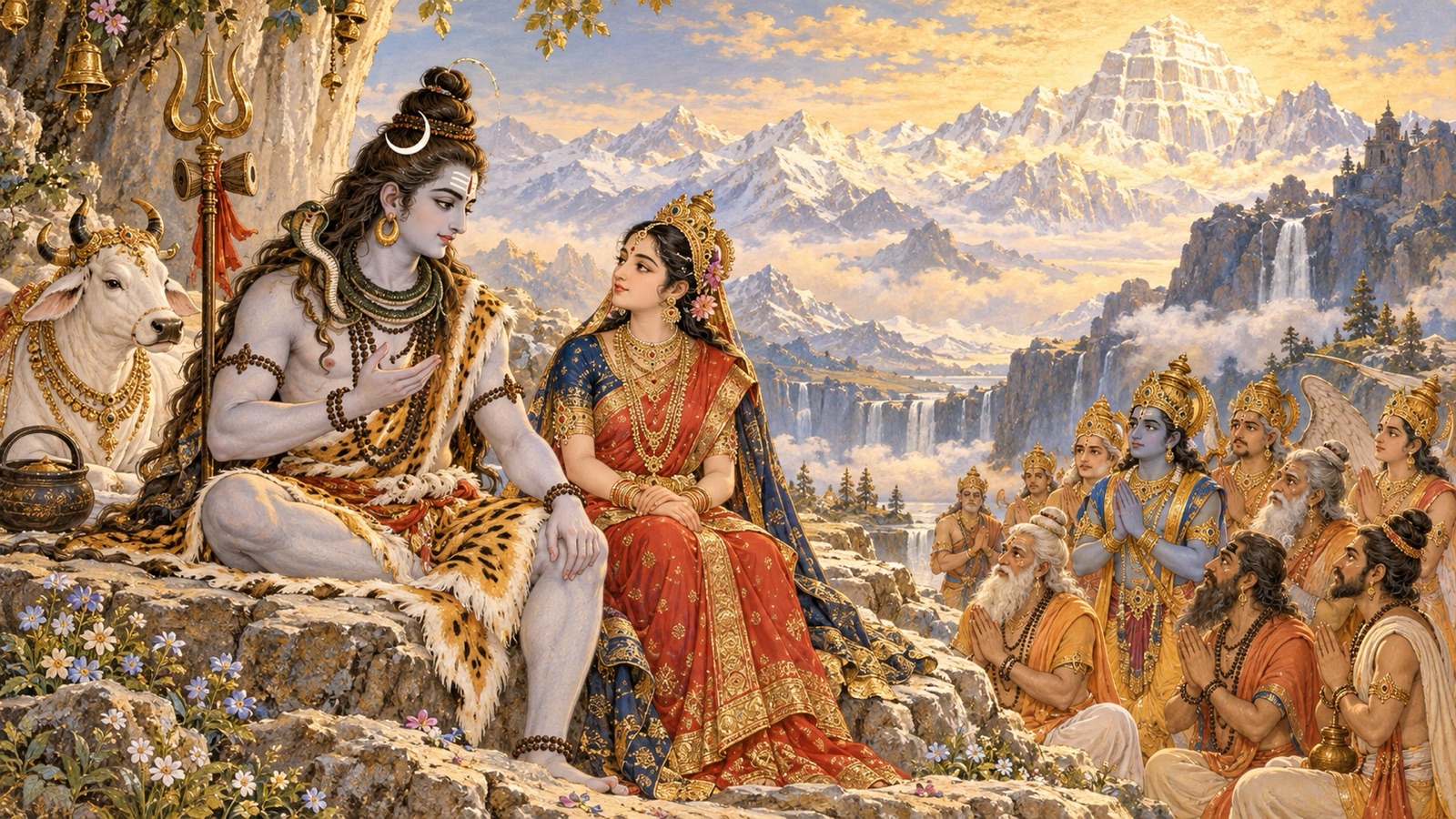
Moved to the depths by their distress, Lord Siva — the friend of all living beings — turned to His beloved consort Sati and spoke.
श्रीशिव उवाच अहो बत भवान्येतत् प्रजानां पश्य वैशसम् । क्षीरोदमथनोद्भूतात् कालकूटादुपस्थितम् ॥ ३७ ॥
śrī-śiva uvāca aho bata bhavāny etat prajānāṁ paśya vaiśasam kṣīroda-mathanodbhūtāt kālakūṭād upasthitam
Meaning: Lord Siva said: Alas, O Bhavani, behold this calamity that has come upon these creatures from the Kalakuta poison produced by the churning of the Ocean of Milk. (Canto 8, Chapter 7, verse 37)
It is my duty, He said, to give these frightened beings the security they seek; to protect the afflicted is the very concern of the powerful. The virtuous protect other beings even at the cost of their own fleeting life. Sri Hari, the Soul of the universe, is pleased with one who shows mercy to bewildered creatures; and when Sri Hari is pleased, I too am gratified, along with all creation. Therefore, He concluded, I shall swallow this poison, that all beings may live in peace.
Having sought and received the consent of Sati — who knew His greatness — Lord Siva gathered the spreading Halahala into His palm and, out of pure compassion, drank it.
तस्यापि दर्शयामास स्ववीर्यं जलकल्मष: । यच्चकार गले नीलं तच्च साधोर्विभूषणम् ॥ ४३ ॥
tasyāpi darśayām āsa sva-vīryaṁ jala-kalmaṣaḥ yac cakāra gale nīlaṁ tac ca sādhor vibhūṣaṇam
Meaning: Even upon Lord Siva the poison showed its power, marking His throat a deep blue — yet that very mark became an ornament upon the saintly Lord. (Canto 8, Chapter 7, verse 43)
He is honoured ever after as Nilakantha, the blue-throated one. As Sukadeva observes, noble souls are pained by the suffering of the world, and to share the affliction of others is itself the highest worship of the Supreme. Brahma, Vishnu, and Sati all applauded His deed, and the little of the poison that leaked from His palm was taken up by scorpions, snakes, and other venomous creatures.
Principal Teachings of This Chapter
1. Pride refuses the humble task. The demons would not hold the serpent’s tail, thinking it beneath their dignity. The Lord took it with a smile. True greatness is never too proud for the humble place (verses 3-4).
2. The Lord sustains every effort, seen and unseen. He bears the mountain as the Tortoise, presses it as the thousand-armed form, and enters gods, demons, and serpent to give them strength. Our work goes forward only because He upholds it from within and without (verses 8-13).
3. Not every fruit of effort is sweet. The first thing the churning yields is deadly poison. In every great undertaking, difficulty and danger often come before reward (verse 18).
4. To take on others’ suffering is the highest worship. Siva drinks the poison so that all may live, and Sukadeva calls this sharing of affliction the highest worship of the Lord. Compassion that bears another’s pain is the truest devotion (verses 39-44).
5. What harms us can become our glory when offered in love. The poison that should have destroyed Siva became instead his blue-throated ornament. Suffering accepted for others’ sake is transformed into beauty (verse 43).
A Devotional Reflection
The image at the heart of this chapter is unforgettable: the whole of creation, gods and demons alike, straining after the nectar of immortality — and when the first thing to rise is deadly poison, it is not the strongest or the cleverest who steps forward, but the one most willing to suffer for others. Lord Siva does not drink the poison to gain anything. There is no reward in it, only pain; the venom scorches even him. Yet he takes it gladly, because the alternative is that others should suffer, and that he cannot bear. Here is a portrait of love stripped of every self-interest. It also reframes our own troubles. We spend so much energy trying to keep all poison away from ourselves. Siva shows another way — that the sorrow we willingly carry for the sake of another is not a stain but an ornament, not a defeat but the highest form of worship. The blue throat is not a wound to be hidden; it is the badge of a heart that loved enough to bear what others could not.
A Daily Devotional Practice
Today, look for one small “poison” you can quietly absorb so that someone else need not — an unkind word you choose not to pass on, an inconvenience you take upon yourself to spare another, a burden you carry without complaint. As you do, remember Lord Siva at the churning sea and offer the act to the Lord with the words “Om Namo Bhagavate Vasudevaya.” Let a little of another’s difficulty become, in your hands, an ornament of love rather than a cause of resentment.
Conclusion
The seventh discourse of the Eighth Canto brings us to its single greatest lesson: love willing to suffer for others is the highest worship of the Lord, and what it costs us is transformed into glory. Lord Siva’s blue throat is not what the poison did to him — it is what love did with the poison. As we return to our own conflicts and burdens, may we remember that goodness is often measured by how much of another’s difficulty we are willing to carry as our own. With the poison subdued, the great churning can continue, and the ocean has yet greater treasures to yield.
May the divine wisdom of Srimad Bhagavatam awaken pure devotion within our hearts.
Om Namo Bhagavate Vasudevaya.
Jay Shree Madhav.
References and Attribution
- Primary edition: Gita Press, Śrīmad Bhāgavata Mahāpurāṇa (English, complete), Book Eight, Discourse 7, pages 762–767.
- Series: Srimad Bhagavatam Wisdom · Biswa Sanatan Dharma Seva Trust.
- Presented following the spiritual guidance and recommendation of Pandit Dr. Shri Kashinath Mishra.
This is an original, faithful retelling in the writer’s own words, with brief quoted verses shown in Devanāgarī and transliteration and their meanings given as summaries. It is not a reproduction of any single publisher’s continuous translation or commentary. No affiliation with or endorsement by any publisher is implied.
Jay Shree Madhav