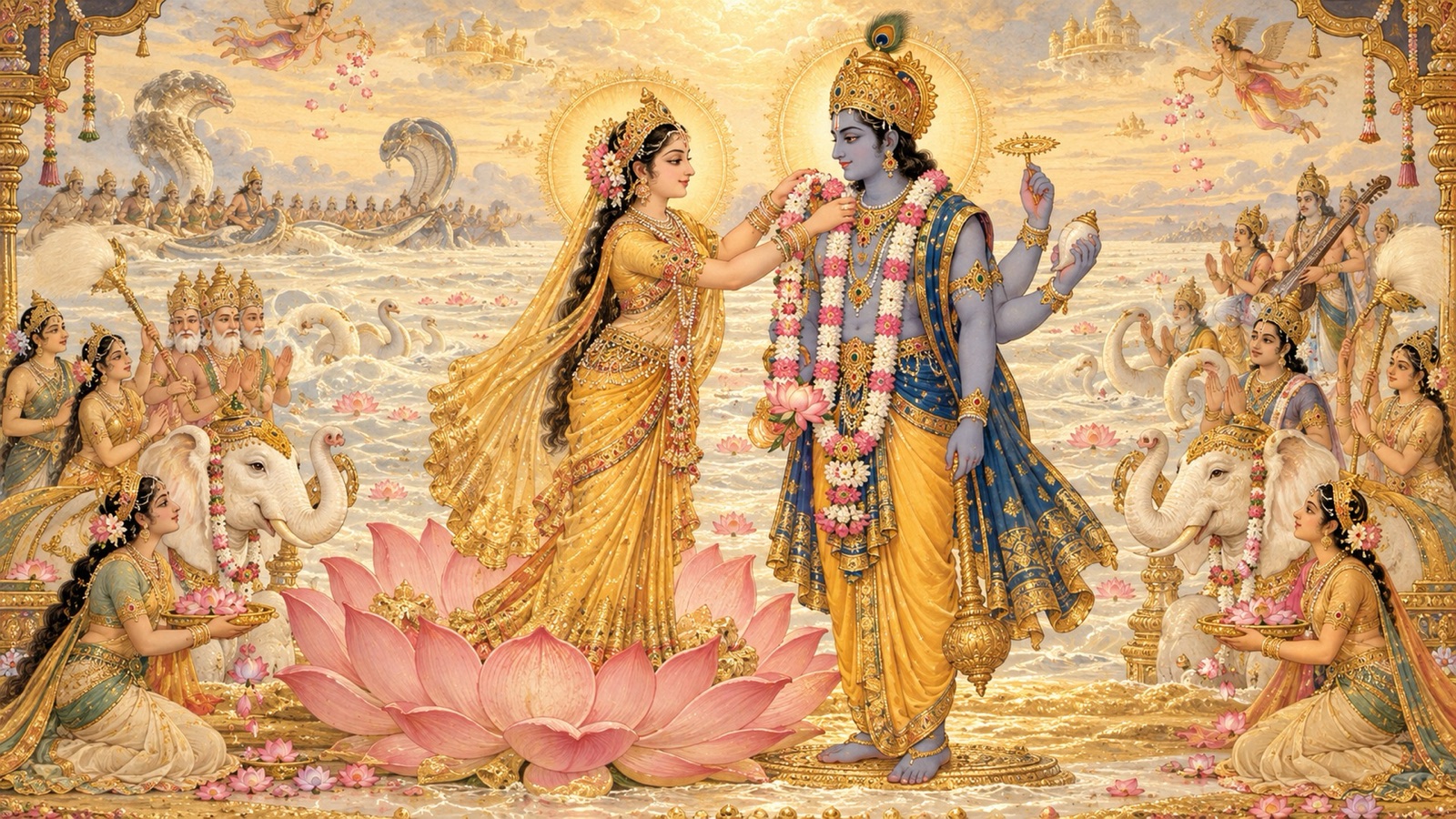
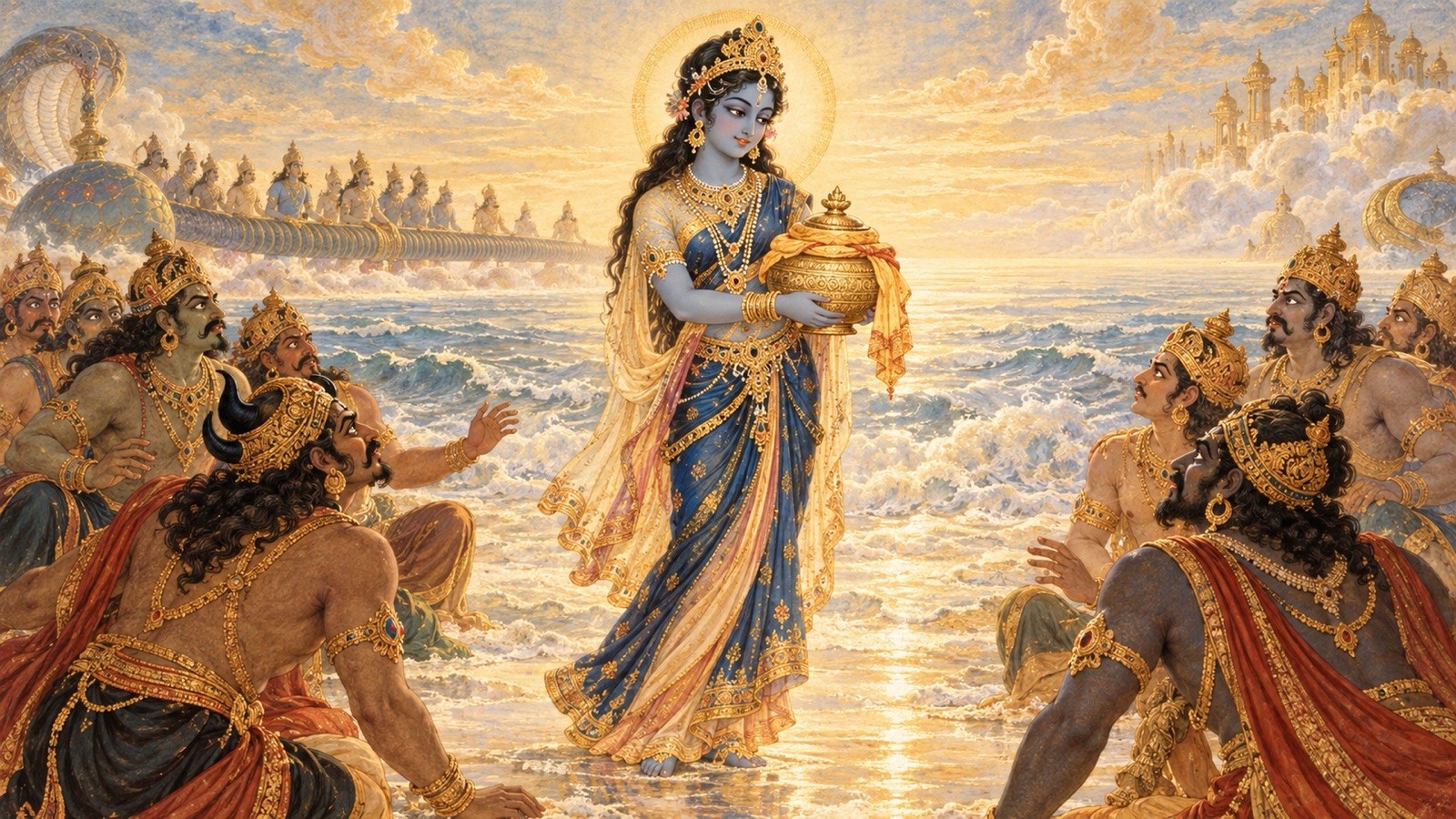
From the churned Ocean of Milk rises Goddess Lakshmi, radiant as lightning, holding a garland of lotuses. Passing by every god, sage, and celestial, she places the garland upon Lord Vishnu alone — and Fortune finds her eternal home upon His breast.
Om Namo Bhagavate Vasudevaya.
Om Namo Bhagavate Vasudevaya.
Om Namo Bhagavate Vasudevaya.
Welcome back to Srimad Bhagavatam Wisdom, a devotional journey through the sacred histories and teachings of the Srimad Bhagavat Mahapurana. With the terrible poison subdued, the churning of the Ocean of Milk resumes in this eighth discourse of the Eighth Canto — and here Goddess Lakshmi appears to choose her eternal Lord.
Chapter Information
- Scripture: Śrīmad Bhāgavata Mahāpurāṇa
- Canto: 8 (Book Eight)
- Chapter: 8 (Discourse 8)
- Chapter title: The Appearance of Lakshmi and the Lord’s Enchanting Form
- Principal speaker: Sukadeva Gosvami, narrating to King Parikshit
- Principal listener: King Parikshit
- Main setting: The shore of the Ocean of Milk
- Central subject: The treasures rise from the churned ocean; Goddess Lakshmi appears and chooses Lord Vishnu; the nectar arises and a quarrel breaks out among the demons; the Lord assumes His enchanting form
- Principal verse range: Canto 8, Chapter 8, verses 1–46
- Primary edition: Gita Press Śrīmad Bhāgavata Mahāpurāṇa
Context From the Previous Chapter
In the seventh discourse, the churning of the Ocean of Milk began, and the Lord sustained the whole endeavour as the divine Tortoise bearing Mount Mandara. But the first thing to rise was the world-destroying Halahala poison, which Lord Siva drank out of compassion, receiving forever the blue throat of the merciful. With the poison subdued, this chapter takes up the churning once more — and now the sea yields its long-awaited treasures.
The Treasures Rise From the Churning Sea
Sukadeva tells King Parikshit that with the poison now gone, the gods and demons took up the churning rope again, their hearts light with renewed hope.
श्रीशुक उवाच पीते गरे वृषाङ्केण प्रीतास्तेऽमरदानवा: । ममन्थुस्तरसा सिन्धुं हविर्धानी ततोऽभवत् ॥ १ ॥
śrī-śuka uvāca pīte gare vṛṣāṅkeṇa prītās te ’mara-dānavāḥ mamanthus tarasā sindhuṁ havirdhānī tato ’bhavat
Meaning: Sri Suka said: When the poison had been drunk by Lord Siva, who bears the emblem of a bull, the gods and demons, full of joy, churned the ocean with vigour; and from that churning came forth Surabhi, the cow of plenty. (Canto 8, Chapter 8, verse 1)
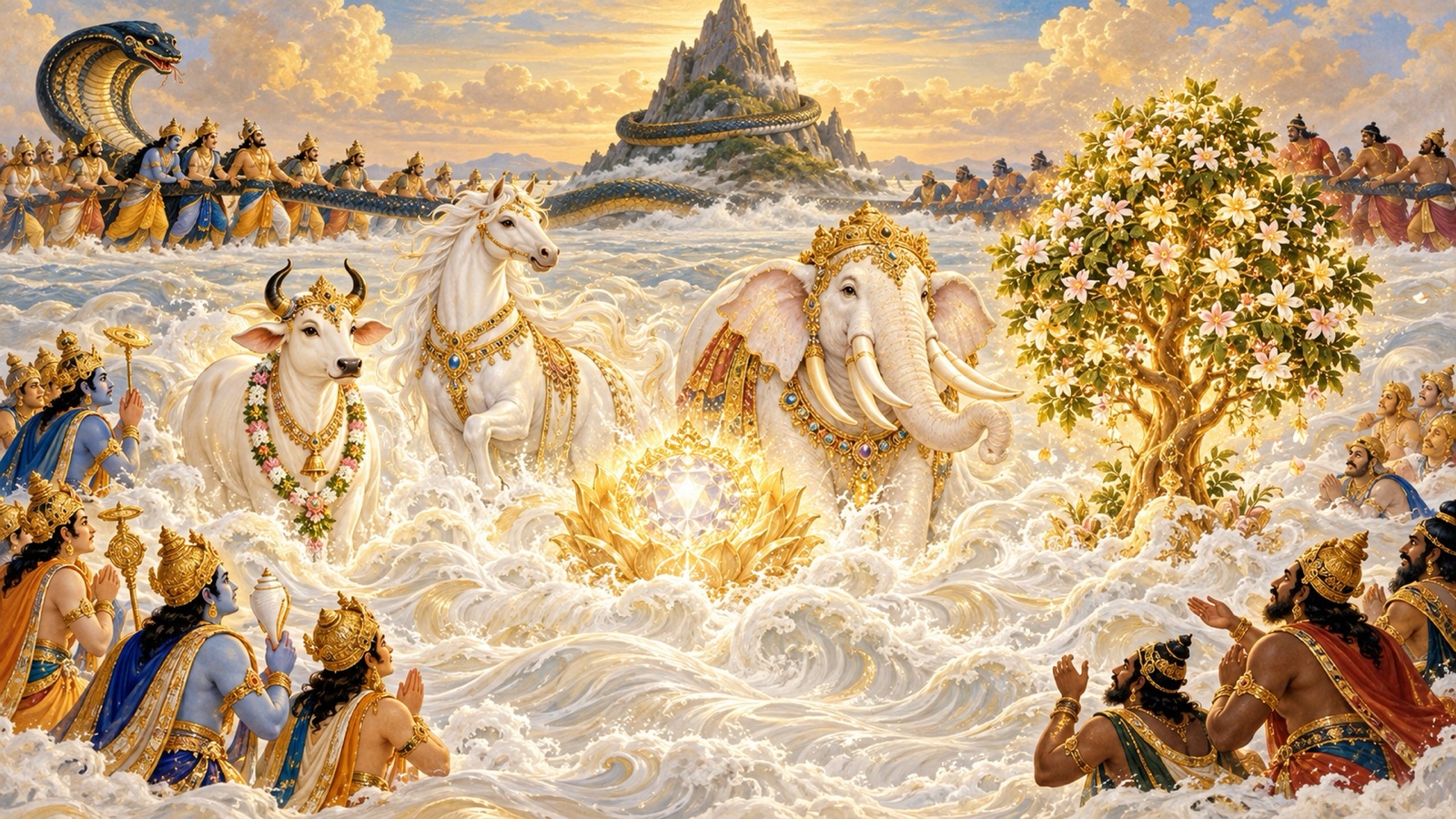
The seers who were exponents of the Vedas took Surabhi for the sacred materials needed in sacrifice. Next sprang forth Uccaihsrava, a horse white as the moon, which Bali longed for and received; then the moon-white king of elephants, Airavata, with four splendid tusks; then the Kaustubha gem, which Sri Hari took to adorn His own breast; then the celestial Parijata tree, which grants every wish; and then the Apsaras, the celestial nymphs, adorned with gold and clothed in fine robes, delighting the denizens of heaven with their graceful movement.
The Appearance of Goddess Lakshmi
Then, most radiant of all, appeared Goddess Rama — Lakshmi — who is Affluence personified and wholly devoted to the Lord, illumining all directions with her splendour like a flash of lightning against a crystalline mountain.
ततश्चाविरभूत् साक्षाच्छ्री रमा भगवत्परा । रञ्जयन्ती दिश: कान्त्या विद्युत् सौदामनी यथा ॥ ८ ॥
tataś cāvirabhūt sākṣāc chrī ramā bhagavat-parā rañjayantī diśaḥ kāntyā vidyut saudāmanī yathā
Meaning: Then there appeared the Goddess of Fortune, Rama, wholly devoted to the Lord, illumining all the quarters with her splendour like a streak of lightning. (Canto 8, Chapter 8, verse 8)
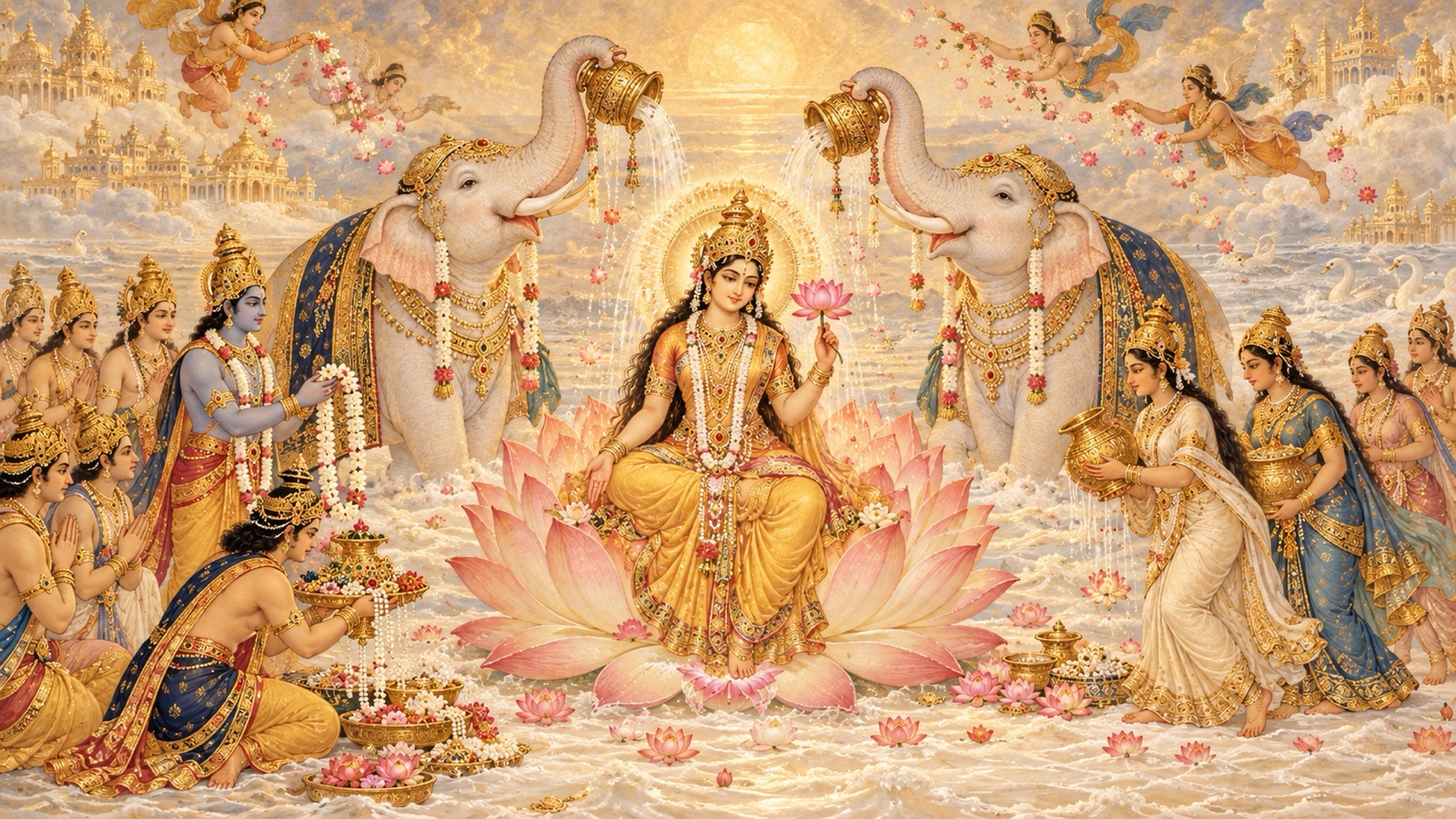
All present — gods, demons, and men alike — longed for her, their minds overpowered by the glory of her beauty, nobility, youth, and grace. Great Indra brought a wonderful throne; the sacred rivers, in their personal forms, brought holy water in golden jars; Mother Earth gave the herbs, the cows their five sacred products, and Spring its flowers and fruits. Seers performed her ablutions according to scripture, Gandharvas sang, and their wives danced. The elephants of the four quarters bathed the Goddess, who held a lotus in her hand, with golden jars to the chanting of hymns. The ocean offered her yellow silk garments; Varuna gave a Vaijayanti garland humming with bees; Vishvakarma offered wonderful ornaments, Saraswati a pearl necklace, Brahma a lotus, and the Nagas a pair of earrings.
Lakshmi Chooses the Lord
Holding her wreath of lotuses, the Goddess moved through the great assembly seeking a husband — one free from every blemish, eternal, and endowed with everlasting virtues. Looking among the Gandharvas, Yakshas, Asuras, Siddhas, Charanas, and gods, she found in each some flaw: in one who had austerity there was no full mastery of anger; in one who had wisdom there was still attachment; in one who was great there was no freedom from desire; another depended for his power upon someone else. In some there was righteousness but no love for living beings; in some, generosity that led to no liberation; in some, prowess that Time could yet destroy. Some had long life but no amiability; others amiability but uncertain life; and the rare one who had both was inauspicious in conduct. Finding no one complete, she at last chose the only Lord in whom every virtue dwells without defect.
एवं विमृश्याव्यभिचारिसद्गुणै- र्वरं निजैकाश्रयतयागुणाश्रयम् । वव्रे वरं सर्वगुणैरपेक्षितं रमा मुकुन्दं निरपेक्षमीप्सितम् ॥ २३ ॥
evaṁ vimṛśyāvyabhicāri-sad-guṇair varaṁ nijaikāśrayatayāguṇāśrayam vavre varaṁ sarva-guṇair apekṣitaṁ ramā mukundaṁ nirapekṣam īpsitam
Meaning: Having thus deliberated, Goddess Rama chose as her husband Lord Mukunda, whose good qualities never diminish, who is the resort of all virtues, who is desired by every excellence though He desires nothing in return. (Canto 8, Chapter 8, verse 23)
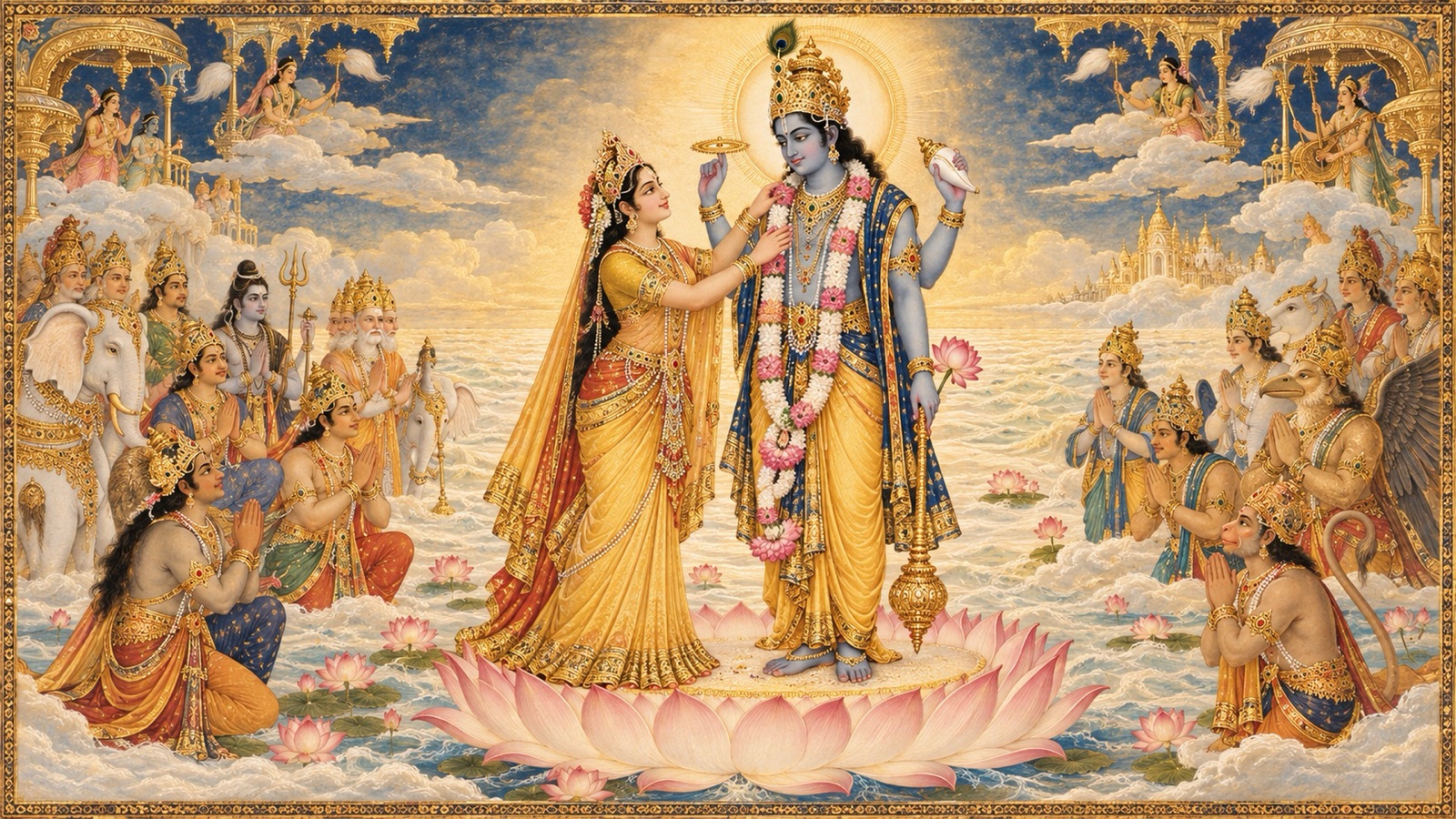
Placing the wreath of fresh lotuses upon His shoulders and attaining His bosom — her own eternal abode — she stood at His side. Lord Vishnu made His chest the permanent dwelling of the Goddess, the Mother of the three worlds; and ensconced there, Lakshmi blessed all creation with her benignant look. Then, looked upon by Sri, the gods and lords of creation grew rich in every good quality and attained supreme felicity — while the Daityas and Danavas, overlooked by Lakshmi, became dispirited, greedy, and devoid of shame.
The Nectar Rises and a Quarrel Breaks Out
The churning continued, and there appeared Varuni, the goddess presiding over wine, in the form of a lotus-eyed maiden, whom the demons took with the Lord’s tacit approval. Then, at last, arose a most wonderful personage — dark-hued and youthful, with strong arms, a conch-shaped neck, and reddish eyes, wearing a garland and bearing in his hands the jar of nectar for which all had laboured. Seeing the nectar, the demons at once seized the jar, and a bitter quarrel broke out among them. “I first! I first — not you!” they cried, snatching it from one another, while the weaker demons protested that the gods too deserved a share by the eternal law of common effort. Amity was abandoned, and their minds were seized by a thirst for the nectar.
The Lord Assumes His Enchanting Form
In that very moment, Lord Vishnu, who knows every means, assumed a most amazing and indescribable form — a wondrous maiden of surpassing beauty.
एतस्मिन्नन्तरे विष्णु: सर्वोपायविदीश्वर: । योषिद्रूपमनिर्देश्यं दधार परमाद्भुतम् ॥ ४१ ॥
etasminn antare viṣṇuḥ sarvopāya-vid īśvaraḥ yoṣid-rūpam anirdeśyaṁ dadhāra paramādbhutam
Meaning: At that moment Lord Vishnu, the Supreme Lord who knows all means, assumed an indescribable and most wonderful feminine form. (Canto 8, Chapter 8, verse 41)
This enchanting form, dark as a blue lotus and lovely in every limb, kindled fascination in the hearts of the demon generals with its gentle smiles and graceful movements. Absorbed in her beauty, the quarrelling demons forgot their strife — and the stage was set, as the next chapter will tell, for the Lord in this form of Mohini to deliver the nectar of immortality to the gods, who had earned it through their devotion.
Principal Teachings of This Chapter
1. True fortune seeks the faultless Lord, because only He needs nothing. Lakshmi examines the whole assembly and finds every candidate flawed: the austere still battles anger, the wise still carries attachment, the mighty still bows to lust, the pious still lacks compassion, the generous still falls short of liberation, and even the long-lived one is not free of blemish. Each virtue she finds is borrowed or incomplete, propped up by something its bearer still lacks. Only the Lord requires no support outside Himself — every excellence is naturally His own, never balanced against a fault. This is why scripture calls Him alone the Supreme Controller: not the greatest among many competitors, but the one being measured against nothing else at all. Fortune, rightly understood, is inseparable from a Lord who wants nothing from her (verses 19-23).
2. Devotion, not grasping, attracts grace. All present coveted Lakshmi, yet she gave herself to the one who desired nothing. What we clutch at flees us; what we surrender to the Lord is fulfilled (verses 9, 23).
3. The offerings we bring reveal our hearts. Each god and celestial honoured the Goddess with a fitting gift. Reverence expressed in humble offering is itself a form of worship (verses 10-16).
4. Grace uplifts, and its withdrawal impoverishes. Looked upon by Lakshmi, the gods grew rich in virtue; overlooked, the demons became greedy and shameless. Nearness to the divine ennobles; forgetfulness of it degrades (verses 28-29).
5. Selfish grasping breeds conflict. The moment the nectar appeared, the demons fell to quarrelling, each crying “I first!” Greed for a shared blessing turns kinsmen into rivals (verses 38-40).
A Devotional Reflection
The most beautiful moment in this chapter is a choice. Goddess Lakshmi — fortune herself, the prize every being in that vast assembly longed to possess — is not seized by the strongest or won by the cleverest. She moves freely through the crowd, weighing each one, and gives herself only to the Lord who wants nothing from her. There is a quiet lesson here about how blessing actually comes to us. We spend our lives grasping — for wealth, for security, for the good fortune that Lakshmi represents — and the harder we grasp, the more it slips away. The demons show us the end of that road: they seize the nectar and immediately fall to fighting, and in their greed they will lose it altogether. But the Lord, who reaches for nothing, becomes the eternal home of Fortune herself. To seek God for God’s own sake, and not for what He can give, is the surest way to receive everything. Lakshmi rests on the heart that is not trying to possess her.
A Daily Devotional Practice
Today, notice one thing you have been anxiously grasping after — a result, a recognition, a security you fear to lose — and consciously offer it into the Lord’s hands, releasing your grip. As you do, say quietly: “Om Namo Bhagavate Vasudevaya.” Ask not for the thing itself but for nearness to the Lord in whom all good things dwell, and trust, like the Goddess who chose the Lord desiring nothing, that what is truly yours will find its home in a heart at peace.
Conclusion
This eighth discourse leaves us with one image to carry forward: Fortune herself examined every claimant to greatness and found only One complete in Himself, needing nothing — and to Him alone she gave her eternal home. May we learn from Lakshmi’s choice, seeking the Lord not for what He grants but for who He is, trusting that the truest wealth belongs only to a heart that no longer grasps. What becomes of the nectar, and how the Lord’s enchanting form answers the devotees’ hope, the Bhagavatam tells us next.
May the divine wisdom of Srimad Bhagavatam awaken pure devotion within our hearts.
Om Namo Bhagavate Vasudevaya.
Jay Shree Madhav.
References and Attribution
- Primary edition: Gita Press, Śrīmad Bhāgavata Mahāpurāṇa (English, complete), Book Eight, Discourse 8, pages 767–771.
- Series: Srimad Bhagavatam Wisdom · Biswa Sanatan Dharma Seva Trust.
- Presented following the spiritual guidance and recommendation of Pandit Dr. Shri Kashinath Mishra.
This is an original, faithful retelling in the writer’s own words, with brief quoted verses shown in Devanāgarī and transliteration and their meanings given as summaries. It is not a reproduction of any single publisher’s continuous translation or commentary. No affiliation with or endorsement by any publisher is implied.
Jay Shree Madhav