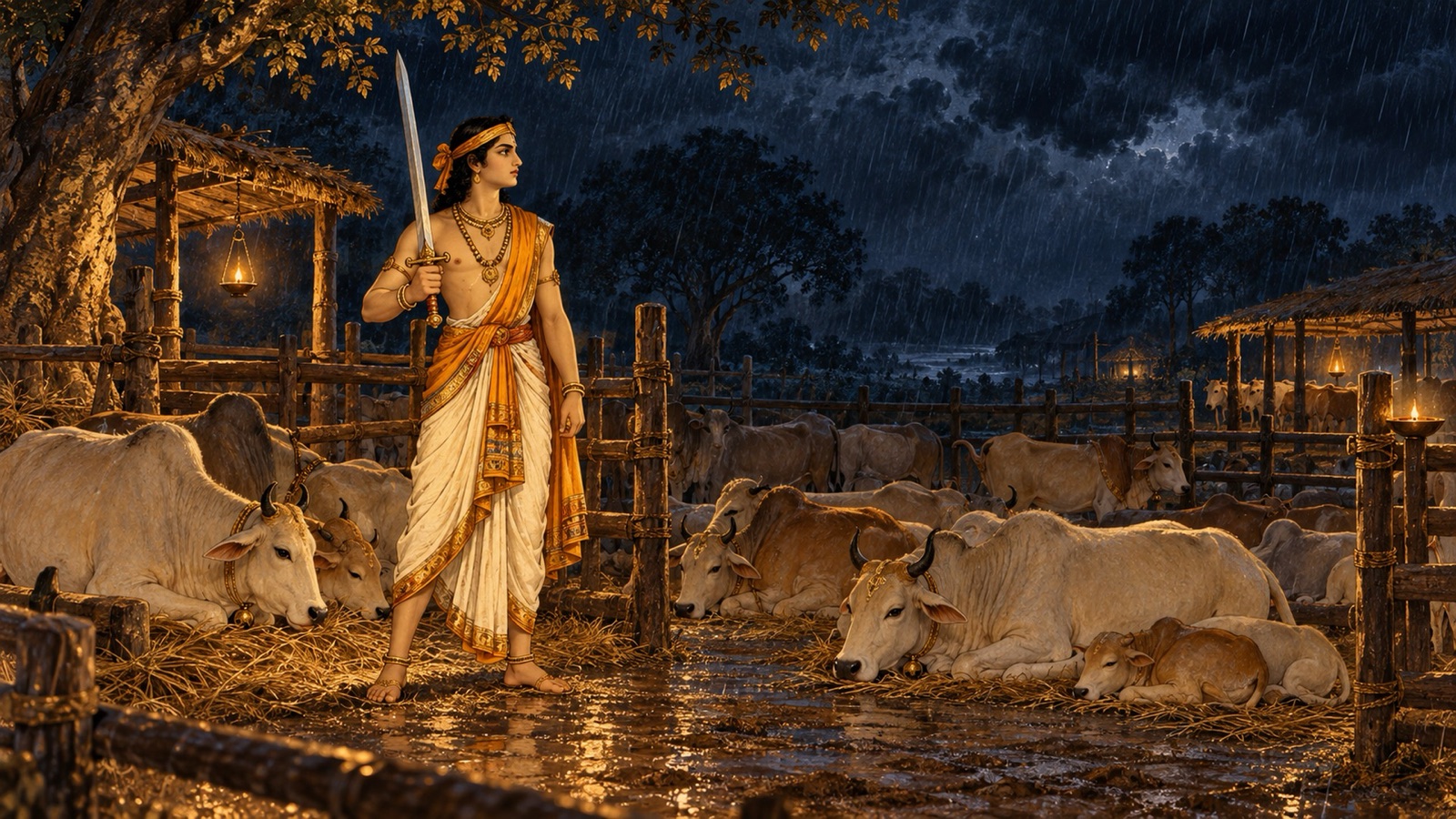
Sword in hand through a rain-swept night, the prince Prshadhra keeps watch over his father’s cows — a single lapse in that darkness will overturn his royal birth, yet lead him, in the end, straight to the Lord.
Om Namo Bhagavate Vasudevaya.
Om Namo Bhagavate Vasudevaya.
Om Namo Bhagavate Vasudevaya.
Welcome to Srimad Bhagavatam Wisdom, a devotional journey through the sacred histories and teachings of the Srimad Bhagavat Mahapurana. With Sudyumna now settled in the forest, King Parikshit turns to hear of Vaivaswata Manu’s remaining sons and the great families descended from them — a chapter of lineages whose branching names conceal some of the most striking devotional lives in the whole Canto.
Chapter Information
- Scripture: Śrīmad Bhāgavata Mahāpurāṇa
- Canto: 9 (Book Nine)
- Chapter: 2 (Discourse 2)
- Chapter title: The Posterity of the Sons of Manu
- Principal speaker: Sukadeva Gosvami, narrating to King Parikshit — the whole related by Suta Gosvami to the sage Saunaka and the assembly of sages at Naimisaranya
- Principal listener: King Parikshit
- Main setting: The bank of the Ganga, where Sukadeva instructs Parikshit; the narrative ranges from Manu’s penance on the Yamuna to the cowpens, forests and royal courts of his descendants
- Central subject: The families descended from Manu’s sons — the devotional lives of Prshadhra and Kavi, and the lines of Karushaka, Dhrshta, Narishyanta and Dishta, including the emperor Marutta and the house of Trnabindu
- Principal verse range: Canto 9, Chapter 2, verses 1–36
- Primary edition: Gita Press Śrīmad Bhāgavata Mahāpurāṇa
Manu’s Renewed Penance and His Ten Sons
With Sudyumna gone to the forest, Vaivaswata Manu — still longing for a son to continue his line — practised austerities for a hundred years on the banks of the Yamuna.
श्रीशुक उवाच एवं गतेऽथ सुद्युम्ने मनुर्वैवस्वत: सुते । पुत्रकामस्तपस्तेपे यमुनायां शतं समा: ॥ १ ॥
śrī-śuka uvāca evaṁ gate ’tha sudyumne manur vaivasvataḥ sute putra-kāmas tapas tepe yamunāyāṁ śataṁ samāḥ
Meaning: Sri Suka said: When his son Sudyumna had thus departed, Vaivaswata Manu, desirous of offspring, practised austerity on the banks of the Yamuna for a hundred years. (Canto 9, Chapter 2, verse 1)
Then, worshipping the almighty Lord Sri Hari for the sake of progeny, Manu obtained ten sons who resembled him, the eldest being Ikshvaku — the fountainhead of the solar dynasty whose glories fill the chapters ahead.
ततोऽयजन्मनुर्देवमपत्यार्थं हरिं प्रभुम् । इक्ष्वाकुपूर्वजान् पुत्रान्लेभे स्वसदृशान् दश ॥ २ ॥
tato ’yajan manur devam apatyārthaṁ hariṁ prabhum ikṣvāku-pūrvajān putrān lebhe sva-sadṛśān daśa
Meaning: Then Manu worshipped the almighty Lord Sri Hari for the sake of offspring, and obtained ten sons resembling himself, with Ikshvaku the foremost. (Canto 9, Chapter 2, verse 2)
Prshadhra the Cowherd
Among these sons was Prshadhra, who had been set to the task of tending cows by his family preceptor, the sage Vasistha. Night after night he guarded the herd, vigilant and unsleeping, keeping the austere vow of the vira-asana — standing watch through the dark hours, sword in hand.
पृषध्रस्तु मनो: पुत्रो गोपालो गुरुणा कृत: । पालयामास गा यत्तो रात्र्यां वीरासनव्रत: ॥ ३ ॥
pṛṣadhras tu manoḥ putro go-pālo guruṇā kṛtaḥ pālayām āsa gā yatto rātryāṁ vīrāsana-vrataḥ
Meaning: But Prshadhra, a son of Manu, made a cowherd by his preceptor, guarded the cows attentively at night, observing the vow of remaining watchful, sword in hand. (Canto 9, Chapter 2, verse 3)
The Tragic Night
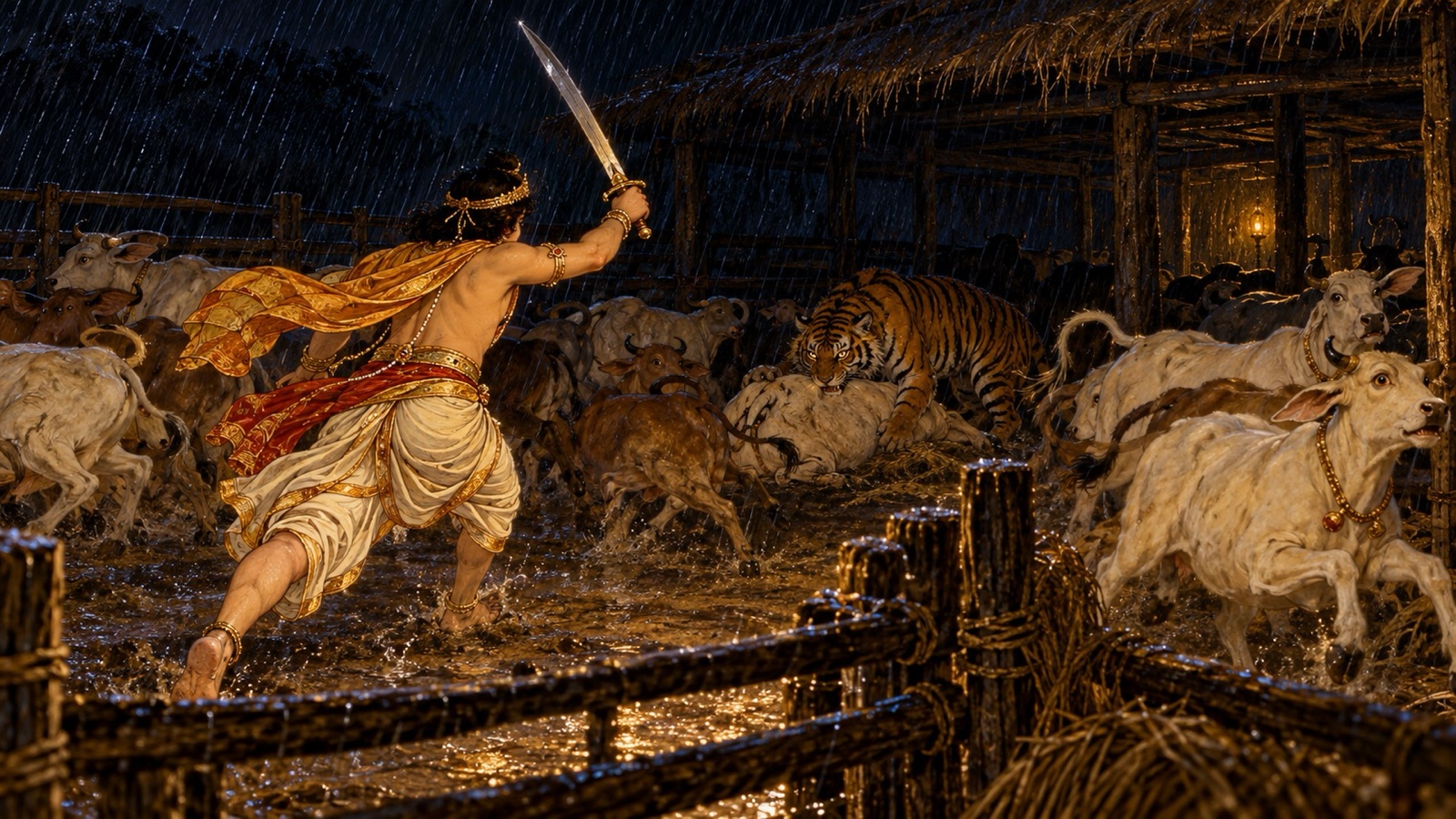
One rainy night a tiger slipped into the cowpen. The resting cows leapt up in terror and scattered, and the powerful beast seized one of them. Hearing the stricken animal’s cry, Prshadhra rushed to the rescue, sword drawn. But the clouds had swallowed the stars, and in that total darkness he mistook the terrified, red-brown cow for the tiger and, with a single swift stroke, cut off her head. The tiger — grazed by the sword’s edge and one ear severed — fled bleeding into the night. When dawn came and Prshadhra saw that he had slain the very cow he meant to save, he was overwhelmed with grief.
एकां जग्राह बलवान् सा चुक्रोश भयातुरा । तस्यास्तु क्रन्दितं श्रुत्वा पृषध्रोऽनुससार ह ॥ ५ ॥ खड्गमादाय तरसा प्रलीनोडुगणे निशि । अजानन्नच्छिनोद् बभ्रो: शिर: शार्दूलशङ्कया ॥ ६ ॥
ekāṁ jagrāha balavān sā cukrośa bhayāturā tasyās tu kranditaṁ śrutvā pṛṣadhro ’nusasāra ha khaḍgam ādāya tarasā pralīnoḍu-gaṇe niśi ajānann acchinod babhroḥ śiraḥ śārdūla-śaṅkayā
Meaning: The powerful tiger seized one cow, and she cried out in terror. Hearing her cry, Prshadhra rushed after it, sword in hand; and in the night, when the stars had vanished, he unknowingly cut off the head of the red-brown cow, mistaking her for the tiger. (Canto 9, Chapter 2, verses 5-6)
The Curse That Became a Blessing
When the sin came to light — the slaying of a cow, even though wholly unintended — his family preceptor Vasistha pronounced a curse upon him: because of this act he would no longer remain a Kshatriya but would fall to the state of a Shudra.
तं शशाप कुलाचार्य: कृतागसमकामत: । न क्षत्रबन्धु: शूद्रस्त्वं कर्मणा भवितामुना ॥ ९ ॥
taṁ śaśāpa kulācāryaḥ kṛtāgasam akāmataḥ na kṣatra-bandhuḥ śūdras tvaṁ karmaṇā bhavitāmunā
Meaning: The family preceptor cursed him, though he had committed the offence unintentionally: “By this act you shall no longer be a Kshatriya, but shall become a Shudra.” (Canto 9, Chapter 2, verse 9)
Prshadhra did not argue or protest. With folded hands he silently accepted the imprecation, and from that day embraced a life of lifelong celibacy and strict continence — the vow so dear to ascetics. Friendly and equal to every living being, he turned the whole of his heart, through unswerving devotion, to Lord Vasudeva, the Self of all, supreme and without blemish. Free of attachment and of possessions, his senses fully controlled, he lived on whatever came to him by chance and wandered the earth in perfect composure, appearing to the world like a dull, blind and deaf man while inwardly satisfied by wisdom alone.
वासुदेवे भगवति सर्वात्मनि परेऽमले । एकान्तित्वं गतो भक्त्या सर्वभूतसुहृत् सम: ॥ ११ ॥ विमुक्तसङ्ग: शान्तात्मा संयताक्षोऽपरिग्रह: । यदृच्छयोपपन्नेन कल्पयन् वृत्तिमात्मन: ॥ १२ ॥ आत्मन्यात्मानमाधाय ज्ञानतृप्त: समाहित: । विचचार महीमेतां जडान्धबधिराकृति: ॥ १३ ॥
vāsudeve bhagavati sarvātmani pare ’male ekāntitvaṁ gato bhaktyā sarva-bhūta-suhṛt samaḥ vimukta-saṅgaḥ śāntātmā saṁyatākṣo ’parigrahaḥ yad-ṛcchayopapannena kalpayan vṛttim ātmanaḥ ātmany ātmānam ādhāya jñāna-tṛptaḥ samāhitaḥ vicacāra mahīm etāṁ jaḍāndha-badhirākṛtiḥ
Meaning: With single-hearted devotion he took exclusive refuge in Lord Vasudeva, the Self of all, supreme and stainless — a friend and equal to every being. Free from attachment, serene, his senses controlled, owning nothing, sustaining himself with whatever came unsought, resting the self in the Self, contented by wisdom and fully composed, he wandered this earth in the guise of a dull, blind and deaf man. (Canto 9, Chapter 2, verses 11-13)
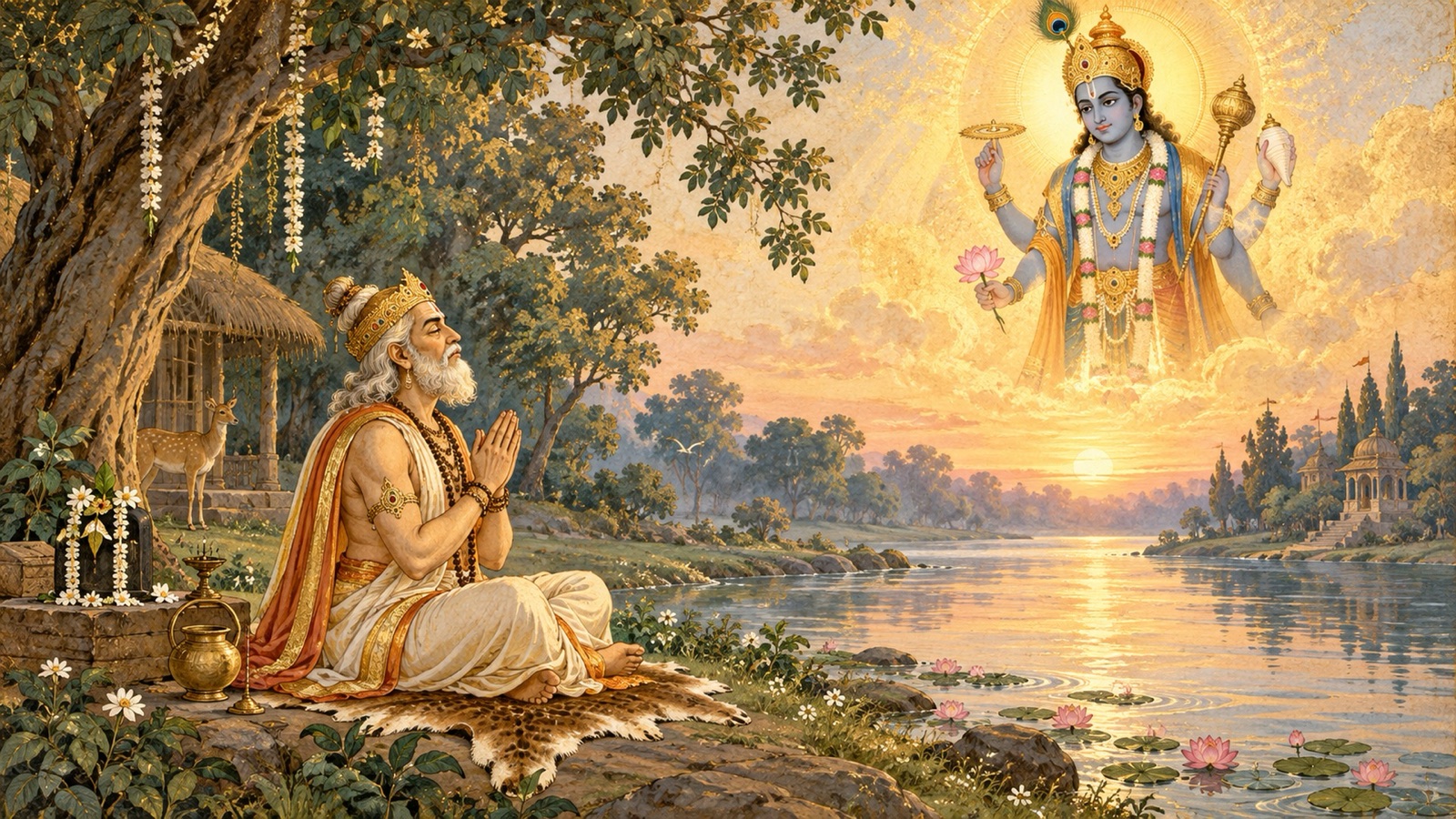
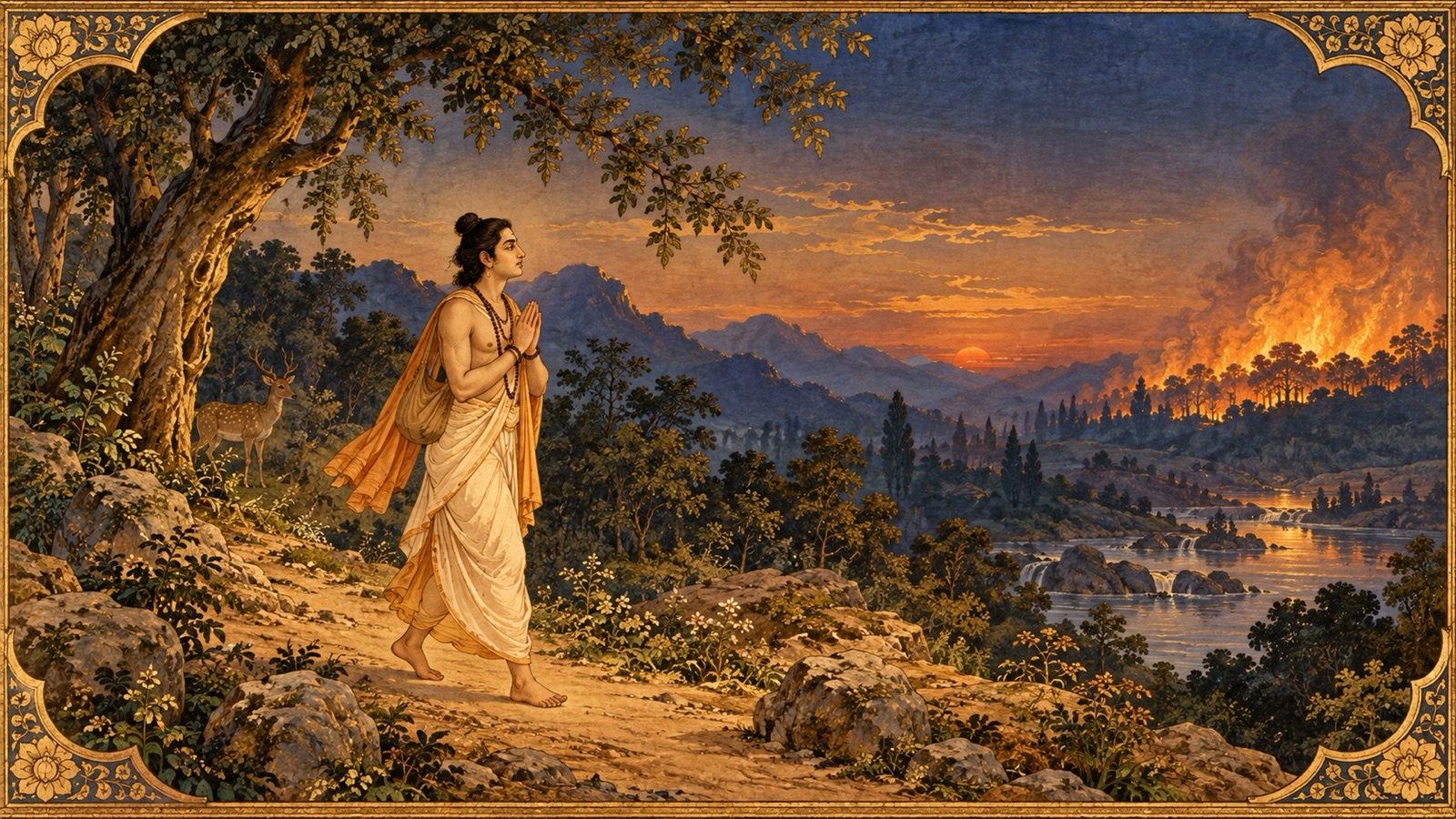
At last, living in this way, he entered a forest and, seeing a great wild fire blazing, offered his body to the flames — and so the sage attained the supreme Brahman.
एवं वृत्तो वनं गत्वा दृष्ट्वा दावाग्निमुत्थितम् । तेनोपयुक्तकरणो ब्रह्म प्राप परं मुनि: ॥ १४ ॥
evaṁ vṛtto vanaṁ gatvā dṛṣṭvā dāvāgnim utthitam tenopayukta-karaṇo brahma prāpa paraṁ muniḥ
Meaning: Living thus, he went to the forest and, seeing a wild fire arisen, gave up his body in it; and the sage attained the supreme Brahman. (Canto 9, Chapter 2, verse 14)
Here lies the chapter’s deepest lesson. Vasistha’s curse was not vague — it fixed Prshadhra’s very next birth as a Shudra, a specific and spoken decree of karma. Yet from the hour he turned his whole heart to Vasudeva in unbroken devotion (verses 11-13), that decree was quietly set aside: when at last he gave up his body in the forest fire, he did not descend to a lower birth at all, but “attained the supreme Brahman” (verse 14). This is what a devotee is meant to carry away from Prshadhra’s story — bhakti does not merely soften the fruit of past karma, it can override even a specific, named sentence of it. No plea, no penance and no clever argument freed him from Vasistha’s word; only surrender to the Lord did.
Kavi’s Youthful Renunciation
The youngest of Manu’s sons, Kavi, was utterly without appetite for the pleasures of the senses. While still a mere youth, he gave up his kingdom along with his kinsfolk, enshrined the self-effulgent Supreme Person within his heart, entered the forest, and attained the Supreme.
कवि: कनीयान् विषयेषु नि:स्पृहो विसृज्य राज्यं सह बन्धुभिर्वनम् । निवेश्य चित्ते पुरुषं स्वरोचिषं विवेश कैशोरवया: परं गत: ॥ १५ ॥
kaviḥ kanīyān viṣayeṣu niḥspṛho visṛjya rājyaṁ saha bandhubhir vanam niveśya citte puruṣaṁ sva-rociṣaṁ viveśa kaiśora-vayāḥ paraṁ gataḥ
Meaning: Kavi, the youngest, free from all craving for sense-objects, renounced his kingdom together with his kinsfolk while still in his boyhood, and, enshrining the self-luminous Supreme Person in his heart, entered the forest and reached the Supreme. (Canto 9, Chapter 2, verse 15)
The Lines of Karushaka, Dhrshta and Narishyanta
Sukadeva then traces the families that sprang from Manu’s remaining sons. From Karushaka descended the Kshatriyas known as the Karushas — devoted to the Brahmanas and lovers of righteousness — who became the guardians of the northern regions.
करूषोन्मानवादासन् कारूषो: क्षत्रजातय: । उत्तरापथगोप्तारो ब्रह्मण्या धर्मवत्सला: ॥ १६ ॥
karūṣān mānavād āsan kārūṣāḥ kṣatra-jātayaḥ uttarā-patha-goptāro brahmaṇyā dharma-vatsalāḥ
Meaning: Manu’s son Karushaka fathered a warrior line, upright in dharma and generous toward the Brahmanas, who came to guard and govern the northern territories. (Canto 9, Chapter 2, verse 16)
From Dhrshta sprang the clan of the Dharshtas, who — though born Kshatriyas — attained the status of Brahmanas in this very life. From Nrga came a line running through Sumati, Bhutajyoti and Vasu down to Pratika, Oghavan, and Oghavan’s daughter Oghavati, whom Sudarshana married. The line of Narishyanta ran through Chitrasena, Rksa, Midhvan, Purna, Indrasena, Vitihotra, Satyashrava, Urushrava and Devadatta. From Devadatta was born Agnivesya, who was none other than the fire-god Agni himself, later renowned as the seer Kanina or Jatukarnya, and from him arose the line of Brahmanas called the Agnivesyayanas.
Emperor Marutta and the Line of Dishta
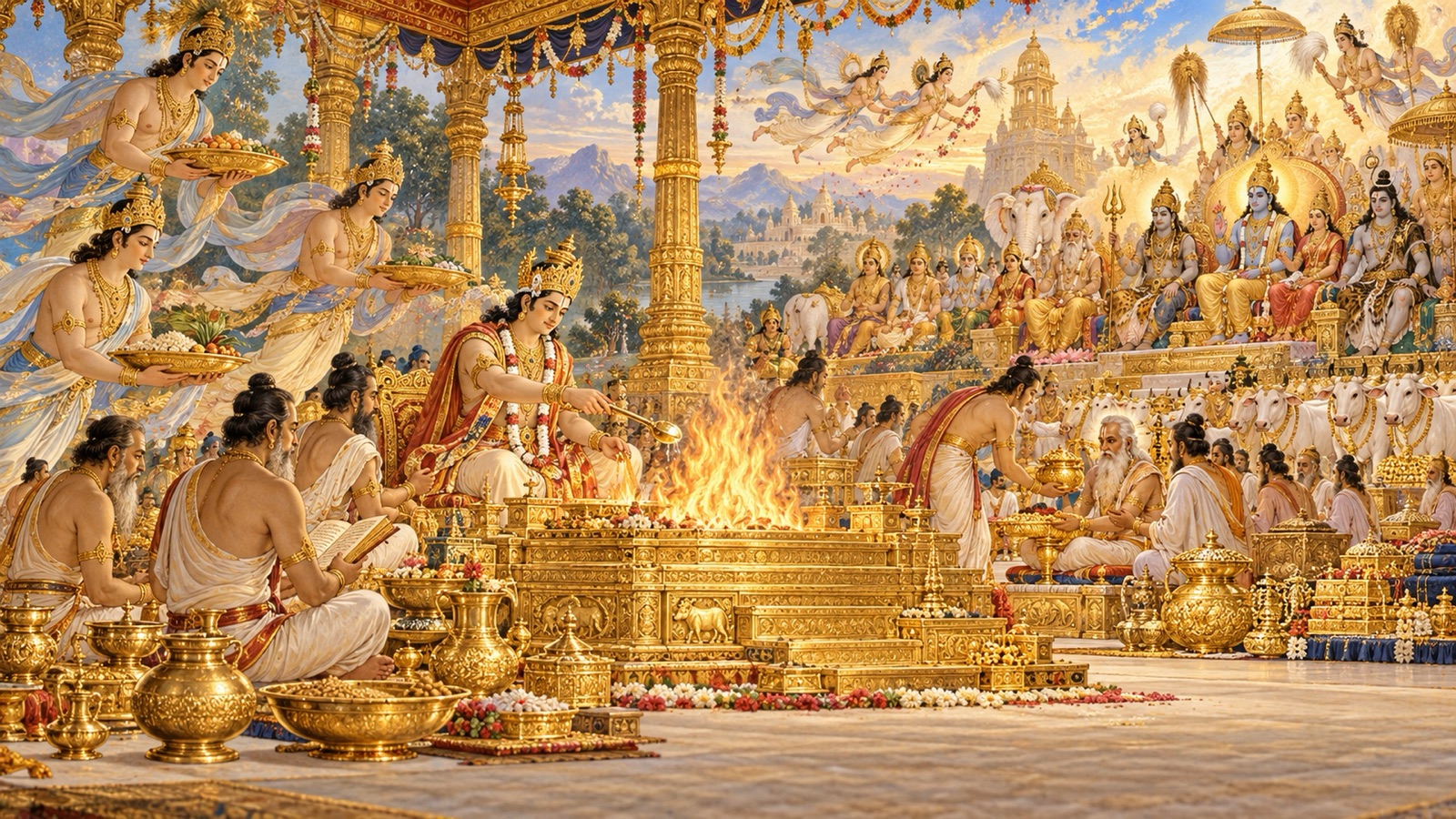
Turning to the line of Dishta, Sukadeva names Nabhaga — degraded to the rank of a Vaishya through his chosen pursuits — and after him Bhalandana, Vatsapriti, Pramshu, Pramati, Khanitra, Chakshusha, Vivimshati, Rambha and the virtuous Khaninetra, down to Karandhama and his son Aviksit. Aviksit’s son was Marutta, who became a mighty emperor and was helped in his great sacrifice by the renowned Yogi Samvarta, son of the sage Angira. No sacrifice performed by anyone else has ever equalled the sacrifice of Marutta: everything beautiful in it was fashioned of pure gold.
मरुत्तस्य यथा यज्ञो न तथान्योऽस्ति कश्चन । सर्वं हिरण्मयं त्वासीद् यत् किञ्चिच्चास्य शोभनम् ॥ २७ ॥
maruttasya yathā yajño na tathānyo ’sti kaścana sarvaṁ hiraṇmayaṁ tv āsīd yat kiñcic cāsya śobhanam
Meaning: No one else’s sacrifice was ever like that of Marutta; whatever was beautiful in it was made entirely of gold. (Canto 9, Chapter 2, verse 27)
So glorious was that offering that Indra himself grew intoxicated on its Soma, the Brahmanas were fully sated with lavish gifts, the forty-nine Maruts served the food, and the Vishvedevas sat as members of the assembly.
अमाद्यदिन्द्र: सोमेन दक्षिणाभिर्द्विजातय: । मरुत: परिवेष्टारो विश्वेदेवा: सभासद: ॥ २८ ॥
amādyad indraḥ somena dakṣiṇābhir dvijātayaḥ marutaḥ pariveṣṭāro viśvedevāḥ sabhā-sadaḥ
Meaning: Indra grew exhilarated by the Soma; the Brahmanas by the gifts of wealth. The Maruts served the food, and the Vishvedevas were the members of the assembly. (Canto 9, Chapter 2, verse 28)
The House of Trnabindu and the City of Vaisali
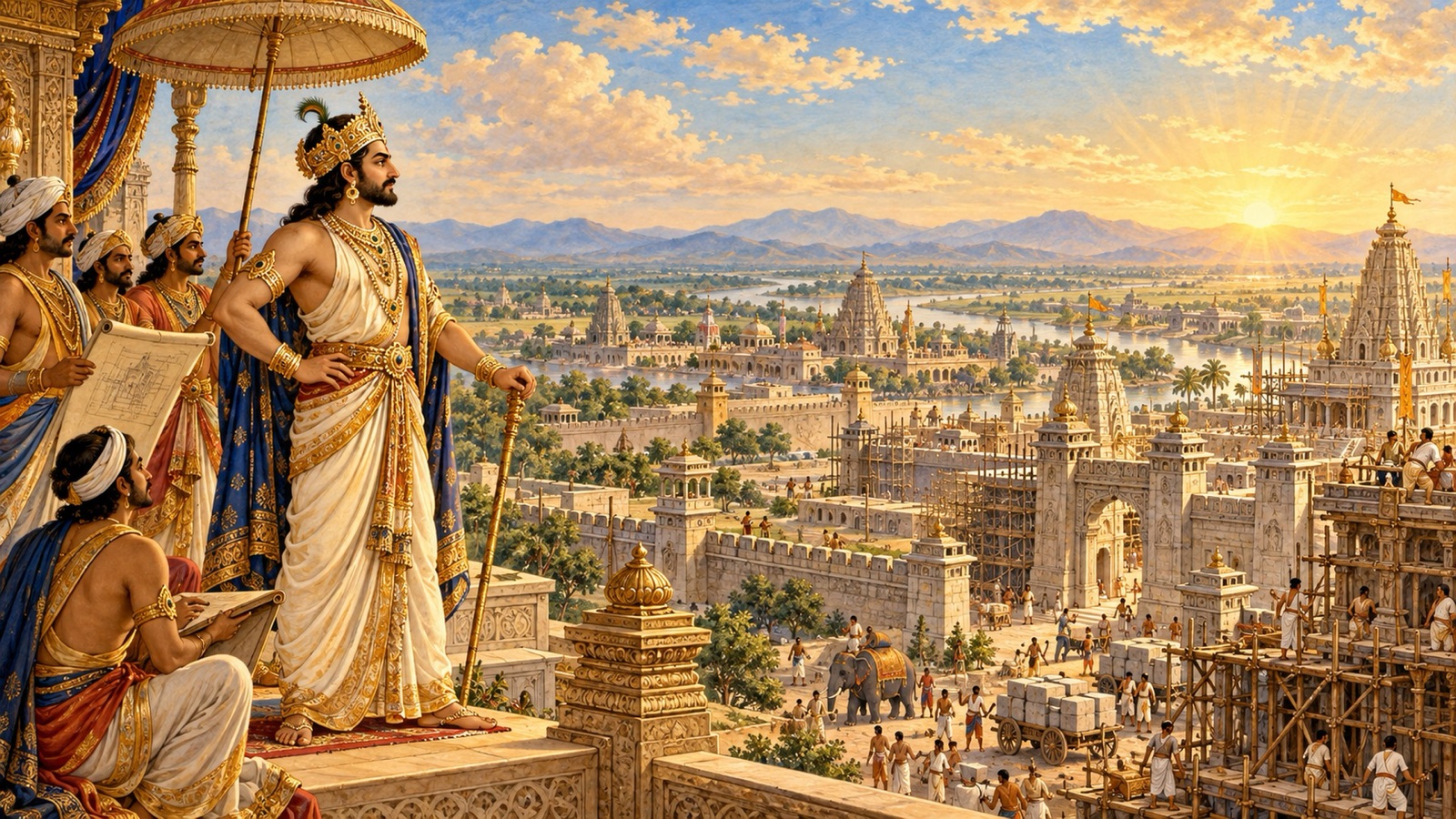
From Marutta the line continued through Dama, Rajyavardhana, Sudhrti, Nara, Kevala, Dhundhuman, Vegavan and Budha, down to the celebrated King Trnabindu. So rich was he in noble qualities that the celestial nymph Alambusa, foremost of the apsaras, chose him for her husband; from their union came several sons and a daughter, Idavida. Through Idavida, the sage Vishrava — having received the highest knowledge from his own father, the sage Pulastya — begot the god Kubera, bestower of riches. Among Trnabindu’s sons were Vishala, Shunyabandhu and Dhumraketu; and it was Vishala, the founder of the line, who built the famous city of Vaisali.
विशाल: शून्यबन्धुश्च धूम्रकेतुश्च तत्सुता: । विशालो वंशकृद् राजा वैशालीं निर्ममे पुरीम् ॥ ३३ ॥
viśālaḥ śūnyabandhuś ca dhūmraketuś ca tat-sutāḥ viśālo vaṁśa-kṛd rājā vaiśālīṁ nirmame purīm
Meaning: Vishala, Shunyabandhu and Dhumraketu were his sons. Vishala, the founder of the line, a king, built the city of Vaisali. (Canto 9, Chapter 2, verse 33)
The house of Vishala continued through Hemachandra, Dhumraksha, Samyama, Krishashva — with his brother Devaja — and Somadatta, who worshipped the Supreme Lord through many horse-sacrifices and, relying wholly on Him, attained the highest goal. From Somadatta came Sumati, and Sumati’s son Janamejaya. These were the kings born in Vishala’s line, who preserved to the last the glory of their ancestor Trnabindu.
Principal Teachings of This Chapter
1. Even an unintended wrong carries consequences — yet devotion transcends them. Prshadhra kills the cow entirely by accident, and still the law of action falls upon him. But rather than being destroyed by his fate, he transforms it into the doorway to God-realization (verses 5-14).
2. Humble acceptance is greater than self-defence. When cursed, Prshadhra offers no protest; with folded hands he accepts his preceptor’s word in silence and turns wholly to the Lord. His humility is the seed of his liberation (verses 9-11).
3. Renunciation can bloom at any age. The youthful Kavi walks away from a kingdom before the world can grip him, showing that detachment is not the fruit of old age but of a heart already fixed on the Supreme Person (verse 15).
4. Even the grandest worldly glory finds its worth in the Lord. Marutta’s incomparable golden sacrifice, and Somadatta’s horse-sacrifices, are remembered not for their opulence alone but because they were offered to the Supreme Lord, through whom they reached their true fruit (verses 27-28, 35).
5. A dynasty is a chain of remembrance. The long roll of names is itself a devotional act — a reminder that each generation is a link binding the present back to Manu, and through Manu to the Lord from whom all lines flow (verses 16-36).
A Devotional Reflection
Prshadhra’s story lingers in the heart long after the genealogies have blurred. Here is a prince who does everything right — keeps a hard vow, stands guard through the storm, races to save a helpless creature — and in one instant of darkness, through no malice of his own, brings ruin upon himself. How easily his life could have curdled into bitterness: I meant only good; why should I suffer? Instead, he bows his head, accepts what has come, and quietly gives the rest of his days to the Lord. The curse that lowered his birth could not lower his soul; stripped of rank and possessions, he becomes freer than any king in this chapter. There is a deep comfort in this for us. Our own reversals are rarely so dramatic, but the pattern is the same: something goes wrong that we did not intend, and we are tempted to protest our innocence to the sky. Prshadhra shows another way — to take even undeserved hardship as an invitation to let go of everything but God, and to discover, in that letting go, a peace the world can neither give nor take away.
A Daily Devotional Practice
Today, recall one situation in which you were blamed, or suffered a loss, for something that was not truly your fault. Notice the urge to defend yourself, to rehearse your innocence. For a few quiet minutes, set that urge down as Prshadhra set down his sword, and instead turn your heart toward the Lord, repeating gently: “Om Namo Bhagavate Vasudevaya.” Ask not to be proved right, but to be drawn nearer to Him through this very difficulty — as Prshadhra was drawn from a cowpen in the dark all the way to the supreme goal.
Conclusion
The second chapter of Book Nine may open like a register of names, but its deepest teaching is Prshadhra’s: that wholehearted devotion to Lord Vasudeva can override even a specific, spoken sentence of karma, carrying the soul past birth and rebirth to the Lord Himself. Kavi’s fearless renunciation, Marutta’s golden sacrifice and the long house of Trnabindu each confirm the same truth in their own idiom — that rank, wealth and even a curse matter less than where the heart is anchored. Sukadeva sets these lives before Parikshit, and before us, as one invitation: to measure a life by its nearness to the Lord from whom the whole great lineage descends.
May the divine wisdom of Srimad Bhagavatam awaken pure devotion within our hearts.
Om Namo Bhagavate Vasudevaya.
Jay Shree Madhav.
References and Attribution
- Primary edition: Gita Press, Śrīmad Bhāgavata Mahāpurāṇa (English, complete), Book Nine, Discourse 2, pages 5–7.
- Series: Srimad Bhagavatam Wisdom · Biswa Sanatan Dharma Seva Trust.
- Presented following the spiritual guidance and recommendation of Pandit Dr. Shri Kashinath Mishra.
This is an original, faithful retelling in the writer’s own words, with brief quoted verses shown in Devanāgarī and transliteration and their meanings given as summaries. It is not a reproduction of any single publisher’s continuous translation or commentary. No affiliation with or endorsement by any publisher is implied.
Jay Shree Madhav