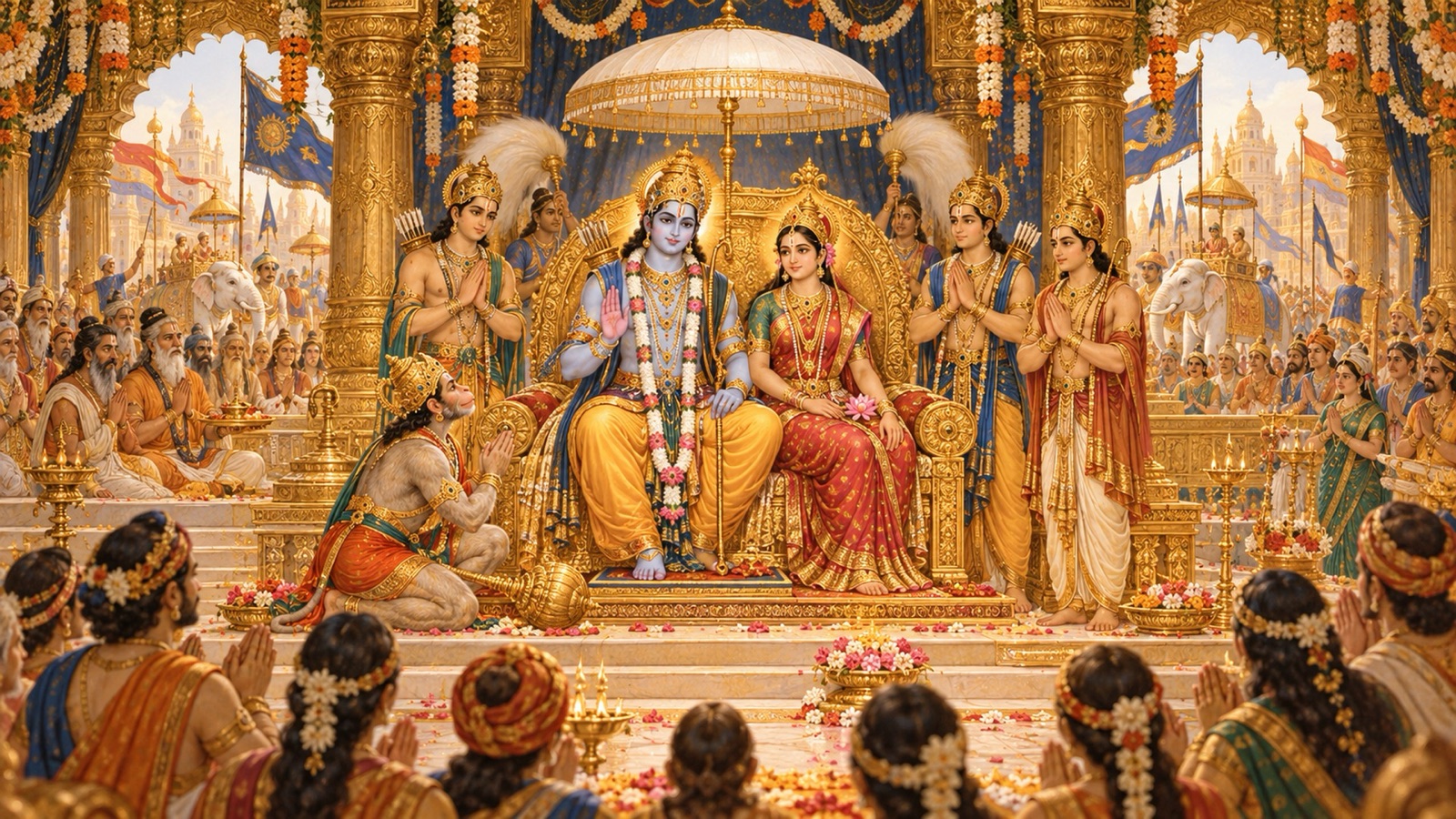
Returned to Ayodhya after fourteen years, Lord Ramachandra is enthroned with Sita at His side and His brothers and devoted servants in attendance — the dawn of the age remembered ever after as Rama-rajya, the perfect reign.
Om Namo Bhagavate Vasudevaya.
Om Namo Bhagavate Vasudevaya.
Om Namo Bhagavate Vasudevaya.
Welcome to Srimad Bhagavatam Wisdom, a devotional journey through the sacred histories and teachings of the Srimad Bhagavat Mahapurana. This tenth chapter of Book Nine gathers the whole story of Lord Ramachandra — the Supreme Lord Himself descending as the son of King Dasaratha — into the devotional summary Sukadeva offers King Parikshit, every event pointing to the Lord’s mercy, His righteousness, and the perfection of His conduct as an ideal king, husband, brother and son.
Chapter Information
- Scripture: Śrīmad Bhāgavata Mahāpurāṇa
- Canto: 9 (Book Nine)
- Chapter: 10 (Discourse 10)
- Chapter title: The Pastimes of Lord Ramachandra
- Principal speaker: Sukadeva Gosvami, narrating to King Parikshit — the whole related by Suta Gosvami to the sage Saunaka and the assembly of sages at Naimisaranya
- Principal listener: King Parikshit
- Main setting: Ayodhya and the kingdom of Kosala; the forests of the Lord’s exile; the ocean shore and Lanka
- Central subject: The advent and pastimes of Lord Ramachandra — the winning of Sita, the exile, the abduction and recovery of Sita, the slaying of Ravana, and the establishment of the ideal reign of Rama-rajya
- Principal verse range: Canto 9, Chapter 10, verses 1–55
- Primary edition: Gita Press Śrīmad Bhāgavata Mahāpurāṇa
The Lord Appears as the Son of Dasaratha
Sukadeva carried the solar line forward: from Khatwanga came Dirghabahu, from him the renowned Raghu, from Raghu the great King Aja, and from Aja, King Dasaratha. Entreated by the gods, Lord Sri Hari Himself — who is entirely constituted of Brahma, the Absolute — became the son of Dasaratha, appearing in four forms as Sri Rama, Bharata, Lakshmana and Satrughna: the Lord in His fullness, and His brothers as His parts.
तस्यापि भगवानेष साक्षाद् ब्रह्ममयो हरि: । अंशांशेन चतुर्धागात् पुत्रत्वं प्रार्थित: सुरै: । रामलक्ष्मणभरतशत्रुघ्ना इति संज्ञया ॥ २ ॥
tasyāpi bhagavān eṣa sākṣād brahmamayo hariḥ aṁśāṁśena caturdhāgāt putratvaṁ prārthitaḥ suraiḥ rāma-lakṣmaṇa-bharata- śatrughnā iti saṁjñayā
Meaning: Entreated by the gods, that very Lord Hari, transcendental and full of Brahman, appeared as the son of Dasaratha, expanding into four — Himself and His portions — under the names Rama, Lakshmana, Bharata and Satrughna. (Canto 9, Chapter 10, verse 2)
Sukadeva noted that the full story of Sri Rama, the husband of Sita, had already been told by realized seers such as Valmiki and heard by Parikshit again and again, and so he would offer it here in a devotional summary. He then gave a benediction in a single sweeping verse: for His father’s sake the Lord gave up His kingdom and wandered from forest to forest on lotus feet too soft even for Sita’s touch, His weariness soothed by Hanuman and Lakshmana; angered by the disfiguring of Surpanakha and the loss of His beloved, the very knitting of His brows terrified the ocean; He bridged the sea and consumed the wicked demons like a forest fire. May that Lord of Kosala protect us.
गुर्वर्थे त्यक्तराज्यो व्यचरदनुवनं पद्मपद्भ्यां प्रियाया: पाणिस्पर्शाक्षमाभ्यां मृजितपथरुजो यो हरीन्द्रानुजाभ्याम् । वैरूप्याच्छूर्पणख्या: प्रियविरहरुषारोपितभ्रूविजृम्भ- त्रस्ताब्धिर्बद्धसेतु: खलदवदहन: कोसलेन्द्रोऽवतान्न: ॥ ४ ॥
gurv-arthe tyakta-rājyo vyacarad anuvanaṁ padma-padbhyāṁ priyāyāḥ pāṇi-sparśākṣamābhyāṁ mṛjita-patha-rujo yo harīndrānujābhyām vairūpyāc chūrpaṇakhyāḥ priya-viraha-ruṣāropita-bhrū-vijṛmbha- trastābdhir baddha-setuḥ khala-dava-dahanaḥ kosalendro ’vatān naḥ
Meaning: For His father’s word He relinquished the throne and roamed from wood to wood on lotus feet too delicate for even His consort’s touch, His fatigue eased by Hanuman and His brother Lakshmana; when Surpanakha was left disfigured and His beloved was torn from Him, His fury alone — the mere arch of His brow — struck fear into the sea; that same Lord who spanned the ocean and consumed the wicked like a wildfire — may the King of Kosala shield us. (Canto 9, Chapter 10, verse 4)
The Bow of Siva and the Winning of Sita
In his boyhood the Lord, alone, defeated Marica and the other night-roaming demons who disturbed the sacrifice of the sage Visvamitra, while Lakshmana looked on. Then, in the assembly of world-famed heroes gathered for the choice-marriage of Princess Sita, He lifted the formidable bow of Lord Siva — a bow that three hundred men had carried into the hall — strung it, drew it, and snapped it in the middle as easily as a playful young elephant breaks a stick of sugar-cane.
यो लोकवीरसमितौ धनुरैशमुग्रं सीतास्वयंवरगृहे त्रिशतोपनीतम् । आदाय बालगजलील इवेक्षुयष्टिं सज्ज्यीकृतं नृप विकृष्य बभञ्ज मध्ये ॥ ६ ॥
yo loka-vīra-samitau dhanur aiśam ugraṁ sītā-svayaṁvara-gṛhe triśatopanītam ādāya bāla-gaja-līla ivekṣu-yaṣṭiṁ sajjyī-kṛtaṁ nṛpa vikṛṣya babhañja madhye
Meaning: In the assembly of the world’s heroes, in the hall of Sita’s choice-marriage, He took up the terrible bow of Lord Siva brought by three hundred men, strung it, and drawing it, broke it in the middle — playful as a young elephant snapping a stalk of sugar-cane. (Canto 9, Chapter 10, verse 6)
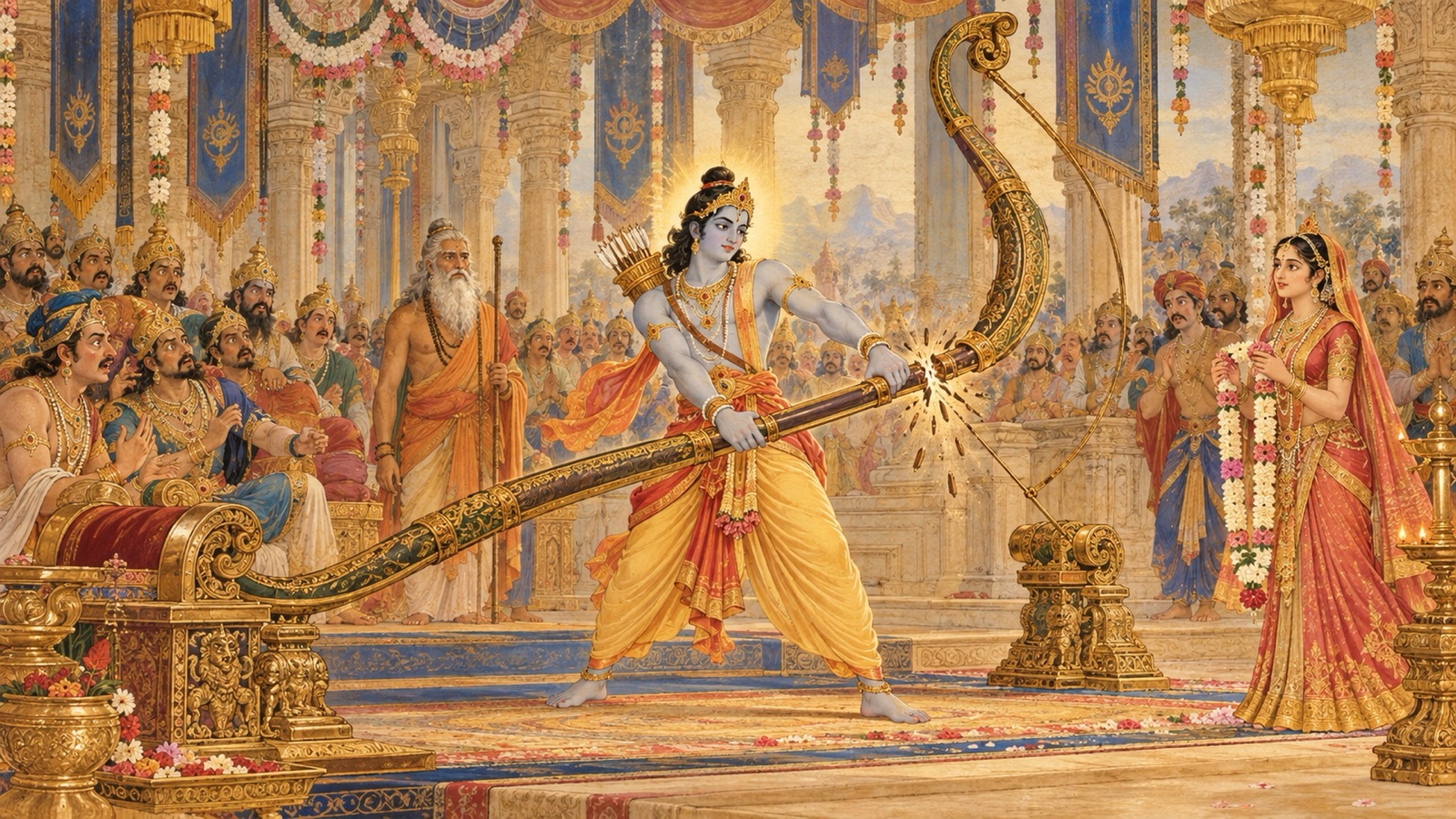
Having won Sita — the very Goddess of Fortune, matching Him in every virtue, disposition and grace — the Lord, on His way home, humbled the pride of Parasurama. Later, at the command of His truthful father, He bowed His head and gave up His claim to the throne, His royal fortune, His kin, friends and home, and left for the forest with His divine consort, as calmly as a liberated soul lays down the body.
Exile, and the Abduction of Sita
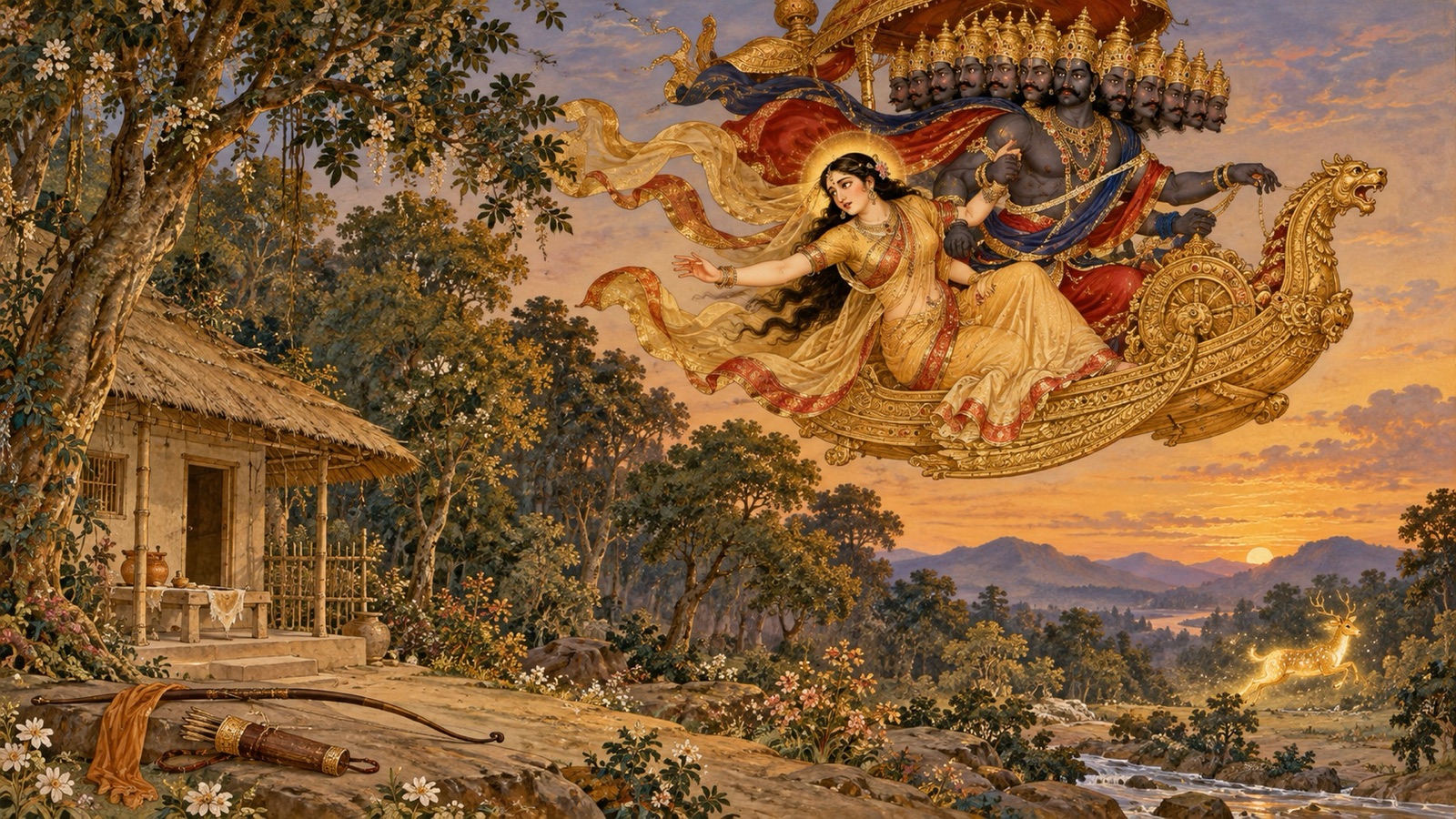
In the forest the Lord punished the wicked-minded Surpanakha by having her disfigured, and slew her demon kinsmen — Khara, Dushana, Trisira and fourteen thousand others. Then Ravana, inflamed by Surpanakha’s description of Sita, sent the demon Marica in the form of a golden deer to lure the Lord away; Rama slew Marica with a single arrow. In His absence Ravana, vilest of demons, carried Sita away like a wolf snatching a lamb. Separated from His beloved, the Lord wandered the forest with His brother like one bereft, showing the world the sorrowful plight of those attached to the objects of love.
रक्षोऽधमेन वृकवद् विपिनेऽसमक्षं वैदेहराजदुहितर्यपयापितायाम् । भ्रात्रा वने कृपणवत् प्रियया वियुक्त: स्त्रीसङ्गिनां गतिमिति प्रथयंश्चचार ॥ ११ ॥
rakṣo-’dhamena vṛkavad vipine ’samakṣaṁ vaideha-rāja-duhitary apayāpitāyām bhrātrā vane kṛpaṇavat priyayā viyuktaḥ strī-saṅgināṁ gatim iti prathayaṁś cacāra
Meaning: When the daughter of the King of Videha had been carried off in the forest by the vilest of demons, like a wolf carrying away a lamb, the Lord, parted from His beloved, wandered with His brother like a grief-stricken man — thus showing the plight that befalls those attached to the company of women. (Canto 9, Chapter 10, verse 11)
The Alliance and the Bridge Across the Sea
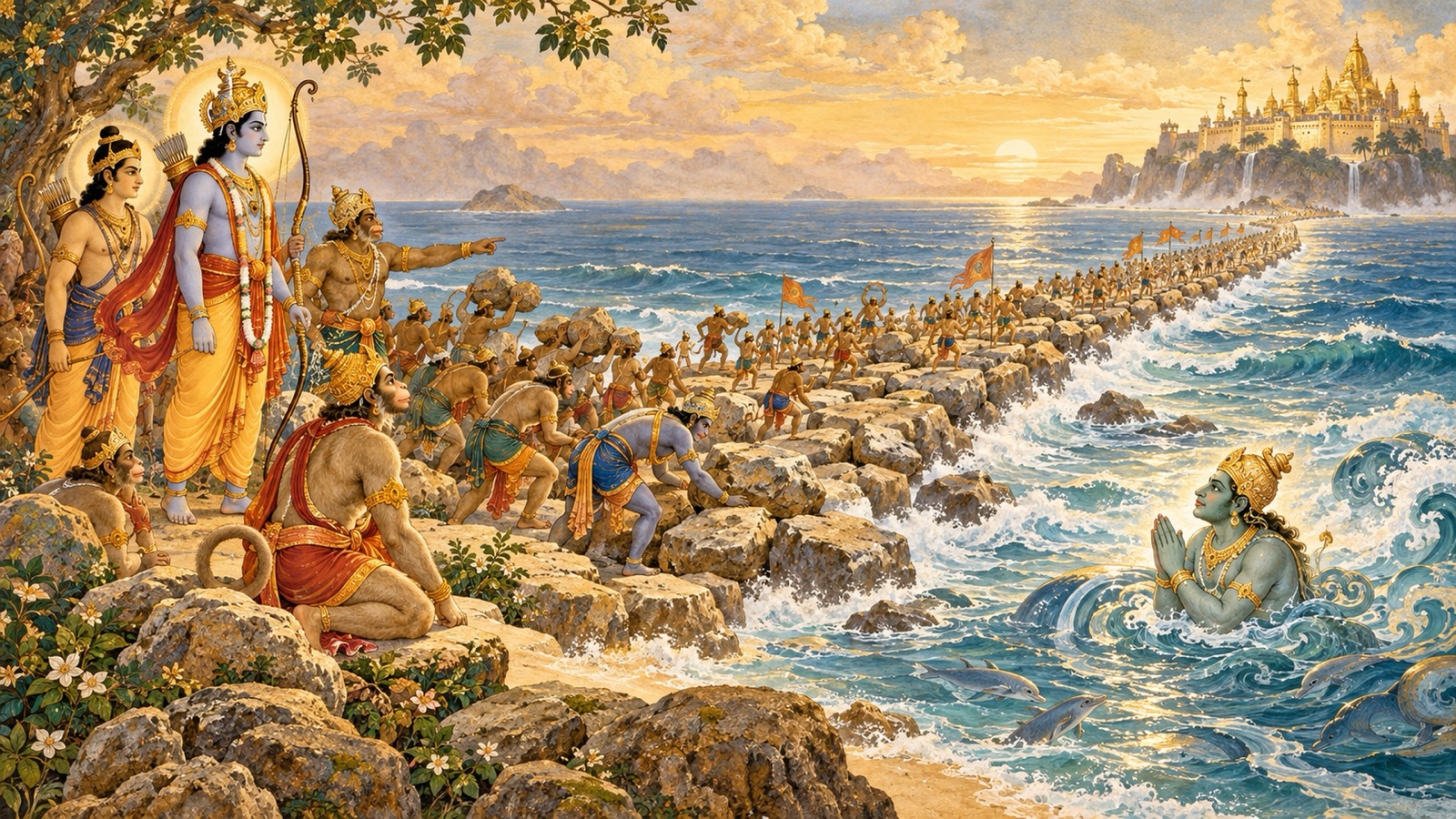
The Lord cremated the noble vulture-king Jatayu, who had died fighting Ravana for His sake, and slew the demon Kabandha. Befriending the monkeys, He killed Vali and learned from Sugriva’s forces where Sita was held; then, behaving as a human being though His feet are worshipped by Brahma and Siva, He marched with the monkey armies to the seashore. When the deity of the ocean at last approached Him in reverence, the Lord had a bridge built across the sea with mountain-peaks carried by the monkey chiefs, and with the armies led by Sugriva, Nila and Hanuman, and guided by Vibhishana, He entered Lanka — already burnt once by Hanuman.
बद्ध्वोदधौ रघुपतिर्विविधाद्रिकूटै: सेतुं कपीन्द्रकरकम्पितभूरुहाङ्गै: । सुग्रीवनीलहनुमत्प्रमुखैरनीकै- र्लङ्कां विभीषणदृशाविशदग्रदग्धाम् ॥ १६ ॥
baddhvodadhau raghu-patir vividhādri-kūṭaiḥ setuṁ kapīndra-kara-kampita-bhūruhāṅgaiḥ sugrīva-nīla-hanumat-pramukhair anīkair laṅkāṁ vibhīṣaṇa-dṛśāviśad agra-dagdhām
Meaning: Having thrown up a bridge across the ocean from mountain-peaks and from trees whose limbs the monkey chiefs shook loose, the Lord of Raghu’s line advanced into Lanka — already scorched once by Hanuman — with Sugriva, Nila and Hanuman commanding the ranks and Vibhishana as His guide. (Canto 9, Chapter 10, verse 16)
The Fall of Ravana
Enraged at the destruction of his forces, Ravana mounted his aerial car and attacked Sri Rama, who shone in a heavenly chariot brought by Indra’s charioteer Matali. Rebuking the demon king for the cowardly theft of Sita, the Lord fitted an arrow to His bow and released it; it pierced Ravana’s adamantine heart, and the demon fell from his car, vomiting blood through his ten mouths, as his people cried out in grief.
एवं क्षिपन् धनुषि संधितमुत्ससर्ज बाणं स वज्रमिव तद्धृदयं बिभेद । सोऽसृग् वमन् दशमुखैर्न्यपतद् विमाना- द्धाहेति जल्पति जने सुकृतीव रिक्त: ॥ २३ ॥
evaṁ kṣipan dhanuṣi sandhitam utsasarja bāṇaṁ sa vajram iva tad-dhṛdayaṁ bibheda so ’sṛg vaman daśa-mukhair nyapatad vimānād dhāheti jalpati jane sukṛtīva riktaḥ
Meaning: Rebuking him thus, the Lord released the arrow fitted to His bow, and like a thunderbolt it pierced Ravana’s heart; vomiting blood through his ten mouths, the demon fell from his aerial car amid the cries of his people — like a once-virtuous soul falling when his merit is spent. (Canto 9, Chapter 10, verse 23)
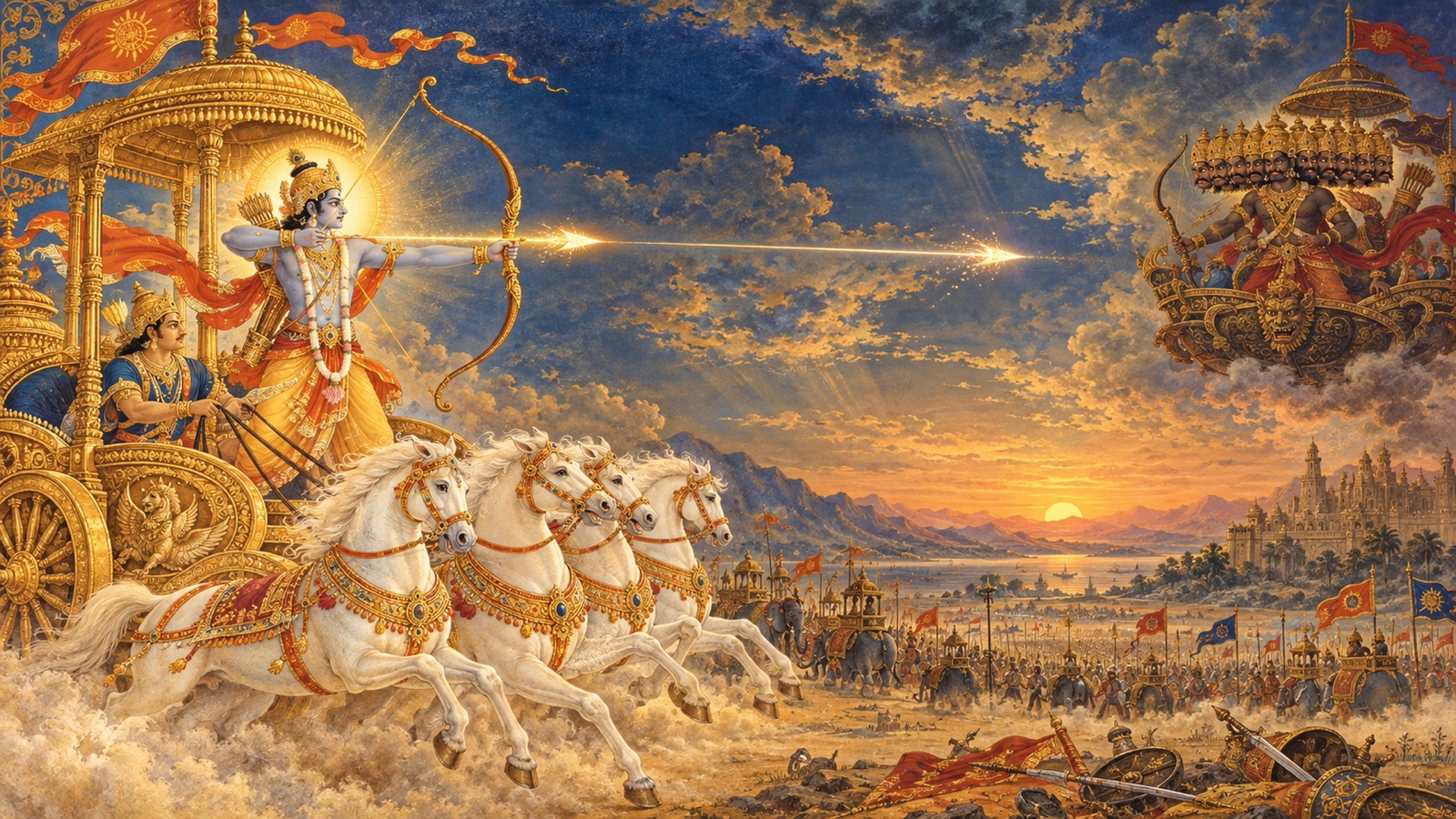
At Rama’s command Vibhishana performed the funeral rites for his slain kinsmen. The Lord found Sita seated beneath an ashoka tree, wasted by grief in her separation from Him, and was filled with compassion. Granting Vibhishana the rule of Lanka and long life, He set Sita upon the aerial car Puspaka and, His fourteen-year vow of forest-dwelling now fulfilled, flew home to Ayodhya with His brothers and Hanuman, showered with flowers by the guardians of the worlds.
The Return, and the Devotion of Bharata
Learning that His brother Bharata had lived as an ascetic in Nandigrama — matted-haired, sleeping on the ground, worshipping the Lord’s wooden sandals set upon the throne in His place — the Lord was moved. Bharata now came out to meet Him with the citizens, ministers and priests, amid the chanting of the Vedas and music, and fell at His feet with tears. His devoted servants each took up an emblem of service.
पादुके भरतोऽगृह्णाच्चामरव्यजनोत्तमे । विभीषण: ससुग्रीव: श्वेतच्छत्रं मरुत्सुत: ॥ ४२ ॥ धनुर्निषङ्गाञ्छत्रुघ्न: सीता तीर्थकमण्डलुम् । अबिभ्रदङ्गद: खड्गं हैमं चर्मर्क्षराण्नृप ॥ ४३ ॥
pāduke bharato ’gṛhṇāc cāmara-vyajanottame vibhīṣaṇaḥ sasugrīvaḥ śveta-cchatraṁ marut-sutaḥ dhanur-niṣaṅgāñ chatrughnaḥ sītā tīrtha-kamaṇḍalum abibhrad aṅgadaḥ khaḍgaṁ haimaṁ carmarkṣa-rāṇ nṛpa
Meaning: Bharata carried the Lord’s wooden sandals; Vibhishana and Sugriva the finest whisks and fans; Hanuman, the son of the wind, the white umbrella; Satrughna the bow and quivers; Sita the water-pot of holy waters; Angada the sword; and Jambavan, king of the bears, the golden shield, O king. (Canto 9, Chapter 10, verses 42-43)
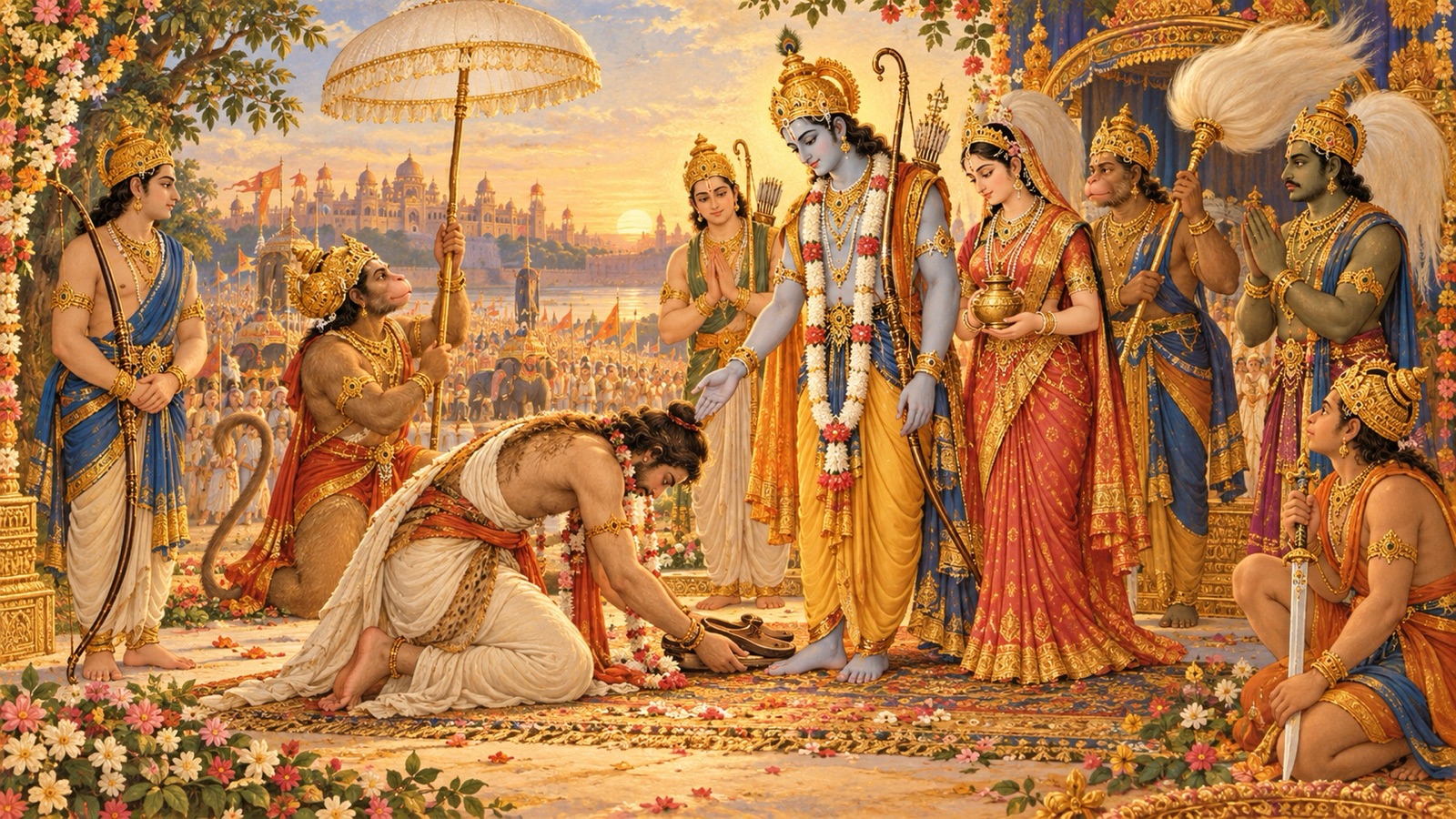
In Ayodhya the Lord honoured His stepmothers and His own mother, His preceptors and elders, and was honoured by them in return; the mothers, rising as if from death to life, took their sons upon their laps and washed away their grief with tears. The sage Vasishtha and the elders of the Raghu line unravelled the Lord’s matted locks and bathed Him with the waters of the four oceans, as Brihaspati once bathed Indra.
The Reign of Rama-rajya
Won over by Bharata’s prostrations, the Lord accepted the throne of Ayodhya and, like a father, protected His people, who in turn recognized Him as their father. While Sri Rama — who knows all righteousness and brings happiness to every being — reigned, the age was Treta, yet time itself felt like the golden Satya-yuga.
त्रेतायां वर्तमानायां काल: कृतसमोऽभवत् । रामे राजनि धर्मज्ञे सर्वभूतसुखावहे ॥ ५१ ॥
tretāyāṁ vartamānāyāṁ kālaḥ kṛta-samo ’bhavat rāme rājani dharma-jñe sarva-bhūta-sukhāvahe
Meaning: Though it was the age of Treta, time became like the golden age of Satya, for Rama, the knower of righteousness and the bringer of happiness to all beings, was the reigning king. (Canto 9, Chapter 10, verse 51)
Under His rule forests, rivers, mountains and oceans yielded all that the people desired; bodily and mental ailments, old age, sorrow, fear and fatigue were unknown, and death did not come to the unwilling. Holding the vow of a single wife and conducting Himself as a sage even while a king, the Lord scrupulously performed His household duties, purely to teach the world by His own example.
एकपत्नीव्रतधरो राजर्षिचरित: शुचि: । स्वधर्मं गृहमेधीयं शिक्षयन् स्वयमाचरत् ॥ ५४ ॥
eka-patnī-vrata-dharo rājarṣi-caritaḥ śuciḥ sva-dharmaṁ gṛha-medhīyaṁ śikṣayan svayam ācarat
Meaning: Holding the vow of a single wife, pure, and conducting Himself like a royal sage, the Lord personally performed the duties of household life in order to teach them to the world. (Canto 9, Chapter 10, verse 54)
The Bhagavatam’s deeper teaching here is that Rama-rajya was never the fruit of clever administration; it was the fruit of a ruler who had first mastered himself. Sri Rama did not merely legislate righteousness for His subjects — He lived it, keeping His vow of one wife and His plain household duties exactly as He wished the humblest of His people to keep them (verses 51-54). Because the king’s own heart was wholly surrendered to dharma, the very earth answered in kind: forests, rivers and oceans gave up their bounty freely, and fear, sickness and untimely death lost their hold on the land. The lesson outlasts Treta-yuga: a home, a community or an age is never transformed by rules handed down from outside, but by one surrendered heart setting a pattern that others are drawn to follow.
Principal Teachings of This Chapter
1. The Supreme Lord descends out of love. Sri Rama is not merely a great king but Lord Hari Himself, come as the son of Dasaratha at the prayer of the gods, expanding into four brothers to accomplish His work on earth (verses 2, 4).
2. Truth and duty above the throne. For the sake of His father’s word, the Lord relinquishes the kingdom without a trace of resentment and takes to the forest — the supreme example of dharma honoured above personal gain (verses 7-8).
3. Evil, however mighty, is undone by its own deeds. Ravana’s tyranny and the theft of Sita bring about his ruin; his adamantine heart is pierced in the end, showing that unrighteousness carries the seed of its own destruction (verses 22-23).
4. Loving service takes many forms. Hanuman, Lakshmana, Bharata, Sugriva, Vibhishana and the rest each serve the Lord in their own way — Bharata even ruling only in the name of the Lord’s sandals. Devotion is measured by love, not by station (verses 42-43).
5. The ideal reign flows from an ideal ruler. Rama-rajya — a time free of sorrow, sickness and fear, where nature yields abundance — arises because the king is righteous, self-controlled and devoted to the good of all. Good government begins with a good and God-centred heart (verses 51-54).
A Devotional Reflection
Sukadeva gives us the whole life of Lord Rama in a handful of verses, and yet nothing essential is lost, because the heart of the story is not its events but its spirit. Here is the Supreme Lord choosing, again and again, the harder and higher path: giving up a throne for a father’s word, bearing the anguish of separation to teach us the cost of attachment, and ruling not for power but for the happiness of every creature. What shines through is not only His majesty but His tenderness — feet too soft for the forest paths, tears for a grieving brother, compassion for a wasted and sorrowing Sita. And around Him gathers a circle of love: Hanuman who carries His umbrella, Bharata who guards His sandals, Lakshmana who never leaves His side. The Bhagavatam holds up Rama-rajya not as a lost golden dream but as a living promise — that wherever the Lord is truly enthroned, in a kingdom or in a single human heart, sorrow loses its grip and life becomes what it was meant to be. We are invited simply to make room for Him, as Bharata did, and to keep His place ready upon the throne of our hearts.
A Daily Devotional Practice
Today, in the spirit of Bharata’s devotion, honour the Lord as the true ruler of your life. Set aside a moment to bow before Him — before your home shrine, a sacred image, or simply within your heart — and offer Him the “throne” of your day’s decisions, resolving to act as He would have you act: truthfully, kindly, and for the good of others. As you go about your duties, repeat gently, “Om Namo Bhagavate Vasudevaya,” and remember that even ordinary household work, done for His sake and as an example to others, becomes worship — just as the Lord Himself performed His duties to teach the world. Let this quiet enthroning of Rama in your heart bring a little of Rama-rajya into your home today.
Conclusion
This tenth chapter of Book Nine distils a single truth from the whole life of Lord Ramachandra: greatness is proven not by power but by perfect surrender to dharma — as son, husband, brother and king. Every trial He embraces, from the forest exile to the fall of Ravana, only deepens that truth, and Rama-rajya stands as its fruit — a reign so wholly given to righteousness that even Treta-yuga felt like the golden age. In the devotion of Bharata, Hanuman and all who served Him, we see the love that such surrender awakens in every heart it touches. May we, like Bharata, keep a throne prepared for the Lord within our own hearts.
May the divine wisdom of Srimad Bhagavatam awaken pure devotion within our hearts.
Om Namo Bhagavate Vasudevaya.
Jay Shree Madhav.
References and Attribution
- Primary edition: Gita Press, Śrīmad Bhāgavata Mahāpurāṇa (English, complete), Book Nine, Discourse 10, pages 39–48.
- Series: Srimad Bhagavatam Wisdom · Biswa Sanatan Dharma Seva Trust.
- Presented following the spiritual guidance and recommendation of Pandit Dr. Shri Kashinath Mishra.
This is an original, faithful retelling in the writer’s own words, with brief quoted verses shown in Devanāgarī and transliteration and their meanings given as summaries. It is not a reproduction of any single publisher’s continuous translation or commentary. No affiliation with or endorsement by any publisher is implied.
Jay Shree Madhav