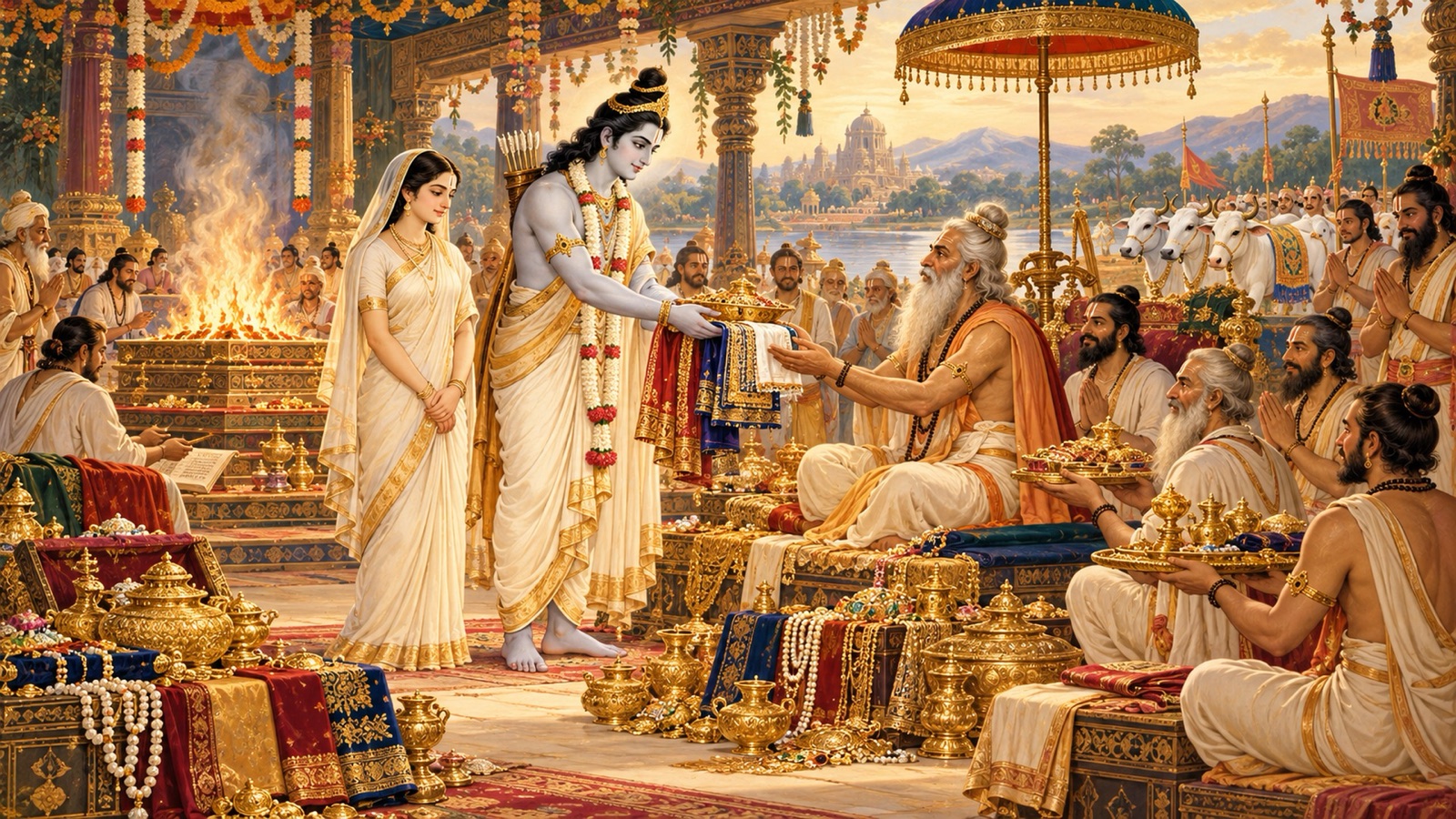
Having worshipped the Lord within His own heart through great sacrifices, Sri Rama gives away the whole earth to the brahmanas and His priests, keeping for Himself only His ornaments and two pieces of cloth — the very image of a king free from all craving.
Om Namo Bhagavate Vasudevaya.
Om Namo Bhagavate Vasudevaya.
Om Namo Bhagavate Vasudevaya.
Welcome to Srimad Bhagavatam Wisdom, a devotional journey through the sacred histories and teachings of the Srimad Bhagavat Mahapurana. This eleventh chapter of Book Nine brings the story of Lord Ramachandra’s earthly reign to its close, showing a King who renounces everything even as He rules everything, and a Lord who parts with His own happiness to protect the faith of the humblest of His subjects.
Chapter Information
- Scripture: Śrīmad Bhāgavata Mahāpurāṇa
- Canto: 9 (Book Nine)
- Chapter: 11 (Discourse 11)
- Chapter title: Lord Ramachandra Rules the World
- Principal speaker: Sukadeva Gosvami, narrating to King Parikshit — the whole related by Suta Gosvami to the sage Saunaka and the assembly of sages at Naimisaranya
- Principal listener: King Parikshit
- Main setting: Ayodhya and the kingdom of Kosala; the hermitage of the sage Valmiki
- Central subject: Lord Ramachandra’s sacrifices and charity, His parting with Sita and the birth of Kusa and Lava, His return to His divine abode, and the glory of His reign
- Principal verse range: Canto 9, Chapter 11, verses 1–36
- Primary edition: Gita Press Śrīmad Bhāgavata Mahāpurāṇa
The Sacrifices and the Gift of the Earth
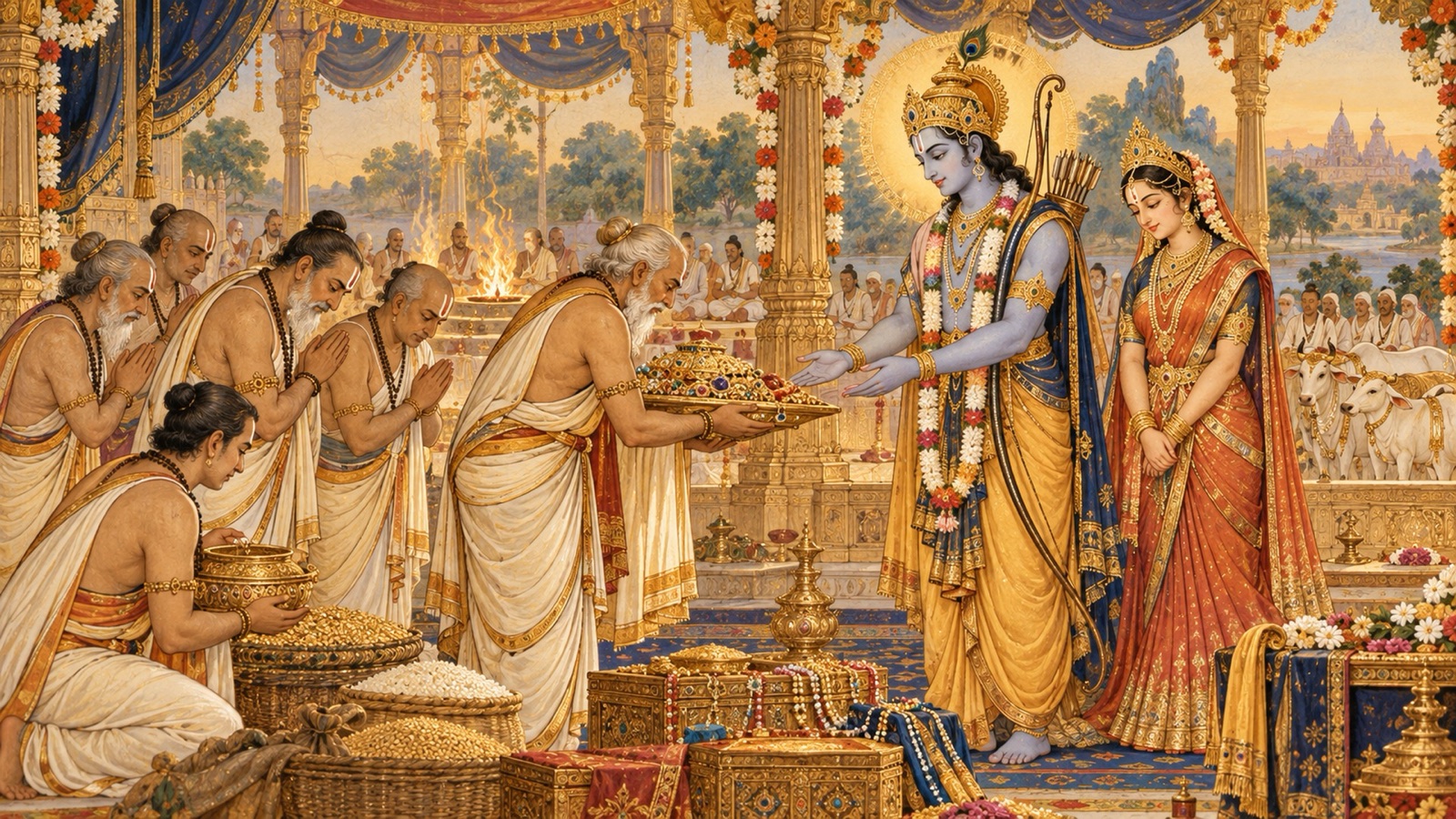
Sukadeva resumed the narrative. Guided by His preceptor Vasishtha, Sri Rama worshipped, through great sacrifices performed with the finest materials, His own Self in the form of Lord Vishnu, who is all the gods. At the close of the sacrifices He gave the eastern quarter to the Hota priest, the southern to the Brahma priest, the western to the Adhwaryu, and the northern to the Udgata; and the whole of the land that remained in the centre He gave to His preceptor — for, free from all craving, He held that the brahmana alone is entitled to the whole earth.
आचार्याय ददौ शेषां यावती भूस्तदन्तरा । मन्यमान इदं कृत्स्नं ब्राह्मणोऽर्हति नि:स्पृह: ॥ ३ ॥
ācāryāya dadau śeṣāṁ yāvatī bhūs tad-antarā manyamāna idaṁ kṛtsnaṁ brāhmaṇo ’rhati niḥspṛhaḥ
Meaning: He gave to His preceptor all the remaining land in between, for, being free from craving, He considered that the brahmana alone deserves this whole earth. (Canto 9, Chapter 11, verse 3)
So it was that Sri Rama was left with only the ornaments and the two pieces of cloth upon His person, and Empress Sita with only the sacred thread of a married woman, every other ornament having been given away. Delighted by the Lord’s affection for the brahmanas, the priests returned everything to Him, saying that nothing had truly been withheld from them by the Lord who enters their innermost hearts and dispels their ignorance by His own splendour.
अप्रत्तं नस्त्वया किं नु भगवन् भुवनेश्वर । यन्नोऽन्तर्हृदयं विश्य तमो हंसि स्वरोचिषा ॥ ६ ॥
aprattaṁ nas tvayā kiṁ nu bhagavan bhuvaneśvara yan no ’ntar-hṛdayaṁ viśya tamo haṁsi sva-rociṣā
Meaning: What, O Lord, O Ruler of the universe, has not already been given to us by You, who enter our innermost hearts and destroy our darkness by Your own effulgence? (Canto 9, Chapter 11, verse 6)
The Parting with Sita
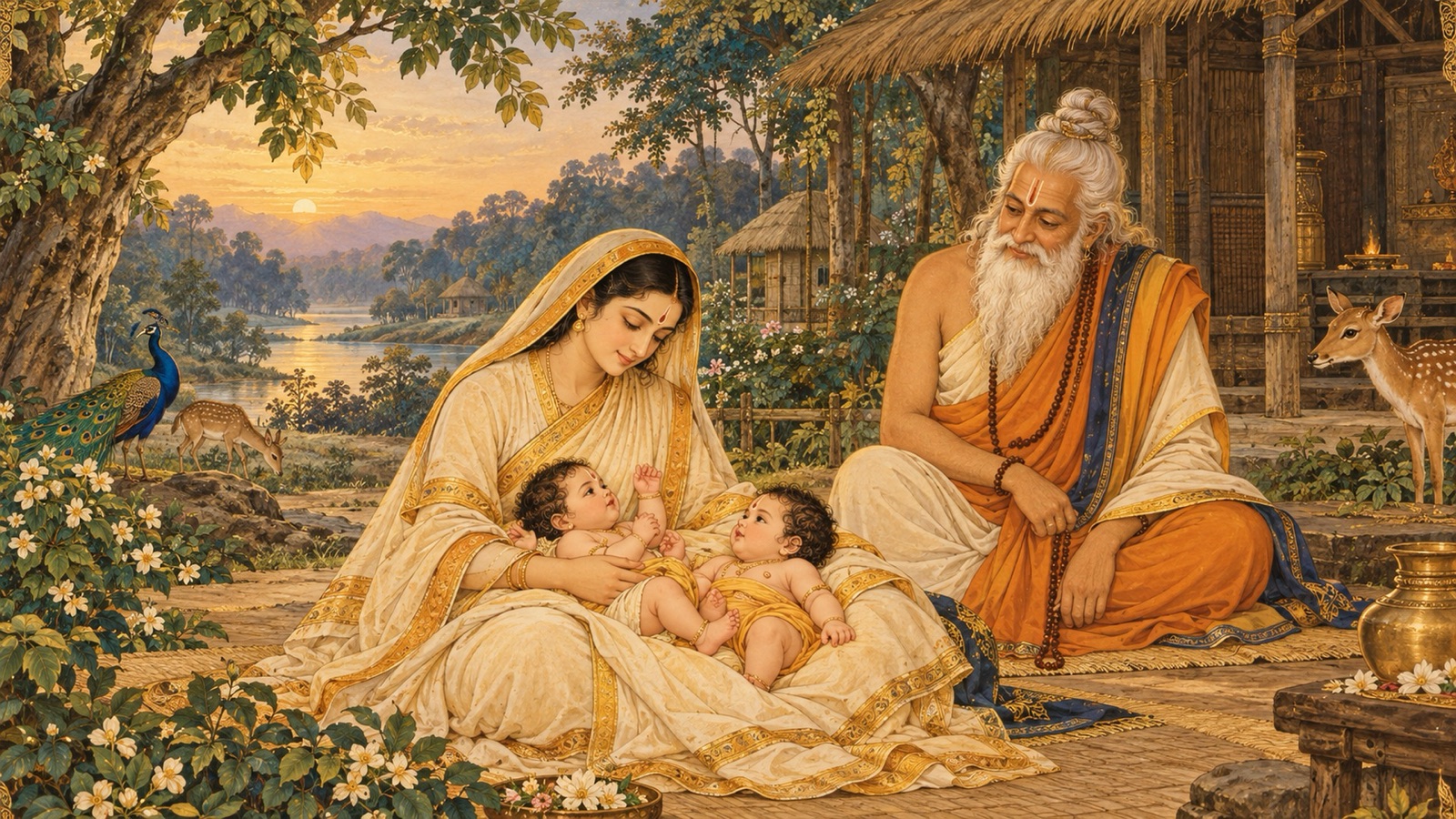
One night, moving about the city in disguise to learn the mind of His people, Sri Rama overheard a man speaking harshly of his own wife, refusing to take her back because she had dwelt in another’s house, and saying that only a king as fond of his wife as Rama would keep such a Sita. To honour the sentiment of even the humblest and most doubting of His subjects — the world being many-mouthed and hard to satisfy — the Lord sent Sita away; and she reached the hermitage of the sage Valmiki. Being with child, in due time she gave birth to twin sons who became renowned as Kusa and Lava, and the sage performed their purificatory rites.
अन्तर्वत्न्यागते काले यमौ सा सुषुवे सुतौ । कुशो लव इति ख्यातौ तयोश्चक्रे क्रिया मुनि: ॥ ११ ॥
antarvatny āgate kāle yamau sā suṣuve sutau kuśo lava iti khyātau tayoś cakre kriyā muniḥ
Meaning: Being with child, when the time came she gave birth to twin sons, who became known as Kusa and Lava; and the sage performed their purificatory rites. (Canto 9, Chapter 11, verse 11)
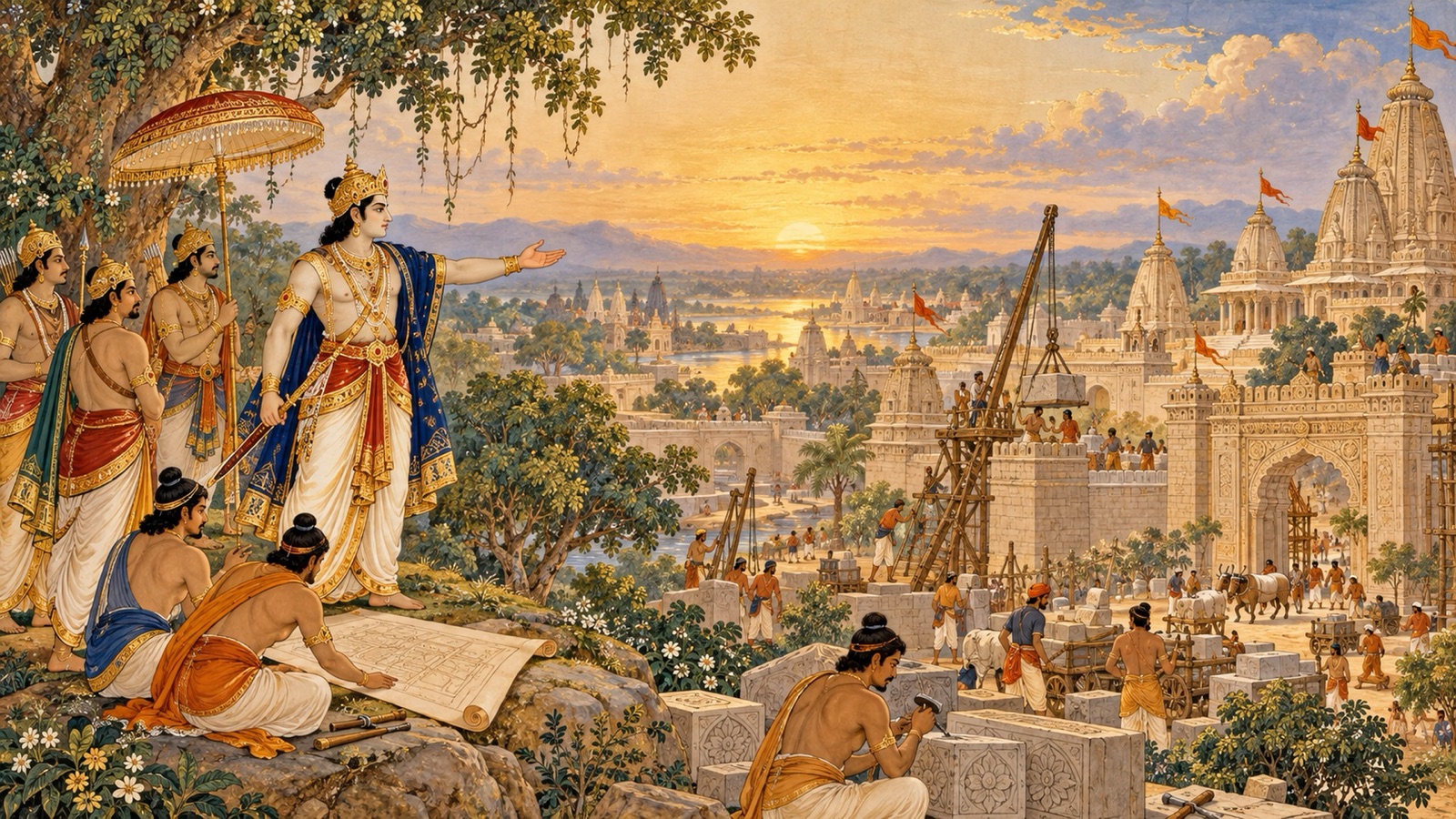
Sukadeva also named the sons of the Lord’s brothers: Angada and Chitraketu were the sons of Lakshmana; Taksha and Pushkala the sons of Bharata; and Subahu and Srutasena the sons of Satrughna. In his conquest of the quarters, Bharata slew Gandharvas in tens of millions and brought their wealth to Sri Rama; and Satrughna, having killed the demon Lavana, son of Madhu, founded upon the site of Madhuvana the city of Mathura.
सुबाहु: श्रुतसेनश्च शत्रुघ्नस्य बभूवतु: । गन्धर्वान् कोटिशो जघ्ने भरतो विजये दिशाम् ॥ १३ ॥ तदीयं धनमानीय सर्वं राज्ञे न्यवेदयत् । शत्रुघ्नश्च मधो: पुत्रं लवणं नाम राक्षसम् । हत्वा मधुवने चक्रे मथुरां नाम वै पुरीम् ॥ १४ ॥
subāhuḥ śrutasenaś ca śatrughnasya babhūvatuḥ gandharvān koṭiśo jaghne bharato vijaye diśām tadīyaṁ dhanam ānīya sarvaṁ rājñe nyavedayat śatrughnaś ca madhoḥ putraṁ lavaṇaṁ nāma rākṣasam hatvā madhuvane cakre mathurāṁ nāma vai purīm
Meaning: Two sons, Subahu and Srutasena, were born to Satrughna. Bharata, while subduing every direction, overcame countless Gandharva forces and laid their riches before the King; Satrughna, for his part, slew the man-eating Lavana, son of Madhu, and raised upon that forest ground the city that came to be called Mathura. (Canto 9, Chapter 11, verses 13-14)
Having entrusted her sons to the care of the sage and fixing her thoughts on the feet of Sri Rama, Sita — unable any longer to bear the separation — entered into the bosom of the earth, which parted to receive her. Hearing of this and recalling her manifold virtues, the almighty Lord, though He strove to master His grief by wisdom, could not restrain it. The Bhagavatam observes that excessive attachment between man and woman brings fear and sorrow even to the strong, and far more to those whose thoughts are riveted to the household.
The Lord Returns to His Own Abode
Thereafter, for thirteen thousand years without interruption, the Lord poured oblations into the sacred fire in strict celibacy. Then, leaving in the hearts of those who remember Him the impression of His feet — tender as young leaves, once pierced by the thorns of the Dandaka forest — Sri Rama departed for His own self-effulgent, divine realm.
स्मरतां हृदि विन्यस्य विद्धं दण्डककण्टकै: । स्वपादपल्लवं राम आत्मज्योतिरगात् तत: ॥ १९ ॥
smaratāṁ hṛdi vinyasya viddhaṁ daṇḍaka-kaṇṭakaiḥ sva-pāda-pallavaṁ rāma ātma-jyotir agāt tataḥ
Meaning: He set within the hearts of His devotees the memory of His soft lotus feet, once wounded by thorns during His days in the Dandaka woods, and thus the Lord passed into His own self-luminous realm. (Canto 9, Chapter 11, verse 19)
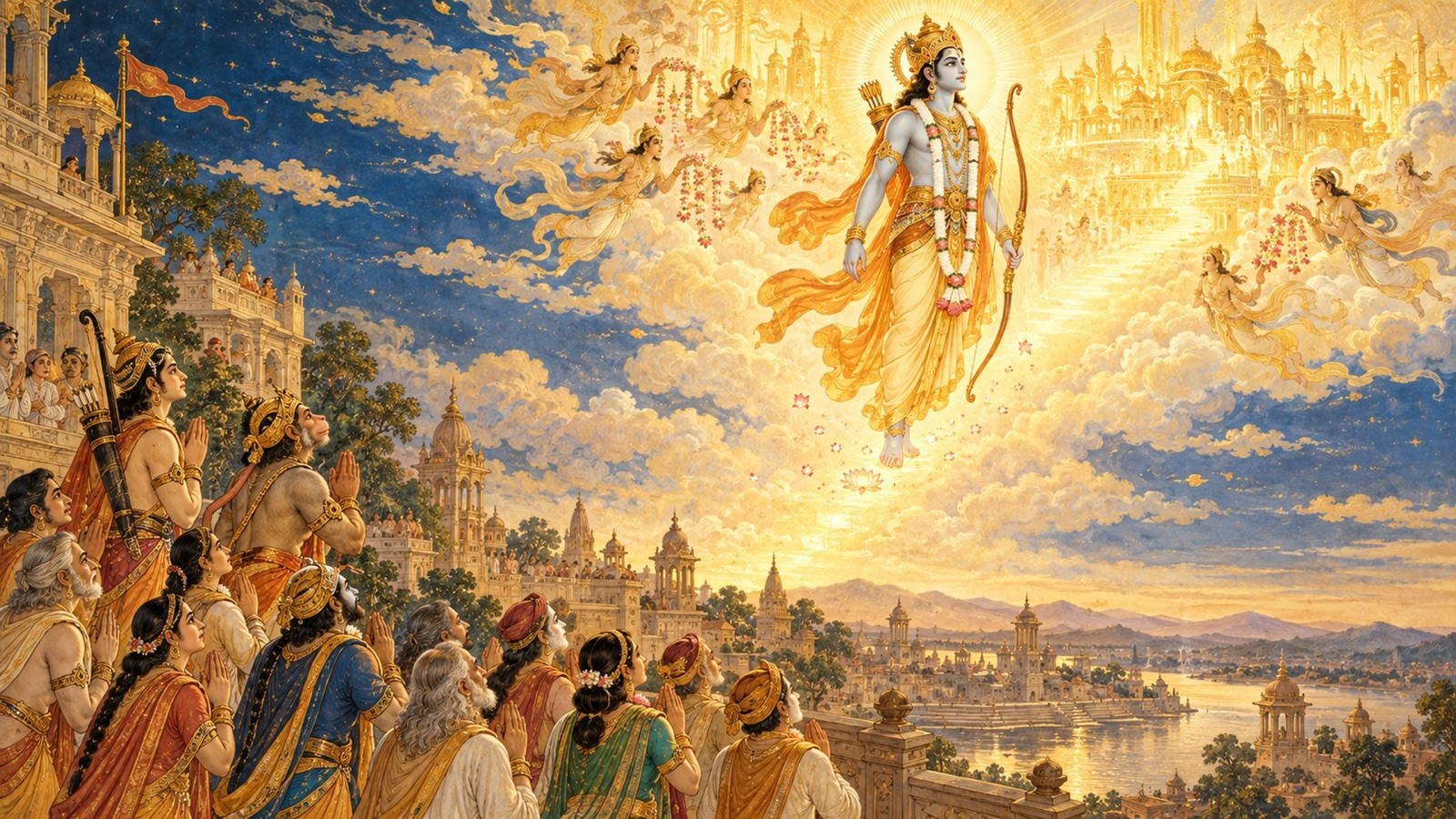
Sukadeva’s telling carries a deeper current here. The Bhagavatam is careful to show that the Lord and His devotees never cease to be persons — not in this world, and not beyond it. When Sri Rama earlier worshipped His own Self through the sacrifices, this was no proof that the soul and God are one; only the one Supreme Person can worship Himself, while the jiva remains forever His distinct part (verse 1). So too His return is no dissolution into a featureless light: the brahmajyoti that draws the impersonalist seeker is only the outer glow of His transcendental body, and beyond it lie the Vaikuntha planets that only a surrendered heart can enter (verse 19). Every citizen of Ayodhya who served, touched or merely followed Sri Rama went on to serve Him in that eternal abode, still themselves, still in loving relationship with Him (verse 22). This is the chapter’s quiet answer to every philosophy that would erase the person from the picture: the Lord remains forever a Person, and love offered to Him is never truly lost — only carried home.
The slaying of demons and the bridging of the ocean, Sukadeva reflected, are no real praise to the Lord of the Raghus, whose glory is matchless and who assumed His form only as a loving sport at the prayer of the gods. He whose spotless glory sages still sing in royal courts, whose lotus feet are touched by the crowns of Indra and Kubera — He is the refuge Sukadeva sought. All the people of Kosala who touched Him, beheld Him, sat beside Him or merely followed Him attained the goal that yogis reach; and whoever treasures the story of Sri Rama through repeated hearing, and holds to a vow of non-violence and tenderness, is freed from the bonds of karma.
पुरुषो रामचरितं श्रवणैरुपधारयन् । आनृशंस्यपरो राजन् कर्मबन्धैर्विमुच्यते ॥ २३ ॥
puruṣo rāma-caritaṁ śravaṇair upadhārayan ānṛśaṁsya-paro rājan karma-bandhair vimucyate
Meaning: A person who takes to heart the story of Sri Rama through repeated hearing, and who is devoted to compassion and non-violence, O King, is freed from the bonds of karma. (Canto 9, Chapter 11, verse 23)
The Glory of Rama’s Reign
King Parikshit then asked how the Lord had conducted Himself toward His brothers, who were His own parts, and how His brothers and subjects had behaved toward Him. Sukadeva replied that Sri Rama charged His brothers with the conquest of the quarters, while He Himself moved about the city with His attendants, allowing His people to behold Him.
श्रीबादरायणिरुवाच अथादिशद् दिग्विजये भ्रातृंस्त्रिभुवनेश्वर: । आत्मानं दर्शयन् स्वानां पुरीमैक्षत सानुग: ॥ २५ ॥
śrī-bādarāyaṇir uvāca athādiśad dig-vijaye bhrātṝṁs tri-bhuvaneśvaraḥ ātmānaṁ darśayan svānāṁ purīm aikṣata sānugaḥ
Meaning: Sukadeva said: Then the Lord of the three worlds charged His brothers with the conquest of the quarters, and, showing Himself to His own people, He looked round the city with His attendants. (Canto 9, Chapter 11, verse 25)
Ayodhya, its roads sprinkled with perfumed water, its palaces crowned with golden domes and bright with flags, festal arches, mirrors and flowers, seemed to rejoice at the sight of her returned Lord. Citizens met Him with articles of worship and blessed Him, praying, “Protect this earth, O Lord, which You Yourself once lifted up.” Leaving their household tasks, men and women climbed to their rooftops to behold Him and showered flowers upon the lotus-eyed Lord, their eyes never sated. In His ancestral palace, rich with every treasure and adorned with coral, emerald and crystal, the Lord — supreme among the wise who delight in the Self — lived joyfully with His beloved Sita.
तस्मिन्स भगवान् राम: स्निग्धया प्रिययेष्टया । रेमे स्वारामधीराणामृषभ: सीतया किल ॥ ३५ ॥
tasmin sa bhagavān rāmaḥ snigdhayā priyayeṣṭayā reme svārāma-dhīrāṇām ṛṣabhaḥ sītayā kila
Meaning: In that palace the glorious Lord Rama — foremost among the self-satisfied sages who delight in the Self — lived joyfully, so it is told, with His affectionate and beloved Sita. (Canto 9, Chapter 11, verse 35)
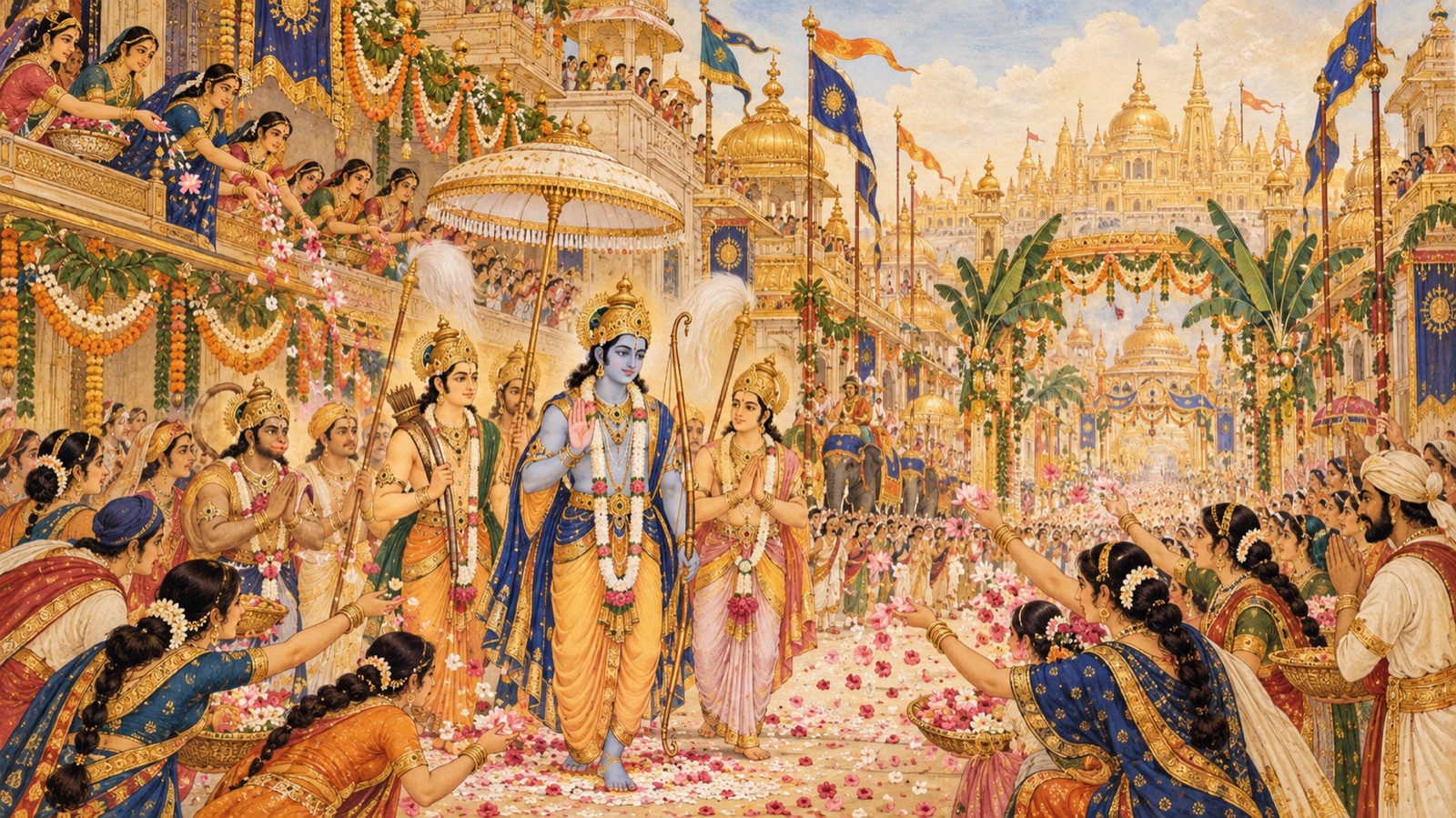
And the Lord, whose feet are meditated upon by the wise, enjoyed the pleasures proper to each season for many years, never once bending the principles of righteousness — for He performed His household duties as an example, to teach the world.
Principal Teachings of This Chapter
1. The greatest king is the one free from craving. Having conquered and ruled the whole earth, Sri Rama gives it all away to the brahmanas, keeping only two pieces of cloth. True royalty is measured not by what one holds but by what one can freely release (verses 3-4).
2. The Lord regards even the humblest voice. To honour the sentiment of a single doubting subject, the Lord bears an immense personal sorrow. His concern for His people’s faith is placed above His own happiness (verses 8-10).
3. Even the Lord’s love is beyond our measure. Rama’s grief at Sita’s departure was not the anxious clinging of worldly love but the fullness of transcendental affection; the same passage warns that for ordinary souls, attraction between man and woman remains a real cause of fear and bondage, felt even by exalted figures like Brahma and Siva, and far more by those absorbed in household life (verses 16-17).
4. The Lord’s descent is loving play, not need. Sukadeva insists that the bridging of the ocean and the slaying of demons are no true measure of the Lord’s glory; He acted only as a sport, at the gods’ request, His true greatness being beyond all deeds (verses 20-21).
5. Hearing Rama’s story liberates the heart. Whoever treasures the narrative of Sri Rama and cultivates compassion and non-violence is freed from the bonds of karma — the simplest and surest path the chapter offers (verses 22-23).
A Devotional Reflection
This chapter shows us the Lord at the height of His power choosing, again and again, to let go. He gives away the whole earth and keeps nothing; He surrenders His own happiness for the peace of mind of the least of His subjects; and though the loss of Sita pierces even His heart, He bears it while continuing to serve His people and honour righteousness. There is a striking humility in a God who rules the three worlds yet accepts the constraints of a good king, who lifts the universe as the divine Boar yet allows His citizens to bless Him with folded hands. Sukadeva gently redirects our wonder away from the spectacular deeds — the bridge, the arrows, the armies — toward the quieter glory of a Lord who acts only out of love, and who leaves His footprints not on the sea but in the hearts of those who remember Him. And the promise at the chapter’s close is wonderfully accessible: we need not build bridges or win wars; we need only take His story to heart with tenderness and compassion, and the bonds of karma begin to loosen. To remember Rama, to soften toward every creature for His sake — this, the Bhagavatam tells us, is itself the path home.
A Daily Devotional Practice
Today, in the spirit of Sri Rama’s reign, practise the twin virtues the chapter praises: remembrance and non-violence. Set aside a few minutes to hear or read a passage of the Lord’s story, and let His name rest gently on your lips — “Om Namo Bhagavate Vasudevaya.” Then carry that remembrance into your day as compassion: choose one small act of gentleness toward another being — a kind word, a forgiven slight, a harm withheld — offering it to the Lord who is freed even the ashes of offenders by His grace. As Rama gave away the whole earth and kept only love, let go today of one thing you cling to too tightly, and place it, and yourself, at His lotus feet.
Conclusion
The eleventh chapter of Book Nine brings Lord Ramachandra’s reign to its close, and with it one luminous point: true greatness is measured by what is released, not by what is held. Sri Rama gives away the whole earth, bears the sorrow of losing Sita for the sake of His people’s faith, and at last returns to His own eternal abode — remaining, through every renunciation, wholly a Person, wholly present to those who love Him. Sukadeva leaves us with a promise as tender as it is sure: to treasure the story of Sri Rama with compassion and non-violence is itself to be freed from the bonds of karma. May we take His name to heart, and grow gentle for His sake.
May the divine wisdom of Srimad Bhagavatam awaken pure devotion within our hearts.
Om Namo Bhagavate Vasudevaya.
Jay Shree Madhav.
References and Attribution
- Primary edition: Gita Press, Śrīmad Bhāgavata Mahāpurāṇa (English, complete), Book Nine, Discourse 11, pages 48–52.
- Series: Srimad Bhagavatam Wisdom · Biswa Sanatan Dharma Seva Trust.
- Presented following the spiritual guidance and recommendation of Pandit Dr. Shri Kashinath Mishra.
This is an original, faithful retelling in the writer’s own words, with brief quoted verses shown in Devanāgarī and transliteration and their meanings given as summaries. It is not a reproduction of any single publisher’s continuous translation or commentary. No affiliation with or endorsement by any publisher is implied.
Jay Shree Madhav