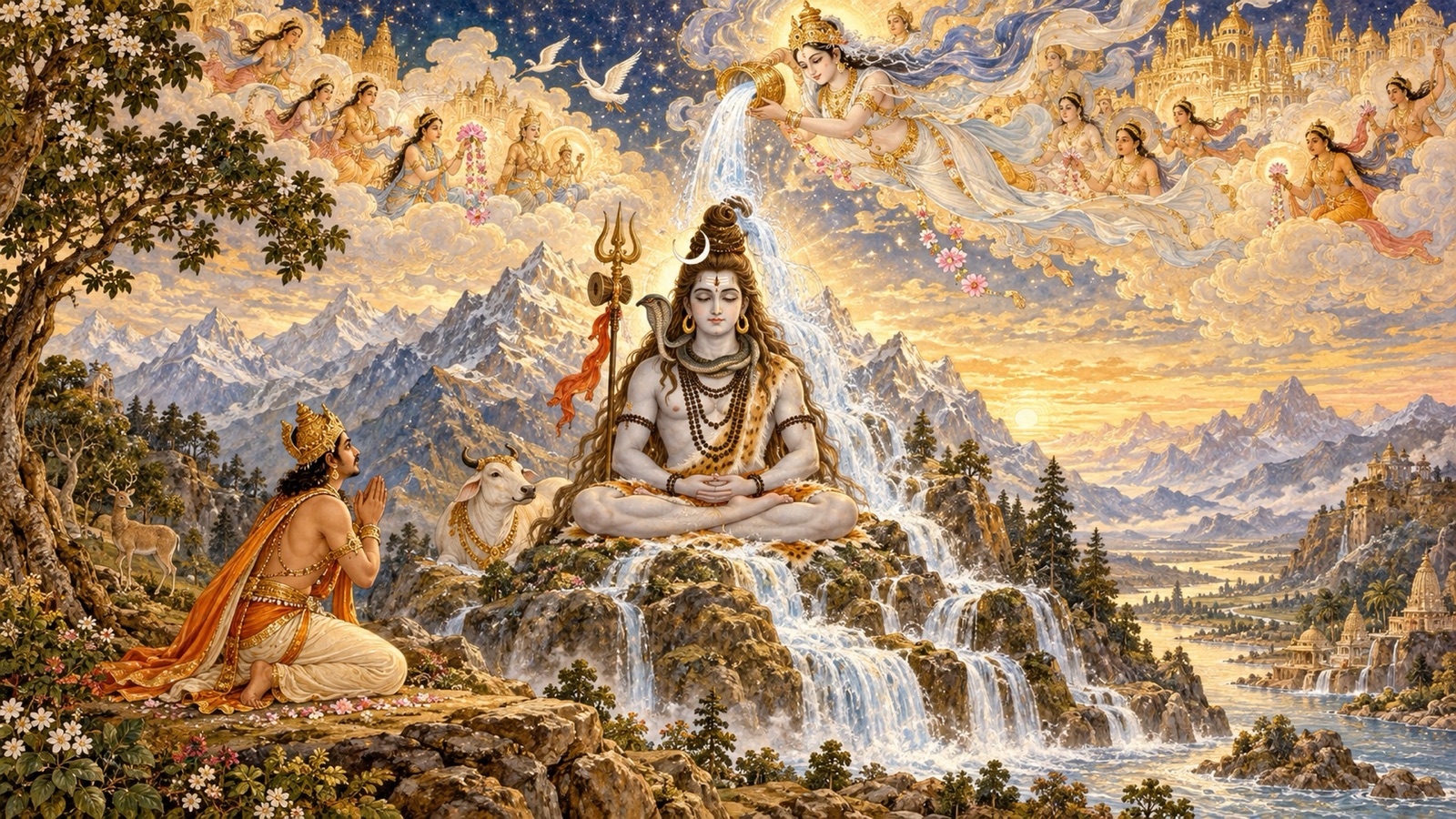
After ages of penance by three generations of kings, the holy Ganga at last descends from heaven — and Lord Siva calmly receives her mighty current upon his matted locks, so that the earth may bear her without being shattered.
Om Namo Bhagavate Vasudevaya.
Om Namo Bhagavate Vasudevaya.
Om Namo Bhagavate Vasudevaya.
Welcome to Srimad Bhagavatam Wisdom, a devotional journey through the sacred histories and teachings of the Srimad Bhagavat Mahapurana. This ninth chapter of Book Nine follows Sukadeva’s narration from the descent of the holy Ganga through the solar dynasty down to King Khatwanga’s final hour, and shows throughout that it is the presence of the Lord — never water, power or opulence alone — that truly purifies and delivers.
Chapter Information
- Scripture: Śrīmad Bhāgavata Mahāpurāṇa
- Canto: 9 (Book Nine)
- Chapter: 9 (Discourse 9)
- Chapter title: King Bhagiratha and the Descent of the Holy Ganga
- Principal speaker: Sukadeva Gosvami, narrating to King Parikshit — the whole related by Suta Gosvami to the sage Saunaka and the assembly of sages at Naimisaranya
- Principal listener: King Parikshit
- Main setting: The kingdom of the solar dynasty; the place of Bhagiratha’s austerities; the heavens and the earth along the Ganga’s course; the hermitages of the Ikshvaku line
- Central subject: The descent of the holy Ganga through the penance of Bhagiratha, the redemption of Sagara’s sons, the story of the cursed King Saudasa, and the liberation of King Khatwanga
- Principal verse range: Canto 9, Chapter 9, verses 1–49
- Primary edition: Gita Press Śrīmad Bhāgavata Mahāpurāṇa
The Long Austerity for the Ganga
Sukadeva continued the tale of the solar dynasty. Amsuman, who had recovered the sacrificial horse, longed to bring the holy Ganga down to redeem his ancestors; he practised austerity for a long time but did not succeed, and in course of time he passed away. His son Dilipa strove in the same way and also failed, meeting his death in the effort. It was Dilipa’s son, Bhagiratha, who performed austerities so great that at last the goddess of the sacred river was pleased. She revealed herself to him in person and offered him a boon. Bowing low with humility, the king submitted his heart’s desire.
दर्शयामास तं देवी प्रसन्ना वरदास्मि ते । इत्युक्त: स्वमभिप्रायं शशंसावनतो नृप: ॥ ३ ॥
darśayām āsa taṁ devī prasannā varadāsmi te ity uktaḥ svam abhiprāyaṁ śaśaṁsāvanato nṛpaḥ
Meaning: The goddess, being pleased, revealed herself to him and said, “I am ready to grant you a boon.” Thus addressed, the king, bowing humbly, laid before her the desire of his heart. (Canto 9, Chapter 9, verse 3)
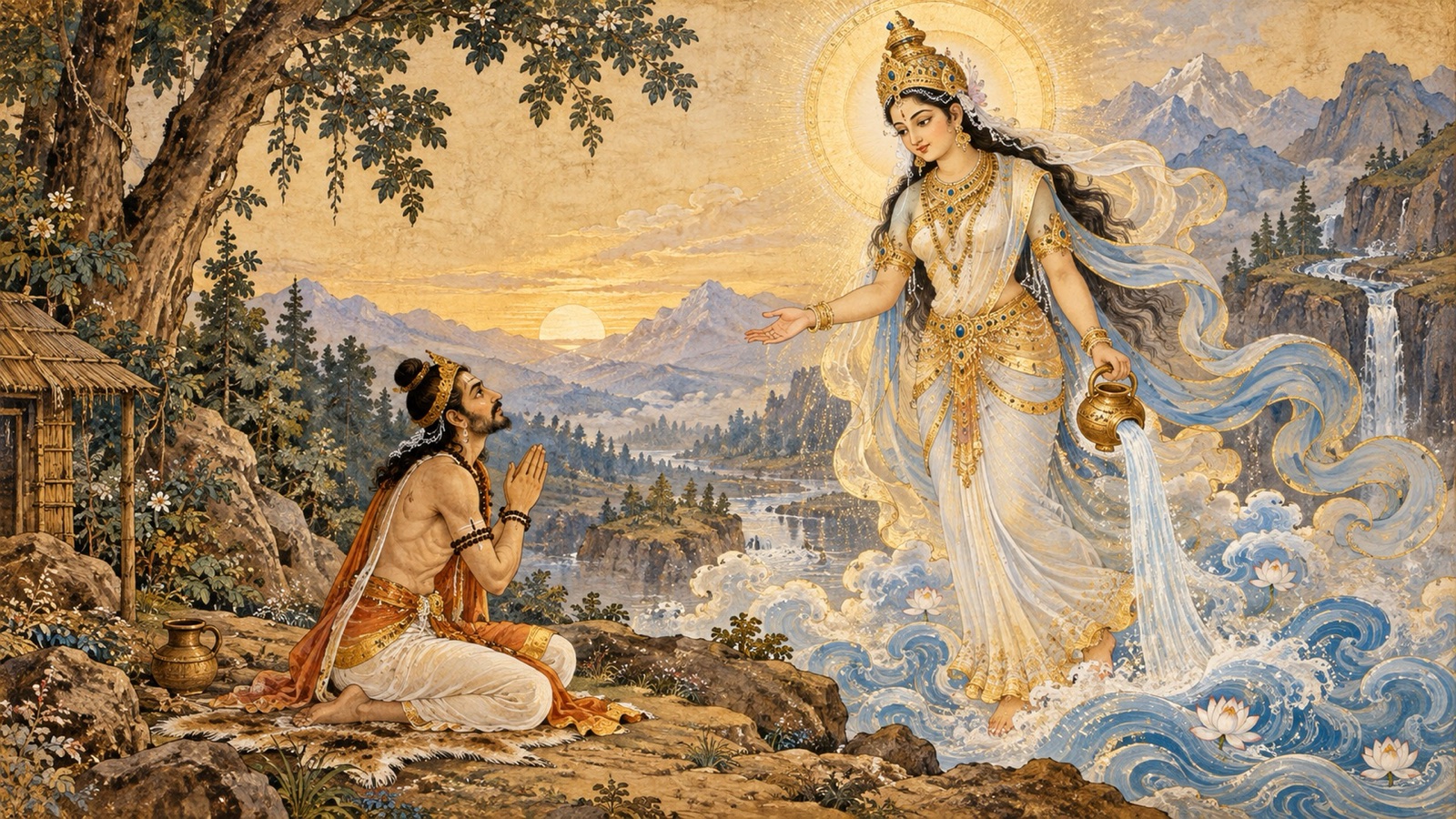
But the goddess raised two grave concerns. Descending with her full force, she said, someone must sustain her — or, piercing the crust of the earth, she would plunge down into the subterranean regions. And more: when the people of the world bathed in her and washed their sins into her waters, where was she herself to wash off that accumulated sin? Let the king, she said, consider this well.
Bhagiratha’s Answer and Lord Siva
Bhagiratha answered both concerns with the wisdom of a devotee. As for her sins, he said, the renunciants of this world — tranquil souls, fixed in the knowledge of the Absolute, whose very presence sanctifies every place — would bathe in her waters, and by the mere touch of their bodies they would carry away her sin; for Lord Sri Hari, the destroyer of all sin, dwells within their hearts.
श्रीभगीरथ उवाच साधवो न्यासिन: शान्ता ब्रह्मिष्ठा लोकपावना: । हरन्त्यघं तेऽङ्गसङ्गात् तेष्वास्ते ह्यघभिद्धरि: ॥ ६ ॥
śrī-bhagīratha uvāca sādhavo nyāsinaḥ śāntā brahmiṣṭhā loka-pāvanāḥ haranty aghaṁ te ’ṅga-saṅgāt teṣv āste hy agha-bhid dhariḥ
Meaning: Bhagiratha said: Holy sages who have renounced the world, who are peaceful, established in the knowledge of Brahma and purifiers of all the worlds, will take away your sin through the touch of their bodies; for Lord Hari, the destroyer of sin, dwells within them. (Canto 9, Chapter 9, verse 6)
And as for sustaining her force, he said, Lord Rudra, the very Self of all embodied beings — he into whom this whole universe is woven, warp and woof, like a cloth into its threads — would bear her descent.
धारयिष्यति ते वेगं रुद्रस्त्वात्मा शरीरिणाम् । यस्मिन्नोतमिदं प्रोतं विश्वं शाटीव तन्तुषु ॥ ७ ॥
dhārayiṣyati te vegaṁ rudras tv ātmā śarīriṇām yasminn otam idaṁ protaṁ viśvaṁ śāṭīva tantuṣu
Meaning: Lord Rudra, the Self of all embodied beings — in whom this universe is woven crosswise and lengthwise, as a cloth is woven in its threads — will sustain your force. (Canto 9, Chapter 9, verse 7)
Having spoken thus, Bhagiratha propitiated Lord Siva by his austerities, and after only a short time the Lord, the well-wisher of all the worlds, was pleased. Accepting the king’s prayer with the word “So be it,” Siva carefully bore upon his head the Ganga, whose water had been sanctified by the touch of Sri Hari’s feet.
तथेति राज्ञाभिहितं सर्वलोकहित: शिव: । दधारावहितो गङ्गां पादपूतजलां हरे: ॥ ९ ॥
tatheti rājñābhihitaṁ sarva-loka-hitaḥ śivaḥ dadhārāvahito gaṅgāṁ pāda-pūta-jalāṁ hareḥ
Meaning: Saying “So be it,” to the king’s request, Lord Siva, the well-wisher of all the worlds, carefully bore upon his head the Ganga, whose waters are purified by the feet of Lord Hari. (Canto 9, Chapter 9, verse 9)
The Descent and the Redemption of Sagara’s Sons
The royal sage Bhagiratha then led the Ganga — capable of purifying the whole universe — to the very place where the bodies of his great-granduncles, the sons of Sagara, lay reduced to ashes. Riding ahead in a chariot swift as the wind, he drew the river on, and the Ganga followed him, hallowing every land along her course, until at last she bathed the ashes of the burnt sons of Sagara. Though those princes had been destroyed by their own grave offence against a holy sage, the mere touch of the Ganga’s waters upon their ashes lifted them to heaven.
यज्जलस्पर्शमात्रेण ब्रह्मदण्डहता अपि । सगरात्मजा दिवं जग्मु: केवलं देहभस्मभि: ॥ १२ ॥
yaj-jala-sparśa-mātreṇa brahma-daṇḍa-hatā api sagarātmajā divaṁ jagmuḥ kevalaṁ deha-bhasmabhiḥ
Meaning: Merely by the touch of her water, the sons of Sagara — though struck down by their offence against a brahmana — ascended to heaven with nothing left of them but their ashes. (Canto 9, Chapter 9, verse 12)
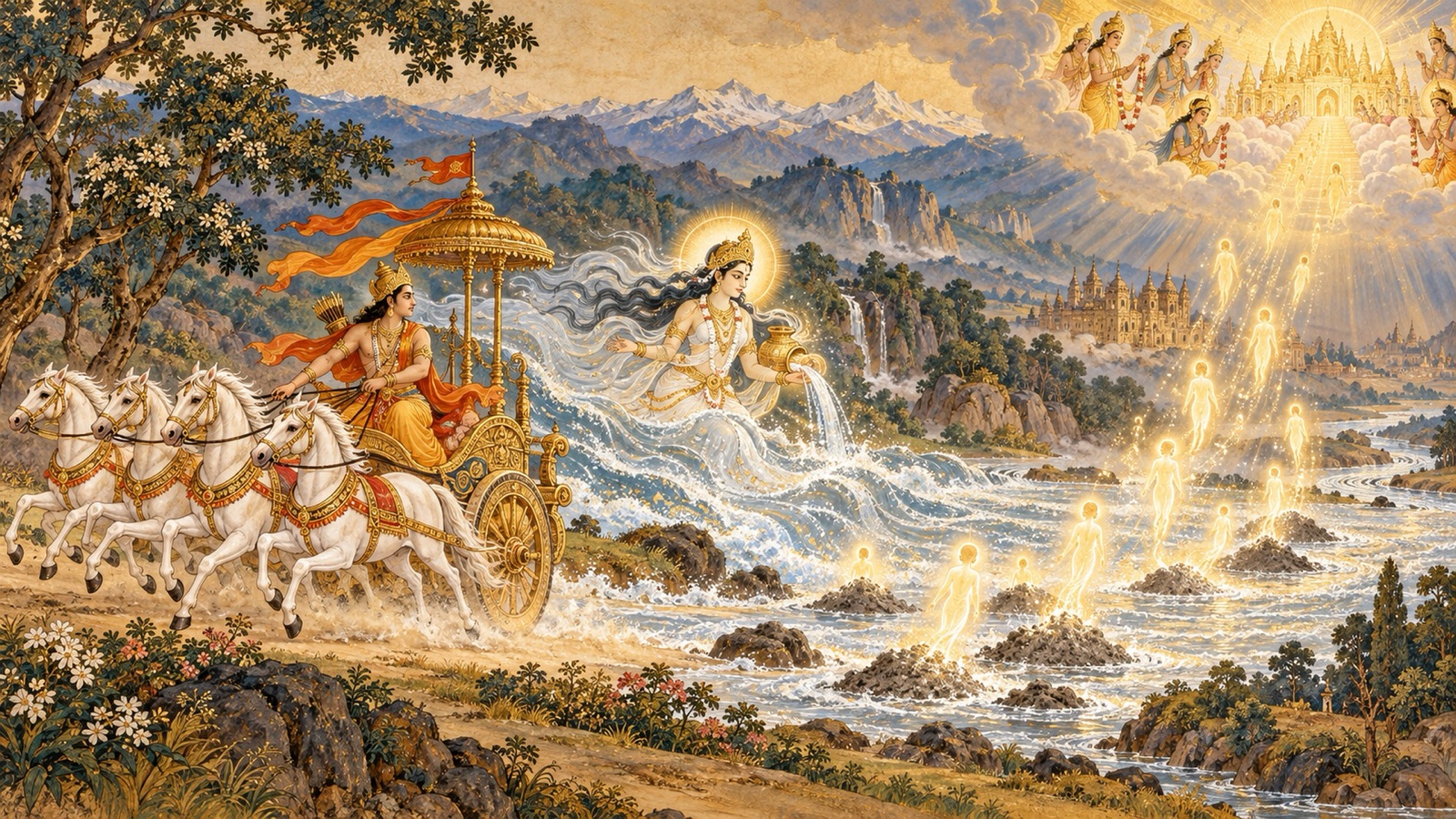
If even the ashes of offenders were raised to heaven by a single touch of her waters, Sukadeva reflected, what then of those who reverently make use of this heavenly stream every day, having taken a vow to do so? This is no cause for wonder, he said, for the Ganga springs from the lotus feet of the infinite Lord and is able to end the whole round of birth and death. And by fixing their minds with reverence upon those same feet, pure-hearted sages have swiftly attained oneness with the Lord, casting off that identification with the body which is otherwise so hard to give up.
The Line of Bhagiratha down to Saudasa
From Bhagiratha came Sruta, whose son was Nabha; from Nabha, Sindhudvipa; from him, Ayutayu; and from Ayutayu, Rtuparna, the friend of Nala, who received from Nala the science of training horses and gave him in return the secret of dice. Rtuparna’s son was Sarvakama.
श्रुतो भगीरथाज्जज्ञे तस्य नाभोऽपरोऽभवत् । सिन्धुद्वीपस्ततस्तस्मादयुतायुस्ततोऽभवत् ॥ १६ ॥ ऋतूपर्णो नलसखो योऽश्वविद्यामयान्नलात् । दत्त्वाक्षहृदयं चास्मै सर्वकामस्तु तत्सुतम् ॥ १७ ॥
śruto bhagīrathāj jajñe tasya nābho ’paro ’bhavat sindhudvīpas tatas tasmād ayutāyus tato ’bhavat ṛtūparṇo nala-sakho yo ’śva-vidyām ayān nalāt dattvākṣa-hṛdayaṁ cāsmai sarvakāmas tu tat-sutam
Meaning: From Bhagiratha was born Sruta, and from him Nabha; from Nabha came Sindhudvipa, and from him Ayutayu; from him came Rtuparna, the friend of Nala, who learned the art of horses from Nala and gave him in exchange the secret of dice; and Rtuparna’s son was Sarvakama. (Canto 9, Chapter 9, verses 16-17)
From Sarvakama came Sudasa, and his son was Saudasa, the husband of Madayanti, also called Mitrasaha and, in some places, Kalmasapada. Through a curse of his preceptor, the sage Vasistha, he became for a time a man-eating ogre and was left without an heir of his own. Hearing this, King Parikshit asked Sukadeva what occasion had led the sage to curse so high-souled a king.
The Curse of King Saudasa
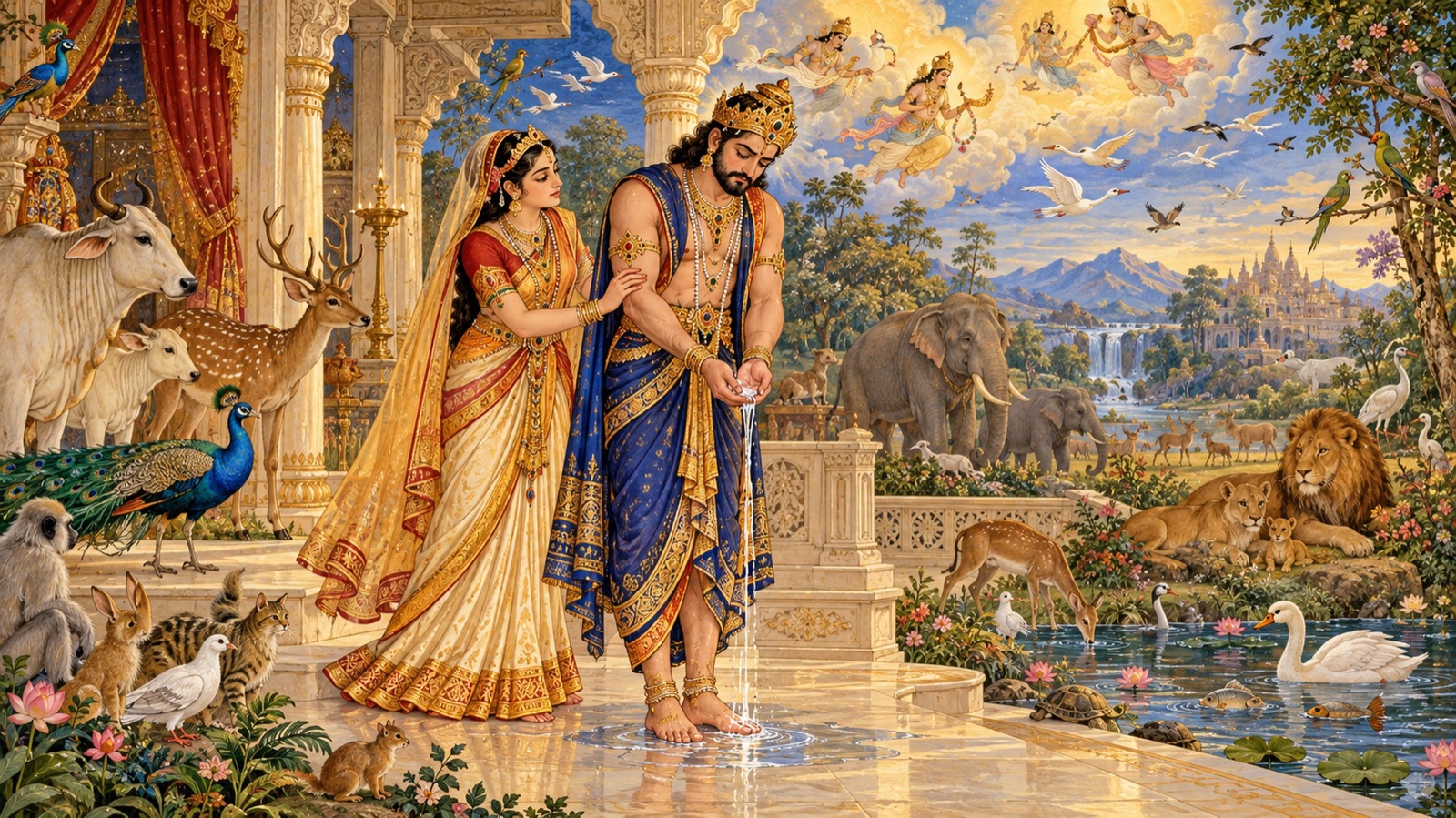
Sukadeva explained. While hunting, Saudasa had killed a certain man-eating ogre but let its brother go free; and the surviving ogre, bent on revenge, took the form of the king’s own cook. When the sage Vasistha came to dine at the palace, the disguised ogre served him human flesh. Perceiving at once the forbidden food, the enraged sage cursed the king to become an ogre. Learning soon after that the deed had really been the ogre’s, Vasistha limited the curse to twelve years. Saudasa in his turn took water in his joined palms, ready to curse his preceptor in return; but his wife Madayanti stopped him. Seeing that the whole world — the quarters, the sky and the earth — was filled with living beings, the king would not fling the wrath-charged water upon any of them, and instead poured it onto his own feet. For this mercy he was called Mitrasaha, “kind to all,” and, because the water blackened his feet, Kalmasapada.
रक्ष:कृतं तद् विदित्वा चक्रे द्वादशवार्षिकम् । सोऽप्यपोऽञ्जलिमादाय गुरुं शप्तुं समुद्यत: ॥ २३ ॥ वारितो मदयन्त्यापो रुशती: पादयोर्जहौ । दिश: खमवनीं सर्वं पश्यञ्जीवमयं नृप: ॥ २४ ॥
rakṣaḥ-kṛtaṁ tad viditvā cakre dvādaśa-vārṣikam so ’py apo-’ñjalim ādāya guruṁ śaptuṁ samudyataḥ vārito madayantyāpo ruśatīḥ pādayor jahau diśaḥ kham avanīṁ sarvaṁ paśyañ jīvamayaṁ nṛpaḥ
Meaning: Learning that the deed had been the ogre’s, Vasistha limited the curse to twelve years; and Saudasa, taking water in his joined palms, was ready to curse his preceptor in return. But, stopped by his queen Madayanti and seeing that all the quarters, the sky and the earth were filled with living beings, the king poured the wrath-charged water upon his own feet instead. (Canto 9, Chapter 9, verses 23-24)
Fallen into an ogre-like nature, Saudasa one day came upon a brahmana couple in the forest and, driven by cruel hunger, seized the husband. The wife pleaded piteously, reminding him that he was no true ogre but a noble scion of Ikshvaku, and begging him to spare a learned and virtuous brahmana who had not yet fathered a son. But, deluded by the curse, the king devoured him. In her grief and anger the chaste brahmana lady cursed the king to die if ever he approached his own wife, and then followed her husband into the fire. When his twelve years ended and the curse lifted, Saudasa was again stopped by Madayanti, who knew of the lady’s curse; thereafter he lived without offspring of his own. Entreated by the king, the sage Vasistha begot a child through Madayanti. She carried the child for seven years without giving birth, until Vasistha struck her womb with a stone, and the boy who emerged was therefore named Asmaka, “born of stone.”
From Asmaka to King Khatwanga
From Asmaka came Mulaka. When Parasurama was destroying the warrior race, Mulaka was shielded by women who surrounded him like an armour, and so he was called Narikavaca, “protected by women”; and since he became the seed of the regenerated warrior line, he was known as Mulaka, “the root.” From Mulaka came Dasaratha, then Aidavida, then Visvasaha, and then Khatwanga, who became a universal monarch. Hard to conquer himself, Khatwanga slew the enemies of the gods in battle at their own request. When the gods offered him a boon, he asked only how long he had left to live — and learning that only a single hour of life remained, he at once returned to his own city and turned his whole mind to the Lord.
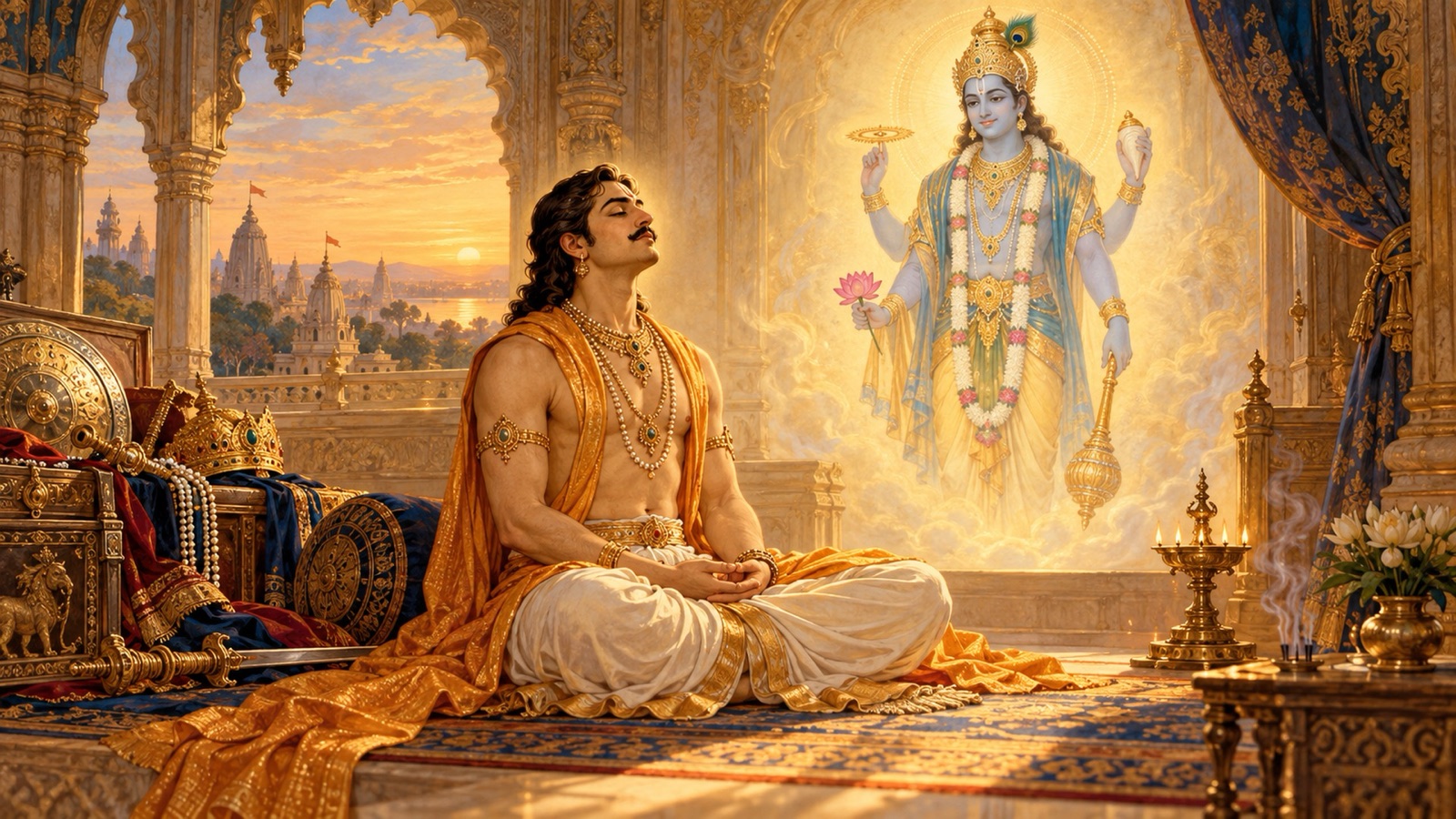
In that final hour Khatwanga reflected that nothing — not life, sons, riches, earth, kingship, nor even his queen — was dearer to him than the brahmanas, the worshipful of his house; that never, even in childhood, had his mind delighted in unrighteousness; and that he had never found any reality other than the Lord of glorious renown. Though the rulers of the three worlds had offered him any boon he wished, he had hankered after no enjoyment, absorbed as he was in the thought of Lord Vishnu. Resolving to shake off, through devotion to the Maker of the universe, all attachment to the fleeting objects of the senses — mere projections of the Lord’s Maya — he gave himself wholly to Him.
इति व्यवसितो बुद्ध्या नारायणगृहीतया । हित्वान्यभावमज्ञानं तत: स्वं भावमास्थित: ॥ ४८ ॥
iti vyavasito buddhyā nārāyaṇa-gṛhītayā hitvānya-bhāvam ajñānaṁ tataḥ svaṁ bhāvam āsthitaḥ
Meaning: Resolved in this way by an intellect drawn wholly to Narayana, and casting off the ignorance of identifying with what is other than the self, Khatwanga at once became established in his own true nature. (Canto 9, Chapter 9, verse 48)
यत् तद् ब्रह्म परं सूक्ष्ममशून्यं शून्यकल्पितम् । भगवान् वासुदेवेति यं गृणन्ति हि सात्वता: ॥ ४९ ॥
yat tad brahma paraṁ sūkṣmam aśūnyaṁ śūnya-kalpitam bhagavān vāsudeveti yaṁ gṛṇanti hi sātvatāḥ
Meaning: He attained that supreme Brahman — subtle, wholly real yet appearing void to the ignorant — whom the devotees of the Lord glorify as the Supreme Person, Vasudeva. (Canto 9, Chapter 9, verse 49)

Principal Teachings of This Chapter
1. Sacred effort is rarely wasted. Three generations — Amsuman, Dilipa, and Bhagiratha — laboured for the Ganga’s descent. The first two did not live to see it, yet their striving was not lost; it was the foundation on which Bhagiratha’s success stood (verses 1-3).
2. The pure carry away the impurity of the world. When the Ganga fears the sins washed into her, the answer is that saints, in whose hearts Lord Hari dwells, cleanse her by their touch. Holiness is contagious; the company of the pure purifies (verses 6-7).
3. Grace can redeem even the fallen. The sons of Sagara, destroyed by their own offence, are lifted to heaven by a single touch of the Ganga’s waters upon their ashes — a sign that the Lord’s mercy reaches even those who seem beyond hope (verses 12-13).
4. True nobility restrains its own power. Wrongly cursed, Saudasa could have cursed his preceptor in return, but rather than risk harm to any living being he poured the wrath-charged water on his own feet. Mercy that spares even at one’s own cost is the mark of a great soul (verses 23-24).
5. A mind fixed on God at the last attains the highest goal. Sukadeva adds here a still deeper truth: even the demigods, seated in the higher worlds with every advantage of power and longevity, cannot steady their minds upon the Lord within the heart, for their minds remain agitated by material conditions — opulence is no substitute for devotion. Given only a single hour of life, King Khatwanga wastes none of it in grief over what he must leave behind; he lets go of every attachment as something no more lasting than a city glimpsed in the clouds, and turns his whole being to the Lord. Whatever the length of our days, it is the direction the heart takes at the final reckoning — not the power or possessions surrounding it — that matters most (verses 45-49).
A Devotional Reflection
There is a quiet thread running through this crowded chapter, and it is the power of a single touch and a single hour. A whole life of penance by Bhagiratha ends in one moment when the Ganga at last falls upon Siva’s head; the ruined sons of Sagara are saved by the mere touch of her waters; and Khatwanga, master of the whole earth, needs only one undistracted hour to reach the Lord. The Bhagavatam seems to whisper that grace does not measure our worthiness by years but meets us wherever the heart turns sincerely toward God. Bhagiratha teaches us to persevere even when our forefathers’ labour seems to have failed; Saudasa, in his one merciful act amid a terrible fate, teaches us that even a cursed and fallen man can choose kindness; and Khatwanga teaches us that it is never too late, that a single hour given wholly to the Lord can gather up a whole lifetime. The Ganga still flows, still born of the Lord’s feet, still ready to carry away what we cannot cleanse ourselves. We have only to turn to her source with a bowed head, as Bhagiratha did, and as Khatwanga did in his last hour.
A Daily Devotional Practice
Today, in the spirit of King Khatwanga’s single hour, set aside a few undistracted minutes for the Lord alone. Sit quietly, let go of the day’s cares as things “no more real than a fanciful project,” and gently repeat, “Om Namo Bhagavate Vasudevaya.” If you live near any river, lake or flowing water, or even beside a simple vessel of clean water at home, remember the holy Ganga born of the Lord’s feet, and offer a silent prayer of gratitude for the grace that cleanses what we cannot cleanse ourselves. Let this small, wholehearted turning toward God be your practice — trusting, as Khatwanga did, that no hour given fully to the Lord is ever too late or too small.
Conclusion
This chapter’s descent of the Ganga and King Khatwanga’s final hour both point to the same central truth: it is never mere water, power or opulence that purifies and delivers a soul, but the presence of the Lord Himself — dwelling in His pure devotees, flowing from His own feet, or held for even a single hour of undivided remembrance. May Bhagiratha’s perseverance, Saudasa’s one act of mercy amid a terrible fate, and Khatwanga’s undistracted surrender all remind us of this: whatever our span of years, a heart that turns wholly to Vasudeva is never turned away.
May the divine wisdom of Srimad Bhagavatam awaken pure devotion within our hearts.
Om Namo Bhagavate Vasudevaya.
Jay Shree Madhav.
References and Attribution
- Primary edition: Gita Press, Śrīmad Bhāgavata Mahāpurāṇa (English, complete), Book Nine, Discourse 9, pages 35–39.
- Series: Srimad Bhagavatam Wisdom · Biswa Sanatan Dharma Seva Trust.
- Presented following the spiritual guidance and recommendation of Pandit Dr. Shri Kashinath Mishra.
This is an original, faithful retelling in the writer’s own words, with brief quoted verses shown in Devanāgarī and transliteration and their meanings given as summaries. It is not a reproduction of any single publisher’s continuous translation or commentary. No affiliation with or endorsement by any publisher is implied.
Jay Shree Madhav