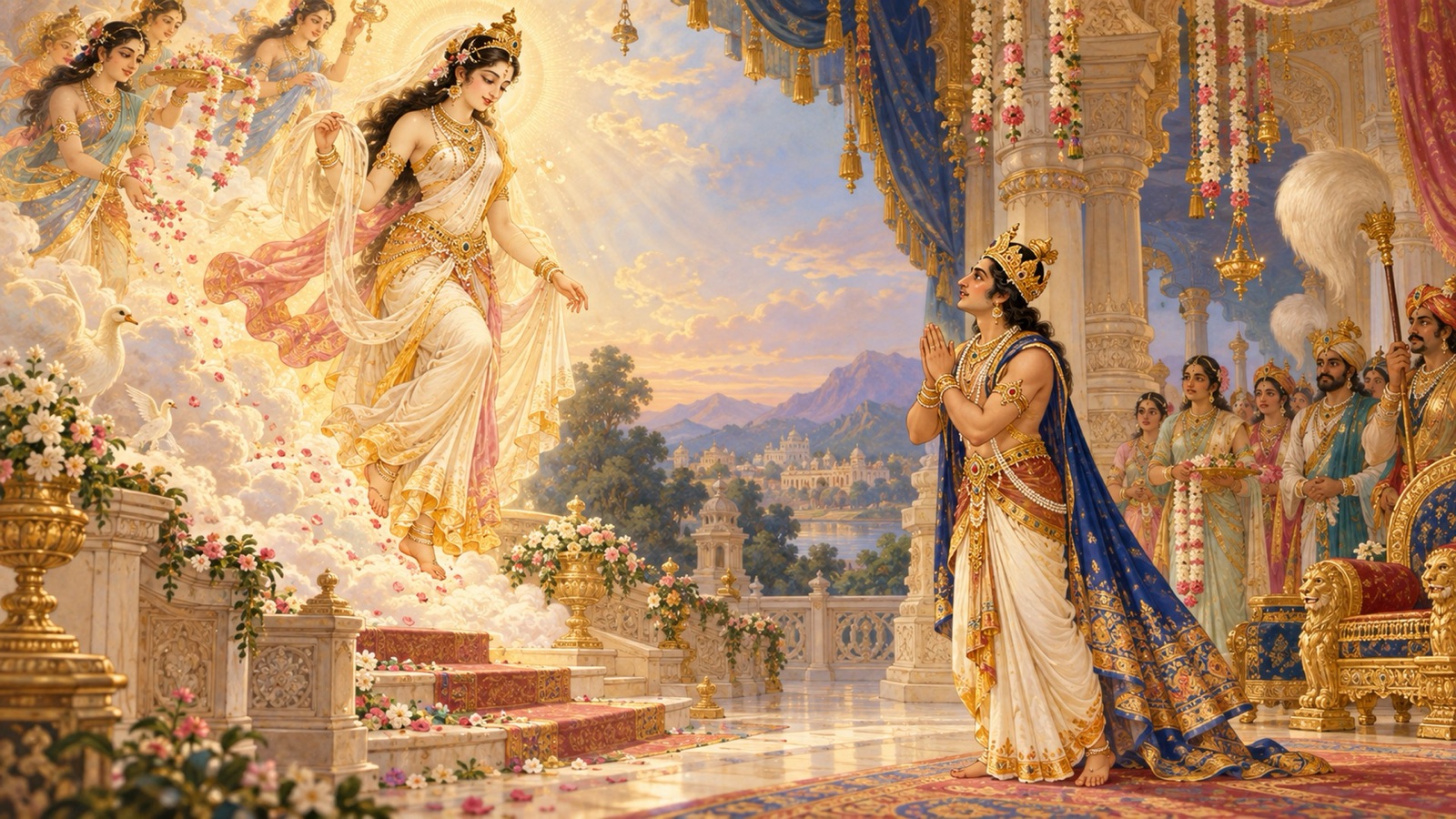
Drawn by his fame and beauty, the celestial nymph Urvasi descends to the court of King Pururava — the beginning of a love that will teach the sorrow of clinging and end in the discovery of the sacred fire.
Om Namo Bhagavate Vasudevaya.
Om Namo Bhagavate Vasudevaya.
Om Namo Bhagavate Vasudevaya.
Welcome to Srimad Bhagavatam Wisdom, a devotional journey through the sacred histories and teachings of the Srimad Bhagavat Mahapurana. This fourteenth chapter of Book Nine turns from the solar dynasty to the sacred lunar line of Soma, the moon-god, and follows the poignant love of King Pururava for the celestial nymph Urvasi into the discovery of the sacred fire at the dawn of the Treta age.
Chapter Information
- Scripture: Śrīmad Bhāgavata Mahāpurāṇa
- Canto: 9 (Book Nine)
- Chapter: 14 (Discourse 14)
- Chapter title: King Pururava Enchanted by Urvasi
- Principal speaker: Sukadeva Gosvami, narrating to King Parikshit — the whole related by Suta Gosvami to the sage Saunaka and the assembly of sages at Naimisaranya
- Principal listener: King Parikshit
- Main setting: The heavens and the earth; the court of King Pururava; Kurukshetra on the bank of the Saraswati
- Central subject: The origin of the lunar dynasty from Soma, the birth of Budha, and the love of King Pururava for the celestial nymph Urvasi, ending in his discovery of the sacred fire
- Principal verse range: Canto 9, Chapter 14, verses 1–49
- Primary edition: Gita Press Śrīmad Bhāgavata Mahāpurāṇa
The Origin of the Moon and the Birth of Budha
Sukadeva turned now to the hallowed race of Soma, the moon-god. From Brahma came a son, Atri, equal to his father in excellence; and from Atri’s tears of joy sprang Soma, an embodiment of nectar, whom Brahma appointed lord of the brahmanas, the herbs and the stars.
तस्य दृग्भ्योऽभवत् पुत्र: सोमोऽमृतमय: किल । विप्रौषध्युडुगणानां ब्रह्मणा कल्पित: पति: ॥ ३ ॥
tasya dṛgbhyo ’bhavat putraḥ somo ’mṛtamayaḥ kila viprauṣadhy-uḍu-gaṇānāṁ brahmaṇā kalpitaḥ patiḥ
Meaning: Soma was born from Atri’s tears of jubilation, radiant as if made of nectar; Brahma placed him over the twice-born brahmanas, the healing herbs, and the countless stars. (Canto 9, Chapter 14, verse 3)
Having conquered the three worlds and worshipped the Lord through a Rajasuya sacrifice, Soma grew proud and forcibly carried away Tara, the wife of Brihaspati, preceptor of the gods. Though asked again and again to return her, he refused out of vanity, and a great war broke out between the gods and the demons over Tara.
सोऽयजद् राजसूयेन विजित्य भुवनत्रयम् । पत्नीं बृहस्पतेर्दर्पात् तारां नामाहरद् बलात् ॥ ४ ॥
so ’yajad rājasūyena vijitya bhuvana-trayam patnīṁ bṛhaspater darpāt tārāṁ nāmāharad balāt
Meaning: Having conquered the three worlds and performed a Rajasuya sacrifice, Soma out of pride forcibly carried off Tara, the wife of Brihaspati. (Canto 9, Chapter 14, verse 4)
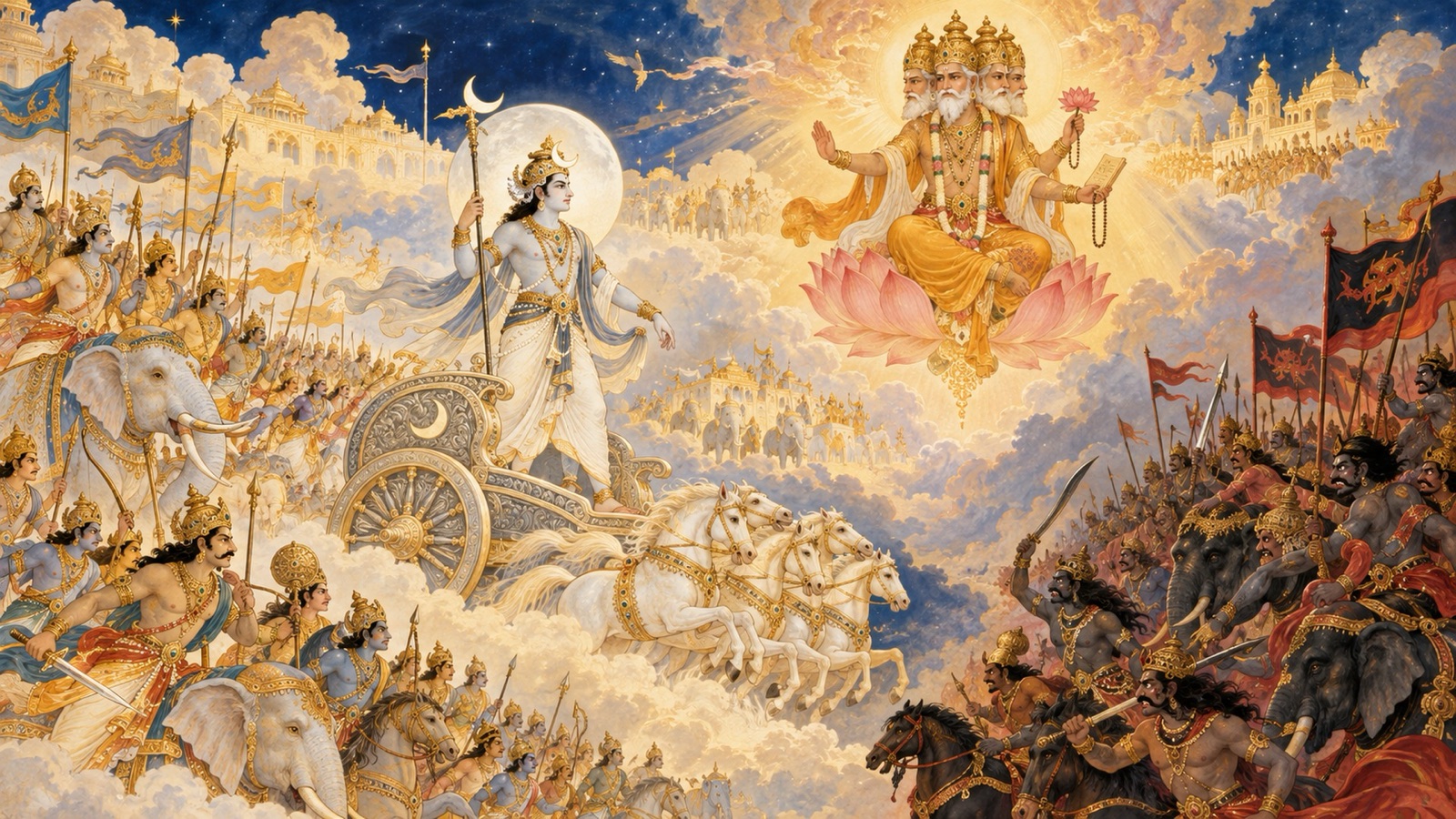
At last Brahma rebuked Soma and restored Tara to her husband. She was found to be with child, and in time bore a son radiant as gold. When Soma and Brihaspati each claimed the boy, Brahma gently drew the truth from Tara, who confessed the child was Soma’s. Brahma then named the boy Budha, “the wise one,” for his profound intelligence.
तस्यात्मयोनिरकृत बुध इत्यभिधां नृप । बुद्ध्या गम्भीरया येन पुत्रेणापोडुराण्मुदम् ॥ १४ ॥
tasyātma-yonir akṛta budha ity abhidhāṁ nṛpa buddhyā gambhīrayā yena putreṇāpoḍurāṇ mudam
Meaning: Brahma gave him the name Budha, O King, for his profound intelligence; and through this son the moon-god derived great joy. (Canto 9, Chapter 14, verse 14)
The Coming of Urvasi
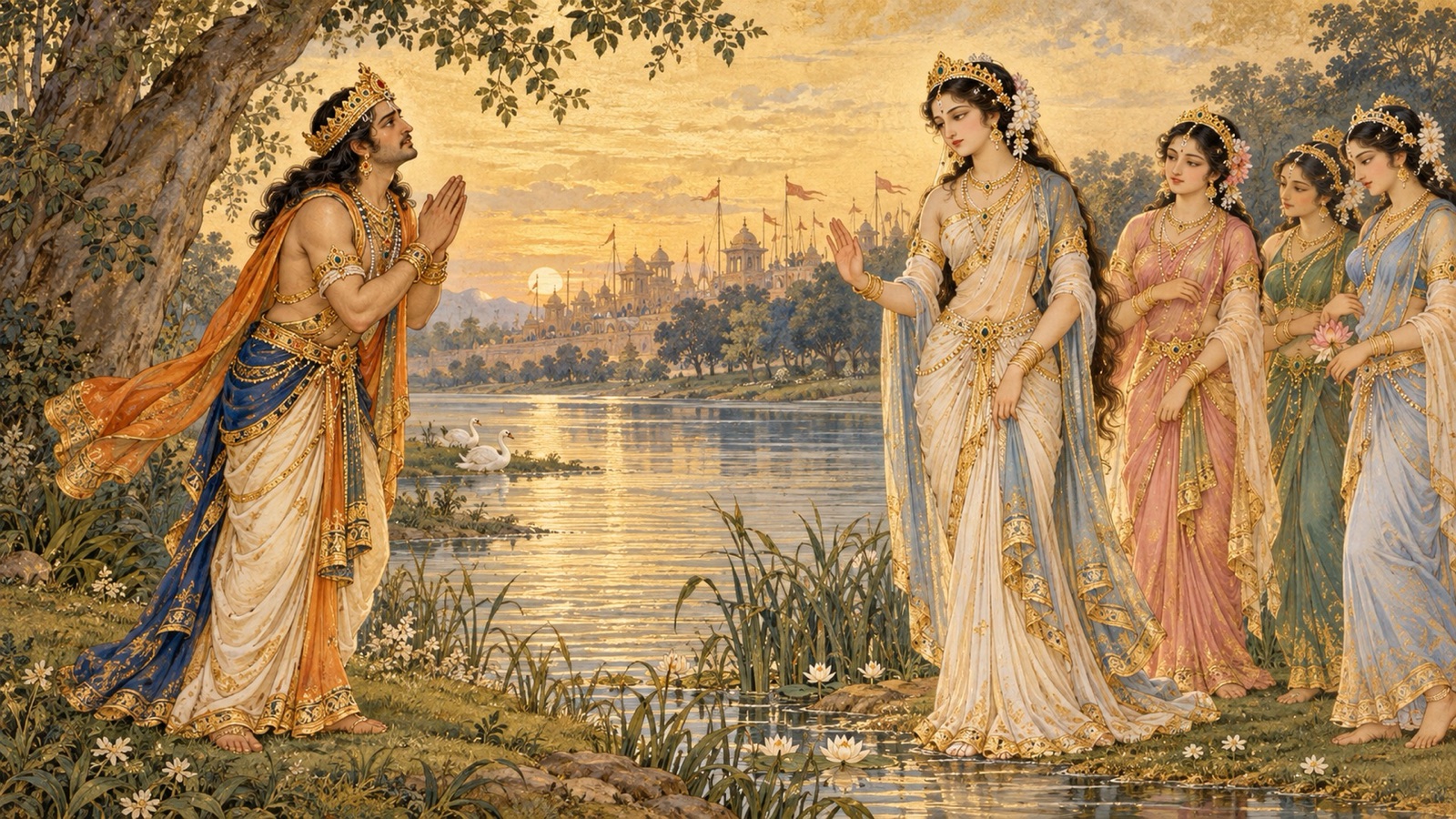
From Budha, through Ila, was born Pururava. Hearing his beauty, virtue, generosity, character, wealth and valour extolled by the celestial sage Narada in Indra’s court, the nymph Urvasi was pierced by the arrows of love and came to seek him.
तत: पुरूरवा जज्ञे इलायां य उदाहृत: । तस्य रूपगुणौदार्यशीलद्रविणविक्रमान् ॥ १५ ॥ श्रुत्वोर्वशीन्द्रभवने गीयमानान् सुरर्षिणा । तदन्तिकमुपेयाय देवी स्मरशरार्दिता ॥ १६ ॥
tataḥ purūravā jajñe ilāyāṁ ya udāhṛtaḥ tasya rūpa-guṇaudārya- śīla-draviṇa-vikramān śrutvorvaśīndra-bhavane gīyamānān surarṣiṇā tad-antikam upeyāya devī smara-śarārditā
Meaning: Then from Ila was born Pururava. Hearing his beauty, virtues, generosity, character, wealth and valour sung by the celestial sage in Indra’s court, the nymph Urvasi, pierced by the arrows of love, came to his presence. (Canto 9, Chapter 14, verses 15-16)
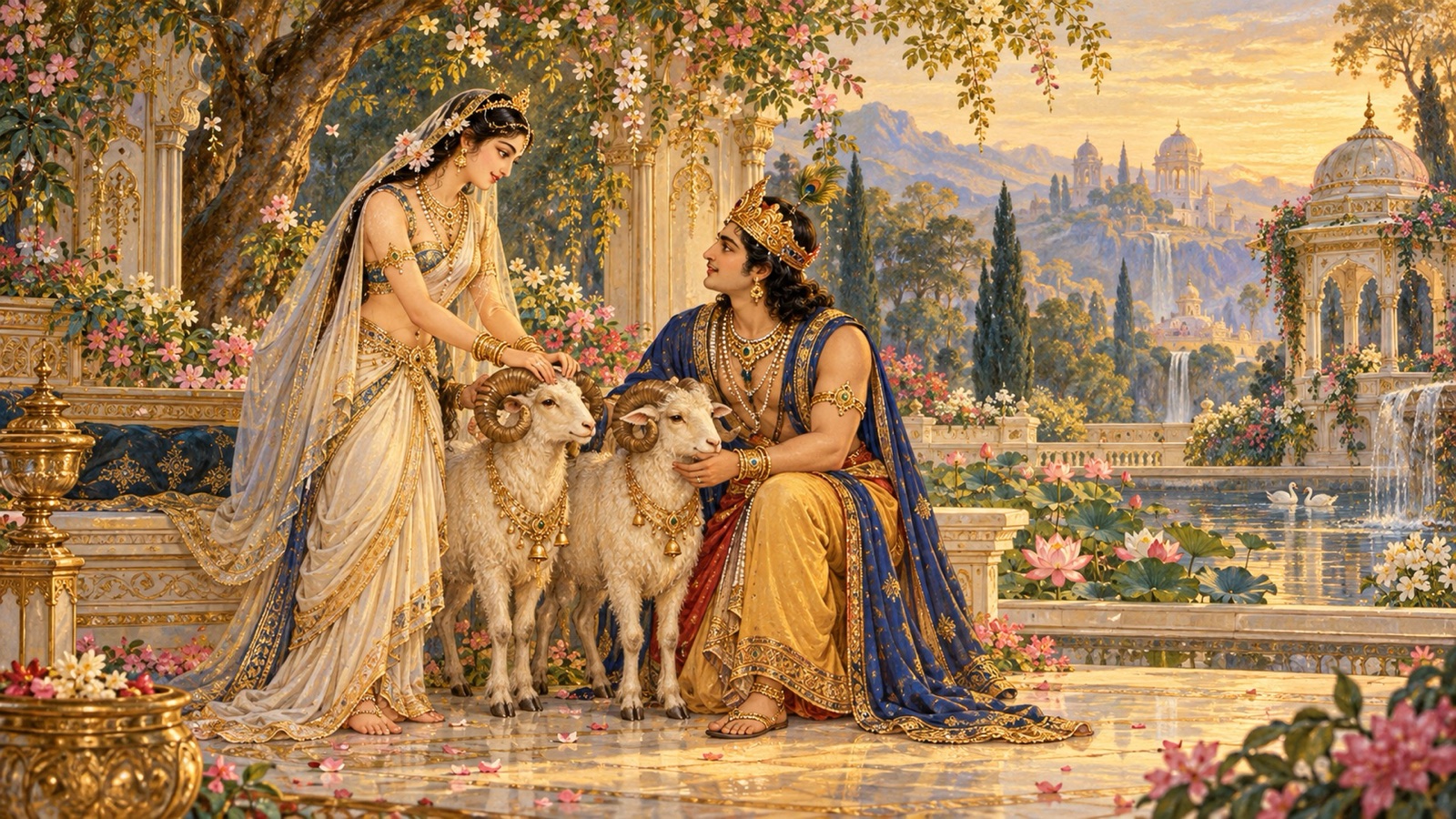
Delighted, Pururava welcomed her, and Urvasi agreed to live with him upon certain conditions: that he guard two pet rams she entrusted to him, that ghee alone be her food, and that she never see him unclothed except in their union. Full of joy, the king accepted, and for many years they revelled together in the gardens of the gods.
The Loss of Urvasi
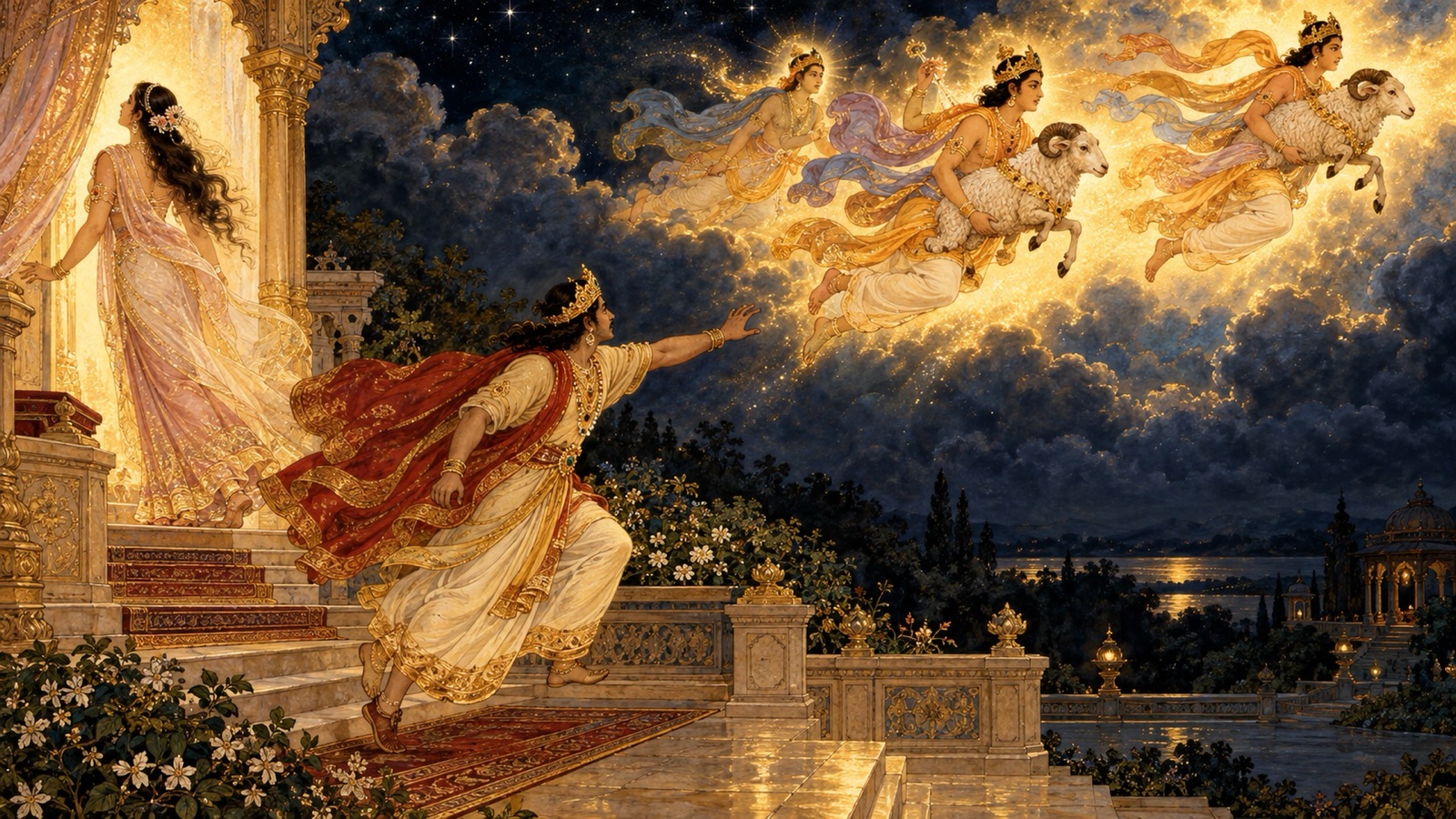
Missing Urvasi from his court, Indra sent the Gandharvas to bring her back. Coming at dead of night, they stole away the two rams she had entrusted to the king. Hearing the cries of the rams, dear to her as children, Urvasi reproached her husband for failing to protect them, calling him unmanly. Stung by her words, Pururava seized a sword and rushed out into the darkness with no clothes on — whereupon the Gandharvas flashed a burst of lightning, and Urvasi, seeing him thus unclothed, held to the letter of her condition and departed for heaven.
Bereft, Pururava wandered the earth like a madman, his mind fixed on her. At Kurukshetra, on the bank of the Saraswati, he found her with her companions and pleaded with her not to abandon him to misery, warning that his body, cast off, would be devoured by wolves and vultures.
But Urvasi answered with hard wisdom, telling him not to die like a weak man, nor let the wolves — the turbulent senses — devour him.
उर्वश्युवाच मा मृथा: पुरुषोऽसि त्वं मा स्म त्वाद्युर्वृका इमे । क्वापि सख्यं न वै स्त्रीणां वृकाणां हृदयं यथा ॥ ३६ ॥
urvaśy uvāca mā mṛthāḥ puruṣo ’si tvaṁ mā sma tvādyur vṛkā ime kvāpi sakhyaṁ na vai strīṇāṁ vṛkāṇāṁ hṛdayaṁ yathā
Meaning: Urvasi said: Do not die — you are a man; and do not let these wolves devour you. She counselled him against despair, that he might not be consumed by the wolves of the restless senses. (Canto 9, Chapter 14, verse 36)
She granted him, however, one night with her at the end of each year, and told him he would have further offspring through her.
The Discovery of the Sacred Fire
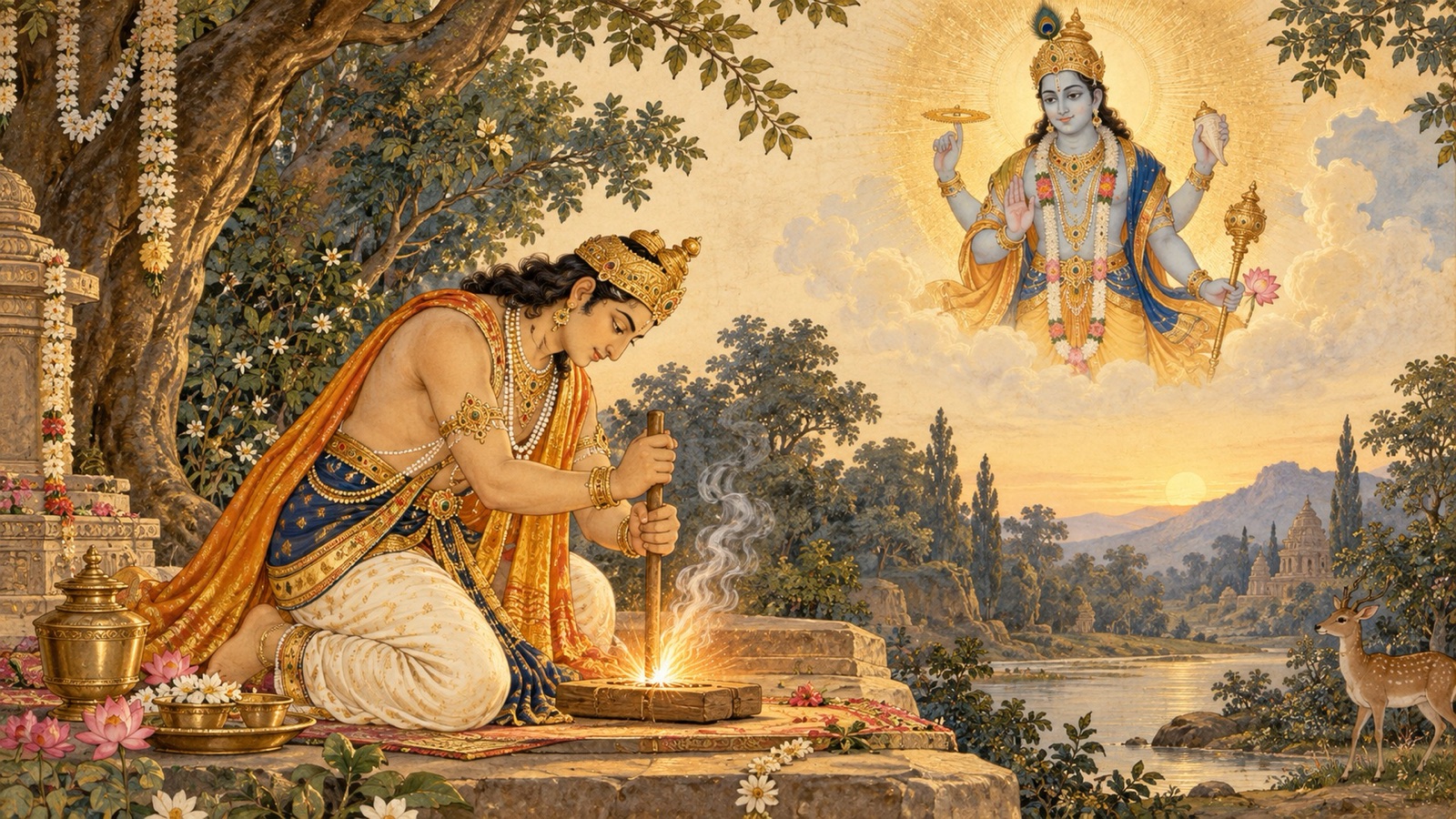
Longing to reach the realm of Urvasi, Pururava at last received from the pleased Gandharvas a vessel of fire. Mistaking it in his passion for Urvasi herself, he wandered the forest with it, until he realized his error and left it behind. Returning home and meditating on her, he found, as the Treta age dawned, the knowledge of the threefold ritual arising in his mind. Going back to the spot, he took from an ashvattha tree grown within a shami tree a pair of churning sticks, and, contemplating Urvasi as the lower stick, himself as the upper, and their union as the child between, he churned them while chanting sacred texts, longing to reach her world.
उर्वशीं मन्त्रतो ध्यायन्नधरारणिमुत्तराम् । आत्मानमुभयोर्मध्ये यत् तत् प्रजननं प्रभु: ॥ ४५ ॥
urvaśīṁ mantrato dhyāyann adharāraṇim uttarām ātmānam ubhayor madhye yat tat prajananaṁ prabhuḥ
Meaning: Meditating with sacred texts upon Urvasi as the lower churning stick and himself as the upper, and upon that which is between the two as their offspring, the lord Pururava churned them. (Canto 9, Chapter 14, verse 45)
From that churning arose the sacred fire, which the king adopted in three forms as his son, and by which he worshipped Lord Sri Hari, the Ruler of sacrifices. In earlier ages, Sukadeva noted, there had been but one Veda — the syllable Om, the seed of all speech; one deity, Narayana, and no other; one fire; and one class of beings, the Hamsas.
एक एव पुरा वेद: प्रणव: सर्ववाङ्मय: । देवो नारायणो नान्य एकोऽग्निर्वर्ण एव च ॥ ४८ ॥
eka eva purā vedaḥ praṇavaḥ sarva-vāṅmayaḥ devo nārāyaṇo nānya eko ’gnir varṇa eva ca
Meaning: In the age before ours, all speech was held within a single Veda, the sacred syllable Om; there was no god but Narayana, only one sacred fire, and only one order of life among human beings. (Canto 9, Chapter 14, verse 48)
Sukadeva’s memory of that single, undivided age (verse 48) carries a quiet lesson for our own time. The elaborate sacrificial rites Pururava was moved to perform belong to the Treta age, with its many rules and many fires; but the Bhagavatam elsewhere teaches that in the present age of Kali, when such disciplined ritual is no longer within most people’s reach, the one Holy Name stands in the place once held by the many Vedas and the many fires. What the syllable Om carried in its fullness in that first age, the maha-mantra of the Lord’s names carries for us today: the same single Narayana, reached not through the churning of wood but through the churning of the heart in chanting. Pururava’s fire was born of longing for a nymph; ours can be born simply of remembrance, kindled again and again until it too burns steadily toward Hari.
At the dawn of Treta the threefold ritual of the Vedas came into being through Pururava, and by means of the sacred fire he attained the realm of the Gandharvas.
Principal Teachings of This Chapter
1. Pride leads even the exalted astray. Soma, lord of the stars, is undone by the pride that makes him seize another’s wife and provoke a war. Even great power cannot excuse the loss of humility (verses 4-5).
2. Attachment binds and wounds. Pururava’s love for Urvasi, however sincere, reduces a mighty king to a madman wandering the earth. The chapter shows unflinchingly the suffering that clinging to any object of desire can bring (verses 30-35).
3. The wise counsel us not to despair. Even in rejecting him, Urvasi urges Pururava not to die like a weak man nor be devoured by the wolves of his senses — a call to master oneself rather than be ruled by longing (verse 36).
4. Longing can be turned toward the sacred. Pururava’s very yearning for Urvasi becomes the seed of worship, leading him to the churning of the sacred fire and the service of Lord Hari. Desire, redirected, can become a path to God (verses 44-47).
5. All multiplicity springs from the One. Sukadeva recalls that once there was one Veda, one deity — Narayana — one fire, one people. Beneath all the world’s diversity lies a single divine source, to which the sacred fire is meant to lead us back (verse 48).
A Devotional Reflection
This chapter is, on its surface, a love story that ends in loss — but the Bhagavatam is never merely telling a romance. In Pururava we see ourselves: a good and capable soul who fixes all his happiness on a single fleeting object, and is left wandering, half-mad, when it slips away. Urvasi’s beauty, the pet rams, the fragile conditions of their union — all of it is as impermanent as moonlight, and clinging to it brings only grief. Yet the chapter does not end in despair. Something remarkable happens: the same fierce longing that nearly destroys Pururava is turned, at last, toward the sacred. Meditating on Urvasi, he churns not a lover into being but a holy fire, and offers it to Lord Hari. The energy of his desire, which had chained him, becomes the very means of his worship and his ascent. And Sukadeva quietly reminds us why this is possible: because beneath all our scattered longings there was, and is, only One — one Word, one Lord, Narayana. The Bhagavatam gently teaches that our desires need not be crushed but redirected; that the heart which learns to churn its longing into love for God will find, where it once found only ashes, a sacred and living flame.
A Daily Devotional Practice
Today, take one longing of your own — a desire, an attachment, a craving that unsettles your peace — and, in the spirit of Pururava’s churning, offer it to the Lord rather than chasing it. When the desire arises, pause, and instead of grasping, kindle it into remembrance: repeat gently, “Om Namo Bhagavate Vasudevaya,” letting the heat of the wanting become the warmth of prayer. If you keep a home shrine or a simple lamp, light it mindfully and recall that beneath every desire lies a deeper longing for the one Lord, Narayana, from whom all things come and to whom they return. Let this small act of turning longing into worship be your practice, trusting that what once brought restlessness can, offered to God, bring peace.
Conclusion
This chapter’s deepest gift is not the sorrow of Pururava’s loss but what he does with it: he lets an unbearable longing become the very fire of his worship. Soma’s pride, Pururava’s grief, and Urvasi’s hard wisdom all point toward the same truth Sukadeva names in the one Veda and the one Lord — that beneath every scattered desire lies a single longing for Narayana. May we, like Pururava, learn to turn whatever consumes our hearts toward Him, chanting Hare Krishna until that fire steadily lights our way home.
May the divine wisdom of Srimad Bhagavatam awaken pure devotion within our hearts.
Om Namo Bhagavate Vasudevaya.
Jay Shree Madhav.
References and Attribution
- Primary edition: Gita Press, Śrīmad Bhāgavata Mahāpurāṇa (English, complete), Book Nine, Discourse 14, pages 58–63.
- Series: Srimad Bhagavatam Wisdom · Biswa Sanatan Dharma Seva Trust.
- Presented following the spiritual guidance and recommendation of Pandit Dr. Shri Kashinath Mishra.
This is an original, faithful retelling in the writer’s own words, with brief quoted verses shown in Devanāgarī and transliteration and their meanings given as summaries. It is not a reproduction of any single publisher’s continuous translation or commentary. No affiliation with or endorsement by any publisher is implied.
Jay Shree Madhav